SUBSCRIBE TO OUR FREE NEWSLETTER
Daily news & progressive opinion—funded by the people, not the corporations—delivered straight to your inbox.
5
#000000
#FFFFFF
To donate by check, phone, or other method, see our More Ways to Give page.
Daily news & progressive opinion—funded by the people, not the corporations—delivered straight to your inbox.
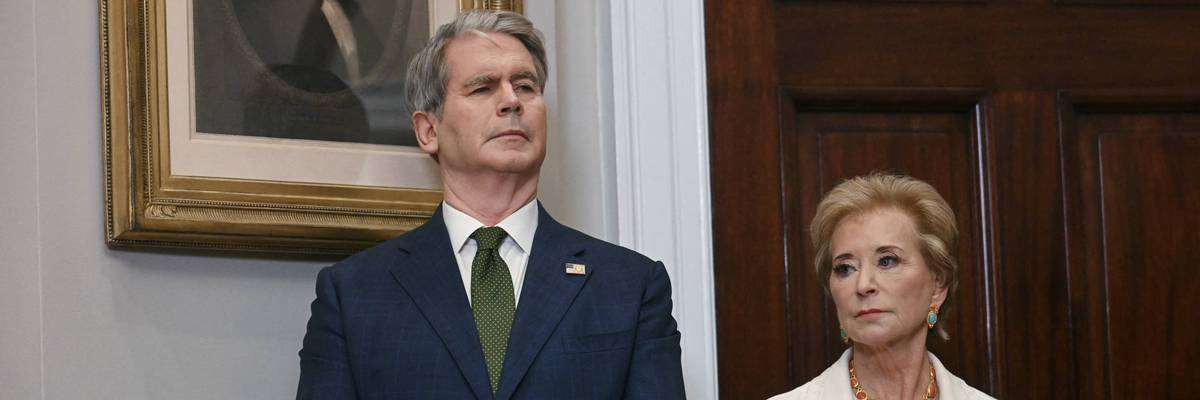
US Secretary of Treasury Scott Bessent and US Secretary of Education Linda McMahon listen after the signing an executive order at the White House in Washington, DC, on July 31, 2025.
"Democrats need to get LOUD," said one political strategist.
As the Trump administration makes plans to task private debt collectors with going after millions of student borrowers in default on their federal loans, officials are reportedly pushing for the effort to begin after the midterm elections—as they grapple with the fact that many supporters of President Donald Trump are likely to be affected.
The Washington Sun reported Monday that the US Department of the Treasury is planning to move forward with punitive measures after previously blocking a push by the Education Department and Office of Management and Budget to garnish wages and seize people's benefits if their loans are in default.
As the Center for American Progress (CAP) said in a report Monday, defaults on student loans have reached record levels, with 9.5 million—or 1 in 5—borrowers unable to make scheduled payments following the passage of the One Big Beautiful Bill Act (OBBBA).
The law eliminated the Saving on a Valuable Education (SAVE) program and forced borrowers into the Repayment Assistance Plan instead, bringing the average annual cost to $2,163 per borrower, according to CAP.
According to the Sun, administration staffers have advised officials to consider the impact that more upheaval for student borrowers—in the form of debt collectors either following through on the earlier wage-garnishing plan or seizing tax refunds and payments—would likely have on Trump voters.
“This is not who you think it is. The demographics are not good for us,” aides told officials last year when they pushed for a delay on the wage-garnishment plan.
An Associated Press analysis in July found that states with the highest rates of student loan defaults were overwhelmingly Republican-leaning, with Mississippi, Louisiana, and Alabama leading the way.
The advocacy group Protect Borrowers also found earlier this year that roughly two-thirds of all defaulted borrowers live in states Trump won in 2024.
Sources in the administration told the Sun that some officials are pushing for a further delay of the debt collection, as they ensure the Treasury Department's portal for defaulted borrowers is working. The Defaulted Loans Support Center was launched last month with the stated goal of giving borrowers "a simple, streamlined way to understand the consequences of default and apply online to either rehabilitate or consolidate their loans."
Others want to begin garnishing wages or seize tax payments for the current tax year ending in April 2027.
One source told the Sun that they expect many calls to government agencies "from borrowers saying: ‘What’s going on? How do I make sure this won’t happen again?'"
"It would be politically insane to do this before the midterms—but 2027 probably makes a little more sense to give Treasury time to get contracts [with debt collectors] signed, up and running," they said.
Democratic strategist Michelle Kinney called on Democratic candidates to "get LOUD" about the reported plan to shield the White House and the GOP from accountability.
Michael Pierce, executive director of Protect Borrowers, told the Sun that if the administration follows through with the plan—as families struggle with rising gas and grocery prices resulting from Trump's tariff policy and illegal war on Iran—"what comes next will be a catastrophe for families across the country," who will have "even less money to put food on the table or make rent.”
"Restarting debt collection the moment any political accountability has passed just shows how little interest Trump has in helping working families stay afloat,” Pierce told the Sun.
On social media, Pierce noted that despite its threats against borrowers, the administration and any debt collectors it contracts with must ensure the defaulted debts are valid for collection.
Along with the Project on Predatory Student Lending and the Debt Collection Lab at Princeton University, Protect Borrowers wrote to Treasury Secretary Scott Bessent last week, noting the "mounting evidence that the US Department of Education may not have the data it needs to certify these debts for collection in the first place."
"Certifying that a debt is accurate requires having accurate data on the debt in the first place," they wrote. "According to industry experts, the default database is rife with incomplete or inaccurate records. Former federal officials described ongoing 'material deficiencies' in [the Debt Management and Collections System], such as dummy Social Security numbers, inaccurate loan balances, [and] missing communication records... Collecting on uncollectable debt will illegally siphon money from the most vulnerable borrowers who can afford it the least."
Marshall Steinbaum, an associate economics professor at the University of Utah, emphasized that defaulted student loan borrowers are "overwhelmingly people whose debts would have been erased" by the student debt cancellation plan by the Biden administration, which was blocked after Republican states and other plaintiffs challenged it in court.
"Congratulations to everyone who blocked that," said Steinbaum, "on their glorious policy success."
Dear Common Dreams reader, It’s been nearly 30 years since I co-founded Common Dreams with my late wife, Lina Newhouser. We had the radical notion that journalism should serve the public good, not corporate profits. It was clear to us from the outset what it would take to build such a project. No paid advertisements. No corporate sponsors. No millionaire publisher telling us what to think or do. Many people said we wouldn't last a year, but we proved those doubters wrong. Together with a tremendous team of journalists and dedicated staff, we built an independent media outlet free from the constraints of profits and corporate control. Our mission has always been simple: To inform. To inspire. To ignite change for the common good. Building Common Dreams was not easy. Our survival was never guaranteed. When you take on the most powerful forces—Wall Street greed, fossil fuel industry destruction, Big Tech lobbyists, and uber-rich oligarchs who have spent billions upon billions rigging the economy and democracy in their favor—the only bulwark you have is supporters who believe in your work. But here’s the urgent message from me today. It's never been this bad out there. And it's never been this hard to keep us going. At the very moment Common Dreams is most needed, the threats we face are intensifying. We need your support now more than ever. We don't accept corporate advertising and never will. We don't have a paywall because we don't think people should be blocked from critical news based on their ability to pay. Everything we do is funded by the donations of readers like you. When everyone does the little they can afford, we are strong. But if that support retreats or dries up, so do we. Will you donate now to make sure Common Dreams not only survives but thrives? —Craig Brown, Co-founder |
As the Trump administration makes plans to task private debt collectors with going after millions of student borrowers in default on their federal loans, officials are reportedly pushing for the effort to begin after the midterm elections—as they grapple with the fact that many supporters of President Donald Trump are likely to be affected.
The Washington Sun reported Monday that the US Department of the Treasury is planning to move forward with punitive measures after previously blocking a push by the Education Department and Office of Management and Budget to garnish wages and seize people's benefits if their loans are in default.
As the Center for American Progress (CAP) said in a report Monday, defaults on student loans have reached record levels, with 9.5 million—or 1 in 5—borrowers unable to make scheduled payments following the passage of the One Big Beautiful Bill Act (OBBBA).
The law eliminated the Saving on a Valuable Education (SAVE) program and forced borrowers into the Repayment Assistance Plan instead, bringing the average annual cost to $2,163 per borrower, according to CAP.
According to the Sun, administration staffers have advised officials to consider the impact that more upheaval for student borrowers—in the form of debt collectors either following through on the earlier wage-garnishing plan or seizing tax refunds and payments—would likely have on Trump voters.
“This is not who you think it is. The demographics are not good for us,” aides told officials last year when they pushed for a delay on the wage-garnishment plan.
An Associated Press analysis in July found that states with the highest rates of student loan defaults were overwhelmingly Republican-leaning, with Mississippi, Louisiana, and Alabama leading the way.
The advocacy group Protect Borrowers also found earlier this year that roughly two-thirds of all defaulted borrowers live in states Trump won in 2024.
Sources in the administration told the Sun that some officials are pushing for a further delay of the debt collection, as they ensure the Treasury Department's portal for defaulted borrowers is working. The Defaulted Loans Support Center was launched last month with the stated goal of giving borrowers "a simple, streamlined way to understand the consequences of default and apply online to either rehabilitate or consolidate their loans."
Others want to begin garnishing wages or seize tax payments for the current tax year ending in April 2027.
One source told the Sun that they expect many calls to government agencies "from borrowers saying: ‘What’s going on? How do I make sure this won’t happen again?'"
"It would be politically insane to do this before the midterms—but 2027 probably makes a little more sense to give Treasury time to get contracts [with debt collectors] signed, up and running," they said.
Democratic strategist Michelle Kinney called on Democratic candidates to "get LOUD" about the reported plan to shield the White House and the GOP from accountability.
Michael Pierce, executive director of Protect Borrowers, told the Sun that if the administration follows through with the plan—as families struggle with rising gas and grocery prices resulting from Trump's tariff policy and illegal war on Iran—"what comes next will be a catastrophe for families across the country," who will have "even less money to put food on the table or make rent.”
"Restarting debt collection the moment any political accountability has passed just shows how little interest Trump has in helping working families stay afloat,” Pierce told the Sun.
On social media, Pierce noted that despite its threats against borrowers, the administration and any debt collectors it contracts with must ensure the defaulted debts are valid for collection.
Along with the Project on Predatory Student Lending and the Debt Collection Lab at Princeton University, Protect Borrowers wrote to Treasury Secretary Scott Bessent last week, noting the "mounting evidence that the US Department of Education may not have the data it needs to certify these debts for collection in the first place."
"Certifying that a debt is accurate requires having accurate data on the debt in the first place," they wrote. "According to industry experts, the default database is rife with incomplete or inaccurate records. Former federal officials described ongoing 'material deficiencies' in [the Debt Management and Collections System], such as dummy Social Security numbers, inaccurate loan balances, [and] missing communication records... Collecting on uncollectable debt will illegally siphon money from the most vulnerable borrowers who can afford it the least."
Marshall Steinbaum, an associate economics professor at the University of Utah, emphasized that defaulted student loan borrowers are "overwhelmingly people whose debts would have been erased" by the student debt cancellation plan by the Biden administration, which was blocked after Republican states and other plaintiffs challenged it in court.
"Congratulations to everyone who blocked that," said Steinbaum, "on their glorious policy success."