SUBSCRIBE TO OUR FREE NEWSLETTER
Daily news & progressive opinion—funded by the people, not the corporations—delivered straight to your inbox.
5
#000000
#FFFFFF
To donate by check, phone, or other method, see our More Ways to Give page.
Daily news & progressive opinion—funded by the people, not the corporations—delivered straight to your inbox.
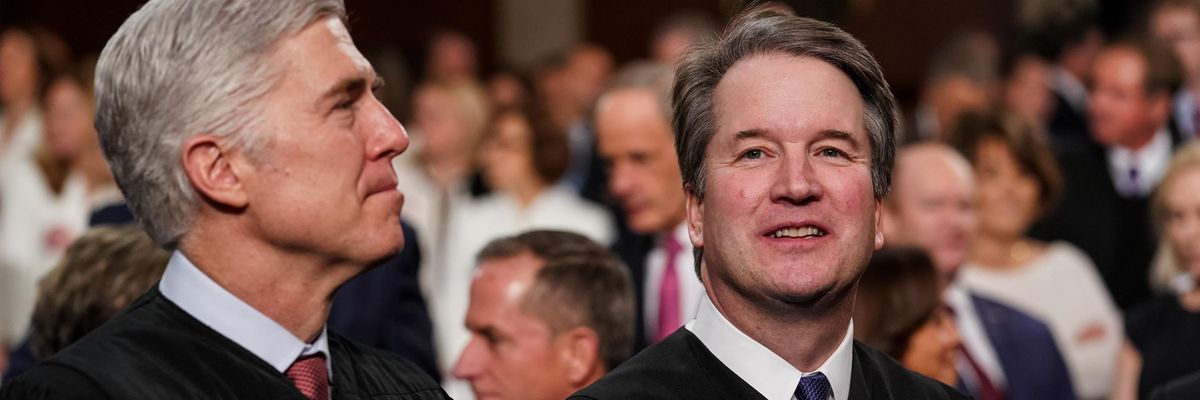
U.S. Supreme Court Justices Brett Kavanaugh (right)—who authored the majority opinion in Snyder v. United States—and Neil Gorsuch (left) attend a State of the Union address on February 5, 2019 in Washington, D.C.
"Snyder's absurd and atextual reading of the statute is one only today's court could love," liberal Justice Ketanji Brown Jackson wrote in a dissent.
The U.S. Supreme Court on Wednesday sided with a former Indiana mayor convicted of accepting a bribe from a business shortly after it was awarded municipal contracts, a ruling that one dissenting justice called "absurd" and critics said weakens public corruption laws.
Ruling 6-3 along ideological lines in
Snyder v. United States, the justices overturned the bribery convictions of former Portage, Indiana Mayor James Snyder, a Republican who took $13,000 from a trucking company after helping it obtain more than $1 million in city contracts.
Snyder maintains that the payment was legal compensation for consulting work. His lawyers contended that prosecutors failed to prove any quid pro quo agreement prior to the awarding of contracts, and that the prosecution of public officials for gratuities given after the fact criminalizes legitimate gift-giving.
"State and local governments often regulate the gifts that state and local officials may accept," Justice Brett Kavanaugh wrote for the court's right-wing supermajority, adding that the anti-corruption law in question "does not supplement those state and local rules by subjecting 19 million state and local officials to up to 10 years in federal prison for accepting even commonplace gratuities. Rather, [it] leaves it to state and local governments to regulate gratuities to state and local officials."
However, Justice Ketanji Brown Jackson wrote in a dissent joined by liberal Justices Elena Kagan and Sonia Sotomayor that "officials who use their public positions for private gain threaten the integrity of our most important institutions."
"Greed makes governments—at every level—less responsive, less efficient, and less trustworthy from the perspective of the communities they serve," Jackson continued. "Perhaps realizing this, Congress used 'expansive, unqualified language' in
18 USC §666 to criminalize graft involving state, local, and tribal entities, as well as other organizations receiving federal funds. Salinas v. United States... imposes federal criminal penalties on agents of those entities who 'corruptly' solicit, accept, or agree to accept payments 'intending to be influenced or rewarded'."
"Today's case involves one such person," Jackson noted. "He asks us to decide whether the language of §666 criminalizes both bribes and gratuities, or just bribes. And he says the answer matters because bribes require an upfront agreement to take official actions for payment, and he never agreed beforehand to be paid the $13,000 from the dealership."
"Snyder's absurd and atextual reading of the statute is one only today's court could love," she asserted. "Ignoring the plain text of §666—which, again, expressly targets officials who 'corruptly' solicit, accept, or agree to accept payments 'intending to be influenced or rewarded'—the court concludes that the statute does not criminalize gratuities at all."
"The court's reasoning elevates nonexistent federalism concerns over the plain text of this statute and is a quintessential example of the tail wagging the dog," Jackson added.
Rolling Stone senior politics editor Andrew Perez, who covers money and its influence on politics and policy, noted:
The decision is hardly a surprise given the Supreme Court has consistently narrowed the definition of corruption under Chief Justice John Roberts—even before conservatives built a supermajority. Still, the Snyder case was exceptionally brazen and unusually ridiculous—and justices chose to hear this case amid an unprecedented controversy over reports that revelations they have routinely accepted and failed to disclose luxury gifts.
"It was a ridiculous performance and display from the justices, but it served a purpose," Perez added. "Now, delivering gratuities to politicians is legal; politicians can procure personal cash payments from companies after acting to their benefit."
Justices Clarence Thomas and Samuel Alito have been accused of inappropriately and possibly illegally accepting gifts or other perks from others including wealthy Republican donors with business before the court. Justice Neil Gorsuch has come under fire for failing to disclose a real estate sale to the head of a law firm subsequently involved in over 20 cases before the high court.
"With the Supreme Court's Snyder decision, it has made clear that bribery has a green light for elected officials—if it happens after the official act," Norman Ornstein, an emeritus scholar at the right-wing American Enterprise Institute, said on social media. "A court with utter chutzpah for its own ethics misconduct is saying ethics don't matter in governing—big money can rule. What a disgrace."
Dear Common Dreams reader, It’s been nearly 30 years since I co-founded Common Dreams with my late wife, Lina Newhouser. We had the radical notion that journalism should serve the public good, not corporate profits. It was clear to us from the outset what it would take to build such a project. No paid advertisements. No corporate sponsors. No millionaire publisher telling us what to think or do. Many people said we wouldn't last a year, but we proved those doubters wrong. Together with a tremendous team of journalists and dedicated staff, we built an independent media outlet free from the constraints of profits and corporate control. Our mission has always been simple: To inform. To inspire. To ignite change for the common good. Building Common Dreams was not easy. Our survival was never guaranteed. When you take on the most powerful forces—Wall Street greed, fossil fuel industry destruction, Big Tech lobbyists, and uber-rich oligarchs who have spent billions upon billions rigging the economy and democracy in their favor—the only bulwark you have is supporters who believe in your work. But here’s the urgent message from me today. It's never been this bad out there. And it's never been this hard to keep us going. At the very moment Common Dreams is most needed, the threats we face are intensifying. We need your support now more than ever. We don't accept corporate advertising and never will. We don't have a paywall because we don't think people should be blocked from critical news based on their ability to pay. Everything we do is funded by the donations of readers like you. When everyone does the little they can afford, we are strong. But if that support retreats or dries up, so do we. Will you donate now to make sure Common Dreams not only survives but thrives? —Craig Brown, Co-founder |
The U.S. Supreme Court on Wednesday sided with a former Indiana mayor convicted of accepting a bribe from a business shortly after it was awarded municipal contracts, a ruling that one dissenting justice called "absurd" and critics said weakens public corruption laws.
Ruling 6-3 along ideological lines in
Snyder v. United States, the justices overturned the bribery convictions of former Portage, Indiana Mayor James Snyder, a Republican who took $13,000 from a trucking company after helping it obtain more than $1 million in city contracts.
Snyder maintains that the payment was legal compensation for consulting work. His lawyers contended that prosecutors failed to prove any quid pro quo agreement prior to the awarding of contracts, and that the prosecution of public officials for gratuities given after the fact criminalizes legitimate gift-giving.
"State and local governments often regulate the gifts that state and local officials may accept," Justice Brett Kavanaugh wrote for the court's right-wing supermajority, adding that the anti-corruption law in question "does not supplement those state and local rules by subjecting 19 million state and local officials to up to 10 years in federal prison for accepting even commonplace gratuities. Rather, [it] leaves it to state and local governments to regulate gratuities to state and local officials."
However, Justice Ketanji Brown Jackson wrote in a dissent joined by liberal Justices Elena Kagan and Sonia Sotomayor that "officials who use their public positions for private gain threaten the integrity of our most important institutions."
"Greed makes governments—at every level—less responsive, less efficient, and less trustworthy from the perspective of the communities they serve," Jackson continued. "Perhaps realizing this, Congress used 'expansive, unqualified language' in
18 USC §666 to criminalize graft involving state, local, and tribal entities, as well as other organizations receiving federal funds. Salinas v. United States... imposes federal criminal penalties on agents of those entities who 'corruptly' solicit, accept, or agree to accept payments 'intending to be influenced or rewarded'."
"Today's case involves one such person," Jackson noted. "He asks us to decide whether the language of §666 criminalizes both bribes and gratuities, or just bribes. And he says the answer matters because bribes require an upfront agreement to take official actions for payment, and he never agreed beforehand to be paid the $13,000 from the dealership."
"Snyder's absurd and atextual reading of the statute is one only today's court could love," she asserted. "Ignoring the plain text of §666—which, again, expressly targets officials who 'corruptly' solicit, accept, or agree to accept payments 'intending to be influenced or rewarded'—the court concludes that the statute does not criminalize gratuities at all."
"The court's reasoning elevates nonexistent federalism concerns over the plain text of this statute and is a quintessential example of the tail wagging the dog," Jackson added.
Rolling Stone senior politics editor Andrew Perez, who covers money and its influence on politics and policy, noted:
The decision is hardly a surprise given the Supreme Court has consistently narrowed the definition of corruption under Chief Justice John Roberts—even before conservatives built a supermajority. Still, the Snyder case was exceptionally brazen and unusually ridiculous—and justices chose to hear this case amid an unprecedented controversy over reports that revelations they have routinely accepted and failed to disclose luxury gifts.
"It was a ridiculous performance and display from the justices, but it served a purpose," Perez added. "Now, delivering gratuities to politicians is legal; politicians can procure personal cash payments from companies after acting to their benefit."
Justices Clarence Thomas and Samuel Alito have been accused of inappropriately and possibly illegally accepting gifts or other perks from others including wealthy Republican donors with business before the court. Justice Neil Gorsuch has come under fire for failing to disclose a real estate sale to the head of a law firm subsequently involved in over 20 cases before the high court.
"With the Supreme Court's Snyder decision, it has made clear that bribery has a green light for elected officials—if it happens after the official act," Norman Ornstein, an emeritus scholar at the right-wing American Enterprise Institute, said on social media. "A court with utter chutzpah for its own ethics misconduct is saying ethics don't matter in governing—big money can rule. What a disgrace."
The U.S. Supreme Court on Wednesday sided with a former Indiana mayor convicted of accepting a bribe from a business shortly after it was awarded municipal contracts, a ruling that one dissenting justice called "absurd" and critics said weakens public corruption laws.
Ruling 6-3 along ideological lines in
Snyder v. United States, the justices overturned the bribery convictions of former Portage, Indiana Mayor James Snyder, a Republican who took $13,000 from a trucking company after helping it obtain more than $1 million in city contracts.
Snyder maintains that the payment was legal compensation for consulting work. His lawyers contended that prosecutors failed to prove any quid pro quo agreement prior to the awarding of contracts, and that the prosecution of public officials for gratuities given after the fact criminalizes legitimate gift-giving.
"State and local governments often regulate the gifts that state and local officials may accept," Justice Brett Kavanaugh wrote for the court's right-wing supermajority, adding that the anti-corruption law in question "does not supplement those state and local rules by subjecting 19 million state and local officials to up to 10 years in federal prison for accepting even commonplace gratuities. Rather, [it] leaves it to state and local governments to regulate gratuities to state and local officials."
However, Justice Ketanji Brown Jackson wrote in a dissent joined by liberal Justices Elena Kagan and Sonia Sotomayor that "officials who use their public positions for private gain threaten the integrity of our most important institutions."
"Greed makes governments—at every level—less responsive, less efficient, and less trustworthy from the perspective of the communities they serve," Jackson continued. "Perhaps realizing this, Congress used 'expansive, unqualified language' in
18 USC §666 to criminalize graft involving state, local, and tribal entities, as well as other organizations receiving federal funds. Salinas v. United States... imposes federal criminal penalties on agents of those entities who 'corruptly' solicit, accept, or agree to accept payments 'intending to be influenced or rewarded'."
"Today's case involves one such person," Jackson noted. "He asks us to decide whether the language of §666 criminalizes both bribes and gratuities, or just bribes. And he says the answer matters because bribes require an upfront agreement to take official actions for payment, and he never agreed beforehand to be paid the $13,000 from the dealership."
"Snyder's absurd and atextual reading of the statute is one only today's court could love," she asserted. "Ignoring the plain text of §666—which, again, expressly targets officials who 'corruptly' solicit, accept, or agree to accept payments 'intending to be influenced or rewarded'—the court concludes that the statute does not criminalize gratuities at all."
"The court's reasoning elevates nonexistent federalism concerns over the plain text of this statute and is a quintessential example of the tail wagging the dog," Jackson added.
Rolling Stone senior politics editor Andrew Perez, who covers money and its influence on politics and policy, noted:
The decision is hardly a surprise given the Supreme Court has consistently narrowed the definition of corruption under Chief Justice John Roberts—even before conservatives built a supermajority. Still, the Snyder case was exceptionally brazen and unusually ridiculous—and justices chose to hear this case amid an unprecedented controversy over reports that revelations they have routinely accepted and failed to disclose luxury gifts.
"It was a ridiculous performance and display from the justices, but it served a purpose," Perez added. "Now, delivering gratuities to politicians is legal; politicians can procure personal cash payments from companies after acting to their benefit."
Justices Clarence Thomas and Samuel Alito have been accused of inappropriately and possibly illegally accepting gifts or other perks from others including wealthy Republican donors with business before the court. Justice Neil Gorsuch has come under fire for failing to disclose a real estate sale to the head of a law firm subsequently involved in over 20 cases before the high court.
"With the Supreme Court's Snyder decision, it has made clear that bribery has a green light for elected officials—if it happens after the official act," Norman Ornstein, an emeritus scholar at the right-wing American Enterprise Institute, said on social media. "A court with utter chutzpah for its own ethics misconduct is saying ethics don't matter in governing—big money can rule. What a disgrace."