

SUBSCRIBE TO OUR FREE NEWSLETTER
Daily news & progressive opinion—funded by the people, not the corporations—delivered straight to your inbox.
5
#000000
#FFFFFF
To donate by check, phone, or other method, see our More Ways to Give page.
Daily news & progressive opinion—funded by the people, not the corporations—delivered straight to your inbox.

"With the blue wave nationally, the billionaire tax is going to be front and center in the new Congress," said economist Gabriel Zucman, who led the charge for California's failed proposal.
California's wealth tax proposal has fallen just short after the state's richest residents spent hundreds of millions of dollars to mobilize voters against it. But Sen. Bernie Sanders is warning them not to get too comfortable.
Sanders (I-Vt.) argued that Proposition 40, which would have used revenue from a one-time 5% tax on billionaire residents to fund the state’s healthcare system, performed quite well given the resources that powerful tech barons like Google co-founder Sergey Brin and its former CEO Eric Schmidt deployed to fight it.
"Oligarchs spent $425 million against California's billionaire wealth tax—outraising supporters 250 to 1 on ads," Sanders wrote on social media. "The result: They got a 'whopping' 52% [of the vote]."
"I've got bad news for these oligarchs," Sanders continued. "Your victory is fleeting. We will pass a federal billionaire wealth tax and end your greed."
Many of the wealthiest Americans pay lower effective tax rates than ordinary workers because much of their wealth is held in stocks, whose gains are generally untaxed until sold—and can be taxed at lower rates than wages when realized.
Polls show that overwhelming majorities of Americans support a federal tax on the wealth of the superrich—including most Republicans.
One February poll by the University of Maryland's Program for Public Consultation found that 80% of Americans, including 72% of Republicans and 88% of Democrats, supported the idea of a federal tax of 2% on fortunes over $50 million and a 3% tax on those over $1 billion.
Sen. Elizabeth Warren (D-Mass.), who has called for a wealth tax for years and made it central to her 2020 presidential bid, has argued that "the best way to do a wealth tax is to do a national wealth tax."
In January, she told The New Republic that a federal proposal would avoid some of the pitfalls the rich used to fearmonger about California’s proposal, such as the possibility of simply fleeing across state lines to avoid paying it.
Escaping a national tax, she said, would mean having to “give up your US citizenship, and forfeit your passport.”
French economist Gabriel Zucman, who helped lead the push for California’s ballot measure, said he was “not surprised” by its defeat.
"The money spent by the billionaires was critical," he told NPR. "Anyone who lives in California has been carpet-bombed by a deluge of ads. One can easily see how this could be pivotal in such a closely contested ballot."
But he said that last week's midterm elections, which saw Democrats swept into power on a wave of anti-billionaire anger, showed that the fight over a wealth tax was not something that could easily be ignored.
"With the blue wave nationally, the billionaire tax is going to be front and center in the new Congress," Zucman said. "Many of the newly elected Democratic senators have been campaigning on curbing the power and influence of billionaires. One can reasonably expect to see significant progress in the next two years."
Sanders, who introduced a 5% annual wealth tax on those worth $1 billion or more with Rep. Ro Khanna (D-Calif.) in March, renewed his call to pass the bill after the elections.
Another proposal, which would impose an annual 2% tax on net worth above $50 million, increasing to 3% on wealth above $1 billion, has gained the support of 63 Democrats, including Warren, Sen. Adam Schiff (D-Calif.), Sen. Chris Van Hollen (D-Md.), and Rep. Alexandria Ocasio-Cortez (D-NY).
Van Hollen, who has suggested he may challenge Sen. Chuck Schumer (D-NY) to become Senate majority leader when Democrats retake the chamber, told Politico last week that he thinks there’s “growing support” in the Democratic caucus for a tax on the ultrarich.
“People are recognizing that we have a tax system that allows individuals to accumulate huge amounts of wealth," he said.
“It is essential that we show the American people where we stand,” Van Hollen added. “If [President Donald Trump] vetoes it, it will just show people that he’s on the side of billionaires.”
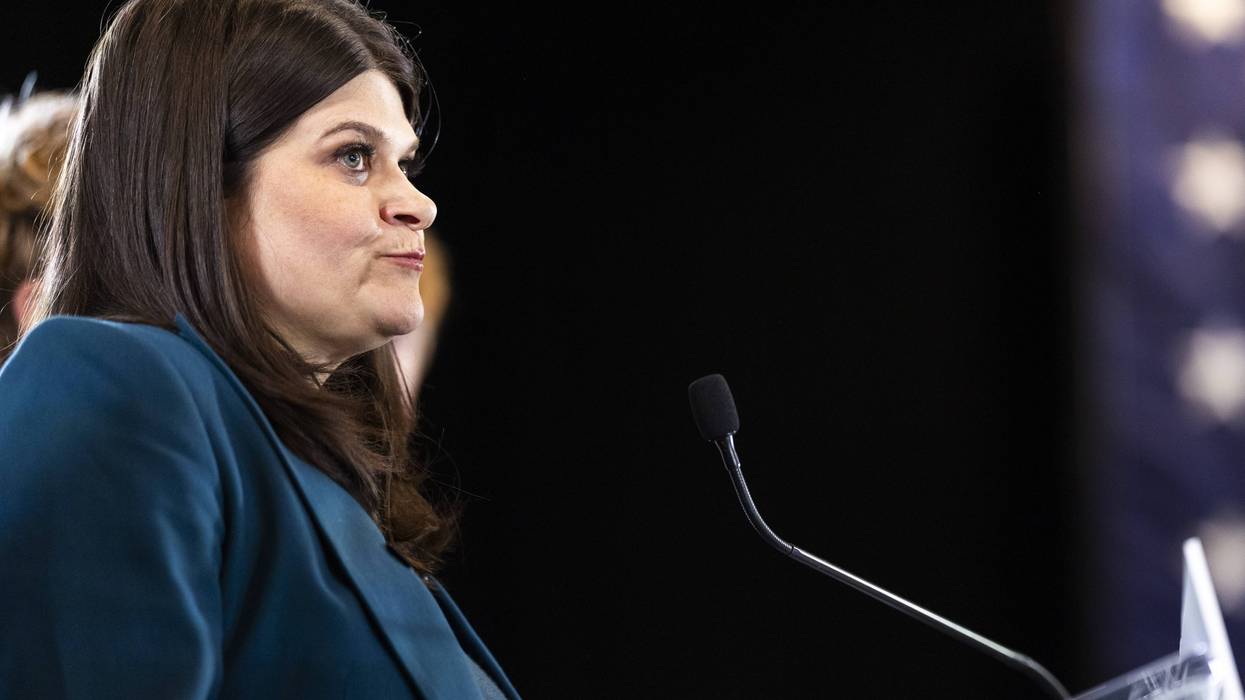
"As a constituent of Haley Stevens, I am appalled that she’s left residents of the 11th Congressional District high and dry."
Progressives are demanding that Rep. Haley Stevens be expelled from the Democratic Party over the Michigan Democrat's last-minute decision to rescind her endorsement of Sen.-elect Abdul El-Sayed.
Just two days before the 2026 midterm elections, Stevens announced that she was supporting Republican Mike Rogers in the US Senate race in Michigan, despite pledging to back El-Sayed after he defeated her in the state's Democratic primary months earlier.
Stevens' surprise endorsement of Rogers led to a mass staff exodus, including her longtime chief of staff. Politico reported that Stevens had been spotted in the Republicans' cloakroom in the US House of Representatives on Monday, and her office door was locked throughout the day.
Levi Teitel, communications director of Progress Michigan, said Stevens' actions merited her being forced out of the Democratic Party.
"As a constituent of Haley Stevens, I am appalled that she’s left residents of the 11th Congressional District high and dry," said Teitel. "Her capriciousness is what’s led to this: flipping to Rogers just two days before polls opened on Election Day without thinking through how she would be able to represent her constituents in her last few weeks in office."
Stevens is still representing her district until January 3, 2027, when Rep.-elect Jeremy Moss (D-Mich.) is slated to take over.
Regardless, Teitel said Stevens' actions are "nothing short of a dereliction of duty," adding that House Democrats "have a responsibility to hold Rep. Stevens accountable and expel her from the caucus."
Former House Speaker Nancy Pelosi (D-Calif.), who is also leaving Congress next year after a 40-year career, cautioned her party against expelling Stevens while speaking with reporters on Tuesday.
"We have about... two more weeks of being in the Congress," said Pelosi, "so I don’t think we should start making judgments about anybody in the caucus at this point."
Nancy Pelosi on Kicking Haley Stevens Out of the Caucus:We have a few more weeks of being in Congress, so I don’t think we should start making judgments about anybody in the caucus at this point.I was disappointed. I conveyed that to her. I want to be helpful to her in terms of how she deals with this, but I’m not supporting kicking her out.Let’s focus on the very positive
— Acyn (@Acyn) November 10, 2026
The California Democrat added that she was "disappointed" in Stevens for endorsing Rogers, but emphasized that she's "not supporting kicking her out of the caucus."
Critics of Pelosi, however, found her position unconvincing and a testament to the failure of Establishment wing of the party that has long been hostile to progressives and accommodating to figures like Stevens.
“Pelosi refusing to kick Haley Stevens out of the caucus because ‘there’s only a few weeks left’ is everything people hate about DC,” said journalist Saad Abedine, in response to the former speaker’s remarks. “Zero accountability, total protection for insiders, and a smile telling us to ‘focus on the positive.’ Utterly absurd.”

“The ‘big-D’ Democratic Party needs some ‘little-D’ democracy,” said Rep.-elect Don Leonard, who conditioned his support for Jeffries on efforts to end the Iran War, cut off support for Israel, and end Citizens United.
Rep.-elect Don Leonard of Ohio said Tuesday that “senior members of the Democratic House” have threatened to make his life “a living hell” unless he backs, without conditions, Rep. Hakeem Jeffries (D-NY) to be the next Speaker of the House.
Leonard, who flipped Ohio's heavily Republican 15th Congressional District blue last Tuesday, said he told senior party leaders that, to win his support, Jeffries would have to meet with him and his constituents to discuss two priorities. One was a constitutional amendment to overturn Citizens United, the 2010 US Supreme Court ruling that struck down restrictions on independent election spending by corporations and unions. The other was ending “US support for the war in Iran and the country, Israel, that led us into it.”
In a video covered by Drop Site News, Leonard said the unnamed party leaders he met with responded with threats that felt like “the stuff you see in the movies.”
Leonard explained how the Democrats told him “in no uncertain terms” that unless he supported Jeffries “regardless” of his demands, “it would basically mean both making my life a living hell for the next two years here in Washington as well as being sure to lose my election in two years.”
Leonard said he had expected to face this kind of pressure once he took office and that support from fellow Democrats might dry up if he refused to “wear the team jersey and be a good team player.”
"We're searching our hearts tonight about how we can reach Leader Jeffries and help him be a better speaker," he said. "At the end of the day, the 'big-D' Democratic Party needs some 'little-d' democracy."
"I'm just a stubborn SOB," he said. "So we'll continue meeting with our fellow members of Congress and members-elect and try and see if we can build support for what we're trying to do here."
 US Senate Minority Leader Chuck Schumer (D-NY) and US House Minority Leader Hakeem Jeffries (D-NY) depart a news conference on Capitol Hill in Washington, DC, on January 8, 2026. (Photo by Saul Loeb/AFP via Getty Images)
Unlike in the US Senate, where a potential leadership challenge is simmering, no House Democrat has stepped forward to take on Jeffries, who has led the caucus since succeeding former Speaker Nancy Pelosi in early 2023.
But Democratic leaders seem wary of a growing grassroots rebellion against Jeffries’ leadership. Axios reported Friday that House Democrats had been “inundated” with calls and emails urging them to oppose Jeffries’ bid for speaker.
One unnamed senior House Democrat reported receiving over 500 calls in two days. A Democratic chief of staff, also unnamed, said their office had received around 300 calls, many urging support for Rep. Jamie Raskin (D-Md.), who has shown no public interest in running for speaker.
"Democrats in both chambers can't go back to business-as-usual politics," said Ezra Levin, the leader of Indivisible—a progressive advocacy group—that has called for Democrats to choose a new speaker. "People want leadership that's ready to join the rest of us in this new era of politics."
In the Senate, Sen. Chris Van Hollen (D-Md.) is considering a challenge to Chuck Schumer (D-NY) for majority leader. Sen.-elect Abdul El-Sayed (D-Mich.) has said he would back Van Hollen if he runs, and several other incoming Democrats have declined to endorse Schumer.
Opponents of Schumer argue that his fealty to the Democratic donor class has led to limp opposition to President Donald Trump and resistance to positions that large majorities of Democrats support, like Medicare for All, ending military aid to Israel, and bringing a swift end to the president’s war in Iran.
The grievances against Jeffries are largely the same. As Joseph Geevarghese, executive director of the progressive advocacy group Our Revolution, summed up in August, “Jeffries’ instinct is to negotiate with the Trump power structure rather than draw lines and fight it.”
Roughly 40 Democrats would need to vote for someone else in order to prevent Jeffries from taking the gavel. Rep. Alexandria Ocasio-Cortez (D-NY), a potential 2028 presidential contender who is popular with the Democratic base, told Drop Site that organizing the votes to challenge Jeffries—as Republican holdouts did when they delayed Kevin McCarthy’s election as speaker in January 2023—“should be absolutely part of the conversation” among progressive Democrats.
"But you have to remember, during that time, there was a very small margin that allowed for that kind of thing to happen,” she said.
Ocasio-Cortez said that without a clear alternative, there’s “no material scenario” in which Democrats could block Jeffries from becoming speaker. She added that “in a contested race [it’s] a different situation.”
In October, RedBox Research, the polling arm of the super political action committee (PAC) A Fight Worth Having, surveyed likely voters in 31 races across 11 states. In the pooled results, only 19% wanted Jeffries as speaker, while 48% wanted “someone else.” Among Democratic respondents, 39% wanted Jeffries and 38% wanted someone else.
Writing about plans for another round of polling, Corbin Trent, a co-founder of Justice Democrats who helped conduct the October surveys, noted Tuesday in an op-ed published in Common Dreams that “support for Jeffries and Schumer is still nearly non-existent, especially where seats flipped.”
“To keep the promises these candidates made, we’ll have to take on the Democratic establishment, corporate greed, and powerful institutions," he added. "People with power and money don’t want to give it up. Unless we pull it from their death grip, we won’t get this country back on the right path.”

If the Republican-controlled Senate is unable to confirm Michael LoSapio before the end of the current legislative session, Democrats could scrutinize his ties to the surveillance giant after they take the majority.
An executive with the company that's come under fire for its participation in President Donald Trump's mass deportation agenda and his illegal war on Iran may serve as the latest link between the Silicon Valley firm and the White House.
As NextGov/FCW reported Monday night, the White House has nominated Michael LoSapio, the chief information security officer for software giant Palantir Technologies, to lead the Cybersecurity and Infrastructure Security Agency (CISA), which operates under the Department of Homeland Security.
CISA oversees cybersecurity protections for agency networks, water systems, power grids, telecommunications networks, and other infrastructure. It has been without a permanent director for nearly two years and has faced wide-scale layoffs and resignations under the Trump administration.
Meanwhile, three major cybersecurity breaches at the FBI, the Pentagon, and DHS have been reported in the past three months.
The company LoSapio has worked for since 2017 has become increasingly intertwined with the Trump administration since the president took office in 2025.
As Common Dreams reported late last month, Palantir has provided "mission-critical software infrastructure" for the Centers for Medicare and Medicaid Services—specifically for the development of an artificial intelligence pilot program that's been linked to healthcare delays for seniors.
The company, co-founded by right-wing Republican megadonor Peter Thiel, has also allowed its Enhanced Leads Identification and Targeting for Enforcement system to identify people for US Immigration and Customs Enforcement to target for Trump's violent mass deportation campaign, in which tens of thousands of people have been sent to "third countries" that they have no connection to and where they may be at risk of persecution.
Palantir has also received hundreds of millions of dollars in federal contracts as it has developed a "mega-database" full of Americans' private taxpayer information.
As NextGov reported, Trump could be forced to renominate LoSapio after the new legislative session begins on January 3, if Congress is unable to confirm the nominee before the end of the current session, during which lawmakers will be busy debating a continuation of government funding and defense spending.
In that case, the new Democratic majority in the US Senate could potentially scrutinize LoSapio's history with the company that lawmakers, including Se. Ron Wyden (D-Ore.), have pushed to investigate.
"Sen. Wyden has a number of questions about Palantir's work to facilitate the Trump-Vance abuse of government data that he intends to ask again as chairman of the Finance Committee," an aide for Wyden told NPR this week. "If Palantir is not responsive next year, compulsory processes will be on the table."

"This isn't strength, it's recklessness. It's illegal, and someone should be held accountable, and we should start with Secretary Pete Hegseth," said US Rep. Sara Jacobs.
Shortly after US Defense Secretary Pete Hegseth declared during a Tuesday press conference that he was proud of the alleged war crimes he's committed, a Democratic lawmaker representing one of the largest military communities in the US came out in favor of his impeachment.
Rep. Sara Jacobs (D-Calif.), who represents a significant portion of San Diego, explained why she would vote to advance Rep. Thomas Massie's (R-Ky.) articles of impeachment against Hegseth in a Tuesday social media post.
In supporting Hegseth's removal from office, Jacobs cited "the illegal Iran war, illegal strikes in Yemen (where he mishandled classified information via Signal), and over 200 murders in boat strikes in the Caribbean and Pacific," where the US military has targeted suspected drug trafficking vessels.
"He’s dangerous and needs to go," said Jacobs.
Jacobs then took to the floor of the US House of Representatives to make her case against the embattled former Fox News host.
"I'm so proud to represent San Diego, the biggest military community in the country," she said. "It's my community, my neighbors and friends, who've been shipped off to fight Secretary Hegseth's reckless war in Iran. So I take it personally when our leaders are cavalier with our servicemembers' lives. I take it personally when our leaders ask our servicemembers to take illegal action in Iran and Venezuela and Yemen."
Jacobs on Hegseth Impeachment: This isn't strength. It's recklessness. It's illegal. And someone should be held accountable. And we should start with Secretary Pete Hegseth. https://t.co/Mw7knLqW0y
— Acyn (@Acyn) November 10, 2026
Jacobs added that Hegseth's actions haven't made the US more secure, but have instead resulted in "a girl's elementary school bombed" in Minab Iran, and "hundreds of people murdered in boats in the Caribbean and the Eastern Pacific."
"This isn't strength, it's recklessness," Jacobs emphasized. "It's illegal, and someone should be held accountable, and we should start with Secretary Pete Hegseth."
Rep. Pramila Jayapal (D-Wash.) explained during a Tuesday interview with CNN why she would be joining Jacobs in voting for Hegseth's impeachment.
"This is not about policy disagreements," Jayapal explained. "I sit on the [House] Judiciary Committee and I can tell you that the Constitution was designed to give Congress the power, the sole power and authority, over war."
"Pete Hegseth has ignored war powers resolutions," the Washington Democrat continued. "He never came to Congress, the president never came to Congress. He has presided over an illegal, unconstitutional war."
Rep. Jayapal: Pete Hegseth is a war criminal, and I don't use those words lightly https://t.co/TEIrnVrVJD
— Acyn (@Acyn) November 10, 2026
Jayapal said that, in addition to waging an illegal war, Hegseth has violated the US laws of armed conflict.
"Pete Hegseth is a war criminal," she said. "I don't use those words lightly. But he has literally presided over civilian casualties that were not necessary. He disbanded the office that is supposed to monitor civilian harm. He has conducted illegal boat strikes off of Venezuela."
Rep.-elect Richard Ojeda (D-NC), a retired US Army major, said during a Tuesday interview with MeidasTouch that Hegseth's boat bombing spree constituted war crimes.
"We don’t kill people in the Caribbean and just think it’s no big deal," Ojeda said. "We don’t bomb a school that kills... little girls and just say that that’s water under the bridge. It's not. Crimes have been committed."
Ojeda: It bothers me that we have so many people that like to rattle the drums of war, and they have no idea what the ramifications are.There have been a lot of things that have been done wrong that need to be addressed.You know, we don’t kill people in the Caribbean and just think it’s no big deal. We don’t bomb a school that kills 160-plus little girls and just say that that’s water under the bridge.Crimes have been committed
— Acyn (@Acyn) November 10, 2026
The House is scheduled to take up a procedural vote on the impeachment articles on Tuesday. If a majority votes to advance them, a full debate and final vote on impeaching Hegseth will likely occur on Wednesday.

“This election was about change," said Sen. Bernie Sanders. "People want new leadership here in the Senate, so I will not be supporting Chuck."
US Sen. Bernie Sanders said Tuesday that he believes a member of the Senate Democratic caucus will emerge to challenge Sen. Chuck Schumer for the majority leader post in the next Congress, the latest indication that the longtime—and deeply unpopular—Democratic leader might not get the coronation he expects come January.
“He’s not going to run unopposed, I don’t think,” Sanders (I-Vt.), who caucuses with the Democrats, told reporters, announcing he will not back Schumer's bid for majority leader. “This election was about change. People want new leadership here in the Senate, so I will not be supporting Chuck."
Schumer, who has led the Senate Democratic caucus for close to a decade, has publicly expressed certainty that his party will elect him as majority leader following Democrats' midterm rout of President Donald Trump's GOP. Senate Democrats are expected to hold a secret-ballot election next month, and Schumer needs the support of a simple majority of Senate Democrats to win the vote.
.@SenSanders (I-VT) says he will not support Sen. Chuck Schumer (D-NY) for majority leader: "But in my view, the time is now for change and I will not be supporting Chuck to be re-elected as the Democratic leader." https://t.co/hGy4zPvDgS
— CSPAN (@cspan) November 10, 2026
The New York Times reported over the weekend that Schumer's aides "say he has locked down another term... having secured commitments of support from enough Democratic senators."
But a number of newly elected Democratic senators, as well as some veteran lawmakers, have publicly declined to endorse Schumer, raising the possibility of a viable challenge to his leadership.
Sen. Chris Van Hollen (D-Md.), the progressive favorite to challenge Schumer, said Monday that he is "in listening mode" on running for the leadership position. Last week, Van Hollen argued that Senate Democrats should not back Schumer without clear commitments to advance "a very bold kitchen table agenda."
"Working people have been screwed for way too long, and we need to unrig an economy that’s been built to serve billionaires and big corporations," said Van Hollen, a Medicare for All supporter and outspoken critic of US support for Israel's genocidal assault on Gaza. "It’s not a time for incrementalism."
"After our seismic wins, we need new leadership to define this new era of politics.”
Abdul El-Sayed, the Democratic senator-elect from Michigan, said last week that he believes Van Hollen would "be an amazing Senate majority leader."
"Of course, that’s a choice he has to make about whether or not he wants to pursue that," said El-Sayed, one of several newly elected Democrats who have declined to endorse Schumer for the leadership post.
Juliana Stratton of Illinois, Adam Hamilton of Kansas, Troy Jackson of Maine, Peggy Flanagan of Minnesota, and James Talarico of Texas have also said they want new leadership in the upper chamber.
Progressive advocacy groups and a machinists union with around 600,000 members are among those backing the newly elected Democrats' call for fresh leadership following the party's historic midterm wins.
“Schumer has a lower approval rating than Trump," the advocacy group Indivisible wrote on social media last week. "After our seismic wins, we need new leadership to define this new era of politics.”
On Tuesday, RootsAction launched a campaign aimed at encouraging Van Hollen to challenge Schumer for the leadership post. The group said it sent mass emails urging supporters across the country to contact their senators and demand that they back Van Hollen.
"As the Senate’s Democratic leader, Chuck Schumer has been a devoted servant of corporatism, Big Tech, go-slow status-quo economics, and Israel-right-or-wrong policies—and he has the receipts (in the form of campaign cash) to prove it," RootsAction's nationwide email reads. "Even though voters across the country—not just Democrats—rejected those policies at the polls, Schumer will have even more power in January as the Senate Majority Leader... unless someone challenges him for that position."
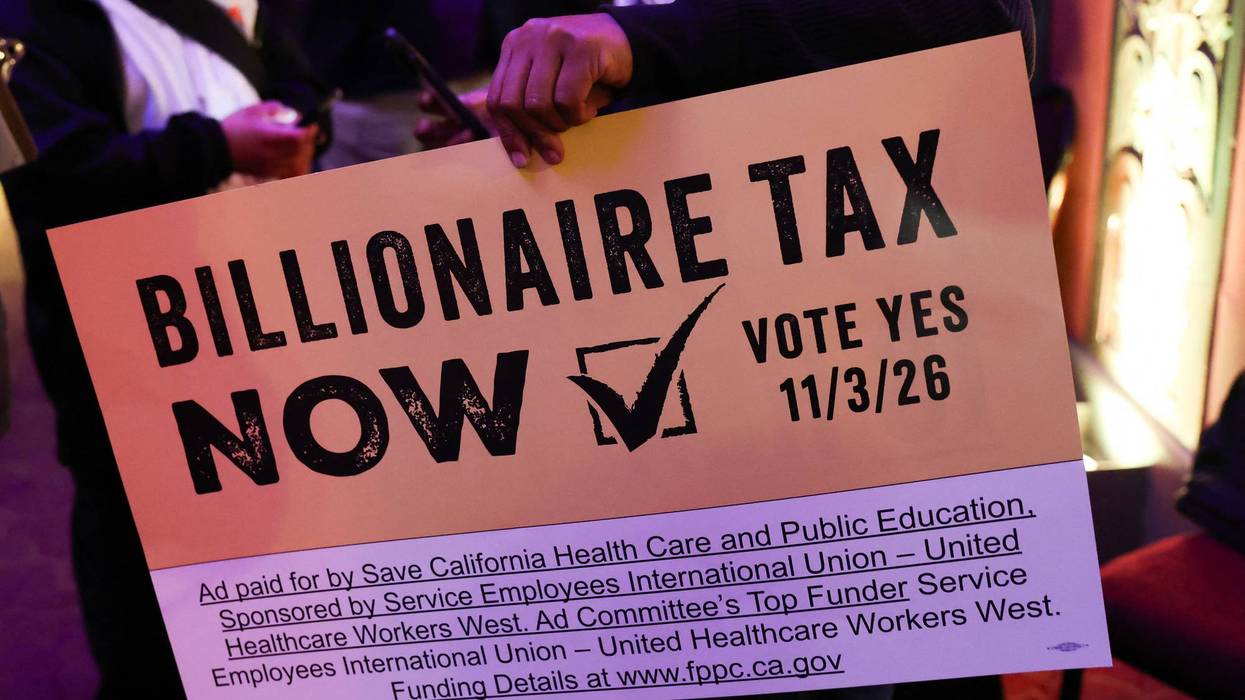
"We may have lost this battle, but we have no doubt we’ll win the war to rein in extreme wealth—both here and around the world," said Patriotic Millionaires.
Bombarded by hundreds of millions of dollars worth of often misleading ads funded by tech titans and other monied interests, California voters narrowly rejected Proposition 40, a one-time 5% tax on the state’s billionaires, but proponents of the measure to fund vital social programs said they'll try again in 2028.
Prop 40 was defeated 52.8% to 47.2%, according to The Associated Press. Also known as the California Billionaire Tax, the ballot measure was sponsored by Service Employees International Union-United Healthcare Workers West (SEIU-UHW) and would have imposed a 5% tax on the wealth of California residents and trusts worth more than $1 billion.
Proponents argued the tax would have generated tens of billions of dollars to help fund healthcare, food assistance, and public education programs facing funding pressures, including from cuts resulting from President Donald Trump’s attacks on Medicaid, the Supplemental Nutrition Assistance Program, and other lifelines.
We’re disappointed to see Prop 40 lost in California.But all hope is not lost. We may have lost this battle, but we have no doubt we’ll win the war to rein in extreme wealth—both here and around the world.Read our full statement here: patrioticmillionaires.org/press/patrio...
[image or embed]
— Patriotic Millionaires (@patrioticmillionaires.org) November 10, 2026 at 9:56 AM
The "No on 40" campaign—including efforts supporting Propositions 41 and 42, a pair of anti-Prop 40 poison pills—was bankrolled by some of Silicon Valley's wealthiest figures, led by Google co-founder Sergey Brin, who contributed upward of $100 million to a committee he established to defeat the measure.
Overall, billionaire opponents contributed approximately $378.4 million, compared with just $33.5 million raised by Prop 40 supporters, according to CalMatters.
“That is incredibly corrosive and corrupting to our democracy and our political system, and that’s been dominating the discussion here in California,” SEIU-UHW president Dan Regan told CalMatters.
Morris Pearl, a former managing director at the investment firm BlackRock who now chairs the advocacy group Patriotic Millionaires, said he's "sad that the ballot measure ultimately fell short, but the attention about what happened in California has sparked not only a national and international conversation around inequality, but also about how billionaires are frightened by voters who very clearly want to shake up the economic status quo."
Initial polling showed 55% of California voters supporting Prop 40 shortly after its introduction last year, and the measure soon won the backing of prominent national figures such as Sen. Bernie Sanders (I-Vt.), Congressman Ro Khanna (D-Calif.), and former US Labor Secretary Robert Reich.
But Prop 40 was opposed by California's Democratic establishment, with Gov. Gavin Newsom, Gov.-elect Xavier Becerra, and the mayors of most major cities coming out against the measure. So did the state NAACP, California Teachers Association, Planned Parenthood Affiliates of California, and other left-leaning groups.
The editors of the Los Angeles Times, San Francisco Chronicle, San Diego Union-Tribune, Orange County Register, San Jose Mercury News, and virtually every major newspaper in the state—the Sacramento Bee being the most notable exception—also urged voters to reject Prop 40.
The "No on 40" campaign's ads relied heavily on misleading scare tactics that portrayed the one-time tax on approximately 200 people as a threat to ordinary Californians. In one particularly deceptive AI-generated ad, bureaucrats terrorize suburban families, steal a bike and a scooter from children, and even try to take a baby's stroller, warning that every Californian would have to disclose their assets or face a 40% penalty.
"Make no mistake—what happened on November 3 was a referendum on the economy, which is why billionaires poured so much money into defeating Proposition 40 and retaining their grasp on their political and economic power," Pearl said. "It will take continued work with leaders from all political parties to fully tackle and address the problem that is extreme wealth concentration."
Economic justice campaigners are already looking forward to trying to pass a billionaire tax in 2028.
“That’s not a hypothetical," said Regan. "That’s our plan."
San Francisco organizer Nadia Rahman said: "And more broadly, we need to tax billionaires throughout the country. We should all demand the new 2027 Congress do so with the mandate the voters gave them last week."
"Contact your congressional representatives," she added, "and tell them to tax the rich."

"The average real wage—what your paycheck buys—is falling," said one economist.
The impact of President Donald Trump's illegal war with Iran continued to hit US consumers hard in October, with the price of groceries experiencing a particularly notable spike.
The latest Consumer Price Index (CPI) report from the US Bureau of Labor Statistics (BLS) released on Tuesday shows that overall prices increased by 0.4% in October, higher than economists' expectations of a 0.3% increase.
Core inflation, which excludes food and energy prices, showed a monthly increase of 0.3%, which was also higher than economists' expectations of a 0.2% increase.
The CPI report doesn't include estimates of yearly price increases, as the BLS last October didn't collect any price data during a government shutdown.
Heather Long, chief economist at Navy Federal Credit Union, estimated in a social media post that the data released by BLS "implies about a ~4% inflation rate for the past year."
Long highlighted a "a big jump in grocery prices" in the report, while also noting that "eating out, electricity, transportation (especially airfares), rent, and medical services (especially hospitals)" all saw "sizable monthly price increases." Analysts have noted that Trump’s Iran war is increasing costs across the economy, including food prices, by jacking up fuel and fertilizer expenses.
Ben Zipperer, an economist at the Economic Policy Institute, posted a chart showing that real wage growth has been in decline in the seven months since Trump launched his illegal war without congressional authorization in February.
Zipperer also mused that the decline in workers' earning power may have "something to do with the recent election results," in which Democrats ousted Trump's Republicans as the majority party in both the US House of Representatives and the US Senate starting in January.
Maybe something to do with the recent election results:
[image or embed]
— Ben Zipperer (@benzipperer.org) November 10, 2026 at 9:56 AM
University of Michigan economist Justin Wolfers observed that real wage growth is now flat throughout Trump's second term, with prices really picking up steam at the start of the Iran War.
"The average real wage—what your paycheck buys—is falling," Wolfers wrote. "That's the sense in which it might feel like you're falling behind. It's not meant to work this way."
The latest inflation report was so ugly that even National Economic Council Director Kevin Hassett, who has been widely criticized for spinning bad data into an implausibly sunny narrative, couldn't paint a rosy picture during a Tuesday interview with Fox Business.
"It's a disappointing report," Hassett acknowledged. "Energy prices in the CPI are up 20% year-over-year, and gasoline prices are up 37% year-over-year... right now, the trickle down from the higher energy prices is definitely very palpable in the data."
🤯 even Hassett can't spin hotter than expected inflation data: "It's a disappointing report ... things have accelerated over the last three months ... the trickle down from higher energy prices is definitely very palpable in the data" https://t.co/yiIylq1mT5
— Aaron Rupar (@atrupar) November 10, 2026
Sen. Chuck Schumer (D-NY), who is facing calls to step aside as Senate Democratic leader before his party takes over as the majority next year, said the latest CPI report showed "why Americans chose Democrats to be in charge."
"From his costly tariffs to his reckless war, Trump has only made inflation worse," said Schumer. "And he openly admits he doesn’t care. Our Senate Democratic majority will work relentlessly to bring down costs for all Americans."

"Lawmakers can act on that right now by passing legislation to prohibit more funding for the war, and by not passing any bills that continue to fund it," said one policy expert.
As Defense Secretary Pete Hegseth, who is expected to face an impeachment vote in the US House in part for his role in launching the illegal war with Iran, declared Tuesday that the US had "achieved a historic MILITARY VICTORY" in the Middle Eastern country, the latest polling on the broadly unpopular conflict suggests few Americans would be convinced by such claims.
Seventy-one percent of people surveyed by Reuters/Ipsos said they wanted the US Congress to urgently pass legislation to end the war in Iran, in which more than 3,400 Iranians, 13 US service members, and thousands of people across the Middle East have been killed as the conflict has wreaked havoc on economies around the world.
Those who were demanding a swift end to the war included 93% of Democrats, 70% of independents, and 51% of Republican voters who expressed their disapproval in the days after the Democratic Party's victory in the midterm elections.
Sixty-three percent of respondents said that Congress should focus "a great deal" or "quite a bit" on ending the war in the first 100 days of the new legislative session, starting January 3, and 54% said the negative impact of the conflict, such as higher gas prices, have not been worth any benefit even as Hegseth and President Donald Trump have claimed, without offering any evidence, that the US waged the war to prevent Iran from obtaining a nuclear weapon.
"Their navy sunk. Their air force grounded. Their defense industrial base—gone. More than 80% of their nuclear industrial base—gone. Their military in ruin. The ironclad blockade, UNBROKEN," said Hegseth Tuesday, without mentioning that the Trump administration had declared months before waging the war that it had already weakened Iran's nuclear infrastructure. "We control the Strait of Hormuz."
Tehran has disputed Hegseth's repeated claims of victory, and the secretary of the Supreme National Security Council, Mohsen Rezaei, on Monday evening called on the Trump administration to "SURRENDER to the seven conditions Iran has repeatedly set out," including an end to the US blockade of Iranian ports and vessels, an end to fighting on all fronts, the lifting of sanctions on Iranian oil and gas sales, and other measures and reparations.
Meanwhile, Trump, who faced a 32% approval rating in the Reuters/Ipsos poll, attempted to deflect questions about ending the conflict, telling reporters Monday: "Iran, militarily, is effectively over. We're just keeping it the status quo."
He added that the US military is "fully locked and loaded with the best equipment ever made" but said, "We don't think there's going to be any reason to use it however."
Trita Parsi, executive vice president of the Quincy Institute of Responsible Statecraft, wrote at Substack Tuesday that Trump may ultimately reject "both war and peace" and choose a "Swiss cheese status quo" that leaves the conflict simmering without any major resolution.
In that scenario, he wrote, Trump "walks away and claims to retain the blockade and sanctions infrastructure, but in reality imperceptibly begins to let it wither away."
"Given Trump’s aversion to admitting defeat, his fear of coming across as a loser, his impatience with complicated diplomacy, his obsession with outdoing Obama’s [Joint Comprehensive Plan of Action], and Iran’s disinterest in giving him an ego-soothing exit ramp, he may end up choosing the Swiss cheese walk-away option," wrote Parsi.
While Hegseth continued to deny the reality of the deeply unpopular war, the anti-war group Just Foreign Policy urged Democratic leaders in the US House and Senate to listen to the vast majority of Americans and take action immediately, without waiting for the new session to begin, to cut off funding for the war.
The group reminded Democrats ahead of the election that they could block more funding for the Iran War on December 11, when current government spending expires, and force a government shutdown if Trump insists on continuing the conflict after that date.
As Common Dreams reported Tuesday, Sen. Chris Van Hollen (D-Md.), who is considering a possible run to serve as Senate Majority Leader, threw his support behind blocking the funding.
Dylan Williams, vice president for government affairs at the Center for International Policy, said the results of the Reuters/Ipsos poll provide Democrats with clear marching orders.
"A 71% supermajority of Americans, including most Republicans, want Congress to end the Iran war," he said. "Lawmakers can act on that right now by passing legislation to prohibit more funding for the war, and by not passing any bills that continue to fund it."
Seeing the poll numbers, political scientist Yousef Munayyer said that many Americans were "enraged" by Trump's decision to join Israel in attacking Iran not just because "it was a stupid decision, [but] it was a stupid decision that was taken with no public debate at all."
"There was not effort at all on the part of the White House to present a rationale for this or convince the public ahead of time," said Muayyer. "They didn't feel they had to because they felt empowered to do whatever the hell they wanted and had a Republican-controlled Congress who would allow it. Voters saw that not only as stupidity, but out-of-control stupidity that needed to be checked before it further wrecked the country."

"Few individuals have been more instrumental to the White House’s campaign to weaken the First Amendment than Brendan Carr," said Reporters Without Borders.
A leading press freedom organization on Monday urged Democratic lawmakers to impeach US President Donald Trump's Federal Communications Commission chairman when they take control of Congress in January, pointing to the official's efforts to "intimidate and punish" media outlets that publish criticism of the White House.
The demand marked the first time that Reporters Without Borders, known internationally as Reporters sans frontières (RSF), has called for the removal of a US official in the group's 40-year history, the organization said in a statement. Clayton Weimers, executive director of RSF North America, said the "severity and persistence" of FCC Chair Brendan Carr's alleged wrongdoing "demand an extraordinary response."
RSF points to Carr's erosion of the FCC's independence from the executive branch and eager willingness to act as the president's attack dog, pursuing investigations into networks that Trump has publicly targeted.
"When Trump took office, Carr reinstated complaints against and announced inquiries into broadcasters that questioned the Trump administration’s policies, from public service media NPR and PBS to major private channels ABC, CBS, and NBC," the group noted. "Carr’s relentless investigations have also targeted local stations, such as California radio station KCBS, which has faced politically motivated scrutiny for its reporting."
RSF also pointed to Carr's threat earlier this year to pull the broadcast licenses of networks accused by the administration of "news distortions"—a threat that came in direct response to Trump's complaint about media coverage of his illegal war on Iran.
"Few individuals have been more instrumental to the White House’s campaign to weaken the First Amendment than Brendan Carr," Weimers said on Monday. "The incoming Congress now faces a defining test of its commitment to the Constitution and the freedoms it guarantees. Press freedom cannot be defended through words alone."
In addition to his attacks on journalism and legally dubious effort to roll back limits on media consolidation, RSF argued that Carr "likely violated the Hatch Act" by hailing his government work at a political rally for Republican US Senate candidate Dan Sullivan in Alaska. RSF and the Democracy Defenders Fund filed a formal complaint last month demanding an investigation into Carr's appearance at the rally.
RSF's call for Carr's impeachment came days after Sen. Richard Blumenthal (D-Conn.) demanded that the FCC chair hand over records as part of an investigation into "how the president and the Federal Communications Commission’s actions erode and undermine freedom of speech and freedom of the press and bear on the laws governing media consolidation."
Jessica González, co-CEO of the advocacy group Free Press Action, welcomed Blumenthal's investigation and argued that Carr's actions "should lead to his removal from office, by impeachment if necessary."
"Carr’s capricious abuse of the law has no place in a legitimate democracy," said González. "Over the past two years, Carr has regularly violated his oath to support and defend the Constitution. He’s been more than happy to browbeat and jawbone broadcasters into silence, though his claims have zero legal merit."

Sen. Chris Van Hollen, who may mount a leadership challenge against Sen. Chuck Schumer, called on Congress to “end this war now” by blocking the bill next month.
House Minority Leader Hakeem Jeffries declined to say on Monday whether he'd support holding up a spending bill next month in an effort to force President Donald Trump to end his war in Iran before Democrats retake Congress in January.
"We're going to end the war in Iran one way or the other," Jeffries (D-NY) said during a news conference Monday, but added that the appropriations process was "in the hands of" Rep. Rosa DeLauro (D-Conn.) and Sen. Patty Murray (D-Wash.), the top Democrats on their chambers' respective appropriations committees.
Since Republicans’ resounding defeat in last Tuesday’s midterms, Trump has fluctuated wildly between declarations that the Iran War may soon end and bellicose threats to “destroy the rest” of the country. Some Democrats have taken this as a sign that urgent action is needed even before their new majorities take office in January.
Their most immediate point of leverage is the next government funding bill, which needs to be enacted by December 11 in order to avert a government shutdown.
With Trump ignoring the war powers resolution passed by Congress earlier this year, some Democrats have said they will withhold their votes unless the next bill contains clear language prohibiting federal funds from being used to continue waging the unauthorized war.
A Reuters/Ipsos post-election survey published Monday showed that 71% of all adults supported legislation to end the war, including 51% of Republicans.
Sen. Chris Van Hollen (D-Md.), who has suggested launching a leadership challenge against Senate Minority Leader Chuck Schumer, said Tuesday morning that Democrats must use their leverage to end the war as soon as possible.
"The American people have spoken loudly and clearly: We need to end the war in Iran now," Van Hollen said in a video posted to social media. "We're now 255 days into that war, a war that Donald Trump said would be over in a matter of weeks."
"What's the fastest way to end this war? Well, to stop funding it, to stop giving it the fuel it needs to keep going," he continued, pointing to the December 11 deadline for a new spending bill.
"If President Trump wants to tell the country that he'll shut down the entire government, all federal agencies, in order to keep his illegal war going, that's his decision," Van Hollen said. "But the American people have rendered their decision. Let's end this war and end it now: not a penny more."
Schumer, whom several incoming members of the Senate Democratic caucus have pledged to vote against as majority leader, has not publicly stated a position on whether he'd support using the December 11 deadline to force concessions from Trump. Last week, he told Politico he was working with Murray to “get something done” on government funding before December 11, but did not say whether he would demand a cutoff of war funding.
In a joint statement Monday, following a Democratic leadership meeting, Schumer and Jeffries pledged to “stop the reckless war of choice in Iran," but did not indicate what action they planned to take. They added that "a new day is coming on January 3."
Jeffries said last week that his goal was “to reach a spending agreement that meets the needs of the American people and prioritizes their economic well-being, health, and safety.”
Drop Site News co-founder Ryan Grim suggested that Van Hollen’s demand for Democrats to hold up the December spending bill may put more pressure on Schumer to endorse a similar strategy. Jeffries, on the other hand, has not had his leadership role challenged, and several progressive members of Congress have said they’ll back him as speaker despite their policy disagreements.
Grim said Jeffries’ response showed he was “feeling absolutely no pressure to end this war, clearly very confident he’ll become speaker regardless.”
Since Trump launched the war in February, critics have argued that Jeffries' response was lackluster. As independent journalist Adam Johnson recounted, Jeffries focused largely on procedural objections to the war while reinforcing many of the Trump administration's justifications for it, including saying that Iran needed to be "aggressively confronted."
While Reps. Ro Khanna (D-Calif.) and Thomas Massie (R-Ky.) were pushing for a war powers resolution as Trump built an “armada” in the Middle East weeks before the start of “Operation Epic Fury,” Jeffries did not force a vote on it to occur until several days after the bombing began.
Johnson argued that Jeffries has been "at best sleepy, useless, and indifferent" in response to the war.
The anti-war group Just Foreign Policy, one of the groups that pressured Democrats to ultimately invoke the War Powers Resolution against Trump, said that cutting off funding was one of the only guaranteed ways to bring the war to an end.
The group noted that Congress' July 1973 decision to cut off funding played a decisive role in forcing President Richard Nixon to end direct combat operations elsewhere in Southeast Asia amid the US withdrawal from Vietnam.
It noted that the US bombing of Cambodia ceased the day that the funding prohibition took effect. After the House voted to restrict funding, then-Secretary of State Henry Kissinger declared, "That finishes us."
"The ONLY way to truly rein in war criminals like [Defense Secretary Pete Hegseth] and Kissinger is for Congress to be willing to force the White House to risk a government shutdown if it wants to continue the war," Just Foreign Policy said. "Time to shut the funding down like Congress did for Vietnam. Force Republicans to fund it themselves if they refuse."