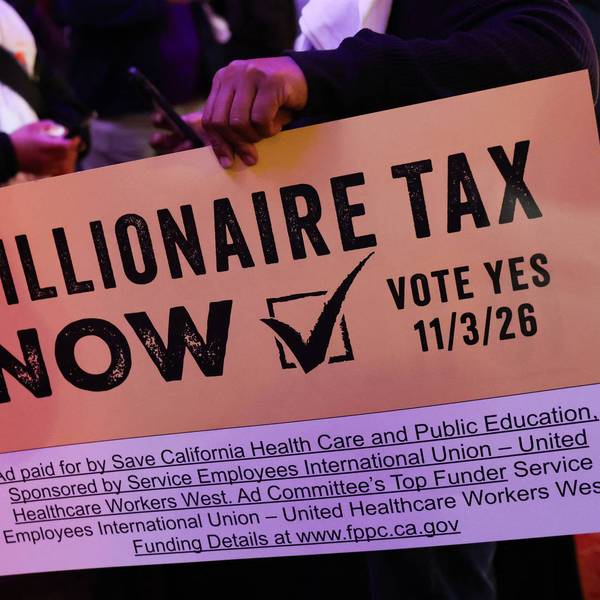
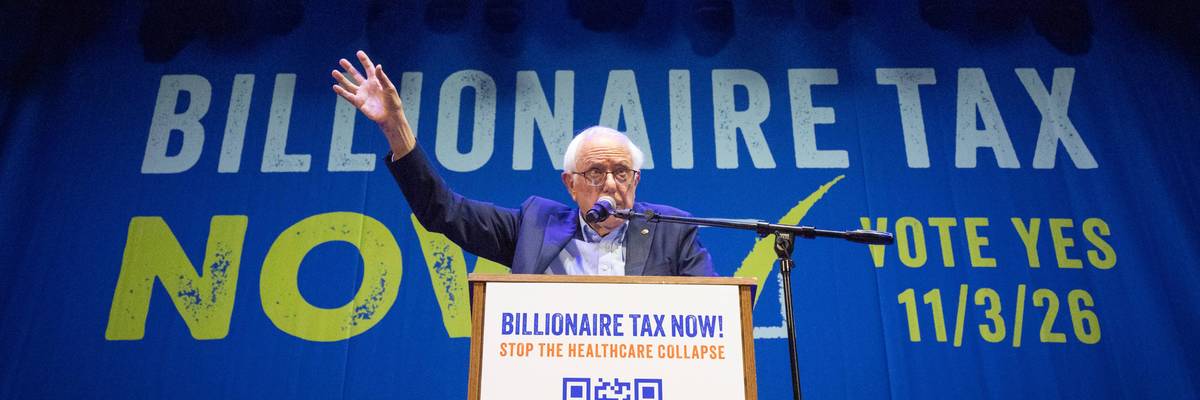
US Sen. Bernie Sanders (I-Vt.) speaks at the Billionaire Tax Now rally on February 18, 2026 in Los Angeles, California.
Sanders: Billionaires Fighting Prop 40 Would 'Rather Poor Kids With Cancer Die Than Pay a Little More in Taxes'
The senator noted that "billionaires in California are spending $333 million to wage a war" on the proposed one-time tax.
As one Golden State tech billionaire suggested he wouldn't move away even if voters passed the California Billionaire Tax Act that he opposes, progressive US Sen. Bernie Sanders on Tuesday took aim at the wealthy taxpayers working to defeat Proposition 40.
"Billionaires in California are spending $333 million to wage a war," Sanders (I-Vt.) wrote on social media. "Against what? Homelessness? No. Cancer? No. Child poverty? No. They're waging war against a 5% billionaire wealth tax. They'd rather poor kids with cancer die than pay a little more in taxes. That is obscene."
Sanders, a former Democratic presidential candidate who has campaigned in California for the ballot measure that would impose a one-time 5% tax on the state's billionaires to offset healthcare funding cuts, was citing contributions to Building a Better California, a group created in January.
"Eighty or so donors have provided more than $333 million to Building a Better California, state records show, making it among the best-funded political efforts in California history," The New York Times reported Tuesday. "The donor list is a who's who of tech celebrities: the Google co-founder Sergey Brin; the former Google chief executive Eric Schmidt; the Stripe chief executive Patrick Collison; the legendary investor John Doerr."
Abby Lunardini, a spokesperson for the group, told the Times that "our supporters have created companies, entirely new industries, and hundreds of thousands of jobs here in California, and they want our state to remain the place where the future is built and where people can still afford to live, dream big, and succeed."
Lunardini claimed the wealth tax would "permanently damage the state's budget, tax base, and economy," though dozens of multimillionaire Californians have signed an open letter supporting the one-time wealth tax, Meta CEO Mark Zuckerberg—one of the richest men in the world—is preparing to potentially pay it, and Anduril co-founder Palmer Luckey said Monday that he won't leave the state.
TechCrunch reported on his latest comments, in which Luckey—whose defense company won key US military contracts after he was announced as one of the leaders of a new Pentagon project on the "future of warfare"—made clear that he opposes Prop 40:
"I think that this tax act, if you can call it a tax, is going to cause a lot of problems. It’s causing a lot of people to run who I don’t want to be running. It’s going to cause companies that I work with to leave the state, which is a problem for me. As of right now, though, I’m not running. I am staying. I think California is something special. I want to fight for California," Luckey said during an invite-only press conference on Monday.
He added that he's felt pressure from other billionaires to declare his intention to leave.
"This has been a point of friction between me and some of my other billionaire friends," he said. "They've said things like: 'Palmer, you have to have solidarity for us. You can't enable these really bad policies. If you stay and if you don't leave, it's going to show them that there's no consequences.' I empathize with that argument, but it's not one that I'm going to participate in right now because I still believe that we can fix things."
Luckey has publicly sparred with US Rep. Ro Khanna (D-Calif.)—who, like Sanders, supports Prop 40. Leading political opponents in the state include term-limited Democratic Gov. Gavin Newsom, who's expected to run for president in 2028, and former US Health and Human Services Secretary Xavier Becerra, a Democrat running to replace the governor.
Estimates vary on how much the tax—which would apply to any billionaire residing in the state as of January 1, 2026—could cost the richest Californians, if approved by voters in next week's midterm elections.
Forbes pointed to one of them on Tuesday: "$104 billion. That's how much economists Jasper Boll, Emmanuel Saez, and Gabriel Zucman estimate California's billionaires would owe if Proposition 40 is enacted, according to an analysis by the National Bureau of Economic Research. Saez and Zucman helped draft the tax proposal."
Ramesh Ponnuru, National Review editor and a fellow at the American Enterprise Institute, noted in a Tuesday column at The Washington Post—owned by Jeff Bezos, another one of the world's richest men—that "a new study by Benjamin Jaros and Joshua Rauh, two economists affiliated with the Hoover Institution, challenges that projection."
After trying to "account for the uncertainty over whether taxes can be collected from other billionaires, such as the ones who have left since the beginning of the year and may thus have a legal case for escaping the tax," Ponnuru summarized, those economists estimated Prop 40 would generate around $30 billion. The columnist also acknowledged that Zucman "has issued a barrage of attacks on that paper."
Specifically, Zucman called it "spectacularly misleading" and explained "its crucial flaw," which is that "they assume that billionaires will leave permanently, frightened by the prospects of an annual wealth tax."
"Let's be clear: This is a highly inappropriate way to model the effect of Prop 40 on taxpayer behavior. For one, it's a basic violation of rational expectations, a cornerstone of modern economics," Zucman said.
In Jaros and Rauh's world, "the billionaires act irrationally: They respond to a policy that does not exist and will never exist," he added. "Economics students around the world are taught this is not an appropriate way to model behavior—but apparently in this context (fighting Prop 40) it's OK."
We are at a crossroads
This country and this world are at a monumental crossroads. In a few short weeks, US voters will have an opportunity to beat back the forces of fascism and confront the billionaires who are rigging the economy, our media system, and our democracy, making it increasingly impossible for ordinary people to get by. We’re not just talking about the election. We’re talking about what must be done once these fascist elements are vanquished from power. We need a bolder set of solutions than what either major party has so far been willing to offer and a working-class movement ready to fight like hell for it. Trump didn't emerge from nowhere. The conditions that fueled MAGA authoritarianism were created by decades of radical neoliberal economic policies and a corrupt political system dominated by corporate interests. They slashed taxes on the super-rich, promising that the benefits would trickle down. They said giveaways to the corporate titans would make life more affordable for the rest of us. It was all bullshit. And when a bitter, betrayed populace searches for someone to blame, right-wing demagogues have little trouble finding scapegoats. People know when they're being lied to, but you won't hear any of this from the corporate media. Only independent journalism—powered and funded by people who believe in building a better world—can deliver truly trustworthy daily news. Our Fall Campaign is underway, and we need your help. To power our newsroom through the rest of the year, we need to raise $125,000 by midnight on October 31. So if you share our vision, please contribute whatever you can to sustain our work. |
As one Golden State tech billionaire suggested he wouldn't move away even if voters passed the California Billionaire Tax Act that he opposes, progressive US Sen. Bernie Sanders on Tuesday took aim at the wealthy taxpayers working to defeat Proposition 40.
"Billionaires in California are spending $333 million to wage a war," Sanders (I-Vt.) wrote on social media. "Against what? Homelessness? No. Cancer? No. Child poverty? No. They're waging war against a 5% billionaire wealth tax. They'd rather poor kids with cancer die than pay a little more in taxes. That is obscene."
Sanders, a former Democratic presidential candidate who has campaigned in California for the ballot measure that would impose a one-time 5% tax on the state's billionaires to offset healthcare funding cuts, was citing contributions to Building a Better California, a group created in January.
"Eighty or so donors have provided more than $333 million to Building a Better California, state records show, making it among the best-funded political efforts in California history," The New York Times reported Tuesday. "The donor list is a who's who of tech celebrities: the Google co-founder Sergey Brin; the former Google chief executive Eric Schmidt; the Stripe chief executive Patrick Collison; the legendary investor John Doerr."
Abby Lunardini, a spokesperson for the group, told the Times that "our supporters have created companies, entirely new industries, and hundreds of thousands of jobs here in California, and they want our state to remain the place where the future is built and where people can still afford to live, dream big, and succeed."
Lunardini claimed the wealth tax would "permanently damage the state's budget, tax base, and economy," though dozens of multimillionaire Californians have signed an open letter supporting the one-time wealth tax, Meta CEO Mark Zuckerberg—one of the richest men in the world—is preparing to potentially pay it, and Anduril co-founder Palmer Luckey said Monday that he won't leave the state.
TechCrunch reported on his latest comments, in which Luckey—whose defense company won key US military contracts after he was announced as one of the leaders of a new Pentagon project on the "future of warfare"—made clear that he opposes Prop 40:
"I think that this tax act, if you can call it a tax, is going to cause a lot of problems. It’s causing a lot of people to run who I don’t want to be running. It’s going to cause companies that I work with to leave the state, which is a problem for me. As of right now, though, I’m not running. I am staying. I think California is something special. I want to fight for California," Luckey said during an invite-only press conference on Monday.
He added that he's felt pressure from other billionaires to declare his intention to leave.
"This has been a point of friction between me and some of my other billionaire friends," he said. "They've said things like: 'Palmer, you have to have solidarity for us. You can't enable these really bad policies. If you stay and if you don't leave, it's going to show them that there's no consequences.' I empathize with that argument, but it's not one that I'm going to participate in right now because I still believe that we can fix things."
Luckey has publicly sparred with US Rep. Ro Khanna (D-Calif.)—who, like Sanders, supports Prop 40. Leading political opponents in the state include term-limited Democratic Gov. Gavin Newsom, who's expected to run for president in 2028, and former US Health and Human Services Secretary Xavier Becerra, a Democrat running to replace the governor.
Estimates vary on how much the tax—which would apply to any billionaire residing in the state as of January 1, 2026—could cost the richest Californians, if approved by voters in next week's midterm elections.
Forbes pointed to one of them on Tuesday: "$104 billion. That's how much economists Jasper Boll, Emmanuel Saez, and Gabriel Zucman estimate California's billionaires would owe if Proposition 40 is enacted, according to an analysis by the National Bureau of Economic Research. Saez and Zucman helped draft the tax proposal."
Ramesh Ponnuru, National Review editor and a fellow at the American Enterprise Institute, noted in a Tuesday column at The Washington Post—owned by Jeff Bezos, another one of the world's richest men—that "a new study by Benjamin Jaros and Joshua Rauh, two economists affiliated with the Hoover Institution, challenges that projection."
After trying to "account for the uncertainty over whether taxes can be collected from other billionaires, such as the ones who have left since the beginning of the year and may thus have a legal case for escaping the tax," Ponnuru summarized, those economists estimated Prop 40 would generate around $30 billion. The columnist also acknowledged that Zucman "has issued a barrage of attacks on that paper."
Specifically, Zucman called it "spectacularly misleading" and explained "its crucial flaw," which is that "they assume that billionaires will leave permanently, frightened by the prospects of an annual wealth tax."
"Let's be clear: This is a highly inappropriate way to model the effect of Prop 40 on taxpayer behavior. For one, it's a basic violation of rational expectations, a cornerstone of modern economics," Zucman said.
In Jaros and Rauh's world, "the billionaires act irrationally: They respond to a policy that does not exist and will never exist," he added. "Economics students around the world are taught this is not an appropriate way to model behavior—but apparently in this context (fighting Prop 40) it's OK."
- 'We Intend to Win': California Billionaire Tax Officially Certified for November Ballot ›
- Nobel-Winning Economists Say California Billionaire Tax Could Be ‘Turning Point in the Battle Between Democracy and Oligarchy’ ›
- Newsom Endorses Ballot Measure That Would Cancel Out Billionaire Tax—and Ban Future Wealth Taxes ›
- Failing 'Moral Test,' Newsom Rejects Compromise 2% Wealth Tax on California Billionaires ›
- 'This Is Huge,' Economist Says as Filing Shows Zuckerberg Getting Ready to Pay California Billionaire Tax ›