SUBSCRIBE TO OUR FREE NEWSLETTER
Daily news & progressive opinion—funded by the people, not the corporations—delivered straight to your inbox.
5
#000000
#FFFFFF
To donate by check, phone, or other method, see our More Ways to Give page.
Daily news & progressive opinion—funded by the people, not the corporations—delivered straight to your inbox.
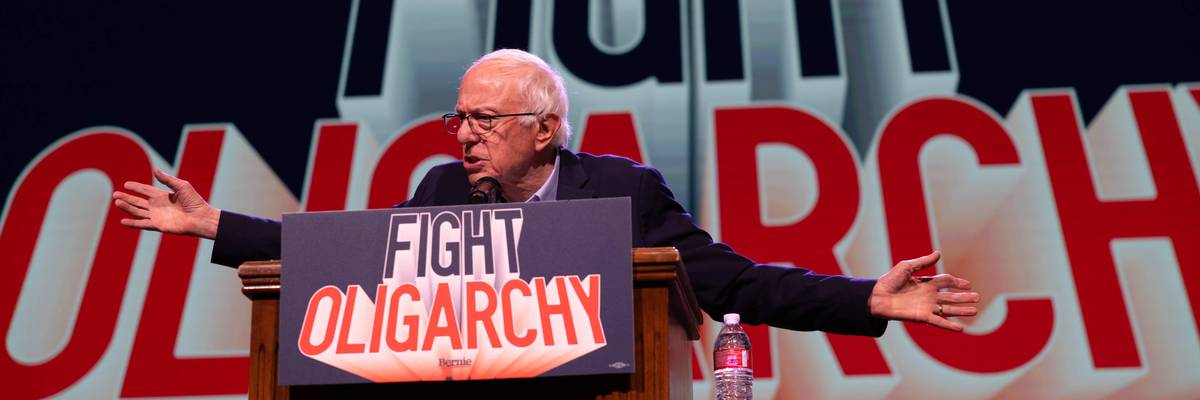
US Sen. Bernie Sanders (I-Vt.) speaks at a campaign rally at Wheeler Avenue Baptist Church on October 20, 2026, in Houston, Texas.
"With the blue wave nationally, the billionaire tax is going to be front and center in the new Congress," said economist Gabriel Zucman, who led the charge for California's failed proposal.
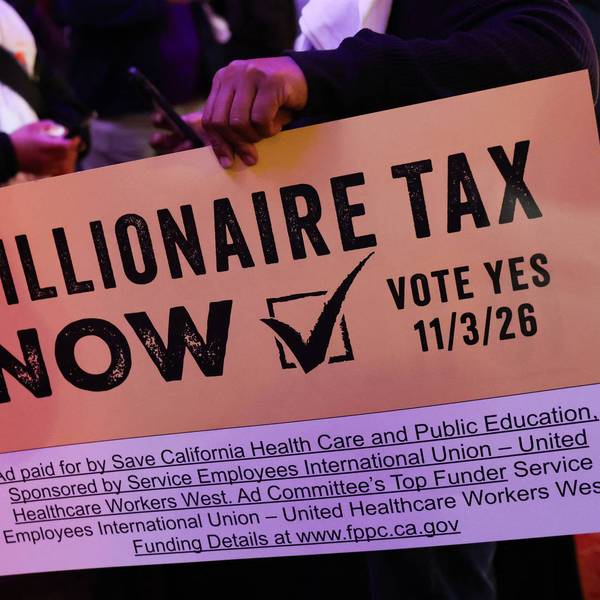
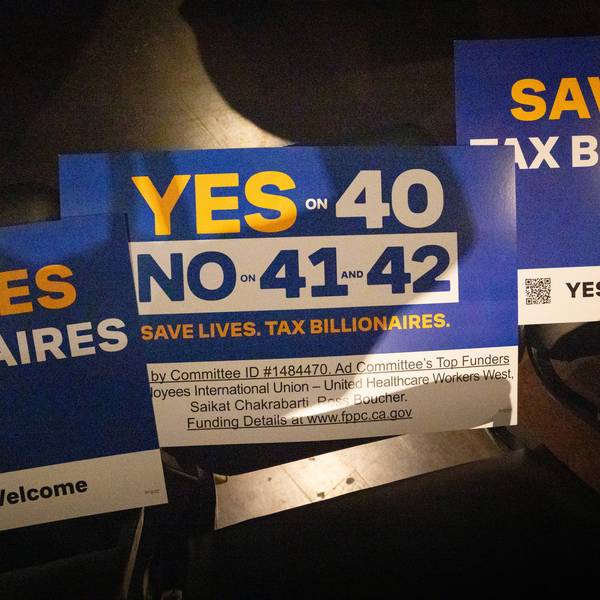
California's wealth tax proposal has fallen just short after the state's richest residents spent hundreds of millions of dollars to mobilize voters against it. But Sen. Bernie Sanders is warning them not to get too comfortable.
Sanders (I-Vt.) argued that Proposition 40, which would have used revenue from a one-time 5% tax on billionaire residents to fund the state’s healthcare system, performed quite well given the resources that powerful tech barons like Google co-founder Sergey Brin and its former CEO Eric Schmidt deployed to fight it.
"Oligarchs spent $425 million against California's billionaire wealth tax—outraising supporters 250 to 1 on ads," Sanders wrote on social media. "The result: They got a 'whopping' 52% [of the vote]."
"I've got bad news for these oligarchs," Sanders continued. "Your victory is fleeting. We will pass a federal billionaire wealth tax and end your greed."
Many of the wealthiest Americans pay lower effective tax rates than ordinary workers because much of their wealth is held in stocks, whose gains are generally untaxed until sold—and can be taxed at lower rates than wages when realized.
Polls show that overwhelming majorities of Americans support a federal tax on the wealth of the superrich—including most Republicans.
One February poll by the University of Maryland's Program for Public Consultation found that 80% of Americans, including 72% of Republicans and 88% of Democrats, supported the idea of a federal tax of 2% on fortunes over $50 million and a 3% tax on those over $1 billion.
Sen. Elizabeth Warren (D-Mass.), who has called for a wealth tax for years and made it central to her 2020 presidential bid, has argued that "the best way to do a wealth tax is to do a national wealth tax."
In January, she told The New Republic that a federal proposal would avoid some of the pitfalls the rich used to fearmonger about California’s proposal, such as the possibility of simply fleeing across state lines to avoid paying it.
Escaping a national tax, she said, would mean having to “give up your US citizenship, and forfeit your passport.”
French economist Gabriel Zucman, who helped lead the push for California’s ballot measure, said he was “not surprised” by its defeat.
"The money spent by the billionaires was critical," he told NPR. "Anyone who lives in California has been carpet-bombed by a deluge of ads. One can easily see how this could be pivotal in such a closely contested ballot."
But he said that last week's midterm elections, which saw Democrats swept into power on a wave of anti-billionaire anger, showed that the fight over a wealth tax was not something that could easily be ignored.
"With the blue wave nationally, the billionaire tax is going to be front and center in the new Congress," Zucman said. "Many of the newly elected Democratic senators have been campaigning on curbing the power and influence of billionaires. One can reasonably expect to see significant progress in the next two years."
Sanders, who introduced a 5% annual wealth tax on those worth $1 billion or more with Rep. Ro Khanna (D-Calif.) in March, renewed his call to pass the bill after the elections.
Another proposal, which would impose an annual 2% tax on net worth above $50 million, increasing to 3% on wealth above $1 billion, has gained the support of 63 Democrats, including Warren, Sen. Adam Schiff (D-Calif.), Sen. Chris Van Hollen (D-Md.), and Rep. Alexandria Ocasio-Cortez (D-NY).
Van Hollen, who has suggested he may challenge Sen. Chuck Schumer (D-NY) to become Senate majority leader when Democrats retake the chamber, told Politico last week that he thinks there’s “growing support” in the Democratic caucus for a tax on the ultrarich.
“People are recognizing that we have a tax system that allows individuals to accumulate huge amounts of wealth," he said.
“It is essential that we show the American people where we stand,” Van Hollen added. “If [President Donald Trump] vetoes it, it will just show people that he’s on the side of billionaires.”
This country and this world are at a monumental crossroads. US voters have an opportunity to beat back the forces of fascism and confront the billionaires who are rigging the economy, our media system, and our democracy, making it increasingly impossible for ordinary people to get by. We’re not just talking about the election. We’re talking about what must be done once these fascist elements are vanquished from power. We need a bolder set of solutions than what either major party has so far been willing to offer and a working-class movement ready to fight like hell for it. Trump didn't emerge from nowhere. The conditions that fueled MAGA authoritarianism were created by decades of radical neoliberal economic policies and a corrupt political system dominated by corporate interests. They slashed taxes on the super-rich, promising that the benefits would trickle down. They said giveaways to the corporate titans would make life more affordable for the rest of us. It was all bullshit. And when a bitter, betrayed populace searches for someone to blame, right-wing demagogues have little trouble finding scapegoats. People know when they're being lied to, but you won't hear any of this from the corporate media. Only independent journalism—powered and funded by people who believe in building a better world—can deliver truly trustworthy daily news. If you share our vision, please contribute whatever you can to sustain our work. |
California's wealth tax proposal has fallen just short after the state's richest residents spent hundreds of millions of dollars to mobilize voters against it. But Sen. Bernie Sanders is warning them not to get too comfortable.
Sanders (I-Vt.) argued that Proposition 40, which would have used revenue from a one-time 5% tax on billionaire residents to fund the state’s healthcare system, performed quite well given the resources that powerful tech barons like Google co-founder Sergey Brin and its former CEO Eric Schmidt deployed to fight it.
"Oligarchs spent $425 million against California's billionaire wealth tax—outraising supporters 250 to 1 on ads," Sanders wrote on social media. "The result: They got a 'whopping' 52% [of the vote]."
"I've got bad news for these oligarchs," Sanders continued. "Your victory is fleeting. We will pass a federal billionaire wealth tax and end your greed."
Many of the wealthiest Americans pay lower effective tax rates than ordinary workers because much of their wealth is held in stocks, whose gains are generally untaxed until sold—and can be taxed at lower rates than wages when realized.
Polls show that overwhelming majorities of Americans support a federal tax on the wealth of the superrich—including most Republicans.
One February poll by the University of Maryland's Program for Public Consultation found that 80% of Americans, including 72% of Republicans and 88% of Democrats, supported the idea of a federal tax of 2% on fortunes over $50 million and a 3% tax on those over $1 billion.
Sen. Elizabeth Warren (D-Mass.), who has called for a wealth tax for years and made it central to her 2020 presidential bid, has argued that "the best way to do a wealth tax is to do a national wealth tax."
In January, she told The New Republic that a federal proposal would avoid some of the pitfalls the rich used to fearmonger about California’s proposal, such as the possibility of simply fleeing across state lines to avoid paying it.
Escaping a national tax, she said, would mean having to “give up your US citizenship, and forfeit your passport.”
French economist Gabriel Zucman, who helped lead the push for California’s ballot measure, said he was “not surprised” by its defeat.
"The money spent by the billionaires was critical," he told NPR. "Anyone who lives in California has been carpet-bombed by a deluge of ads. One can easily see how this could be pivotal in such a closely contested ballot."
But he said that last week's midterm elections, which saw Democrats swept into power on a wave of anti-billionaire anger, showed that the fight over a wealth tax was not something that could easily be ignored.
"With the blue wave nationally, the billionaire tax is going to be front and center in the new Congress," Zucman said. "Many of the newly elected Democratic senators have been campaigning on curbing the power and influence of billionaires. One can reasonably expect to see significant progress in the next two years."
Sanders, who introduced a 5% annual wealth tax on those worth $1 billion or more with Rep. Ro Khanna (D-Calif.) in March, renewed his call to pass the bill after the elections.
Another proposal, which would impose an annual 2% tax on net worth above $50 million, increasing to 3% on wealth above $1 billion, has gained the support of 63 Democrats, including Warren, Sen. Adam Schiff (D-Calif.), Sen. Chris Van Hollen (D-Md.), and Rep. Alexandria Ocasio-Cortez (D-NY).
Van Hollen, who has suggested he may challenge Sen. Chuck Schumer (D-NY) to become Senate majority leader when Democrats retake the chamber, told Politico last week that he thinks there’s “growing support” in the Democratic caucus for a tax on the ultrarich.
“People are recognizing that we have a tax system that allows individuals to accumulate huge amounts of wealth," he said.
“It is essential that we show the American people where we stand,” Van Hollen added. “If [President Donald Trump] vetoes it, it will just show people that he’s on the side of billionaires.”