SUBSCRIBE TO OUR FREE NEWSLETTER
Daily news & progressive opinion—funded by the people, not the corporations—delivered straight to your inbox.
5
#000000
#FFFFFF
To donate by check, phone, or other method, see our More Ways to Give page.
Daily news & progressive opinion—funded by the people, not the corporations—delivered straight to your inbox.
Multiple consumer surveys have shown that Americans have never been more pessimistic about the state of the economy.
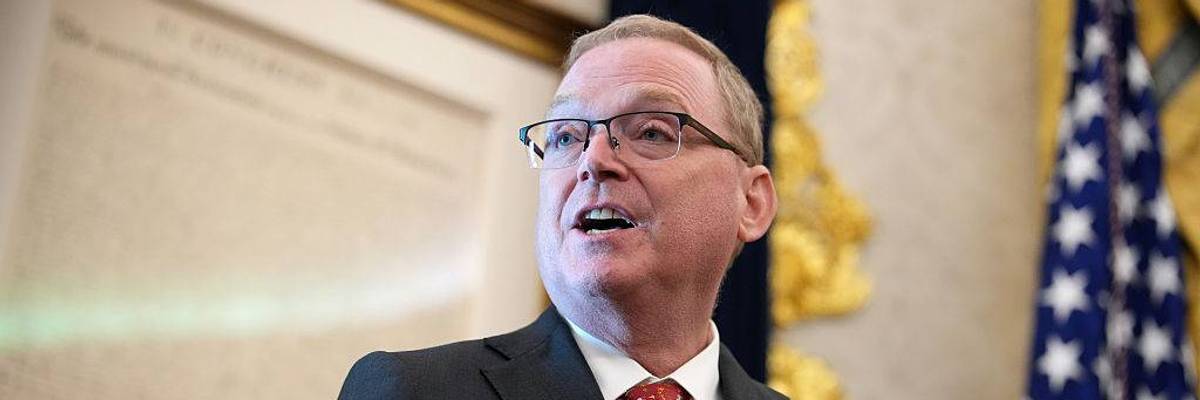
For the second time in a month, National Economic Council Director Kevin Hassett on Tuesday claimed that Americans spending more money on gasoline and other goods is a sign of strength for the US economy—rather than evidence of the Trump administration's inflationary policy decisions.
During an interview with Fox Business, Hassett tried to counter recent data showing US consumer sentiment hitting all-time lows during President Donald Trump's second term.
"The thing that I've seen when I look at credit card data," Hassett said, "is that while people have been spending more money at gas stations, they've been spending more money on everything else, which means that they're still very, very optimistic about the state of the economy, and they should be."
Hassett: "The thing I've seen is that while people have been spending more money at gas stations, they've been spending more money on everything else, which means they're still very very optimistic about the state of the economy"
(Consumer sentiment is actually at an all time… pic.twitter.com/oyWfsCGy8O
— Aaron Rupar (@atrupar) May 26, 2026
In fact, multiple consumer surveys have shown that Americans have never been more pessimistic about the state of the economy.
Last week, the University of Michigan's latest Surveys of Consumers showed consumer sentiment hitting the lowest level ever, driven primarily by concerns about the cost of living.
Gallup last week published new data showing that Americans’ economic confidence has fallen to its lowest level since October 2022, with just 16% of Americans rating the economy as excellent or good, and nearly half describing it as poor.
Fox Business host Maria Bartiromo asked Hassett about these surveys, and he said they should be dismissed because they only show negative sentiment from Democrats and independents, who combined make up the majority of US voters.
"They call it 'consumer sentiment' but I don't think those words mean what they think they mean anymore," Hassett said. "We find that basically the consumer sentiment indicator at the University of Michigan, it's just a political survey. And in fact, what the correlation between what Democrats say and what independents say... it's almost exactly perfectly correlated."
BARTIROMO: Consumer sentiment is a record low. What's the most important messaging you can put out there to help sentiment?
HASSETT: They call it 'consumer sentiment' but I don't think those words mean what they think they mean anymore. The correlation between what independents… pic.twitter.com/kAM3JyWUjD
— Aaron Rupar (@atrupar) May 26, 2026
In fact, consumer sentiment surveys taken during President Joe Biden's administration showed that independents joined with Republican voters to rate the economy significantly more poorly than Democratic voters, indicating that independents' views of the economy are not in lockstep with Democrats'.
Polling averages calculated by elections analyst Nate Silver currently show Trump's approval rating on his handling to the economy to be just 34%, with disapproval standing at 63%.
The numbers are even worse when it comes to the president's handling of inflation, where an average of 28% of Americans approve and 69% disapprove.
This country and this world are at a monumental crossroads. US voters have an opportunity to beat back the forces of fascism and confront the billionaires who are rigging the economy, our media system, and our democracy, making it increasingly impossible for ordinary people to get by. We’re not just talking about the election. We’re talking about what must be done once these fascist elements are vanquished from power. We need a bolder set of solutions than what either major party has so far been willing to offer and a working-class movement ready to fight like hell for it. Trump didn't emerge from nowhere. The conditions that fueled MAGA authoritarianism were created by decades of radical neoliberal economic policies and a corrupt political system dominated by corporate interests. They slashed taxes on the super-rich, promising that the benefits would trickle down. They said giveaways to the corporate titans would make life more affordable for the rest of us. It was all bullshit. And when a bitter, betrayed populace searches for someone to blame, right-wing demagogues have little trouble finding scapegoats. People know when they're being lied to, but you won't hear any of this from the corporate media. Only independent journalism—powered and funded by people who believe in building a better world—can deliver truly trustworthy daily news. If you share our vision, please contribute whatever you can to sustain our work. |
For the second time in a month, National Economic Council Director Kevin Hassett on Tuesday claimed that Americans spending more money on gasoline and other goods is a sign of strength for the US economy—rather than evidence of the Trump administration's inflationary policy decisions.
During an interview with Fox Business, Hassett tried to counter recent data showing US consumer sentiment hitting all-time lows during President Donald Trump's second term.
"The thing that I've seen when I look at credit card data," Hassett said, "is that while people have been spending more money at gas stations, they've been spending more money on everything else, which means that they're still very, very optimistic about the state of the economy, and they should be."
Hassett: "The thing I've seen is that while people have been spending more money at gas stations, they've been spending more money on everything else, which means they're still very very optimistic about the state of the economy"
(Consumer sentiment is actually at an all time… pic.twitter.com/oyWfsCGy8O
— Aaron Rupar (@atrupar) May 26, 2026
In fact, multiple consumer surveys have shown that Americans have never been more pessimistic about the state of the economy.
Last week, the University of Michigan's latest Surveys of Consumers showed consumer sentiment hitting the lowest level ever, driven primarily by concerns about the cost of living.
Gallup last week published new data showing that Americans’ economic confidence has fallen to its lowest level since October 2022, with just 16% of Americans rating the economy as excellent or good, and nearly half describing it as poor.
Fox Business host Maria Bartiromo asked Hassett about these surveys, and he said they should be dismissed because they only show negative sentiment from Democrats and independents, who combined make up the majority of US voters.
"They call it 'consumer sentiment' but I don't think those words mean what they think they mean anymore," Hassett said. "We find that basically the consumer sentiment indicator at the University of Michigan, it's just a political survey. And in fact, what the correlation between what Democrats say and what independents say... it's almost exactly perfectly correlated."
BARTIROMO: Consumer sentiment is a record low. What's the most important messaging you can put out there to help sentiment?
HASSETT: They call it 'consumer sentiment' but I don't think those words mean what they think they mean anymore. The correlation between what independents… pic.twitter.com/kAM3JyWUjD
— Aaron Rupar (@atrupar) May 26, 2026
In fact, consumer sentiment surveys taken during President Joe Biden's administration showed that independents joined with Republican voters to rate the economy significantly more poorly than Democratic voters, indicating that independents' views of the economy are not in lockstep with Democrats'.
Polling averages calculated by elections analyst Nate Silver currently show Trump's approval rating on his handling to the economy to be just 34%, with disapproval standing at 63%.
The numbers are even worse when it comes to the president's handling of inflation, where an average of 28% of Americans approve and 69% disapprove.