SUBSCRIBE TO OUR FREE NEWSLETTER
Daily news & progressive opinion—funded by the people, not the corporations—delivered straight to your inbox.
5
#000000
#FFFFFF
To donate by check, phone, or other method, see our More Ways to Give page.
Daily news & progressive opinion—funded by the people, not the corporations—delivered straight to your inbox.
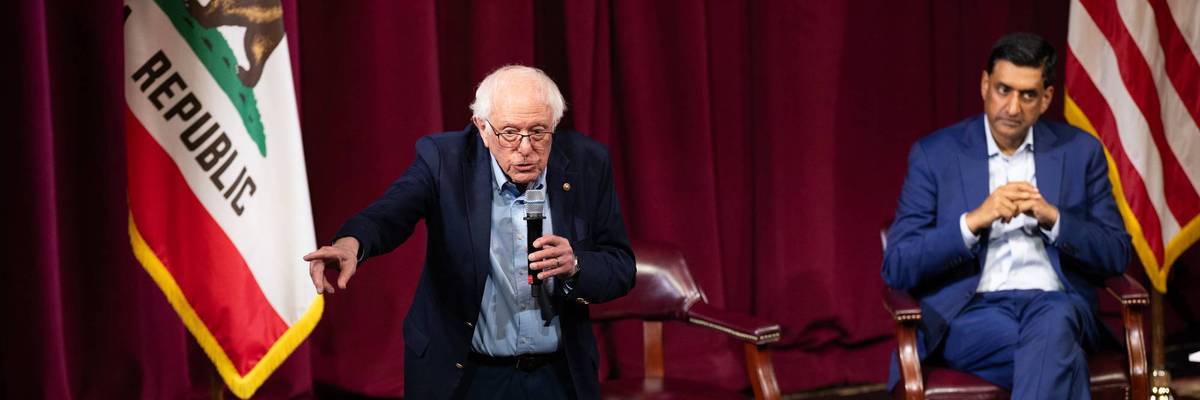
Sen. Bernie Sanders (I-Vt.) speaks next to Rep. Ro Khanna (D-Calif.) at a town hall event on February 20, 2026 in Stanford, California.
"In a democratic society, we cannot tolerate 60% of our people living paycheck to paycheck—struggling to pay for housing, food, and healthcare—while 938 billionaires have become $1.5 trillion richer."
The US economy has reached a breaking point, suggested Sen. Bernie Sanders on Monday as he and Rep. Ro Khanna introduced legislation to force billionaires pay their fair share in taxes.
"We can no longer tolerate a corrupt tax code that enables billionaires to pay a lower tax rate than the average worker," said Sanders (I-Vt.) "In a democratic society, we cannot tolerate 60% of our people living paycheck to paycheck—struggling to pay for housing, food, and healthcare—while 938 billionaires have become $1.5 trillion richer. We cannot continue a trend in which, over the past 50 years, $79 trillion in wealth in our country has been redistributed from the bottom 90% to the top 1%. Enough is enough. Billionaires cannot have it all."
The taxes of fewer than 1,000 people in the US would be impacted by the Make Billionaires Pay Their Fair Share Act, but just a 5% annual wealth tax on those households would be able to raise an estimated $4.4 trillion in revenue over the next decade, said Sanders' office—a fact that underscores the immense wealth of the 938 billionaires who would be targeted by the bill.
Those 938 people have a collective net worth of $8.2 trillion, and Sanders and Khanna (D-Calif.) pointed out how the immense fortunes of some high-profile billionaires would be affected by the bill.
According to the lawmakers, Tesla CEO and President Donald Trump ally Elon Musk, whose $833 billion net worth makes him richer than the bottom 53% of US households, would owe $42 billion in taxes—an unfathomable amount to the vast majority of Americans, but a comparatively tiny tax bill for Musk, who would be left with about $792 billion.
Meta CEO Mark Zuckerberg and Amazon founder Jeff Bezos would each owe just $11 billion compared to their $220 billion and $218 billion net worth.
The wealth of billionaires has risen rapidly in recent years, increasing by about 20% in 2025, according to Americans for Tax Fairness.
“We have a deep economic divide in this country. On one side, places like Silicon Valley are generating extreme wealth. On the other side, families are struggling to cover the cost of healthcare, housing, and basic needs," said Khanna. "We can tax billionaires a modest amount to make sure everyone has a fair chance while keeping our innovative engine. That is why I am proud to join Sen. Bernie Sanders to lead the Make Billionaires Pay Their Fair Share Act."
With the revenue collected from the wealth tax, said Sanders and Khanna, the federal government would:
"Democracies become oligarchies when wealth becomes too concentrated," said the economists. "The US has now reached an unprecedented level of top wealth concentration. US billionaire wealth has exploded in recent years, more than doubling since 2019. A billionaire wealth tax is the most direct policy tool to curb the growing concentration of wealth among the billionaire class in the United States."
"Combining top wealth taxation with policies to rebuild middle class economic security," said Saez and Zucman, "is what the United States needs to ensure vibrant and equitable growth for the future."
As Jeff Stein wrote at the Washington Post, the proposal of a wealth tax—which is supported by roughly two-thirds of Americans, according to polls—could become a litmus test in the 2028 presidential election, in which Khanna has been named as a potential candidate.
California Gov. Gavin Newsom has also been named as a possible Democratic contender and has expressed vehement opposition to a billionaire tax that's been proposed in his state, putting him at odds with about 90% of Democratic voters there and three-quarters of all Californians.
Sanders—who supports the California measure—said that "it is time to enact a wealth tax on billionaires and use this revenue to address some of the major crises facing working families, the children, the elderly, the sick, and the most vulnerable.”
“At a time of unprecedented income and wealth inequality," he said, "this legislation demands that the billionaire class in America finally pay their fair share of taxes so that we can create an economy that works for all of us, not just the 1%."
Dear Common Dreams reader, It’s been nearly 30 years since I co-founded Common Dreams with my late wife, Lina Newhouser. We had the radical notion that journalism should serve the public good, not corporate profits. It was clear to us from the outset what it would take to build such a project. No paid advertisements. No corporate sponsors. No millionaire publisher telling us what to think or do. Many people said we wouldn't last a year, but we proved those doubters wrong. Together with a tremendous team of journalists and dedicated staff, we built an independent media outlet free from the constraints of profits and corporate control. Our mission has always been simple: To inform. To inspire. To ignite change for the common good. Building Common Dreams was not easy. Our survival was never guaranteed. When you take on the most powerful forces—Wall Street greed, fossil fuel industry destruction, Big Tech lobbyists, and uber-rich oligarchs who have spent billions upon billions rigging the economy and democracy in their favor—the only bulwark you have is supporters who believe in your work. But here’s the urgent message from me today. It's never been this bad out there. And it's never been this hard to keep us going. At the very moment Common Dreams is most needed, the threats we face are intensifying. We need your support now more than ever. We don't accept corporate advertising and never will. We don't have a paywall because we don't think people should be blocked from critical news based on their ability to pay. Everything we do is funded by the donations of readers like you. When everyone does the little they can afford, we are strong. But if that support retreats or dries up, so do we. Will you donate now to make sure Common Dreams not only survives but thrives? —Craig Brown, Co-founder |
The US economy has reached a breaking point, suggested Sen. Bernie Sanders on Monday as he and Rep. Ro Khanna introduced legislation to force billionaires pay their fair share in taxes.
"We can no longer tolerate a corrupt tax code that enables billionaires to pay a lower tax rate than the average worker," said Sanders (I-Vt.) "In a democratic society, we cannot tolerate 60% of our people living paycheck to paycheck—struggling to pay for housing, food, and healthcare—while 938 billionaires have become $1.5 trillion richer. We cannot continue a trend in which, over the past 50 years, $79 trillion in wealth in our country has been redistributed from the bottom 90% to the top 1%. Enough is enough. Billionaires cannot have it all."
The taxes of fewer than 1,000 people in the US would be impacted by the Make Billionaires Pay Their Fair Share Act, but just a 5% annual wealth tax on those households would be able to raise an estimated $4.4 trillion in revenue over the next decade, said Sanders' office—a fact that underscores the immense wealth of the 938 billionaires who would be targeted by the bill.
Those 938 people have a collective net worth of $8.2 trillion, and Sanders and Khanna (D-Calif.) pointed out how the immense fortunes of some high-profile billionaires would be affected by the bill.
According to the lawmakers, Tesla CEO and President Donald Trump ally Elon Musk, whose $833 billion net worth makes him richer than the bottom 53% of US households, would owe $42 billion in taxes—an unfathomable amount to the vast majority of Americans, but a comparatively tiny tax bill for Musk, who would be left with about $792 billion.
Meta CEO Mark Zuckerberg and Amazon founder Jeff Bezos would each owe just $11 billion compared to their $220 billion and $218 billion net worth.
The wealth of billionaires has risen rapidly in recent years, increasing by about 20% in 2025, according to Americans for Tax Fairness.
“We have a deep economic divide in this country. On one side, places like Silicon Valley are generating extreme wealth. On the other side, families are struggling to cover the cost of healthcare, housing, and basic needs," said Khanna. "We can tax billionaires a modest amount to make sure everyone has a fair chance while keeping our innovative engine. That is why I am proud to join Sen. Bernie Sanders to lead the Make Billionaires Pay Their Fair Share Act."
With the revenue collected from the wealth tax, said Sanders and Khanna, the federal government would:
"Democracies become oligarchies when wealth becomes too concentrated," said the economists. "The US has now reached an unprecedented level of top wealth concentration. US billionaire wealth has exploded in recent years, more than doubling since 2019. A billionaire wealth tax is the most direct policy tool to curb the growing concentration of wealth among the billionaire class in the United States."
"Combining top wealth taxation with policies to rebuild middle class economic security," said Saez and Zucman, "is what the United States needs to ensure vibrant and equitable growth for the future."
As Jeff Stein wrote at the Washington Post, the proposal of a wealth tax—which is supported by roughly two-thirds of Americans, according to polls—could become a litmus test in the 2028 presidential election, in which Khanna has been named as a potential candidate.
California Gov. Gavin Newsom has also been named as a possible Democratic contender and has expressed vehement opposition to a billionaire tax that's been proposed in his state, putting him at odds with about 90% of Democratic voters there and three-quarters of all Californians.
Sanders—who supports the California measure—said that "it is time to enact a wealth tax on billionaires and use this revenue to address some of the major crises facing working families, the children, the elderly, the sick, and the most vulnerable.”
“At a time of unprecedented income and wealth inequality," he said, "this legislation demands that the billionaire class in America finally pay their fair share of taxes so that we can create an economy that works for all of us, not just the 1%."
The US economy has reached a breaking point, suggested Sen. Bernie Sanders on Monday as he and Rep. Ro Khanna introduced legislation to force billionaires pay their fair share in taxes.
"We can no longer tolerate a corrupt tax code that enables billionaires to pay a lower tax rate than the average worker," said Sanders (I-Vt.) "In a democratic society, we cannot tolerate 60% of our people living paycheck to paycheck—struggling to pay for housing, food, and healthcare—while 938 billionaires have become $1.5 trillion richer. We cannot continue a trend in which, over the past 50 years, $79 trillion in wealth in our country has been redistributed from the bottom 90% to the top 1%. Enough is enough. Billionaires cannot have it all."
The taxes of fewer than 1,000 people in the US would be impacted by the Make Billionaires Pay Their Fair Share Act, but just a 5% annual wealth tax on those households would be able to raise an estimated $4.4 trillion in revenue over the next decade, said Sanders' office—a fact that underscores the immense wealth of the 938 billionaires who would be targeted by the bill.
Those 938 people have a collective net worth of $8.2 trillion, and Sanders and Khanna (D-Calif.) pointed out how the immense fortunes of some high-profile billionaires would be affected by the bill.
According to the lawmakers, Tesla CEO and President Donald Trump ally Elon Musk, whose $833 billion net worth makes him richer than the bottom 53% of US households, would owe $42 billion in taxes—an unfathomable amount to the vast majority of Americans, but a comparatively tiny tax bill for Musk, who would be left with about $792 billion.
Meta CEO Mark Zuckerberg and Amazon founder Jeff Bezos would each owe just $11 billion compared to their $220 billion and $218 billion net worth.
The wealth of billionaires has risen rapidly in recent years, increasing by about 20% in 2025, according to Americans for Tax Fairness.
“We have a deep economic divide in this country. On one side, places like Silicon Valley are generating extreme wealth. On the other side, families are struggling to cover the cost of healthcare, housing, and basic needs," said Khanna. "We can tax billionaires a modest amount to make sure everyone has a fair chance while keeping our innovative engine. That is why I am proud to join Sen. Bernie Sanders to lead the Make Billionaires Pay Their Fair Share Act."
With the revenue collected from the wealth tax, said Sanders and Khanna, the federal government would:
"Democracies become oligarchies when wealth becomes too concentrated," said the economists. "The US has now reached an unprecedented level of top wealth concentration. US billionaire wealth has exploded in recent years, more than doubling since 2019. A billionaire wealth tax is the most direct policy tool to curb the growing concentration of wealth among the billionaire class in the United States."
"Combining top wealth taxation with policies to rebuild middle class economic security," said Saez and Zucman, "is what the United States needs to ensure vibrant and equitable growth for the future."
As Jeff Stein wrote at the Washington Post, the proposal of a wealth tax—which is supported by roughly two-thirds of Americans, according to polls—could become a litmus test in the 2028 presidential election, in which Khanna has been named as a potential candidate.
California Gov. Gavin Newsom has also been named as a possible Democratic contender and has expressed vehement opposition to a billionaire tax that's been proposed in his state, putting him at odds with about 90% of Democratic voters there and three-quarters of all Californians.
Sanders—who supports the California measure—said that "it is time to enact a wealth tax on billionaires and use this revenue to address some of the major crises facing working families, the children, the elderly, the sick, and the most vulnerable.”
“At a time of unprecedented income and wealth inequality," he said, "this legislation demands that the billionaire class in America finally pay their fair share of taxes so that we can create an economy that works for all of us, not just the 1%."