SUBSCRIBE TO OUR FREE NEWSLETTER
Daily news & progressive opinion—funded by the people, not the corporations—delivered straight to your inbox.
5
#000000
#FFFFFF
To donate by check, phone, or other method, see our More Ways to Give page.
Daily news & progressive opinion—funded by the people, not the corporations—delivered straight to your inbox.
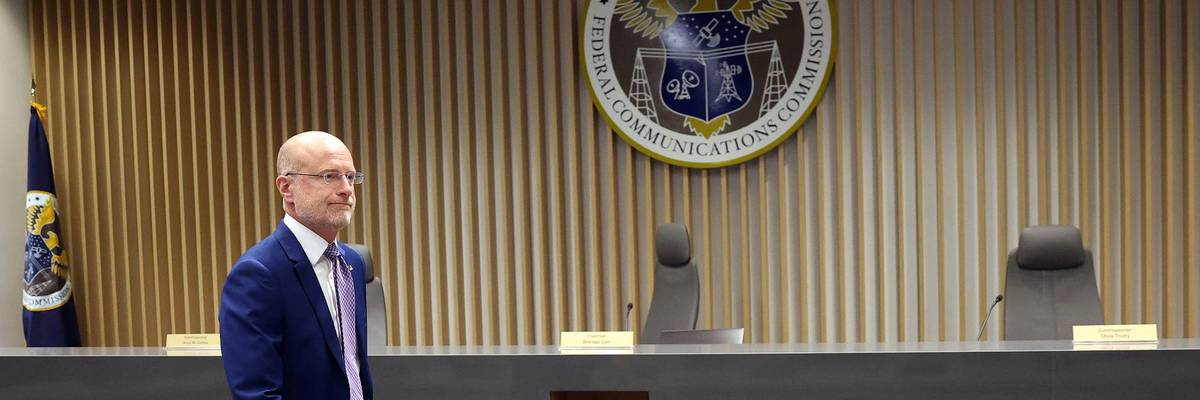
Federal Communications Commission Chair Brendan Carr arrives for a meeting on February 18, 2026 in Washington, DC.
"Full respect for media independence and freedoms is all the more important in such circumstances, as fundamental to holding governments to public account," said Volker Türk.
The United Nations' top human rights official on Tuesday accused a Trump administration agency of attempting to "limit media freedom" by publicly threatening outlets engaged in critical coverage of the Iran war.
Volker Türk, the UN human rights chief, specifically called out the US Federal Communications Commission (FCC) over its chairman's threat last month to pull the broadcast licenses of broadcasters accused by the administration of "news distortions." FCC Chair Brendan Carr issued the threat in response to a March 14 tirade by US President Donald Trump, who baselessly condemned The Wall Street Journal and other media outlets for publishing "intentionally misleading" war coverage.
Türk's mention of the FCC came at the tail-end of a statement decrying the "deepening clampdown on freedom of expression" amid the US-Israeli war on Iran. The UN official pointed to mass arbitrary detentions in Qatar, the United Arab Emirates, the Israeli-occupied Palestinian territories, and Iran, as well as crackdowns on free assembly.
"There have also been attempts to limit media freedom, such as restrictions imposed by Israeli military censorship authorities, and a threat by the US Federal Communications Commission to revoke broadcast licenses for coverage deemed critical of the war," said Türk. "Full respect for media independence and freedoms is all the more important in such circumstances, as fundamental to holding governments to public account. The exercise of such rights must be protected, not threatened."
A day after the FCC chief threatened broadcasters, Trump floated "treason" charges against media outlets he accused of spreading "false information"—something the president does constantly.
Tom Jones, senior media writer at Poynter, wrote earlier this week that "perhaps the most dangerous figure in Trump’s aggression against the press is Brendan Carr," who "made his feelings abundantly clear at the Conservative Political Action Conference in Texas on Friday."
"He bragged about the damage Trump has done to the media," Jones wrote. "Carr told an approving crowd, 'Look at the results so far. PBS, defunded. NPR, defunded. Joy Reid, gone from MSNBC. Sleepy-eyes Chuck Todd, gone. Jim Acosta, gone. John Dickerson, gone. Stephen Colbert is leaving. CBS is under new ownership, and soon enough, CNN is going to have new ownership as well.'"
"Then," Jones added, "he chillingly said, 'So, we’re not at the point yet where we’re raising the mission accomplished flag, but President Trump is taking on the fake news media, and President Trump is winning.'"
Carr's attack on broadcasters over their Iran war coverage led Sen. Ed Markey (D-Mass.) to reiterate his call for the FCC chair's resignation. In a letter to Carr, Markey wrote that the chairman's threat demonstrated his "continued effort to turn the FCC into Trump’s personal speech police."
Carr's threat to pull media outlets' broadcast licenses "follows that same logic but extends it to the coverage of an active military conflict, where the chilling effect on journalists and the damage to the public’s right to know are most severe."
Other Trump administration officials, most notably Pentagon Secretary Pete Hegseth, have vocally complained about press coverage of the illegal Iran war, describing American media outlets as insufficiently "patriotic."
Under Hegseth's leadership, the Pentagon recently ramped up its crackdown on journalists' access to the department following a court ruling against earlier press restrictions. As part of the new crackdown, the Pentagon closed a press area known as Correspondents' Corridor and moved reporters to an unfinished annex in a separate building.
“Closing the Correspondents’ Corridor and forcing escorted access undermines independent reporting at the Pentagon at a moment when the public needs clear, unfiltered information about the US military," said Mark Schoeff Jr., president of the National Press Club. "Independent reporting on the US military is not optional. It is essential to accountability, transparency, and public trust. Any policy that curtails that access should concern everyone who values a free and informed society.”
Dear Common Dreams reader, It’s been nearly 30 years since I co-founded Common Dreams with my late wife, Lina Newhouser. We had the radical notion that journalism should serve the public good, not corporate profits. It was clear to us from the outset what it would take to build such a project. No paid advertisements. No corporate sponsors. No millionaire publisher telling us what to think or do. Many people said we wouldn't last a year, but we proved those doubters wrong. Together with a tremendous team of journalists and dedicated staff, we built an independent media outlet free from the constraints of profits and corporate control. Our mission has always been simple: To inform. To inspire. To ignite change for the common good. Building Common Dreams was not easy. Our survival was never guaranteed. When you take on the most powerful forces—Wall Street greed, fossil fuel industry destruction, Big Tech lobbyists, and uber-rich oligarchs who have spent billions upon billions rigging the economy and democracy in their favor—the only bulwark you have is supporters who believe in your work. But here’s the urgent message from me today. It's never been this bad out there. And it's never been this hard to keep us going. At the very moment Common Dreams is most needed, the threats we face are intensifying. We need your support now more than ever. We don't accept corporate advertising and never will. We don't have a paywall because we don't think people should be blocked from critical news based on their ability to pay. Everything we do is funded by the donations of readers like you. When everyone does the little they can afford, we are strong. But if that support retreats or dries up, so do we. Will you donate now to make sure Common Dreams not only survives but thrives? —Craig Brown, Co-founder |
The United Nations' top human rights official on Tuesday accused a Trump administration agency of attempting to "limit media freedom" by publicly threatening outlets engaged in critical coverage of the Iran war.
Volker Türk, the UN human rights chief, specifically called out the US Federal Communications Commission (FCC) over its chairman's threat last month to pull the broadcast licenses of broadcasters accused by the administration of "news distortions." FCC Chair Brendan Carr issued the threat in response to a March 14 tirade by US President Donald Trump, who baselessly condemned The Wall Street Journal and other media outlets for publishing "intentionally misleading" war coverage.
Türk's mention of the FCC came at the tail-end of a statement decrying the "deepening clampdown on freedom of expression" amid the US-Israeli war on Iran. The UN official pointed to mass arbitrary detentions in Qatar, the United Arab Emirates, the Israeli-occupied Palestinian territories, and Iran, as well as crackdowns on free assembly.
"There have also been attempts to limit media freedom, such as restrictions imposed by Israeli military censorship authorities, and a threat by the US Federal Communications Commission to revoke broadcast licenses for coverage deemed critical of the war," said Türk. "Full respect for media independence and freedoms is all the more important in such circumstances, as fundamental to holding governments to public account. The exercise of such rights must be protected, not threatened."
A day after the FCC chief threatened broadcasters, Trump floated "treason" charges against media outlets he accused of spreading "false information"—something the president does constantly.
Tom Jones, senior media writer at Poynter, wrote earlier this week that "perhaps the most dangerous figure in Trump’s aggression against the press is Brendan Carr," who "made his feelings abundantly clear at the Conservative Political Action Conference in Texas on Friday."
"He bragged about the damage Trump has done to the media," Jones wrote. "Carr told an approving crowd, 'Look at the results so far. PBS, defunded. NPR, defunded. Joy Reid, gone from MSNBC. Sleepy-eyes Chuck Todd, gone. Jim Acosta, gone. John Dickerson, gone. Stephen Colbert is leaving. CBS is under new ownership, and soon enough, CNN is going to have new ownership as well.'"
"Then," Jones added, "he chillingly said, 'So, we’re not at the point yet where we’re raising the mission accomplished flag, but President Trump is taking on the fake news media, and President Trump is winning.'"
Carr's attack on broadcasters over their Iran war coverage led Sen. Ed Markey (D-Mass.) to reiterate his call for the FCC chair's resignation. In a letter to Carr, Markey wrote that the chairman's threat demonstrated his "continued effort to turn the FCC into Trump’s personal speech police."
Carr's threat to pull media outlets' broadcast licenses "follows that same logic but extends it to the coverage of an active military conflict, where the chilling effect on journalists and the damage to the public’s right to know are most severe."
Other Trump administration officials, most notably Pentagon Secretary Pete Hegseth, have vocally complained about press coverage of the illegal Iran war, describing American media outlets as insufficiently "patriotic."
Under Hegseth's leadership, the Pentagon recently ramped up its crackdown on journalists' access to the department following a court ruling against earlier press restrictions. As part of the new crackdown, the Pentagon closed a press area known as Correspondents' Corridor and moved reporters to an unfinished annex in a separate building.
“Closing the Correspondents’ Corridor and forcing escorted access undermines independent reporting at the Pentagon at a moment when the public needs clear, unfiltered information about the US military," said Mark Schoeff Jr., president of the National Press Club. "Independent reporting on the US military is not optional. It is essential to accountability, transparency, and public trust. Any policy that curtails that access should concern everyone who values a free and informed society.”
The United Nations' top human rights official on Tuesday accused a Trump administration agency of attempting to "limit media freedom" by publicly threatening outlets engaged in critical coverage of the Iran war.
Volker Türk, the UN human rights chief, specifically called out the US Federal Communications Commission (FCC) over its chairman's threat last month to pull the broadcast licenses of broadcasters accused by the administration of "news distortions." FCC Chair Brendan Carr issued the threat in response to a March 14 tirade by US President Donald Trump, who baselessly condemned The Wall Street Journal and other media outlets for publishing "intentionally misleading" war coverage.
Türk's mention of the FCC came at the tail-end of a statement decrying the "deepening clampdown on freedom of expression" amid the US-Israeli war on Iran. The UN official pointed to mass arbitrary detentions in Qatar, the United Arab Emirates, the Israeli-occupied Palestinian territories, and Iran, as well as crackdowns on free assembly.
"There have also been attempts to limit media freedom, such as restrictions imposed by Israeli military censorship authorities, and a threat by the US Federal Communications Commission to revoke broadcast licenses for coverage deemed critical of the war," said Türk. "Full respect for media independence and freedoms is all the more important in such circumstances, as fundamental to holding governments to public account. The exercise of such rights must be protected, not threatened."
A day after the FCC chief threatened broadcasters, Trump floated "treason" charges against media outlets he accused of spreading "false information"—something the president does constantly.
Tom Jones, senior media writer at Poynter, wrote earlier this week that "perhaps the most dangerous figure in Trump’s aggression against the press is Brendan Carr," who "made his feelings abundantly clear at the Conservative Political Action Conference in Texas on Friday."
"He bragged about the damage Trump has done to the media," Jones wrote. "Carr told an approving crowd, 'Look at the results so far. PBS, defunded. NPR, defunded. Joy Reid, gone from MSNBC. Sleepy-eyes Chuck Todd, gone. Jim Acosta, gone. John Dickerson, gone. Stephen Colbert is leaving. CBS is under new ownership, and soon enough, CNN is going to have new ownership as well.'"
"Then," Jones added, "he chillingly said, 'So, we’re not at the point yet where we’re raising the mission accomplished flag, but President Trump is taking on the fake news media, and President Trump is winning.'"
Carr's attack on broadcasters over their Iran war coverage led Sen. Ed Markey (D-Mass.) to reiterate his call for the FCC chair's resignation. In a letter to Carr, Markey wrote that the chairman's threat demonstrated his "continued effort to turn the FCC into Trump’s personal speech police."
Carr's threat to pull media outlets' broadcast licenses "follows that same logic but extends it to the coverage of an active military conflict, where the chilling effect on journalists and the damage to the public’s right to know are most severe."
Other Trump administration officials, most notably Pentagon Secretary Pete Hegseth, have vocally complained about press coverage of the illegal Iran war, describing American media outlets as insufficiently "patriotic."
Under Hegseth's leadership, the Pentagon recently ramped up its crackdown on journalists' access to the department following a court ruling against earlier press restrictions. As part of the new crackdown, the Pentagon closed a press area known as Correspondents' Corridor and moved reporters to an unfinished annex in a separate building.
“Closing the Correspondents’ Corridor and forcing escorted access undermines independent reporting at the Pentagon at a moment when the public needs clear, unfiltered information about the US military," said Mark Schoeff Jr., president of the National Press Club. "Independent reporting on the US military is not optional. It is essential to accountability, transparency, and public trust. Any policy that curtails that access should concern everyone who values a free and informed society.”