SUBSCRIBE TO OUR FREE NEWSLETTER
Daily news & progressive opinion—funded by the people, not the corporations—delivered straight to your inbox.
5
#000000
#FFFFFF
To donate by check, phone, or other method, see our More Ways to Give page.
Daily news & progressive opinion—funded by the people, not the corporations—delivered straight to your inbox.
Instead of sharing video after someone is killed by police, it’s time to prioritize preventative measures.
When Black street performer Jordan Neely was murdered on a New York subway, four minutes of video by a freelance journalist captured the event, prompting last week’s protests and a nationwide outcry. This is part of an ongoing flood of video documenting violence against Black bodies.
This month alone, body cam video showed Alabama police sending a police dog after an unarmed Black man and Minnesota officers mistakenly attacking a 65-year-old Black man using a walker (after the video had been suppressed for three years). Also, San Francisco supervisors unanimously passed a resolution demanding the release of video footage of the killing of Banko Brown, a 24-year-old Black transgender man killed in late April.
Thanks to technology, cameras are now ubiquitous tools that save lives and hold the perpetrators of state-sanctioned violence accountable, but I see a sinister effect in motion as well. It’s no coincidence that when the video of Tyre Nichols’ murder was released in January, my Facebook timeline included trigger warnings. These images stay with us, and have an insidious impact. Who can forget the haunting footage of former Minneapolis police officer Derek Chauvin murdering George Floyd on the sidewalk in plain sight in May 2020?
When these murders do occur, society should be more mindful about sharing the resulting footage and shaping the public narrative.
The frequency of publicized police violence on social media, television, and in print is desensitizing us to violent acts against Black bodies, fueling an obsession with Black trauma porn. The infatuation with Black trauma porn has real consequences for real people. It can lead to further deaths by police as their workforce becomes more desensitized to unpenalized and incentivized violence.
Instead of sharing video after someone is killed by police, it’s time to prioritize preventative measures.
First, alternatives to calling 911 should be made more widely available. Mental health crises or Black BBQ-ers are not situations that require police to respond. When they do, this can lead to unnecessarily hostile contact with police and unintended deaths.
Additionally, the police force should come from or look like the communities they represent. To be sure, racial and ethnic commonalities did not protect Mr. Nichols at all. However, the foundation of Memphis law enforcement is rooted in anti-Blackness that affects Black officers too.
Statistically, White men are less than one-third of the U.S. population but represent two-thirds of the police force. Yet, countless studies show that diverse workforces are safer. For instance, economist Bocar Ba and colleagues found that Black officers made 15.16 fewer stops and 1.93 fewer arrests than their White counterparts over 100 shifts. This behavior resulted in a 32% reduction in use of force among Black officers compared to White officers. Less force leads to fewer deaths.
There should also be a SWOT analysis (a type of program assessment that identifies strengths, weaknesses, opportunities and threats) for existing implicit bias training for police officers, as little research exists proving its efficacy. A study of the NYPD by criminal justice professor Robert Worden and colleagues shows that while implicit bias training does impact attitude, it doesn’t always change behavior. Implicit bias training for their department showed no significant reduction in the frisks in stops, summonses, and arrests involving Black and Hispanic people after police were trained.
Lastly, there needs to be frequent and equitable internal and external review of any police misconduct allegations. Police officers are supposed to serve and protect the public and should be held to the highest scrutiny when they unnecessarily kill citizens instead.
When these murders do occur, society should be more mindful about sharing the resulting footage and shaping the public narrative. The Black community suffers from the harmful tropes resulting from narratives that are not our own. The public witnesses these narratives and internalizes harmful tropes that lead to us being even more discriminated against and stereotyped.
Headlines depicting White mass murders read more like their dating app profiles than a description of their gruesome crimes. Meanwhile, Black perpetrators of petty crimes are shown by their mugshot. This has to stop.
Sending thoughts and prayers to mourning families on the receiving end of society’s obsession with Black trauma porn is not enough—and it’s not fair. Implementing policies and practices that create an anti-discriminatory system with accessible 911 alternatives is the most effective and genuine response.
The death rate of marginalized peoples at the hands of police is a public health crisis. In the last 12 months, police have killed over 1,100 people, with a disproportionate number of deaths being Black or Brown people.
Police departments, judicial systems, and infrastructure are all needed to fight this ugly reality and uphold the responsibility to build a diverse, well-trained police force that doesn’t contribute so heavily to Black trauma porn and holds its members accountable.
FAIR studies of New York Times coverage from George Floyd to Tyre Nichols.
Since the brutal police killing of George Floyd in Minneapolis in 2020, and the Black Lives Matter protests that spread across the country, how have news media covered issues of policing policy and police reform?
To offer perspective on this question, FAIR looked at which kinds of sources have been most prominent in the New York Times‘ coverage of these issues, and therefore are given the most power to shape the narrative. We compared three time periods: June 2020, when the BLM protests were at their height; May–June 2022, leading up to and encompassing the two-year anniversary of those protests; and mid-January to mid-February 2023, when the police killing of Tyre Nichols was prominent in news coverage and reignited conversations around police reform.
We found that, overall, the Times leaned most heavily on official (government and law enforcement) sources when reporting on the issue of policing policy—giving the biggest platform to the targets of reform, rather than the people who would most benefit from it. We also found a prominent stress on party politics and a lack of racial and gender diversity among sources.
However, we also found that the Times‘ 2023 Tyre Nichols coverage offered a wider diversity of sources, and a greater percentage of Black sources, than in the previous time periods. This appeared to result in part from many of the articles focusing on deeper reporting on the local situation in Memphis, a majority-Black city (unlike, for instance, Minneapolis, where George Floyd was killed).
In contrast, the 2022 articles focused more on policing and crime as an election topic at a national level. The 2020 articles covered the broadest range of issues and geography, but with particular attention to the protests, and the federal and local legislative responses.
The most recent coverage had more voices critical of policing policy and practices than in the previous study periods—though, at the same time, those voices came less from protests on the streets and more from advocacy groups, lawyers, academics, religious leaders and general public sources, and so shifted from the raw anger and “defund the police” demands of 2020 to less radical accountability measures.
Eliminating passing mentions and opinion pieces, we examined New York Times news articles centrally about policing policy or reform. We found 10 articles (with 58 sources) meeting our criteria between May 1 and June 30, 2022, and 16 articles (111 sources) between January 13 and February 10, 2023 (two weeks before and after the main day of the Tyre Nichols protests). Because the Times covered the issue so extensively in 2020, we took a random sample of 25 articles (142 sources) meeting our criteria from June 2020.
Sources were coded for occupation, gender, race/ethnicity and party affiliation (for government officials and politicians). Each source could receive more than one code for occupation (e.g., academic and former law enforcement) and race/ethnicity (e.g., Black and Asian American).
The movement to protest racist policing has been led primarily by Black activists, many of them women. It is a movement fundamentally about race, racism and white supremacy. Yet white sources handily outnumbered Black sources in coverage of police reform in two of the three periods studied, and men outnumbered women by roughly three-to-one in all three.
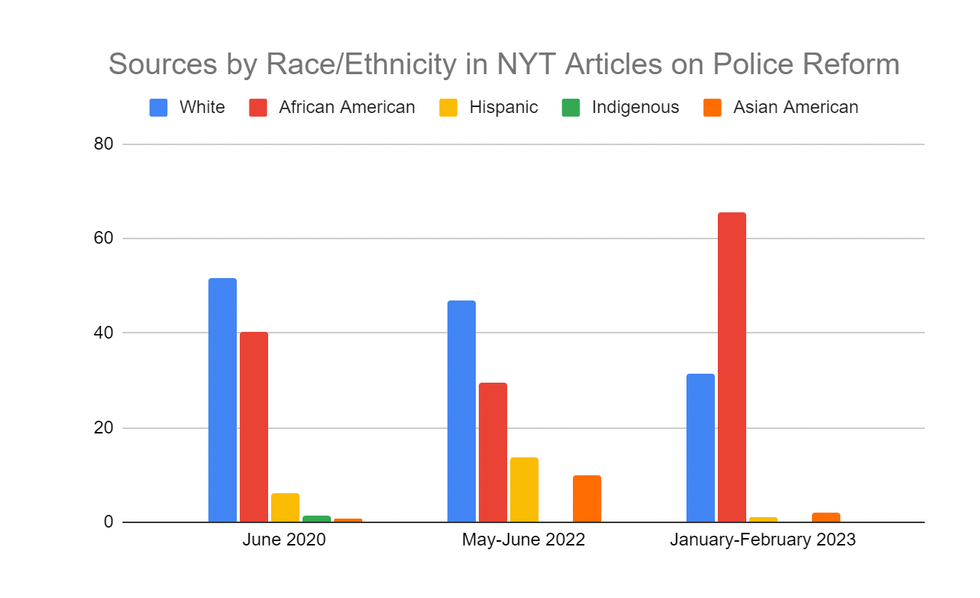
Of sources whose race could be identified, 52% were white and 40% Black in the 2020 data. In the 2022 data, white sources decreased slightly, but dominated Black sources by an even greater margin: 48% to 30%.
In the 2023 data, that trend reversed, and Black sources reached 66%, while white sources dropped to 31%.
One thing that didn’t change across the time periods was the New York Times‘ reliance on male sources: Men were 72% of sources with an identifiable gender in 2020, 74% in 2022 and 76% in 2023.
Policing is not a strictly Black-and-white issue, of course, and the coverage played out against the backdrop of rising xenophobia and anti-Asian hate resulting from the ongoing Covid-19 pandemic, with many using rising bias crimes against people perceived as Asian as an excuse to increase policing. Yet such voices were largely excluded from the conversation at the Times.
In 2020, 6% of sources were Hispanic and 2% were Indigenous; 1% were Asian-American and none were of Middle Eastern descent. In 2022, Times sources expanded a bit from the racial binary, with 14% Hispanic sources and 10% Asian-American. (No Indigenous sources or sources of Middle Eastern descent were quoted in 2022.) In 2023, that diversity disappeared, and of the 99 sources with identifiable race/ethnicity, only 2% were of Asian descent and 1% were Hispanic; none were of Indigenous or Middle Eastern descent.
The bias toward white and male sources—and the decrease in white sources in 2023—can be explained partly by the New York Times‘ bias toward government and law enforcement sources, both of which are disproportionately white, male fields.
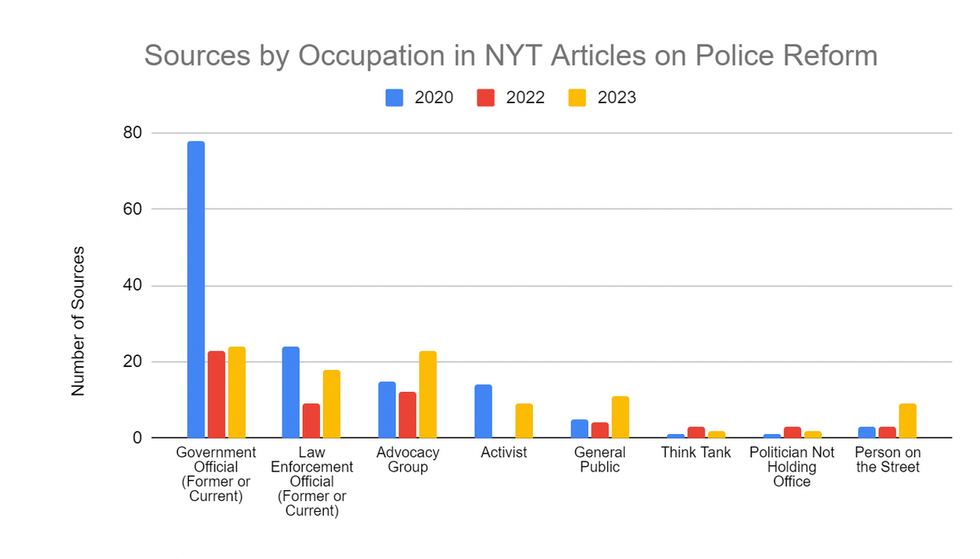
In June 2020, a majority of all sources (55%) were current or former government officials—not including law enforcement, which formed the second-largest share of sources quoted, at 17%. Two years later, government sources had dropped to 40%, while law enforcement stayed roughly the same, at 16%; politicians running for office increased from less than 1% of 2020 sources to 5% of 2022 sources. In 2023, government sources dropped yet again, to only 22% of sources, and law enforcement remained steady at 16%.
Meanwhile, activists (protesters or organizers) accounted for 10% of 2020 sources, and representatives of professional advocacy groups accounted for 11%. In 2022, when street protests were relatively much smaller compared to 2020, activist voices were missing entirely, and professional advocate sources—such as the president of the NAACP and the director of Smart Justice California—increased to 21%. In 2023, the total across these two groups increased, with advocates accounting for 21% of sources and activists for 9%, and a greater number of non-governmental sources such as lawyers, academics and religious leaders appeared than in the previous time periods.
Combined, more than 7 in 10 of all sources quoted in 2020, more than 5 in 10 in 2022, and nearly 4 in 10 in 2023 were the government and law enforcement officials the protests sought to hold accountable. Only about 2 in 10 in 2020 and 2022, and 3 in 10 in 2023, were civil society members protesting or advocating for (or, in some cases, against) reform.
The proportion of white sources in these stories was high among law-enforcement sources (54% in 2020, 67% in 2022, 56% in 2023) and, less uniformly, among government sources (54% in 2020, 39% in 2022, 33% in 2023). Black sources were represented most among activists (79% in 2020, 89% in 2023) and advocates (20% in 2020, 58% in 2022, 52% in 2023).
In 2020 and 2022, women were likewise better represented among activists and advocates than among government and law enforcement sources. In 2020, 47% of advocate sources and 36% of activist sources were female, as compared to 22% of government and 17% of law enforcement sources. In 2022, 50% of advocates were female, compared to 13% of government and 22% of law enforcement sources.
In 2023, however, female government sources rose to 38%, a higher proportion of women in that year than among advocates (17%) or activists (29%). (Law enforcement sources continued to be a low 17% women.)
The increases in racial and ethnic diversity from 2020 to 2022 came largely within government sources, with officials quoted including the Black mayor of New York City, Eric Adams; Asian-American House representatives Pramila Jayapal and Ro Khanna; and Hispanic legislators Rep. Alexandria Ocasio-Cortez and Sen. Ted Cruz.
This diversification of government sources happened along with a shift in partisanship of sources: While Democrats dominated the conversation in 2020, with 51 sources to Republicans’ 25, Republicans were almost entirely absent in 2022, with a single source (Cruz) to Democrats’ 25. The absence of Republican sources continued in 2023, when 18 of 20 sources with party affiliations were Democrats, and one was an independent.
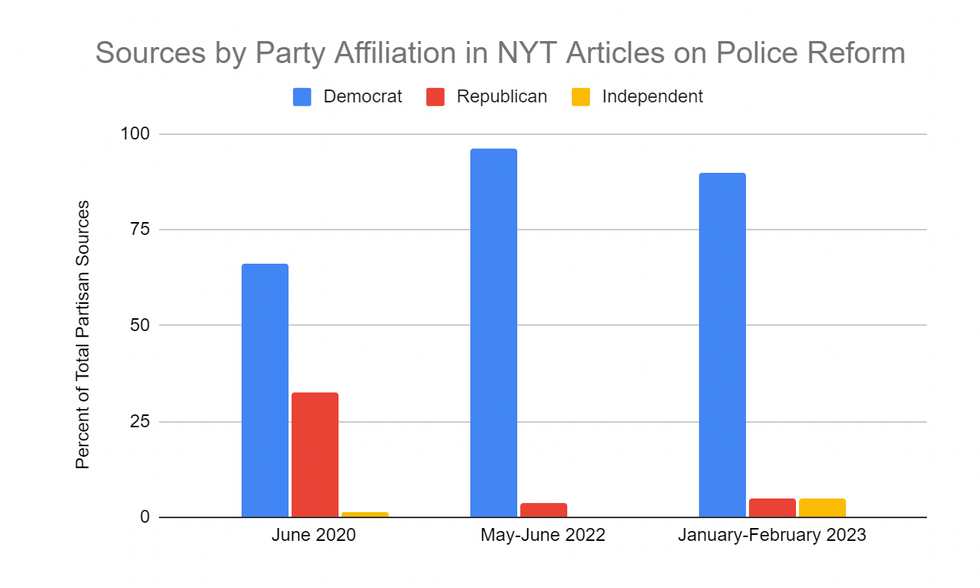
This near-total absence of Republicans from the conversation reflects in part the switch in power at the national level; Republicans controlled both the White House and Senate in 2020, and both had flipped to the Democrats by 2022. It also reflects the reality that the massive nature of the protests forced Republicans to address the issue of police reform in 2020, but they were no longer talking about it much in 2022—nor were outlets like the New York Times forcing them to.
The striking shift in the race of sources in the 2023 time period is not only about the decrease in government sources; it appears to be partly due to the focus on Memphis, where nearly two-thirds of residents and more than half of the police force (including its police chief, and all five of the officers charged with the murder of Nichols) are Black.
In one front-page article (2/5/23) that focused on the “Scorpion” unit that killed Tyre Nichols, headlined “Memphis Unit Driven by Fists and Violence,” a team of six Times reporters quoted 15 different sources, eight of whom were either victims of the unit or family members of victims; all victims and family members were Black. (These were coded as “General Public”: people without a particular professional or activist affiliation, but with experience relevant to the subject they are speaking on.) Only three of the total sources were government officials, and none were law enforcement.
Some articles not exclusively about the Nichols killing still focused on race. “Officers’ Race Turns Focus to System” (1/29/23) featured 14 sources across an array of nine different types of occupations; none were current or former government, and 11 were Black.
The focus on the Tyre Nichols killing also translated at the Times into more of a focus on police accountability, compared with coverage that did not center on police killings. In the absence of a police killing, an article (1/27/23) focused on policing policy appeared under the print-edition headline, “Heavier Police Presence Sees Success as Crime Drops in New York Subways.” It featured four New York government officials, two of whom touted increased policing. Only one advocate questioned those officials, calling for more frequent subway and bus service as an alternative form of public safety. The headline reflects whose narrative was given more credence by the Times.
That such an article so credulous of increased policing, and so light on critical sources, could appear against the backdrop of the Tyre Nichols story illustrates the blinkered nature of the Times‘ improved coverage. While high-profile incidents of police violence might narrowly prompt more critical coverage, systemic shifts in reporting face an uphill battle against corporate media’s longstanding reliance on and trust in government and law enforcement sources to establish the narrative on policing.
In 2020, when protests against police violence erupted across the country, the New York Times covered issues of policing policy and reform with a heavy tilt toward government and law-enforcement sources, and toward white sources.
Activists voicing their grievances against racist, violent policing, and making demands that such policing be rethought in more radical ways, occasionally found their way into the paper of record. Black Futures Lab’s Alicia Garza, for example, was quoted by the Times (6/21/20): “The continual push to shield the police from responsibility helps explain why a lot of people feel now that the police can’t be reformed.”
But their voices were largely drowned out by government officials, many of whom wanted nothing more than to make the protests go away, like Minneapolis city council member Steve Fletcher (6/5/20):
It’s very easy as an activist to call for the abolishment of the police. It is a heavier decision when you realize that it’s your constituents that are going to be the victims of crime you can’t respond to if you dismantle that without an alternative.
In letting government sources dominate again in 2022, Times coverage turned primarily to party politics, rather than investigations into whether reforms had been enacted, and whether or how police tactics had changed. The idea of defunding the police shifted from being presented as a concept to be debated to little more than a political punching bag, with law enforcement sources like former New York police commissioner Bill Bratton (6/9/22) calling the Defund movement “toxic.” Most Democrats distanced themselves from the movement, as when Joe Biden (5/31/22) was quoted: “We should all agree the answer is not to defund the police. It’s to fund the police. Fund them. Fund them.”
When Tyre Nichols was killed by police in 2023, it was not against a backdrop of an election season, nor did it spark protests at the scale of 2020. This time, Times coverage dug a bit deeper at the local level, turning to a wider variety of sources, and resulting in a greater emphasis on the need for police accountability.
While at least one source (1/29/23) called for defunding the police, most critical voices called more generally for accountability, and expressed frustration at the lack of any effective reforms since 2020. For instance, in an article headlined “Many Efforts at Police Reform Remain Stalled” (2/9/23), the president of the NAACP was quoted: “Far too many Black people have lost their lives due to police violence, and yet I cannot name a single law that has been passed to address this issue.”
The shift to a more diverse set of sources on the issue at the Times, during this one-month time period, is commendable. While the circumstances and location of Tyre Nichols’ killing offered strong opportunities to bring in more Black sources, the Times could easily have fallen back on its usual reliance on official sources, as it did in 2020 and 2022. Now it’s incumbent upon the Times to apply that more diverse and critical approach across all policing stories—not only when similarly high-profile police killings rock the country.
Beware the scorpions.
To residents of Memphis’s resource-poor, predominantly nonwhite neighborhoods, the Scorpions were easy to spot. The plainclothes patrols were known for driving their unmarked Dodge Chargers through the streets, often all too recklessly, sowing fear as they went, spitting venom from their windows, jumping out with guns drawn at the slightest sign of an infraction.
On the night of January 7th, Tyre Nichols was two minutes from home when members of that squad pulled him over. Probable cause: reckless driving (if you believe the official story). Five Scorpions, all of them trained use-of-force specialists, proceeded to take turns hitting him with everything they had, including boots, fists, and telescopic batons.
The 29-year-old photographer died three days later. Cause of death? “Excessive bleeding due to severe beating.” A body-cam snuff film of sorts was later released, showing some of Nichols’s last moments. The video transcripts speak for themselves.
Officer to Tyre:
“You’re gonna get your ass blown the fuck up. Oh, I’m gonna knock your ass the fuck out!”
Tyre to officers:
“OK. You guys are really doing a lot right now…”
— “Lay down!”
— “Stop! I’m just trying to go home.”
— “Spray him! Spray him!”
— “Stop! I’m not doing anything.”
— “Tase him! Tase him!”
Tyre cries out:
“Mom! Mom!”
Officer to Tyre:
“Watch out! I’m gonna baton the fuck out of you!”
— “Dude, hit him!”
— “Hit him!”
— “Hit him!”
— “Mom…”
Plainclothes Paramilitaries
Welcome to America’s emerging predator state.
Memphis is anything but an outlier. There are thousands of “elite” teams like that city’s Scorpion unit and they come in all calibers, shapes, and sizes. They range from specially trained teams in small-town police departments to sprawling “anti-crime” squads in big cities like Atlanta and New York, not to mention federal tactical units like the Border Patrol’s BORTAC and counter-terrorism task forces like the one that killed Manuel Terán in Georgia last month.
Beyond the scary names, such specialized units tend to share some other characteristics. In their warlike tactics, their strategic outlook, and their often-violent subculture — if not always in their uniforms — they are virtually indistinguishable from their counterparts in the military. In their “wars” on crime, drugs, and terror, they work with a similar playbook imported from U.S. combat missions overseas but seemingly stripped of any reference to the rules of war.
They conduct themselves, in other words, as plainclothes paramilitaries in America’s urban war zones (or what they like to call “hot spots”). Like Army Special Operations forces, they are regularly charged with the execution of “time-sensitive,” “clandestine,” and often “unilateral” missions — with or without the support of the local population — using “assurance, deterrence, and coercion” to fight the enemies of the state and exert control over “hostile, denied, or politically sensitive environments.”
What’s more, these units operate with a legal guarantee of “qualified immunity” for violence against civilians. In other words, despite the recent Memphis exception, they normally have near-total impunity when it comes to violent offenses which, had they been committed in another country, might be classified as war crimes, crimes of aggression, or even crimes against humanity.
For offenses of this nature, the United States is itself an international hot spot. In the course of a given year, according to one recent study, our law enforcement agencies were responsible for 13% of all fatalities caused by the police globally, even though Americans make up just 4% of the world’s population. And as investigative journalism has revealed, specialized units like the Scorpions are responsible for a wildly disproportionate share of those deaths.
Take the New York City Police Department. Since 2000, its own use-of-force reports show that nearly one in three police killings have been by non-uniformed officers, especially “anti-crime” plainclothes units with paramilitary training and a long-standing reputation for terrorizing communities of color.
Nearly a decade before the slaying of Tyre Nichols, there was, for instance, the murder of Eric Garner, a 43-year-old street vendor, “neighborhood peacekeeper,” and father of six. His life was snuffed out thanks to a police chokehold after he was stopped for selling “loosies,” unlicensed cigarettes, on a Staten Island street corner in the summer of 2014. (In the end, the only person to serve jail time in Garner’s death was the young filmmaker of color who had the courage to record the encounter.)
Like the officers in the South Bronx who gunned down Amadou Diallo outside his home as he reached for his wallet, the ones in Queens who sprayed Sean Bell with 50 bullets on his wedding day, and the ones in Brooklyn who opened fire on a mentally ill man named Saheed Vassell in 2018, those responsible for Garner’s murder were members of the infamous “anti-crime” units whose work would become a blueprint for Scorpion-style policing.
The force’s predatory philosophy is often summed up in a single sentence lifted from Ernest Hemingway’s 1936 (satirical) short story, “On the Blue Water.” Officers of the peace have been known to quote it, to wear it to work, and to plaster it on the walls of their precincts: “There is no hunting like the hunting of man, and those who have hunted armed men long enough and liked it, never care for anything else thereafter.”
In the words of one New Yorker, a nurse from Crown Heights who witnessed the killing of Vassell, “The undercovers think they have the authority to do anything they want. They hunt [people] — like us black people — down… They act tough… like they’re from a gang. But they’re only like that because they have a badge.”
A History of Violence Against Women
In December 2019, the city of Louisville, Kentucky, rolled out its version of the Scorpion unit. It was labeled the Place-Based Investigations Squad (PBI) and put under the aegis of its police department’s Criminal Interdiction Division.
Following paid consultations with “problem-oriented” academics and police executives from other cities, the Louisville Metropolitan department implemented a then-little-known practice called “Place-Based Investigations of Violent Offender Territories,” or PIVOT. In the end, this would prove but a variation on an already all-too-familiar theme of hot-spot policing first pioneered by “police scientists” in Minneapolis some 30 years before George Floyd’s murder. (In fact, the use of the term “hot spots” can be traced back to the early years of World War II.)
Under this model, police assets were to be specially directed toward a handful of hot spots or “chronically violent urban locations.” That such places were home to populations of disproportionately Black, Indigenous, and immigrant Americans will no longer shock anyone; nor that they overlapped strikingly with areas of concentrated impoverishment and “planned abandonment”; nor that an influx of heavily armed strangers was undoubtedly the last thing such communities needed from the government. All of this was beside the point. The “marginal deterrent effect” — the minimal difference such hot-spot policing purportedly made in the calculations of would-be criminals — was enough to keep most critics quiet.
Three months after the rollout, the Place-Based Investigations Squad would play an integral part in the police raid that took the life of Breonna Taylor, a 26-year-old Black woman and emergency-room technician at the University of Louisville, accused of no crime, but executed anyway by three Louisville police officers standing in the hallway of her own home. Officers from the PBI Squad had requested and obtained five search warrants with “no-knock” clauses, including one for Ms. Taylor, acting on what one would later call a “gut feeling.”
Within moments of the officers’ arrival at her apartment on the night of March 13, 2020, Breonna Taylor lay dying, felled by six of 32 shots fired into her home. It would be 20 minutes before she even received medical attention — 15 minutes too late to save her life. Although four officers have now been federally charged for civil rights violations, and three stand accused of lying on the affidavit they used to secure the warrants, a grand jury ultimately failed to return a single indictment for the officers who opened fire.
That night in 2020, Ms. Taylor joined a long litany of Black women, robbed of their lives while simply trying to live them by those supposedly tasked with their protection. According to the latest count, some 280 women have been slain in encounters with law enforcement over just the past five years. Researchers have found that women made up nearly half of all police-initiated contacts and Black women were three times more likely than white ones to experience the use of force during a police-initiated stop.
“Elite” police units have played an outsized role in such state-sanctioned femicides.
Take the case of India Kager, 27, a Navy vet killed by a tactical team in Virginia Beach in 2015, as she sat in her car with her four-month-old baby in the back. Or consider Atlanta’s RED DOG (short for “Run Every Drug Dealer Out of Georgia”) Unit. On November 21, 2006, plainclothes officers from that narcotics squad — having lied under oath to obtain a no-knock warrant — barged into the home of Kathryn Johnston, a 92-year-old grandmother, and promptly gunned her down. Drugs were then planted near her body in a sorry attempt at a cover-up.
Disbanded or Rebranded?
We’ve been here before: Officers are charged with second-degree murder. Sweeping reforms are promised. Controversial units are “deactivated,” their officers reassigned to other bureaus.
We saw this with the Amadou Diallo protests and the New York Police Department’s Street Crimes Unit in the early 2000s. We saw it with Atlanta’s RED DOGs after the killing of Kathryn Johnston. We saw it with Louisville’s PBI Squad in the months following the murder of Breonna Taylor — and we’re seeing it now in the aftermath of the assault on Tyre Nichols.
Count on this, however: as time passes and attention subsides, reforms are abandoned, charges are dropped, or the defendants found not guilty by juries of their peers. And special ops teams are rebranded and brought back to life under different names.
Today, Atlanta’s “Titans” have replaced the “RED DOGs” of old, while the very police executive who ran the old unit, Cerelyn “CJ” Davis, was made commissioner of the Memphis police department. The city of Memphis has also sought guidance from Ray Kelly, who was New York police commissioner during a particularly trigger-happy period in that department’s history (including the deaths of Sean Bell, Ousmane Zongo, Timothy Stansbury, Ramarley Graham, and Kimani Gray).
Meanwhile, New York City Mayor Eric Adams, himself a veteran of a plainclothes police unit, is touting his “Neighborhood Safety Teams” (along with another elite strike force inherited from his predecessors, the “Strategic Response Group”) as the basis for a whole new approach to policing. In truth, they are simply picking up where the Street Crimes Unit left off. The only real differences: longer guns, modified uniforms, and body cameras that can be turned on or off at will.
The names change, but the strategy (such as it is) remains the same and the body counts only climb higher.
“Collateral Damage” and the War at Home
Yet such police killings are not truly local matters. The final piece of the puzzle is the national security state, itself a predatory entity and the source of much of the surplus that supplies the police with significant military-grade weaponry and the bipartisan consensus that keeps the dollars flowing.
Local police agencies would not have anything like the arsenals they have today — ones that would be the envy of many of the world’s militaries — without the largesse of the Pentagon’s popular 1033 program. For years, it has been arming police departments around the country in a distinctly military fashion, sometimes even with weapons directly off the battlefields of this country’s distant wars. Thanks to that program, the Memphis police department has managed to obtain a significant stockpile of high-powered rifles and multiple armored personnel carriers, while the State of Tennessee alone has received $131 million worth of weaponry from the Department of Defense.
Meanwhile, paving new ground, the Special Operations Bureau of the San Francisco Police Department has procured unmanned, remotely piloted killer robots with names like TALON and DRAGON RUNNER. It is now advertising its intent to use them as a “deadly force option” in criminal apprehensions and other incidents like “riots, insurrection, or potentially violent demonstrations.”
None of this would be possible without the support of politicians from both parties. The 2023 budget agreed upon by both parties, for instance, promises $37 billion in new spending on law enforcement — with double-digit percentage increases in discretionary funding for local police departments, above and beyond the nearly $1 trillion for the Departments of Defense and Homeland Security. As a “moral statement,” that document bears a striking resemblance to its predecessors, backing the blue with billions of public tax dollars, while bearing witness to the priorities of a government on the warpath against enemies domestic and foreign.
Zooming out, we can see this kind of predatory policing for the national crisis it really is.
In recent decades, according to a definitive study published in the British medical journal The Lancet, more than 30,000 American civilians have lost their lives in encounters with law enforcement, a figure perhaps best compared to the rates of “collateral damage” in war-torn places like Ukraine, Gaza, Yemen, or the Sahel. And whatever we call them, “elite” units like the Scorpions have played a leading role in that carnage. From their basic training to their advanced technology and heavy weaponry, they are increasingly cast as the protagonists in what has become America’s homeland theater of war, producing content of spectacular violence as this country’s war machine turns inward.
At a time when significant crossover can be seen between law enforcement and the white nationalist militia movement, it should be obvious that police departments are, among other things, playing a dangerous game with democracy. With Donald Trump and his crew still going full Blue Lives Matter and the Biden administration failing to pass meaningful police reform, count on another bloody harvest of police violence in 2023 and 2024. In the event of sustained civil conflict, there is little mystery about which side some elite police units would choose to fight on or who would find themselves in the scopes of their semi-automatic rifles.
Still, the predator state is not invincible, nor is its ascendancy inevitable. After all, the claims of police departments to legitimacy rest upon the support of elected officials who remain vulnerable to popular pressure, while the very existence of such paramilitary units depends on their access to the public purse. In a very real sense, then, they can still be fired, or at least defunded.
For now, in the absence of consequences, the hunt for humans goes on uninterrupted and that’s likely to continue as long as so many Americans remain willing to put up with it.
Diversity is important. But diversity, when devoid of a political agenda that fights the oppressor on behalf of the oppressed, is window dressing.
The brutal murder of Tyre Nichols by five Black Memphis police officers should be enough to implode the fantasy that identity politics and diversity will solve the social, economic and political decay that besets the United States. Not only are the former officers Black, but the city’s police department is headed by Cerelyn Davis, a Black woman. None of this helped Nichols, another victim of a modern-day police lynching.
The militarists, corporatists, oligarchs, politicians, academics and media conglomerates champion identity politics and diversity because it does nothing to address the systemic injustices or the scourge of permanent war that plague the U.S. It is an advertising gimmick, a brand, used to mask mounting social inequality and imperial folly. It busies liberals and the educated with a boutique activism, which is not only ineffectual but exacerbates the divide between the privileged and a working class in deep economic distress. The haves scold the have-nots for their bad manners, racism, linguistic insensitivity and garishness, while ignoring the root causes of their economic distress. The oligarchs could not be happier.
Did the lives of Native Americans improve as a result of the legislation mandating assimilation and the revoking of tribal land titles pushed through by Charles Curtis, the first Native American Vice President? Are we better off with Clarence Thomas, who opposes affirmative action, on the Supreme Court, or Victoria Nuland, a war hawk in the State Department? Is our perpetuation of permanent war more palatable because Lloyd Austin, an African American, is the Secretary of Defense? Is the military more humane because it accepts transgender soldiers? Is social inequality, and the surveillance state that controls it, ameliorated because Sundar Pichai — who was born in India — is the CEO of Google and Alphabet? Has the weapons industry improved because Kathy J. Warden, a woman, is the CEO of Northop Grumman, and another woman, Phebe Novakovic, is the CEO of General Dynamics? Are working families better off with Janet Yellen, who promotes increasing unemployment and “job insecurity” to lower inflation, as Secretary of the Treasury? Is the movie industry enhanced when a female director, Kathryn Bigelow, makes “Zero Dark Thirty,” which is agitprop for the CIA? Take a look at this recruitment ad put out by the CIA. It sums up the absurdity of where we have ended up.
Colonial regimes find compliant indigenous leaders — “Papa Doc” François Duvalier in Haiti, Anastasio Somoza in Nicaragua, Mobutu Sese Seko in the Congo, Mohammad Reza Pahlavi in Iran — willing to do their dirty work while they exploit and loot the countries they control. To thwart popular aspirations for justice, colonial police forces routinely carried out atrocities on behalf of the oppressors. The indigenous freedom fighters who fight in support of the poor and the marginalized are usually forced out of power or assassinated, as was the case with Congolese independence leader Patrice Lumumba and Chilean president Salvador Allende. Lakota chief Sitting Bull was gunned down by members of his own tribe, who served in the reservation’s police force at Standing Rock. If you stand with the oppressed, you will almost always end up being treated like the oppressed. This is why the FBI, along with Chicago police, murdered Fred Hampton and was almost certainly involved in the murder of Malcolm X, who referred to impoverished urban neighborhoods as “internal colonies.” Militarized police forces in the U.S. function as armies of occupation. The police officers who killed Tyre Nichols are no different from those in reservation and colonial police forces.
We live under a species of corporate colonialism. The engines of white supremacy, which constructed the forms of institutional and economic racism that keep the poor poor, are obscured behind attractive political personalities such as Barack Obama, whom Cornel West called “a Black mascot for Wall Street.” These faces of diversity are vetted and selected by the ruling class. Obama was groomed and promoted by the Chicago political machine, one of the dirtiest and most corrupt in the country.
“It’s an insult to the organized movements of people these institutions claim to want to include,” Glen Ford, the late editor of The Black Agenda Report told me in 2018. “These institutions write the script. It’s their drama. They choose the actors, whatever black, brown, yellow, red faces they want.”
Ford called those who promote identity politics “representationalists” who “want to see some Black people represented in all sectors of leadership, in all sectors of society. They want Black scientists. They want Black movie stars. They want Black scholars at Harvard. They want Blacks on Wall Street. But it’s just representation. That’s it.”
The toll taken by corporate capitalism on the people these “representationalists” claim to represent exposes the con. African-Americans have lost 40 percent of their wealth since the financial collapse of 2008 from the disproportionate impact of the drop in home equity, predatory loans, foreclosures and job loss. They have the second highest rate of poverty at 21.7 percent, after Native Americans at 25.9 percent, followed by Hispanics at 17.6 percent and whites at 9.5 percent, according to the U.S. Census Bureau and the Department for Health and Human Services. As of 2021, Black and Native American children lived in poverty at 28 and 25 percent respectively, followed by Hispanic children at 25 percent and white children at 10 percent. Nearly 40 percent of the nation’s homeless are African-Americans although Black people make up about 14 percent of our population. This figure does not include people living in dilapidated, overcrowded dwellings or with family or friends due to financial difficulties. African-Americans are incarcerated at nearly five times the rate of white people.
Identity politics and diversity allow liberals to wallow in a cloying moral superiority as they castigate, censor and deplatform those who do not linguistically conform to politically correct speech. They are the new Jacobins. This game disguises their passivity in the face of corporate abuse, neoliberalism, permanent war and the curtailment of civil liberties. They do not confront the institutions that orchestrate social and economic injustice. They seek to make the ruling class more palatable. With the support of the Democratic Party, the liberal media, academia and social media platforms in Silicon Valley, demonize the victims of the corporate coup d’etat and deindustrialization. They make their primary political alliances with those who embrace identity politics, whether they are on Wall Street or in the Pentagon. They are the useful idiots of the billionaire class, moral crusaders who widen the divisions within society that the ruling oligarchs foster to maintain control.
Diversity is important. But diversity, when devoid of a political agenda that fights the oppressor on behalf of the oppressed, is window dressing. It is about incorporating a tiny segment of those marginalized by society into unjust structures to perpetuate them.
A class I taught in a maximum security prison in New Jersey wrote “Caged,” a play about their lives. The play ran for nearly a month at The Passage Theatre in Trenton, New Jersey, where it was sold out nearly every night. It was subsequently published by Haymarket Books. The 28 students in the class insisted that the corrections officer in the story not be white. That was too easy, they said. That was a feign that allows people to simplify and mask the oppressive apparatus of banks, corporations, police, courts and the prison system, all of which make diversity hires. These systems of internal exploitation and oppression must be targeted and dismantled, no matter whom they employ.
My book, “Our Class: Trauma and Transformation in an American Prison,” uses the experience of writing the play to tell the stories of my students and impart their profound understanding of the repressive forces and institutions arrayed against them, their families and their communities. You can see my two-part interview with Hugh Hamilton about “Our Class” here and here.
August Wilson’s last play, “Radio Golf,” foretold where diversity and identity politics devoid of class consciousness were headed. In the play, Harmond Wilks, an Ivy League-educated real estate developer, is about to launch his campaign to become Pittsburgh’s first Black mayor. His wife, Meme, is angling to become the governor’s press secretary. Wilks, navigating the white man’s universe of privilege, business deals, status seeking and the country club game of golf, must sanitize and deny his identity. Roosevelt Hicks, who had been Wilk’s college roommate at Cornell and is a vice president at Mellon Bank, is his business partner. Sterling Johnson, whose neighborhood Wilks and Hicks are lobbying to get the city to declare blighted so they can raze it for their multimillion dollar development project, tells Hicks:
You know what you are? It took me a while to figure it out. You a Negro. White people will get confused and call you a nigger but they don’t know like I know. I know the truth of it. I’m a nigger. Negroes are the worst thing in God’s creation. Niggers got style. Negroes got . A dog knows it’s a dog. A cat knows it’s a cat. But a Negro don’t know he’s a Negro. He thinks he’s a white man.
Terrible predatory forces are eating away at the country. The corporatists, militarists and political mandarins that serve them are the enemy. It is not our job to make them more appealing, but to destroy them. There are amongst us genuine freedom fighters of all ethnicities and backgrounds whose integrity does not permit them to serve the system of inverted totalitarianism that has destroyed our democracy, impoverished the nation and perpetuated endless wars. Diversity when it serves the oppressed is an asset, but a con when it serves the oppressors.
When a major paper tells you that a traffic stop "escalated into a violent confrontation that ended up with" a dead Black person, understand that they are trying to gently lead you away from a painful reality.
It’s hard to find words after yet another brutal police killing of a Black person, this time of 29-year-old Tyre Nichols in Memphis, Tennessee, captured in horrifying detail on video footage released last week. But the words we use—and in that “we,” the journalists who frame these stories figure critically—if we actually want to not just be sad about, but end state-sanctioned racist murders, those words must not downplay or soften the hard reality with euphemism and vaguery.
Yet that’s exactly what the New York Times did in recent coverage. In its January 28 front-page story, reporter Rick Rojas led with an unflinching description of the brutal footage, noting that Nichols “showed no signs of fighting back” under his violent arrest for supposed erratic driving.
Yet just a few paragraphs later, Rojas wrote: “The video reverberated beyond the city, as the case has tapped into an enduring frustration over Black men having fatal encounters with police officers.”
People get frustrated when their bus is late. People get frustrated when their cell phone’s autocorrect misbehaves. If people were merely “frustrated” when police officers violently beat yet another Black person to death, city governments wouldn’t be worried, in the way the Times article describes, about widespread protests and “destructive unrest.”
By describing protest as “destructive,” while describing state-sanctioned law enforcement’s repeated murder of Black people as “Black men having fatal encounters with police officers,” the Times works to soften a blow that should not be softened, to try to deflect some of the blame and outrage that rightfully should be aimed full blast at our country’s racist policing system.
That linguistic soft-pedaling and back-stepping language was peppered throughout the piece, describing how police brigades like the “Scorpion” unit these Memphis police were part of are “designed to patrol areas of the city struggling with persistent crime and violence”—just trying to protect Black folks from ourselves, you see—yet they mysteriously “end up oppressing young people and people of color.” Well, that’s a subject for documented reporting, not conjecture.
When a local activist described himself as “not shocked as much as I am disgusted” by what happened to Tyre Nichols, the Times added, “Still, he acknowledged the gravity of the case”—as if anti-racist activists’ combined anger, sorrow and exhaustion might be a sign that they can’t really follow what’s happening or respond appropriately.
Folks on Twitter (1/28/23) and elsewhere called out the New York Times for this embarrassing “Black people encounter police and somehow end up dead” business, but the paper is apparently happy with it. So much so that the paper came back a few days later with an update (2/1/23), with the headline: “What We Know About Tyre Nichols’ Lethal Encounter With Memphis Police.”
In it, Rojas and co-author Neelam Bohra wrote in their lead, “The stop escalated into a violent confrontation that ended with Mr. Nichols hospitalized in critical condition. Three days later, he died.”
Journalism school tells you that fewer, more direct words are better. So when a paper tells you that a traffic stop “escalated into a violent confrontation that ended up with” a dead Black person, understand that they are trying to gently lead you away from a painful reality—not trying to help you understand it, and far less helping you act to change it.
Here‘s what we need to defund: the nation’s us-vs.-them mentality, which accomplishes virtually nothing except the maintenance of a status quo of fear.
America, America . . . God kicks thee in the head.
The twisted irony here — the irony of the brutal murder of Tyre Nichols in Memphis, Tennessee last month — is that his killers were the ones hired and trained to keep the city safe. Instead, they created half an hour of hell for the young man, kicking and beating and tasing him to death a short distance away from his mother’s house, after a random, and perhaps unjustified, traffic stop.
One of the last words he uttered, as recorded on a pole-mounted police surveillance video of the incident, was a desperate cry: “Mom-m-m-m-m!”
Should we outlaw hell? Or maybe at least defund it?
My words of outrage right now are hardly the first such words expressed over the murder of 29-year-old Tyre Nichols, a beloved man, father of a 4-year-old son, aspiring photographer — and victim of the phenomenon of police violence in a community of color, where the role of law enforcement isn’t so much protector as occupying army. And the primary role of an occupying army is to protect itself, not the occupied territory.
Here‘s what we need to defund: the nation’s us-vs.-them mentality, which accomplishes virtually nothing except the maintenance of a status quo of fear. And the death of Tyre Nichols — hardly the first such incident, hardly the last — is simply one more manifestation of the country’s flawed social infrastructure.
The five officers who were the initial perpetrators of Nichols’ gang-beating were members of a Memphis special police unit, now disbanded, called SCORPION, an ironic acronym (you might say) for: Street Crimes Operation to Restore Peace in Our Neighborhoods. The unit’s mission wasn’t to issue traffic tickets, but to confront serious matters: gangs, drugs, etc. They were, indeed, at war with a perceived enemy, and the point of traffic stops was to find possible gangbangers and such. The five have been arrested and charged with, among other things, second-degree murder.
As David Kirkpatrick, writing for the New Yorker, explained: “Convinced that they risk their life each time they stop such a driver, many officers approach each encounter prepared for a life-or-death struggle. Few may be as hyperaggressive as the officers who killed Nichols, but their fear and belligerence can still evoke a reciprocal urge in a driver to talk back or flee, sparking a deadly cycle.”
Kirkpatrick’s article also makes this telling point: Embedded in what he calls the “folklore” of American policing is the belief that an officer with a “warrior mindset” is safer than Officer Friendly. Friendliness, not to mention empathy, are forms of weakness, and a display of weakness can kill you. Thus, the cycle of violence is destined to continue — until there is a consciousness shift, both within and beyond American police departments. Is it possible?
Let’s be clear. Such a shift in awareness, followed by a change in attitude and procedures at the American street level, would not be simple, though perhaps it may, to a certain extent, seem that way.
For instance, a former New York City police officer, quoted by CNN, in response to the video of Nichols’ killing, noted: “It’s clearly excessive force. What’s even more troubling is, no officer was willing to intervene and say, ‘Stop.’”
The larger context, beyond those words, is that order and safety are not us-vs.-them in nature, and therefore official maintenance of public safety cannot and must not be limited to dominance, force and (when “necessary”) violence. What about a two-way relationship — respect and empathy that flow in both directions? What about . . . ?
Warning. The following question — perhaps the largest question of all — is seldom addressed in a public context and is virtually taboo politically: What about disarming the police and completely rethinking the nature of public safety?
TIME magazine, in the wake of the killing of George Floyd by Minneapolis police in 2020, did address this issue, noting that 19 countries worldwide have primarily unarmed police departments, and share this common thread: “officers will police by consent rather than with the threat of force.” The article, by Mélissa Godin, focuses primarily on Norway, but notes that there can’t be a simple, one-to-one comparison between Norway and the U.S., which is far more beset with the social turmoil created by such issues as poverty, gun prevalence and historic racism.
Nonetheless, there are things the U.S. can (must) learn, given that, in 2020 a total of 1,090 people were killed by police here, compared to zero in Norway (and in 2022, the U.S. total of police killings was 1,183).
Perhaps the primary difference between policing in the two countries, according to the article, is training. In Norway, the training process is a truly big deal: “Norwegian student officers must complete a three-year bachelor’s degree,” Godwin writes, “where they spend one year studying society and ethics, another shadowing officers, and a final year focusing on investigations and completing a thesis.” In contrast, she points out, average officer training in the U.S. is 21 weeks, “modelled on military bootcamps.”
She also notes that police officers in Norway and other Scandinavian countries work “in tandem with medical professionals, particularly psychiatric specialists that accompany officers when dealing with people who are exhibiting signs of mental illness.”
Hmmm...
You mean it turns out that policing is complex — that boot camp isn’t enough? Perhaps the takeaway here is this: What if we envisioned policing not as the maintenance of order at the barrel of a gun (or the toe of a boot, the tip of a baton) but, rather, as something like social psychology — medical work at the social level? She quotes an Icelandic sociology professor at one point, who says he thinks the greatest skill a police officer can have is (are you ready?) . . . “critical reflection.”
In contrast, here’s a quote from one of the officers in the midst of the Tyre Nichols killing, caught on surveillance video: “Bitch, put your (hands) behind your back before I break them.”
What if we weren’t at war with so many enemies, including ourselves?
Attorneys for Nichols' family called the move "appropriate and proportional" in response to his death and urged other cities to follow suit but also stressed that "misconduct is not restricted to these specialty units."
The family of Tyre Nichols and others appalled by his death—for which five fired Memphis cops now face murder charges—welcomed the police department's decision on Saturday to disband a unit created in 2021 to patrol high-crime areas.
The move came a day after the Tennessee city put out videos of the former Memphis Police Department (MPD) officers—Tadarrius Bean, Demetrius Haley, Emmitt Martin III, Desmond Mills Jr., and Justin Smith—brutally beating Nichols following a traffic stop on January 7. The 29-year-old Black man was hospitalized and died three days later from cardiac arrest and kidney failure.
The MPD's Street Crimes Operation to Restore Peace in Our Neighborhoods (SCORPION) Unit hasn't been active since Nichols' January 10 death, according to the mayor. The five ex-officers, who are all Black, were part of the unit and on assignment with it when they pulled over Nichols, police spokesperson Maj. Karen Rudolph confirmed to multiple news outlets on Saturday.
In public comments leading up to the footage being released Friday night—which sparked nationwide peaceful protests—Nichols' family along with Memphis residents and people across the United States called for the unit to be shut down.
The MPD said in a statement that members of the unit met with Chief Cerelyn "C.J." Davis on Saturday "to discuss the path forward for the department and the community in the aftermath of the tragic death of Tyre Nichols."
"In the process of listening intently to the family of Tyre Nichols, community leaders, and the uninvolved officers who have done quality work in their assignments, it is in the best interest of all to permanently deactivate the SCORPION Unit," the statement continued. "The officers currently assigned to the unit agree unreservedly with this next step."
In response, attorneys Ben Crump and Antonio Romanucci said in a statement that "the Nichols family and their legal team find the decision to permanently disband this unit to be both appropriate and proportional to the tragic death of Tyre Nichols, and also a decent and just decision for all citizens of Memphis."
"We hope that other cities take similar action with their saturation police units in the near future to begin to create greater trust in their communities," the pair added. "We must keep in mind that this is just the next step on this journey for justice and accountability, as clearly this misconduct is not restricted to these specialty units. It extends so much further."
Memphis City Council Member J.B. Smiley Jr. told the Commercial Appeal that shutting down the unit was "essential for the family" of Nichols, but "my ultimate concern is just, it may just be surface level," because "the police department has the ability to create other units and just call it something else."
Fellow Memphis City Council Member Patrice Robinson told CNN's Jim Acosta that "the community has a lot more questions and a lot more demands."
"We have gotten emails from many citizens in our community, they're all concerned and they're expressing exactly what they see and what they want to see in our police department," she said. "We really need to investigate and find out what's going on."
Rolling Stone reported on institutional changes that some locals want, according to Memphis organizer Amber Sherman:
They're calling for widespread reforms in the Memphis police: dissolving similar task forces in the city, ending the use of unmarked cars and plainclothes officers, and banning traffic stops without probable cause. All three help escalate police violence, Sherman tells Rolling Stone. "We can't just get rid of one of them. We have to do all three."
The SCORPION Unit was only 14 months old when it was disbanded. Founded in late 2021 during a rise in the city's murder rate, it was touted by local officials for its high number of arrests and a decline in violent crime, but locals say the unit quickly developed a reputation for its policing tactics. "Here in Memphis we call them the Jump-out Boys," Sherman says. "They're in unmarked cars, and they jump out of them and assault people."
Activists in Memphis emphasized that this type of policing is not a new phenomenon. "It's not just the SCORPION Unit. We've had these task forces for years," Sherman continues. "I'm born and raised here, in my 20s, and this has always been a practice."
National leaders also responded to the development on Saturday by warning that much more must still be done at all levels.
"This is what immediate action looks like in the face of crisis and traumatic events on behalf of a community," NAACP president and CEO Derrick Johnson declared of the department disbanding the unit, while also wondering why local leaders can "move to address the needs of the people faster than elected officials throughout the halls of Congress."
Meanwhile, Black Lives Matter activist DeRay Mckesson tweeted: "This is good. And not enough. And we've seen this happen before only for these units to pop back up when the world isn't watching."
"I must reiterate that this is not the win they want you to think it is. Cops have and will continue to be brutal despite not being in a cool 'special taskforce,'"
coder, organizer, and YouTuber Sean Wiggs warned.
Legal reform advocate Dyjuan Tatro similarly argued that "the problem with this statement is that the SCORPION Unit should have never existed. It's well documented that police special units are violent, reckless, and racist. Furthermore, the rest of the officers of this violent unit are still on the police force, armed and ready to kill."
Strategist and writer Jodi Jacobson
took issue with another element of the department's statement, telling the MPD: "It was NOT a 'tragic death.' It was murder at the hands of our department. What you say matters, and you clearly are not taking responsibility."
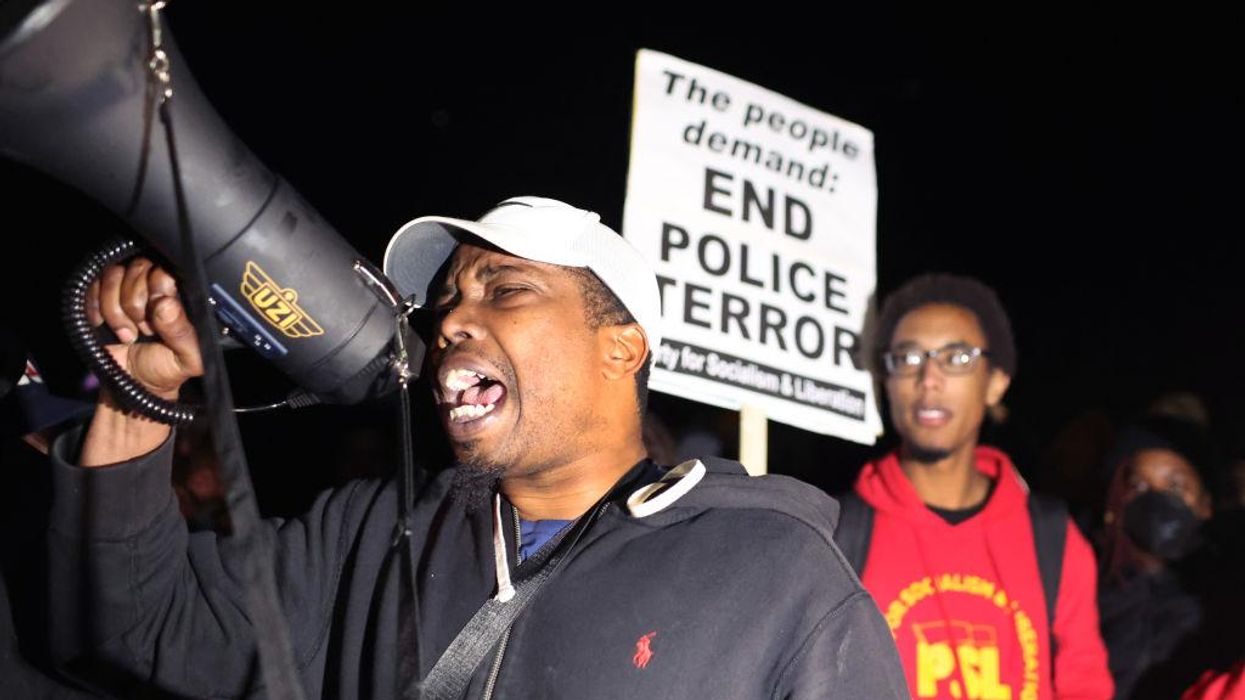
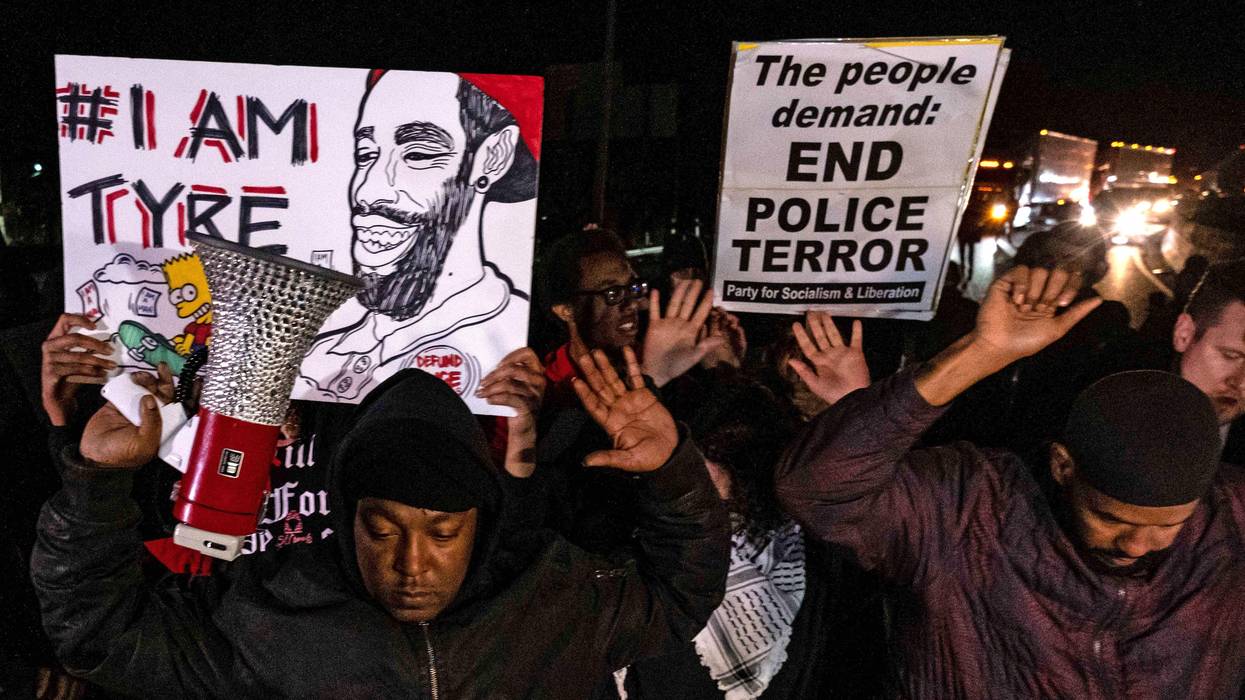
"These killer cops have got to go," chanted demonstrators in Chicago who carried signs that read, "Justice for Tyre Nichols" and "End police terror."
This is a developing story… Please check back for possible updates...
People took to the streets across the United States Friday night after the city of Memphis, Tennessee released videos of a January 7 traffic stop that led to five police officers being fired and charged with the murder of 29-year-old Black motorist Tyre Nichols.
MEMPHIS, TENNESSEE
The Memphis-based Commercial Appeal reported that protesters advocating for police reform shut down the Interstate 55 bridge that connects Tennessee and Arkansas:
As of 8:30 pm, more than 100 people remained on the Harahan Bridge with protest leaders saying they wanted to talk with Memphis Mayor Jim Strickland and Memphis Police Department Chief Cerelyn "C.J." Davis before disbanding. MPD officers closed off roads leading to the bridge―and several others downtown―but had not directly confronted protesters.
Protesters started moving off of the bridge around 9:00 pm. As they marched eastbound on E.H. Crump Boulevard towards police, they locked arms and chanted "we ready, we ready, we ready for y'all." Protestors then turned north, toward central downtown. As they passed by residences, some people came out on their balconies to cheer.
Surrounded by protestors on I-55, NBC News' Priscilla Thompson said that "they are chanting, they are calling the name of Tyre Nichols. They are calling for change."
Demonstrators and the Nichols family have called for disbanding the MPD Street Crimes Operation to Restore Peace in Our Neighborhoods (SCORPION) team that launched in 2021 and was involved in the traffic stop. The Memphis mayor said Friday afternoon that the unit has been inactive since Nichols' January 10 death.
The footage shows that after police brutally beat Nichols—pushing him to the ground; using pepper spray; punching and kicking him; and striking him with a baton—it took 22 minutes from when officers said he was in custody for an ambulance to arrive and take him to the hospital, where he later died from cardiac arrest and kidney failure.
ATLANTA, GEORGIA
In Georgia, though Republican Gov. Brian Kemp earlier this week signed an executive order enabling him to deploy 1,000 National Guard troops "as necessary" following protests in Atlanta over law enforcement killing 26-year-old forest defender Manuel "Tortuguita" Teran, those who gathered after the video release Friday night "expressed outrage but did so peacefully."
That's according to The Atlanta Journal-Constitution, which detailed that "a small but spirited crowd" of roughly 50 people formed in downtown Atlanta.
"We want to make one thing very clear, no executive order and no National Guard is going to stop the people for fighting for justice," Zara Azad said at the corner of Marietta Street and Centennial Olympic Park Drive. "We do not fear them because we are for justice."
BOSTON, MASSACHUSETTS
Just before the footage was released Friday, a vigil was held at "The Embrace" statue installed on Boston Common to honor Rev. Dr. Rev. Martin Luther King Jr. and his wife Coretta Scott King.
The Boston Globe reported that Imari Paris Jeffries, executive director of King Boston, which installed the monument, highlighted that the civil rights icon was assassinated while visiting Memphis in 1968 to advocate for sanitation workers whose slogan was "Am I a man?"
"Today we are thinking about Memphis and Brother Tyre, and the slogan of today is still, 'Am I a man?'" Jeffries said. "Seeing the humanity in each of us is the cornerstone of true change. Experiencing another heinous display reminds us that no family should feel this pain, ever. And there's still work to do."
"This is a problem that confronts us all," he added. "This is a problem that we need to defeat together, as a family, as a community."
CHICAGO, ILLINOIS
"From Memphis to Chicago, these killer cops have got to go," chanted about a dozen people who gathered near a police precinct in the Illinois city despite freezing temperatures, according to USA TODAY. Their signs read, "Justice for Tyre Nichols" and "End police terror."
Kamran Sidiqi, a 27-year-old who helped organize the protest—one of the multiple peaceful gatherings held throughout the city—told the newspaper that "it's tough to imagine what justice is here because Tyre is never coming back."
"That's someone's son, someone's friend lost forever. That's a human being's life that is gone," he said. "But a modicum of justice would be putting these killer cops in jail. A modicum of justice would be building a whole new system so that this can't happen again."
DALLAS, TEXAS
In Texas, The Dallas Morning News reported that Dominique Alexander, founder of the Next Generation Action Network, called Nichols' death a "total disregard for life, for humanity."
"The culture of policing is what is allowing these officers to feel like they can take our lives," Alexander said. "We want peace and calm in our communities, and we will do whatever is necessary to demand justice so our children don't have to deal with the same bullcrap we are dealing with now."
Around two dozen people who came together outside the Dallas Police Department headquarters Friday night shouted, "No justice, no peace" and "No good cops in a racist system," and held signs that said, "Stop the war on Black America" and "Justice for Tyre Nichols," according to the newspaper.
DETROIT, MICHIGAN
The Detroit branch of the Party for Socialism and Liberation (PSL) organized a Friday rally featuring speeches and a moment of silence. Michiganders held signs that declared, "Unions against police murder" and "Systems of racist police, violence must end."
"I'd like to see a civilian oversight board in every city, community control of the police department," 30-year-old Cameron Harrison, a member of the United Food and Commercial Workers Local 876 who attended the rally, told the Detroit Free Press.
"I'd like to see funding go away from weapons and [go to] jobs, housing, and water," said Harrison, adding that he does not need to watch the footage released from Memphis to know "what the police are capable of."
LOS ANGELES, CALIFORNIA
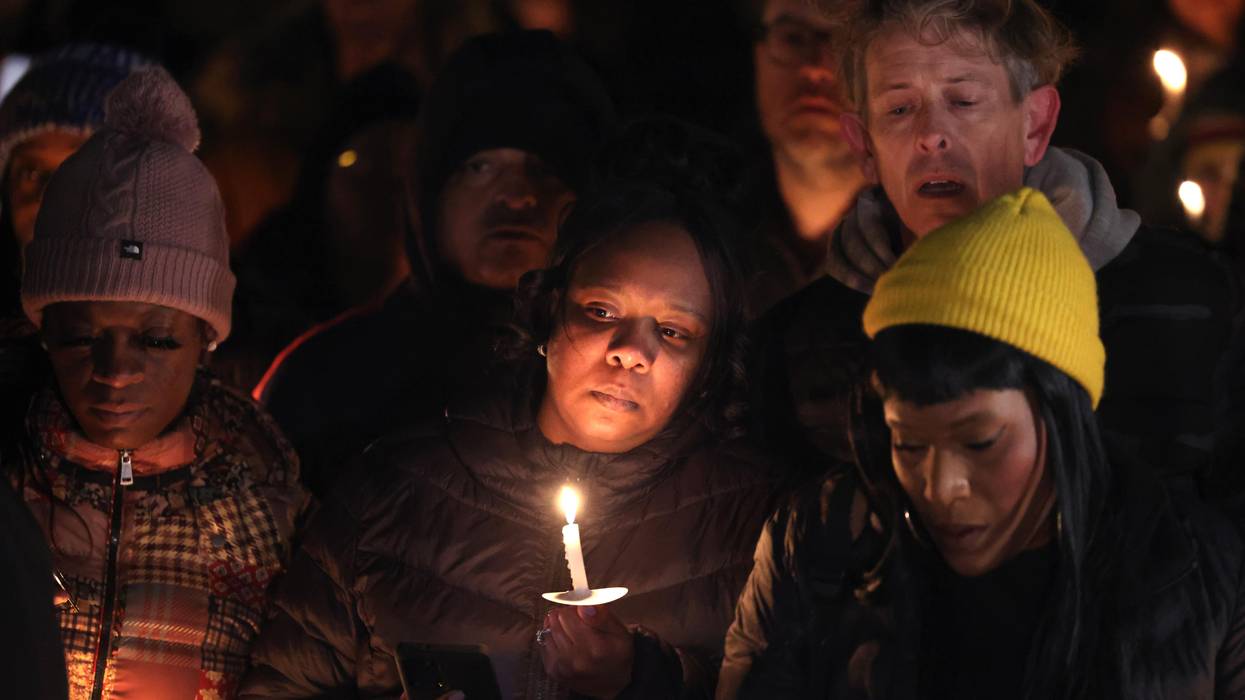
A demonstration outside the Los Angeles Police Department (LAPD) headquarters became "tense" late Friday after a "protest march grew out of a candlelight vigil for Nichols and
Keenan Anderson, who died this month after L.A. police pinned him to the ground and discharged a Taser on him at least six times in 42 seconds," according to the Los Angeles Times.
The videos of Memphis police brutalizing Nichols have provoked comparisons to the 1991 footage of LAPD officers brutally beating Rodney King—who survived the assault but died in 2012.
"My dad didn't die that night, but a big part of him did that we never got back," Lora Dene King, who was seven years old when her father was abused by police, told NBC News this week. She said that Nichols' death was "very triggering" for her and part of a "repetitive pattern" that includes her father, Eric Garner, and George Floyd.
"The whole situation is sickening to me, there is no reason he shouldn't be alive," she said of Nichols. "It'll just be another hashtag and we'll go on with our lives, and then it'll happen again."
NEW YORK, NEW YORK
In New York City, "protests were mostly peaceful, but emotions ran high," reported a local ABC affiliate, noting three arrests.
According to the outlet:
Demonstrators held up signs, chanting: "What's his name? Tyre! Say his name. Tyre!"
They demonstrated at Grand Central Terminal and Union Square, and crisscrossed the city, eventually bringing the Crossroads of the World to a screeching halt.
"When is this gonna end?" Bronx resident Chris Campbell said of police killings during a street interview with a CBS reporter.
"It's absolutely disgusting," PSL organizer Talia Gile said of the footage during a Friday speech in Philadelphia's Center City. "It shows the complete and utter disregard for human life. It shows the fact that police, no matter what their race is, are going to terrorize people because that's what the system is meant to do. It's meant to abuse its power against citizens."
Five former MPD cops, Tadarrius Bean, Demetrius Haley, Justin Smith, Emmitt Martin III, and Desmond Mills Jr.—who are all Black—were charged with second-degree murder and other crimes related to Nichols' death on Thursday.
After the videos were released Friday, Shelby County Sheriff Floyd Bonner Jr. announced that two deputies "who appeared on the scene following the physical confrontation between police and Tyre Nichols" have been relieved of duty pending the outcome of an internal investigation.
PORTLAND, OREGON
The Oregonian reported that in Portland on Friday night, "People kept mostly to sidewalks but blocked the Burnside Bridge for a few minutes as they stood to honor Nichol."
"The marchers chanted 'Whose lives? Black lives!' 'No justice, no peace,' and 'Say his name—Tyre Nichols!'" the newspaper added. "Some people knocked down road barriers but there were none of the clashes with police that had marked many of the nights of unrest in Portland after the 2020 killing of George Floyd by police in Minneapolis."
WASHINGTON, D.C.
Protests were held in the nation's capital Friday night on K Street Northwest and at Lafayette Square.
"It should not take the releasing of body cam footage of a Black man being murdered by police for people to jump to action, and for those who feel moved by this, and you should, ‘cause it could be any one of us standing out here today," said one speaker at the former event. "We urge you to not only protest, to not only engage on social media, to not only be flabbergasted and distraught and angry, but to take action."
Additional protests were planned for the weekend. The group ColorOfChange shared resources for demonstrators on Twitter:
"Tyre Nichols was a father to a 4-year-old boy, a son, a skateboarder, a beloved member of his community. And he was murdered after complying while the cameras were rolling," ColorOfChange president Rashad Robinson said in a series of tweets Friday. "Cosmetic 'solutions' like body cameras will not prevent the police from taking Black lives, nor will hiring Black police officers without reforming the overall racist, violent system."
"Now," he argued, "we must make sure the Memphis City Council takes action to end the practice of pretextual stops, hold officers accountable, eliminate the [Organized Crime Unit] and the SCORPION task force that killed Tyre, and fund a civilian response unit."
"Charging or jailing the killers is not enough," said the national director of the Working Families Party. "Justice is changing the conditions so no one dies during a traffic stop."
The city of Memphis, Tennessee on Friday night
released four videos of the January 7 arrest of Tyre Nichols, a 29-year-old Black motorist who died after being beaten by five officers who were subsequently fired and charged with murder.
The footage was privately seen by Nichols' family on Monday. Three of the videos are from body-worn cameras issued by the Memphis Police Department (MPD). Another is from a camera mounted on a pole and contains no audio.
Before the videos were released, MPD Chief Cerelyn "C.J." Davis warned that they show "acts that defy humanity."
Nichols was pulled over by Memphis officers for alleged reckless driving that Davis has since said her department has been "unable to substantiate." After three days in the hospital, he died on January 10 from cardiac arrest and kidney failure.
"I am disturbed and disgusted by the sheer brutality and lack of humanity on display in the footage released today," said NAACP president and CEO Derrick Johnson in a statement Friday night. "No person should ever be subjected to such violence, to have to call for their mother as they are being brutalized by police."
"This video is a stark reminder that in America, on any day of the week, a Black person can be brutally beaten to death less than a hundred feet from his home by those who are supposedly here to 'serve and protect' our communities," he continued. "Let me be clear—a traffic stop should not result in the brutal death of an unarmed man—period."
As Common Dreams reported Thursday, former MPD cops Tadarrius Bean, Demetrius Haley, Justin Smith, Emmitt Martin III, and Desmond Mills Jr.—who are all Black—were charged with second-degree murder and various other crimes.
In a series of tweets responding to the charges, ColorOfChange president Rashad Robinson said Friday, "Let's be clear, while the mass movement of people demanding some level of accountability has succeeded in this one instance, convictions aren't the goal."
"WE WANT AN END TO POLICE MURDERS OF BLACK PEOPLE. So, this moment isn't about Black vs. white, it's about blue vs. Black. Diversity cannot and does not solve systemic problems," he continued. "If we don't change the structure of policing and safety in our country, Black people will continue to be killed, by police of all races. The evidence is clear—investing in communities will keep us safe, not the police."
Damon Hewitt, president and executive director of the Lawyers' Committee for Civil Rights Under Law, said Friday evening that "Tyre's death is a bitter reminder of the Black lives that we've lost due to police brutality. Thirty years ago, we were horrified by the footage of police beating Rodney King. And yet, despite our decades of protest, we're still fighting the same battle."
"The only difference now is more of the horrific incidents are being captured on video, whether it be bodycams or bystanders," he added. "Tinkering at the margins of a violent police state is not enough. It never was. This death must amount to more than just another viral moment or hashtag. It must spark a serious reconsideration and shifting of priorities, deployment, and resources."
Before the footage was released, major cities across the United States were preparing for potential Friday evening protests.
According to The Associated Press:
As a precaution, Memphis-area schools canceled all after-class activities and postponed an event scheduled for Saturday morning. Other early closures included the city power company’s community offices and the University of Memphis.
Nichols' mother, RowVaughn Wells, warned supporters of the "horrific" nature of the video but pleaded for peace.
"I don't want us burning up our city, tearing up the streets, because that's not what my son stood for," she said Thursday. "If you guys are here for me and Tyre, then you will protest peacefully."
Noting that "there's been a lot of focus on the perceived threat of violence," MLK50: Justice Through Journalism, a nonprofit Memphis newsroom, on Friday published a collection of stories and columns "to add context to this tragedy" for those who may be unfamiliar with "the antagonistic relationship police have cultivated with the community, dating back decades."
The coalition Decarerate Memphis shared on Twitter demands from Nichols' family and the community, including reforms to reduce the chances of similar future events.
The Movement for Black Lives tweeted advice on "how to limit viewing sensitive content" on social media platforms, for those who do not want to be traumatized by the footage.
"We grieve with Tyre's family, friends, and the entire Memphis community," the movement said in a statement. "Had those officers not pulled Tyre over, he would be here right now with his four-year-old son, taking photos of sunsets and skateboarding. Yet, even as we try to grieve and stand in solidarity with Tyre's family, we know the police are ramping up to criminalize our actions—meeting our calls for justice and accountability with more state violence and suppression."
Officials in several cities on Friday were expecting large-scale protests to break out over Nichols' killing.
Social justice advocates on Friday registered the Memphis police chief's response to footage of the fatal beating of Tyre Nichols by five officers as evidence that the video "must be awful," as Chief Cerelyn Davis said the soon-to-be-released footage shows "acts that defy humanity."
"You're going to see a disregard for life, duty of care that we're all sworn to, and a level of physical interaction that is above and beyond what is required in law enforcement," David told CNN.
The footage is expected to be released Friday. Officials in a number of cities including Memphis, Los Angeles, Dallas, New York, and Minneapolis have all said they are preparing for large-scale protests.
"Just the disregard for humanity... That's what really pulls at your heartstrings and makes you wonder: Why was a sense of care and concern for this individual just absent from the situation by all who went to the scene?" Davis told CNN.
U.S. Attorney General Merrick Garland also called the footage "deeply disturbing," and President Joe Biden acknowledged that nationwide protests may break out over Nichols' killing, demanding "accountability when law enforcement officers violate their oaths" and joining Nichols' family in "calling for peaceful protest."
"I called on Congress to send the George Floyd Justice in Policing Act to my desk," said Biden on Thursday. "When they didn't, I signed an executive order that included stricter use of force standards and accountability provisions for federal law enforcement, as well as measures to strengthen accountability at the state and local level. Today, we all must re-commit ourselves to the critical work that must be done to advance meaningful reforms."
Nichols died on January 10 from cardiac arrest and kidney failure, three days after he was pulled over by Memphis officers—allegedly for reckless driving—although Davis said her department has been "unable to substantiate that at this time."
The 29-year-old had two violent "confrontations" with the officers, according to the Memphis Police Department, before being rushed to a hospital in critical condition.
The five officers were fired from the department after the attack and on Thursday were charged with crimes including second-degree murder.
Antonio Romanucci, an attorney representing Nichols' family, called on the nation's police unions to condemn the killing.
"Where does the Fraternal Order of Police stand on this?" he asked at a press conference. "We have not heard from you... We want to hear you say that what happened to Tyre, what happened to this family, should never, ever happen again."
FBI Director Christopher Wray announced the bureau will open a civil rights investigation into the killing.
"I've seen the video myself," said Wray. "I'm struggling to find a stronger word, but I will tell you that I was appalled."
Grassroots organizer Bree Newsome Bass expressed disgust over the latest police killing and the drawn-out lead-up to the video being made public.
"The way they've spent days and hours emphasizing the violence of Tyre Nichols' murder like it's a countdown to a movie release tells you everything about the depravity of the system we live under," said Newsome Bass.