SUBSCRIBE TO OUR FREE NEWSLETTER
Daily news & progressive opinion—funded by the people, not the corporations—delivered straight to your inbox.
5
#000000
#FFFFFF
To donate by check, phone, or other method, see our More Ways to Give page.


Daily news & progressive opinion—funded by the people, not the corporations—delivered straight to your inbox.
Why did the Democrats under former President Joe Biden choose to transform the party into one that embraced war and glorified warmongers like Cheney, while protecting and enabling a genocide?
In less than three weeks, U.S. President Donald Trump secured a cease-fire in Gaza, spoke directly to Russian President Vladimir Putin and Ukrainian President Volodomyr Zelensky, and kickstarted diplomacy to end the Ukraine war. At the same time, he has also put forward some idiotic ideas, such as pushing Palestinians out of Gaza and making Canada the 51st state.
But it raises important questions: Why didn't the Biden administration choose to push for an end to the wars in Gaza and Ukraine? Why didn't the majority of the Democrats demand it? Instead, they went down the path of putting Liz Cheney on a pedestal and having former Vice President Kamala Harris brag about having the most lethal military in the world while Trump positioned himself as a peace candidate—justifiably or not.
A profound reckoning is needed within the Democratic Party to save it from slipping into becoming neocon by default.
Undoubtedly, Trump's plans in Gaza may make matters worse and his diplomacy with Putin may fail. But that isn't the point.
The point is: Why did Trump choose to pursue diplomacy and seek an end to the wars, and why did the Democrats under former President Joe Biden choose to transform the party into one that embraced war and glorified warmongers like Cheney, while protecting and enabling a genocide?
What happened that caused the party to vilify its own voices for peace—such as Reps. Ilhan Omar (D-Minn.) and Rashida Tlaib (D-Mich.)—while embracing some of the architects of the Iraq war?
And all of this, of course, in complete defiance of where the party base was (throughout the Gaza war, the base supported a cease-fire with 70% majority, for instance).
A profound reckoning is needed within the Democratic Party to save it from slipping into becoming neocon by default.
And with the pace at which Trump is moving, that reckoning needs to come fast. It will, for instance, be a severe mistake if the party positions itself to the right of Trump and reflexively opposes him on every foreign policy issue instead of basing the party's positions on solid principles, such as centering diplomacy, military restraint, and peace. Trump currently speaks more about peace than the Democrats do.
A senior Democratic lawmaker asked me rhetorically last week if I knew anyone who was happy with the foreign policy of Biden and voted for Harris on that basis.
I was happy to hear that the question was being asked. That's a good first step.
"It's time for Democrats to offer Americans a new and affirmative vision of U.S. foreign policy, one that boldly and unashamedly embraces global peacemaking as an essential component of our own security and prosperity."
"Democrats have become the party of war" and "Americans are tired of it."
That's the message that Matt Duss, a former top aide to U.S. Sen. Bernie Sanders (I-Vt.) who is now the executive vice president at the Center for International Policy, imparted in an opinion piece published Thursday in The Guardian.
"In defending the militarist status quo, Democrats ceded the anti-war lane to Republicans," Duss wrote. "As they enter the political wilderness, it's time to reckon with what they got so wrong."
Among other things, what they got wrong during Vice President Kamala Harris' failed 2024 Democratic presidential bid, according to Duss, was embracing figures like former CIA director Leon Panetta and "torture advocate" Liz Cheney in a bid to woo right-wing and moderate voters.
As President-elect Donald Trump's campaign painted the Republican nominee—who fulfilled his 2016 campaign promise to "bomb the shit out of" Islamic State militants and "take out their families" with devastating results—as the "
candidate of peace," Democrats "left the anti-war lane wide open for him by leaning into a tired, curdled militarism as a substitute for an actual foreign policy vision," Duss said.
"It's time for Democrats to offer Americans a new and affirmative vision of U.S. foreign policy, one that boldly and unashamedly embraces global peacemaking as an essential component of our own security and prosperity," he wrote. "One that insists that keeping Americans safe does not require spending more on defense than the next 10 countries combined."
Duss continued:
Our leaders should be clear about the genuine security threats that our country faces, but decide, at long last, to stop being drawn into dumb bidding wars about being "tougher on Russia/terrorism/China/whatever"—a framing designed to sustain the hawkish status quo. They should broaden the national security conversation to include the challenge of domestic and global inequality and the grievances it powers. They should articulate not just a domestic but a global pro-worker agenda—in addition to a global corporate minimum tax, a global minimum wage, for example. Make clear that a foreign policy fit for this era doesn't pit the security and prosperity of Americans against workers in other countries but recognizes that our security and prosperity are bound together.
"All of this will of course require confronting the various defense, business, and foreign lobbies that distort and constrain our policy discussions, which is why a strong anti-corruption plank is essential for any such platform," Duss said.
That's a tall order. Reflecting on President Joe Biden's term, Duss asserted: "I never imagined I would write this, but by the end of his presidency he will have done more damage to the so-called 'rules-based order' than Trump did. Fifteen months and counting of support for Israel's horrific assault on Gaza has violated virtually every international norm on the protections of civilians in war and left America's moral credibility in tatters. Biden showed that international law is little more than a cudgel to be used against our enemies while being treated as optional for our friends."
"In his 2020 election victory speech, Biden proclaimed: 'I believe at our best America is a beacon for the globe. And we lead not by the example of our power, but by the power of our example,'" Duss recalled. "It's a nice line, but Biden showed that he sees it as little more than that. The question now for Democrats is whether they can actually mean it, or if they even want to."
Addressing the recent phenomenon of Republicans being perceived as the anti-war party of the working class—even if such perception is divorced from reality on both fronts—Duss lamented that "this year's Democratic ticket failed to provide a sufficient response."
"Instead of responding to the right's tech oligarch-funded faux-populism by offering a genuine alternative and attacking the real sources of our country's insecurity, they leaned into a defense of a militarist status quo that most Americans rightly recognize as broken," he added. "They must not make that mistake again."
The Republican nominee also said during the same rally in Pennsylvania that he "shouldn't have left" the White House after losing the 2020 election.
During a rally on the final Sunday before the presidential election, Republican nominee Donald Trump told an audience gathered in the battleground state of Pennsylvania that he wouldn't mind if a gunman shot through the group of reporters covering the event.
After discussing the protective glass surrounding him, the former president said a would-be assassin "would have to shoot through the fake news" to get to him.
"I don't mind that so much," Trump said, drawing laughter and applause from his supporters. "I don't mind."
Watch:
Trump says he doesn't mind if someone shoots the press.
He repeatedly encourages violence against anyone who challenges his narrative.
That's what a dictator does — and Trump's Supreme Court gave him immunity to do whatever he wants if re-elected.
Votepic.twitter.com/W0dUWro2g9
— Melanie D'Arrigo (@DarrigoMelanie) November 3, 2024
Journalist Jeff Sharlet wrote in response that during his time covering "the fascism beat," he's met "men who've been itching for that encouragement, who openly fantasize about beating or killing reporters."
"It's not a joke," Sharlet wrote. "It's fascism."
Trump has long reveled in attacking members of the press, vilifying them as "the enemy of the people" and directing the ire of his supporters in their direction. Kash Patel, a Trump confidant who's expected to get a senior national security post if the former president wins Tuesday's election, suggested earlier this year that a second Trump administration would go after "the people in the media" with criminal or civil charges, underscoring the threat the Republican nominee poses to press freedom.
Facing backlash over Trump's latest attack on the press, his campaign issued an absurd statement claiming the former president was "actually looking out for [reporters'] welfare" by "stating that the media was in danger."
The Atlantic's Helen Lewis noted Sunday that "journalists are only some of the many 'enemies from within' whom Trump has name-checked at his rallies and on his favored social network, Truth Social."
Lewis continued:
He has suggested that Mark Zuckerberg should face "life in prison" if Facebook's moderation policies penalize right-wingers. He has suggested using the National Guard or the military against "radical-left lunatics" who disrupt the election. He believes people who criticize the Supreme Court "should be put in jail." A recent post on Truth Social stated that if he wins on Tuesday, Trump would hunt down "lawyers, Political Operatives, Donors, Illegal Voters, & Corrupt Election Officials" who had engaged in what he called "rampant Cheating and Skullduggery." Just last week, he fantasized in public about his Republican critic Liz Cheney facing gunfire, and he previously promoted a post calling for her to face a "televised military tribunal" for treason. In all, NPR found more than 100 examples of Trump threatening to prosecute or persecute his opponents. One of his recent targets was this magazine.
Trump also said during Sunday's rally in Pennsylvania—where he and Democratic nominee Kamala Harris are in a dead heat—that he "shouldn't have left" the White House after losing the 2020 election.
The fight against Trump's authoritarianism, while certainly necessary, is being used as cover to shore up support for a status quo that is itself profoundly anti-democratic in its functioning.
In recent months, a curious phenomenon has emerged in American politics—the endorsement of Democratic candidates by figures traditionally associated with the Republican far right. Most notably, former U.S. Vice President Dick Cheney and his daughter Liz Cheney made headlines by throwing their support behind Kamala Harris' presidential bid. This unexpected alliance has been framed by centrist media outlets as a heartening example of cross-party unity in the face of former President Donald Trump's purported threat to democracy. However, a more critical examination reveals that these endorsements are less a triumph of democratic values and more a damning indictment of the current political status quo.
Defenders of this unlikely alliance argue that it represents a necessary "popular front" against the authoritarian threat posed by Trump and his supporters. They contend that in times of crisis, we must set aside ideological differences and unite to preserve the foundations of our democracy. But this framing relies on a fundamentally flawed premise—that the system these centrists and right-wingers are rallying to protect is itself truly democratic.
The political establishment that the Cheneys and their Democratic allies seek to preserve is one that perpetuates endless wars and military interventions across the globe, from Iraq to Libya to the ongoing support for Israel's assault on Gaza. It allows for and exacerbates grotesque levels of economic inequality, with wealth increasingly concentrated in the hands of a tiny elite. This system routinely supports and arms authoritarian regimes when it aligns with U.S. corporate interests, from Saudi Arabia to Thailand. It oversees a mass incarceration system that disproportionately targets communities of color and fails to take meaningful action on existential threats like climate change due to the influence of fossil fuel lobbyists.
The Democratic Party's willingness to embrace far-right endorsements puts the lie to their posturing as champions of the working class and foes of elite power.
This is the system that the so-called "popular front" is mobilizing to defend. Not a beacon of democracy, but a corrupt oligarchy that masquerades as one. The fight against Trump's authoritarianism, while certainly necessary, is being used as cover to shore up support for a status quo that is itself profoundly anti-democratic in its functioning.
The embrace of figures like the Cheneys also reveals a deeply troubling moral relativism at the heart of the Democratic establishment. Dick Cheney, after all, was one of the primary architects of the Iraq War—a conflict built on lies that resulted in hundreds of thousands of civilian deaths and destabilized an entire region. He has been an unapologetic defender of torture and a champion of unchecked executive power.
That Democrats would welcome such a figure into their tent speaks volumes about their own moral compass and political priorities. It suggests that in their calculus, the taint of association with war criminals and corporate oligarchs is outweighed by the potential electoral benefits. This is not principled politics—it is cynical maneuvering that betrays any claim to real progressive values.
Central to understanding this phenomenon is recognizing the intellectual and moral bankruptcy of political centrism as it exists in the United States today. Centrists pride themselves on their supposed pragmatism and willingness to reach across the aisle. But in practice, this "pragmatism" almost always skews rightward, dragging the entire political spectrum in a more conservative direction.
We see this in the way that ideas once considered radical right-wing positions have become normalized as "centrist" compromises. We see it in the adoption of Republican framing on issues like crime, fracking, welfare, and national security. And we see it now in the lionization of figures like Dick Cheney as principled defenders of democracy, memory-holing their long records of supporting deeply anti-democratic policies.
This narrowing of the political spectrum has profound consequences for American democracy, effectively disenfranchising millions of citizens whose views and interests are not represented by either major party.
The Democratic Party's willingness to embrace far-right endorsements puts the lie to their posturing as champions of the working class and foes of elite power. Their rhetoric may occasionally nod to populist themes, but their actions reveal a party that is fundamentally comfortable with the current distribution of power and wealth in society. By welcoming figures like the Cheneys into their coalition, Democrats are sending a clear message—they are not opposed to elites per se, only to those particular elites who threaten their own place in the established order.
This elite consensus is evident in the policy priorities of Democratic administrations. Whether under former President Barack Obama or current President Joe Biden, we see a consistent pattern of bailing out banks and major corporations while offering only crumbs to struggling workers. We see promises of a new direction in foreign policy coupled with a continuation of the same interventionist approach.
The result is a democracy where the differences between the two parties, while real, are far narrower than their rhetoric would suggest. Both ultimately serve the interests of corporate power and the military-industrial complex, merely disagreeing on the details of implementation. This narrowing of the political spectrum has profound consequences for American democracy, effectively disenfranchising millions of citizens whose views and interests are not represented by either major party.
Moreover, this centrist consensus serves to stifle genuine debate and innovation in policymaking. By defining the range of "acceptable" ideas so narrowly, it excludes potentially transformative solutions to the pressing problems facing the country. Ideas like Medicare for All, a Green New Deal, or serious corporate regulation are dismissed as fringe or unrealistic, while failed policies of the past are recycled under new branding.
As we survey this bleak political landscape, the urgent need for genuine alternatives becomes increasingly apparent. While strategically it remains important to influence local and national elections, recent events in France serve as a stark reminder of the limitations of this approach.
French President Emmanuel Macron's appointment of Michel Barnier, a conservative politician, as prime minister following a fractured election result illustrates how centrist parties will ultimately betray the left in favor of the right. Despite the left-wing New Popular Front coalition winning the most seats in snap elections, Macron chose to align with the right, including placating the far-right National Rally. This decision reveals where the true class allegiances of centrist politicians lie—with the established order and corporate interests, rather than with progressive change.
Ultimately, the spectacle of Democrats embracing far-right endorsements should serve not as cause for despair, but as a clarion call for genuine, transformative change.
This pattern is not unique to France. In the United States, the Democratic Party's embrace of far-right endorsements follows a similar logic. By welcoming figures like the Cheneys into their fold, Democrats signal their willingness to preserve the status quo at the expense of meaningful reform. This move rightward is not an aberration but a reflection of the party's fundamental priorities.
The danger in this situation lies not just in the immediate policy implications, but in the long-term erosion of political possibilities. By supporting these endorsements, even tacitly through not challenging the Democrats to reject them, progressives risk ceding the ground of real transformative change to the right wing. The language of anti-elitism and systemic change, divorced from a genuinely progressive economic and social agenda, becomes the domain of right-wing populists.
The challenge, then, is twofold. On one hand, there is an urgent need to build political power outside of the two-party system. This means investing in grassroots organizing, mutual aid networks, and alternative economic structures that can provide a glimpse of a different way of organizing society. It means fostering a political culture that prioritizes the needs of working people over the demands of corporate donors.
On the other hand, there is a need for a more forceful and unapologetic progressive movement within electoral politics. This movement must be willing to challenge the Democratic establishment, to reject compromises that betray core values, and to articulate a vision of change that goes beyond incremental reforms. It must be willing to call out the hypocrisy of embracing far-right figures in the name of "unity" while marginalizing progressive voices.
Ultimately, the spectacle of Democrats embracing far-right endorsements should serve not as cause for despair, but as a clarion call for genuine, transformative change. It exposes the hollowness at the core of centrist politics and underscores the need for a political movement that truly represents the interests of the many rather than the elite few.
An example of absurdist drama that prophesied Trumpist transformation is Eugène Ionesco’s Rhinoceros—the classic play in which an entire town devolves into rhinoceroses that silence any hope of coherent conversation.
In 1968, the Youth International Party nominated a pig named Pigasus for president; in 2024, the Republican Party will likely nominate a Traitor named Trump for president, a dumber and more corrupt candidate than Pigasus. The Youth International Party—the anarchic, counter-culture Yippies— nominated the pig as an absurd joke. While it’s absurd to nominate an indicted felon who tried to overturn the 2020 election, the GOP is not joking.
The Yippies’ pig had no chance of becoming president: according to the Constitution Pigasus wasn’t qualified, being younger than 35 years old. Trump as an insurrectionist is—like the pig—unqualified to be president, according to the Constitution. Yet, unlike Pigasus, he has a good chance to become president: The Supreme Court will likely discount the Constitution, he leads Biden in some polls, and, if he loses, he will try to steal the election again, threatening “bedlam” if that happens.
To rational people, it is mindbogglingly surreal that an incompetent, ignorant megalomaniac and sexual abuser like Trump, whose grating voice alone rattles teeth, would be deemed fit for the presidency, let alone close to winning power. Yet he is. Despite his enabling of the pandemic, his 2020 defeat, his instigation of the January 6 attack on the Capital, the 91 charges across four criminal cases, and his never-ending hurricane of lies, millions of reality-challenged Americans worship and support him.
Exposing its total MAGA-tization, the Republican Party has crawled with Trump into a moral abyss that turns out to be a bottomless pit of unreality. The fake GOP primary delivers phony, cowardly candidates Nikki Haley and Ron DeSantis, who are terrified of criticizing him and have promised to support him even if he were a convicted felon. They continue their sham candidacies, hoping that the laws of gravity will reverse on Trump and he will be sucked up into the vacuum of outer space. Failing that, it is perfectly fine with them that the defeated president attempted a coup and, though stopped, he can still return to the presidency.
The deranged Trump swamped his “opposition” in the Iowa caucus by 30 points. Watching cable news afterwards, it felt like I was living in Russia and Putin was running against two puppet candidates. The pundits seriously discussed the micro-details of the race and how each of the candidates fared in Nowheresville, Iowa, and no one screamed, “This is insanity—this is the cult of a madman!”
The craven cult that inflates Trump’s already-enormous self-esteem has given him the power to bend the arc of reality.
The nightmarish possibility of electing the shameless septuagenarian— a self-described dictator—is helped by his politically weak octogenarian opponent Joe Biden who frames the election as a choice between him and doomsday, but provides doomsday-style weapons and unconditional support for Israel’s Gaza genocide. In addition, Biden risks a “Red Sea War” by bombing Yemen, one of the poorest countries in the world.
Angry with Biden, pro-Palestine anti-war progressives might turn away from him in disgust—not voting or voting for third party candidates, undoubtedly funded by Republican donors. Other voters don’t like him because he is too old. In any case, Biden-hating voters might help elect the Muslim-hating, also elderly Trump, who is even more supportive of Israeli Prime Minister Benjamin Netanyahu than Biden. In his first torturous term, Trump moved the American embassy to Jerusalem and left Palestinians out of the Abraham Accords, which many viewed as a betrayal of Palestine.
In his first term, Trump’s brutality and corruption were slightly mitigated by his ignorance and laziness. In a second, Trump—older and lazier—would better understand the system’s vulnerabilities and loopholes. On inauguration day 2025, Trump will be an indicted or convicted outlaw. He will commit the first crime of his second term at noon: His oath to defend the United States Constitution will be a perjury.
In a second term, he would install an army of political loyalists whose fealty to his most unhinged demands will take precedence over their commitment to the Constitution or legal governance. They will help him drive a much more focused agenda of vengeance against his adversaries and impunity for himself. For his own survival, he must destroy the rule of law by stopping all state and federal, civil and criminal cases against him. If a president can order the justice department to stop a case against him—as Trump would surely do—then obstruction of justice becomes a normal privilege of the presidency.
A former insurrectionist re-elected to the Presidency, he would use the Insurrection Act to order the military to crush protests—which he hoped to do during the summer of 2020—and turn the power of the federal government against his perceived enemies. Paraphrasing Hitler, he said, “We will root out the communists, Marxists, fascists, and the radical-left thugs that live like vermin within the confines of our country.” It has always been Trump’s supreme political wish to wield military violence as personal weapons of power—a wish that many in his party now seem determined to help him achieve.
As xenophobe-in-chief, he hopes to institute a program of mass detainment and deportation of undocumented immigrants, who he says are “poisoning the blood” of the country, employing the rhetoric of European totalitarians. His aides have already drawn up plans for new detention centers at the U.S.-Mexico border, where anyone suspected of illegal entry would be held until officials have settled the person’s immigration status.
If Trump is returned to office, he will undoubtedly make January 6 a national holiday—the Day of the Patriotic Martyrs.
American democracy will disintegrate piece by piece as a second Trump term erects a postmodern fascist state modeled on Victor Orbán’s Hungary—destroying the legitimacy of elections, trampling constitutional rights, instituting a nation-wide abortion ban, cutting off immigration, suppressing derogatory media, promoting Christian nationalism, and undermining the rule of law.
Even beyond this horror, the craven cult that inflates Trump’s already-enormous self-esteem has given him the power to bend the arc of reality. His hallucinating supporters believe in an elaborate MAGA phantasmagoria that Trump has concocted: that the previous election was stolen, that Biden is an illegitimate president, that Biden has weaponized the legal system to prosecute his strongest opponent Trump, and that the January 6 riot was not an insurrection by Trump supporters but an instigation by the FBI and antifa.
In a brief moment after the January 6 Capitol attack, many in the GOP thought the Trump monster had been banished, a pariah in the Party. Republican leaders blamed him for the insurrection. Party fund-raisers assured donors they were done with him. Trump’s own loyalists turned against him. Former Attorney General Barr said Trump’s conduct was a “betrayal of his office and supporters.”
The Murdoch-owned lapdog Wall Street Journal argued that Trump was done: “This week finished him as a serious political figure. He has betrayed his loyal supporters by lying to them about the election and the ability of Congress and Mr. Pence to overturn it. He has refused to accept the basic bargain of democracy, which is to accept the result, win or lose.” Trump also got blamed when the 2022 midterms went seriously awry as Trump-endorsed election deniers lost winnable races and the much-hyped “red tsunami” turned into a dribble. In her book, purged Republican Liz Cheney reported that afterwards Trump was depressed and refused to eat.
After condemning Trump for January 6 and even suggesting that he resign, now-deposed House Speaker Kevin McCarthy traveled to Mar-a-Lago and, in an historically spineless act of recantation, embraced and absolved the starving former President. Cheney and many others have identified this as a pivotal moment in reviving the former president’s political viability and appetite.
Still, previous to this submission, the Republican Party threw away its best chance to bury him forever when 43 senators voted to acquit him in his impeachment after the Capitol riot. They could have relegated him to Palm Beach and saved America from hearing the despicable rants of this malfunctioning moron and putting the police and the nuclear button under his thumb.
Trump resumed eating, lying, and constructing a new absurd reality that has proven more politically salient with the GOP and its voters than many of us thought possible on January 7, 2021, even after seeing it happen over and over for the previous six exhausting, gut-wrenching years.
Pulling off a kind of double coup, this psychopathic fabricator added to the original Big Lie about the “rigged election.” He called January 6 “a beautiful day,” and he designated the nearly 1,300 defendants arrested in connection with the Capitol attack ”martyrs” and “hostages.” He has promised to pardon insurrectionists and threatened to lock up the police who tried to defend the Capitol that day. If Trump is returned to office, he will undoubtedly make January 6 a national holiday—the Day of the Patriotic Martyrs.
The GOP and the right-wing media echo system has been so effective in pumping out Trump’s upside-down-world propaganda that polling recently found that, in the intervening three years, the number of Republicans who believe Trump’s lies about a “rigged election” has, in fact, gone up. Today, only 31% of Republicans believe that Biden is the “legitimate” president, down from 39% in late 2021. The poll also showed that Republicans thought the insurrectionist mob were mostly peaceful.
For millions of people, Trump has managed to transmute historical events that everyone saw with their own eyes into theater of the absurd, an anti-realistic dramatic genre characterized by dark humor, incoherent language, strange symbolism, and themes that relate to human irrationality.
An example of absurdist drama that prophesied Trumpist transformation is Eugène Ionesco’s Rhinoceros—the classic play in which an entire town devolves into hard-skinned, monstrous rhinoceroses that issue ear-shattering bellows that silence any hope of coherent conversation. Rhinoceros thundered onto the stage, in 1960, with a chilling yet farcically funny allegory of how fascism can mutate ordinary people into angry, violent, mindless beasts whose articulateness dissolves into a cacophony of guttural honks.
Writing in the wake of Hitler and Stalin, Ionesco painted a picture of a society succumbing to the contagion of “rhinoceritis,” a disease that erodes individuality and replaces it with groupthink and casual brutality as well as a hatred of non-rhinoceroses. The transformative infection suggests the dehumanizing force of tyrannical ideologies.
Becoming a huge, horned rhinoceros is gradually normalized: A formerly concerned character Jean dismisses his friend’s terror at the multiplication of grotesque rhino mutations and their deleterious effects on human freedom. Jean debases himself and enables rhinoceritis when he says that despite their savage deformity, they’re “harmless, docile herbivores” and “seem so sure of themselves.” This mindless acceptance and rationalization foreshadows the insidious nature of the disease, disguising its destructive potential.
Ionesco’s play exposes the lure of surrendering to a mass authoritarian movement and abandoning the burden of independent thought. Among Trump’s abettors are numerous verifiably insane congresspeople who have been infected by rhinoceritis for a long time such as Marjorie Taylor Green, Lauren Boebert, and Matt Gaetz. But it’s the transformed normies that are most pathetic.
Current House Majority Whip Tom Emmer angered Trump when he voted to certify Biden’s election, unlike 147 colleagues who voted to overturn the election. When Emmer ran for his dream-job Speaker of the House, Trump sank his candidacy, warning that he would be a “tragic mistake” and calling him a “Globalist RINO” (not a rhinoceros). Two months later, Emmer—like nearly 100 members of the House, said, “I am proud to endorse Donald J. Trump for President.” Expressing his gratitude to Emmer for his miserable self-abasement, Trump smirked, “They always bend the knee.”
One of the more pitiful examples of “Trump Debasement Syndrome” is Sen. Josh Hawley, the guy who egged on the January 6 rhinoceros-thugs with a fist-pump that lamely showed solidarity with them and then was recorded in security footage fleeing for his life to avoid those same stampeding thugs. Hawley has decided to “forget” his traumatic escape from the mob, though he had not endorsed King Rhinoceros as the Iowa caucus approached. Exhibiting concern for Hawley’s electoral health, Trump warned him to “be very careful” in his Senate re-election campaign. Shortly thereafter, Hawley joined the Republican Rhino herd and publicly endorsed Trump saying, “I’m with him.”
Rhinoceros explored the erosion of moral values, the seductive nature of power as people become mere instruments of brute strength and aggression. As authority figures collapse and undergo metamorphosis, other people find it easier to justify why becoming a rhinoceros is desirable. As one character declares, “It‘s the strength that counts, don’t you want to be strong?”
Once a rising conservative normie in the party—an acolyte of former Republican VP candidate Paul Ryan, Rep. Elise Stefanik has transmogrified into an automated MAGA rhinoceros. She trumpeted Trump’s reference to the January 6 criminals as “hostages,” and embraced the claim that the 2020 election was an “unconstitutional circumventing of the Constitution.” Stefanik refused to commit to certifying the results of the 2024 election, saying “We will see if this is a legal and valid election.” After calling the media biased against Trump, she said the “border crisis is poisoning Americans.” Desperately thirsty for Trump’s VP spot, Stefanik has become a eager demagogue.
What began, in Rhinoceros, as isolated incidents becomes a rhinoceros contagion as the town’s residents witness an astonishing metamorphosis as more and more people sprout horns, grow enormously huge with hard green skin, and succumb to the allure of the rampaging Rhino fascists. There are no elections in Rhinoceros Town so the entire society is transformed, except for one individual Berenger who shouts, “I’ll take on the whole of them! I’ll put up a fight against the lot of them! I’m the last man left, and I’m staying that way until the end. I’m not capitulating.”
The entire Republican Party—elected officials and voters—have capitulated. They’ve chosen the sickness, nihilism, and absurdity. Fortunately, we still have democracy. Stopping the Trump contagion will not suddenly eradicate the disease and make America perfectly healthy, but it is vital to embrace reality, reject the absurd, prevent further suffering, and preserve the possibility of progress.

"If we don't confront Christian nationalism then we are leaving ourselves open to future attacks, like what we saw on January 6," said one critic.
In an effort to fill in what they say are critical gaps in the U.S. House select committee's report on the January 6, 2021 attack on the U.S. Capitol, faith leaders are pushing the corporate media and the American public to confront the role Christian nationalism played in the insurrection, warning that ignoring the link could make similar violence more likely in the future.
The committee's report, released last week, laid out extensive evidence showing that former President Donald Trump was the driving force behind the attack aimed at stopping lawmakers from certifying the 2020 presidential election results, but mentioned Christian nationalism just once, despite the fact that many of the Trump supporters who stormed the Capitol openly expressed Christian nationalist beliefs before, during, and after the attack.
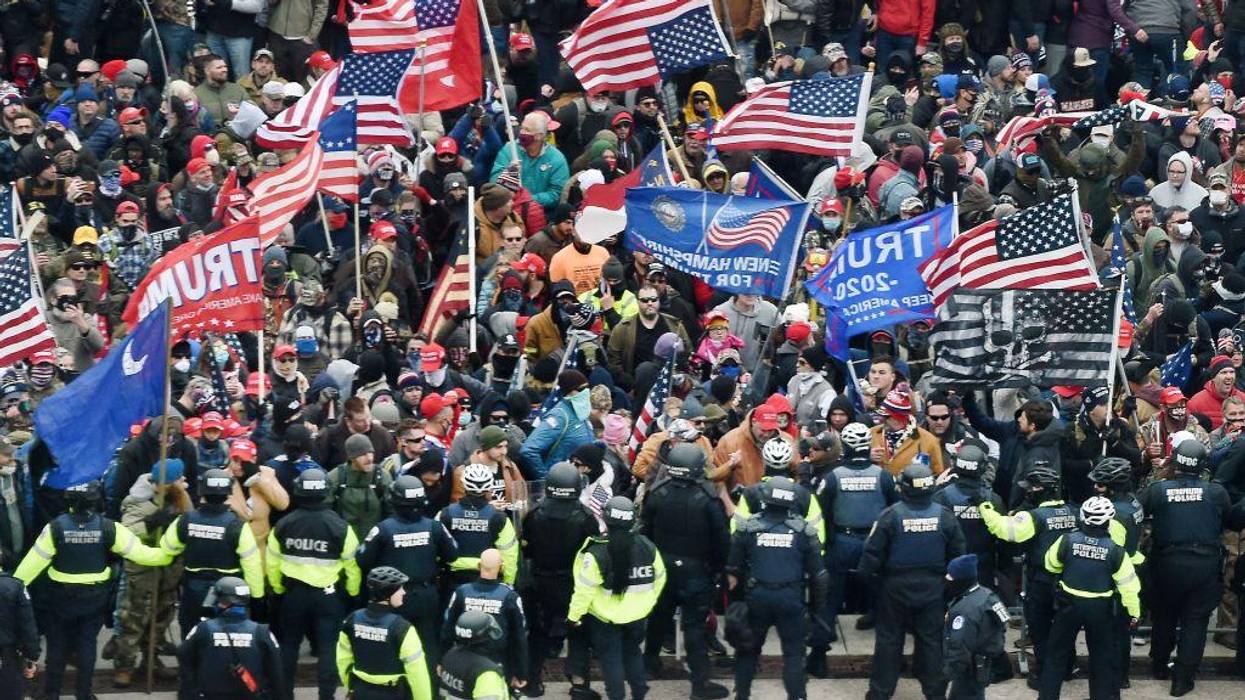
As Religion News Service reported last week, some Trump supporters who attempted to overthrow the government carried flags displaying a so-called "Jesus fish" painted red, white, and blue like the American flag along with the words "Proud American Christian." Hundreds took part in what they called a "Jericho March" and prayed for the election results to be overturned the day before the insurrection, and some were heard chanting, "Christ is king" in Washington, D.C. on January 6.
"The symbols of Christian nationalism were on full display not only on January 6 itself, but at numerous rallies leading up to the attack," Amanda Tyler, executive director of the Baptist Joint Committee for Religious Liberty (BJC), told Alicia Menendez on MSNBC on Wednesday.
Christian Nationalism Conspicuously Absent From January 6 Reportwww.youtube.com
The report, however, only noted that supporters of white supremacist Nick Fuentes, who was in Washington on January 6 but has not been accused of breaching the Capitol, have "repeatedly promoted white supremacist and Christian nationalist beliefs."
The inclusion of just a single reference to Christian nationalism—the belief that the government should actively ensure that the U.S. is a Christian nation—was something faith leaders warned against earlier this year when they called on lawmakers to closely examine the role the belief system played in convincing thousands of people to storm the Capitol and continue to question the 2020 election results long after January 6.
In June, Christians Against Christian Nationalism, a project of the BJC, wrote in a letter to the House committee that "Christian nationalism helped motivate and intensify the insurrection" and that lawmakers should "thoroughly investigate the role that Christian nationalism played in the attack."
"This seditious mob was motivated not just by loyalty to Trump, but by an unholy amalgamation of white supremacy and Christianity that has plagued our nation since its inception and is still with us today," wrote Robert P. Jones, president of the Public Religion Research Institute (PRRI), at the time.
As Religion News Service reported last week, a spokesperson for committee member Rep. Liz Cheney (R-Wy.) suggested weeks before the report was released that the congresswoman objected to focusing seriously on Christian nationalism, telling The Washington Post that Cheney "won't sign onto any 'narrative' [that] suggests every American who believes God has blessed America is a white supremacist."
Lawmakers including Cheney, who leaves office next week, "fear that confronting Christian nationalism might be misconstrued as an attack on Christianity or Christians, and nothing could be further from the truth," Tyler told MSNBC. "We are trying to draw attention to what Christian nationalism is... Christian nationalism turns Christianity's gospel of love into a false idol of power. It turns John's gospel teaching us that God so loved the world on its head, saying falsely that God has a special plan for the U.S. or that God loves the U.S. more than any other country, or that God has preordained election results."
Faith leaders are working to explain "why that's not the case," added Tyler, "because if we don't confront Christian nationalism then we are leaving ourselves open to future attacks, like what we saw on January 6."
Members of the House Select Committee to Investigate the January 6th Attack on the United States Capitol are expected to finalize decisions on criminal referrals during a virtual meeting Sunday afternoon.
CBS News' Margaret Brennan inquired about the panel's plans earlier Sunday, when Rep. Adam Schiff (D-Calif.)--a member of the subcommittee created to deal with outstanding issues, including potential referrals--to the U.S. Department of Justice (DOJ)--appeared on "Face the Nation."
Pointing to reporting that the committee is considering referrals for former President Donald Trump, ex-DOJ official Jeffrey Clark, right-wing attorney John Eastman, former Trump lawyer Rudy Giuliani, and ex-White House chief of staff Mark Meadows, she asked, "Is there a consensus on whether to send a referral for criminal prosecution to the Justice Department, and would doing that be anything more than symbolic?"
"I think we are in common agreement about what our approach should be. I'm not ready or authorized at this point to tell you what that is. We are, as a subcommittee--several of us that were charged with making the recommendation about referrals--gonna be making that recommendation to full committee today," Schiff said, adding that the decisions will be included in a panel report set to be released later this month.
Schiff continued:
What I can tell you about the process is we're looking at: What is the quantum of evidence that we have against individuals? What is the impact of making a referral? Are we gonna create some suggestion by referring some, that others, there wasn't sufficient evidence, when we don't know, for example, what evidence is in the position of the Justice Department?
So, if we do make referrals, we want to be very careful about how we do them. But I think we're all certainly in agreement that there is evidence of criminality here and we want to make sure that the Justice Department is aware of that.
In the wake of Trump's announcement last month that he is seeking the GOP's presidential nomination for 2024--despite his various legal issues and inciting last year's deadly Capitol attack with his "Big Lie" about the 2020 contest--Attorney General Merrick Garland appointed Jack Smith, a longtime federal prosecutor, as special counsel to oversee ongoing investigations involving the twice-impeached former president.
The DOJ notably does not need a referral from Congress to bring charges. Referencing the department's probes, Brennan asked Schiff, "So what does the committee sending a referral do other than look political?"
"Well, look, we have been far out ahead in most respects of the Justice Department in conducting our investigation," the congressman responded. "I think they have made use of the evidence that we have presented in open hearings. I think they'll make use of the evidence that we present in our report to further their investigations."
"And I think it makes an important statement, not a political one, but a statement about the evidence of an attack on the institutions of our democracy and the peaceful transfer of power, that Congress examining an attack on itself is willing to report criminality," he added. "So I think it's an important decision in its own right if we go forward with it and one that the department ought to give due consideration to."
Committee Chairman Rep. Bennie Thompson (D-Miss.) had confirmed to reporters on Thursday that the committee planned to make decisions about criminal referrals during Sunday's meeting.
"I think the more we looked at the body of evidence that we had collected," he said, "we just felt that while we're not in the business of investigating people for criminal activities, we just couldn't overlook some of them."
The panel's only two Republicans--Vice Chair Liz Cheney (Wyo.) and Rep. Adam Kinzinger (Ill.)--are both leaving office in a few weeks and the GOP is set to take control of the House. Rep. Kevin McCarthy (R-Calif.), who hopes to be the next speaker, has vowed to hold hearings investigating the committee.
The Hill reported Sunday that McCarthy and the other four members of Congress who ignored subpoenas from the committee--GOP Reps. Andy Biggs (Ariz.), Mo Brooks (Ala.), Jim Jordan (Ohio), and Reps. Scott Perry (Pa.)--could be referred to the House Ethics Committee rather than the DOJ.
Rep. Jamie Raskin (D-Md.), a constitutional law expert who chairs the subcommittee focusing on referrals, pointed to the relevant part of the U.S. Constitution.
"The speech or debate clause makes it clear that Congress doesn't hold members of Congress accountable in the judiciary or other places in the government," he said. "Members of Congress are only held accountable through Article 1 in their own chambers for their actions."
This post has been updated with reporting about the five House Republicans who defied subpoenas from the panel.
As former President Donald Trump faced an onslaught of criticism and ridicule over his "rambling" 14-page response Friday to a subpoena from the U.S. House select committee investigating the January 6, 2021 Capitol attack, calls for action by the Department of Justice continued to mount.
The bipartisan panel voted unanimously to subpoena Trump at the end of Thursday's hearing--which was the ninth that the committee has held publicly since June and is expected to be the last before next month's midterm elections.
Throughout the hearings, "the evidence has proven" that "in a staggering betrayal of his oath, Donald Trump attempted a plan that led to an attack on a pillar of our democracy," Chair Bennie Thompson (D-Miss.) declared Thursday. "It's still hard to believe. But the facts and testimony are clear, consistent, and undisputed."
Trump's response to the subpoena, said former federal prosecutor and NBC News legal analyst Glenn Kirschner, "is powerfully incriminating evidence that will be introduced against him when he's prosecuted. And those who helped him draft it are co-conspirators."
The ex-president began his missive with what's known as his "Big Lie," writing to Thompson, "THE PRESIDENTIAL ELECTION OF 2020 WAS RIGGED AND STOLEN!"
The letter continues:
The same group of Radical Left Democrats who utilized their Majority position in Congress to create the fiction of Russia, Russia, Russia, Impeachment Hoax #1, Impeachment Hoax #2, the $48 Million Mueller Report (which ended in No Collusion!), Ukraine, Ukraine, Ukraine, the atrocious and illegal Spying on my Campaign, and so much more, are the people who created this Committee of highly partisan political Hacks and Thugs whose sole function is to destroy the lives of many hard-working American Patriots, whose records in life have been unblemished until this point of attempted ruination. The double standard of the Unselects between what has taken place on the "RIGHT," and what has taken place with Radical Left, lawless groups such as Antifa, Black Lives Matter, and others, is startling and will never be acceptable, even to those who will be writing the history of what you have done to America.
This memo is being written to express our anger, disappointment, and complaint that with all of the hundreds of millions of dollars spent on what many consider to be a Charade and Witch Hunt, and despite strong and powerful requests, you have not spent even a short moment on examining the massive Election Fraud that took place during the 2020 Presidential Election, and have targeted only those who were, as concerned American Citizens, protesting the Fraud itself.
Trump's letter to the panel spans four pages but includes a 10-page appendix featuring photos and bullet-point lists attacking the legitimacy of the 2020 presidential election results in Arizona, Georgia, Michigan, Pennsylvania, and Wisconsin.
Noting that Trump's response "doubles down on the bogus claim that he won the election and on siding with the violent insurrectionists," Noah Bookbinder of the watchdog group Citizens for Responsibility and Ethics in Washington (CREW) said that "he not only tried to overturn an election and incited insurrection, he is still doing it."
Bookbinder and his group also shared Philip Bump's Washington Post column about Trump's letter, which he wrote "was exactly what you would have expected."
Highlighting that Trump used the term "fraud" many times, Bump argued that "what hinders Trump's response, of course, is that there was no rampant fraud in the 2020 election. This is by now so concretely established--following nearly two years of desperate digging and countless tennis matches of debunking and rebunking--that it barely merits lengthy examination."
"To a good-faith actor, regurgitating the same debunked nonsense would be embarrassing. To have every part of your claims collapse under scrutiny would be humiliating. But Trump is not worried about it," Bump added. "He knows he can just produce this document and his allies will simply skim it and nod. And he knows that people who work for The Washington Post will angrily print it out and scribble on it and reinforce to the reality-adjacent that his arguments are reality-defiant."
Several federal lawmakers said after the committee's vote that, in the words of Senate Majority Leader Chuck Schumer (D-N.Y.), "Donald Trump must testify before Congress."
Rep. Ayanna Pressley (D-Mass.) also demanded "the former occupant of the White House" testify about "his role in inciting the violent, white supremacist attack on our democracy," while Sen. Jeff Merkley (D-Ore.) called the subpoena an "an important step" to bring to justice "everyone involved in this attack on democracy--including the former president."
Some, such as Rep. Jimmy Gomez (D-Calif.), even said that if Trump "refuses to comply, he must be held in contempt of Congress."
However, some experts don't believe the committee will be able to force Trump to testify, given that its work could end in early January, depending on which party wins control of Congress next month. Notably, the panel's GOP vice chair, Rep. Liz Cheney of Wyoming, lost her primary race against a Trump-backed candidate, and its only other Republican, Rep. Adam Kinzinger of Illinois, is leaving office after this term.
"They're essentially out of time to enforce a subpoena like this," explained former federal prosecutor and University of Alabama School of Law professor Joyce White Vance on MSNBC. "If Trump were to come in voluntarily and tell the truth, well, we all know, I think, that that's unlikely to happen. And going through a court process to enforce this would take some period of time--so likely where we are with this is that we will not hear his testimony but this will simply become a part of the public record."
Analyzing the panel's work after the vote Thursday, The New York Times' Peter Baker noted that there has been "relatively little movement in public opinion since the hearings opened in June, at least as measured by an array of polls."
According to Baker:
Having fallen short of changing many minds, however, the committee may yet have influenced the thinking closer to home. It amassed an overwhelming collection of interviews, documents, and other evidence that may have lit a fire at the Justice Department just half a dozen blocks from the Capitol, as federal prosecutors appeared to ratchet up their own investigation in recent months.
The real verdict, therefore, may still be months away. If Attorney General Merrick B. Garland ultimately pursues a criminal prosecution against Mr. Trump or his closest allies, the committee will have set the stage by airing the case in painstaking detail. And as they made their final arguments before next month's midterm elections, the panel members on Thursday left little doubt what they think should happen but left any decision on criminal referrals until after the vote.
As The Hill reported Saturday, New York University School of Law professor Ryan Goodman similarly said of the panel, "I think they were trying to hand the Justice Department all the evidence on a silver platter."
"I do think that it's very significant information for a Justice Department with much more powerful tools to pursue a full-blown investigation," he said. "I do think that they did a very good job of handing that off, and, in a certain sense, showing what a closing argument can look like in a powerful way."
The panel, concluded CREW's Bookbinder, "has masterfully laid out overwhelming evidence that Donald Trump engaged in a criminal conspiracy to overturn an election, but the committee cannot itself bring accountability. It's up to the Justice Department to act now."
House Democrats on Wednesday took aim at the overwhelming majority of their Republican colleagues in the lower chamber who voted against proposed legislation that aims to prevent another attempt to use Congress to subvert presidential elections.
"It comes as no surprise that only nine Republicans voted to ensure the integrity of the electoral vote count."
The Presidential Election Reform Act, written by Reps. Liz Cheney (R-Wyo.) and Zoe Lofgren (D-Calif.), seeks to prevent presidents from manipulating the Electoral Count Act like former President Donald Trump attempted to do as part of his effort to overturn the 2020 presidential election and prevent the peaceful transfer of power to President Joe Biden.
The measure passed by a vote of 229-203, with every House Democrat present voting in favor. Only nine House Republicans joined them. All nine are leaving Congress after this term, either because they lost primary challenges or are retiring.
In addition to Cheney, they are Reps. Anthony Gonzalez (Ohio), Jamie Herrera Beutler (Wash.), Chris Jacobs (N.Y.), John Katko (N.Y.), Adam Kinzinger (Ill.), Peter Meijer (Mich.), Tom Rice (S.C.), and Fred Upton (Mich.).
"To all those who oppose this legislation, I ask you, how could anyone vote against free and fair elections--the cornerstone of our constitution?" House Speaker Nancy Pelosi (D-Calif.)--who leads a party that has repeatedly fought to keep more progressive challengers off ballots and out of debates across the country--said Wednesday on the House floor.
"How could anyone vote against our founders' vision: placing power in the hands of the people?" she added. "How could anyone vote against their own constituents, allowing radical politicians to rip away their say in our democracy?"
In a swipe at Sen. Ron Johnson (R-Wis.), Rep. Mark Pocan (D-Wis.) tweeted that the newly passed bill "eliminates loopholes insurrectionists tried to exploit on January 6th--even for those who only spent 'a couple seconds' trying to overthrow democracy."
Speaking of his 203 GOP colleagues who voted against the bill, Rep. Jim McGovern (D-Mass.), chair of the House Rules Committee, told Politico that "the idea that they're siding with insurrectionists, they're siding with people who are trying to undermine our democracy is really disgusting."
Politico reports that some House Republicans could be open to supporting a Senate version of the legislation introduced in July by Sens. Joe Manchin (D-W.Va.) and Shelley Moore Capito (R-W.Va.), which might include provisions of the lower chamber's bill.
Manchin's office said Wednesday that his bill has 10 Republican co-sponsors--enough GOP votes for filibuster-free passage.
This post has been updated to clarify that Rep. Mark Pocan's tweet was directed at Sen. Ron Johnson.
Liz Cheney's electoral defeat is not the fall of an American hero. She's not going anywhere, and she's no hero. The good she is doing on the January 6 Committee is almost certainly being done for less than admirable purposes. To ignore that fact is to overlook another front in the war on democracy.
"It wasn't that long ago that Cheney was one of Trump's fiercest defenders."
Cheney is one face of the creeping totalitarianism that has been eroding American democracy for decades (and it wasn't in great shape to start). Her bitter feud with Donald Trump is best understood as part of an internal battle currently raging within this country's anti-democratic forces.
Any doubt on that score should be alleviated by the television commercial her father made on her behalf, where the draft-dodging elder Cheney called Trump a "coward" and said his daughter was "standing up for the truth." Being lectured on bravery and truth by Dick Cheney is like getting sailing lessons from the captain of the Exxon Valdez.
Besides, what exactly did Liz Cheney sacrifice with this latest turn? Her congressional career was over the moment Trump turned against her--which was well before the January 6 Committee began.
As a senior staffer in the Bush/Cheney Administration, Liz Cheney served a president who succeeded in doing what Donald Trump failed to do: steal an election, albeit using the more genteel technique of judicial corruption. The Bush/Cheney body count and list of war crimes far exceeds Trump's (although that could certainly change should Trump return to power.)
The sins of the father should not be visited upon the daughter. But Liz actively helped that administration lie its way into war, an act of deception that undermine democracy's most essential building block: truth. (She was still pushing lies nine years later.) Cheney actively was part of a national security team that secretly and illegally spied on millions of American citizens and others around the world. Throughout her career, Liz Cheney has been a tireless advocate for war and a staunch opponent of any reduction in war activities (often at the expense of the truth).
As an added affront to the MSNBC crowd, which seems newly infatuated with the intelligence services, Cheney worked closely with her father as he overruled and at times intimidated career intelligence analysts. She attacked the FBI's agents at a time when entrepreneurs were selling votive candles featuring its former director, Robert Mueller.
Democracy? Until recently, Cheney helped lead a political party that has systematically undermined American democracy through voter suppression, gerrymandering, caging, and other illegal schemes. She actively participated in this Republican war on democracy by, for example, defending GOP laws aimed at voter suppression and voting against the John Lewis Voting Rights Act.
Cheney also called upon Trump's Attorney General, William Barr, to have the Justice Department investigate environmental groups like the NRDC, Sea Change, and the Sierra Club, claiming that "their interests align with those of our adversaries" like Russia and China. And Cheney tried to deny due process to terrorism defendants by attacking their defense attorneys, potentially risking their lives with a campaign that called them "the Al Qaeda 7." (That earned her a scolding from Sen. Lindsey Graham and Clinton prosecutor Kenneth Starr, among other Republicans.)
The media's memory-holing of the anti-democracy, pro-Trump Liz Cheney is an erasure of Stalin-era efficiency. It wasn't that long ago that Cheney was one of Trump's fiercest defenders. She didn't hesitate to attack one of democracy's basic principles, equality before the law, on Trump's behalf, telling ABC News: "We had people that are at the highest levels of our law enforcement ... saying that they were going to stop a duly elected president of the United States. That sounds an awful lot like a coup and it could well be treason."
Coup? Treason? Sounds familiar. When she was on the other side during Trump's first impeachment, Cheney lashed out at the Democrats in rhetoric that has now become familiar:
"I think the Democrats have got to understand the danger that they're creating here and the damage they're doing to the Constitution and to the republic."
-- Rep. Liz Cheney, Fox News, December 2019"... in the case of both the impeachment and their embrace of socialism, it's just a complete fraud ... they ignore their constitutional duty ..."
"I think the American people are going to hold the Democrats accountable for what they've done over the course of the last several months in terms of the real circus and their failure to uphold their oath to the Constitution."
-- Rep. Liz Cheney, Fox News Radio, February 2020
Once she turned on Trump, Cheney wrote that Republicans "must decide whether we are going to choose truth and fidelity to the Constitution." (Emphasis mine.)
Liz Cheney's go-to move has always been to accuse her opponents of undermining the Constitution. The fact that it happens to be true in Trump's case is probably immaterial to Cheney. Then, as now, it's a means to an end.
"My dear," Maya Angelou reportedly said, "when people show you who they are, why don't you believe them?" That question could be posed to the liberal commentators who whitewash Cheney's record. Most of this commentary is witless hagiography. But the more self-aware liberal praise singers, like writer Rebecca Solnit, try to wrestle with the paradoxical nature of their enthusiasm.
Solnit wrote a Facebook post which begins,
"Apparently a lot of adults have trouble with the concept--and reality--that just as good people can do bad things, so bad people can do good things, and I give you Liz Cheney, who after what appears to be a lifetime of doing or at least supporting very bad things, including her war-crimes-profiteer father, is doing a good thing and paying for it."
Solnit, often a fine writer, chooses to adopt the all-too-common Democratic posture of lofty condescension toward those who disagree. Failure to share her opinion is presented as a kind of learning disability (without the sympathy and solidarity such a condition should inspire). After offering a list of historical bad people who did good things--I assume her opponents know such people exist--Solnit concludes that Cheney critics lack "the ability to cope with complexity."
That lack, she writes,
"helps people become manipulable, become cult followers who having once made the decision that the leader is right keep following into all sorts of dank places, become unable to perceive what's going on around them ...."
Solnit's mind, and presumably those of like-minded Democratic liberals, people who critically analyze Cheney's behavior are "cult followers," while those who praise her unquestioningly are able to "cope with complexity." Such is the intellectual rabbit hole that is modern center-left liberalism.
Instead of condescension, here's a question: What is the likeliest explanation for this sudden shift in behavior from a politician who has shown a lifelong antipathy, not only to the public interest, but specifically to democracy and civil liberties? Here are five possibilities:
My best guess, for reasons I'm about to lay out, is some combination of numbers 3 and 4, with a little of the second option thrown in for good measure. But number 5? That's the big one.
Option number 1, which Cheney's liberal admirers have embraced, seems to be the least plausible of the five--by far. Maybe that's the product of a cognitive defect or an inclination to cultism, but to me it seems more like a good application of Occam's Razor.
The January 6th Committee is doing important work. It has made some critical discoveries, ones that should harden anyone's conviction that Trump--and an alarmingly large number of other people--are determined to overthrow democracy and replace it with a form of fascism. (It has failed to communicate many of those discoveries as well as it should have, but that's a discussion for another day.)
Cheney has proven extremely effective in the prosecutorial role. It takes nothing away from her skill, however, to acknowledge that she may have long-range goals that stand against everything her new fan base says it believes in.
"As is so often the case in history, there are no heroes in the Cheney/Trump conflict."
The problem, from the point of view of Cheney et al., isn't that the actions of Trump and his followers are unconstitutional. The problem is that they're conspicuous. They're obvious. And they're moving too fast. A midnight lock picker doesn't want another thief to show up with a blowtorch.
Trump's brand of fascism is hasty, unruly, and impulsive, a cult of personality that is built around an unstable and vain figure. Cheney represents another branch of American totalitarianism, one built on institutions, elites, and stability. Hers is the slow totalitarianism of internal spying, voter suppression, dark money elections, and dynastic politics.
Cheney's branch of American totalitarianism helped the military-national security establishment grow in power, forging ever-deepening ties with corporations, educational institutions, religious establishments, and political institutions at all levels--a hybrid form of government, lest we forget, that political scientists call 'fascism.'
She and her peers kept this complex humming for many years. Then, Trump and his minions triggered the hasty and unruly violence of 'the wrong people,' who came breaking glass and shouting ugly names. This intrusion of the hoi polloi is led by people who don't care about establishment figures like the Cheneys. They humiliate generals and intelligence officers, while acting outside the predictable range of bipartisan behaviors in Washington.
But with the threat has come an opportunity. As Republicans move ever closer to Trump's lowbrow totalitarianism, Democrats and liberal voters are increasingly embracing the intelligence and military establishment. They idealize the FBI and CIA, hang onto the televised words of generals, and elevate war criminals like George W. Bush and the Cheneys at the slightest prompting. (In Bush's case, apparently all it took was a piece of candy.)
Cheney and her colleagues are smart. If they have an endgame, and they almost certainly do, it is to build on this growing liberal support for elites--the same elites that have been eroding American democracy for decades. My suspicion is that Cheney's new organization, "the Great Task," will raise a great deal of money from Democrats in the name of opposing Trump and will use it to reinforce elite perceptions and institutions.
As is so often the case in history, there are no heroes in the Cheney/Trump conflict. One side is steadily eroding freedom at home while promoting wars abroad. The other side offers rage and chaos. That's not to say there isn't a fight underway to build genuine democracy in the United States. There is, and its outcome will shape the future. But if that's your fight, Liz Cheney is not your ally.