

SUBSCRIBE TO OUR FREE NEWSLETTER
Daily news & progressive opinion—funded by the people, not the corporations—delivered straight to your inbox.
5
#000000
#FFFFFF
To donate by check, phone, or other method, see our More Ways to Give page.
Daily news & progressive opinion—funded by the people, not the corporations—delivered straight to your inbox.

"Lindsey himself said to me, in his office, 'This is the best military budget I've seen since I've been in Congress,'" the Pentagon chief claimed.
US Defense Secretary Pete Hegseth "can't persuade Republicans to back his big budget," but that didn't stop him from pushing the $1.5 trillion proposal during a Monday event to rename Joint Base Charleston after the late Sen. Lindsey Graham.
When Graham, who served in the Air Force, unexpectedly died last month, critics remembered the South Carolina Republican as someone who "never met a war he didn't want to send your kids to," as well as "a bloodthirsty bastard who cheered the killing of Muslims and sold his soul to the fascists."
On Monday, Hegseth—who deployed to Afghanistan and Iraq—fondly recalled meeting with Graham while part of the group Vets for Freedom. Joined at the base by the senator's replacement, his sister Darline Graham, and Treasury Secretary Scott Bessent, who is from South Carolina, the Pentagon chief declared that "it falls to us to complete the work that Lindsey Graham began and advocated for for decades."
"As we gather here today, the War Department is seeking a historic, generational investment of $1.5 trillion for America's warriors, and Lindsey himself said to me, in his office, 'This is the best military budget I've seen since I've been in Congress,'" Hegseth claimed, using President Donald Trump's preferred name for the Department of Defense.
"This department pays tribute to Lindsey Graham in the naming of this base, but there could be no greater tribute than for Congress to give and invest in our warriors for the full $1.5 trillion," he added.
The GOP narrowly controls both chambers of Congress, but as Politico reported just hours before the event, "Hegseth hasn't persuaded Republicans to steamroll Democrats and advance the record-breaking plan, despite regularly trekking to the Hill in recent weeks and hobnobbing with lawmakers. Instead, an increasingly vocal group of GOP lawmakers argue the administration hasn't explained why Republicans should burn valuable political capital in pursuit of Trump's vision—especially with the midterms just months away."
"Several top Republicans are skeptical about the Trump administration's two-track approach to clinching $1.5 trillion. This relies on the GOP using the partisan reconciliation process—which allows the majority to bypass Democrats entirely—to provide $350 billion, the bulk of the increase," the outlet detailed. The Republican majority "has—mostly—had Hegseth's back" since the battle to confirm him, despite widely condemned bombings of boats allegedly trafficking drugs on the high seas and the ongoing war on Iran.
Hegseth on Monday shared some supposed details from his last meeting with Graham, who chaired the Senate Budget Committee.
"Mr. Secretary, what do you need for a reconciliation?" Graham said, according to Hegseth. "I said: 'Well, in total, sir, we're going to need $350 billion for our military. That's what we believe gets us to $1.5 trillion—$115 [billion] in the base budget, $350 [billion] in reconciliation, and we'll be ready.'"
"He looked at me and said, 'How's $355 [billion] sound to you?' He wanted to give even more than $350 [billion]," Hegseth continued. "I saw firsthand as a young first lieutenant, as a captain in a combat zone, and as a secretary, the unwavering commitment of Lindsey Graham."
Hegseth's recounting of their meeting isn't the first time Graham's pro-war ideology has been highlighted since he died. As Common Dreams reported late last month, footage filmed for a documentary that was in the works shows the then-senator joyfully reacting to Trump's Iran War. He said: "I almost cried. I mean, like, how long have we been pushing this?"
Responding to the release of that footage, Brian Finucane, senior adviser to the US Program at the International Crisis Group, said that "the warmonger got his wish and the result has been a catastrophe."
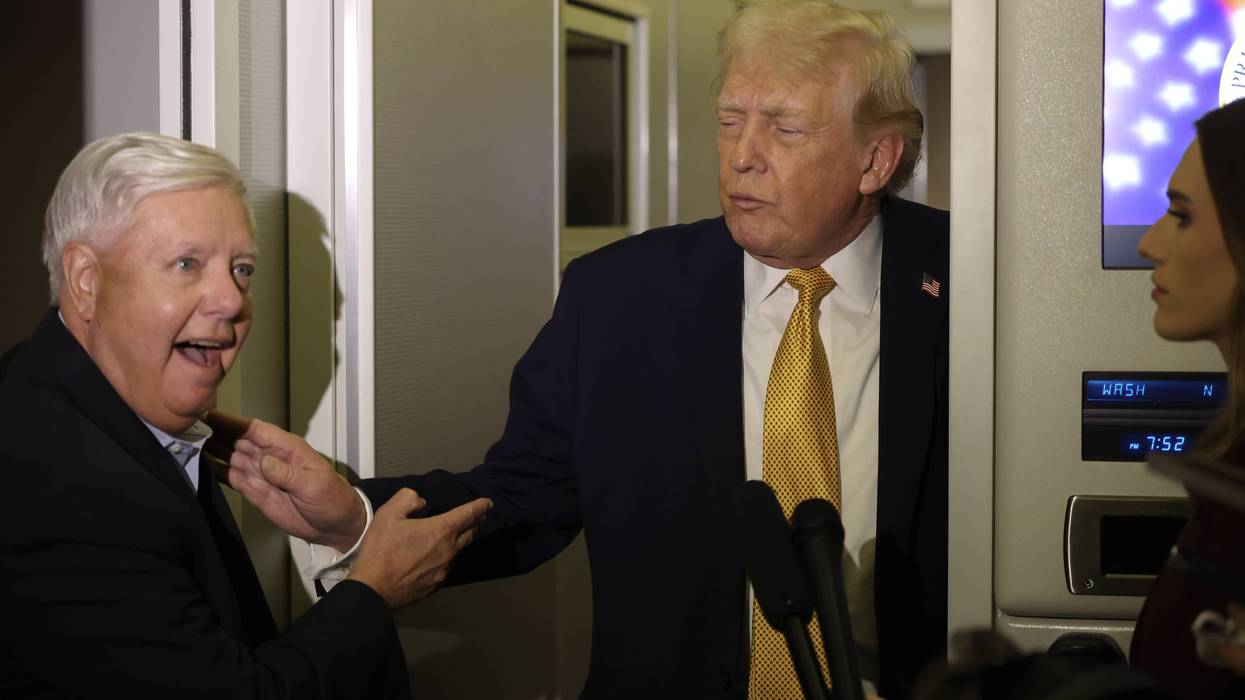
"He's never seen a war that he didn't like."
US President Donald Trump on Tuesday recalled Lindsey Graham's warmongering ways ahead of the late Republican senator's funeral, while once again threatening to commit more atrocities in Iran if an agreement to stop the war he and Israel started there is not reached soon.
Trump phoned in to Fox News' "Fox and Friends" morning show to laud his "great friendship" with the senator from South Carolina, who died on July 11 at the age of 71. Previously unreleased video published over the weekend shows Graham jubilant over Trump's decision to attack Iran in February and saying the president "loves blowing stuff up."
The president told "Fox and Friends" hosts: "He was very much a hawk, as you would say, on Iran. Lindsey liked war, to be honest with you."
"I said, you're a nice guy, how can you like war so much?" the president added. "He was a guy that liked war. I jokingly say—and there's nothing funny about it—but he's never seen a war that he didn't like."
Trump on Lindsey Graham: "He's never seen a war that he didn't like. He was very much into that -- you know, for good reason. He felt that way, some other people feel that way." pic.twitter.com/YbAttT8h8s
— Aaron Rupar (@atrupar) July 28, 2026
Graham had pushed for attacking Iran since at least 2010, both for strategic and financial reasons; in March, he boasted that the United States was "gonna make a ton of money" from the war.
While Graham isn't the only Republican in Congress to make inflammatory comments about Iran—just over the weekend, Sen. John Kennedy of Louisiana opined that "sometimes you have to kill a few chickens to scare the monkeys"—he was the most consistent cheerleader for continuing attacks on the Mideast nation.
Trump also discussed Israeli Prime Minister Benjamin Netanyahu's visit to Washington, DC to attend Graham's funeral and make the case for continued war on Iran. Netanyahu is Trump's partner in the illegal war of choice, and is additionally wanted by the International Criminal Court in The Hague for alleged war crimes and crimes against humanity in Gaza.
Graham was accused of incitement to genocide for advocating the total destruction of Gaza.
Moving on during Tuesday's interview, Trump said that if the Iranian government does not agree to a deal to end the 150-day war, "then I go back and I finish the job."
Trump and Netanyahu have both been accused of sabotaging negotiations with Iran when agreements seemed nearly at hand.
The president again said he would destroy Iranian bridges and power plants if a deal is not reached soon, his latest in a string of war crime threats that has included an earlier genocidal vow to wipe out the "whole civilization" of Iran.
"I could take out most of their bridges in less than an hour," Trump claimed on Tuesday. "I could knock out the power plants within one day."
"I think of 91 million people without power, without the bridges," he said. "And there's always the desalination plants. And who am I hurting there? I'm hurting the people. So I'm not looking to do that, [but Iran] cannot have a nuclear weapon."
US and Israeli intelligence have said for decades—including during both Trump administrations—that Iran is not trying to develop nuclear weapons.

"America is so much worse off listening to this warmonger's deranged fantasies."
Republican Sen. Lindsey Graham, who died earlier this month at the age of 71, was never quiet about his desire for a military assault on Iran.
But previously unreleased footage, filmed for a documentary that was in the works before the South Carolina lawmaker's death, shows Graham reacting with unrestrained jubilance to President Donald Trump's decision in late February to launch a large-scale attack on Iran, in coordination with the Israeli government.
"Look what we've done here," said a joyful Graham shortly after the US-Israeli bombing campaign began. "I almost cried. I mean, like, how long have we been pushing this?"
Graham, who has supported US military action against Iran for years, went on to say he "had his challenges" in advocating for the war, as "a lot of people" within the administration "didn't want to do it."
Tomorrow is Lindsey Graham's funeral.
Here is some previously unseen footage of his monstrous reaction to Trump starting the illegal war with Iran.
[laughing]
- We have done it!
[more laughter]
- I almost cried! [of happiness]
- How long have we pushed this? pic.twitter.com/Gcv6XxuKzM
— Trita Parsi (@tparsi) July 27, 2026
"The warmonger got his wish and the result has been a catastrophe," Brian Finucane, senior adviser to the US Program at the International Crisis Group, wrote in response to the footage, adding that it is "particularly outrageous for a US senator to lobby the president to violate the Constitution."
"Lindsey’s legacy will include the mass slaughter of Iranian children in a school at Minab on the opening day of the war," wrote Finucane.
Another moment captured by documentary filmmaker Alex Holder was an exchange in early March between Graham and Israeli Prime Minister Benjamin Netanyahu. As The Wall Street Journal noted in its report on the footage, Graham had "planned to travel to Florida" to "persuade President Trump to join Israel in the bombing of Hezbollah in Lebanon."
But Netanyahu—an International Criminal Court fugitive who is expected to travel to the US this week for Graham's funeral services—told Graham that "right now that's not in our interest."
“We’re concentrating right now on Iran,” Netanyahu told Graham in a March 4 phone call. “If we tell Hezbollah that we’re going all the way, we threaten them, but if we actually do it, then they have no reason not to go all the way against us."
The exchange was part of hundreds of hours of raw camera footage of Graham accumulated since 2023. "It provides an unvarnished look at Graham’s yearslong quest to topple the Iranian regime and the ways in which he persuaded Trump to strike, at times pushing for even more aggressive action than Netanyahu was prepared to take," the Journal noted.
In one clip, Graham predicted days into the US-Israeli assault that "in three to four weeks, we’re going to have them in a spot where they start losing control of some cities."
On March 4, a week into the illegal war with Iran, Lindsey Graham says that within 3-4 weeks, the Iranian government would lose control over some cities.
And by the end of that week, the Arab states would be more "openly" involved in the war, he predicts, suggesting that some… pic.twitter.com/rjTvjzjSrJ
— Trita Parsi (@tparsi) July 27, 2026
The war is now in its fifth month without a clear end in sight, and no Iranian cities have fallen.
"America is so much worse off listening to this warmonger's deranged fantasies," Trita Parsi, executive vice president of the Quincy Institute for Responsible Statecraft, wrote on social media.
Over the weekend, the US and Iran paused strikes to provide space for diplomatic talks following the collapse of an earlier ceasefire deal.
Estimates indicate that more than 3,500 Iranians have been killed by US-Israeli bombing since late February. At least 18 American servicemembers have been killed during the war, though there is considerable skepticism about that figure, given the Pentagon's lack of transparency and accounting maneuvers.

Lindsey Graham is part of the answer to the question of how a genocide could be pursued in plain sight with impunity.
The sudden death of South Carolina Sen. Lindsey Graham, 71, has been greeted with the full spectrum of reactions. Many of them were personal in character. I never met or testified before Sen. Graham, and I’m not under the illusion that the persona politicians project on television gives much insight into them as persons. This maxim is especially true for a politician, who typically tacks with the wind, as Graham often did. Nor is my interest here personal. People depict him as a nice guy to colleagues who was capable of praising rivals such as Joe Biden. That sort of senatorial bonhomie is irrelevant to the issue I want to address.
Genocides in the past 50 years have not always been easy to recognize in real time. The Khmer Rouge polished off a fifth of Cambodia’s population, but isolated journalistic reports of what was going on were dismissed in Washington. Likewise, the Clinton administration was slow to understand the mass killings in Rwanda.
It was not until April 23, 2005, that the first video was successfully posted to the World Wide Web. It was that breakthrough that made the Gaza genocide that began in October 2023 the first televised such mass atrocity. The Israeli policy of systematic killing of innocent noncombatants was live-streamed on smartphones on a daily basis throughout the world. There was no doubt about what we were seeing.
And yet, the Israeli leadership has suffered almost no repercussions for having disregarded the value of civilian life, adopting a monstrous Rules of Engagement allowing for as many as a hundred women, children, and noncombatant men to be killed for each militant targeted. NATO has ceased joint military exercises with Israel because its army violated its RoE so egregiously.
We have to revise the old saying. If you have neither the law nor the facts on your side, pound racist superiority and inherent lack of accountability.
Lindsey Graham is part of the answer to the question of how a genocide could be pursued in plain sight with impunity.
When the prosecutor for the International Criminal Court, Karim Khan, prepared in April 2024 to apply for arrest warrants for Israeli Prime Minister Benjamin Netanyahu and former Defense Minister Yoav Gallant for war crimes and crimes against humanity, former Prime Minister David Cameron shouted angrily at him that Britain would withdraw from and defund the ICC if the indictment went forward. Cameron was not in office at that time, and may have been used by the Tory government to express its displeasure without intervening officially. Labour promised to do better when it came back to power. It didn’t.
There is an old adage among lawyers: “If you have the facts on your side, pound the facts. If you have the law on your side, pound the law. If you have neither, pound the table.”
Israel’s lawyers, like Cameron and the Conservative Party in general, had neither the facts nor the law on their side, so they pounded the table. In fact, they threatened to dismantle the judge’s bench, strip his clothing off, and shoot him in the head.
Sen. Graham then joined a conference call with Khan in April, 2024, in which he lambasted the prosecutor, saying that ICC indictments are for “Africa and thugs like Putin,” not for the United States and its allies such as Israel.
If Khan’s report of this conversation is correct, it casts the late senator in an extremely poor light. It is hard to see the reference to Africa as anything but racism.
South Carolina had for centuries had one law for white people and another one for African Americans, who were kidnapped in Africa and brought to the lowcountry. Until 1863 they were held as chattel, property rather than persons. After a brief period of emancipation, they were gradually denied the right to vote or hold office, until the mid-1960s Civil Rights Act and Voting Rights Act. The point of the Trump administration, of which Graham became a pillar, is to repeal those laws and to again disenfranchise African Americans, with outrageous racial gerrymanders and measures such as limiting the number of polling stations in heavily African American districts.
While it is controversial whether Graham was personally a racist, what he said about the ICC being for Africans was certainly a racist comment, and it unfortunately replicated the long history of white sentiment in South Carolina that some laws do not pertain to white people, which is a way of saying that whites have impunity. He clearly coded Israelis as “white.” Such categorizations are worthless and arbitrary, however. Whiteness has no stable meaning. Most Israelis couldn’t have gotten served at a diner in South Carolina in the 1950s, though. What is important is that Graham so categorized them, and the significance he attached to that categorization.
That he threw Putin (and who could be more pasty?) into the mix might tell against this analysis. Yet obviously even under slavery and Jim Crow there were white criminals who harmed propertied white gentry and who did not share in impunity as a result. An example was Ian Gale, the cat burglar who robbed a hundred homes of valuables totaling as much as half a million dollars. Putin became a “thug” by attacking other white people in Ukraine, and so deserves to be dealt with as though he were an African.
It is still a racist comment.
Graham’s angry attack on Khan showed the Nixonian logic of genocide denial. It isn’t a crime if the United States or Israel does it.
Ironically, Graham was a law school graduate and served in the US Air Force Judge Advocate General’s (JAG) Corps for more than 30 years while in the Air National Guard and Reserves. He rose to hold the rank of colonel.
The JAG Corps of the Air Force admitted in 2020, “The statistics show that black male Airmen under the age of 25 and with less than 5 years of service receive NJP [nonjudicial punishment] and courts-martial actions at a higher rate than similarly situated white male Airmen.”
You give the white guy a break but throw the book at the Black guy. That was how Graham’s second institution often behaved during the decades he served in it. While for some JAG officers, this outcome may have resulted from an unconscious prejudice, Sen. Graham made his invidious view explicit in the conference call with Khan.
He also once said that it would be “terrible” if he took a DNA test and it showed he had Iranian ancestry. In retrospect I think he may have meant that such a bloodline might have made him partially brown and so would have denied him the benefits of being above the law enjoyed by white people. (Persian is an Indo-European language and Iran comes from the same root as “Aryan,” and a lot of Iranian Americans identify as white, but Graham was too incurious to have known all that.)
We have to revise the old saying. If you have neither the law nor the facts on your side, pound racist superiority and inherent lack of accountability.
And that is how Graham, in his guise as master prestidigitator, made the elephant of genocide disappear.
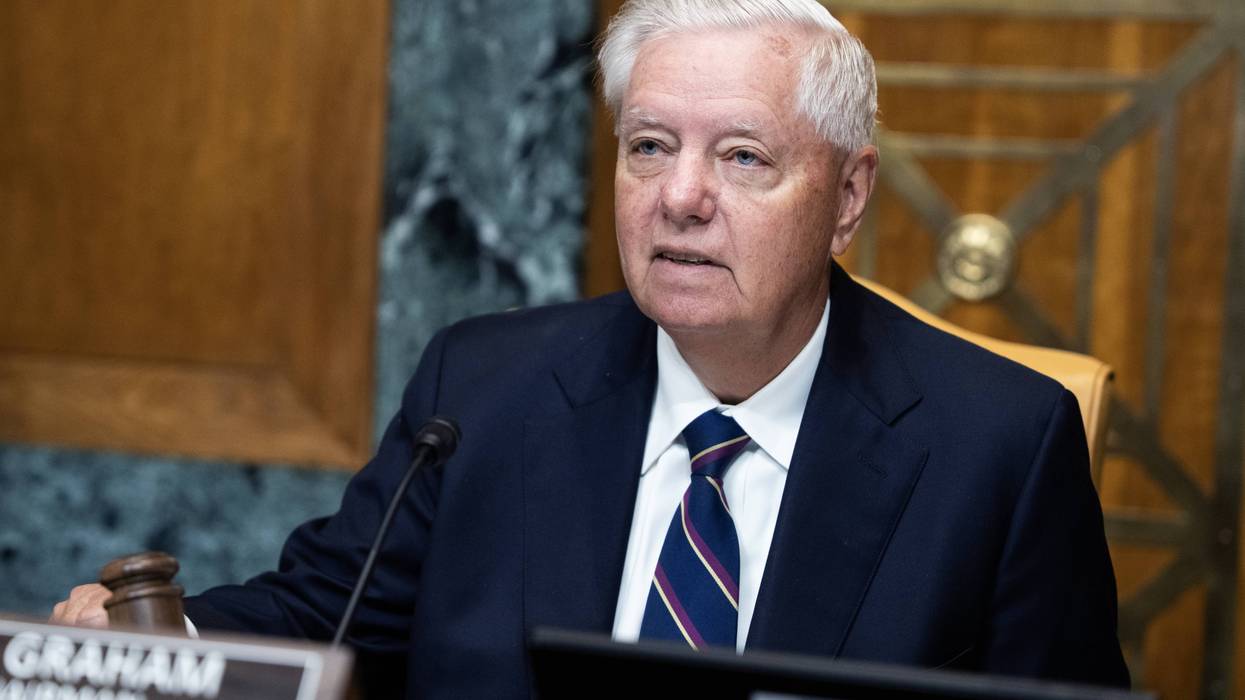
"I don't care about any other part of him: his choices caused mass death. That's it," said one critic.
Hours after Sen. Lindsey Graham unexpectedly died on Saturday, many of his Democratic colleagues in the US Senate posted statements on their social media pages paying tribute to the South Carolina Republican.
Sen. Adam Schiff (D-Calif.) said that he would most remember Graham (R-SC) for his "his sense of humor and how he deployed it to move his policy positions forward."
"Though we did not often agree," Schiff added, "Senator Graham was never disagreeable."
Sen. Elizabeth Warren (D-Mass.) similarly said of Graham that "even though we disagreed on much, he was always willing to negotiate, with humor and wit," adding "my heart goes out to his loved ones."
Sen. Andy Kim (D-NJ) said he was "saddened" to hear of news of Graham's death, which he said came "as a real shock."
"I’m grateful I had the chance to work with Lindsey," said Kim, "including several international trips working on foreign policy."
However, many critics argued that these tributes to Graham overlooked his destructive legacy in public office, including his decades of war mongering and his slavish devotion to the authoritarian President Donald Trump.
"I don't give a fuck that Graham used to be friends with Democratic senators," wrote Thomas Lecaque, associate professor of history at Grand View University. "He was a bloodthirsty bastard who cheered the killing of Muslims and sold his soul to the fascists to be able to push it more effectively. I don't care about any other part of him: his choices caused mass death. That's it."
Princeton historian Kevin Kruse, responding directly to Schiff's post, reminded him of Graham's behavior during the Brett Kavanaugh confirmation hearings when he "threw an angry tantrum in defense of a SCOTUS nominee credibly accused of rape."
"Did you all have a good collegial chuckle over that?" Kruse asked.
Brandon Friedman, co-founder of the Rakkasan Tea Company and a veteran of the Iraq War, also responded directly to Schiff.
"What I'll remember most about Senator Graham," Friedman wrote, "is how he sent my friends to die in an unnecessary war in Iraq."
Jen Rubin, editor-in-chief of The Contrarian and former columnist for The Washington Post, described the Democrats' tributes to Graham as "nauseating" and "everything that is wrong" with the US Senate.
Nicholas Grossman, professor of international relations at the University of Illinois, said the Democrats' statements were just one more signal of weakness from the party.
"The Democratic Party's approval rating is in the toilet," Grossman wrote, "and the main reason is voters see Dem leaders and prominent members acting like things are basically okay instead of fighting like there's an emergency. Slot 'my friend Lindsey Graham, so funny, how great to work with him' comments into that."
Cartoonish Eli Valley was apoplectic about Democrats' fawning hagiography of their late Republican colleague.
"That Democrats see mass-murdering fascists dismantling the country as nothing more than 'colleagues they dislike' is why we've been in a non-stop plummet," Valley wrote. "Incredible this is still debatable, by people who ostensibly oppose fascism, ten years into this?!?"
Political consultant Jamison Foser wrote a parody of the Democrats' statements that imagined them paying tribute to none other than Satan.
"Deeply saddened to learn of the loss of my dear friend Satan, the Prince of Lies," wrote Foser. "Though we often disagreed about matters such as the appropriate role of torture in the afterlife, I will most remember how his quick wit and affable nature made our weekly golf outings a ritual. He will be missed."

"Lindsey Graham will forever be remembered as an enabler of a regime that has murdered people, destroyed democratic norms, and caused irreparable harm to this country. What a horrific legacy," said one critic.
Sen. Lindsey Graham, one of the most relentless proponents for using US military force overseas, died on Saturday night at the age of 71.
In a statement posted on Graham's (R-SC) social media account, the senator's office said that he "passed away from a brief and sudden illness."
"Sen. Graham's family appreciates prayers at this time," the office added, "and asks for privacy during this incredibly difficult period."
During his life, Graham advocated either starting or getting involved in multiple wars across the world, and he was reportedly instrumental in convincing President Donald Trump to launch an illegal attack on Iran without any authorization from the US Congress.
Although Graham was once a Trump critic—he infamously declared in 2016 that the Republican Party would get "destroyed" if it made the former Celebrity Apprentice host its presidential nominee—the South Carolina Republican grew to become one of the president's staunchest allies.
Some critics of Graham reacted to his death by rehashing what they considered to be his least admirable traits.
David Dayen, executive editor of The American Prospect, remarked that Graham "never met a war he didn't want to send your kids to."
Alejandra Caraballo, clinical instructor at the Harvard Law School Cyberlaw Clinic, also reflected on Graham's lifetime of war mongering.
"You can say a lot about Lindsey Graham," Caraballo wrote, "but at least he got to see the thing he most wanted before he died, bombing school children in Iran."
Princeton historian Kevin Kruse predicted that Graham would leave behind a decidedly poor legacy.
"When Lindsey Graham appears in a history book," wrote Kruse, "it'll be his prediction in 2016 that the Republican Party would be destroyed for supporting Donald Trump and then a few lines about how he proved it by becoming Trump's toady. That's pretty much it. That's his legacy. Pathetic lickspittle."
Steve Schmidt, a former Republican strategist who left the party due to its embrace of Trump, wrote that Graham was "a simple, tragic man" who "lacked a moral core."
"The great empty spaces of his life were filled with an insatiable need for 'relevance,'" Schmidt observed. "He found it as a cast member in the most malignant reality show ever made."
Kenneth Roth, former executive director of Human Rights Watch, had a similar analysis of Graham's character.
"Lindsey Graham supported the International Criminal Court when it charged [Russian President Vladimir] Putin but turned on it when it charged [Israeli Prime Minister] Netanyahu," wrote Roth. "Principled, he wasn't."
Nicholas Grossman, professor of international relations at the University of Illinois, wrote that Graham "spent the last decade of his life in public service... trying hard to be remembered as an enemy of the Constitution who worked to destroy American democracy."
Grossman added that Graham "exhibited occasional signs that he knew why that was bad but kept doing it anyway."
Ruth Zakarin, CEO of the Massachusetts Coalition to Prevent Gun Violence, offered a grim assessment of the late senator.
"Lindsey Graham will forever be remembered as an enabler of a regime that has murdered people, destroyed democratic norms, and caused irreparable harm to this country," wrote Zakarin. "What a horrific legacy."

"Nothing was accomplished by Operation Epic Fury except putting the Islamic Revolutionary Guard Corps in charge of Iran and the Strait of Hormuz," said one critic of the war.
President Donald Trump revealed on Saturday that he is mulling a deal that would end his illegal war with Iran, and some hawks within the Republican Party are expressing alarm.
According to a Sunday report in The New York Times, many details of the agreement to end the war remain murky, with the fate of Iran's enriched uranium up in the air. US and Iranian officials have also given contradictory messages about the proposed deal's contents, suggesting there is much work still to be done before any agreement is finalized.
Regardless, three hawkish GOP senators on Saturday raised major concerns about the contents of the deal, warning against accepting any agreement that will leave Iran in a stronger position than before Trump illegally launched a war against it without any authorization from Congress in late February.
"If it is perceived in the region that a deal with Iran allows the regime to survive and become more powerful over time, we will have poured gasoline on the conflicts in Lebanon and Iraq," wrote Sen. Lindsey Graham (R-SC), who lobbied Trump to attack Iran repeatedly before the start of the war. "A deal that is perceived to allow Iran to survive and possess the ability to control the [Strait of Hormuz] in the future will put Hezbollah in Lebanon and the Shia militias in Iraq on steroids.
Sen. Ted Cruz (R-Texas), another longtime Iran hawk, said he was "deeply concerned" about what he's been hearing about the deal and expressed particular worry about Iran getting relief from US sanctions while still maintaining the ability to shut down the Strait of Hormuz.
"If the result of all that is to be an Iranian regime—still run by Islamists who chant 'death to America'—now receiving billions of dollars," Cruz wrote, "being able to enrich uranium and develop nuclear weapons, and having effective control over the Strait of Hormuz, then that outcome would be a disastrous mistake."
Sen. Roger Wicker (D-Miss.) was even blunter in his condemnation of the reported agreement.
"The rumored 60-day ceasefire—with the belief that Iran will ever engage in good faith—would be a disaster," Wicker wrote. "Everything accomplished by Operation Epic Fury would be for naught!"
Ben Rhodes, a former deputy national security adviser for President Barack Obama, challenged Wicker's claims that Trump's illegal war had achieved anything of value.
"Nothing was accomplished by Operation Epic Fury," Rhodes wrote, "except putting the Islamic Revolutionary Guard Corps in charge of Iran and the Strait of Hormuz."
Rhodes' criticism was echoed by Stephen Wertheim, senior fellow at the Carnegie Endowment for International Peace, who wrote that "everything accomplished by Operation Epic Fury is already for naught."
Ali Vaez, director of the Iran Project at the International Crisis Group, accused the Iran hawks of being delusional for thinking further bombing would force Iran to capitulate.
"DC's Iran hawks got two wars, nearly every conceivable sanction designation, a blockade, threw a wrench in global economy," Vaez wrote, "and will still claim that just a little more pressure and a touch more bombing will magically yield the concessions they still won't be satisfied with."

"The only realistic path to a diplomatic breakthrough would require Washington to engage more directly with the structure and substance of the Iranian proposal itself," said a national security expert.
With the economic impact of the war on Iran linked to President Donald Trump's plummeting approval rating, the president issued his latest threat to destroy the Middle Eastern country Sunday as he demanded negotiators "get moving, FAST" to end the conflict the US and Israel began by choice in February.
"For Iran, the Clock is Ticking," said the president in a Truth Social post, adding that if a peace deal is not reached soon, "there won’t be anything left of them. TIME IS OF THE ESSENCE!”
Trump rejected Iran's latest peace proposal last week; the country has reportedly offered significant concessions on its uranium enrichment, but seeks to have separate nuclear talks after achieving peace and reaching a deal to reopen the Strait of Hormuz, which the Iranians effectively closed in retaliation for the US-Israeli attacks.
Since launching the conflict, Trump has demanded the dismantling of Iran's missile arsenal as well as its nuclear program, which Iran has said is not for military purposes, and has called for the country to cut ties with its regional allies.
Iran's Mehr news agency said Sunday that Trump had offered "no tangible concessions" in his response to the Iranians' latest proposal.
"The United States," said the news outlet, "wants to obtain concessions that it failed to obtain during the war, which will lead to an impasse in the negotiations."
Trump told Fox News in Beijing over the weekend that the Iranians are "crazy, and you know what? Because of that, they cannot have a nuclear weapon," explaining why he viewed it as "unacceptable" for nuclear talks to take place separately after a peace deal is brokered.
Trump reportedly spoke to Israeli Prime Minister Benjamin Netanyahu Sunday about the possibility of renewing strikes on Iran, which would break a ceasefire that was reached more than a month ago.
Danny Citrinowicz, a senior researcher at the Institute for National Security Studies, said Sunday that "the only realistic path to a diplomatic breakthrough would require Washington to engage more directly with the structure and substance of the Iranian proposal itself."
"Iran’s priorities remain consistent: ending what it views as economic siege conditions, reopening maritime access and reducing pressure in the Gulf, negotiating an end to the broader conflict, and only afterward addressing the nuclear issue," said Citrinowicz. "At the present moment, it is difficult to see the Iranian leadership agreeing to any framework that does not meaningfully engage with those core demands."
As with Trump's earlier threats of violence, including one in April in which he declared that Iran's entire civilization would die, "never to be brought back again," Iranian officials said the president's latest comments—which followed his posting of an image of himself on a military ship accompanied by the words, "It was the calm before the storm"—would not be tolerated.
A spokesperson for Iran's armed forces, Abolfazl Shakarchi, told Mehr that "repeating any folly to compensate for America’s disgrace in the Third Imposed War against Iran will result in nothing but receiving more crushing and severe blows."
Reporting for Al Jazeera, correspondent Almigdad Alruhaid said that the "kind of language" displayed by Trump on Sunday "is not acceptable here in Tehran. They are projecting defiance rather than [giving] an immediate response to this kind of rhetoric."
“Behind all of this rhetoric, there is awareness that the diplomatic window right now is narrowing,” said Alruhid.
Meanwhile, US Sen. Lindsey Graham (R-SC) urged Trump to "hurt them more" in order to force a deal, calling on the president to go through with bombing Iran's energy infrastructure as he's threatened to in recent months.
Uber-warmonger Lindsey Graham calls on Trump to bomb Iran's energy infrastructure.
The reason why Trump didn't do this during the war - despite threatening it - was because he realized Tehran would retaliate and take out the energy infrastructure in the GCC states. This would… pic.twitter.com/rvrewkavNr
— Trita Parsi (@tparsi) May 17, 2026
"The reason why Trump didn't do this during the war—despite threatening it—was because he realized Tehran would retaliate and take out the energy infrastructure in the [Gulf Cooperation Council] states," said Trita Parsi, executive vice president at the Quincy Institute for Responsible Statecraft. "This would lead to a far worse oil crisis—one rooted in production problems, not just a bottleneck in the Persian Gulf."
"The global economy would be thrown into a deep recession. Fuel shortages would lead to food shortages worldwide. Trump's presidency would be destroyed," he said. "None of this matters to Lindsey. He'll burn the entire planet as long as he gets his war. Trump's biggest mistake has been to listen to Lindsey and his allies."
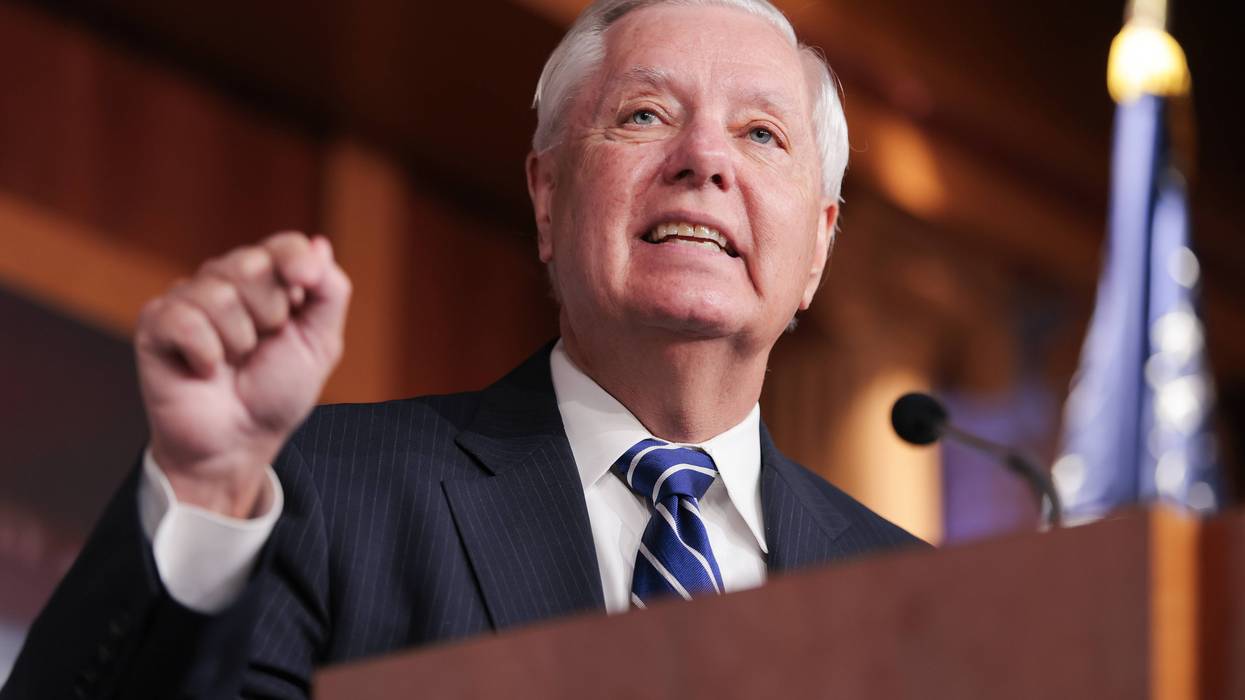
"The Republican pitch to voters in an election year dominated by the crushing costs of living in this country should be the urgent need for a new marble and gold ballroom," said one observer.
With just over seven months to go until the midterm elections, the US-Israeli war on Iran pushing gas prices past $4 per gallon, and the rising cost of living bringing consumer confidence to an all-time low, political observers marveled on Monday at Republican senators' decision to center President Donald Trump's demand for a new $400 million, 90,000-square-foot ballroom at the White House as a top legislative goal.
Sens. Lindsey Graham (R-SC), Katie Britt (R-Ala.), and Eric Schmitt (R-Mo.) held a press conference late Monday to announce their intention to expedite a bill to the Senate floor to use public funds to pay for the construction of a secure ballroom, joining Trump in insisting that a shooting at the White House Correspondents Association (WHCA) dinner on Saturday proved the project is a national security priority.
Trump has demanded the construction of the ballroom for months, ordering demolition work to begin last year as he insisted the project would be paid for entirely by private donations from companies with government contracts like Amazon, Lockheed Martin, and Google—a plan that has raised alarm over significant conflicts of interest.
The construction was halted recently after a federal court ruled the project must be approved by Congress, but an appeals court this month allowed the building to continue while it reviews the ruling.
On Monday evening, the US Department of Justice also filed a motion—which observers noted appeared to be written in the same style the president frequently uses in his social media posts—demanding that US District Judge Richard Leon dissolve his previous injunction blocking the project.
The motion started by claiming the name of the National Trust for Historic Preservation, the nonprofit that sued over the ballroom construction, is "FAKE."
"They suffer from Trump Derangement Syndrome, commonly referred to as TDS," reads the filing.
Graham said Monday that the ballroom should be paid for with $400 million in taxpayer funds collected in the form of national park fees and customs fees, with the private funding Trump secured going to extra costs like fine china.
The senator insisted the American public, whose approval of the president stood at 40% in one monthly survey in March, would support the bill.
"If you don't think $400 million of taxpayer money is a good investment to create a secure facility at the White House, then I disagree. I bet you 90% of Americans would love to have a better facility," said Graham.
Rep. Pramila Jayapal responded: "Nope. Ninety percent of Americans would love to have affordable healthcare, housing, and childcare. Or lower gas prices. Or lower grocery prices. Not a frigging illegally constructed ballroom."
Graham explained that beneath the ballroom there would be "a lot of military stuff" and "infrastructure that is national security-centric," and suggested the construction of the facility would allow Trump and future presidents to stay on the White House grounds instead of leaving for public events.
The WHCA has held its annual dinner at the Washington Hilton for decades, and it's unclear whether it would ever change the venue to the White House in order to hold the event in a "secure" ballroom.
The press conference came two days after a man armed with multiple guns and knives tried to break into the WHCA dinner and exchanged gunfire with Secret Service personnel before being tackled and disarmed. Just hours after being evacuated from the chaotic scene, Trump held a press conference with his top administration officials and declared the incident had proven that "we need the ballroom."
Graham said Monday that the president talks about the ballroom "all the time" in his conversations with Republican senators. He said the White House supports the plan to pay for the project with $400 million in public funds.
"The Republican pitch to voters in an election year dominated by the crushing costs of living in this country should be the urgent need for a new marble and gold ballroom for members of the American ruling class to have safer banquets," said one observer sardonically.
Rep. Brad Schneider (D-Ill.) told Pablo Manriquez of MeidasTouch that regardless of the GOP's claims about national security, the ballroom is "about what Donald Trump wants and what makes him more money and puts his name on another edifice. That's all the ballroom is, it's nothing the American people asked for."
Rep. Schneider tells PabloReports that the American people need lower costs, not a new ballroom.
Schneider: It’s always about what Trump wants, what makes him more money, or what puts his name on another edifice. That’s all the ballroom is. It’s not what the American people… pic.twitter.com/gvAu4w9knm
— Acyn (@Acyn) April 27, 2026
"It's nothing the American people need at a time where grocery prices continue to rise and are rising faster, gasoline costs are through the sky, and it's harder for everyday Americans to make it through every day," said Schneider. "The president's always focused on himself."
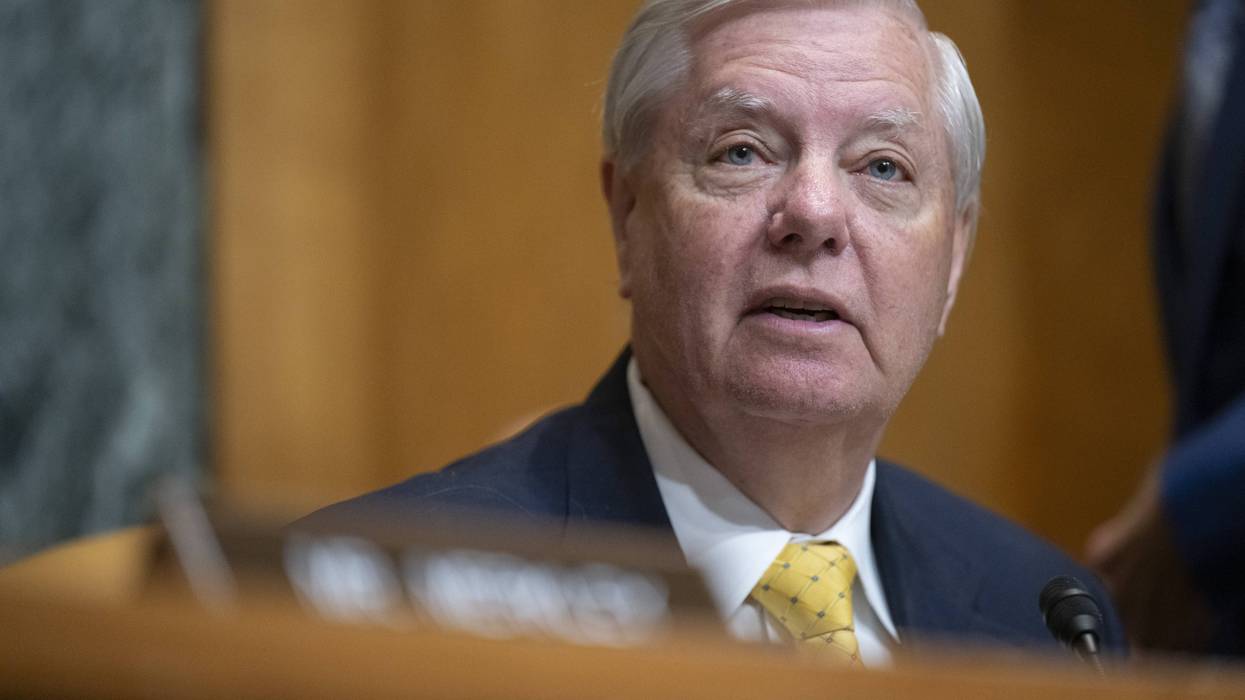
"They want to give $140 billion for ICE and Border Patrol without reforms, but $0 to lower Americans’ costs," said Senate Minority Leader Chuck Schumer.
Congressional Democrats and advocacy groups on Tuesday slammed Senate Republicans' proposed budget resolution, which authorizes up to $140 billion in new deficit spending for Department of Homeland Security agencies responsible for President Donald Trump's deadly immigration crackdown.
Senate Budget Committee Chair Lindsey Graham (R-SC) introduced the fiscal year 2026 budget resolution, which the senator's office described as "the blueprint that unlocks the pathway for a targeted reconciliation bill that will provide funding for US Immigration and Customs Enforcement (ICE) and US Customs and Border Protection (CBP)" for at least the remainder of Trump's term.
"The resolution includes reconciliation instructions allowing for up to $70 billion of deficit increases each for the Judiciary and Homeland Security and Governmental Affairs committees," explained the advocacy group Committee for a Responsible Federal Budget.
ICE is already flush with a $75 billion funding boost thanks to Republicans' so-called One Big Beautiful Bill Act, which Trump signed last July 4.
“The threats to our homeland from radical Islam are only getting more intense," Graham said, despite there being no significant attack by such forces on US soil in a decade. "Now is not the time to defund Border Patrol, and now is certainly not the time to put ICE out of business."
"These men and women have been dealing with the consequences of the over 11 million illegal immigrants that came to the United States during the Biden administration," the senator added.
There is no evidence that anywhere near that number of undocumented migrants entered the US during former President Joe Biden's tenure.
Responding to Graham's proposal, Senate Minority Leader Chuck Schumer (D-NY) said: "Earlier today, we caught our first glimpse of the Senate Republicans’ budget resolution. Forget being on the same page, Republicans aren’t even on the same planet as the American people."
"They want to give $140 billion for ICE and Border Patrol without reforms, but $0 to lower Americans’ costs," he continued. "Let me say that again: $140 billion for ICE and Border Patrol—no reforms, no accountability, no strings attached; $0 to lower Americans’ costs."
"That’s their priority. That’s why they are dragging the Senate through the arduous, convoluted reconciliation process: to put money in the coffers of Trump’s rogue agencies, rather than in Americans’ pockets," Schumer said.
"Democrats want to lower Americans’ grocery, gas, healthcare, and housing costs. Senate Republicans want to appease Donald Trump... by giving ICE and Border Patrol tens of billions of dollars to continue spreading violence in our streets," he added.
Center for American Progress (CAP) senior director of federal budget policy Bobby Kogan called the GOP budget proposal "a missed opportunity to help Americans."
"In addition to doing nothing to rein in DHS, many civil and human rights abuses, congressional Republicans’ reconciliation plan misses an opportunity to do affirmative good for struggling households," he said.
Kogan continued:
While there was broad agreement in Congress on the funding levels for the agencies within DHS itself, congressional Democratic leadership asked for a handful of reforms to try to prevent more killings of citizens and noncitizens and avoid another wave of other civil rights violations from being undertaken by the department. Congressional Republican leadership has rejected calls for legislative reforms to ICE and Border Patrol operations and is now instead using this process to provide funding with no oversight.
The Republican proposal comes as immigrant deaths in ICE custody have soared, with at least 17 people dying since January. DHS officers have also killed two US citizens, Renee Good and Alex Pretti, during the Operation Metro Surge blitz in Minneapolis.