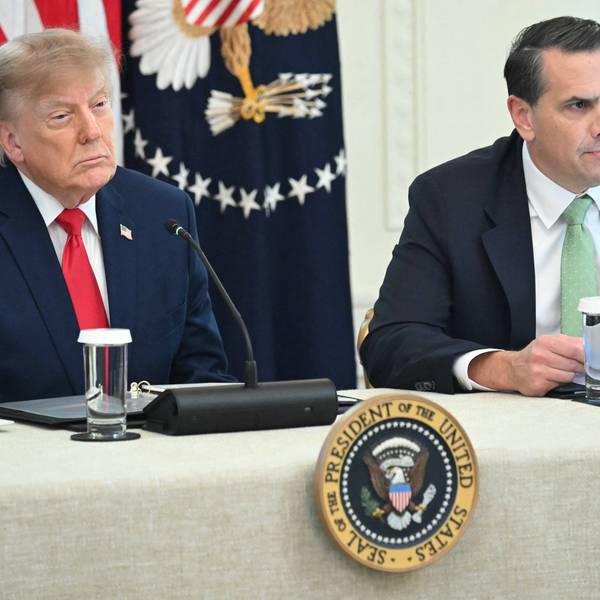

Former U.S. President Donald Trump speaks at the Mar-a-Lago Club in Palm Beach, Florida, on November 15, 2022. (Photo: Alon Skuy/AFP via Getty Images)
'There Is Evidence of Criminality': Jan. 6 Panel Meets to Decide Referrals to DOJ
The committee is reportedly considering criminal referrals for former President Donald Trump and four associates: Jeffrey Clark, John Eastman, Rudy Giuliani, and Mark Meadows.
Members of the House Select Committee to Investigate the January 6th Attack on the United States Capitol are expected to finalize decisions on criminal referrals during a virtual meeting Sunday afternoon.
CBS News' Margaret Brennan inquired about the panel's plans earlier Sunday, when Rep. Adam Schiff (D-Calif.)--a member of the subcommittee created to deal with outstanding issues, including potential referrals--to the U.S. Department of Justice (DOJ)--appeared on "Face the Nation."
Pointing to reporting that the committee is considering referrals for former President Donald Trump, ex-DOJ official Jeffrey Clark, right-wing attorney John Eastman, former Trump lawyer Rudy Giuliani, and ex-White House chief of staff Mark Meadows, she asked, "Is there a consensus on whether to send a referral for criminal prosecution to the Justice Department, and would doing that be anything more than symbolic?"
"I think we are in common agreement about what our approach should be. I'm not ready or authorized at this point to tell you what that is. We are, as a subcommittee--several of us that were charged with making the recommendation about referrals--gonna be making that recommendation to full committee today," Schiff said, adding that the decisions will be included in a panel report set to be released later this month.
Schiff continued:
What I can tell you about the process is we're looking at: What is the quantum of evidence that we have against individuals? What is the impact of making a referral? Are we gonna create some suggestion by referring some, that others, there wasn't sufficient evidence, when we don't know, for example, what evidence is in the position of the Justice Department?
So, if we do make referrals, we want to be very careful about how we do them. But I think we're all certainly in agreement that there is evidence of criminality here and we want to make sure that the Justice Department is aware of that.
In the wake of Trump's announcement last month that he is seeking the GOP's presidential nomination for 2024--despite his various legal issues and inciting last year's deadly Capitol attack with his "Big Lie" about the 2020 contest--Attorney General Merrick Garland appointed Jack Smith, a longtime federal prosecutor, as special counsel to oversee ongoing investigations involving the twice-impeached former president.
The DOJ notably does not need a referral from Congress to bring charges. Referencing the department's probes, Brennan asked Schiff, "So what does the committee sending a referral do other than look political?"
"Well, look, we have been far out ahead in most respects of the Justice Department in conducting our investigation," the congressman responded. "I think they have made use of the evidence that we have presented in open hearings. I think they'll make use of the evidence that we present in our report to further their investigations."
"And I think it makes an important statement, not a political one, but a statement about the evidence of an attack on the institutions of our democracy and the peaceful transfer of power, that Congress examining an attack on itself is willing to report criminality," he added. "So I think it's an important decision in its own right if we go forward with it and one that the department ought to give due consideration to."
Committee Chairman Rep. Bennie Thompson (D-Miss.) had confirmed to reporters on Thursday that the committee planned to make decisions about criminal referrals during Sunday's meeting.
"I think the more we looked at the body of evidence that we had collected," he said, "we just felt that while we're not in the business of investigating people for criminal activities, we just couldn't overlook some of them."
The panel's only two Republicans--Vice Chair Liz Cheney (Wyo.) and Rep. Adam Kinzinger (Ill.)--are both leaving office in a few weeks and the GOP is set to take control of the House. Rep. Kevin McCarthy (R-Calif.), who hopes to be the next speaker, has vowed to hold hearings investigating the committee.
The Hill reported Sunday that McCarthy and the other four members of Congress who ignored subpoenas from the committee--GOP Reps. Andy Biggs (Ariz.), Mo Brooks (Ala.), Jim Jordan (Ohio), and Reps. Scott Perry (Pa.)--could be referred to the House Ethics Committee rather than the DOJ.
Rep. Jamie Raskin (D-Md.), a constitutional law expert who chairs the subcommittee focusing on referrals, pointed to the relevant part of the U.S. Constitution.
"The speech or debate clause makes it clear that Congress doesn't hold members of Congress accountable in the judiciary or other places in the government," he said. "Members of Congress are only held accountable through Article 1 in their own chambers for their actions."
This post has been updated with reporting about the five House Republicans who defied subpoenas from the panel.
We are at a crossroads
This country and this world are at a monumental crossroads. In a few short weeks, US voters will have an opportunity to beat back the forces of fascism and confront the billionaires who are rigging the economy, our media system, and our democracy, making it increasingly impossible for ordinary people to get by. We’re not just talking about the election. We’re talking about what must be done once these fascist elements are vanquished from power. We need a bolder set of solutions than what either major party has so far been willing to offer and a working-class movement ready to fight like hell for it. Trump didn't emerge from nowhere. The conditions that fueled MAGA authoritarianism were created by decades of radical neoliberal economic policies and a corrupt political system dominated by corporate interests. They slashed taxes on the super-rich, promising that the benefits would trickle down. They said giveaways to the corporate titans would make life more affordable for the rest of us. It was all bullshit. And when a bitter, betrayed populace searches for someone to blame, right-wing demagogues have little trouble finding scapegoats. People know when they're being lied to, but you won't hear any of this from the corporate media. Only independent journalism—powered and funded by people who believe in building a better world—can deliver truly trustworthy daily news. Our Fall Campaign is underway, and we need your help. To power our newsroom through the rest of the year, we need to raise $125,000 by midnight on October 31. So if you share our vision, please contribute whatever you can to sustain our work. |
Members of the House Select Committee to Investigate the January 6th Attack on the United States Capitol are expected to finalize decisions on criminal referrals during a virtual meeting Sunday afternoon.
CBS News' Margaret Brennan inquired about the panel's plans earlier Sunday, when Rep. Adam Schiff (D-Calif.)--a member of the subcommittee created to deal with outstanding issues, including potential referrals--to the U.S. Department of Justice (DOJ)--appeared on "Face the Nation."
Pointing to reporting that the committee is considering referrals for former President Donald Trump, ex-DOJ official Jeffrey Clark, right-wing attorney John Eastman, former Trump lawyer Rudy Giuliani, and ex-White House chief of staff Mark Meadows, she asked, "Is there a consensus on whether to send a referral for criminal prosecution to the Justice Department, and would doing that be anything more than symbolic?"
"I think we are in common agreement about what our approach should be. I'm not ready or authorized at this point to tell you what that is. We are, as a subcommittee--several of us that were charged with making the recommendation about referrals--gonna be making that recommendation to full committee today," Schiff said, adding that the decisions will be included in a panel report set to be released later this month.
Schiff continued:
What I can tell you about the process is we're looking at: What is the quantum of evidence that we have against individuals? What is the impact of making a referral? Are we gonna create some suggestion by referring some, that others, there wasn't sufficient evidence, when we don't know, for example, what evidence is in the position of the Justice Department?
So, if we do make referrals, we want to be very careful about how we do them. But I think we're all certainly in agreement that there is evidence of criminality here and we want to make sure that the Justice Department is aware of that.
In the wake of Trump's announcement last month that he is seeking the GOP's presidential nomination for 2024--despite his various legal issues and inciting last year's deadly Capitol attack with his "Big Lie" about the 2020 contest--Attorney General Merrick Garland appointed Jack Smith, a longtime federal prosecutor, as special counsel to oversee ongoing investigations involving the twice-impeached former president.
The DOJ notably does not need a referral from Congress to bring charges. Referencing the department's probes, Brennan asked Schiff, "So what does the committee sending a referral do other than look political?"
"Well, look, we have been far out ahead in most respects of the Justice Department in conducting our investigation," the congressman responded. "I think they have made use of the evidence that we have presented in open hearings. I think they'll make use of the evidence that we present in our report to further their investigations."
"And I think it makes an important statement, not a political one, but a statement about the evidence of an attack on the institutions of our democracy and the peaceful transfer of power, that Congress examining an attack on itself is willing to report criminality," he added. "So I think it's an important decision in its own right if we go forward with it and one that the department ought to give due consideration to."
Committee Chairman Rep. Bennie Thompson (D-Miss.) had confirmed to reporters on Thursday that the committee planned to make decisions about criminal referrals during Sunday's meeting.
"I think the more we looked at the body of evidence that we had collected," he said, "we just felt that while we're not in the business of investigating people for criminal activities, we just couldn't overlook some of them."
The panel's only two Republicans--Vice Chair Liz Cheney (Wyo.) and Rep. Adam Kinzinger (Ill.)--are both leaving office in a few weeks and the GOP is set to take control of the House. Rep. Kevin McCarthy (R-Calif.), who hopes to be the next speaker, has vowed to hold hearings investigating the committee.
The Hill reported Sunday that McCarthy and the other four members of Congress who ignored subpoenas from the committee--GOP Reps. Andy Biggs (Ariz.), Mo Brooks (Ala.), Jim Jordan (Ohio), and Reps. Scott Perry (Pa.)--could be referred to the House Ethics Committee rather than the DOJ.
Rep. Jamie Raskin (D-Md.), a constitutional law expert who chairs the subcommittee focusing on referrals, pointed to the relevant part of the U.S. Constitution.
"The speech or debate clause makes it clear that Congress doesn't hold members of Congress accountable in the judiciary or other places in the government," he said. "Members of Congress are only held accountable through Article 1 in their own chambers for their actions."
This post has been updated with reporting about the five House Republicans who defied subpoenas from the panel.