SUBSCRIBE TO OUR FREE NEWSLETTER
Daily news & progressive opinion—funded by the people, not the corporations—delivered straight to your inbox.
5
#000000
#FFFFFF
To donate by check, phone, or other method, see our More Ways to Give page.
Daily news & progressive opinion—funded by the people, not the corporations—delivered straight to your inbox.

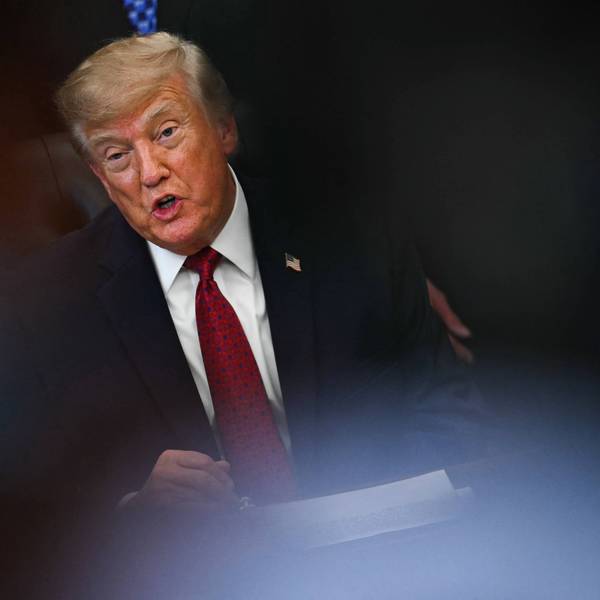
Republican presidential nominee Donald Trump is pictured during a photo-op at a McDonald's on October 20, 2024 in Feasterville-Trevose, Pennsylvania.
"Donald Trump left workers behind when he was president," said United Auto Workers president Shawn Fain.
The final stretch of the 2024 U.S. presidential race has seen Donald Trump, the billionaire Republican nominee, perform a staged shift at a Pennsylvania McDonald's and dress as a garbage truck driver in a clear effort to appeal to working-class voters who are set to play a decisive role in Tuesday's election.
But a detailed examination of Trump's first four-year term in the White House shows that despite his recent cosplaying, the GOP nominee was no ally of the working class when he was in a position to influence and enact policy.
"When Donald Trump was president, he repeatedly tried to raise the rent on at least 4 million of the poorest people in this country, many of them elderly or disabled," the investigative outlet ProPublica reported over the weekend. "He proposed to cut the federal disability benefits of a quarter-million low-income children, on the grounds that someone else in their family was already receiving benefits. He attempted to put in place a requirement that poor parents cooperate with child support enforcement, including by having single mothers disclose their sexual histories, before they and their children could receive food assistance."
Additionally, the outlet noted, Trump "tried to enact a rule allowing employers to pocket workers' tips" and succeeded in enacting "a rule denying overtime pay to millions of low-wage workers if they made more than $35,568 a year"—all of which casts serious doubt on the Republican candidate's pledge to prioritize the economic interests of U.S. workers in a second term.
ProPublica also analyzed Trump's proposed federal budgets from 2018 to 2021 and found that the former president "advanced an agenda across his administration that was designed to cut healthcare, food, and housing programs and labor protections for poor and working-class Americans."
Meanwhile, Trump worked with his Republican allies in Congress to ram through a massive tax cut for the rich and large corporations—a measure he wants to double down on if he defeats Democratic nominee Kamala Harris on Tuesday.
Trump's 2024 campaign has featured some policy proposals aimed at boosting the working class, such as eliminating taxes on tips and overtime pay.
But economists and progressive organizers have argued that the benefits of such policy changes would be marginal compared to broader proposals that Trump has not backed, such as raising the federal minimum wage and eliminating subminimum wages for tipped workers. A recent Institute on Taxation and Economic Policy analysis found that Trump's economic plans overall would cut taxes for the richest 5% of U.S. households while raising them for the bottom 95%.
During his McDonald's stunt last month, Trump ignored a question about whether he supports raising the federal minimum wage, which has been stuck at $7.25 an hour for over 15 years. Harris, by contrast, has expressed support for lifting the federal wage floor to at least $15 an hour.
"He does not give a damn about working-class people," United Auto Workers president Shawn Fain said of Trump during an appearance on MSNBC alongside Rep. Alexandria Ocasio-Cortez (D-N.Y.) late last week. "Donald Trump left workers behind when he was president. He did nothing to stop manufacturing plants leaving this country."
"With the Harris and Biden administration, we have seen a bigger investment in this country and manufacturing than I have ever seen in my lifetime. They walk the walk," Fain added. "Trump is all talk."
In a video message to the country ahead of Election Day, Sen. Bernie Sanders (I-Vt.) similarly criticized Trump as an opponent of union rights and argued Harris is the "clear" choice for those who want to improve the lives of working-class Americans.
"While some of us may have differences of opinion and disagree with Kamala Harris on this or that issue, I hope very much we will not sit out this election. We cannot sit it out," said Sanders. "So let's get involved. Let's do everything we can. Let's come out and vote on Election Day, and let's make sure that Donald Trump is defeated and that Kamala Harris is our next president."
Dear Common Dreams reader, It’s been nearly 30 years since I co-founded Common Dreams with my late wife, Lina Newhouser. We had the radical notion that journalism should serve the public good, not corporate profits. It was clear to us from the outset what it would take to build such a project. No paid advertisements. No corporate sponsors. No millionaire publisher telling us what to think or do. Many people said we wouldn't last a year, but we proved those doubters wrong. Together with a tremendous team of journalists and dedicated staff, we built an independent media outlet free from the constraints of profits and corporate control. Our mission has always been simple: To inform. To inspire. To ignite change for the common good. Building Common Dreams was not easy. Our survival was never guaranteed. When you take on the most powerful forces—Wall Street greed, fossil fuel industry destruction, Big Tech lobbyists, and uber-rich oligarchs who have spent billions upon billions rigging the economy and democracy in their favor—the only bulwark you have is supporters who believe in your work. But here’s the urgent message from me today. It's never been this bad out there. And it's never been this hard to keep us going. At the very moment Common Dreams is most needed, the threats we face are intensifying. We need your support now more than ever. We don't accept corporate advertising and never will. We don't have a paywall because we don't think people should be blocked from critical news based on their ability to pay. Everything we do is funded by the donations of readers like you. When everyone does the little they can afford, we are strong. But if that support retreats or dries up, so do we. Will you donate now to make sure Common Dreams not only survives but thrives? —Craig Brown, Co-founder |
The final stretch of the 2024 U.S. presidential race has seen Donald Trump, the billionaire Republican nominee, perform a staged shift at a Pennsylvania McDonald's and dress as a garbage truck driver in a clear effort to appeal to working-class voters who are set to play a decisive role in Tuesday's election.
But a detailed examination of Trump's first four-year term in the White House shows that despite his recent cosplaying, the GOP nominee was no ally of the working class when he was in a position to influence and enact policy.
"When Donald Trump was president, he repeatedly tried to raise the rent on at least 4 million of the poorest people in this country, many of them elderly or disabled," the investigative outlet ProPublica reported over the weekend. "He proposed to cut the federal disability benefits of a quarter-million low-income children, on the grounds that someone else in their family was already receiving benefits. He attempted to put in place a requirement that poor parents cooperate with child support enforcement, including by having single mothers disclose their sexual histories, before they and their children could receive food assistance."
Additionally, the outlet noted, Trump "tried to enact a rule allowing employers to pocket workers' tips" and succeeded in enacting "a rule denying overtime pay to millions of low-wage workers if they made more than $35,568 a year"—all of which casts serious doubt on the Republican candidate's pledge to prioritize the economic interests of U.S. workers in a second term.
ProPublica also analyzed Trump's proposed federal budgets from 2018 to 2021 and found that the former president "advanced an agenda across his administration that was designed to cut healthcare, food, and housing programs and labor protections for poor and working-class Americans."
Meanwhile, Trump worked with his Republican allies in Congress to ram through a massive tax cut for the rich and large corporations—a measure he wants to double down on if he defeats Democratic nominee Kamala Harris on Tuesday.
Trump's 2024 campaign has featured some policy proposals aimed at boosting the working class, such as eliminating taxes on tips and overtime pay.
But economists and progressive organizers have argued that the benefits of such policy changes would be marginal compared to broader proposals that Trump has not backed, such as raising the federal minimum wage and eliminating subminimum wages for tipped workers. A recent Institute on Taxation and Economic Policy analysis found that Trump's economic plans overall would cut taxes for the richest 5% of U.S. households while raising them for the bottom 95%.
During his McDonald's stunt last month, Trump ignored a question about whether he supports raising the federal minimum wage, which has been stuck at $7.25 an hour for over 15 years. Harris, by contrast, has expressed support for lifting the federal wage floor to at least $15 an hour.
"He does not give a damn about working-class people," United Auto Workers president Shawn Fain said of Trump during an appearance on MSNBC alongside Rep. Alexandria Ocasio-Cortez (D-N.Y.) late last week. "Donald Trump left workers behind when he was president. He did nothing to stop manufacturing plants leaving this country."
"With the Harris and Biden administration, we have seen a bigger investment in this country and manufacturing than I have ever seen in my lifetime. They walk the walk," Fain added. "Trump is all talk."
In a video message to the country ahead of Election Day, Sen. Bernie Sanders (I-Vt.) similarly criticized Trump as an opponent of union rights and argued Harris is the "clear" choice for those who want to improve the lives of working-class Americans.
"While some of us may have differences of opinion and disagree with Kamala Harris on this or that issue, I hope very much we will not sit out this election. We cannot sit it out," said Sanders. "So let's get involved. Let's do everything we can. Let's come out and vote on Election Day, and let's make sure that Donald Trump is defeated and that Kamala Harris is our next president."
The final stretch of the 2024 U.S. presidential race has seen Donald Trump, the billionaire Republican nominee, perform a staged shift at a Pennsylvania McDonald's and dress as a garbage truck driver in a clear effort to appeal to working-class voters who are set to play a decisive role in Tuesday's election.
But a detailed examination of Trump's first four-year term in the White House shows that despite his recent cosplaying, the GOP nominee was no ally of the working class when he was in a position to influence and enact policy.
"When Donald Trump was president, he repeatedly tried to raise the rent on at least 4 million of the poorest people in this country, many of them elderly or disabled," the investigative outlet ProPublica reported over the weekend. "He proposed to cut the federal disability benefits of a quarter-million low-income children, on the grounds that someone else in their family was already receiving benefits. He attempted to put in place a requirement that poor parents cooperate with child support enforcement, including by having single mothers disclose their sexual histories, before they and their children could receive food assistance."
Additionally, the outlet noted, Trump "tried to enact a rule allowing employers to pocket workers' tips" and succeeded in enacting "a rule denying overtime pay to millions of low-wage workers if they made more than $35,568 a year"—all of which casts serious doubt on the Republican candidate's pledge to prioritize the economic interests of U.S. workers in a second term.
ProPublica also analyzed Trump's proposed federal budgets from 2018 to 2021 and found that the former president "advanced an agenda across his administration that was designed to cut healthcare, food, and housing programs and labor protections for poor and working-class Americans."
Meanwhile, Trump worked with his Republican allies in Congress to ram through a massive tax cut for the rich and large corporations—a measure he wants to double down on if he defeats Democratic nominee Kamala Harris on Tuesday.
Trump's 2024 campaign has featured some policy proposals aimed at boosting the working class, such as eliminating taxes on tips and overtime pay.
But economists and progressive organizers have argued that the benefits of such policy changes would be marginal compared to broader proposals that Trump has not backed, such as raising the federal minimum wage and eliminating subminimum wages for tipped workers. A recent Institute on Taxation and Economic Policy analysis found that Trump's economic plans overall would cut taxes for the richest 5% of U.S. households while raising them for the bottom 95%.
During his McDonald's stunt last month, Trump ignored a question about whether he supports raising the federal minimum wage, which has been stuck at $7.25 an hour for over 15 years. Harris, by contrast, has expressed support for lifting the federal wage floor to at least $15 an hour.
"He does not give a damn about working-class people," United Auto Workers president Shawn Fain said of Trump during an appearance on MSNBC alongside Rep. Alexandria Ocasio-Cortez (D-N.Y.) late last week. "Donald Trump left workers behind when he was president. He did nothing to stop manufacturing plants leaving this country."
"With the Harris and Biden administration, we have seen a bigger investment in this country and manufacturing than I have ever seen in my lifetime. They walk the walk," Fain added. "Trump is all talk."
In a video message to the country ahead of Election Day, Sen. Bernie Sanders (I-Vt.) similarly criticized Trump as an opponent of union rights and argued Harris is the "clear" choice for those who want to improve the lives of working-class Americans.
"While some of us may have differences of opinion and disagree with Kamala Harris on this or that issue, I hope very much we will not sit out this election. We cannot sit it out," said Sanders. "So let's get involved. Let's do everything we can. Let's come out and vote on Election Day, and let's make sure that Donald Trump is defeated and that Kamala Harris is our next president."