
SUBSCRIBE TO OUR FREE NEWSLETTER
Daily news & progressive opinion—funded by the people, not the corporations—delivered straight to your inbox.
5
#000000
#FFFFFF
To donate by check, phone, or other method, see our More Ways to Give page.


Daily news & progressive opinion—funded by the people, not the corporations—delivered straight to your inbox.
The arguments against an improved IRS are motivated by private corporations worried about their profit margins and by anti-government activists seeking to undermine the public’s trust in the agency.
As Congress negotiates a bill for federal funding during the lame-duck session, lawmakers would be wise to remember that stripping funds from the Internal Revenue Service costs more than it saves. On the table in the appropriations bill is a $20 billion recission of funds to the nation’s tax administration. While this may look like a spending cut, it will increase deficits by $46 billion due to a drop in the agency’s capacity to enforce taxes on wealthy individuals owed under existing federal law.
At the same time, congressional Republicans are calling on the incoming Trump administration to end the popular program that allows taxpayers to file their returns for free directly through the IRS. This will ultimately lead to more costs for taxpayers as they pay private services such as Intuit or H&R Block to carry out paperwork that they are required by law to file each year.
Regular taxpayers benefit from a competent and well-funded IRS. Most people do their best to pay their taxes accurately and on time, and slashes to funding that leave the agency understaffed and underequipped only create headaches for compliant taxpayers. Until recently, the IRS was not given the funding and capacity to pursue the high-income taxpayers who have the most complex returns but who also account for a hugely disproportionate share of the tax avoidance, which unfairly shifted the agency’s scrutiny to everyone else.
The arguments against an improved IRS are motivated by private corporations worried about their profit margins and by anti-government activists seeking to undermine the public’s trust in the agency.
Congress must appropriate funding to each federal agency every year, even when that funding has already been authorized through prior legislation. When Congress cannot come to an agreement on funding levels, they frequently pass “continuing resolutions,” which generally keep funding at its current level to prevent a government shutdown.
To help rebuild the agency after a decade of cuts in its annual appropriations, Congress provided an additional $80 billion in the Inflation Reduction Act to supplement its annual appropriations for 10 years. Most of this money is for tax enforcement targeting profitable corporations and the wealthy. That was unpopular among congressional Republicans, who sought to eliminate the additional funding during 2023’s debt ceiling negotiations.
Filing tax returns is required by federal law, and taxpayers should not need to pay money to a private company to hand over their private information to complete the service for them.
U.S. President Joe Biden signed the IRA into law but shortly after compromised with then-Speaker Kevin McCarthy (R-Calif.) and agreed to rescind $20 billion in funds over the upcoming two years as part of a deal to prevent the Republican-controlled House from driving the United States to default on its debts. The provision to cut those funds was included in the next year’s spending bill, negotiated between Republican and Democratic lawmakers. But rather than spreading the cuts over two years, all $20 billion was included in the first year—fiscal year 2024.
Now, Congress is likely to pass a continuing resolution that would extend funding levels from 2024. Without an agreement between lawmakers, this would include an additional $20 billion funding cut to the IRS that was not included in the initial Biden and McCarthy agreement.
This is bad for the federal deficit and bad for average taxpayers.
This year, for the first time ever, many taxpayers were able to file their taxes for free directly through the IRS as part of the Direct File pilot program. In past years, taxpayers were forced to either file by hand themselves or to use paid tax preparers like TurboTax, H&R Block, or Jackson Hewitt.
Taxpayers who used the Direct File program (which was only available in 12 states during its first year) were pleased with the results. The pilot program exceeded its goal for the number of users, and 90% of users rated their experience with the program as excellent or above average.
State governments were excited about the opportunity as well. Thirteen additional states are cooperating with the IRS to expand Direct File to include their state income taxes.
It makes sense. Filing tax returns is required by federal law, and taxpayers should not need to pay money to a private company to hand over their private information to complete the service for them.
But that is exactly what many congressional Republicans are now asking the incoming Trump administration to require of honest taxpayers. Twenty-nine Republican lawmakers signed a letter to the incoming administration asking them to end the popular program on “day one.”
Previously, the IRS attempted to persuade private companies to offer free filing services for taxpayers with relatively simple returns through a program called the Free File Alliance, and the companies participated for some time. But this arrangement did not always go as planned.
Some companies hid the free services from search engine results, and in TurboTax’s case, their parent company Intuit was eventually sued for deceptively leading taxpayers into paid services rather than the free services. Intuit eventually settled for $141 million.
Between 2010 and 2021, the agency’s budget was cut by a fifth and the number of revenue agents dropped by 35%. Meanwhile, the amount of tax returns filed grew by 13%, and the amount of tax returns filed by individuals making more than $500,000 grew by 70% from 2011 to 2019. As a result, the audit rate on these wealthy individuals dropped by more than 76%.
Although the IRS budget cuts were part of a larger campaign of government austerity following the Great Recession, the cuts put the federal budget in a worse position. The gap between the taxes that people legally owed and what they actually paid grew as high as $600 billion annually by 2021, more than half of that due to unpaid taxes from the top 5% of income earners.
Every hour spent auditing the returns of the most well-off families found $13,000 in unpaid taxes.
It wasn’t just the country’s fiscal situation that suffered from the assault on the IRS. Regular taxpayers trying to file accurate and timely tax returns found themselves dealing with an agency unable to meet the needs of the public. In 2022, The Washington Post reported on outdated and understaffed IRS processing facilities. IRS employees were in many cases using 70s-era technology and business processes. The Austin, Texas facility was so strained that its cafeteria became an impromptu document storage room.
The result was that the agency was failing. It was simply unable to answer calls, respond to letters, and issue swift tax refunds.
The Inflation Reduction Act passed in 2022 reversed the decades of funding cuts to the IRS. The bill allocated $80 billion (now reduced to $60 billion and potentially even further) in funding to the agency to return its workforce to adequate levels, modernize its business systems and technology, and increase tax enforcement on big businesses and people making more than $400,000 a year.
The results were immediate. In prior years, the IRS had satisfactorily answered just 15% of phone calls. In 2023—the first tax year with the new funding—they answered 85%. That’s still too low by most standards, but a remarkable improvement. The agency also opened or re-opened 54 in-person centers to assist taxpayers across the country.
The improvements to the IRS have delivered progress toward closing the tax gap as well. In 2023, the agency released a comprehensive strategic operating plan. In addition to improving taxpayer services, the document laid out the agency’s strategy for increasing audit rates on high-income individuals and complex business structures. While it may only take one auditor a few hours to review the tax return of a family claiming the Child Tax Credit, dissecting the tax return of a large S-corporation could be a years-long project for an entire team of auditors. So, the first step was to hire highly-skilled staffers and provide them with the best training and technology available.
This year, the IRS announced that it had collected $1.3 billion in unpaid taxes from millionaire households. In many cases, these were individuals simply not even bothering to file their tax returns. The agency had also begun leveraging modern technology like artificial intelligence to identify the most suspicious returns from large, complex partnerships.
If these funding cuts are passed, there will be thousands of fewer audits of wealthy individuals and large corporations. The latest estimates from the Congressional Budget Office show that an additional $20 billion recission in IRS funds will result in $66 billion in lost revenue, creating a $46 billion rise in deficits. That estimate tracks with a recent Government Accountability Office report that found every hour spent auditing the returns of the most well-off families found $13,000 in unpaid taxes. Cutting this funding is costly, not just for the honest taxpayers who will spend more hours waiting on the phone, but with direct increases in the federal deficit.

An example of absurdist drama that prophesied Trumpist transformation is Eugène Ionesco’s Rhinoceros—the classic play in which an entire town devolves into rhinoceroses that silence any hope of coherent conversation.
In 1968, the Youth International Party nominated a pig named Pigasus for president; in 2024, the Republican Party will likely nominate a Traitor named Trump for president, a dumber and more corrupt candidate than Pigasus. The Youth International Party—the anarchic, counter-culture Yippies— nominated the pig as an absurd joke. While it’s absurd to nominate an indicted felon who tried to overturn the 2020 election, the GOP is not joking.
The Yippies’ pig had no chance of becoming president: according to the Constitution Pigasus wasn’t qualified, being younger than 35 years old. Trump as an insurrectionist is—like the pig—unqualified to be president, according to the Constitution. Yet, unlike Pigasus, he has a good chance to become president: The Supreme Court will likely discount the Constitution, he leads Biden in some polls, and, if he loses, he will try to steal the election again, threatening “bedlam” if that happens.
To rational people, it is mindbogglingly surreal that an incompetent, ignorant megalomaniac and sexual abuser like Trump, whose grating voice alone rattles teeth, would be deemed fit for the presidency, let alone close to winning power. Yet he is. Despite his enabling of the pandemic, his 2020 defeat, his instigation of the January 6 attack on the Capital, the 91 charges across four criminal cases, and his never-ending hurricane of lies, millions of reality-challenged Americans worship and support him.
Exposing its total MAGA-tization, the Republican Party has crawled with Trump into a moral abyss that turns out to be a bottomless pit of unreality. The fake GOP primary delivers phony, cowardly candidates Nikki Haley and Ron DeSantis, who are terrified of criticizing him and have promised to support him even if he were a convicted felon. They continue their sham candidacies, hoping that the laws of gravity will reverse on Trump and he will be sucked up into the vacuum of outer space. Failing that, it is perfectly fine with them that the defeated president attempted a coup and, though stopped, he can still return to the presidency.
The deranged Trump swamped his “opposition” in the Iowa caucus by 30 points. Watching cable news afterwards, it felt like I was living in Russia and Putin was running against two puppet candidates. The pundits seriously discussed the micro-details of the race and how each of the candidates fared in Nowheresville, Iowa, and no one screamed, “This is insanity—this is the cult of a madman!”
The craven cult that inflates Trump’s already-enormous self-esteem has given him the power to bend the arc of reality.
The nightmarish possibility of electing the shameless septuagenarian— a self-described dictator—is helped by his politically weak octogenarian opponent Joe Biden who frames the election as a choice between him and doomsday, but provides doomsday-style weapons and unconditional support for Israel’s Gaza genocide. In addition, Biden risks a “Red Sea War” by bombing Yemen, one of the poorest countries in the world.
Angry with Biden, pro-Palestine anti-war progressives might turn away from him in disgust—not voting or voting for third party candidates, undoubtedly funded by Republican donors. Other voters don’t like him because he is too old. In any case, Biden-hating voters might help elect the Muslim-hating, also elderly Trump, who is even more supportive of Israeli Prime Minister Benjamin Netanyahu than Biden. In his first torturous term, Trump moved the American embassy to Jerusalem and left Palestinians out of the Abraham Accords, which many viewed as a betrayal of Palestine.
In his first term, Trump’s brutality and corruption were slightly mitigated by his ignorance and laziness. In a second, Trump—older and lazier—would better understand the system’s vulnerabilities and loopholes. On inauguration day 2025, Trump will be an indicted or convicted outlaw. He will commit the first crime of his second term at noon: His oath to defend the United States Constitution will be a perjury.
In a second term, he would install an army of political loyalists whose fealty to his most unhinged demands will take precedence over their commitment to the Constitution or legal governance. They will help him drive a much more focused agenda of vengeance against his adversaries and impunity for himself. For his own survival, he must destroy the rule of law by stopping all state and federal, civil and criminal cases against him. If a president can order the justice department to stop a case against him—as Trump would surely do—then obstruction of justice becomes a normal privilege of the presidency.
A former insurrectionist re-elected to the Presidency, he would use the Insurrection Act to order the military to crush protests—which he hoped to do during the summer of 2020—and turn the power of the federal government against his perceived enemies. Paraphrasing Hitler, he said, “We will root out the communists, Marxists, fascists, and the radical-left thugs that live like vermin within the confines of our country.” It has always been Trump’s supreme political wish to wield military violence as personal weapons of power—a wish that many in his party now seem determined to help him achieve.
As xenophobe-in-chief, he hopes to institute a program of mass detainment and deportation of undocumented immigrants, who he says are “poisoning the blood” of the country, employing the rhetoric of European totalitarians. His aides have already drawn up plans for new detention centers at the U.S.-Mexico border, where anyone suspected of illegal entry would be held until officials have settled the person’s immigration status.
If Trump is returned to office, he will undoubtedly make January 6 a national holiday—the Day of the Patriotic Martyrs.
American democracy will disintegrate piece by piece as a second Trump term erects a postmodern fascist state modeled on Victor Orbán’s Hungary—destroying the legitimacy of elections, trampling constitutional rights, instituting a nation-wide abortion ban, cutting off immigration, suppressing derogatory media, promoting Christian nationalism, and undermining the rule of law.
Even beyond this horror, the craven cult that inflates Trump’s already-enormous self-esteem has given him the power to bend the arc of reality. His hallucinating supporters believe in an elaborate MAGA phantasmagoria that Trump has concocted: that the previous election was stolen, that Biden is an illegitimate president, that Biden has weaponized the legal system to prosecute his strongest opponent Trump, and that the January 6 riot was not an insurrection by Trump supporters but an instigation by the FBI and antifa.
In a brief moment after the January 6 Capitol attack, many in the GOP thought the Trump monster had been banished, a pariah in the Party. Republican leaders blamed him for the insurrection. Party fund-raisers assured donors they were done with him. Trump’s own loyalists turned against him. Former Attorney General Barr said Trump’s conduct was a “betrayal of his office and supporters.”
The Murdoch-owned lapdog Wall Street Journal argued that Trump was done: “This week finished him as a serious political figure. He has betrayed his loyal supporters by lying to them about the election and the ability of Congress and Mr. Pence to overturn it. He has refused to accept the basic bargain of democracy, which is to accept the result, win or lose.” Trump also got blamed when the 2022 midterms went seriously awry as Trump-endorsed election deniers lost winnable races and the much-hyped “red tsunami” turned into a dribble. In her book, purged Republican Liz Cheney reported that afterwards Trump was depressed and refused to eat.
After condemning Trump for January 6 and even suggesting that he resign, now-deposed House Speaker Kevin McCarthy traveled to Mar-a-Lago and, in an historically spineless act of recantation, embraced and absolved the starving former President. Cheney and many others have identified this as a pivotal moment in reviving the former president’s political viability and appetite.
Still, previous to this submission, the Republican Party threw away its best chance to bury him forever when 43 senators voted to acquit him in his impeachment after the Capitol riot. They could have relegated him to Palm Beach and saved America from hearing the despicable rants of this malfunctioning moron and putting the police and the nuclear button under his thumb.
Trump resumed eating, lying, and constructing a new absurd reality that has proven more politically salient with the GOP and its voters than many of us thought possible on January 7, 2021, even after seeing it happen over and over for the previous six exhausting, gut-wrenching years.
Pulling off a kind of double coup, this psychopathic fabricator added to the original Big Lie about the “rigged election.” He called January 6 “a beautiful day,” and he designated the nearly 1,300 defendants arrested in connection with the Capitol attack ”martyrs” and “hostages.” He has promised to pardon insurrectionists and threatened to lock up the police who tried to defend the Capitol that day. If Trump is returned to office, he will undoubtedly make January 6 a national holiday—the Day of the Patriotic Martyrs.
The GOP and the right-wing media echo system has been so effective in pumping out Trump’s upside-down-world propaganda that polling recently found that, in the intervening three years, the number of Republicans who believe Trump’s lies about a “rigged election” has, in fact, gone up. Today, only 31% of Republicans believe that Biden is the “legitimate” president, down from 39% in late 2021. The poll also showed that Republicans thought the insurrectionist mob were mostly peaceful.
For millions of people, Trump has managed to transmute historical events that everyone saw with their own eyes into theater of the absurd, an anti-realistic dramatic genre characterized by dark humor, incoherent language, strange symbolism, and themes that relate to human irrationality.
An example of absurdist drama that prophesied Trumpist transformation is Eugène Ionesco’s Rhinoceros—the classic play in which an entire town devolves into hard-skinned, monstrous rhinoceroses that issue ear-shattering bellows that silence any hope of coherent conversation. Rhinoceros thundered onto the stage, in 1960, with a chilling yet farcically funny allegory of how fascism can mutate ordinary people into angry, violent, mindless beasts whose articulateness dissolves into a cacophony of guttural honks.
Writing in the wake of Hitler and Stalin, Ionesco painted a picture of a society succumbing to the contagion of “rhinoceritis,” a disease that erodes individuality and replaces it with groupthink and casual brutality as well as a hatred of non-rhinoceroses. The transformative infection suggests the dehumanizing force of tyrannical ideologies.
Becoming a huge, horned rhinoceros is gradually normalized: A formerly concerned character Jean dismisses his friend’s terror at the multiplication of grotesque rhino mutations and their deleterious effects on human freedom. Jean debases himself and enables rhinoceritis when he says that despite their savage deformity, they’re “harmless, docile herbivores” and “seem so sure of themselves.” This mindless acceptance and rationalization foreshadows the insidious nature of the disease, disguising its destructive potential.
Ionesco’s play exposes the lure of surrendering to a mass authoritarian movement and abandoning the burden of independent thought. Among Trump’s abettors are numerous verifiably insane congresspeople who have been infected by rhinoceritis for a long time such as Marjorie Taylor Green, Lauren Boebert, and Matt Gaetz. But it’s the transformed normies that are most pathetic.
Current House Majority Whip Tom Emmer angered Trump when he voted to certify Biden’s election, unlike 147 colleagues who voted to overturn the election. When Emmer ran for his dream-job Speaker of the House, Trump sank his candidacy, warning that he would be a “tragic mistake” and calling him a “Globalist RINO” (not a rhinoceros). Two months later, Emmer—like nearly 100 members of the House, said, “I am proud to endorse Donald J. Trump for President.” Expressing his gratitude to Emmer for his miserable self-abasement, Trump smirked, “They always bend the knee.”
One of the more pitiful examples of “Trump Debasement Syndrome” is Sen. Josh Hawley, the guy who egged on the January 6 rhinoceros-thugs with a fist-pump that lamely showed solidarity with them and then was recorded in security footage fleeing for his life to avoid those same stampeding thugs. Hawley has decided to “forget” his traumatic escape from the mob, though he had not endorsed King Rhinoceros as the Iowa caucus approached. Exhibiting concern for Hawley’s electoral health, Trump warned him to “be very careful” in his Senate re-election campaign. Shortly thereafter, Hawley joined the Republican Rhino herd and publicly endorsed Trump saying, “I’m with him.”
Rhinoceros explored the erosion of moral values, the seductive nature of power as people become mere instruments of brute strength and aggression. As authority figures collapse and undergo metamorphosis, other people find it easier to justify why becoming a rhinoceros is desirable. As one character declares, “It‘s the strength that counts, don’t you want to be strong?”
Once a rising conservative normie in the party—an acolyte of former Republican VP candidate Paul Ryan, Rep. Elise Stefanik has transmogrified into an automated MAGA rhinoceros. She trumpeted Trump’s reference to the January 6 criminals as “hostages,” and embraced the claim that the 2020 election was an “unconstitutional circumventing of the Constitution.” Stefanik refused to commit to certifying the results of the 2024 election, saying “We will see if this is a legal and valid election.” After calling the media biased against Trump, she said the “border crisis is poisoning Americans.” Desperately thirsty for Trump’s VP spot, Stefanik has become a eager demagogue.
What began, in Rhinoceros, as isolated incidents becomes a rhinoceros contagion as the town’s residents witness an astonishing metamorphosis as more and more people sprout horns, grow enormously huge with hard green skin, and succumb to the allure of the rampaging Rhino fascists. There are no elections in Rhinoceros Town so the entire society is transformed, except for one individual Berenger who shouts, “I’ll take on the whole of them! I’ll put up a fight against the lot of them! I’m the last man left, and I’m staying that way until the end. I’m not capitulating.”
The entire Republican Party—elected officials and voters—have capitulated. They’ve chosen the sickness, nihilism, and absurdity. Fortunately, we still have democracy. Stopping the Trump contagion will not suddenly eradicate the disease and make America perfectly healthy, but it is vital to embrace reality, reject the absurd, prevent further suffering, and preserve the possibility of progress.
While the chamber's GOP leader brushed off concerns, others predict that "Johnson's days as speaker could be numbered."
Just over a week away from a partial government shutdown, 13 far-right Republicans in the U.S. House of Representatives on Wednesday protested Speaker Mike Johnson's bipartisan spending deal by joining Democrats to tank an unrelated procedural vote.
Congressional Democrats, Capitol Hill journalists, and other observers highlighted the development as further proof of "Republicans in disarray" as the January 19 deadline looms. Some government agencies are funded until then; others have until February 2.
"The House is essentially frozen again. The GOP leadership cannot bring up any bills that are not already noticed on the suspension calendar. And conservatives just killed leadership's ability to bring up any bills under a rule," Punchbowl News' Jake Sherman explained, calling the House "ungovernable" and the vote "an unmitigated disaster" for Republicans.
"House Republicans are intent on having 2024 in Congress look a lot like it did in 2023: full of dysfunction and chaos."
Decrying "another week of House GOP chaos and confusion," U.S. Rep. Jim McGovern (D-Mass.) similarly declared that "the incompetence of Republican leadership is a total unmitigated disaster for this country."
Other House Democrats also piled on and stressed that a government shutdown is just nine days away.
"So far, it seems House Republicans are intent on having 2024 in Congress look a lot like it did in 2023: full of dysfunction and chaos," asserted Rep. Raja Krishnamoorthi (D-Ill.).
"Deja vu! House Republicans have lost control of the House floor, again. House Republicans have repeatedly shown that they cannot govern," said Rep. Ted Lieu (D-Calif.).
Congressional Progressive Caucus Chair Pramila Jayapal (D-Wash.) agreed, saying that "Republicans simply can't govern," and separately pointing out that "they're leading the least productive Congress since the Great Depression—it's an embarrassment."
Last October, far-right House Republicans ousted then-Speaker Kevin McCarthy (R-Calif.)—who ultimately resigned from Congress at the end of last year, reducing his party's majority—and eventually replaced him with Johnson (R-La.), after Reps. Tom Emmer (D-Minn.), Steve Scalise (R-La.), and Jim Jordan (R-Ohio) all abandoned their speakership bids.
While Johnson's election was seen as a sign of the far-right's hold on the Republican Party, he and Senate Majority Leader Chuck Schumer (D-N.Y.) still reached a spending agreement on Sunday that largely aligns with the deal McCarthy and President Joe Biden negotiated last year while passing the Fiscal Responsibility Act to prevent a U.S. default.
Johnson and Schumer agreed to $886 billion for defense and nearly $773 billion for nonmilitary spending for fiscal year 2024. The Senate leader and House Minority Leader Hakeem Jeffries (D-N.Y.) also said Sunday that they made clear to Johnson that "Democrats will not support including poison pill policy changes in any of the 12 appropriations bills."
NBC News noted that before the vote on Wednesday, Johnson "did not rule out another short-term funding bill to avert a shutdown later this month, a shift from December when he vowed there would be no more stopgap bills in 2024."
Explaining the far-right revolt, House Freedom Caucus Chair Bob Good (R-Va.) reportedly told journalists, "We're making a statement that the deal, as has been announced—that doesn't secure the border and doesn't cut out spending and is going to be passed apparently under suspension of the rules with predominantly Democrat votes—is unacceptable."
According to Politico:
As the vote failed, Johnson left the floor and huddled in his office with Republicans on the Rules Committee, including Rep. Chip Roy (R-Texas), who has flirted with trying to oust the speaker after the topline spending agreement.
"We'll see," Roy said as he was leaving Johnson's office about the potential that additional bills go down. "Right now, the point here is that we're not remotely satisfied."
Appearing on Fox News after the revolt on Wednesday, Johnson stressed that he, too, is a "conservative hardliner" and acknowledged the frustrations of Roy and others, while also dismissing concerns that he may be ousted like McCarthy was just a few months ago.
Johnson said that "I don't think I'm in any jeopardy of being 'vacated,'" but others were quick to frame the vote as a signal that a motion to vacate may be coming soon.
"The GOP can't manage to pass rules (largely unheard of before this Congress), they're about to chase off another speaker, and they're showing revenge porn in committee again... The 118th Congress," said Rep. Summer Lee (D-Pa.).
Democratic strategist Sawyer Hackett declared: "Here we go again. A dozen or so Republicans are blocking passage of a rules vote to protest Speaker Johnson agreeing to a spending deal similar to McCarthy. Johnson's days as speaker could be numbered."
The Louisiana congressman has been called "the most important architect" of a scheme inside the House to provide cover for Republicans trying to overturn the election results of 2020.
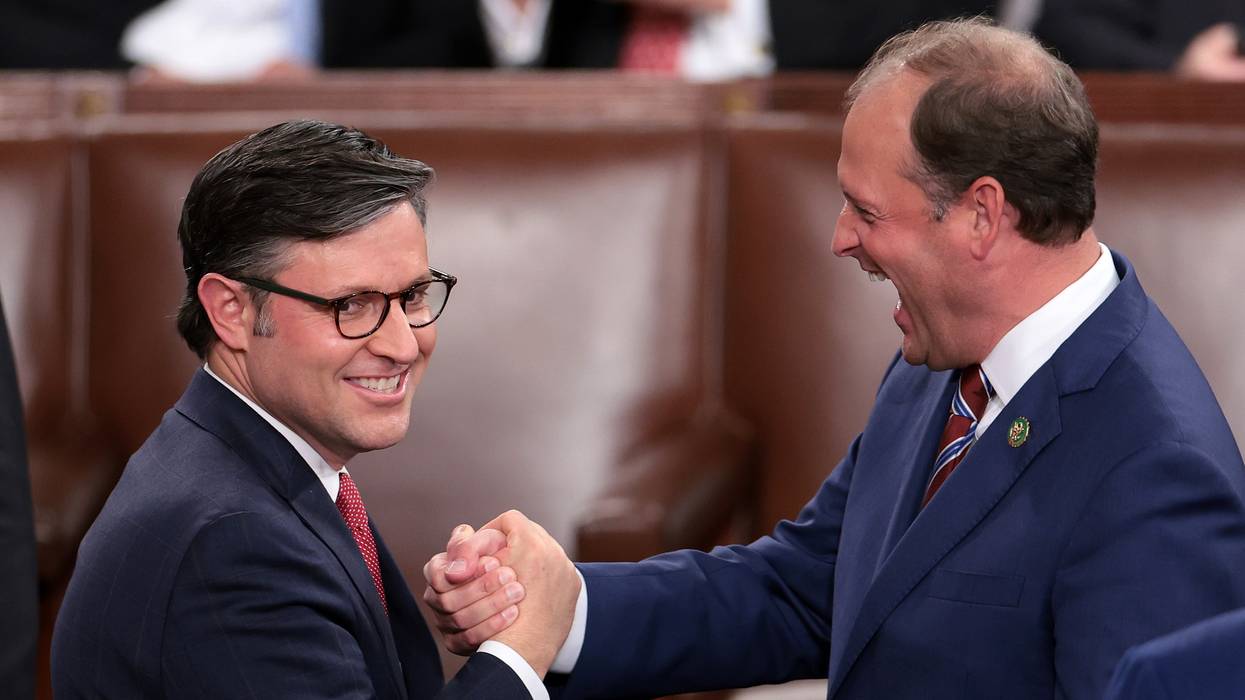
After three failed nominees in as many weeks, Republicans in the U.S. House of Representatives on Wednesday elected Louisiana Congressman Mike Johnson as speaker—a signal of the far-right's hold on the party.
The 220-209 vote along party lines came after Reps. Tom Emmer (D-Minn.), Steve Scalise (R-La.), and Jim Jordan (R-Ohio) abandoned their speakership bids in the wake of a few far-right Republicans voting with Democrats earlier this month to remove Rep. Kevin McCarthy (R-Calif.), whose January election took 15 rounds of voting and required concessions to the far-right.
"MAGA is ascendant," Rep. Matt Gaetz (R-Fla) declared this week, referring to the "Make America Great Again" campaign slogan of former President Donald Trump, who is Republicans' 2024 presidential front-runner, despite his ongoing criminal cases.
"If you don't think that moving from Kevin McCarthy to MAGA Mike Johnson shows the ascendance of this movement and where the power in the Republican Party truly lies, then you're not paying attention," added Gaetz. He was speaking with Steve Bannon, Trump's former chief strategist, who last year was found guilty of contempt of Congress for defying a subpoena from the U.S. House Select Committee to Investigate the January 6th Attack on the United States Capitol.
Some objections to Johnson, vice chair of the House Republican Conference, relate to the January 6, 2021 insurrection, incited by Trump and his "Big Lie" allies as Congress was certifying Joe Biden's 2020 win.
"Today is a dark day for American democracy," Stand Up America founder and president Sean Eldridge said Wednesday following the vote. "Mike Johnson's record of election denial and his attempts to overturn the will of the people make him totally unfit to be second in line to the presidency. Those who have spent years trying to undermine our democracy cannot be trusted to lead it."
"Entrusting the House of Representatives to a man The New York Times called 'the most important architect of the Electoral College objections' is proof of House Republicans' contempt for our freedom to vote," Eldridge added. "The American people deserve a speaker who will stand up for our democracy and our fundamental freedoms, but sadly, House Republicans have embraced MAGA extremism instead."
Reporting earlier this month on the 139 House Republicans who voted to dispute the Electoral College count in 2021, the Times explained:
While most House Republicans had amplified Mr. Trump's claims about the election in the aftermath of his loss, only the right flank of the caucus continued to loudly echo Mr. Trump's fraud allegations in the days before January 6, the Times found. More Republican lawmakers appeared to seek a way to placate Mr. Trump and his supporters without formally endorsing his extraordinary allegations. In formal statements justifying their votes, about three-quarters relied on the arguments of a low-profile Louisiana congressman, Rep. Mike Johnson, the most important architect of the Electoral College objections.
On the eve of the January 6 votes, he presented colleagues with what he called a "third option." He faulted the way some states had changed voting procedures during the pandemic, saying it was unconstitutional, without supporting the outlandish claims of Mr. Trump's most vocal supporters. His Republican critics called it a Trojan horse that allowed lawmakers to vote with the president while hiding behind a more defensible case.
Patriotic Millionaires chair Morris Pearl, who also noted the Times' reporting on Wednesday, said, "That Republicans would elevate Mike Johnson to the speakership is as reprehensible as it is predictable."
"His actions leading up to January 6th were disqualifying: He has no business in elected office, let alone wielding the speaker's gavel," Pearl added. "Sadly, this is of no concern for the modern GOP, which is contemptuous of the basic tenets of democracy. His election as speaker is a damning statement on our politics and a blight on the institution of the House of Representatives."
Advocates of reproductive freedom, climate action, and protecting programs like Social Security also opposed Johnson.
"Johnson has a long history of hostility towards Social Security and Medicare," noted Social Security Works executive director Alex Lawson. "Multimillionaire Johnson has also made the outrageous claim that forced births are necessary to fund Social Security."
Food & Water Action deputy director Mitch Jones warned in a statement Wednesday that "Speaker Johnson, an egregious climate skeptic and proud election denier, has had his career bought and paid for by the oil and gas industry. Johnson's shameful anti-truth, anti-science views are a clear and present danger to America's public health and environment.
NextGen America similarly said on social media that "from denying the results of the 2020 election to supporting a national abortion ban, it's clear: He's a threat to our future and democracy. Yeah, we're just as horrified as you are."
Public Citizen executive vice president Lisa Gilbert asserted that "Mike Johnson's claim to fame is leading the charge to deny President Biden's certification and attempting to overturn a democratic election."
"A year out from the next presidential election," she added, "House Republicans have made their contempt for democracy and their intent to lean into full-on election denialism crystal clear."
This post has been updated with comment from Patriotic Millionaires.
They don’t want to drown the government quietly in a bathtub but to strangle it on live TV, and keep in mind that they have imagined nothing with which to replace it.
Sometimes the right wing in this country seems like a riddle wrapped in an enigma encased in a conundrum.
Do they want to strengthen the government in line with the once-fringe doctrine of the “unitary executive,” concentrating most official power in the hands of a president who would then rule more or less by fiat? That’s the fascist position.
Or would they prefer to destroy the government, to “starve the beast,” something anti-tax activist Grover Norquist used to call for decades ago? “I don’t want to abolish government,” he declared. “I simply want to reduce it to the size where I can drag it into the bathroom and drown it in the bathtub.” That’s the anti-government nihilist position.
Just as we face so many crises globally, the legislative branch of the world’s (theoretically) most powerful country has ceased to function.
You might not think that those two goals could coexist comfortably within a single party. And of course, you’d be right if you were talking about an ordinary American political party. But the Republicans are no longer an ordinary party. In many respects, in fact, they have become the however-fractious sole property of one Donald J. Trump. That former and quite possibly (God forbid) future president has no trouble simultaneously advocating contradictory, not to mention devastating, ideas. That’s because, for him, ideas are an entirely fungible currency that he deploys primarily to maintain the attention and adulation of his—and it is increasingly his alone—GOP “base.” And precisely because Trump has so little invested in actual policy, the right wing believes he’s a weapon they can point and shoot in whatever direction they choose.
You might also wonder why, at a moment when horror is being heaped on horror in Israel/Palestine, when wars continue unabated in Ukraine and Sudan, I find myself focusing on some distinctly in-the-weeds aspects of the American political system. Perhaps it’s partly to distract myself from all the other nightmares around us. But even if I believed (which I don’t) that the right response to the crisis in Israel/Palestine involved sending more weapons and money to Benjamin Netanyahu, Congress isn’t in a position to appropriate anything at the moment.
Just as we face so many crises globally, the legislative branch of the world’s (theoretically) most powerful country has ceased to function. Perhaps by the time you read this, Republicans in the House of Representatives will have stopped squabbling over which right-wing bigot should be speaker. Maybe they will have opted for Jim Jordan, who has accused the Biden administration of planning to replace white voters with immigrants, or perhaps someone else entirely. Remember, too, that whatever joker emerges as speaker from such a chaotic process will be second in line to the presidency, should something happen to Joe Biden and Kamala Harris.
Recently, I’ve somehow managed to end up on a few right-wing email lists. The strangest people (Ron DeSantis, for example) are writing to ask me for money. My most recent supplicant was Stephen Miller, former senior adviser to President Trump and co-author, with Steve Bannon, of Trump’s 2017 inaugural address in which the new president inveighed darkly against the “American carnage” he saw defiling the nation’s landscape. These days, Miller is himself a president of something called the America First Legal Foundation, which bills itself as “Fighting Back against lawless executive actions and the Radical Left.”
Miller, it turns out, has written to let me know that “we are living in extremely perilous times and a truly dangerous moment for our Republic.” As it happens, I agree with him, though obviously not for the same reasons. “The federal bureaucracy has turned against the American people,” Miller’s missive continues. “It has been completely corrupted into an ideological monolith of hard-left loathing for America. The fearsome power [his emphasis] of the state is raining down on political dissidents, while violent and vile criminals are released into our communities.” The solution, of course, is to send money to America First Legal, so it can get on with the business of “Fighting Back against lawless executive actions.”
Miller, however, will likely be less concerned about the fearsome power of the state once it’s again in the hands of Donald Trump. Indeed, he’s part of a group of former and present Trump advisers engaged in planning for a potential presidential transition in 2025. These include Russell Vought, who ran Trump’s Office of Management and Budget, and former Trump White House chief of personnel John McEntee. As The New York Times reported in July,
Mr. Vought and Mr. McEntee are involved in Project 2025, a $22 million presidential transition operation that is preparing policies, personnel lists, and transition plans to recommend to any Republican who may win the 2024 election. The transition project, the scale of which is unprecedented in conservative politics, is led by the Heritage Foundation, a think tank that has shaped the personnel and policies of Republican administrations since the Reagan presidency.
The key thrust of Project 2025 is full implementation of the “unitary executive” principle—the view that the Constitution locates the power of the executive branch in a single individual, the president. In its maximalist version, according to the Times, this theory also contradicts the long-held doctrine of the separation of powers, under which three co-equal branches of government—executive, legislative, and judicial—provide checks and balances on each other. Under the unitary executive principle, presidential power simply outweighs that of either Congress or the Supreme Court. Project 2025’s backers know that Donald Trump will agree and act accordingly.
By “long-held doctrine” I mean a blueprint for democratic government that goes back to two 17th- and 18th-century political philosophers: Charles Montesquieu, who first wrote about the separation of powers, and John Locke, whose ideas about unalienable rights were enshrined in the Declaration of Independence. Like Montesquieu, Locke advocated for a separation of governmental powers in which the legislative, not the executive, would be supreme. In that view, the democratically elected legislature makes a nation’s laws and—just as the name suggests—the executive exists to “execute” them.
Despite their occasional homages to Montesquieu and Locke, the Heritage Foundation and its followers have flipped that thinking upside down by insisting that the Constitution considers the executive branch superior to the other two. If that were the case, wouldn’t the executive branch be described in that document’s first article? In fact, Articles I, II, and III describe the legislative, executive, and judicial functions in that order, suggesting that if any of these is superior, it is (as Locke argued) the legislative.
Heritage, however, points to Article II, which begins: “The executive Power shall be vested in a President of the United States of America. He shall hold his Office during the Term of four Years, and, together with the Vice President, chosen for the same Term, be elected, as follows…” What “follows” is a lengthy description of the very electoral process that Trump and company tried so hard to suborn on January 6, 2021.
While Trump was president, he delighted in explaining to anyone who’d listen that he had “an Article II, where I have the right to do whatever I want as president.” At the time, that suggestion of ultimate power was met with widespread derision.
However, were Trump to be re-elected, the folks at the Heritage Foundation’s Project 2025 and the America First Policy Institute have plans to, as the starship Enterprise captain Jean-Luc Picard would say, make it so. As the Times reported in July, their goal is “to alter the balance of power by increasing the president’s authority over every part of the federal government that now operates, by either law or tradition, with any measure of independence from political interference by the White House.” Consider what follows a first step in exactly that direction.
Okay, now let’s truly dive into the weeds: In his final year as president, Trump issued an executive order amending the regulations governing the federal civil service. That service was instituted by law in 1871 in response to what was then seen as rampant favoritism throughout the federal government. Patronage jobs—positions granted, often to the friends and family of powerful politicians or in return for money or favors—were officially eliminated. Competitive processes designed to select qualified candidates for specific positions replaced the old system.
Today, the Office of Personnel Management oversees the hiring and firing of roughly 2.2 million civilian federal employees, the people who keep the wheels of government turning. They administer Social Security, Medicare, and the Internal Revenue Service, among many other things. They make sure that your meat isn’t rotten and the alcohol content of your vodka bottle is what it says on the label.
The vast majority of those employees are chosen through competitive examinations, but about 4,000 key positions are directly appointed by the president or other senior officials, including the leadership of many agencies, like the Environmental Protection Agency or the Occupational Safety and Health Administration, and other government executives. It’s not unreasonable for presidents to want to put their own policy stamp on various branches of government through such appointments.
It’s estimated that implementing Schedule F would have sent the number of exempt civil service employees soaring from 4,000 to roughly 50,000.
Those 4,000 positions exempted from competitive hiring fall into five categories, delineated in five “schedules” (lists) described in a subsection of Title 5 of the United States Code. To be exact, Rule VI of Subsection A of Title 5—I told you we were going to get into the weeds!—lists in Schedules A through E the employees exempt from civil service exams.
Or at least those were all the exempt categories until October 2020. That’s when Donald Trump issued an executive order creating Schedule F, which exempted from competitive hiring all “career positions in the Federal service of a confidential, policy-determining, policy-making, or policy-advocating character.”
Such a broad, ill-defined category could, in fact, have come to include any junior employee in any federal department who might in the course of his or her employment have cause to send a memo to a superior advocating any action. It’s estimated that implementing Schedule F would have sent the number of exempt civil service employees soaring from 4,000 to roughly 50,000.
On taking office, however, President Joe Biden immediately rescinded that executive order so, at the moment at least, Schedule F no longer exists.
In fact, the feckless President Trump we knew wasn’t even vaguely prepared to replace 50,000 civil servants with his own people during his last few months in office or, likely as not, over the following four years had he been re-elected. That’s where the Heritage Foundation’s Project 2025 comes in. They are now spending millions of dollars to recruit and vet political appointees who would toe the Trump line (a line they hope to draw in a future Trump presidency).
The rock band Stealers Wheel caught our current situation perfectly back in 1972 when they sang about “Clowns to the left of me/Jokers to the right.” The jokers to the right of me (and to the right of the majority of the people in this country) are the members of the House Freedom Caucus, their allies, and other MAGA followers. They are the ones (de)constructing the house of cards that Congress is becoming at this very moment. To call them anarchists would be an insult to conscientious anarchists everywhere. They are, in fact, anti-government nihilists who believe in little beyond a kind of gun-slinging performative violence. They don’t want to drown the government quietly in a bathtub but to strangle it on live TV. And keep in mind that they have imagined nothing with which to replace it.
Where to begin? Those Freedom Caucusers in the House are now walking weapons in search of a target. Yes, they threatened to shut down the government unless their demands were met, but then they couldn’t even decide what those demands were. Did they want to cut Social Security, Medicare, and other social service programs? Impeach President Biden? Stop the prosecutions of Donald Trump? Increase border security? Stop funding Ukraine’s war effort?
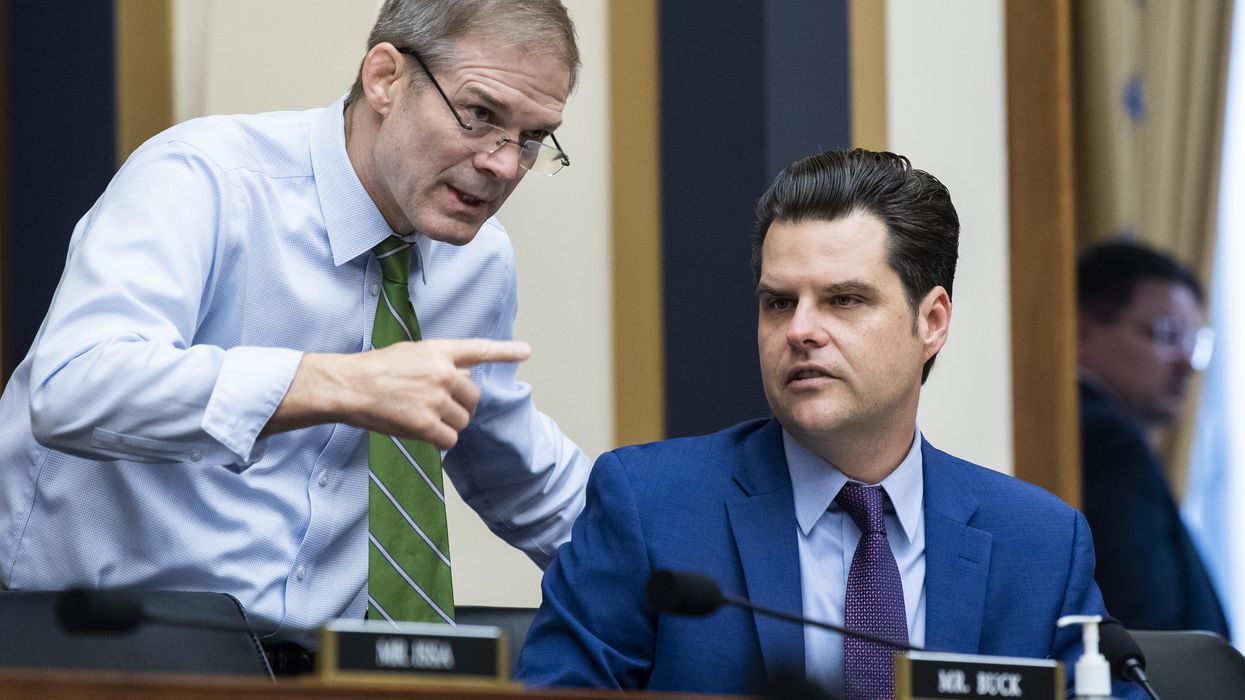
When House Speaker Kevin McCarthy agreed to cooperate with the Democrats to prevent just such a shutdown, they threw him out. Then they couldn’t agree on a new speaker, even though the House of Representatives can’t conduct business without one. Yet not a day passes without a bomb-thrower like Matt Gaetz strutting around saying things like:
My goal is to get the most conservative Speaker of the House with broad trust across the conference. The Swamp of Washington D.C. is going crazy right now because they are not in complete and total control—this gives us a great opportunity to put the interests of our fellow Americans first.
Much of this would be funny if it weren’t so deadly serious. However, recent polls suggest that a 2024 contest between Donald Trump and Joe Biden remains a toss-up. As historian Heather Cox Richardson recently told The Guardian, “Democracies die more often through the ballot box than at gunpoint.” The re-election of Trump. she believes, will signal
an end of American democracy. I have absolutely no doubt about that, and he’s made it very clear. You look at Project 2025, which is a thousand pages on how you dismantle the federal government that has protected civil rights, provided a basic social safety net, regulated business, and promoted infrastructure since 1933. The theme of his 2024 campaign is retribution.
I don’t think people understand now that, if Donald Trump wins again, what we’re going to put in power is those people who want to burn it all down.
I can’t say it any better than she has. They want to burn it all down so that they can rule over the smoldering ashes. That would put us on a true Schedule F—for Failed State—a condition this country now seems hellbent on achieving.
As former President Donald Trump attacked him, some progressives argued that "Democrats should only support a speaker that would disempower the Freedom Caucus through a power-sharing agreement."
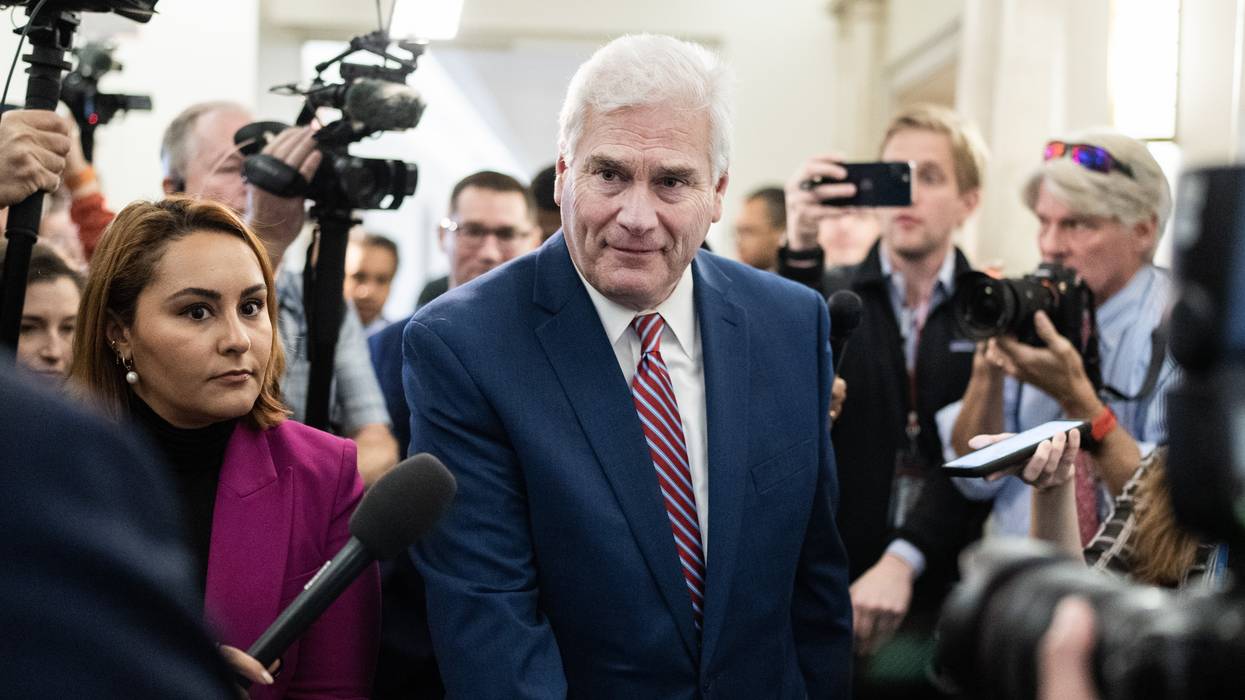
Just hours after Republicans in the U.S. House of Representatives selected Majority Whip Tom Emmer as their third speaker nominee in as many weeks, the Minnesota congressman dropped out of the race Tuesday afternoon.
Congressman Lance Gooden (R-Texas) told CNN that Emmer "wanted to do what's best for the conference and he didn't have the votes so he pulled his name down and got a standing ovation, and so now we're moving onto the next phase," which is a Tuesday night candidate forum.
Emmer's short-lived campaign followed failed bids by Reps. Steve Scalise (R-La.) and Jim Jordan (R-Ohio) in the weeks since a few far-right Republicans joined with Democrats to oust former House Speaker Kevin McCarthy (R-Calif.), whose January election required 15 rounds of voting.
Over two dozen House Republicans opposed Emmer's bid, leaving him short of the 217 votes necessary for election to the leadership role, and former President Donald Trump—the GOP's 2024 presidential front-runner, despite his legal trouble—spoke out against him on Tuesday.
Trump said on social media that Emmer "never respected the Power of a Trump Endorsement, or the breadth and scope of MAGA," his campaign slogan Make American Great Again, and "voting for a Globalist RINO," or Republican in name only, like him "would be a tragic mistake!"
While some GOP opponents of Emmer tried to paint him as too "moderate," progressives on Tuesday stressed that the Minnesota Republican is anything but, given his record on the 2020 election, reproductive healthcare, the climate emergency, and more.
"So Republicans have picked Tom Emmer as their next speaker nominee. I hear some people alleging he's 'not as bad' as some options," DemCast's Nick Knudsen said on social media Tuesday before the congressman withdrew.
Emmer voted against "the Violence Against Women Act, ensuring our right to contraception, improved red flag laws and banning of high capacity magazines, establishment of a January 6th commission, capping insulin costs at $35, bipartisan infrastructure, and the banning of wage discrimination based on gender (to name a few)," he highlighted. "Sounds pretty bad to me."
Indivisible on Tuesday reiterated a message the progressive group sent last week to every single House Democrat, which says in part that "while House Republicans remain in disarray and are unable to elect a speaker, Democrats have been united around their shared values—prioritizing people over politics and governing effectively."
The message notably went out before Republicans made clear that they won't support temporarily empowering Speaker Pro Tempore Patrick McHenry (R-N.C.) to pass spending bills before a potential government shutdown in mid-November.
"Indivisible encourages all House Democrats to stay united and only consider plans that also include a strong power-sharing agreement," the group added. "An agreement would disempower the Freedom Caucus and empower Democrats to meaningfully govern, mitigating Republican disarray. Any agreement would also need to be codified in the rules of the House."
More tax giveaways to the rich simply mean less revenue, higher deficits, and more justification for taking a meat cleaver to programs that serve and protect ordinary Americans.
Let’s talk Social Security. The government shutdown was averted (temporarily), so that’s a good thing, right? Trump is promising not to touch it. Benefits are not threatened, right?
Wrong. Social Security has a bullseye on its back. As descendants of the New Deal leaders who created it, we recognize the warning signs, and need to shout the alarm.
The right-wing hard-liners who fired House Speaker Kevin McCarthy—with no replacement anywhere in sight—are determined to balance the budget by reducing spending. The word “revenues” is an obscenity to them. And defense spending is sacred and untouchable.
For a sustainable Social Security—the most popular government program in America—taking revenues off the table is two things: 1) insanity, and 2) unshakeable Republican orthodoxy.
But even if they completely eliminated every single non-defense discretionary program—from food stamps to the FBI to border protection—it wouldn’t be enough. It would add up to about $900 billion, or about 15% of total federal spending, which would fall far short of balancing the budget. So their deficit-cutting zeal must inevitably turn to what is called mandatory spending, most prominently the largest government program of all, Social Security.
Republican presidential candidates are increasingly emboldened to touch this deadly “third rail” of American politics. Nikki Haley mocked other candidates for promising not to touch Social Security. Ron DeSantis wants to “revamp” it. Mike Pence wants to privatize it, turning it over to Wall Street and adding trillions to the national debt—to replace the New Deal with a “better deal.”
And although former President Donald Trump now swears he would never harm a hair on Social Security’s head, his history renders such assurances hollow. He has previously suggested that a second Trump term would mean cuts to Social Security and Medicare. Let’s not forget that his hugest unachieved social policy goal at the end of his presidency was the complete termination of Social Security’s principal funding source, the payroll tax.
Former Speaker McCarthy proposes a national commission to examine ways to cut Social Security. The 175 members of the House Republican Study Committee have released their proposed budget for fiscal 2024, which would cut benefits by one-third, essentially transforming Social Security from an earned insurance benefit into a subsistence-level welfare benefit.
Previous threats have included plans to sunset all mandatory spending every five years (brainchild of Senate GOP campaign chair Rick Scott), or even every single year (proposed by Wisconsin Sen. Ron Johnson).
It’s true that Social Security will start having solvency problems by 2034 (according to the Social Security Administration), with retirees taking out more than current workers are putting in. To this, there are obviously only two solutions—cutting payout or increasing revenues. The Republicans in their budget acknowledge this, but they absolutely reject any whiff of the latter (here at 87-88).
For a sustainable Social Security—the most popular government program in America—taking revenues off the table is two things: 1) insanity, and 2) unshakeable Republican orthodoxy.
As Oliver Wendell Holmes counselled, revenues—i.e., taxes—“are the price we pay for civilized society.” And to fund our civilization, it’s obvious that those with the most money should pay their fair share. Americans are shocked that billionaires like Jeff Bezos and Elon Musk can get away with paying zero in federal income taxes.
Let’s not forget that during FDR’s New Deal, which rescued the nation from the Great Depression and grew the great American middle class as never before, the tax rate on the richest Americans was 90%, up from 25% under previous Republican administrations, which produced nothing but a do-nothing government, the Gilded Age, and the Depression.
Taxing the 1% to indefinitely assure modest financial security for the 99% is blindingly logical and fair, and overwhelmingly popular.
So let’s make the rich pay more of their fair share for Social Security. Let’s start with eliminating the cap on earnings that are subject to the payroll tax. Currently, earnings over $160,200 are totally exempt from payroll taxes. That means that the CEO making $10 million stops paying the 6.2% payroll tax after the first week of the year, while his janitor pays 6.2% for the entire year. That’s an outrageous affront to ordinary working people throughout America.
Democrats in Congress are brimming with proposals to guarantee Social Security’s solvency for generations, without cutting benefits one iota. Nearly 200 House Democrats recently introduced a bill called Social Security 2100: A Sacred Trust, which would extend solvency for more than 40 years, expand benefits for most recipients, and even cut taxes for 23 million beneficiaries. It would fund this by imposing the 6.2% payroll tax on earned income above $400,000 (honoring Biden’s promise not to raise taxes on anyone with income under that level), and similarly taxing investment income above that level.
Senator Sheldon Whitehouse (D-R.I.) recently held a hearing on a similar bill sponsored by him and Rep. Brendan Boyle (D-Pa.), called Protecting Social Security for All: Making the Wealthy Pay Their Fair Share, ensuring Social Security’s solvency for 75 years.
Most expansively, there’s a bill by Sens. Warren and Sanders and dozens of other Senate and House members, the Social Security Expansion Act. It would not only extend solvency for more than a century, by setting the threshold for payroll and investment tax at $250,000 of annual income (the wealthiest 7% in America), but would increase benefits for Social Security recipients by an average of $2,400 a year and help reduce the federal deficit by sending some of its investment-tax revenue to the general treasury.
Yet all these simple and sustainable fixes are supported only by Democrats. It makes one wonder: what fundamentally drives Republicans’ single-minded obsession with cutting Social Security? Is it hatred of the program itself—the largest component of federal expenditures, created by the greatest Democratic President ever, amid Republican cries of “socialism”?
Or is it hatred of the notion of raising taxes on anybody, even the most obscenely rich? After all, Republican Presidents from Reagan to Trump have delighted in cutting taxes for the rich, on the thoroughly debunked theory that the money would somehow “trickle down” to ordinary Americans. Trump and congressional Republicans have promised more of the same if they regain power. In fact, they blatantly label all taxes as pure theft (here, at p.20). They literally laugh at the notion of taxing the wealthiest Americans, even though voters of all political stripes overwhelmingly support it.
Suffice to say that the two obsessions are conjoined. More tax giveaways to the rich simply mean less revenue, higher deficits, and more justification for taking a meat cleaver to programs that serve and protect ordinary Americans.
Former Speaker McCarthy’s “commission” idea is just another prescription for slashing Social Security benefits, according to Sen. Ron Wyden, Chair of the Senate Committee responsible for Social Security. McCarthy himself acknowledged that all the “cutting,” including Social Security, would “make some people uncomfortable.” Indeed, polls show overwhelming opposition to his commission, and only 2% of Republicans support cutting Social Security.
As Republican President Dwight Eisenhower warned, there may be “a tiny splinter group” of politicians who want to mess with Social Security, but “their number is negligible and they are stupid.”
Taxing the 1% to indefinitely assure modest financial security for the 99% is blindingly logical and fair, and overwhelmingly popular. Yet not a single congressional Republican—even ones in districts that Biden won—is willing to support it.
FDR was called a “traitor to his class” when he forced the “economic royalists” and the “over-privileged” to pay their fair share for programs to help ordinary people struggling to get by. He responded that he “welcomed their hatred,” because he knew he was on the right side. Indeed, Social Security passed in 1935 with overwhelming bipartisan support, 372-33 in the House. We could use a bit of that courage and bipartisanship today.
Fortunately, America’s most beloved and beleaguered government program is finally going to get a true champion—an actual Senate-confirmed leader. In the two years since President Biden fired the misbegotten Trump-holdover leadership, the agency has suffered a drastic decline in staffing, funding, and morale. Facing daunting challenges both from within and without, Biden’s newly announced nominee, former Maryland Gov. Martin O’Malley, will need every ounce of his legendary administrative acumen, as well as a backbone of steel.
O’Malley should come out with guns blazing—demanding a solid long-term legislative fix, and driving a stake through Republicans’ insistence that President Biden is responsible for the looming solvency crisis.
The $33 trillion national debt is a product of spending by both parties over many decades. The far right’s sudden burn-it-all-down obsession with deficit spending, after four years of happily running up record deficits under a Republican President, is a reckless and hypocritical abdication of the duty to govern and serve the ordinary people of this country. It signals tough times ahead for Americans’ favorite government program. Our ancestors who created Social Security 88 years ago would work their butts off to protect and strengthen it.
"It is embarrassing that MAGA House Republicans continue to let the petty sniping and infighting in their own party prevent them from working with the president," President Joe Biden's campaign said.
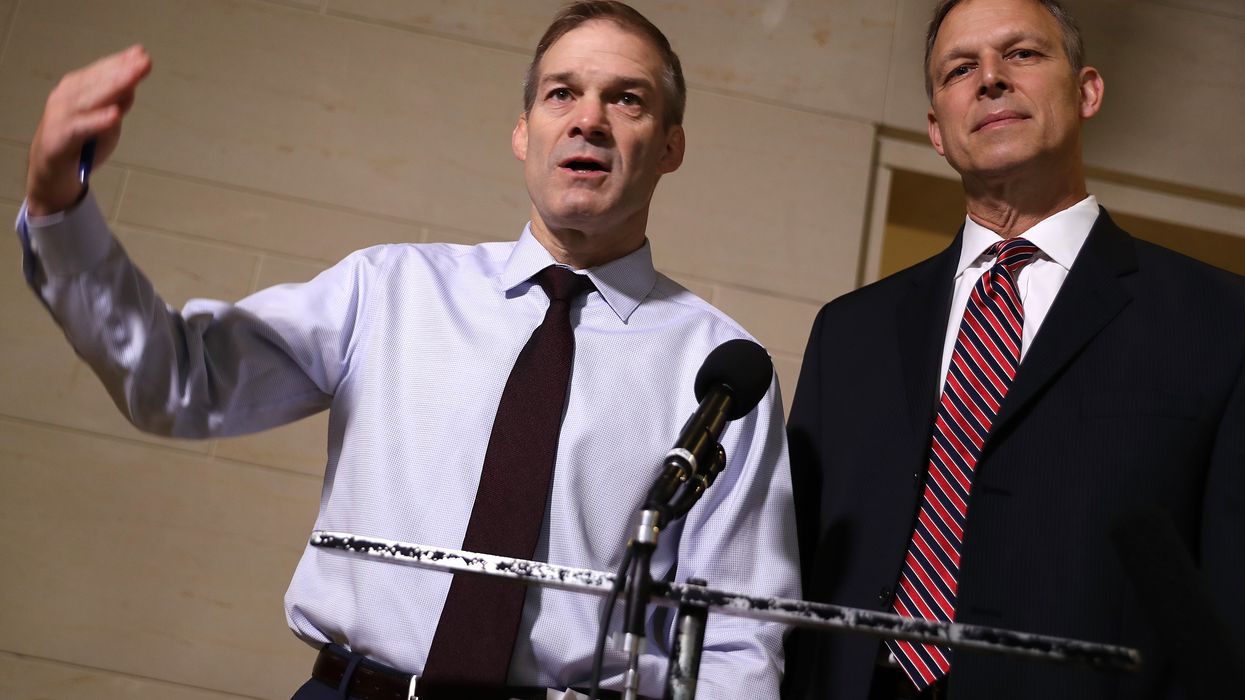
In what could be the final nail in the coffin of Ohio GOP Congressman Jim Jordan's speakership bid, U.S. House Republicans on Friday secretly voted to drop the far-right 2020 election denier's candidacy, leaving the fractured party without a nominee for the chamber's top job more than two weeks after former Speaker Kevin McCarthy's ouster.
The clandestine GOP move—in which 112 Republicans elected to drop Jordan and only 86 supported his bid—came after Jordan, who was endorsed by former President Donald Trump, on Friday failed to garner enough support in a third House floor vote on his proposed speakership.
Jordan lost three Republican supporters since the last roll call vote, finishing with 194 of 217 required votes. All Democrats present voted for House Minority Leader Hakeem Jeffries (D-N.Y.), who received 210 votes.
"The third time was not the charm," said Emily Trifone, deputy communications director for the Democratic Attorneys General Association.
The Hill reported that the GOP conference on Thursday rejected a proposal to temporarily appoint Speaker Pro Tempore Patrick McHenry (R-N.C.), an apparent last-ditch attempt to resume House business during the unresolved struggle for a new leader.
Responding to the third failed vote on Jordan, McCarthy (R-Calif.) said, "We are in a very bad place right now."
In a statement, President Joe Biden's reelection campaign slammed "MAGA House Republicans' self-inflicted chaos and chronic inability to govern."
"It is embarrassing that MAGA House Republicans continue to let the petty sniping and infighting in their own party prevent them from working with the president on bipartisan national security priorities," the statement added. "Voters will remember how when world events called for American leadership, President Biden stepped up and MAGA House Republicans humiliated themselves and failed the American people."
It's back to the drawing board for House Republicans, who have until Sunday to declare speaker candidates ahead of Monday's scheduled restart of the selection process.
"It's a pleasure to get to vote against Jim Jordan every single day, but I never thought that would be my job," Rep. Jamie Raskin (D-Md.) quipped on social media. "Come on GOP, let's get back to work."
Nearly two dozen of Jordan's GOP colleagues opposed him for the leadership role.
An aggressive pressure campaign to convince holdouts in the Republican Party to back far-right Rep. Jim Jordan for House speaker on Wednesday was unsuccessful, with 22 GOP lawmakers voting against the Ohio congressman in the second round of voting—two more than the number that opposed him in the first vote Tuesday.
Jordan received 199 votes, while seven Republicans backed Rep. Steve Scalise (R-La.)—who withdrew from consideration last week shortly after being nominated—and five supported Rep. Kevin McCarthy (R-Calif.), who was ousted from the House speaker role earlier this month by a far-right faction in the party.
Others rejected Jordan—a close ally of former President Donald Trump who played a "significant" role in strategizing to challenge the 2020 election, according to the House January 6 Committee—in favor of former lawmakers who haven't held office in years and others who have not run to replace McCarthy, despite what some have called Jordan's "bullying" tactics to garner votes.
In addition to Trump ally Sean Hannity's interviews on Fox News in recent days in which the anchor has pointedly questioned members about their refusal to back Jordan, NBC News reported on Wednesday that the spouse of at least one Republican, Rep. Don Bacon of Nebraska, received anonymous messages threatening her husband's political career if he opposed the Ohio lawmaker.
"If House Republicans want to stand for their families to receive anonymous political threats every time their leadership wants to push a tough vote, they can vote Jordan," said Rep. Alexandria Ocasio-Cortez (D-N.Y.). "But they'd be fools to think this is the last time it happens. Members who vote for him affirm this kind of practice."
The threats didn't deter Bacon from supporting McCarthy in both rounds of voting so far.
Some of the nearly two dozen Republicans who opposed Jordan represent districts carried by Democratic President Joe Biden in 2020, while others sit on the House Appropriations Committee and "are deeply distrustful of Mr. Jordan's approach to spending and the types of cuts he has endorsed," The New York Times reported.
Progressives mocked a speech given by Rep. Tom Cole (R-Okla.) in favor of Jordan, in which he praised the congressman for having "the courage to talk about a long-term plan and to get at the real drivers of debt, and we all know what they are. We all know it's Social Security, we all know it's Medicare, we all know it's Medicaid."
The Congressional Progressive Caucus, whose members have repeatedly warned in recent years that the Republicans are planning to cut the broadly popular programs, called Cole's speech "a campaign ad for Democrats."
"Jim Jordan may never be speaker, but we should never forget the reasons so many Republicans wanted him for the role," said Rep. Jesús "Chuy" García (D-Ill.).
Progressives including Ocasio-Cortez have noted this week that while Republicans struggle to find a House speaker candidate who can convince 217 members of the party to back them, House Minority Leader Hakeem Jeffries (D-N.Y.) has all 212 Democrats in the House supporting him.
"Seems like we know who should be Speaker," said Rep. Pramila Jayapal (D-Wash.).
Jordan indicated after the second round of voting that he will continue vying for the leadership position.
"If elected speaker, Jordan would effectively give the House to Trump," said former Labor Secretary Robert Reich. "No alliance poses a greater threat to our democracy."
As the U.S. House began its latest voting process in an attempt to secure a speaker, progressive lawmakers made clear their view that Rep. Jim Jordan's history of spreading lies about the 2020 election and racist anti-immigration rhetoric disqualifies him from the role that would place him second in line for the presidency.
Not only that, said Rep. Cori Bush (D-Mo.) as the first round of voting got underway, but Jordan (R-Ohio) is "unfit to be in office."
Like other progressives have in recent days, Bush connected Jordan's refusal to accept former Republican President Donald Trump's loss in the 2020 election and his involvement in strategizing to challenge the election with the violent insurrection at the U.S. Capitol on January 6, 2021.
Jordan emerged on Friday as the latest candidate to lead Republicans in the House, where they hold a majority, after winning his party's nomination to replace former House Speaker Kevin McCarthy (R-Calif.) and beginning a pressure campaign to secure the 217 votes he needed to win the speakership.
Last week, Rep.Steve Scalise (R-La.) failed to garner the votes he needed, leading critics including Rep. Alexandria Ocasio-Cortez (D-N.Y.) to reason that House Minority Leader Hakeem Jeffries (D-N.Y.)—with all 212 Democrats supporting him—was far closer to gathering the support needed to win the speaker election.
Rep. Ilhan Omar (D-Minn.) repeated that sentiment on Tuesday, calling Jordan an "insurrectionist" and posting a video made by the Democratic Policy and Communications Committee which noted that in 17 years of public service, the lawmaker has never managed to get a bill signed into law or passed in the House.
"Rep. Jeffries has the votes if four Republicans work for the people," said Omar. "Americans deserve better than these political games."
Jordan, founder of the far-right House Freedom Caucus, quickly began a pressure campaign saying Republicans who wouldn't support him were harming the party and the country, with Fox News anchor Sean Hannity commencing "a thinly veiled pressure campaign by querying GOP House members about their refusal to support Jordan," as The Daily Beast reported.
Still, he failed to convince 20 of his GOP colleagues in the first round of voting on Tuesday afternoon, with several of the holdouts supporting Scalise and McCarthy. The vote placed Jordan further away from victory than McCarthy was in the first round of voting when he was eventually elected speaker in January; 19 Republicans opposed McCarthy in the first round, and lawmakers voted 15 times before McCarthy garnered enough support to win.
Jordan began speaking to the dissenters shortly after the first vote, while former U.S. Labor Secretary Robert Reich accused him of using "[Former President Donald] Trump's playbook to try to bully his way to victory."
"If elected speaker, Jordan would effectively give the House to Trump," said Reich. "No alliance poses a greater threat to our democracy."
Rep. Pete Aguilar (D-Calif.), who serves as chair of the House Democratic Caucus, urged his colleagues to vote against "the architect of a nationwide abortion ban, a vocal election denier, and an insurrection insider," saying elevating Jordan to the top House position would send "a terrible message to the country and our allies."
Ocasio-Cortez urged New York voters in districts represented by House Republicans to call their members and make their opposition to Jordan known.
"We will see if individuals like Mike Lawler or Marc Molinaro who represent New Yorkers in the Hudson Valley, the Catskills, Westchester County, will actually vote to install a man who voted to overturn the election and who supports a national abortion ban to be speaker of the House and second in line for the presidency," said Ocasio-Cortez Tuesday night on CNN. "I have my doubts that people in New York will stand for that."