

SUBSCRIBE TO OUR FREE NEWSLETTER
Daily news & progressive opinion—funded by the people, not the corporations—delivered straight to your inbox.
5
#000000
#FFFFFF
To donate by check, phone, or other method, see our More Ways to Give page.
Daily news & progressive opinion—funded by the people, not the corporations—delivered straight to your inbox.
This is a developing story... Please check back for possible updates...
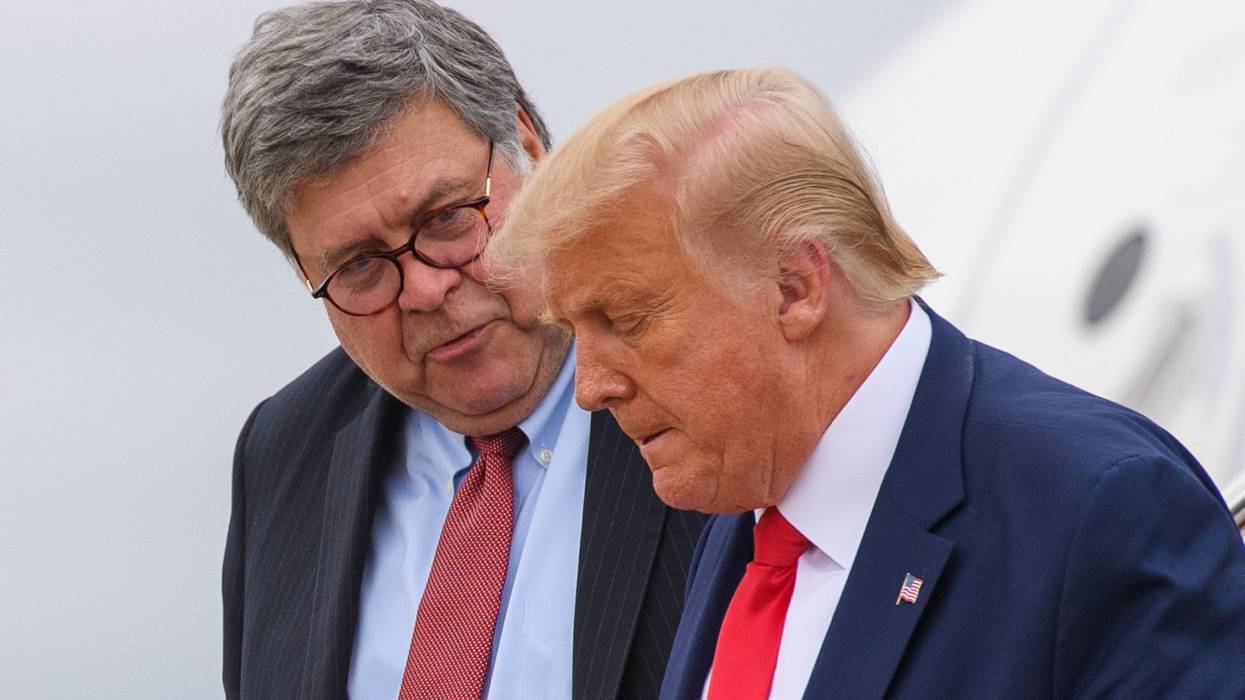
Following a watchdog group's win in court last week, the Biden administration on Wednesday released an unredacted memorandum from 2019 about whether then-President Donald Trump obstructed Special Counsel Robert Mueller's probe of Russia's election interference.
Noah Bookbinder--president of the organization, Citizens for Responsibility and Ethics in Washington (CREW)--highlighted that then-U.S. Attorney General Bill Barr pointed to the memo from the Department of Justice's Office of Legal Counsel to claim there was no justification for charging Trump with obstruction of justice.
"The memo presents a breathtakingly generous view of the law and facts for Donald Trump," Bookbinder said. "It twists the facts and the law to benefit Trump and does not comport with a serious reading of the law of obstruction of justice or the facts as found by Special Counsel Mueller."
As Bookbinder explained: "The memo is premised in large part on the argument that there was no underlying criminal conduct and that it's hard to charge obstruction without an underlying crime. Of course, that's not what Mueller actually found."
"Mueller found there was not sufficient evidence to charge Trump and others with conspiring with Russia," CREW's leader continued. "He didn't find no crime, just not enough evidence for charges. Of course, Trump couldn't know about that future conclusion when he decided whether or not to obstruct."
He also noted that the document "takes an exceedingly cramped view of prior cases" and "relies on Trump's use of open-ended language [about] his 'hope' the investigation would be let go, and his delegation of firing prosecutors or narrowing investigations to others when he could have done it himself, as exonerating Trump."
"The memo is not just wrong; it is dangerous coming from a usually respected office at the Department of Justice," Bookbinder added. "It is clear why Barr did not want the public to see it."
In a series of Wednesday tweets contrasting the memo with Mueller's report, New York Times reporter Charlie Savage said that the newly released document "reads like a defense lawyer's brief."
The Biden administration on Thursday laid it right out in the open.
It's time to seriously discuss a 60-year problem we've had with treasonous and illegitimate Republican presidents.
When Trump 2016 campaign chairman Paul Manafort was passing secret polling information about swing states like Michigan, Wisconsin, and Pennsylvania to Konstantin Kilimnik, as is laid out in the Mueller Report, it was part of a very specific and successful effort on the part of Russian Intelligence to help put Trump in office.
This was the data they would have used to have troll accounts and ads target individuals in those states via social media, particularly Facebook, to both suppress the vote for Clinton and encourage voters to show up for Trump and other down-ticket Republicans.
This is not the first time a Republican candidate for president has committed treason to get into the White House. In fact, it's been the norm since 1968, and therefore it's time to seriously discuss a 60-year problem we've had with treasonous and illegitimate Republican presidents.
America must stop giving criminal Republican presidents a pass. Every GOP president since Dwight Eisenhower used treason or deception to come to office (or inherited office from one who did), and it needs to end. It's a truly astonishing and horrifying story.
It started in 1968, when President Lyndon Johnson was desperately trying to end the Vietnam War. It had turned into both a personal and political nightmare for him, and his vice president, Hubert Humphrey, was running for president in the election that year against a "reinvented" Richard Nixon.
Johnson spent most of late 1967 and early 1968 working back-channels to North and South Vietnam, and by the summer of 1968 had a tentative agreement from both for what promised to be a lasting peace deal they'd both sign that fall.
But Richard Nixon knew that if he could block that peace deal, it would kill Humphrey's chances of winning the 1968 election. So Nixon sent envoys from his campaign to talk to South Vietnamese leaders to encourage them not to attend upcoming peace talks in Paris.
Nixon promised South Vietnam's corrupt politicians that he'd give them a richer deal when he was president than LBJ could give them then.
The FBI had been wiretapping Nixon's people and told LBJ about his effort to prolong the Vietnam War. Thus, just three days before the 1968 election, Johnson phoned the Republican Senate leader, Everett Dirksen, (you can listen to the entire conversation here):
President Johnson: Some of our folks, including some of the old China lobby, are going to the Vietnamese embassy and saying please notify the [South Vietnamese] president that if he'll hold out 'til November 2nd they could get a better deal. Now, I'm reading their hand. I don't want to get this in the campaign. And they oughtn't to be doin' this, Everett. This is treason.
Sen. Dirksen: I know.
Those tapes were only released by the LBJ library in the past decade, and that's Richard Nixon who Lyndon Johnson was accusing of treason.
At that point, for President Johnson, it was no longer about getting Humphrey elected. By then Nixon's plan had already worked and Humphrey was being wiped out in the polls.
Instead, Johnson was desperately trying to salvage the peace talks to stop the death and carnage as soon as possible. He literally couldn't sleep.
In a phone call to Nixon himself just before the election, LBJ begged him to stop sabotaging the peace process, noting that he was almost certainly going to win the election and inherit the war anyway. Instead, Nixon publicly said LBJ's efforts were "in shambles."
But South Vietnam had taken Nixon's deal and boycotted the peace talks, the war continued, and Nixon won the White House thanks to it.
An additional 22,000 American soldiers, and over an additional million Vietnamese, died because of Nixon's 1968 treason, and he left it to Gerald Ford to end the war and evacuate the American soldiers.
Nixon was never held to account for it, and when the LBJ library released the tapes and documentation it was barely noticed by the American press.
Gerald Ford, who succeeded Nixon, was never elected to the White House (he was appointed to replace VP Spiro Agnew, after Agnew was indicted for decades of taking bribes), and thus would never have been president had it not been for Richard Nixon's treason. He pardoned Nixon.
Next up was Ronald Reagan.
During the Carter/Reagan election battle of 1980, then-President Carter had reached a deal with newly elected Iranian President Abdolhassan Bani-Sadr to release the 52 hostages held by students at the American Embassy in Tehran.
Bani-Sadr was a moderate and, as he explained in an editorial for The Christian Science Monitor, successfully ran for president on the popular position of releasing the hostages:
I openly opposed the hostage-taking throughout the election campaign. ...I won the election with over 76% of the vote. ...Other candidates also were openly against hostage-taking, and overall, 96% of votes in that election were given to candidates who were against it [hostage-taking].
Carter was confident that with Bani-Sadr's help, he could end the embarrassing hostage crisis that had been a thorn in his political side ever since it began in November of 1979.
But behind Carter's back, the Reagan campaign worked out a deal with the leader of Iran's radical faction--Supreme Leader Ayatollah Khomeini--to keep the hostages in captivity until after the 1980 presidential election. Khomeini needed spare parts for American weapons systems the Shah had purchased for Iran, and Reagan was happy to promise them.
This was the second act of treason by a Republican wanting to become president.
The Reagan campaign's secret negotiations with Khomeini--the so-called "October Surprise"-- sabotaged President Carter's and Iranian President Bani-Sadr's attempts to free the hostages. As President Bani-Sadr told The Christian Science Monitor in March of 2013:
"After arriving in France [in 1981], I told a BBC reporter that I had left Iran to expose the symbiotic relationship between Khomeinism and Reaganism.
"Ayatollah Khomeini and Ronald Reagan had organized a clandestine negotiation, later known as the 'October Surprise,' which prevented the attempts by myself and then-U.S. President Jimmy Carter to free the hostages before the 1980 U.S. presidential election took place. The fact that they were not released tipped the results of the election in favor of Reagan."
And Reagan's treason--just like Nixon's treason--worked perfectly.
The Iran hostage crisis continued and torpedoed Jimmy Carter's re-election hopes. And the same day Reagan took the oath of office--to the minute, as Reagan put his hand on the bible, by way of Iran's acknowledging the deal--the American hostages in Iran were released.
Keeping his side of the deal, Reagan began selling the Iranians weapons and spare parts in 1981, and continued until he was busted for it in 1986, producing the so-called "Iran-Contra" scandal.
But, like Nixon, Reagan was never held to account for the criminal and treasonous actions that brought him to office.
After Reagan--Bush senior was elected--but like Jerry Ford--Bush was really only president because he served as vice president under Reagan. And, of course, the naked racism of his Willie Horton ads helped keep him in office.
The criminal investigation into Iran-Contra came to a head with independent prosecutor Lawrence Walsh subpoenaing President George H.W. Bush after having already obtained convictions for Weinberger, Ollie North and others. Bush's attorney general, Bill Barr, suggested he pardon them all to kill the investigation, which Bush did. The screaming headline across the New York Times front page on December 25, 1992, said it all:
THE PARDONS; BUSH PARDONS 6 IN IRAN AFFAIR, ABORTING A WEINBERGER TRIAL; PROSECUTOR ASSAILS 'COVER-UP'
And if the October Surprise hadn't hoodwinked voters in 1980, you can bet Bush senior would never have been elected in 1988. That's four illegitimate Republican presidents.
Which brings us to George W. Bush, the man who was given the White House by five right-wing justices on the Supreme Court.
In the Bush v. Gore Supreme Court decision in 2000 that stopped the Florida recount--and thus handed George W. Bush the presidency--Justice Antonin Scalia wrote in his opinion:
The counting of votes... does in my view threaten irreparable harm to petitioner [George W. Bush], and to the country, by casting a cloud upon what he [Bush] claims to be the legitimacy of his election.
Apparently, denying the presidency to Al Gore, the guy who actually won the most votes in Florida, did not constitute "irreparable harm" to Scalia or the media.
And apparently it wasn't important that Scalia's son worked for a law firm that was defending George W. Bush before the high court (with no Scalia recusal).
Just like it wasn't important to mention that Justice Clarence Thomas's wife worked on the Bush transition team--before the Supreme Court shut down the count in Florida--and was busy accepting resumes from people who would serve in the Bush White House if her husband stopped the recount in Florida... which he did. (No Thomas recusal, either.)
More than a year after the election a consortium of newspapers including The Washington Post, The New York Times, and USA Today did their own recount of the vote in Florida--manually counting every vote in a process that took almost a year--and concluded that Al Gore did indeed win the presidency in 2000.
As the November 12th, 2001 article in The New York Times read:
If all the ballots had been reviewed under any of seven single standards and combined with the results of an examination of overvotes, Mr. Gore would have won.
That little bit of info was slipped into the seventeenth paragraph of the Times story so that it would attract as little attention as possible because the 9/11 attacks had happened just weeks earlier and journalists feared that burdening Americans with the plain truth that George W. Bush actually lost the election would further hurt a nation already in crisis.
To compound the crime, Bush could only have gotten as close to Gore in the election as he did because his brother, Florida Gov. Jeb Bush, had ordered his Secretary of State, Kathrine Harris, to purge at least 57,000 mostly-Black voters from the state's voter rolls just before the election.
So, for the third time in four decades, Republicans took the White House under illegitimate electoral circumstances. Even President Carter was shocked by the brazenness of that one. And Jeb Bush and the GOP were never held to account for that crime against democracy.*
Most recently, in 2016, Trump ally Kris Kobach and Republican secretaries of state across the nation used Interstate Crosscheck to purge millions of legitimate voters--most people of color--from the voting rolls just in time for the Clinton-Trump election.
Meanwhile, Russian oligarchs or the Russian state, and possibly pro-Trump groups or nations in the Middle East, are alleged to have funded a widespread program to flood social media with pro-Trump, anti-Clinton messages from accounts posing as Americans, as documented by Robert Mueller's investigation.
One can only wonder how much better off America would be if six Republican presidents hadn't stolen or inherited a stolen White House and used it to put right-wing cranks on the Supreme Court and other federal benches.
And on top of that, we learned today that Republican campaign data on the 2016 election, including which states needed a little help via phony influencers on Facebook and other social media, was not only given to Konstantin Kilimnik by Paul Manafort, but Kilimnik transferred it to Russian intelligence.
Donald Trump still lost the national vote by nearly three million votes, but came to power through an electoral college designed to keep slavery safe in colonial America.
One can only wonder how much better off America would be if six Republican presidents hadn't stolen or inherited a stolen White House and used it to put right-wing cranks on the Supreme Court and other federal benches.
Now, finally, there may be an opportunity for some accountability for another criminal Republican president.
The depth and breadth of Trump's involvement in the January 6th attempt to destroy our form of government and replace it with single-party strongman rule is becoming more and more obvious. As a result, the pressure is building to hold him and many of those in his administration to account.
America has ignored GOP crimes to seize and hold the White House long enough. It's time, at long last, to put this one in prison.
This piece initially appeared on The Hartmann Report.

"You can't always get what you want
But if you try sometime, you find
You get what you need."
--Keith Richards & Mick Jagger
Barring a last-minute failure of nerve by House Democrats, Donald John Trump will become only the third President in U.S. history to be impeached. That's welcome news for anyone concerned with defending the Constitution, upholding the separation of powers among the branches of the federal government, and safeguarding the rule of law in general. It's also welcome news for anyone interested in ensuring the integrity of our 2020 elections.
But for progressives and liberals, there is also a measure of disappointment because of the narrow focus on Ukraine in the two articles of impeachment that have been introduced in the House Judiciary Committee, and which will be voted on in the coming days by the entire legislative chamber. If either article is passed by the House, an impeachment trial likely will be held in the Senate sometime in January.
Together, the Trump articles of impeachment comprise a mere nine pages of text. That's not much, considering the track record of malfeasance Trump has amassed in his first three years in office for everything from using the presidency for personal economic gain in violation of the Constitution's prohibition on the acceptance of foreign and domestic "emoluments" to incarcerating immigrant children in cages along the southern border and obstructing justice in connection with the investigation conducted by former special counsel Robert Mueller into Russian interference in the 2016 U.S. elections.
Still, the Trump articles comprise a narrative of corruption, and on close inspection may not be as constrained as they appear at first glance.
Article 1 sketches the well-publicized outlines of the Ukraine scandal. In legalistic but no less stinging terms, it charges Trump with "abuse of power" for "soliciting" the government of Ukraine to interfere in the 2020 American elections by announcing that it would launch investigations aimed at digging up political dirt on former Vice President Joe Biden, and promoting the discredited rightwing conspiracy theory that Ukraine, rather than Russia, meddled with the 2016 American election. It charges Trump with conditioning both the release of $391 million in military assistance and a "head of state meeting" at the White House with Ukrainian President Volodymyr Zelensky on such announcements.
History, as they say, will be the ultimate judge of the course the Democratic leadership has charted.
"In so doing," Article 1 asserts, Trump acted with the "corrupt purpose" of obtaining the "personal political benefit" of weakening an electoral opponent "in a manner that compromised the national security of the United States and undermined the integrity of the United States democratic process."
Perhaps most ominously of all, the first article alleges that even after the promised military aid to Ukraine was released following public revelations of the solicitation scheme, Trump "has persisted in openly and corruptly urging and soliciting Ukraine to undertake investigations for his personal benefit."
Article 1 concludes with a dire warning--that Trump will "remain a threat to national security and the Constitution if he is allowed to remain in office." The message, though slightly sub-textual, is simple and clear: Trump must be stopped now before he sabotages the next election.
The second article of impeachment charges Trump with "obstruction of Congress" for directing an "unprecedented, categorical, and indiscriminate defiance of subpoenas issued by the House of Representatives pursuant to its 'sole Power of Impeachment' under the Constitution." It accuses Trump of ordering federal agencies to withhold documentation sought by the House, and barring all executive-branch employees--including acting White House Chief of Staff Mick Mulvaney, who is explicitly cited along with eight other administration officials--from cooperating with the impeachment inquiry.
"In the history of the Republic," Article 2 asserts, "no President has ever ordered the complete defiance of an impeachment inquiry or sought to obstruct and impede so comprehensively the ability of the House of Representatives to investigate 'high Crimes and misdemeanors.' "
Both articles of impeachment allege that the President's conduct in abusing his power and obstructing Congress on Ukraine was "consistent" with his "previous invitations of foreign interference in U.S. elections," and his "previous efforts to undermine investigations" into such interference.
These are, of course, thinly veiled references to the Mueller probe, without mentioning the probe by name. They are, in my view, the product of clever draftsmanship, and will permit the House managers selected to prosecute Trump's impeachment trial in the Senate to introduce elements of the Mueller probe to corroborate Trump's corrupt intent in his dealings with Ukraine.
Reasonable minds can dispute the wisdom of restricting the scope of the Trump impeachment articles. Going small has the tactical advantage of appealing to moderate House Democrats, especially those who represent swing districts that turned blue in 2018 and fear that going big on impeachment will endanger their own reelection prospects. Going small also has the virtue of allowing a clear and easily understood case to be presented against the president, and offers the albeit-slim possibility of shaming a few conscience-stricken Republicans into voting for conviction in the Senate.
Going small, however, runs the danger of losing sight of the enormity of Trump's crimes, and of losing support from segments of the public with little specific interest in Ukraine. Any way you analyze it, the decision on how best to proceed is anything but easy.
History, as they say, will be the ultimate judge of the course the Democratic leadership has charted.
In the meantime, there can be little doubt that we, as a nation, have reached another historical inflection point. As James Madison argued during the Constitutional Convention of 1787, the country's legal charter needed the remedy of impeachment to hold in check a President who "might betray his trust to foreign powers." Elaborating on Madison's reasoning a year later in Federalist (Paper) No. 65, Alexander Hamilton described impeachable offenses as arising from "the misconduct of public men, or in other words from the abuse or violation of some public trust."
Donald Trump has clearly met that standard. He is the nightmare the Founders dreaded. Though surgical and narrow, the Trump impeachment articles deserve our support.

Imagine for a moment that political discussions can assume the same evidence-based knowledge as active components in decision making as treatment pathways do when responding to illness and disease. The impact of care is studied out of a need for protecting and preserving quality of life. Politics should also serve these same ends, but, indeed, politics carries a burden healthcare does not: different values. Forgetting that there are legitimate differences in values--like I prioritize equality over security or others prioritize fiscal responsibility over freedom--let's briefly return to the idea of truth as a foundation for politics and policy.
Ignorance presents a challenge to truth. After all, there is no way to accommodate good decision making when there are serious gaps in information. Medical professionals make diagnostic tests in order to figure out what's wrong, the same as mechanics do when the check engine light comes on in your car. Drinking water, for example, will help alleviate a headache caused by dehydration but is unlikely to help much for a headache caused by meningitis.
The (then) War Department, published, in Washington, D.C., November 30, 1928. It provides instruction on being a citizen, and describes and defines key terms. "These precise and scholarly definitions of a Democracy and a Republic were carefully considered as a proper guide for U.S. soldiers and U.S. citizens by the Chief of Staff of the United States Army." What people should, or should not do, has always been a source of conflict, but "a well informed public" is enumerated in most democratic proscriptions. After all, the power is in the hands of the people and information is prerequisite to good decision making. The current political crisis in the United States could actually be resolved with evidence-based decision making.
Do not take my word for it, read the "Report on the Investigation into Russian Interference in the 2016 Presidential Election" (in short: "Mueller Report") yourself. Once you have read it you will likely have the same conclusion that everyone (except William Barr, but virtually literally everyone else) has. An abbreviated list of the evidence:
Or, read the executive summaries provided with the report, volume 1 (pp. 4-10) and volume 2 (pp. 1-8) provide the reader with the important conclusions from an assessment of the evidence.
If, as a country, we do not seriously push back against dishonest politicians and the politics of corruption, then we are responsible for the ugly outcomes. Walter Cronkite said, "Freedom is a package deal... with it comes responsibilities and consequences." I believe we have moved past the point of debate; the facts are crystal clear as is the next step. But we have not moved at all; we are living in the gross injustice of dishonesty--we are failed by citizens ignoring their patriotic responsibilities to inform themselves and respond to the undeniable corruption and we are more supremely punished by the death of democracy. Political thieves are getting away with their immoral and illegitimate inaction by claiming all the power, even though the numb and fatigued public could seize it legitimately. Reclaim the urgency and higher ground by addressing the ignorance and dishonesty of our times--read and react to the Mueller Report--or you will be sorry.
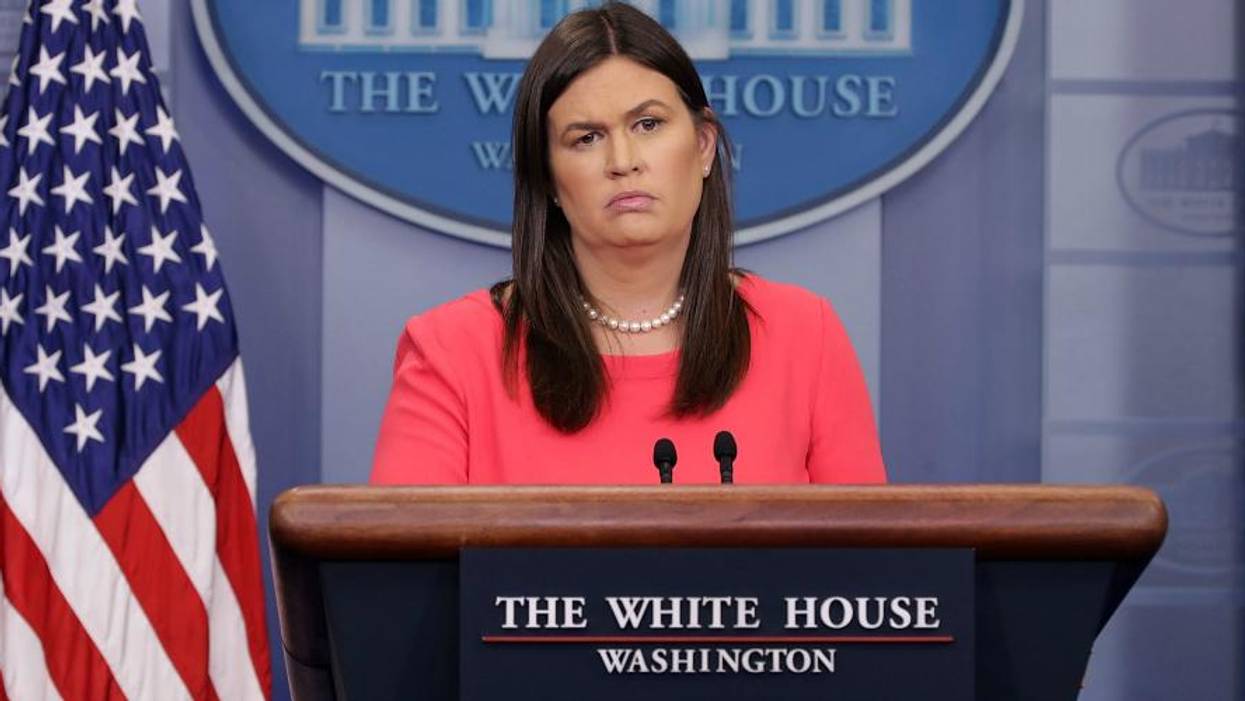
At Politico's "Women Rule" event in late 2018, Sarah Huckabee Sanders, who President Trump announced Thursday would soon be leaving her position as White House press secretary, said that she hoped her legacy would be as a person who was, "transparent and honest throughout that process" and did "everything I could to make America a little better that day than it was the day before."
"In essence, Sanders embraced a scorched earth strategy where--in a quite shameless effort to defend Trump--she would gladly sacrifice core elements of democratic society."
Of course, given the sheer volume and magnitude of lies Sanders and her boss have inflicted on the U.S. population over the years, it's hard now not to laugh at these words. Most recently, Sanders claimed that she had heard from "countless...individuals who work at the FBI who said they were very happy" with the firing of James Comey. It should go without saying that Sanders simply made that up. When offering testimony under oath to the Mueller investigation, Sanders openly admitted that her statement "was not founded on anything."
"Not Founded on Anything." I can't think of a better epitaph to trademark for the Sarah Huckabee Sanders era at the White House. Actually, I can't think of a better epitaph for the Trump administration in general.
The phrase "Not Founded On Anything" points to the role of Sanders in the embrace of a cruel, cynical, nihilistic worldview rooted in nothing but the quest to obtain and maintain power in the service of personal gain. (After all, this is a person who even lied about the death of migrant children at the U.S. border.) I previously described this Trumpite worldview as "corrosive dystopianism" which encourages "the rejection and destruction of the very structures in society that can, if reformed properly, be agents for positive change." Journalists? The state? Universities? Courts? Science? Immigrants? The FBI? All pitched as obstacles in the way of so-called "patriots" searching for their piece of the American Dream. If we have to lie to crush those institutions, well, that's the rather counter-intuitive price of freedom.
In essence, Sanders embraced a scorched earth strategy where--in a quite shameless effort to defend Trump--she would gladly sacrifice core elements of democratic society, such as a free press.
Make no mistake, this strategy was not a glitch or bug in the Trumpite operating system. It was--and remains--a feature of that system. Sanders was not simply doing her best at an "impossible job," as New York Times columnist Nicholas Kristof tweeted. On the contrary, Sanders was doing precisely the job that she was asked, and loved, to do: lie, attack, deflect and question the very nature of reality, and undermine anyone or anything that threatened the power of the privileged.
And, let's not lose sight of the irony of conservatives who endlessly pontificate about the evils of "liberal, postmodern" university classes where the "nature of reality" is questioned gleefully falling into lock-step behind an administration that has done nothing but question fact, truth, and reality.
So farewell, Sarah Huckabee Sanders. Your tenure was indeed "Not Founded on Anything." And that's one of the most dangerous foundations imaginable.

Sarah Huckabee Sanders is leaving the White House at the end of June.
One of the longest-serving members of the President Donald Trump administration, Sanders began her time in the press office as deputy White House press secretary. She took the full-time position on July 26, 2017, taking over for the beleaguered Sean Spicer.
The departure was announced in a pair of tweets by the president.
According to The New York Times:
Ms. Sanders informed her staff about an hour before the president's tweets that she would be leaving. No successor was immediately announced, but the next press secretary will take over just as Mr. Trump is heading into the thick of a re-election campaign that will determine the fate of his presidency.
If you've largely forgotten who Huckabee-Sanders is, that's understandable: she hasn't held a press conference in 94 days.
When she did appear before the camera, a diplomatic way to describe the Huckabee-Sanders approach to reporters and press conferences would be "hostile."
During her time in the White House, Huckabee-Sanders defended the administration on its policies, including:
Sanders lied to the American people on multiple occasions:
Huckabee-Sanders regularly told blatant untruths from the podium, ignored questions she didn't care for, and got into endless theatrical fights with members of the press.
Her departure was welcomed by a number of prominent figures, like The Intercept's Mehdi Hasan, who simply tweeted:"Good. Riddance."
"Sarah Huckabee Sanders is leaving the White House so she can spend more time with her lies," said writer J.D. Crowley.
Commentators speculated that the next move for Huckabee-Sanders could be a cushy role in media, something that filled progressives with dread and disgust.
"Anybody who writes anything rehabilitating Sarah Sanders should be forced to sleep in a cage," writer Jeb Lund tweeted.
"Dear all media/entertainment outlets," producer Andrew Kimmel wrote on Twitter, "do not have Sarah Sanders on your show. Do not put her on Dancing With the Stars. Do not have her surprise the audience at the Emmys. Do not invite her on to Saturday Night Live. The danger she has put our country in must not be overlooked."
"Hollywood entertainers can now stop pretending they don't like Sarah Huckabee Sanders," said journalist Elizabeth King.
"Remember Sean Spicer at the Emmy's?" King continued. "They can't wait to embrace these people."

After President Donald Trump openly stated he would accept dirt on his 2020 opponents from a foreign power and not necessarily alert law enforcement, members of Congress and contenders for the Democratic presidential nomination said Trump's remarks provide yet another reason for the House to immediately launch impeachment proceedings.
"The Mueller report made it clear: A foreign government attacked our 2016 elections to support Trump, Trump welcomed that help, and Trump obstructed the investigation," Sen. Elizabeth Warren (D-Mass.), a 2020 White House hopeful, tweeted late Wednesday. "Now, he said he'd do it all over again. It's time to impeach Donald Trump."
"The Mueller report made it clear: A foreign government attacked our 2016 elections to support Trump, Trump welcomed that help, and Trump obstructed the investigation. Now, he said he'd do it all over again. It's time to impeach Donald Trump."
--Sen. Elizabeth Warren
Sen. Bernie Sanders (I-Vt.) echoed his 2020 rival, saying Trump's comments--which came during an ABC News interview that aired Wednesday--demonstrated once more that "[w]e have a president who thinks he is above the law."
"The House should immediately begin impeachment inquiries," Sanders tweeted.
Democratic presidential candidates Beto O'Rourke and Sen. Kirsten Gillibrand (D-N.Y.) also called for impeachment hearings in response to Trump's remarks.
The renewed calls for impeachment proceedings against the president came after Trump told ABC's George Stephanopoulos that he would accept damaging information on his 2020 opponents from a foreign power.
"I think I'd take it," Trump said.
"I'll tell you what, I've seen a lot of things over my life. I don't think in my whole life I've ever called the FBI," the president added, expressing disagreement with FBI director Christopher Wray's insistence that the agency would want to know about attempted election interference by a foreign power.
"You don't call the FBI," Trump said. "Give me a break--life doesn't work that way."
In response to the president's comments, Rep. Ted Lieu (D-Calif.) tweeted, "FBI Director Chris Wray is right and you are wrong."
"Not only does life work that way, the law works that way," said Lieu. "Under the Federal Election Campaign Act, it's illegal to knowingly accept anything of material value from a foreign power."
Trump's comments, according to commentators and numerous members of Congress, added to the seemingly ever-growing list of reasons to begin impeachment proceedings and will likely increase pressure on House Speaker Nancy Pelosi (D-Calif.), who has refused to back impeachment hearings despite growing pressure from inside her caucus and the grassroots.
According to an Axios tally, 59 House Democrats and one Republican--Rep. Justin Amash (R-Mich.)--support launching impeachment proceedings against Trump.
"Trump just blew way past 'no collusion,' he's broadcasting his willingness to receive help from a hostile foreign power in 2020," Rep. Don Beyer (D-Va.) tweeted Wednesday. "He's glad his son didn't call the FBI about Russian help and says he wouldn't call them in 2020. Yes we absolutely need an impeachment inquiry."

Because "the moral clarion call to pursue impeachment is clear," progressive advocacy groups announced on Friday a national day of action to push Congress to hold President Donald Trump accountable.
With events across the country set for June 15--over 100 are already mapped out--lead organizers MoveOn and By the People say they intend to show and grow public support for the House starting an impeachment inquiry.
" Donald Trump has broken the law, violated the constitution, and put the safety and future of the American people at risk," said Alexandra Flores-Quilty, a spokesperson with By the People. "But by now, it is clear that Congress won't act unless we demand it."
"We need to take to the streets in every neighborhood in America to defend democracy," she continued. "Join us on June 15 across the country--from the biggest cities to the smallest towns--as we make the urgent call for Congress to act and begin an impeachment inquiry now."
The nationwide events will take different forms, with some featuring public readings of impeachment calls from lawmakers like Rep. Rashida Tlaib. The Michigan Democrat will also speak in person at the June 15 event in Detroit, according to organizers.
Other groups supporting the day of action include Indivisible, the Courage Campaign, and CREDO Action.
"We can either allow powerful men like Trump to abuse their power and divide us based on the color of our skin or where we were born or our religion," a FAQ from organizers states, "or we can unite, impeach the president, and make this country work for all of us."
A tally out Friday by Axios shows that Tlaib isn't alone in her call for an impeachment inquiry.
The outlet reports that 58 other House Democrats and one House Republican, Justin Amash of Michigan, also publicly support impeachment. That still leaves 158 more needed to impeach, though that's not the only hurdle.
Speaker Nancy Pelosi this week faced heat from over two dozen progressive organizations for her refusal to begin the process.
"With 10 distinct episodes of obstruction of justice already clear from the Mueller report, violations of the emoluments clause happening on an almost daily basis, and Trump's administration now defying subpoenas for both documents and testimony, waiting is a privilege," they said in their letter to Pelosi. "But it is not a privilege available to the families separated by his deportation force or his Muslim ban, the asylum seekers languishing in Mexico, the people threatened by his embrace of white supremacy, the LGBTQ people whose rights he is taking away, the women whose bodies he is trying to control or the communities threatened by his denial of the climate crisis."
"We can't wait," they wrote. "Lead on impeachment now."
As 2020's elections edge closer, recent troubling developments are casting new light on an old question--what will it take for the results to be trusted?
The emergence of powerful forms of online political propaganda, the absence of progress in 2019 state legislatures on improving audits and recounts, and new revelations about the extent of Russian hacking in 2016--accessing more election administration details than previously reported--all point to the same bottom line: what evidence can be presented to a polarized electorate to legitimize the results?
To be fair, some policy experts who network with senior election officials--who have authority to order more thorough vote-verification steps without new legislation--say there is still time to act. But as 2020 gets closer, there are fewer opportunities to do so.
The question of what additional proactive steps could be a public trust counterweight is not theoretical. There are many signs that 2020 will be very fractious, starting with the emergence of new forms of political propaganda. The latest is doctored videos, such as one recently of House Speaker Nancy Pelosi--slurring her words--that drew millions of views, or another video mocking ex-Vice President Joe Biden after announcing his candidacy that President Trump tweeted. An emerging norm, where seeing is not necessarily believable, underscores the need for vote count evidence trails.
The latest revelations about Russian hacking in 2016 concern different issues, but point to a similar conclusion: that, arguably, more could or should be done at the process's finish line to legitimize outcomes. In Florida, however, the full impact of Russian meddling has not been investigated by state or federal officials, according to Ion Sancho, who recently retired after nearly three decades as Supervisor of Elections in Leon County, where Tallahassee is located.
Russian hacking is back in the news, in part, because it poses questions about 2020 readiness. The Mueller report said that election administration computers in "at least one Florida county government" had been hacked, and the FBI later said that two unnamed counties had been breached. The accessed data included all the Election Day logistics, from poll workers to payrolls, as well as voter registration data, Sancho said.
"To me, all this says is at the front end, we fail, and we cannot presume to know that any mitigation has been successful, which puts the onus on auditing [the reported results]," Sancho said. "The issue is Florida is not protected because we do not verify our totals on the machines through any kind of an audit that is reliable."
"This Russian intervention should push all election officials to say, 'We've got to audit now,'" he continued. "We've got to verify that those... votes are correct and assume that there could be something that happened at the front end, so now you need to ensure the process [is legitimate]--by making sure that the paper ballots are properly audited. That's the only solution I can see."
Legislative Action or Inaction
To be fair, many states and counties have been collaborating with the U.S. Department of Homeland Security to block hackers. Those efforts have been followed by statements that voting infrastructure is better protected than ever, and the "No. 1 threat is around public confidence in the process," as DHS's top election expert Matt Masterson has said.
While there have been no government disclosures of successful hacks after 2016's breaches, election officials say that voting systems are routinely targeted. Stepping back, however, it's notable that cybersecurity has commanded more attention than other steps that could boost public assurance that election results will be accurate--or more aggressively double-checked.
In many states, 2019's legislative sessions are now over. Odd-numbered years are when states fine-tune election laws and protocols--as it is between federal cycles and there is time to implement changes. However, 2019 has seen scant legislation to make counting votes more transparent and rigorous, especially in swing states.
The National Conference of State Legislatures' online database listed 44 recount-related bills in 2019 from 15 states. Hawaii, which had 14 proposed bills, passed a bill requiring a mandatory recount if the margin was less than 0.25 percent, but other bills requiring that recounts be done by hand have not moved. Virginia passed a bill requiring new "standards and instructions" if there is more than one recount in play. New York has a recount bill, but it too is stalled.
On the audit front, the NCSL database lists 55 bills from 21 states. Most are pending, which means their fate is uncertain when legislatures reconvene. Of the few that passed, such as in Georgia and in Indiana, there are different timetables when the new laws are to take effect. Georgia is after the 2020 election. Indiana is before the 2020 election, although state election officials can exempt counties.
What passed in these two states merits scrutiny. It is an audit whose goal is not to verify the unofficial election night results to the greatest extent possible--to try to account for every vote in the closest contests. It is a different objective and methodology, a statistical estimate of the tabulation's overall accuracy called a "risk-limiting audit."
In contrast, a 2019 bill backed by the Florida State Association of Supervisors of Elections to let counties use digital images of paper ballots to conduct more thorough recounts failed. Its opponents included Republicans (no House co-sponsors), activists who oppose using computers in vote counting, and some officials seeking less work, Sancho said.
Conversely, 2019 also saw several states pass voting-related bills intended to tilt the electorate for perceived partisan advantage.
Florida, again, offers several examples. Republicans have received wide press attention for a bill aimed at blocking 1.4 million ex-felons from expediently restoring their voting rights, which Republican Gov. Ron DeSantis said he would sign. The bill requires former non-violent felons pay court fines. Critics have said the fees were akin to a poll tax.
That wide-ranging bill has other features that could alter who votes in 2020. Like many states, Florida has growing numbers of people voting by mail. The bill pushes back the window for absentee voting, which blunts impulsive last-minute voters. (That change gives officials a little more up-front time to process the ballots, its defenders said.)
The legislation also gives counties two days to fix problems with validating signatures on the mail-in ballot envelopes. In red rural counties, two days is enough time for officials to knock on affected voters' doors, said Sancho. But in blue urban counties, where officials contact voters by postcards, he said that timetable was intentionally insufficient.
Another electorate-shaping bill passed in Texas. In that increasingly purple state, the bill would make it harder for Libertarian candidates to get on the ballot--critics say to keep voters in the GOP camp, while, conversely, making it easier for Greens to run--to dilute Democratic votes. That's done through ballot qualification thresholds.
Meanwhile, there's other backsliding. John Brakey, a voting transparency advocate who has been assessing North Carolina's landscape, recently learned that election officials in the state's most populated county do not want to install paper ballot-based voting systems before 2020--as had been expected. The officials are more comfortable with decade-old paperless technology, Brakey said, even if it cannot be independently audited.
"They don't have the money" to buy new machines, he said. "They hope to extend the deadline. DREs [direct-recording electronic machines] are outlawed on December 31. They would rather deal with the devil they know. Even if they get money, it's unlikely they would be ready for primary time next March."
What to Do If 2020 Is Contested?
These examples raise troubling questions. How can such a polarized country believe the election results will be legitimate if vote counts are not more thoroughly and openly verified? And, should the presidential election be disputed, what then? Two nationally known legal scholars recently noted that Congress is currently incapable of resolving a disputed presidential result.
"No neutral referee presently exists," wrote Ned Foley, a professor of law at Ohio State University who led the drafting of the American Law Institute principles for resolving any ballot counting disputes, and Michael McConnell, a professor of law at Stanford University and an ex-federal appellate judge, in the Hill.
"The Constitution gives Congress the role of declaring the winner of the presidential election. But Congress, being bicameral, cannot perform this important role if the Senate insists that Donald Trump won, while the House is equally adamant that the Democratic candidate did," they wrote. "Congress, being ever more partisan, stands institutionally incapable of resolving an election contest in a way that supporters of the losing party will view as legitimate. The closer it gets to Inauguration Day, the more precarious this kind of stalemate becomes."
The scholars proposed that Speaker Pelosi and Senate GOP Leader Mitch McConnell each pick a person, and those two individuals pick a third member of a to-be-formed committee to serve as a "neutral referee."
"This approach, modeled after private sector arbitration, is the simplest method for finding an umpire whom both sides can accept as fair," they argued. "But whatever method of selection Pelosi and McConnell prefer, their chosen umpire should be ready before counting ballots begins. They should also pledge to accept the findings of the neutral arbiter unless both agree otherwise, a commitment that maintains the bipartisanship of their arrangement."
Rarely have legal scholars suggested that a remedy outside the Constitution might be needed before a presidential election. But their view fits with the volatile 2020 landscape that is emerging. There's a lack of vote count evidence trails and transparent audits to serve as a counterweight to the newest forms of propaganda. And Congress is not poised to handle the power struggle if the presidential result is contested.
The clock has not run out with taking proactive steps before 2020, but it is ticking, and opportunities to act are ebbing away while new worries are emerging.
This article was produced by Voting Booth, a project of the Independent Media Institute.

Like Abraham Lincoln, Benjamin Franklin is one of those great Americans to whom sparkling aphorisms are attributed that may or may not be true. The Internet has only made matters worse.
A favorite quote, which I always assumed was Franklin's, appears not to be, at least as far as I can tell. I made a cursory and unsuccessful Google search of various editions of his famous Poor Richard's Almanack and the later Poor Richard Improved, but even my pedantic wonkishness can only go so far. I finally gave up.
The quote in question: "Never confuse motion with action."
No matter its provenance, it is a true thing that especially would seem to apply to our welcome but foot-dragging Democratic majority in the House of Representatives.
"Trump's disregard of the law and all democratic principles cannot be ignored."
As they fret and fuss as to whether or not to impeach the imperial bedlamite, semblances of motion seem to hold the upper hand over action. Hearings are held but slowly, and requests and subpoenas for documents and witnesses are issued on a steady basis but largely ignored by the White House and a Justice Department that has been turned by Trump and Attorney General Barr into the president's personal Jacoby & Meyers, with Barr acting as mob consigliere.
Historian Julian Zelizer notes in an analysis at CNN that he fears, "With the decentralized oversight hearings by House Democrats tied up in legal knots, the media will just end up shifting to the administration's probable investigations into law enforcement and intelligence agencies."
(On Monday, the House Judiciary Committee announced it will hold a hearing June 10 entitled "Lessons from the Mueller Report: Presidential Obstruction and Other Crimes" that will include former Nixon White House Counsel John Dean "as well as former U.S. Attorneys and legal experts." On the one hand, I could watch MSNBC just about any night and see the same witnesses. On the other, so many people still have no idea what Mueller reported so maybe this is better than nothing?)
Speaker Nancy Pelosi and other members of the Democratic leadership worry about how a House impeachment--without a conviction because of the GOP senators' pet-like obsequiousness--will impact the party's 2020 election chances. But in part their concern is based on beliefs and principles that were thrown under the trolley by the Trump gang long ago.
As David Atkins wrote at Washington Monthly last week, "In the Trump era, when the guard rails against an unbalanced despotic executive are rapidly failing and every battle is being waged not within the guidelines of institutional laws and norms but in the court of public opinion, it is crucial that every player understand and participate in the game that is being played...
"...The Founders made a forgivable error in assuming that the prerogatives of each branch of government would overwhelm partisan corruption by giving Congress the power to hold a lawless executive accountable. But in the modern era, it is obvious that only a very public airing of a president's crimes would put enough pressure on congressional members of his own party to convict and remove him from office."
Further, many Dems argue that public opinion just isn't solid enough in favor of impeachment for it to proceed right now. But as many have noted and I recently wrote, "Go back to June 1973, a year after the Watergate break-in and a month or so into the now famous Senate Watergate hearings (just as John Dean was about to tell the committee that he advised Nixon there existed 'a cancer growing on the presidency'). At that point, per a Gallup poll at the time, only 19 percent of Americans sought Nixon's impeachment; in other words, just half of those who favor it now. Within months, as hearings publicized Nixon's wrongdoings and the Saturday Night Massacre appalled the public, that number had doubled."
Julian Zelizer observed to Greg Sargent of The Washington Post that when the House moved against Nixon in 1974, it "wasn't Congress waiting on the public. It was the other way around - Congress provided guidance to the public."
On impeachment, Sargent writes, "public opinion can be moved in a big way, including, presumably, on Trump." But, "The bottom line is that insisting that even an impeachment inquiry can't happen until Republicans support one might be tantamount to giving Republican intransigence -- and Trump's disinformation network -- total veto power over whether our political system ever even considers the question of whether Trump's corruption and misconduct amount to the high crimes and misdemeanors that merit removal."
(Note, by the way, that the third article of impeachment voted by the House Judiciary Committee against Nixon in 1974 was for his refusal to comply with congressional subpoenas.)
I confess that I keep going back and forth on the issue of impeachment, too, having been adamantly in favor just a couple of weeks ago yet in subsequent days occasionally swayed by the arguments against. But as Zelizer writes in his CNN analysis, "If they refuse to undertake impeachment proceedings, the President will continue to claim the Mueller investigation was a two-year witch hunt -- and that ultimately House Democrats reached the same conclusion.
"... A House vote in favor of articles of impeachment would not inevitably benefit the President, as some Democrats have been arguing. The likely revelation of more possible abuses of power as a result of impeachment proceedings, along with the extensive findings in the Mueller report, could easily drag down his already low approval ratings. Under an impeachment process, the House Judiciary Committee would have greater leverage in the courts to obtain documents and testimony, while administration members would be at greater risk if they continued to stonewall."
Trump's disregard of the law and all democratic principles cannot be ignored. On Tuesday morning, the latest obstruction occurred as the White House ordered former staffer Hope Hicks and Annie Donaldson, former White House counsel Donald McGahn's chief of staff, not to comply with subpoenas from the House Judiciary Committee.
As Benjamin Franklin also may--or may not!--have said, "It is hard for an empty sack to stand upright," so Trump tries to fill that sack not with the needed character and ability Franklin's words imply but with lies and accusations, one calumny after another, using each abuse as an attempt to bolster support and flood the zone with deception.
Therefore I've come to finally and firmly believe it's past time for the impeachment inquiry to begin. Call witnesses--send out the Federal marshals to haul in the recalcitrant--fill the public's eyes and ears with information, tell the story each and every day, explain to them the Mueller report's findings--insist that Mueller testify--and take the preliminary steps toward a formal impeachment.
This won't happen overnight, so no fear; clearly there won't be a rush to judgment. Nor will the other issues of the day be ignored. And, yes, there is plenty of other legal activity against Trump slowly grinding through the mills of the courts. But as far as the House goes, it's time for action, not merely motion.
Perhaps it would be best to create a select committee with daily televised hearings, much like the Senate Watergate committee, which wisely had only seven members and delegated much of the questioning to qualified attorneys who could help vector in on the truth without the preening self-promotion of politicians.
Someone has to bell this cat and right now, House of Representatives, we're looking to you.