

SUBSCRIBE TO OUR FREE NEWSLETTER
Daily news & progressive opinion—funded by the people, not the corporations—delivered straight to your inbox.
5
#000000
#FFFFFF
To donate by check, phone, or other method, see our More Ways to Give page.

Daily news & progressive opinion—funded by the people, not the corporations—delivered straight to your inbox.
Corporate tax dodging deprives the nation of billions of dollars in revenue while exorbitant executive pay siphons money from worker wages, R&D, and other productive investments to support a strong economy.
Want to know just how bad the problems of corporate tax dodging and excessive executive pay have gotten?
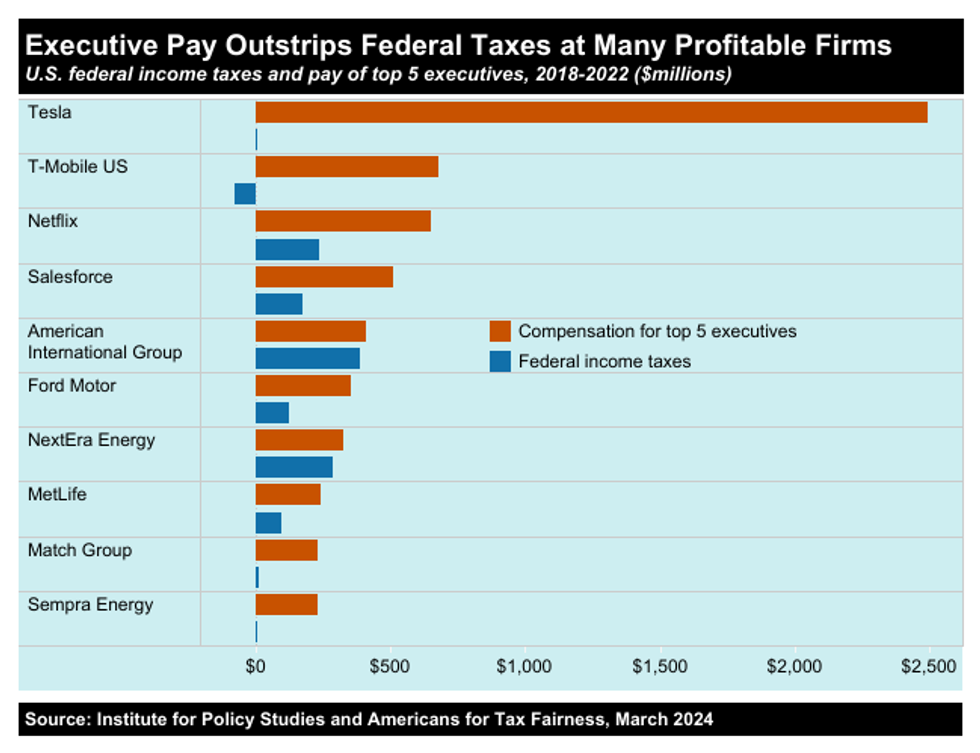
In a new report, the Institute for Policy Studies and Americans for Tax Fairness analyze executive pay data for some of the country’s most notorious corporate tax dodgers over the period 2018-22. What did we find? Thirty-five of these firms actually paid less in federal income taxes than they paid their top five executives—despite reporting strong profits.
This chart looks at the 10 firms in that group of 35 that shelled out the most in executive compensation. As you can see, they include many household names, such as Tesla, T-Mobile, Netflix, and Ford.
Big corporations have used their enormous economic and political power to push Congress to slash rates and blow huge loopholes in our tax code. They get to fleece Uncle Sam, and the rest of us get stuck with the bill.
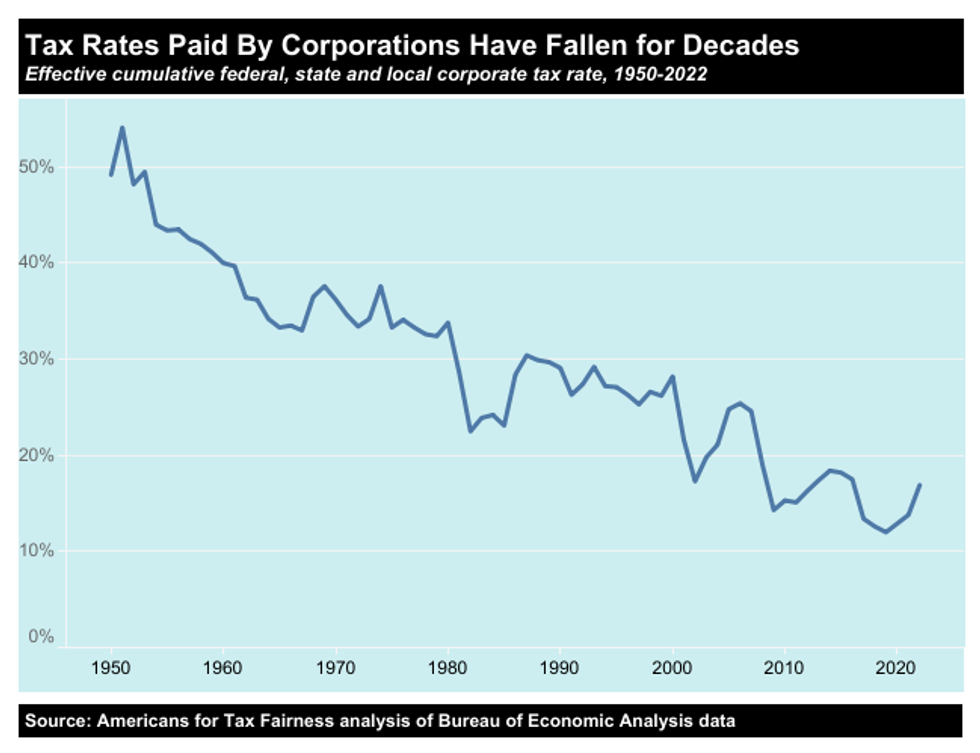
According to Americans for Tax Fairness analysis of Bureau of Economic Analysis data, the effective corporate tax rate—what firms actually pay as a percentage of their earnings—in the middle of the last century was around 50% to 54% when including state and local taxes as well. As of 2022, the corporate rate was just 17%.
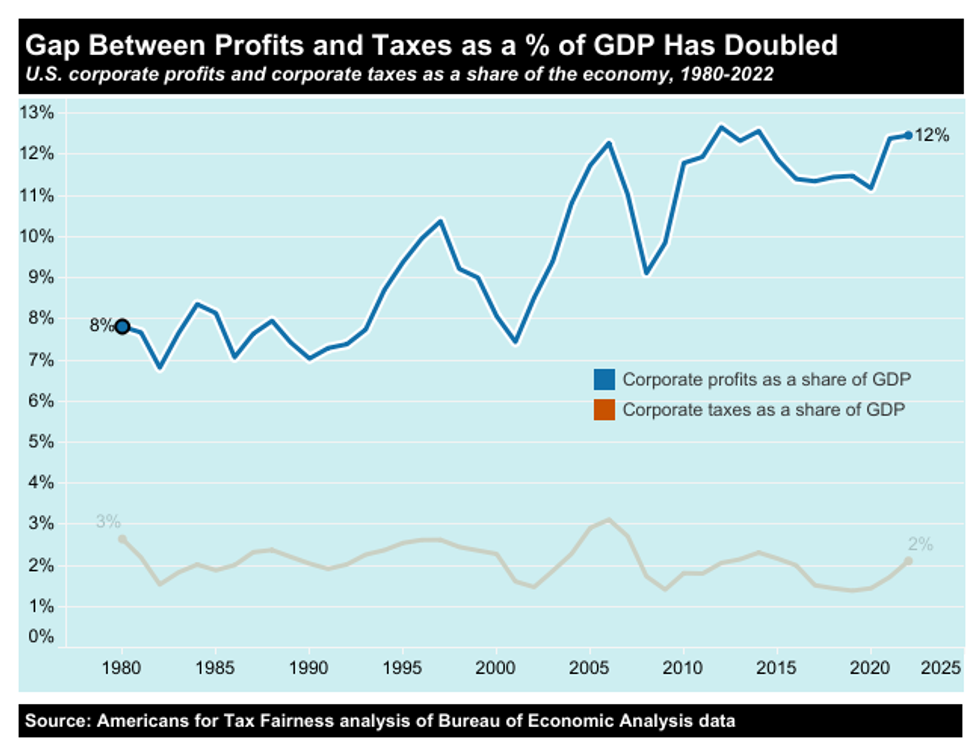
Another damning indicator of our broken corporate tax system: the disconnect between profits and tax revenue. For decades, corporate profits as a share of the economy have been generally rising. Higher profits should lead to higher tax revenue, but they have not. Instead, according to Bureau of Economic Analysis data, the gap between U.S. corporate profits and corporate taxes as a share of GDP doubled between 1980 and 2022.
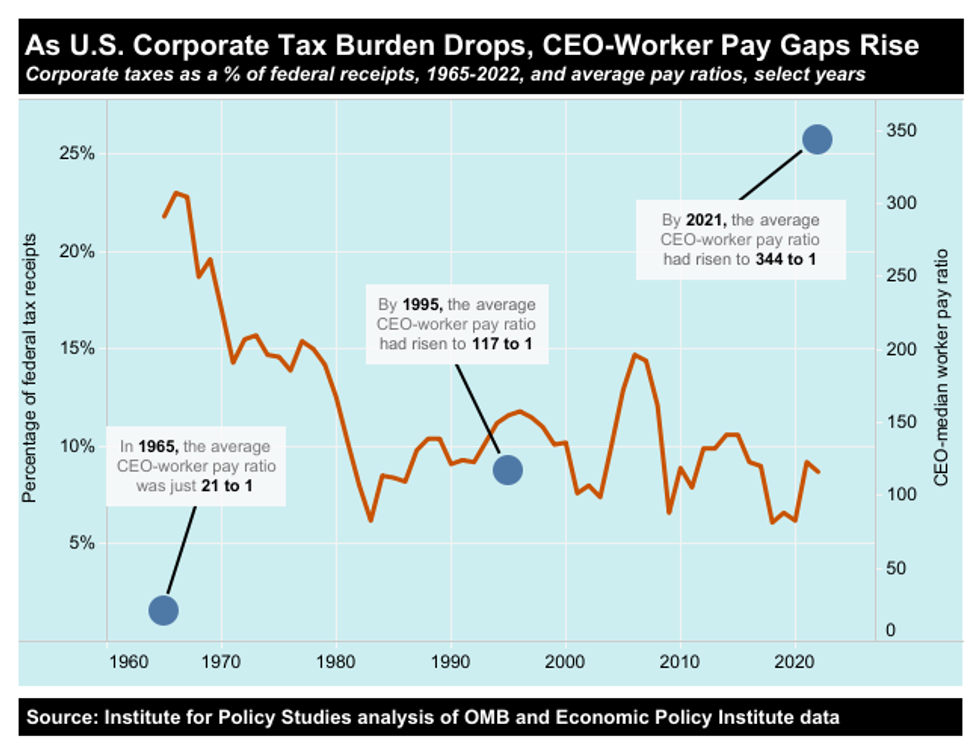
CEOs have a personal incentive for hiring armies of lobbyists to push for corporate tax cuts. Why? Because the windfalls from those cuts often wind up in their own pockets. It’s hardly surprising that as corporate contributions to federal tax revenue have plummeted, CEO pay has skyrocketed, leaving typical worker pay far behind.
According to Institute for Policy Studies analysis of Office of Management and Budget and Economic Policy Institute data, when corporate taxes made up 21.8% of all federal revenue in 1965, the average CEO-to-median worker pay ratio was 21 to 1. By 2022, corporate tax receipts had fallen to just 8.7% of federal revenue and the average pay ratio had risen to 344 to 1.
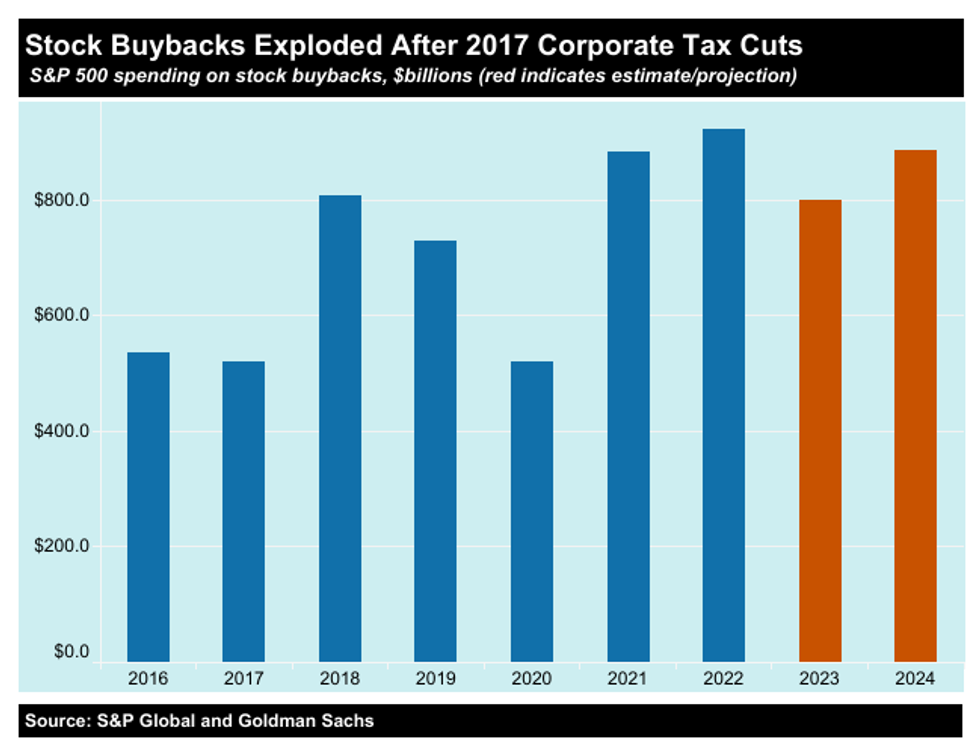
In the immediate aftermath of the 2017 tax law, America’s largest corporations used windfalls from this legislation to boost executive paychecks through a record-breaking stock buyback spree. Stock buybacks artificially inflate the value of a company’s shares–and the value of the stock-based pay that makes up the bulk of executive compensation packages.
In 2018, the first year of the Trump-GOP tax cuts, S&P 500 firms plowed $806 billion into stock buybacks, a massive jump from $519 billion in 2017. And buyback spending has stayed sky-high every year except the first year of the pandemic.
Ordinary Americans are getting cheated twice. Corporate tax dodging deprives the nation of billions of dollars in revenue that could be used to improve public infrastructure and services. At the same time, exorbitant executive pay siphons money from worker wages, R&D, and other productive investments to support a strong economy.
See our full report for ideas on how to make corporations pay their fair share of taxes. The Institute for Policy Studies has also co-published with the Congressional Progressive Caucus Center a summary of practical proposals for reining in CEO pay, from tax and contracting reforms to stronger regulations on stock buybacks and Wall Street bonuses.
Until we fix our tax and executive pay systems, we’ll never have an economy that works for all of us.
A president facing a major scandal, just as the highest-profile trial is about to begin, pardons the indicted or convicted officials around him to effectively stop the investigation that's closing in on his own illegal conduct.

Trump soon? We'll see. But this actually describes what President George H.W. Bush did in 1992.
The Iran/Contra scandal revealed, among other things, that the Reagan/Bush White House had secretly sold missiles to Iran in exchange for hostages held in Lebanon, using the proceeds to fund right-wing forces fighting the leftist Nicaraguan government in violation of US law.
On Christmas Eve 1992, just as the indicted former Defense Secretary Caspar Weinberger was about to face trial, Bush pardoned him and five others, including former Assistant Secretary of State Elliott Abrams and and former National Security Advisor Robert McFarlane. The New York Times (12/25/92) reported this as "Bush Pardons 6 in Iran Affair, Averting a Weinberger Trial; Prosecutor Assails 'Cover-Up.'"
The attorney general for Bush who approved the pardons, William Barr, is now being nominated for the same position by Trump. Is this background relevant? Though current news columns are rife with speculation that Trump might likewise protect himself by pardoning his indicted or convicted associates, the dominant US news wire service doesn't seem to think so.

In "Barr as Attorney General: Old Job, Very Different Washington" (1/14/19), Associated Press reporter Eric Tucker made no mention whatsoever of the Iran/Contra pardons. Rather than seriously examine the trajectory of presidential power and accountability, Tucker framed the story, as the headline indicates, as a stark contrast between the gentlemanly Bush and the "twice-divorced" Trump:
Serving Trump, who faces intensifying investigations from the department Barr would lead, is unlikely to compare with his tenure under President George H.W. Bush.
The false implication is that Bush did not himself face intensifying investigations from Lawrence Walsh, who operated out of the Justice Department's Office of Special Counsel. The misleading comparison is compounded by Tucker describing Trump as "breaking with the practice of shielding law enforcement from political influence" and ousting Attorney General Jeff Sessions for "not protecting him in the Russia investigation"--as if Barr didn't have direct experience in the first Bush administration with imposing political influence on law enforcement to protect a president from investigation.
Instead, Tucker cites Barr's supporters calling him "driven by his commitment to the department" and "very much a law-and-order guy." (The praise for the new head of the department Tucker regularly covers marks his article as a "beat-sweetener," a long and unfortunate tradition of journalists' making their jobs easier by sucking up to sources.)
This deceptive piece was apparently picked up by literally thousands of media outlets. A search of "unlikely to compare with his tenure under President George H.W. Bush" produces over 2,400 results.
As Consortium News founder Robert Parry, who broke much of the Iran-Contra story for AP, would later write in a review of Walsh's book Firewall: Inside the Iran/Contra Cover-Up:
The Republican independent counsel [Lawrence Walsh] infuriated the GOP when he submitted a second indictment of Weinberger on the Friday before the 1992 elections. The indictment contained documents revealing that President Bush had been lying for years with his claim that he was "out of the loop" on the Iran/Contra decisions. The ensuing furor dominated the last several days of the campaign and sealed Bush's defeat at the hands of Bill Clinton.
Walsh had discovered, too, that Bush had withheld his own notes about the Iran/Contra Affair, a discovery that elevated the President to a possible criminal subject of the investigation. But Bush had one more weapon in his arsenal. On Christmas Eve 1992, Bush destroyed the Iran/Contra probe once and for all by pardoning Weinberger and five other convicted or indicted defendants.
Parry, who died a year ago, left AP after many of his stories on Iran/Contra were squashed (Consortium News, 1/28/18).
"Conventional wisdom"--which in its current formulation depicts Trump's authoritarian tendencies as aberrations from the norms of US politics, rather than a continuation of the worst tendencies of his predecessors.
After I criticized AP on Twitter for the omission, a later piece by Tucker, co-written with Michael Balsamo, noted perfunctorily in the 16th graph: "As attorney general in 1992, he endorsed Bush's pardons of Reagan administration officials in the Iran/Contra scandal." (A search on "as attorney general in 1992, he endorsed Bush's pardons of Reagan administration officials in the Iran/Contra scandal" produced a mere 202 results.)
While much of the media obsesses over every bit of "Russiagate," some breathlessly anticipating the next revelation will surely bring down the Trump presidency, it's remarkable how little interest there is in the trajectory of presidential power.
Rather, much of the establishment media has gone to great lengths to rehabilitate officials from both Bush administrations, including the elder Bush himself when he died last month. (One exception to the generally hagiographic coverage of his death was Arun Gupta's "Let's Talk About George H.W. Bush's Role in the Iran/Contra Scandal"-- in The Intercept, 12/7/18.) Indeed, Trump naming Barr just after George H.W. Bush's funeral could be seen as a jiu-jitsu move: How could anyone object to his nominating the AG of the just-sainted Poppy Bush? It's as though Trump were saying, "If you all like him so much, I'll have what he had." See the Institute for Public Accuracy news release, "Barr as AG? Bush and Trump Dovetail."
AP's actions also fit into the institution-protecting mode of what Parry derided as the "conventional wisdom"--which in its current formulation depicts Trump's authoritarian tendencies as aberrations from the norms of US politics, rather than a continuation of the worst tendencies of his predecessors.
Offering their "advice in a spirit of friendship" in an open letter issued on Wednesday, over 100 noted intellectuals, left-wing academics, and progressive activists have urged Sen. Bernie Sanders (I-Vt.) to lay out clear proposals for a foreign policy that rejects U.S. militarism, overseas misadventures, and the outrageous Pentagon budget that continues to cripple funding for many of the progressive programs and policy solutions the senator advocates.
Given the $1 trillion annually in so-called "national security spending" as well as the military industrial complex's impact on the environment and "the erosion of liberties," Sanders's public comments and policy proposals should address head-on the military and its spending, the group writes in the open letter.
They write that they have "great respect for [his] domestic policies," but in terms of foreign policy, Sanders has come up quite short. His recently laid-out "bold agenda" for Democrats, for example, has no mention of foreign policy, the group notes. And while the progressive lawmaker has pushed for a Senate vote on ending U.S. support for the Saudi-led coalition's war on Yemen, the letter urges Sanders to go further by being laser-focused on "the existence of the military and its price tag" to show how easily the nation could fund his proposals like Medicare-for-All and tuition-free public colleges.
We write to you as U.S. residents with great respect for your domestic policies.
We support the position of more than 25,000 people who signed a petition during your presidential campaign urging you to take on militarism.
We believe that Dr. King was correct to assert that racism, extreme materialism, and militarism needed to be challenged together rather than separately, and that this remains true.
We believe this is not only practical advice, but a moral imperative, and -- not coincidentally -- good electoral politics.
During your presidential campaign, you were asked repeatedly how you would pay for human and environmental needs that could be paid for with small fractions of military spending. Your answer was consistently complicated and involved raising taxes. We believe it would be more effective to more often mention the existence of the military and its price tag. "I would cut 4% of spending on the never-audited Pentagon" is a superior answer in every way to any explanation of any tax plan.
Much of the case that we believe ought to be made is made in a video posted on your Facebook page in early 2018. But it is generally absent from your public comments and policy proposals. Your recent 10-point plan omits any mention of foreign policy whatsoever.
We believe this omission is not just a shortcoming. We believe it renders what does get included incoherent. Military spending is well over 60% of discretionary spending. A public policy that avoids mentioning its existence is not a public policy at all. Should military spending go up or down or remain unchanged? This is the very first question. We are dealing here with an amount of money at least comparable to what could be obtained by taxing the wealthy and corporations (something we are certainly in favor of as well).
A tiny fraction of U.S. military spending could end starvation, the lack of clean water, and various diseases worldwide. No humanitarian policy can avoid the existence of the military. No discussion of free college or clean energy or public transit should omit mention of the place where a trillion dollars a year is going.
War and preparations for war are among the top destroyers, if not the top destroyer, of our natural environment. No environmental policy can ignore them.
Militarism is the top source of the erosion of liberties, and top justification for government secrecy, top creator of refugees, top saboteur of the rule of law, top facilitator of xenophobia and bigotry, and top reason we are at risk of nuclear apocalypse. There is no area of our social life that is untouched by what Eisenhower called the military industrial complex.
The U.S. public favors cutting military spending.
Even candidate Trump declared the wars since 2001 to have been counterproductive, a statement that appears not to have hurt him on election day.
A December 2014 Gallup poll of 65 nations found the United States to be far and away the country considered the largest threat to peace in the world, and a Pew poll in 2017 found majorities in most countries polled viewing the United States as a threat. A United States responsible for providing clean drinking water, schools, medicine, and solar panels to others would be more secure and face far less hostility around the world; that result would cost a fraction of what is invested in making the United States resented and disliked.
Economists at the University of Massachusetts at Amherst have documented that military spending is an economic drain rather than a jobs program.
We compliment you on your domestic policies. We recognize that the presidential primaries were rigged against you, and we do not wish to advance the baseless idea that you were fairly defeated. We offer our advice in a spirit of friendship. Some of us worked in support of your presidential campaign. Others of us would have worked, and worked hard, for your nomination had you been a candidate for peace.
SIGNED BY
Elliott Adams, Chair, Meta Peace Team, Training Team, and former President, Veterans For Peace
Christine Ahn, International Coordinator, Women Cross DMZ
Shireen Al-Adeimi, Assistant Professor, Michigan State University
Hisham Ashur, Amnesty International of Charlottesville, VA
Medea Benjamin, Cofounder, CODEPINK for Peace
Karen Bernal, Chair, Progressive Caucus, California Democratic Party
Leah Bolger, Chair of Coordinating Committee, World BEYOND War; former President, Veterans For Peace
Philip Brenner, Professor, American University
Jacqueline Cabasso, Executive Director, Western States Legal Foundation; National Co-convener, United for Peace and Justice
Leslie Cagan, peace and justice organizer
James Carroll, author of House of War
Noam Chomsky, Professor, University of Arizona; Professor (emeritus), MIT
Helena Cobban, President, Just World Educational
Jeff Cohen, Founder of FAIR and co-founder of RootsAction.org
Marjorie Cohn, activist scholar; former President, National Lawyers Guild
Gerry Condon, President, Veterans For Peace
Nicolas J.S. Davies, author, journalist
John Dear, author, Campaign Nonviolence
Roxanne Dunbar Ortiz, author
Mel Duncan, Founding Director, Nonviolent Peaceforce
Carolyn Eisenberg, Professor of History and American Foreign Policy, Hofstra University
Michael Eisenscher, National Coordinator Emeritus, U.S. Labor Against the War (USLAW)
Pat Elder, Member of Coordinating Committee, World BEYOND War
Daniel Ellsberg, author, whistleblower
Jodie Evans, co-founder CODEPINK
Rory Fanning, author
Robert Fantina, Member of Coordinating Committee, World BEYOND War
Mike Ferner, Former President, Veterans For Peace
Margaret Flowers, Co-Director, Popular Resistance
Carolyn Forche, University Professor, Georgetown University
Bruce K. Gagnon, Coordinator, Global Network Against Weapons & Nuclear Power in Space
Pia Gallegos, Former Chair, Adelante Progressive Caucus of the Democratic Party of New Mexico
Joseph Gerson (PhD), President, Campaign for Peace Disarmament and Common Security
Chip Gibbons, Journalist; Policy & Legislative Counsel, Defending Rights & Dissent
Charles Glass, author of They Fought Alone: The True Story of the Starr Brothers, British Secret Agents in Nazi-Occupied France
Van Gosse, Professor, Franklin & Marshall College
Arun Gupta, Independent Journalist
Hugh Gusterson, Professor of anthropology and international affairs, George Washington University
David Hartsough, Co-Founder, World BEYOND War
Matthew Hoh, Senior Fellow, Center for International Policy
Odile Hugonot Haber, Member of Coordinating Committee, World BEYOND War
Sam Husseini, Senior Analyst, Institute for Public Accuracy
Helen Jaccard, member, Veterans For Peace
Dahr Jamail, author, journalist
Tony Jenkins, Education Director, World BEYOND War
Jeff Johnson, President, Washington State Labor Council
Steven Jonas, M.D., M.P.H., columnist, author of The 15% Solution
Rob Kall, host, Bottom-Up Radio; publisher, OpEdnews.com
Tarak Kauff, member, Veterans For Peace; Managing Editor, Peace in Our Times
Kathy Kelly, Co-Coordinator, Voices for Creative Nonviolence
John Kiriakou, CIA torture whistleblower and former senior investigator, U.S. Senate Committee on Foreign Relations
Michael D. Knox, PhD, Chair, U.S. Peace Memorial Foundation
David Krieger, President, Nuclear Age Peace Foundation
Jeremy Kuzmarov, lecturer, Tulsa Community College; author of The Russians Are Coming Again
Peter Kuznick, Professor, American University
George Lakey, author; Co-Founder, Earth Quaker Action Team (EQAT)
Sarah Lanzman, activist
Joe Lauria, Editor-in-Chief, Consortium News
Hyun Lee, U.S. National Organizer, Women Cross DMZ
Bruce E. Levine, psychologist; author of Resisting Illegitimate Authority
Nelson Lichtenstein, Professor, UC Santa Barbara
Dave Lindorff, journalist
John Lindsay-Poland, Coordinator, Project to Stop U.S. Arms to Mexico
David Lotto, Psychoanalyst, Editor of the Journal of Psychohistory
Chase Madar, author and journalist
Eli McCarthy, Professor of Justice and Peace Studies, Georgetown University
Ray McGovern, former CIA analyst and presidential briefer
Myra MacPherson, author and journalist
Bill Moyer, Executive Director, Backbone Campaign
Elizabeth Murray, member, Veteran Intelligence Professionals for Sanity
Michael Nagler, Founder and President, the Metta Center for Nonviolence
Dave Norris, Former Mayor, Charlottesville, VA
Carol A. Paris, MD, Immediate Past President, Physicians for a National Health Program
Miko Peled, author of The General's Son: Journey of an Israeli in Palestine
Gareth Porter, author, journalist, historian
Margaret Power, Professor, Illinois Tech
Steve Rabson, Professor Emeritus, Brown University; Veteran, United States Army
Ted Rall, cartoonist, author of Bernie
Betty Reardon, Founder, International Institute on Peace Education
John Reuwer, Member of Coordinating Committee, World BEYOND War
Mark Selden, Senior Researcher, Cornell University
Martin J. Sherwin, University Professor of History, George Mason University
Tim Shorrock, author and journalist
Alice Slater, Member of Coordinating Committee, World BEYOND War; UN NGO Rep., Nuclear Age Peace Fdn
Donna Smith, National Advisory Board Chair, Progressive Democrats of America
Gar Smith, Director, Environmentalists Against War
Norman Solomon, National Coordinator, RootsAction.org; Executive Director, Institute for Public Accuracy
Jeffrey St. Clair, Co-author, The Big Heat: Earth on the Brink
Rick Sterling, activist and journalist
Oliver Stone, filmmaker
Rivera Sun, Author and Nonviolence Strategy Trainer
David Swanson, Director, World BEYOND War; Advisory Board Member, Veterans For Peace; author of War Is A Lie
Brian Terrell, Co-Coordinator, Voices for Creative Nonviolence
Brian Trautman, National Board Member, Veterans For Peace
Sue Udry, Executive Director, Defending Rights & Dissent
David Vine, Professor, Department of Anthropology, American University
Donnal Walter, Member of Coordinating Committee, World BEYOND War
Rick Wayman, Deputy Director, Nuclear Age Peace Foundation
Barbara Wien, Professor, American University
Ann Wright, Retired U.S. Army Colonel and former U.S. diplomat who resigned in opposition to U.S. war on Iraq
Greta Zarro, Organizing Director, World BEYOND War
Kevin Zeese, Co-Director, Popular Resistance
Stephen Zunes, Professor of Politics, University of San Francisco
Just moments before Russian President Vladimir Putin and U.S. President Donald Trump began their joint press conference after meeting one-on-one in Finland on Monday, journalist and activist Sam Husseini--the communications director of the Institute for Public Accuracy--was forcibly removed from the event while wielding a sign that read "Nuclear Weapon Ban Treaty."
"I want to ask a question about this issue," Husseini said as a security official attempted to snatch the sign from his hands.
"I want to ask about nuclear weapons," the journalist said as he was led out of the conference room.
Watch:
Responding to Husseini's forced ejection from the joint press conference on Monday, Katrina vanden Heuvel, editor and publisher of The Nation, confirmed that Husseini "received press accreditation from The Nation to cover" the Trump-Putin summit and said the magazine staff is "deeply troubled" by his removal.
"Journalistic solidarity [is] needed more than ever to confront a WH that considers media the enemy of the people, and relentlessly attacks accountability media in order to delegitimize checks on its abuses, corruption," vanden Heuvel added.
Daniel Ellsberg has a message that managers of the warfare state don't want people to hear.
"If you have information that bears on deception or illegality in pursuing wrongful policies or an aggressive war," he said in a statement released last week, "don't wait to put that out and think about it, consider acting in a timely way at whatever cost to yourself.... Do what Katharine Gun did."
If you don't know what Katharine Gun did, chalk that up to the media power of the war system.
Ellsberg's video statement went public as this month began, just before the 15th anniversary of when a British newspaper, the Observer, revealed a secret NSA memo -- thanks to Katharine Gun. At the UK's intelligence agency GCHQ, about 100 people received the same email memo from the National Security Agency on the last day of January 2003, seven weeks before the invasion of Iraq got underway. Only Katharine Gun, at great personal risk, decided to leak the document.
If more people had taken such risks in early 2003, the Iraq War might have been prevented. If more people were willing to take such risks in 2018, the current military slaughter in several nations, mainly funded by U.S. taxpayers, might be curtailed if not stopped. Blockage of information about past whistleblowing deprives the public of inspiring role models.
That's the kind of reality George Orwell was referring to when he wrote: "Who controls the past controls the future; who controls the present controls the past."
Fifteen years ago, "I find myself reading on my computer from the Observer the most extraordinary leak, or unauthorized disclosure, of classified information that I'd ever seen," Ellsberg recalled, "and that definitely included and surpassed my own disclosure of top-secret information, a history of U.S. decision-making in Vietnam years earlier." The Pentagon Papers whistleblower instantly recognized that, in the Observer article, "I was looking at something that was clearly classified much higher than top secret.... It was an operational cable having to do with how to conduct communications intelligence."
What Ellsberg read in the newspaper story "was a cable from the NSA asking GCHQ to help in the intercepting of communications, and that implied both office and home communications, of every member of the Security Council of the UN. Now, why would NSA need GCHQ to do that? Because a condition of having the UN headquarters and the Security Council in the U.S. in New York was that the U.S. intelligence agencies promised or were required not to conduct intelligence on members of the UN. Well, of course they want that. So, they rely on their allies, the buddies, in the British to commit these criminal acts for them. And with this clearly I thought someone very high in access in Britain intelligence services must dissent from what was already clear the path to an illegal war."
But actually, the leak didn't come from "someone very high" in GCHQ. The whistleblower turned out to be a 28-year-old linguist and analyst at the agency, Katharine Gun, who had chosen to intervene against the march to war.
As Gun has recounted, she and other GCHQ employees "received an email from a senior official at the National Security Agency. It said the agency was 'mounting a surge particularly directed at the UN Security Council members,' and that it wanted 'the whole gamut of information that could give U.S. policymakers an edge in obtaining results favorable to U.S. goals or to head off surprises.'"
In other words, the U.S. and British governments wanted to eavesdrop on key UN delegations and then manipulate or even blackmail them into voting for war.
Katharine Gun took action: "I was furious when I read that email and leaked it. Soon afterwards, when the Observer ran a front-page story--'U.S. dirty tricks to win vote on Iraq war'--I confessed to the leak and was arrested on suspicion of the breach of section 1 of the Official Secrets Act."
The whistleblowing occurred in real time. "This was not history," as Ellsberg put it. "This was a current cable, I could see immediately from the date, and it was before the war had actually started against Iraq. And the clear purpose of it was to induce the support of the Security Council members to support a new UN resolution for the invasion of Iraq."
The eavesdropping was aimed at gaining a second--and this time unequivocal--Security Council resolution in support of an invasion. "British involvement in this would be illegal without a second resolution," Ellsberg said. "How are they going to get that? Obviously essentially by blackmail and intimidation, by knowing the private wants and embarrassments, possible embarrassments, of people on the Security Council, or their aides, and so forth. The idea was, in effect, to coerce their vote."
Katharine Gun foiled that plan. While scarcely reported in the U.S. media (despite cutting-edge news releases produced by my colleagues at the Institute for Public Accuracy beginning in early March of 2003), the revelations published by the Observer caused huge media coverage across much of the globe-- and sparked outrage in several countries with seats on the Security Council.
"In the rest of the world there was great interest in the fact that American intelligence agencies were interfering with their policies of their representatives in the Security Council," Ellsberg noted. A result was that for some governments on the Security Council at the time, the leak "made it impossible for their representatives to support the U.S. wish to legitimize this clear case of aggression against Iraq. So, the U.S. had to give up its plan to get a supporting vote in the UN." The U.S. and British governments "went ahead anyway, but without the legitimating precedent of an aggressive war that would have had, I think, many consequences later."
Ellsberg said: "What was most striking then and still to me about this disclosure was that the young woman who looked at this cable coming across her computer in GCHQ acted almost immediately on what she saw was the pursuit of an illegal war by illegal means.... I've often been asked, is there anything about the release of the Pentagon Papers on Vietnam that you regret. And my answer is yes, very much. I regret that I didn't put out the top-secret documents available to me in the Pentagon in 1964, years before I actually gave them to the Senate and then to the newspapers. Years of war and years of bombing. It wasn't that I was considering that all that time. I didn't have a precedent to instruct me on that at that point. But in any case, I could have been much more effective in averting that war if I'd acted much sooner."
Katharine Gun "was not dealing only with historical material," Ellsberg emphasizes, she "was acting in a timely fashion very quickly on her right judgement that what she was being asked to participate in was wrong. I salute her. She's my hero. I think she's a model for other whistleblowers. And for a long time I've said to people in her position or my old position in the government: Don't do what I did. Don't wait till the bombs are falling or thousands more have died."
By making her choice, Gun risked two years of imprisonment. In Ellsberg's words, she seemed to be facing "a sure conviction--except that the government was not willing to have the legality of that war discussed in a courtroom, and in the end dropped the charges."
As this month began, Katharine Gun spoke at a London news conference, co-sponsored by ExposeFacts and RootsAction.org (organizations I'm part of) and hosted by the National Union of Journalists. Speaking alongside her were three other whistleblowers--Thomas Drake, Matthew Hoh and Jesselyn Radack--who have emerged as eloquent American truth tellers from the NSA, State Department and Justice Department. The presentations by the four are stunning to watch.
Their initiatives, taken at great personal risk, underscore how we can seize the time to make use of opportunities for forthright actions of conscience. This truth is far from confined to what we call whistleblowing. It's about possibilities in a world where silence is so often consent to what's wrong, and disruption of injustice is imperative for creating a more humane future.
The U.S. officially entered war with Yemen late Wednesday, launching strikes on Houthis for the first time, purportedly in retaliation for attempted missile attacks on American warships earlier this week.
An anonymous U.S. spokesperson said the strikes destroyed three radar installations used to target the USS Mason over the past four days. The American warship had been operating out of the Bab al-Mandeb waterway between Yemen and East Africa, the Guardian reports.
U.S. officials claimed to Reuters that there were "growing indications" the rebels or allied forces had carried out strikes on Sunday, which saw two coastal cruise missiles launched at the warship, but not reaching it. However, Houthi rebels have denied any involvement, stating that allegations otherwise from U.S. officials were pretext to "escalate aggression and cover up crimes committed against the Yemeni people."
In addition to making the U.S. an official combatant in the war, the strikes further complicate a tense situation on the ground in Yemen, where the Saudi Arabia-led coalition bombed a funeral ceremony on Saturday, killing by some estimates at least 155 people. It prompted human rights advocates on Capitol Hill and beyond to implore the U.S. to stop supporting the Saudi campaign, although the Obama administration recently authorized a $1.13 billion arms sale to the Gulf kingdom.
The campaign began in March 2015 and according to recent figures has killed at least 6,500 people, more than half of them civilians, and injured 32,000. As the New York Times summed up on Thursday:
Despite skepticism in Washington about the wisdom of the campaign, the Obama administration threw its support behind the Saudis, in part because it needed support in Riyadh for the nuclear deal it was then negotiating with Iran, a bitter enemy of Saudi Arabia.
Human Rights Watch on Thursday declared the funeral bombing "an apparent war crime," writing in a news brief, "[w]hile military personnel and civilian officials involved in the war effort were attending the ceremony, the clear presence of several hundred civilians strongly suggests that the attack was unlawfully disproportionate."
Likewise, on Wednesday, even before the U.S. launched the missiles, Rep. Ted Lieu (D-Calif.) urged the administration to cut ties with Saudi Arabia over the more than 70 strikes the coalition has carried out in Yemen that he described as unlawful.
"It appears that either the Saudi coalition is intentionally targeting civilians or they are not distinguishing between civilians and military targets. Both would be war crimes," Lieu wrote in a letter to U.S. Secretary of State John Kerry.
"Immediately stopping the aiding and abetting of the Saudi military coalition would not only help reduce the legal risk to U.S. officials, it would send a strong message to the world that the U.S. respects the law of war and basic human rights," the letter continued. "As you know, the State Department has an entire office dedicated to preventing foreign entities from committing war crimes. The credibility of that office has been shredded by the U.S.-enabled airstrikes on civilians in Yemen."
But as political professor and Middle East expert Christopher Davidson posited on Thursday, keeping the war going is exactly the point.
By launching the strikes on Wednesday, "the U.S. has made a direct, but very limited intervention to ensure that no one side is really able to get the upper hand in the country's slow-burning conflict," he said in a statement for the Institute for Public Accuracy. "[T]he longer the current Yemen conflict lasts, the longer the arms race will keep going, and the more dependent both Saudi and Iranian clients will be on support from their patrons."
Bernie Sanders responded to Hillary Clinton's foreign policy speech on Thursday with a hit at her credentials, including her involvement in the Iraq War and so-called "regime change" in Libya.
"We need a foreign policy based on building coalitions and making certain that the brave American men and women in our military do not get bogged down in perpetual warfare in the Middle East," he said in a statement. "That's what I will fight for as president."
Earlier Thursday, Clinton gave a speech that laid out her own foreign policy agenda and criticized presumptive Republican nominee Donald Trump for his "thin skin" and "dangerously incoherent" ideas.
"Americans aren't just electing a president in November, we're choosing our next commander-in-chief, a person we count on to answer questions of war and peace, life and death," Clinton said. "The person the Republicans have nominated for president cannot do the job."
On that point, Sanders agreed.
However, he added, Clinton wasn't much better.
"I agree with Secretary Clinton that Donald Trump's foreign policy ideas are incredibly reckless and irresponsible," he said in his statement. "But when it comes to foreign policy, we cannot forget that Secretary Clinton voted for the war in Iraq, the worst foreign policy blunder in modern American history, and that she has been a proponent of regime change, as in Libya, without thinking through the consequences."
His comments fell in line with much of the progressive sector's response to Clinton's speech, which included criticism from journalists and policy experts such as Jeet Heer of The New Republic, Glenn Greenwald of The Intercept, and Sam Husseini of the Institute for Public Accuracy.
As Jeffrey D. Sachs, director of The Earth Institute and a steadfast critic of Clinton's hawkish foreign policy record, tweeted after her Thursday speech:
On Friday, the Sanders campaign tweeted out a new campaign video, featuring Rep. Tulsi Gabbard (D-Hawaii), titled simply "Judgement." Gabbard, still on active duty for the U.S. Army and a veteran of the Iraq War, stresses in the ad that her support for Sanders stems from his proven reluctance to put lives at risk in overseas misadventures. "[Sanders] has foresight," she says, "when it comes to making these most critical decisions that affect us all about war or peace." Watch:
As Common Dreams reported on Thursday, "Pew Research Center surveys have laid bare how Sanders and Clinton supporters differ on foreign policy issues," with polls conducted in April and May finding that 66 percent of Clinton's Democratic supporters believe world problems would be "even worse" without U.S. intervention, with only 49 percent of Sanders supporters saying the same.
A former CIA officer described as the latest victim of the Obama administration's war on whistleblowers has issued a scathing open letter to civil rights groups asking, "Where were you?"
In the letter published at the St. Louis Post-Dispatch, Jeffrey Sterling, who is black, specifically calls out the NAACP, National Action Network, Rainbow PUSH Coalition, and Congressional Black Caucus, writing "I saw you when other black faces were either killed or mistreated." But, to these civil rights groups, he writes, he is "invisible."
In a case that relied on circumstantial evidence, Sterling was convicted in January on nine separate felony charges, including seven counts of espionage.
He was given a 42-month sentence in May, which Norman Solomon, executive director of the Institute for Public Accuracy and coordinator of whistleblower advocacy organization ExposeFacts.org, described as "the continuation of a war on whistleblowing and journalism, to clamp down on the absolutely essential flow of information for democracy."
As torture whistleblower John Kiriakou previously explained, Sterling "didn't sell secrets to the Russians. He didn't trade intelligence for personal gain." He continues:
He reported to the Senate Intelligence Committee that the CIA had botched an operation to feed false information about nuclear technology to Iran -- and may have actually helped Iran's enrichment program instead.
Largely based on this, the government accused Sterling of leaking details about the program to journalist James Risen, who wrote about it in his book State of War.
Even worse, the feds claimed that Sterling, who is black, did it out of resentment over a failed racial discrimination lawsuit against the agency -- in effect using Sterling's willingness to stand up for his rights against him.
"Where were you when I, one of the first black officers to do so, filed a discrimination suit against the Central Intelligence Agency?" Sterling asks in his letter.
"Where were you when the justice system of the United States dismissed my discrimination suit because the U.S. government maintained that trying my suit would endanger national security?"
He goes on to ask: "Where were you when the United States put me -- the only person and only black face investigated over a 10-year period of time -- on trial in federal court on Espionage Act charges, claiming that I am a traitor to national security?"
The Missouri native refers to the groups' presence in the wake of the killing of Michael Brown, but says that the his own injustices have been largely ignored by the civil rights groups.
"I am now in prison for a crime I did not commit," he writes. "Where are you?"
On August 6, 2015, a highly praised public mural funded by the National Endowment for the Arts and the D.C. Commission on the Arts & Humanities was defaced by a vandal or vandals. Unashamedly, a leading left-wing activist wrote a vile article celebrating the willful destruction of the artwork because it depicts eleven U.S. presidents from Eisenhower to Obama. Then, one of America's leading "radical" websites published the filthy screed.
What the hell is going on here? Please allow this working artist to fill in the details.
On August 6, 2015, a highly praised public mural funded by the National Endowment for the Arts and the D.C. Commission on the Arts & Humanities was defaced by a vandal or vandals. Unashamedly, a leading left-wing activist wrote a vile article celebrating the willful destruction of the artwork because it depicts eleven U.S. presidents from Eisenhower to Obama. Then, one of America's leading "radical" websites published the filthy screed.
What the hell is going on here? Please allow this working artist to fill in the details.
In 2008 the owners of Mama Ayesha's, a Middle Eastern restaurant in Washington D.C., commissioned award winning artist Karla Cecilia Rodas Cortez, popularly known as Karlisima, to paint a large mural on the outside wall of the restaurant.
The mural work was meant to honor the founder of the eatery, Ayesha Abraham, a Palestinian born in Jerusalem in the late 1800's who came to the U.S. as an emigre in the late 1940s. Abraham opened her restaurant, originally named Calvert Cafe, and it was a success in the community and frequented by the politicos that worked in Washington. When Ayesha died in 1993, her family renamed the business Mama Ayesha's in her honor.
Karlisima's mural depicts Ayesha Abraham in traditional Palestinian dress, flanked on her right by presidents Dwight D. Eisenhower, John F. Kennedy, Lyndon Baines Johnson, Richard M. Nixon, Gerald R. Ford, and Jimmy Carter, while on her left Abraham was flanked by Ronald Reagan, George H.W. Bush, Bill Clinton, George W. Bush, and Barack Obama. In the background one can see blossoming Cherry trees and the White House. The mural is framed on both sides by a border set in mosaic tile that depicts the U.S. flag. No doubt the restaurant owners wanted to praise Ayesha, but they also wanted to laud their establishment as a favored bistro with government workers, ambassadors, and political dignitaries.
It took three years on a scaffold for Karlisima to paint her Presidential Mural. The cost of producing the artwork was $25,000, and the funding was provided by the Abraham family, the National Endowment for the Arts, and the D.C. Commission on the Arts & Humanities. The artist hired some assistants, but most of the work she did by herself. $25,000 is a pittance for three years of labor, is it not? Allow this proletarian artist to explain the concept for you. I support the fifteen dollar an hour movement, so I know that a 40-hour-a-week job that pays the current federal minimum wage of $7.25 nets a worker a yearly salary of around $13,926, or $41,778 for a three year period. This is wholly inadequate as a living wage, but it also means that in three years of hard work Karlisima earned far less than a worker laboring in a fast food business.
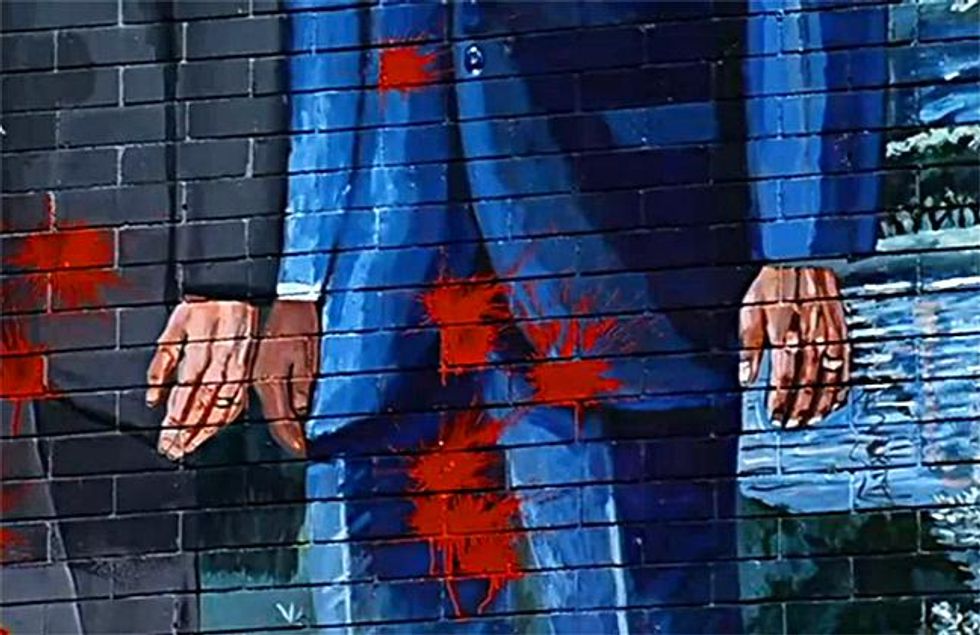
On the night of August 6, a vandal, or possibly a group of hooligans, shot up Karlisima's mural using a paint ball gun or guns loaded with bright red paint. It took time to methodically place over 50 shots in the groin area of the presidents. The central figure of Ayesha Abraham was not destroyed. One of the hoodlums supposedly signed the work with a scrawl reading, "The War Thugs." Channel 4 NBC Washington reported that the manager of Mama Ayesha's, Amir Abu-El-Hawa, responded to the destruction by saying: "It's sad. My family has worked hard for this restaurant - blood, sweat and tears over the past 55 years." The television station also spoke to the artist, who simply said: "I'm just so devastated."
On August 7, 2015, the Common Dreams website published an article by Sam Husseini with the awkwardly sophomoric title of: On Shooting the 'War Thug' Presidents in the (Paint) Balls. A writer and left-wing political activist, Mr. Husseini is the communications director of the progressive Institute for Public Accuracy. His articles on pop culture, media, and political matters have been widely published, from the Nation to the Washington Post, but his Paint Balls essay is utterly reprehensible. From the opening paragraph to the last moral high-horse sentence, Husseini's anti-art diatribe made my blood boil; this passionate article is the result.
I will be direct, Sam Husseini is a philistine, a classic example of an individual who knows absolutely nothing about art. The fact that he writes about pop culture and media, and his rubbish is published, points not only to the intellectual squalor of our times, but to the bankruptcy of America's so-called "left."
In the malicious opening sentence of his article, Husseini informs the reader that Karlisima's mural had been "transformed" or "made more whole, reborn" by its defacement! He completely dismisses the artist, barely mentioning her, saying only that "the mural was originally labored over by Karlisima Rodas."
Of Mayan ancestry, Karlisima was born in San Salvador, El Salvador, and was considered a prodigy for her artistic abilities. As a child Karlisima was mentored by none other than Jose Mejia Vides, a printmaker, sculptor, and painter now considered to be an outstanding luminary in Salvadoran art. One does not need to dwell on the conditions suffered by El Salvador in the 1980s. As an artist I worked hard to oppose the "death squad" democracy the U.S. hoisted upon the unfortunate Salvadorans at the time, creating a multitude of prints and drawings that depicted that country's bloody "civil war." Karlisima left El Salvador in 1984 and emigrated to the United States where she settled in Washington D.C. In 1992 she graduated from Washington University with a Bachelor degree in Fine Arts, and went on to work at the National Gallery of Art and the National Museum of African American Art as a silk screen specialist.
Husseini goes on to call the paint ball vandalism "a sort of art work that is literally paint as paint," and that for the destroyed mural "there's a case to be made that this more completes the piece than defaces it." Husseini adds the wisecrack that "some people, including Karlisima, now seem upset by the addition of the paintballs, but murals are not typically done to glorify the high and mighty." In what would not be his final spasm of mental incapacity, Husseini jeered that "the original mural is not destroyed, it's not painted over, but used to make a perhaps unexpected point." Ah, there it is, the postmodern gobbledegook. You see, an anonymous street artist has merely "appropriated" and "repurposed" Karlisima's mural! It is with the most bitter sarcasm that I must point out that our paint ball vandal could enjoy a lucrative career in today's trendy art world, if he or she would only step out of the shadows.
Instead of criticizing Karlisima's artwork, perhaps Mr. Husseini should offer some critical analysis of America's progressive movement. The U.S. antiwar movement totally collapsed with the ascendancy of Mr. Hope and Change, the "antiwar" president; the left simply folded itself into the Obama campaign and the democratic party, willingly and mostly uncritically. It has not since recovered, and I have serious doubts that it will. The left's ineptitude and total incompetence has prevented it from impacting the American political scene, and now out of sheer frustration, lefties are attacking an artist for painting the portraits of eleven U.S. presidents.
What really stuck in Husseini's craw was that Karlisima dared to paint 11 U.S. presidents without giving them devil horns and fangs. In Husseini's words: "From using nuclear weapons to bombing Vietnam and invading Iraq to deploying killer drones in country after country, the thuggish-ness of these presidents is hard to compete with." He went on to say that "an augmented mural could include mushroom clouds in the background, and perhaps jet fighters, bombers and killer drones flying overhead." Yes, but... we are not talking about the augmentation of an artwork, we are talking about artless pillage. Husseini completely disregards Karlisima's right to freedom of expression because he deems her artwork "politically incorrect."
I am in no way opposed to the creation of acerbic works of art that malign the war making ruling class, I have created such images myself. Here I must mention the brilliance of English artist Gee Vaucher. In 1977 she joined the anarchist punk rock band Crass, producing extraordinary hand drawn images that everyone thought were photomontages. In 1980 Vaucher drew the cover art for the band's Nagasaki Nightmare single, an antiwar musical masterwork. The artwork depicted the leaders of nuclear armed powers and their allies standing on the pulverized remains of Nagasaki, the charred body of a child at their feet. Vaucher's drawing and the band's lyrics continue to haunt me: "They've done it once, and they'll do it again, they'll shower us all in their deadly rain." If Husseini actually knew anything, he might have told his readers about Vaucher's works, instead he went for the denigrating cheap shot by belittling an artist and praising a vandal. Crass did not destroy anyone else's artwork in order to make their point.
Husseini attempts to justify the destruction of an artwork that he does not politically approve of, and he makes light of it. His tone is more appropriate for TMZ or Buzzfeed. He condones the ruining of an artist's depiction of U.S. presidents, because "all these presidents have used violence." I find the crudeness and philistinism of Sam Husseini to be frightening. By giving a green light to the defacement of Karlisima's Presidential Mural, my fear is that he incites some screwball to visit the U.S. National Portrait Gallery and begin defacing the museum's historic Portraits of the Presidents collection; justifying the vandalism of art is a slippery slope.
Furthermore, Husseini assumes the "transformation" of the mural was carried out as a left critique of power. How does he know the defacement was not carried out by your garden-variety lunatic, or simply as an act of teenage vandalism? The signature "The War Thugs" could have been left by anyone and should not be considered evidence for political motivation.
More to the point, it is so much easier to destroy a work that took an artist three years to create, than it is to produce your own artistic statement. Husseini did not call for artists to step forward to create skillful and persuasive works of art to open minds and touch the human soul, no, he made excuses for an act of sheer brutish intimidation, and no American should put up with it.
What would Husseini have written about the City of Los Angeles partially white washing the Siqueiros America Tropical mural on Olvera Street in 1932? Would he have written that it had simply been "transformed" or "made more whole, reborn?" I have to wonder how Husseini would respond to a pro-Palestinian public mural being defaced on U.S. streets with red paint ball splats. Would he say that "the paintball artist perhaps admirably exercised restraint from engaging in figurative head shots," like he did when referring to the ruined Karlisima mural?
It seems so obvious that I hesitate to bring it up, but history has shown us many examples where art and artists were destroyed for political purposes. Starting in 1947, the House Un-American Activities Committed destroyed the lives and careers of hundreds of directors, screenwriters actors, and other professionals in the Hollywood motion picture industry, because they were accused of being communists. In the late 1930's the Nazis began to ban artists that they perceived to be "un-German" and "degenerate," in particular banning Jewish and communist artists. Husseini's claptrap regarding Karlisima's mural reminds me of the Nazi Degenerate Art exhibitions (German: Entartete Kunst), where the fascists exhibited modern art for ridicule and derision before destroying the canvases, sculptures, and prints, or selling them overseas for profit.
I am a dedicated realist painter and printmaker with a lifelong commitment to creating socially conscious works of art. If Sam Husseini, his minions and supporters, would care to go through my online portfolio of artworks and writings published on my Art For A Change website, they will find nothing that even remotely smacks of reactionary politics. That being said, I strongly denounce Husseini's vile contention that Karlisima's mural was "transformed" and "made more whole, reborn," by a wretched act of vandalism.
In 1758 the French philosopher Claude-Adrien Helvetius published a controversial book titled On the Mind. The work was banned by the Parliament and the Sorbonne while Helvetius came under relentless attack. The Enlightenment philosopher and writer Voltaire was unimpressed by the book, but when he heard it had been publicly torched, he resolved to support Helvetius.
In 1919 the English writer Evelyn Beatrice Hall published a book that summarized Voltaire's position regarding Helvetius in the following words: "I disapprove of what you say, but I will defend to the death your right to say it." Hall's phrase is what Husseini should have proclaimed when announcing his displeasure with Karlisima's mural. Hall's words should be ringing in our ears. The act of vandalism approved of by Husseini clarifies her words and brings them new life and meaning.
Truth be told, I don't really care for Karlisima's Presidential Mural, as I do not believe an artist's role is to give uncritical support to those at the top. Let us just say it is the Francisco Goya in me. But when goons attempt to physically obliterate her work, and slippery eels publish rationales and apologia for those attacks... I will stand with Karlisima as a fellow artist. I would hope that I would have the same support, were my own works ever defaced.
The manager of Mama Ayesha's, Amir Abu-El-Hawa, has set up a GoFundMe page to raise the money necessary to restore the damaged mural; the goal is to raise $4,000 dollars. At the time of this writing, $3,285 dollars have been raised. Please join me and contribute whatever you can to the restoration of Karlisima's Presidential Mural.
One day after a federal court sentenced the former CIA officer to 42 months in prison for allegedly blowing the whistle on a botched CIA mission, Jeffrey Sterling is sharing his side of the story.
In The Invisible Man: Whistleblower Jeffrey Sterling, a short documentary released Tuesday, Sterling describes how his experience with racial discrimination within the CIA took him from working as an Agency case manager to living out of his car, to years later facing charges under the Espionage Act for supposedly leaking national intelligence secrets to New York Times journalist James Risen.
The film was directed by Judith Erlich, whose past works include the Oscar-nominated The Most Dangerous Man in America: Daniel Ellsberg and the Pentagon Papers.
"They already had the machine geared up against me," Sterling said. "The moment that they felt there was a leak, every finger pointed at Jeffery Sterling."
Sterling, who has maintained his innocence, says he had lawfully approached the Senate Intelligence Committee to express concerns over certain CIA operations and the impact those missions might have on the safety of troops in Iraq.
Prior to reporting those concerns, however, Sterling had filed racial discrimination charges against the CIA, becoming the first CIA case officer ever to do so. That case was eventually dismissed on the grounds that its details might compromise national security and Sterling was eventually fired.
Years later, after meeting his wife and moving on to a job in the healthcare industry, Sterling was told by his attorneys that he was being looked at as a possible leak.
Sterling, who was convicted on January 26, 2015, said, "It was a shock. It's still a shock. He added, "They shut me up with my discrimination case and they closed the door on me with the criminal case."
Throughout the case, Sterling's supporters have denounced the injustice of the charges and sentencing, particularly as it contrasts with the recent plea bargain deal granted to former CIA chief General David Petraeus, who leaked troves of classified material to his mistress and biographer Paula Broadwell.
Norman Solomon, executive director of the Institute for Public Accuracy and coordinator of whistleblower advocacy organization ExposeFacts.org, who produced the Sterling documentary, told Democracy Now! on Tuesday that the sentence marks a "continuation of the war on whistleblowing and journalism and a clampdown on the essential flow of information for democracy" under the Obama administration.
"General Petraeus's 'fondle on the wrist' by the government was hovering over the courtroom yesterday," Solomon continued, "showing the absurdity and tyranny of what the administration continues to do."
In a press statement following the sentencing, former CIA analyst Ray McGovern said: "It seems clear that the White House told the Department of Justice to make an example of Jeffrey Sterling--an example of what one can expect if s/he decides to blow the whistle."