

SUBSCRIBE TO OUR FREE NEWSLETTER
Daily news & progressive opinion—funded by the people, not the corporations—delivered straight to your inbox.
5
#000000
#FFFFFF
To donate by check, phone, or other method, see our More Ways to Give page.
Daily news & progressive opinion—funded by the people, not the corporations—delivered straight to your inbox.

What working people did with others outside the ballot box to improve their lives and those of their children and grandchildren is what secured the victories of the past.
The resounding Democratic Party candidates' victories over Republican opponents on November 3 begs the question of a new political moment in the US. Is it similar to Blue Waves of the recent past—meaning a change in political party but no improvement in the material conditions of the American population?
To ask the question means, in my view, to unpack the powerful actors that hold the reins of power, economically and politically. The actors are corporate America and the wealthy, the ruling class.
This class of owners was large and in charge before the November 3 midterm elections. Crucially, that anti-GOP vote failed to dislodge this class that controls the profit system.
Money shapes policies in ways that votes don't under the current imbalance of power between the rulers and the ruled.
It's a case of voting against President Donald Trump and GOP candidates. It's not the same thing, I suggest, as a vote for Democrats who allied with Republicans to coordinate and fund the daily operations of the American empire, or hegemon, arming and funding Israel's genocide of Palestinians in Gaza, before the November 3 midterm elections.
The franchise or the vote is necessary but not sufficient to alter the relationship of domination and subordination between the rulers and the ruled in America. What follows from that relationship is more of the same, war abroad, directly in Iran, and by proxy in Ukraine, to the detriment of living and working standards in the US.
The two-party monopoly, or duopoly, and its addiction to perpetual war, retains a stranglehold over American society. All is not lost.
Take heart. There are tactics and strategies that address this relationship beyond voting for Democrats.
And I am not talking about the 1960s and protests against the American War in Vietnam. As a youngster, I participated along with millions of others across the US.
Rather, I am talking about the here and now. Consider this.
People in Spain have gone on a general strike to protest the scarcity of affordable rental housing. Millions of Spanish people are participating.
Students in France and throughout Europe have taken to the streets to protest substandard education conditions and overall living situations against the backdrop of elected officials funding Ukraine's proxy war against Russia. European elites' animus toward Russia has a kind of parallel to how the ruling class of Israel and the US demonizes the nation of Iran.
In the US, there is a history of general strikes, one you don't learn about in school. There was a Seattle General Strike of 1919 and the Oakland General Strike of 1946, for instance.
It's been 80 years since a general strike in America. I recall talking to a friend passing out flyers to a No Kings rally earlier this year.
She mentioned talk of a general strike in the fall. Well, it's fall now, and a general strike seems nowhere near on the horizon.
Instead, there's euphoria about the landslide midterm vote against Republicans and for Democrats. Meanwhile, the robust voter mobilization is over, and danger looms as the population gets a green light to lapse back into observing national, state, and local politics.
This of course is in part what fuels the establishment of pay-for-play politics that sidelines the (non-)voting public. A symptom of this is that each election season is breaking fundraising records.
"In the 2026 midterms, the 40 biggest donors made more than $2.4 billion in campaign finance contributions through mid-October," according to the Brennan Center. "The top 40 have given more in every midterm since 2014, and the total from this cycle is eight times the giving of 2014’s top donors, even accounting for inflation."
The working class, to use the language of the marketplace, can't with its votes compete with that amount of money in pay-to-play politics. Money shapes policies in ways that votes don't under the current imbalance of power between the rulers and the ruled
That statement might appear strange. Americans are taught that voting defines democracy.
However, the transformational working class victories of the past—from abolishing chattel slavery to ending child labor—were not the outcomes of voting. What working people did with others outside the ballot box to improve their lives and those of their children and grandchildren is what secured such victories.
Time for new working-class tactics and strategies to forge an American movement politics that puts people first? If not now, then when?

Schumer is the opposite of what Democratic voters said they wanted and in countless ways he represents exactly what they voted against.
Now that Democratic Sen. Chris Van Hollen of Maryland is challenging Sen. Chuck Schumer (D-NY) for Senate majority leader, we have a choice that lets us honor an election of change. Schumer’s supporters credit him for every Senate upset and proclaim his inevitable coronation as majority leader after leading the Senate Democrats for nearly ten years. But if he’s such a Zen master strategist, why do most of the new senators who represent so much of the party’s future almost unanimously want someone different? Maybe because they’re actually in touch with average Americans, and recognize that letting Schumer continue to symbolize the Democratic brand as majority leader insults the very desire for a different direction that powered their victory.
The new senators-elect calling for change so far include Annie Andrews, Abdul El-Sayed, Troy Jackson, Peggy Flanagan, Adam Hamilton, Chris Pappas, James Talarico, and Juliana Stratton. Scott Colom, who just claimed a historic victory in Mississippi, has questioned having two leaders from the same borough of the same city. Existing senators opposing Schumer range from Sens. Bernie Sanders and Raphael Warnock to Elissa Slotkin and Mark Warner. These senators represent diverse sectors of the party—the problems with Schumer go beyond any “progressive vs. moderate” divide. But all recognize the need for a change, and their response undercuts every argument about Schumer being key to the Democratic victories. Why kneecap them from the start by insisting on the old regime?
I saw the grassroots response this past June when I gave the opening keynote at the Washington State Democratic convention. The delegates were a diverse group of hard-working volunteer activists, spanning highly progressive Seattle districts, suburbs that recently turned blue, blue-collar cities like Spokane and Tacoma, and conservative rural areas where even identifying as a Democrat takes courage. After exploring the possibilities and challenges of the moment, I described how Schumer has dragged down the Democratic brand—with his closeness to Wall Street and relentless embrace of Israel being particularly toxic with young voters—and why he needed to go.
To succeed in 2028 and beyond, Democrats will need a strong positive vision, not Schumer’s tepid rehash of corporate-friendly Clintonism.
I then asked the crowd to try a thought experiment: Would anyone want Schumer campaigning alongside them in a critical race, whether local, state, or national? Given the breadth of delegates in the room, I expected some pushback and argument. Instead, which I didn’t expect, the entire room burst into laughter. They responded to that idea as though it was literally absurd.
So why would the Democrats want Schumer, with his 13% approval rating, as a leading spokesperson for the party? They need leaders to inspire enthusiasm, build on the election’s successes, and rebuild the party brand, not a leader who deflates momentum and sows doubt every time he opens his mouth. Here are three reasons why picking Schumer would undermine the amazing achievement of the Democratic wave:
Schumer’s strategic record is far weaker than the Democratic victories imply. Supporters say Schumer helped recruit candidates like Roy Cooper, Josh Turek, Sherrod Brown, and Mary Peltola. But all but Turek were obvious choices whom many others were also working to convince. Schumer also backed Haley Stevens in Michigan, Janet Mills in Maine, and Angie Craig in Minnesota, all of whom were problematic—in Stevens’s case, her election-eve backstabbing nearly cost Democrats the seat. Schumer’s Senate Majority PAC controlled massive Democratic dollars. But Schumer didn’t invest in Kansas until October 9, or in South Carolina until five days before the election. Schumer never invested in Louisiana, where Democrats lost by less than two points after July and September polls showed they were within four points. Nor in Florida, where Angie Nixon lost by less than three after select polls had shown her equally close. In contrast, Ken Martin’s Democratic National Committee paved the way for even the long-shot victories by routing money to every state party, with red states getting proportionately more, echoing the role that Howard Dean’s 50-state strategy played in the Obama wave.
Mississippi is a key example. Democrats like Sens. Sheldon Whitehouse and Warnock helped Colom’s long-shot candidacy raise money early on, with Warnock raising $750,000 and offering valuable introductions and advice. JB Pritzker also played a key role, investing $1.6 million. AOC helped too, as did grassroots donors. I gave my $100 in April after reading a thoughtful Bulwark assessment of Colom’s chances. With every resource and access to inside data, Schumer should have had the judgment to invest early even on the possibility of Colom winning. But aside from one joint fundraiser, Schumer didn’t financially support Colom until October 20, although he now tries to take credit, and credulous reporters seem to accept his claim. He’s embodied the opposite of strategic acuity.
Schumer’s a terrible symbol for the party. Physically, though “only” 75, Schumer echoes Joe Biden’s frailty. He’s useless on social media, rambles in interviews, and writes press releases with 35-word titles. He’s rightly been called “the senator from Wall Street,” a disaster in a populist moment. He refused to endorse Zohran Mamdani after the Democratic primary, even though Mamdani excited precisely the kinds of new voters who then fueled this national wave election. Schumer also voted for the disastrous Iraq War that helped pave the way for Trump, and continues to excuse the actions of an Israeli government that’s rightly condemned worldwide. As majority leader, he’ll be under even more public scrutiny, which will make it far harder for Democrats to marshal the grassroots enthusiasm necessary to build on their successes and battle Trump and Stephen Miller on the public stage.
Democrats won in spite of their brand, not because of it. We don’t need someone who embodies the brand’s weaknesses. Only 29% of voters viewed the party favorably in an October 28 NBC poll, a week before they threw the Republicans out. Schumer’s the last person to change that assessment. In contrast, Van Hollen has ties to all the elements of the Democratic coalition, having run the fundraising efforts for both House and Senate Democrats, and then emerged as a critic of Democratic complacency in the last couple of years, including challenging Biden’s unflinching allegiance to Israel and confronting leaders like Schumer, who refused to back Mamdani. It took real courage for Van Hollen to travel to El Salvador to meet with and help build the pressure to free Kilmar Abrego García, the Maryland man whom ICE had deported there in defiance of a court order. So he’d make an excellent majority leader, and would have my vote.
If senators prefer someone other than Van Hollen, there are lots of others who could similarly unite the party, embody the best of its values, and be powerful spokespeople instead of coming off as if they have one foot in the grave. Democrats won because people so hated what Trump has done, and because grassroots volunteers organized with such commitment, persistence, and intensity to make the blue wave a reality. To succeed in 2028 and beyond, Democrats will need a strong positive vision, not Schumer’s tepid rehash of corporate-friendly Clintonism.
It’s right to keep celebrating our amazing victory, but replacing Schumer will make building on all we’ve won far easier. Groups from Indivisible to the Machinists union have weighed in for change so far. Now it’s time to get other organizations to join the grassroots pressure and to insist that our Democratic senators back a majority leader who embodies the vision we’re fighting for and can present it to the public in a way that builds on all we’ve just achieved.

Governments across the globe have the choice at COP31 to unleash its power of agroecology and divert funds to a food system that nourishes people, supports fair livelihoods, and gives animals better lives while protecting the planet.
At COP 31, governments will be talking about tackling climate change and food system resilience, but unless they tackle their own contradictions, this is just hot air.
The contradictions are stark. This year, the African Development Bank warned that El Niño could cost the continent up to $20 billion. Despite a football field-sized field of tropical rainforest being destroyed every day by farms supplying industrial agriculture giant JBS, the Nigerian government has approved major expansion into Nigeria by JBS.
Nigerians needs answers about the real consequences of JBS' expansion. Corporations like JBS concentrate power in the hands of a few, very rich people, such as Brazilian billionaire Joesely Batista whose shares control JBS and who met with US President Donald Trump just a day before Trump set out reduced tariffs on beef imports.
The opportunity to have a food system that is equitable, humane, and sustainable is truly exciting and a tangible prospect.
These giant industrial agriculture corporations also put pressure on precious nature resources; 1 kilogram of animal protein requires roughly 100 times more water than 1 kg of grain protein. They threaten livelihoods and how families support and feed themselves; when smallholder farmers already produce over 90% of the nation’s food—what will happen to them? Then the job creation narrative pushed by JBS needs questioning. Why not ask JBS workers in Colorado, who this year walked out in protest about labor rights abuses?
In Europe during unprecedented summer heat, the UK government set out increased support for chicken production in the name of food security, despite previously acknowledging that in the UK “animal farming at its current scale is unsustainable without a reliance on imports,” With South American soy providing 18% of produced animal feed.
Just two months earlier, the UK saw its biggest ever environmental lawsuit being brought to the High Court in London, by over 4,000 people, against Welsh Water and Avara Foods. Avara Foods are allegedly raising an estimated 24 million chickens in the catchment area. Litigants cited damage to three rivers, including the iconic River Wye, with impact on local ecosystems, communities, and tourism reliant businesses on these once thriving rivers.
Industrial agriculture is not the answer to hunger either. An estimated 766 million tonnes of grain is diverted annually to feed farmed animals rather than people. Nor is this a food system that provides food security. Quite the opposite, this is a teetering system that relies on synthetic fertilizers, imported animal feed, and fossil fuels. It’s hugely vulnerable to climate change, supply chain shocks, and geopolitical instability, including the conflicts involving Russia and Ukraine and Iran and the US.
Industrial agriculture even threatens the effectiveness of vital medicines. Antibiotic overuse in industrial agriculture has been linked to nearly 2,000 premature deaths in the UK alone. Antibiotics are given to animals to aid their survival and growth in the harsh conditions in which they are forced to live. Let’s be clear, we are risking antimicrobial resistance so that a few people can continue to put profit before animal welfare.
But central to this failing system is injustice. This is injustice not only for people and the planet, but for the over 90 billion animals trapped right now in the system. This cannot be overlooked in talk of climate change and food security. Every cow, sheep, pig, chicken, and goat is a sentient being capable of feeling pain and fear. Mother pigs are kept so confined that they cannot turn around. Chickens buckle under the weight of their selectively bred bodies. Baby animals are routinely mutilated without pain relief. Industrial agriculture is a horror system for animals.
The good news is, there is a better food system, called agroecology. Evidence increasingly demonstrates it has the power to provide long-term food and reduce animal suffering. Agroecology works with nature not against it. It adapts to climate change and offers resilience against market shocks. It connects how we grow food with how we treat animals, protect ecosystems, and support livelihoods. The opportunity to have a food system that is equitable, humane, and sustainable is truly exciting and a tangible prospect.
Governments across the globe have the choice at COP31 to unleash its power. They have the choice to stop using our money to prop up an unjust, cruel, and failing food system and divert to a food system that nourishes people, supports fair livelihoods, and gives animals better lives while protecting the planet. They must aid businesses to pursue the opportunities needed here alongside increased plant rich food production.
In Africa, how we produce our food must be shaped by the knowledge and insight of the people who grow it now and by the communities who depend on it. The government must also make finance and practical support accessible to them.
Factory farming grew following the Second World War, when maximizing food production was an urgent priority. Today we must judge success by more than volume. Our world has changed; we know more about animal sentience, ecological limits, and the fragility of supply chains,
That is what we do at World Animal Protection, we work to protect animals from cruelty and suffering. Governments must stop funding relentless cruelty to animals. At COP31, we don't need more contradictions and hot air from governments. We need meaningful change.

While voters in both countries have just withheld a mandate, Washington and Jerusalem are moving to bind their militaries together in a way that is harder to undo than any election.
Two elections in eight days sent leaders the same message, and neither country got a clean answer.
On November 3, American voters delivered a landslide. Democrats flipped eight Senate seats and now hold a 55-44 majority. They have won the House as well, with fewer than twenty races still uncalled, and they are on track to match or pass the 257 seats Democrats won in 2008. They won Senate seats in states Trump carried by double digits in 2024, including Texas, for the first time since 1988. The president is trying to distance himself from the result.
A week earlier, Israelis voted on October 27 and could not decide. Benjamin Netanyahu’s Likud won 27 seats, the most of any party, but his right-wing and ultra-Orthodox bloc holds only 53 of 120, eight short of a majority and down from 64 in 2022. Gadi Eisenkot’s centrist bloc holds 48, and Arab parties hold a record 19. On November 8, Israel’s President Isaac Herzog gave Eisenkot the first chance to form a government after 67 lawmakers endorsed him, against 46 for Netanyahu, who stays on as caretaker prime minister in the meanwhile.
Israel’s system explains why. Voters choose a party list, and seats are divided proportionally nationwide, so no party has ever won a majority alone. Israel’s president asks the candidate with the best chance of assembling 61 seats to form a government, which usually means the leader of the largest party, though not this time. That candidate gets 28 days, extendable by 14. If the candidate fails, another gets a turn, and if that fails too, the country goes to a new election. The 67 endorsements include Arab-led parties, but Eisenkot has ruled out governing with them, so they are not likely to be part of his majority. His clearest path to 61 runs through the two ultra-Orthodox parties that sit in Netanyahu’s bloc. Otherwise he would need a minority government that survives a no-confidence vote. If he fails, Netanyahu is next in line. Each side needs people it has sworn it will not work with.
Voters in both countries have just withheld a mandate. Washington and Jerusalem are, meanwhile, binding their militaries together in a way that is harder to undo than any election. The first signal came on Monday in Paris, where Secretary of State Marco Rubio told reporters that Israel is rich enough to buy American weapons and that President Trump wants U.S. military financing to end “as soon as possible.” That financing is about $3.8 billion a year under a 10-year agreement that expires in September 2028: $3.3 billion for weapons purchases and $500 million for missile defense.
Rubio said the terms are being worked out in a new memorandum of understanding, that Israel could “absolutely” stop receiving aid by the end of the year if it chose, and that the deal could include joint weapons production. “We’ll negotiate the timeline,” he said. Trump had said the week before that the two countries had agreed to end the aid by the end of 2026, which according to The Times of Israel surprised officials on both sides. Netanyahu has proposed phasing it out over about a decade.
That sounds like distance. Read together with the defense bill, it looks more like a change of form: military grants give way to joint production and shared technology. Critics of the aid may welcome the end of grants. The question is what replaces them, and who gets a say. The vehicle is the National Defense Authorization Act (NDAA). The House passed the FY2027 bill, 216 to 212, with $750 million for joint programs with Israel, including $500 million for missile defense, the figure the current agreement already commits, plus counter-drone, tunnel, and emerging-technology work. The Senate Armed Services Committee’s version carries its own provisions for the military support of Israel.
Both include the Defense Technology Cooperation Initiative, which would make the Pentagon designate an executive agent to coordinate joint research, testing, integration, and industrial cooperation—which would move coordination out of the realm of foreign aid and into the more opaque world of Pentagon contracts. The House bill also expands intelligence sharing with Israel and creates an Abraham Accords defense initiative. And U.S. taxpayers pay the bill.
The Senate has not passed its version. A July vote to begin debate failed 50 to 46, and the final text is expected to be a compromise drafted by the Armed Services Committee leaders in the lame-duck session, competing for floor time with a December 11 government funding deadline. What that text will contain on Israel is not yet clear.
Supporters, including the American Israel Public Affairs Committee (AIPAC), say that the provisions make existing cooperation more efficient and were co-sponsored by members of both parties. They also argue that the United States gets a multiple return in technology and lessons from combat. Critics disagree. Representatives across the aisle, Thomas Massie (R-KY) and Ro Khanna (D-CA), tried to strike the section and failed. Massie warned that writing it into law would make it harder for a future administration to reverse it.
The lobby from AIPAC that praised these provisions had a poor election. According to an analysis from Responsible Statecraft, its super PAC and affiliated groups spent about $84 million this cycle, and nearly two-thirds of it, about $55 million, went to candidates who lost. The largest effort, more than $31 million, failed to stop Abdul El-Sayed from winning Michigan’s Senate seat in both the primary and the general election. “Thank you for giving me the opportunity to beat you twice,” he told AIPAC in his victory speech. James Talarico won Texas after saying he had never taken AIPAC’s money and would not take it in his campaign. A Democratic strategist told Agence France-Presse that campaigns that once coveted AIPAC’s support now see it as a liability. Opinion is moving too: in the Chicago Council on Global Affairs survey, Americans’ favorability toward Israel averaged 44 out of 100 this year, a record low, down from 58 in 2022, and among Democrats it fell from 52 to 30.
Voters in both countries have just reopened the question of who governs and on what terms. A provision written into a defense bill by a Congress whose majority is about to change closes it for them. The final bill is expected to come together before the new Congress is sworn in.
The rebuke, though, is not symbolic. The new Democratic majority takes office in January, and the final NDAA text is not yet settled. Constituents who want their representatives to explain what the Defense Technology Cooperation Initiative does, and whether it should carry a review date, still have a few weeks to ask.
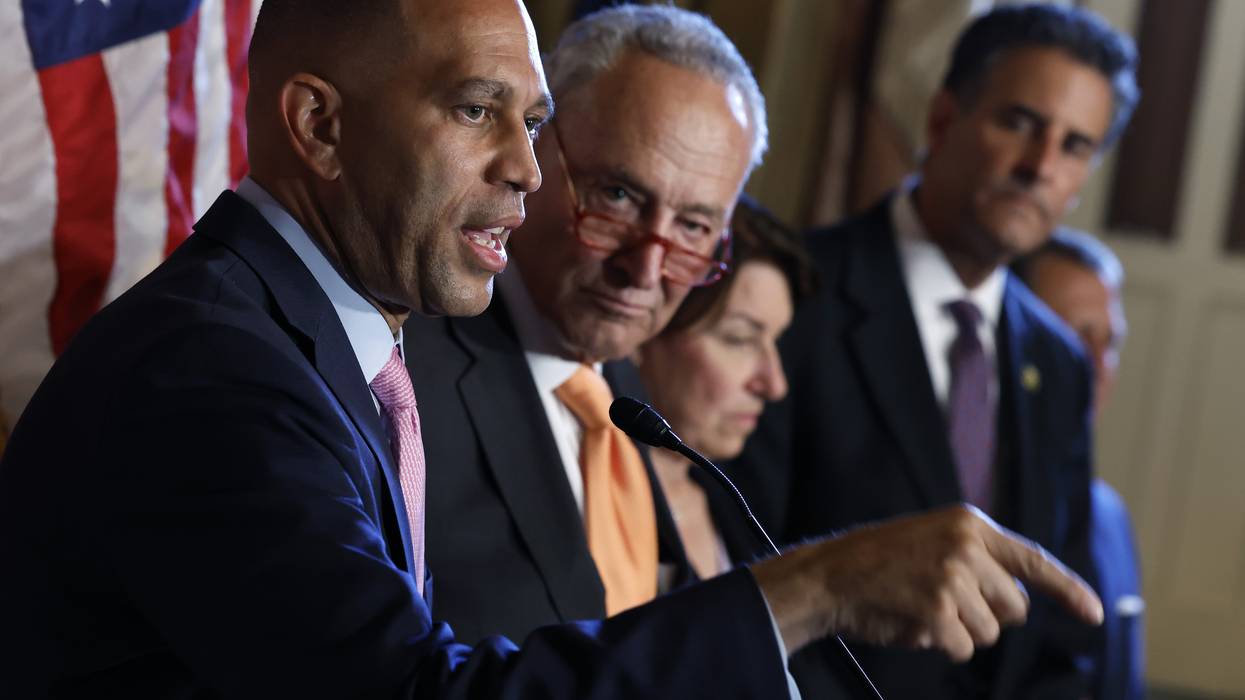
When so many Americans don’t want to see these two in leadership positions in the House and the Senate, it’s a dereliction of duty in a democracy to ignore that.
“Why not?” is an important question, so I’m going to answer it as clearly as I can.
For many decades, the Democratic Party has been guided by leadership like that of Hakeem Jeffries and Chuck Schumer. In Schumer’s case, I mean him specifically. In Jeffries’ case, it’s more the ideology. And that leadership has led to the Democratic Party being disrespected, mistrusted, and unliked nationwide. Of course, we still have pockets where the party is strong, but in general, we’re running at about a 39% approval rating across the country. And those two are even less popular than President Donald Trump.
But the biggest reason the Democratic Party needs new leadership is that it needs to rebuild trust with the American people. It needs to rebuild trust with its own voters, in government, in our institutions, and in our systems of justice and accountability. The party needs to make sure life is affordable enough for people to not only survive, but thrive. It also needs to work towards restoring faith in our democracy by strengthening it.
That means taking on a lot of efforts where the people’s interests are at odds with many of the members in the House and the Senate. Those policy fights will go against not just their donors, but their friendships and their relationships. They’re still in a mindset of bipartisanship as opposed to supermajoritarian rule. You can’t have both.
If you want a country that’s able to change things, like ending Citizens United and ending gerrymandering at the federal level, you need a powerful Democratic Party. And if you look back through history, America has made most of its major changes and improvements under supermajoritarian, single-party rule at the federal level, with big majorities in state legislatures and governors’ mansions around the country too.
The simple fact of the matter is that divided governments are great for maintaining the status quo, but they’re not built for change at all. And this moment we’re in, and the foreseeable future, are going to require change. Systemic, dramatic, radical change. Adapting to things like AI and robotics. Adapting to climate change. Working to repair broken institutions like our judicial branch, our prison systems, and our healthcare systems. Fixing our relationship with tech companies, with markets, and with private firms, including what we require from them in exchange for allowing them to exist.
Neither Chuck Schumer nor Hakeem Jeffries is well-suited for this. I’m not sure any of the people who’ve raised their hands are the exact choices we need. But at this point, the most valuable thing that comes out of the fight to replace them is just the fight itself. Flexing the muscles of the electorate.
When so many Americans don’t want to see Hakeem and Chuck in leadership positions in the House and the Senate, it’s a dereliction of duty in a democracy to ignore that. But that, in and of itself, has no consequences unless we provide them.
That, I think, is why it’s so important that we’re doing what we’re doing. All across this country, organizations, individuals, and a handful of elected officials are taking a stand and saying, “No. We need to move in a different direction. This isn’t the way.” And that unity of purpose, that unity of mission, is one of the most valuable things to come out of this fight.
So what are we doing here at A Fight Worth Having?
We’re sending LED trucks all across DS so the new members, the Congressional Progressive Caucus, and others are reminded that the American people are behind them if they choose to be brave. We’re running ads on television in DC. We’re running full-page newspaper ads. We’re trying to make sure the people in DC see and know that the American people are united in their resistance to this leadership, and that they’ll be doing the people’s business if they take a stand.
We’re also running a series of about 110 polls across the country to see exactly where Americans stand, and we’re releasing that polling, hopefully on Monday or Tuesday, before the votes for Speaker. We’re doing everything we can to make sure these folks are ready.
The other thing we’re doing is raising money for the handful of folks who’ve said, “No more” and committed to opposing Jeffries. So far, we’ve raised $86,000.
If you want to help these members, you can do so here.
This is the first of many fights that are worth having. Let's go.

For more than half a century, powerful interests have worked to build an America that serves the wealthy few. Now we have an opportunity to chart a different course, rooted in economic justice, human dignity, democracy, peace, and a livable planet.
The billionaire class made a bad bet. They thought their extraordinary wealth could buy them a country. That hundreds of millions of dollars in campaign contributions, control over powerful communications platforms, and an increasingly authoritarian political movement could overwhelm the democratic will of the American people.
On November 3, millions of Americans reminded them of something they had forgotten: Organized money has an opponent. Organized people.
From the millions who marched in the No Kings demonstrations to the volunteers who knocked on doors, registered voters, and mobilized their communities, Americans delivered an extraordinary repudiation of Donald Trump and his assault on democracy.
Democrats need an ambitious agenda that improves people's lives while confronting the concentrated wealth and political power that have prevented meaningful reform.
Young Americans helped power the Democratic victories. Latino voters shifted away from Republicans. Across the country, voters expressed their frustration with an administration that has prioritized the wealthy while ordinary Americans struggle with the cost of living.
Democrats won control of both houses of Congress. But the significance of this election extends far beyond which party holds the gavels. We may be witnessing a historic opportunity to reverse a political and economic transformation more than half a century in the making.
In 1971, corporate attorney Lewis Powell wrote a confidential memorandum for the US Chamber of Commerce urging business leaders to organize a sustained campaign to influence universities, the media, the courts, and government.
The Powell Memo helped inspire a corporate political offensive that reshaped American politics. Business interests invested enormous resources in think tanks, lobbying, political campaigns, and legal institutions, advancing policies that weakened unions, reduced taxes on corporations and the wealthy, rolled back regulations, and concentrated economic and political power.
The consequences are all around us. America has generated extraordinary prosperity, but an increasingly disproportionate share has flowed to the top. Housing, healthcare, and education have become increasingly unaffordable, while billionaires exercise extraordinary political influence.
Today's tech oligarchs didn't invent this power grab. They inherited a playbook.
But this election demonstrated that ordinary people, acting collectively, still possess the power to challenge concentrated wealth.
The question now is what we do with that power.
For decades, Democrats have been told that winning elections requires moving toward the center, moderating their ambitions, and reassuring wealthy donors that fundamental economic arrangements will remain undisturbed.
I've spent much of my adult life watching Democrats invoke Ronald Reagan more often than Franklin Roosevelt. Think about that. The party of the New Deal, Social Security, and organized labor has too often looked to the political philosophy of a president who helped undermine that legacy.
Yet Roosevelt understood something today's Democrats desperately need to remember: Government can transform people's lives, and doing so can build lasting political support.
Medicare for All would help democratize economic security. Public financing would help democratize political power.
His New Deal, propelled in significant part by organized labor and popular movements, established Social Security, strengthened workers' rights, created jobs, and helped build a more economically secure middle class. Those reforms were incomplete, and many Americans were excluded from their benefits. But they demonstrated the extraordinary possibilities of government acting on behalf of ordinary people.
In 1944, Roosevelt proposed a Second Bill of Rights that included the right to a decent job, adequate income, housing, medical care, education, and economic security.
More than 80 years later, that vision remains unfinished.
And in the wealthiest nation in human history, there is no justification for leaving it that way.
Democrats need an ambitious agenda that improves people's lives while confronting the concentrated wealth and political power that have prevented meaningful reform.
Two commitments should stand at its center: Medicare for All and public financing of elections.
The first would transform economic security. The second would help transform political power.
Start with healthcare.
The United States spends approximately two and a half times the OECD average per person on healthcare, yet delivers worse outcomes across key measures, from life expectancy to preventable deaths. Millions remain uninsured, while many people with coverage cannot afford to use it when they need care.
In America, cost effectively rations access to healthcare.
Other wealthy nations guarantee universal health coverage while spending substantially less. Yet our political leaders continue defending a fragmented, profit-driven system that places the financial interests of insurance companies ahead of people's health.
Medicare for All would guarantee healthcare as a fundamental human right, eliminate a major source of financial insecurity, and reduce workers' dependence on employers for health coverage.
But why has such fundamental reform remained politically elusive?
Part of the answer lies in the extraordinary influence of the industries that profit from the existing system. Insurance companies, pharmaceutical manufacturers, and other powerful interests spend enormous sums lobbying politicians, financing campaigns, and influencing the public debate.
Which brings us to the second pillar: getting big money out of politics.
We need to overturn Citizens United, end the system of unlimited independent political spending and super PAC contributions, and establish robust public financing of elections so candidates can compete without depending on wealthy donors and corporate interests.
We should ban congressional stock trading and strengthen protections against conflicts of interest. But those reforms alone will not address the underlying system in which politicians must continually raise money from the very industries they are supposed to regulate.
Public financing offers a way to change that relationship, allowing candidates to rely more heavily on ordinary voters rather than wealthy contributors.
This is essential because campaign finance reform is not simply another progressive issue. It affects our ability to accomplish virtually everything else.
How can Democrats seriously challenge corporate monopolies, tax billionaires, protect workers, or reform healthcare while remaining financially dependent on the interests determined to block those changes?
Medicare for All would help democratize economic security. Public financing would help democratize political power.
Together, they could fundamentally change the terrain on which every other progressive struggle takes place.
These two reforms must anchor a broader commitment to economic and social justice.
We need a living wage of at least $20 an hour, stronger unions and collective bargaining rights, affordable housing and childcare, and a tax system that requires billionaires and giant corporations to contribute their fair share.
We need to defend reproductive freedom, confront climate change, regulate Wall Street, enforce antitrust laws, and protect the democratic institutions increasingly threatened by concentrated wealth and authoritarianism.
The millions who marched, organized, and voted cannot simply return home and wait for the next election. They must continue demanding accountability and building the political power necessary to sustain change.
We must also challenge a foreign policy that devotes extraordinary resources to militarism while urgent human needs go unmet, and use congressional power to end illegal wars.
These are not radical demands in a society with the wealth and resources to achieve them. They are the foundations of a government that places human well-being above corporate profits.
And they challenge the conventional wisdom that progressive ambition is politically dangerous.
Sen. Bernie Sanders (I-Vt.) built a national movement by demanding universal healthcare, economic justice, and an end to billionaire domination of politics. New York Mayor Zohran Mamdani demonstrated that an unapologetically progressive affordability agenda could win broad support in America's largest city.
Their success does not mean every progressive candidate will win. But it demolishes the assumption that Democrats must abandon ambitious ideas to appeal to voters.
As Mamdani has emphasized, voters want change they can experience in their everyday lives, in the cost of rent, groceries, childcare, and healthcare.
Winning is one thing. Delivering is another.
None of this will happen overnight.
Trump remains president. Corporate interests will fight to protect their power. Even with congressional majorities, Democrats face vetoes, Senate procedural obstacles, and opposition from within their own ranks.
But political obstacles are not reasons to abandon fundamental principles.
Democrats should introduce Medicare for All legislation, fight for living wages, advance public financing, and investigate corporate abuses and political corruption. If Trump vetoes popular legislation, let Americans see what Democrats fought for and who stood in the way.
Congressional Democrats can also use hearings, subpoenas, oversight, and their control over federal spending to expose corruption, challenge corporate influence, and build the case for structural reform.
And that accountability must extend beyond Trump and the Republican Party. Democrats cannot credibly challenge a corrupt political system while protecting its beneficiaries within their own ranks.
The millions who marched, organized, and voted cannot simply return home and wait for the next election. They must continue demanding accountability and building the political power necessary to sustain change.
If Democrats fail to deliver meaningful improvements in people's lives, they risk recreating the disillusionment that helped bring Trump to power.
The political and economic system that has concentrated so much wealth and power in the hands of so few was not inevitable. It was built through decades of deliberate political choices. And it can be changed through collective action.
The millions who marched, organized, and voted must remain engaged. Join an organization. Organize in your workplace and community. Hold elected officials accountable. Keep marching, keep voting, and keep demanding more.
For more than half a century, powerful interests have worked to build an America that serves the wealthy few. Now we have an opportunity to chart a different course, rooted in economic justice, human dignity, democracy, peace, and a livable planet.
This is what democracy looks like. Now let's show what democracy can deliver.

While there are a number of steps Congress must take to help increase revenue, they should start by asking the wealthiest Americans to pay their fair share.
Last week, Americans went to the polls demanding change, and they got it. Democrats flipped both the House and the Senate, winning not only in blue states and battlegrounds, but in states that hadn’t sent a Democrat to the Senate in decades. Older voters played a crucial role in that outcome, accounting for roughly 34% of the electorate despite being just 24% of eligible voters. According to analysis by The New York Times and Siena College, voters 65 and older moved six points toward Democrats, voting 52-47 Democratic in the midterms.
These voters came with a clear priority. According to a post-election survey by the NORC Civic Health & Elections Project, 90% of voters over 50, including 87% of Republicans and Independents, said protecting Social Security from cuts was very or extremely important to their vote.
Candidates across the political spectrum knew that Social Security would be an animating issue in this election. Democrats campaigned on making the wealthiest Americans pay their fair share. Republicans touted the president’s message about ending taxes on Social Security benefits. While the messages differed, both parties recognized that older voters care deeply about the future of the program that helps tens of millions of Americans retire with dignity after a lifetime of hard work.
Social Security’s own estimates show that eliminating the income cap entirely could close roughly half of the program’s long-term shortfall. While it’s not the end-all solution, and Congress will need to come up with a lasting solution, it’s the right place to start.
Now that the dust has settled on the election, voters are demanding action. This week, newly elected members are in Washington for orientation, and Democratic leaders are deciding how to put their new majorities to work. But voters handed these members something more important than control of Congress. They handed them a mandate to protect Social Security, and a deadline.
This deadline is not abstract. Earlier this year, the Social Security Trustees Report projected that unless Congress acts, beginning in 2032, Social Security will no longer be able to pay full scheduled benefits. That would trigger an automatic benefit cut of 22%, or roughly $500 a month for a typical retiree. For many, their benefits have to cover utilities, food, transportation, and healthcare. A $500 monthly cut would be devastating.
The Senators elected last week will serve until January 2033. If that cut comes, it comes on their watch.
Every year that Congress delays action, the fix gets bigger and more complex. But the good news is that few Congresses in history have been better positioned to act. New members won by promising to protect Social Security, and the voters who elected them are watching.
While there are a number of steps Congress must take to help increase revenue, they should start by asking the wealthiest Americans to pay their fair share. When Congress last strengthened Social Security in 1983, lawmakers intended payroll taxes to apply to about 90% of wages. But as income at the very top has grown disproportionately, only about 83% of today’s wages are subject to the payroll tax. Once someone earns over $184,500 a year, they stop paying Social Security taxes on additional wages. That means teachers, custodians, mechanics, construction workers, and nurses pay on every dollar they earn. Meanwhile, someone making over $5 million a year is done paying into the trust fund before mid-January.
Social Security’s own estimates show that eliminating the income cap entirely could close roughly half of the program’s long-term shortfall. While it’s not the end-all solution, and Congress will need to come up with a lasting solution, it’s the right place to start.
This idea is widely popular. A September poll found that 72% of respondents would support Congress instituting even a 1% tax on income above $184,500. Other surveys have found broad support for applying the payroll tax to income above $400,000. That’s why candidates around the country ran on it. In North Carolina, Roy Cooper warned voters about looming cuts and told them “the wealthy have to pay their fair share.” In Ohio, Sherrod Brown won back a Senate seat by calling to raise the cap so billionaires pay their fair share. In Texas, James Talarico flipped a seat held by Republicans for more than three decades by pledging to apply the tax to earnings over $400,000. In Michigan, Abdul El-Sayed campaigned on scrapping the cap altogether.
The idea doesn’t belong to one party, either. Republican Sen. Bernie Moreno (Ohio) has joined Democratic Senator Elizabeth Warren (Mass.) in calling for eliminating the cap. But just as the idea doesn’t belong to one party alone, the responsibility to act doesn’t either.
The American people have demanded urgent action, and this new Congress is primed to deliver it. For the sake of today’s retirees and future generations, they must not squander this opportunity.

Brazil’s COP30 presidency promised a science-based path to halting and reversing deforestation by 2030. Instead, the resulting road map overlooks a primary driver of deforestation: the world's appetite for meat.
On November 3, Brazil released the highly anticipated COP30 Presidency Roadmap on Enhancing Efforts Towards Halting and Reversing Deforestation and Forest Degradation by 2030. At COP30 last year, which Brazil hosted, the presidency's commitment to produce it was a key compromise that helped the summit reach an agreement after more than 90 countries called for one. The road map comes at a critical time: The world remains far off track to meet its 2030 deforestation target.
The road map discusses forest protection, management, and restoration through financial incentives, regulation, and international cooperation. For food, this entails increasing production on existing farmland (how food is produced) and preventing further forest clearing (where food is produced), including measures that prohibit purchasing products from deforested land. But it ignores the question of which foods are produced and consumed.
This matters because food systems overwhelmingly drive deforestation, and what we eat determines how much land they require.
Countries should urge the Brazilian COP30 presidency to incorporate explicit action on diets as the road map moves into implementation, and include similar commitments in their own plans.
Demand for food generally means demand for agricultural land—for crops, livestock, or animal feed—and forests are cleared to meet this. That’s why, despite increased productivity, agricultural expansion drives nearly 90% of global deforestation.
How much land we need depends largely on which foods we eat. A meat-heavy diet can require approximately four times as much land—or more—than plant-based ones. That’s why expert bodies are so explicit about the need to address diets. The United Nation’s Global Land Outlook, for example, states that, where appropriate, a transition to plant-based diets is a logical first step to ensure food systems deliver positive outcomes for nature and climate while continuing to provide sustenance. The Intergovernmental Panel on Climate Change (IPCC), the Intergovernmental Science-Policy Platform on Biodiversity and Ecosystem Services, UNEP’s Global Environment Outlook, and EAT-Lancet Commission likewise emphasize the importance of dietary change in reducing pressure on land. In light of this consensus across major global scientific assessments, the road map's absence of guidance on diets is highly unusual.
As 2030 approaches, half measures won’t do. Reducing consumption-related pressure on land needs to be a top priority.
Governments already shape what people eat through subsidies, public procurement, and other policies. As the road map notes, potentially harmful agricultural subsidies amounted to approximately US$406 billion in 2023. Redirecting this could make healthier, less land-intensive foods more affordable.
There are good examples already of policies supporting forest-friendly food systems. France’s strategy against imported deforestation calls for a shift toward plant proteins. Denmark has a permanent fund to support the development of plant-based food and demand for it. Brazil’s own Food Systems and Climate Framework for Public Policies recommends measures to promote healthy, sustainable diets, including discouraging excessive consumption of animal-source foods.
The road map’s other measures can’t compensate for this omission.
First, national and local forest protection measures are better suited to preventing deforestation within their own jurisdictions. Given that markets for meat and animal feed are highly globalized, preventing deforestation in one location does not necessarily translate into equivalent global or even national progress. Demand for meat and animal feed can simply shift pressure onto forests elsewhere. Real success means reducing deforestation, not relocating it.
Second, increasing production efficiency can be counterproductive without demand-side measures—lower production costs can stimulate demand, encouraging further agricultural expansion. As the IPCC notes, increasing profits from intensive farming can incentivize land conversion. To achieve the necessary environmental outcomes, agricultural intensification must also be accompanied by dietary changes and food waste reduction.
At COP31, countries and NGOs may be inclined to welcome the road map without reservation.
Historically, many forest policy discussions have placed less emphasis on food consumption than science demands. Food is deeply personal and sociocultural, meaning that policy interventions, such as subsidies, are often mistakenly framed as critiques of individual behavior rather than systemic reform. Policymakers may therefore find it more comfortable to focus on production than on consumption.
Industry narratives deepen this discomfort by alleging that addressing meat consumption puts nutritionally vulnerable populations at risk. But reducing high meat consumption where suitable alternatives are available does not mean depriving people who lack access to those alternatives. On the contrary, reducing excessive consumption where alternatives exist is necessary to keep food systems within safe planetary boundaries, with major benefits for public health, climate, and biodiversity.
For these reasons, many have understandably focused on forest initiatives that seemed more achievable. But a global road map must identify the measures needed to meet its targets. If the most impactful measures are politically uncomfortable, the road map should help build support for them.
The road map’s release can still mark an important step forward, but only if countries recognize that much more is needed. There is already significant awareness—during the development of the road map, numerous stakeholders representing civil society, government, and academia shared extensive inputs on the need to address diets.
Countries should urge the Brazilian COP30 presidency to incorporate explicit action on diets as the road map moves into implementation, and include similar commitments in their own plans. Countries with high levels of meat consumption should lead by committing to reductions in their forest and climate plans—using credible policy measures such as public procurement policies and dietary guidelines that account for environmental impacts as well as nutritional needs. They should also work through the formal negotiations—particularly on agriculture and in any cover decision—to strengthen climate action on food systems, including consumption.
With just over four years remaining until the end of 2030, another plan that leaves one of the most powerful tools for reducing deforestation untouched is little cause for celebration.

I'm a democrat and a socialist, but there are reasons I'm not a member of the Democratic Socialists of America.
I am a democrat and a socialist.
I am a democrat because I believe that everyone should be free and enabled to live lives of their own choosing in a society governed by and in the interests of all.
And I am a socialist because I believe that our work together should be democratically managed and its fruits equitably shared to maximize the prosperity of all and not just the profits of a few.
That makes me a democratic socialist. But I am not now a member of the Democratic Socialists of America, though I was once, decades ago. It has since become the largest organization of democratic socialists in the country. But for now, I have no interest in rejoining.
My reasons are simple and straight forward. The DSA has duly elected leaders and national spokespeople who are self-declared Leninists and not democratic by any reasonable definition of the term.
It also has declared itself in favor of the very top-down, centralized “socialism” built on “public ownership of the largest corporations and essential industries” that bears a stronger resemblance to the Soviet Union’s correctly derided “dictatorship of the proletariat” than it does to Sweden’s widely admired “People’s Home.”
I understand that DSA consists of several competing tendencies. I find many of them agreeable and applaud many of the goals outlined in the national program.
But if socialists have learned anything from the movement’s successes and failures over the last 150 years, it is that Leninism is not democratic and that monopolistic industries, whether private or public, do not lead to widely shared prosperity.
These organizational inconsistencies might seem unimportant, or even a virtuous sign of open-mindedness. They are neither. Instead, they raise serious questions about the organizations maturity and reliability. If it hasn’t learned anything from socialism’s past and can't figure out how to keep cuckoo birds from laying eggs in its nest, how mature and reliable can it be?
If we are serious about democracy and socialism, we need to be clear about what they are, how they work, and why they matter.
For example, many say that governing in the interests of all is impossible because no group of people can agree on everything. To which I would reply, true. But just because democracy is hard does not mean it is impossible.
Democracy does not demand conformity; it requires learning to live with difference. It is about learning to accept—to agree to disagree. There are very few things about which we can all agree and most are incontrovertible (the sun will come tomorrow). But there are a great many things we can all accept (even bad drivers try to obey the rules of the road).
Most people in my experience think "democracy" is about either procedure (elections, debates, laws, etc.), or power (the control of everything by everyone—or, at least, "the majority"). I think, on the contrary, that it is about freedom—the ability of everyone to lead lives of their own choosing.
Many also say that the best way to ensure prosperity is to encourage private property and free markets, and that public ownership and planned markets deliver not prosperity but poverty.
To which I would reply, not if the public options are envisioned as complements to private property and free markets rather than alternatives to them.
Private property and free markets are essential to prosperity. But when private property becomes concentrated in the hands of a very few people, markets become less free and prosperity becomes less widely shared, super-sized for some and doled out in teaspoonfuls for others.
Public property and social provision are essential counterweights to these baleful effects of private monopolies and ruinous competition.
I am a socialist thus for the same reason I am a democrat. Capitalism is a market economy run by and in the interests of capitalists; socialism is a market economy run by and in the interests of the whole society—wage earners and consumers as well as owners, managers, and investors.
An economy that best serves the interests of everyone is, as I understand the term, “socialist” by definition. It combines both private property and public enterprise to protect and maximize the profits of capital and the wages of labor, with each sharing equitably in the prosperity of all.
Some say that this sort of mixed economy is impossible, that the best we can do is to govern the private economy from the outside by imposing “rules of the road” that companies and other economic actors must obey.
But people don’t obey the rules of the road because they have to. They obey them because they choose to.
Hasn’t every driver driven over the speed limit, run a red light, or veered into the on-coming lane of traffic, when it suited them to do so? It isn’t the law that keeps us from doing so all the time. It is our self-interest.
Similarly, if we are going successfully to release the energies and simultaneously to restrain the excesses of private enterprise, we must have a countervailing system of public enterprises that can compete with the private by providing the goods and services required for a decent standard of living at prices everyone can afford.
Our public enterprises— think the post office, public schools, the transportation network, the national parks, the armed forces, etc., even the farm bill—thus represent a really existing, actually desirable socialism we already have. They provide affordable goods and services we need or want, not in the place of private provision, but as a complement and counterweight to it.
The best way to achieve the kind of democratic socialism we might want, or can at least accept, is not to make all private property public, but to expand the number and functioning of the affordable public options.
We don’t need to burn down the American People’s Home! We need to open it up, air it out, renovate the broken bits, extend it here and there, and make it the welcoming and comfortable place for everyone that the best of its founders wanted it to be.

If Democrats want to show Americans that government can work for them, the minority party cannot be allowed to undermine the majority’s enactments.
The Democrats’ path to enduring power is clear: Demonstrate that they have the competence and commitment to confront the troubles that drove the blue tsunami—to attack inflation, corruption, affordability, and falling incomes. If Democrats can do this, they will secure the voters’ trust and their stewardship of the nation may endure. If they fail, sadly there will be another turn of the wheel in two years.
What should this strategy look like? The voters have told us loud and clear: Pass laws that address the problems. Confront President Donald Trump with the choice: Either sign them into law, showing that Democrats can indeed “get things done,” or veto them and make clear who is the problem.
But this strategy faces a colossal institutional barrier: the filibuster. Unless Democrats abolish that barrier, Congress will not enact new laws and President Trump will not be forced to accept or veto those enactments.
When a majority elected to “get things done” cannot do so, their failure undermines public confidence in democracy and supports the reactionary view that government is good for nothing.
In the new Congress that convenes on January 3, 2027, Democrats will hold at least 54 Senate seats against the Republicans’ 44. Their decisive margin reflects the voters’ determination that the Democrats should run Congress.
But hard as it is to believe, 54 to 44 isn’t good enough.
Under current Senate rules, a simple majority is not enough to pass legislation. The Senate’s “cloture” or filibuster rule requires the support of no fewer than 60 senators before the Senate can end debate and enact a proposed law. Otherwise the law dies stillborn. The filibuster turns our majority-rule democracy inside out and gives a minority party veto power.
The issue is simple: After the voters have said No to a party, does the party have the right to say No to the voters?
The minority veto is a perversion of the Framers’ constitutional design. Under the Constitution, a handful of matters require supermajorities: overriding a presidential veto, proposing constitutional amendments, removing an impeached president, ratifying treaties. Under the Constitution, ordinary legislation requires only a simple majority. That is as it should be.
Requiring a supermajority for ordinary legislation is a formula for gridlock. When a majority elected to “get things done” cannot do so, their failure undermines public confidence in democracy and supports the reactionary view that government is good for nothing. We can no longer tolerate the damage done by that viewpoint.
Victories in formerly red states are bringing to Washington new Democratic senators who campaigned as moderates and seek to promote bipartisanship and “reaching across the aisle” to Republicans.
Well and good, but that is no reason for preserving the anti-democracy filibuster.
First, few if any Republicans are willing to reciprocate. Rep. Steve Scalise (R-La.), one of the aspirants to replace exiting GOP leader Mike Johnson (R-La.), demands Republicans “stand united” to protect the “progress” supposedly made by President Trump, so they can win in 2028. Another, Jim Jordan (R-Ohio), touts his readiness to provide “battle-tested” leadership and calls for an “offensive” against Democratic “havoc.”
Does this sound like Republicans reaching across the aisle?
History shows that winning the support of a handful of Republicans to overcome the 60-vote supermajority hurdle requires compromises that harm the public and rob Democrats of credit for achieving what the public wants. Consider two examples from the Obama era.
Voters astonished most political pundits, the political class, and even themselves when they swept Republicans away and turned formerly deep red states blue. Now it is up to Democrats to protect this amazing achievement.
The sub-prime housing bubble and the Great Recession: In 2008, Barack Obama and the Democrats won a decisive electoral victory in the midst of a devastating national financial crisis. Many feared that another Great Depression was imminent. The rescue plan required (among other things) stimulating the economy with government spending to prevent mass unemployment. But Republicans had no interest in being part of the solution. As they later acknowledged, their number one goal was making President Obama a one-term president.
Obama compromised on the size of the stimulus in an effort to accommodate supposed moderate Republicans and overcome the filibuster. Nonetheless, not one GOP representative voted for the “bipartisan” plan to save the economy.
Three Republican senators—just enough to beat the filibuster—did vote Yes. But the compromised program led to an anemic recovery, in which millions remained unemployed or underemployed for over two years. Obama’s similar “moderacy” with regard to the housing crisis yielded equally disastrous compromises. Banks were bailed out, but not homeowners—and 10 million families lost their homes to foreclosures.
Democrats got little credit for the economic rescue because the filibuster-beating compromises created misery for millions of Americans, not relief.
Expanding health insurance: Passing the Affordable Care Act—Obamacare—also required undesirable and unpopular compromises because of the filibuster. The health insurance law should, for example, have included a “public option”—giving Americans the choice of a government-run insurance program, essentially Medicare for all—but it was eliminated to gain the extra votes needed to satisfy the filibuster supermajority. Other bad compromises included barring Medicare from negotiating with pharmaceutical companies over drug prices.
What was a great accomplishment—bringing medical insurance to tens of millions of Americans whose healthcare was inadequate—became a political liability.
Ending the filibuster would not prevent Democrats from trying to work with Republicans. If you see yourself as a moderate Democrat who wants to reach across the aisle, nothing stops you from doing so after repealing the filibuster.
Ending the filibuster just means that the agreement of the people who call Democrats jihadists, child abusers, crazy, communists, and Godless America-haters should not be needed to pass legislation.
Voters astonished most political pundits, the political class, and even themselves when they swept Republicans away and turned formerly deep red states blue. Now it is up to Democrats to protect this amazing achievement. The filibuster will allow Republicans to destroy what the people are clearly demanding.
Time to end the filibuster.

The midterm results offer a major ray of hope that ordinary people possess enough knowledge and determination to challenge the powerful interests, mega donors, and shadowy agendas shaping their country's foreign policy.
On the very morning of the critical US midterm elections, President Donald Trump made what seemed like a shocking announcement: no more aid to Israel.
“Bibi Netanyahu and I have made a deal that we give Israel $4 billion a year, and we made a deal months ago that we're stopping,” Trump told Fox News' Fox & Friends.
He goes on to make two seemingly contradictory assertions: “We won't be paying Israel,” and “We'll help Israel if they need it.”
There is a fundamental lesson here: Americans can no longer be satisfied with empty promises.
In truth, there was little euphoria among those who have long campaigned against US funding of Israel. The lack of enthusiasm can be explained by two factors: Few take Trump's pledges seriously, and his remarks were widely understood as a desperate attempt to stave off what was shaping up to be a disastrous election outcome.
The election ultimately delivered one of the most humiliating defeats in Republican Party history, with Democrats capturing both the Senate and House of Representatives and making sweeping gains across the country.
Republicans quickly turned against Trump, who made the unusual admission that the war on Iran had contributed to their defeat.
Vice President JD Vance, widely considered a potential presidential contender in 2028, was more explicit. “The reason we lost is the war,” Vance tweeted on November 4, calling for Republicans to “change our relationship to Israel.”
Though Vance was criticized by some within his party for naming Israel, the clearest indication that unconditional US support for Israel had become a major political liability came from Trump himself.
First, his rushed Election Day announcement was an unmistakable attempt to influence voters before they cast their ballots. Trump failed, but in doing so, he revealed that he and his party understood Israel had become a major factor in their political predicament.
Indeed, Trump described the $4 billion payment as “a bad talking point,” complaining that critics were using it against Republicans.
Second, Trump's acknowledgment that the Iran War had hurt Republicans exposed the very Israel connection that Vance was prepared to articulate more openly.
The war on Iran was not America's war. It was Netanyahu's war, pursued as part of his longstanding quest to dominate the Middle East, with Washington paying the military, economic, and political price.
This is hardly hyperbole. Netanyahu has repeatedly presented Iran as an existential enemy, while his far-right allies have openly celebrated American military involvement.
Ironically, Washington's own 2026 National Defense Strategy had identified defending the US homeland and asserting American interests throughout the Western Hemisphere as its foremost priorities. Yet the administration plunged into another devastating Middle Eastern war.
Thanks to independent journalists and analysts operating outside mainstream media, Americans have become increasingly aware of the damage this relationship has inflicted on their country's economy, military standing, and international reputation.
According to Quinnipiac University, 48% of registered American voters now believe the US is too supportive of Israel, compared with just 16% in January 2017.
This growing awareness, coupled with the seismic shift in Congress following the midterms, is still not enough to guarantee tangible and irreversible change.
The midterm results nevertheless offer a major ray of hope that America is not a lost cause after all, and that ordinary people possess enough knowledge and determination to challenge the powerful interests, mega donors, and shadowy agendas shaping their country's foreign policy.
There is a fundamental lesson here: Americans can no longer be satisfied with empty promises. And this brings us back to Trump's announcement.
Israel has been the largest cumulative recipient of US foreign assistance, with the Council on Foreign Relations estimating that American aid since 1948 has exceeded $300 billion, adjusted for inflation.
That staggering figure, however, hardly tells half the story. Washington has consistently found ways to finance Israel's wars beyond the declared annual military assistance of $3.8 billion.
For example, in April 2024, President Joe Biden signed emergency legislation providing Israel with an additional $8.7 billion in direct military assistance, separate from the regular annual allocation. The money included $3.5 billion in additional Foreign Military Financing and $5.2 billion for missile defense programs.
These extraordinary funding mechanisms demonstrate how Washington can continue financing Israel's military even when regular assistance becomes politically controversial.
And that is only part of the picture.
Congress has been considering proposals to expand US-Israeli defense technology cooperation, potentially shifting more spending into Pentagon research, development, and procurement accounts.
In essence, Israel could continue benefiting from billions in American military spending without those expenditures being labeled conventional foreign aid.
What Trump appears to be offering, therefore, is a sleight of hand: Remove the politically damaging label of aid while preserving, and potentially expanding, the military relationship itself.
A Democratic-controlled Congress could block some of these initiatives. But many Democrats remain committed supporters of Israel, and the American Israel Public Affairs Committee (AIPAC) will continue to spend heavily to influence congressional elections.
True, association with the lobby has become a political liability for some candidates. But AIPAC and its allies can be expected to seek alternative strategies, political vehicles, and alliances to preserve their influence.
The election results are certainly a major step in the right direction, but America's political civil war is only beginning: progressive Democrats against the party establishment, disillusioned Republicans against MAGA loyalists, independent media against mainstream institutions, and so on.
The good news, for now, is that the tireless work of generations of conscientious Americans are finally paying off. Thanks in no small part to their efforts, millions of Americans are beginning to recognize that Israel is not a friend of their country, and that this sinister relationship must end once and for all.