SUBSCRIBE TO OUR FREE NEWSLETTER
Daily news & progressive opinion—funded by the people, not the corporations—delivered straight to your inbox.
5
#000000
#FFFFFF
To donate by check, phone, or other method, see our More Ways to Give page.
Daily news & progressive opinion—funded by the people, not the corporations—delivered straight to your inbox.
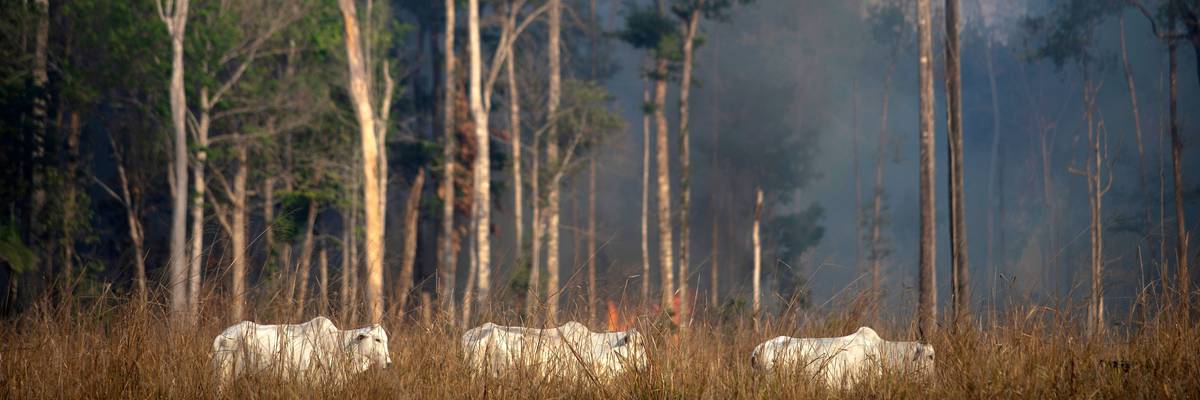
Cattle graze with a fire behind them in the Amazon rainforest near Novo Progresso, Para state, Brazil, on August 25, 2019.
Brazil’s COP30 presidency promised a science-based path to halting and reversing deforestation by 2030. Instead, the resulting road map overlooks a primary driver of deforestation: the world's appetite for meat.
On November 3, Brazil released the highly anticipated COP30 Presidency Roadmap on Enhancing Efforts Towards Halting and Reversing Deforestation and Forest Degradation by 2030. At COP30 last year, which Brazil hosted, the presidency's commitment to produce it was a key compromise that helped the summit reach an agreement after more than 90 countries called for one. The road map comes at a critical time: The world remains far off track to meet its 2030 deforestation target.
The road map discusses forest protection, management, and restoration through financial incentives, regulation, and international cooperation. For food, this entails increasing production on existing farmland (how food is produced) and preventing further forest clearing (where food is produced), including measures that prohibit purchasing products from deforested land. But it ignores the question of which foods are produced and consumed.
This matters because food systems overwhelmingly drive deforestation, and what we eat determines how much land they require.
Countries should urge the Brazilian COP30 presidency to incorporate explicit action on diets as the road map moves into implementation, and include similar commitments in their own plans.
Demand for food generally means demand for agricultural land—for crops, livestock, or animal feed—and forests are cleared to meet this. That’s why, despite increased productivity, agricultural expansion drives nearly 90% of global deforestation.
How much land we need depends largely on which foods we eat. A meat-heavy diet can require approximately four times as much land—or more—than plant-based ones. That’s why expert bodies are so explicit about the need to address diets. The United Nation’s Global Land Outlook, for example, states that, where appropriate, a transition to plant-based diets is a logical first step to ensure food systems deliver positive outcomes for nature and climate while continuing to provide sustenance. The Intergovernmental Panel on Climate Change (IPCC), the Intergovernmental Science-Policy Platform on Biodiversity and Ecosystem Services, UNEP’s Global Environment Outlook, and EAT-Lancet Commission likewise emphasize the importance of dietary change in reducing pressure on land. In light of this consensus across major global scientific assessments, the road map's absence of guidance on diets is highly unusual.
As 2030 approaches, half measures won’t do. Reducing consumption-related pressure on land needs to be a top priority.
Governments already shape what people eat through subsidies, public procurement, and other policies. As the road map notes, potentially harmful agricultural subsidies amounted to approximately US$406 billion in 2023. Redirecting this could make healthier, less land-intensive foods more affordable.
There are good examples already of policies supporting forest-friendly food systems. France’s strategy against imported deforestation calls for a shift toward plant proteins. Denmark has a permanent fund to support the development of plant-based food and demand for it. Brazil’s own Food Systems and Climate Framework for Public Policies recommends measures to promote healthy, sustainable diets, including discouraging excessive consumption of animal-source foods.
The road map’s other measures can’t compensate for this omission.
First, national and local forest protection measures are better suited to preventing deforestation within their own jurisdictions. Given that markets for meat and animal feed are highly globalized, preventing deforestation in one location does not necessarily translate into equivalent global or even national progress. Demand for meat and animal feed can simply shift pressure onto forests elsewhere. Real success means reducing deforestation, not relocating it.
Second, increasing production efficiency can be counterproductive without demand-side measures—lower production costs can stimulate demand, encouraging further agricultural expansion. As the IPCC notes, increasing profits from intensive farming can incentivize land conversion. To achieve the necessary environmental outcomes, agricultural intensification must also be accompanied by dietary changes and food waste reduction.
At COP31, countries and NGOs may be inclined to welcome the road map without reservation.
Historically, many forest policy discussions have placed less emphasis on food consumption than science demands. Food is deeply personal and sociocultural, meaning that policy interventions, such as subsidies, are often mistakenly framed as critiques of individual behavior rather than systemic reform. Policymakers may therefore find it more comfortable to focus on production than on consumption.
Industry narratives deepen this discomfort by alleging that addressing meat consumption puts nutritionally vulnerable populations at risk. But reducing high meat consumption where suitable alternatives are available does not mean depriving people who lack access to those alternatives. On the contrary, reducing excessive consumption where alternatives exist is necessary to keep food systems within safe planetary boundaries, with major benefits for public health, climate, and biodiversity.
For these reasons, many have understandably focused on forest initiatives that seemed more achievable. But a global road map must identify the measures needed to meet its targets. If the most impactful measures are politically uncomfortable, the road map should help build support for them.
The road map’s release can still mark an important step forward, but only if countries recognize that much more is needed. There is already significant awareness—during the development of the road map, numerous stakeholders representing civil society, government, and academia shared extensive inputs on the need to address diets.
Countries should urge the Brazilian COP30 presidency to incorporate explicit action on diets as the road map moves into implementation, and include similar commitments in their own plans. Countries with high levels of meat consumption should lead by committing to reductions in their forest and climate plans—using credible policy measures such as public procurement policies and dietary guidelines that account for environmental impacts as well as nutritional needs. They should also work through the formal negotiations—particularly on agriculture and in any cover decision—to strengthen climate action on food systems, including consumption.
With just over four years remaining until the end of 2030, another plan that leaves one of the most powerful tools for reducing deforestation untouched is little cause for celebration.
This country and this world are at a monumental crossroads. US voters have an opportunity to beat back the forces of fascism and confront the billionaires who are rigging the economy, our media system, and our democracy, making it increasingly impossible for ordinary people to get by. We’re not just talking about the election. We’re talking about what must be done once these fascist elements are vanquished from power. We need a bolder set of solutions than what either major party has so far been willing to offer and a working-class movement ready to fight like hell for it. Trump didn't emerge from nowhere. The conditions that fueled MAGA authoritarianism were created by decades of radical neoliberal economic policies and a corrupt political system dominated by corporate interests. They slashed taxes on the super-rich, promising that the benefits would trickle down. They said giveaways to the corporate titans would make life more affordable for the rest of us. It was all bullshit. And when a bitter, betrayed populace searches for someone to blame, right-wing demagogues have little trouble finding scapegoats. People know when they're being lied to, but you won't hear any of this from the corporate media. Only independent journalism—powered and funded by people who believe in building a better world—can deliver truly trustworthy daily news. If you share our vision, please contribute whatever you can to sustain our work. |
On November 3, Brazil released the highly anticipated COP30 Presidency Roadmap on Enhancing Efforts Towards Halting and Reversing Deforestation and Forest Degradation by 2030. At COP30 last year, which Brazil hosted, the presidency's commitment to produce it was a key compromise that helped the summit reach an agreement after more than 90 countries called for one. The road map comes at a critical time: The world remains far off track to meet its 2030 deforestation target.
The road map discusses forest protection, management, and restoration through financial incentives, regulation, and international cooperation. For food, this entails increasing production on existing farmland (how food is produced) and preventing further forest clearing (where food is produced), including measures that prohibit purchasing products from deforested land. But it ignores the question of which foods are produced and consumed.
This matters because food systems overwhelmingly drive deforestation, and what we eat determines how much land they require.
Countries should urge the Brazilian COP30 presidency to incorporate explicit action on diets as the road map moves into implementation, and include similar commitments in their own plans.
Demand for food generally means demand for agricultural land—for crops, livestock, or animal feed—and forests are cleared to meet this. That’s why, despite increased productivity, agricultural expansion drives nearly 90% of global deforestation.
How much land we need depends largely on which foods we eat. A meat-heavy diet can require approximately four times as much land—or more—than plant-based ones. That’s why expert bodies are so explicit about the need to address diets. The United Nation’s Global Land Outlook, for example, states that, where appropriate, a transition to plant-based diets is a logical first step to ensure food systems deliver positive outcomes for nature and climate while continuing to provide sustenance. The Intergovernmental Panel on Climate Change (IPCC), the Intergovernmental Science-Policy Platform on Biodiversity and Ecosystem Services, UNEP’s Global Environment Outlook, and EAT-Lancet Commission likewise emphasize the importance of dietary change in reducing pressure on land. In light of this consensus across major global scientific assessments, the road map's absence of guidance on diets is highly unusual.
As 2030 approaches, half measures won’t do. Reducing consumption-related pressure on land needs to be a top priority.
Governments already shape what people eat through subsidies, public procurement, and other policies. As the road map notes, potentially harmful agricultural subsidies amounted to approximately US$406 billion in 2023. Redirecting this could make healthier, less land-intensive foods more affordable.
There are good examples already of policies supporting forest-friendly food systems. France’s strategy against imported deforestation calls for a shift toward plant proteins. Denmark has a permanent fund to support the development of plant-based food and demand for it. Brazil’s own Food Systems and Climate Framework for Public Policies recommends measures to promote healthy, sustainable diets, including discouraging excessive consumption of animal-source foods.
The road map’s other measures can’t compensate for this omission.
First, national and local forest protection measures are better suited to preventing deforestation within their own jurisdictions. Given that markets for meat and animal feed are highly globalized, preventing deforestation in one location does not necessarily translate into equivalent global or even national progress. Demand for meat and animal feed can simply shift pressure onto forests elsewhere. Real success means reducing deforestation, not relocating it.
Second, increasing production efficiency can be counterproductive without demand-side measures—lower production costs can stimulate demand, encouraging further agricultural expansion. As the IPCC notes, increasing profits from intensive farming can incentivize land conversion. To achieve the necessary environmental outcomes, agricultural intensification must also be accompanied by dietary changes and food waste reduction.
At COP31, countries and NGOs may be inclined to welcome the road map without reservation.
Historically, many forest policy discussions have placed less emphasis on food consumption than science demands. Food is deeply personal and sociocultural, meaning that policy interventions, such as subsidies, are often mistakenly framed as critiques of individual behavior rather than systemic reform. Policymakers may therefore find it more comfortable to focus on production than on consumption.
Industry narratives deepen this discomfort by alleging that addressing meat consumption puts nutritionally vulnerable populations at risk. But reducing high meat consumption where suitable alternatives are available does not mean depriving people who lack access to those alternatives. On the contrary, reducing excessive consumption where alternatives exist is necessary to keep food systems within safe planetary boundaries, with major benefits for public health, climate, and biodiversity.
For these reasons, many have understandably focused on forest initiatives that seemed more achievable. But a global road map must identify the measures needed to meet its targets. If the most impactful measures are politically uncomfortable, the road map should help build support for them.
The road map’s release can still mark an important step forward, but only if countries recognize that much more is needed. There is already significant awareness—during the development of the road map, numerous stakeholders representing civil society, government, and academia shared extensive inputs on the need to address diets.
Countries should urge the Brazilian COP30 presidency to incorporate explicit action on diets as the road map moves into implementation, and include similar commitments in their own plans. Countries with high levels of meat consumption should lead by committing to reductions in their forest and climate plans—using credible policy measures such as public procurement policies and dietary guidelines that account for environmental impacts as well as nutritional needs. They should also work through the formal negotiations—particularly on agriculture and in any cover decision—to strengthen climate action on food systems, including consumption.
With just over four years remaining until the end of 2030, another plan that leaves one of the most powerful tools for reducing deforestation untouched is little cause for celebration.