SUBSCRIBE TO OUR FREE NEWSLETTER
Daily news & progressive opinion—funded by the people, not the corporations—delivered straight to your inbox.
5
#000000
#FFFFFF
To donate by check, phone, or other method, see our More Ways to Give page.
Daily news & progressive opinion—funded by the people, not the corporations—delivered straight to your inbox.
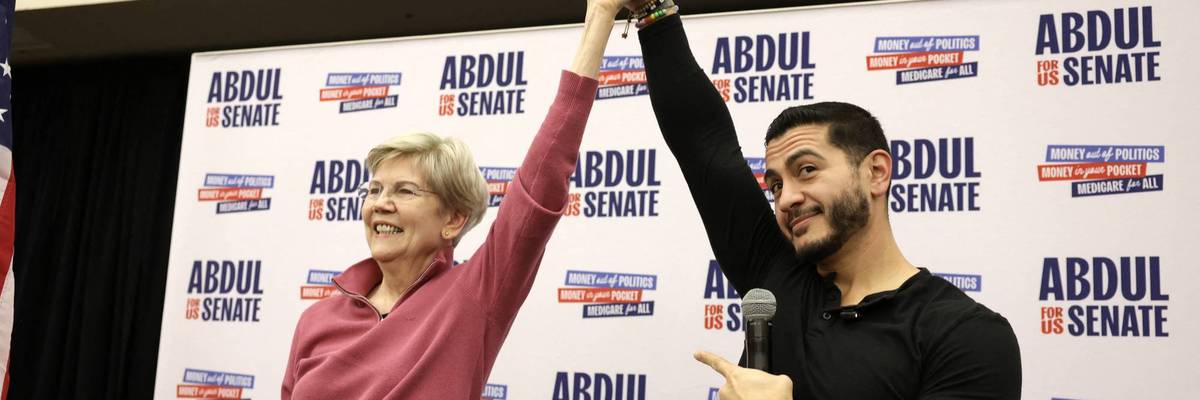
US Senator Elizabeth Warren (L), Democrat from Massachusetts, joins Democratic US Senate candidate for Michigan Abdul El-Sayed at a midterm campaign rally in Eastern Michigan University in Ypsilanti, Ann Arbor, Michigan on November 2, 2026.
For more than half a century, powerful interests have worked to build an America that serves the wealthy few. Now we have an opportunity to chart a different course, rooted in economic justice, human dignity, democracy, peace, and a livable planet.
The billionaire class made a bad bet. They thought their extraordinary wealth could buy them a country. That hundreds of millions of dollars in campaign contributions, control over powerful communications platforms, and an increasingly authoritarian political movement could overwhelm the democratic will of the American people.
On November 3, millions of Americans reminded them of something they had forgotten: Organized money has an opponent. Organized people.
From the millions who marched in the No Kings demonstrations to the volunteers who knocked on doors, registered voters, and mobilized their communities, Americans delivered an extraordinary repudiation of Donald Trump and his assault on democracy.
Democrats need an ambitious agenda that improves people's lives while confronting the concentrated wealth and political power that have prevented meaningful reform.
Young Americans helped power the Democratic victories. Latino voters shifted away from Republicans. Across the country, voters expressed their frustration with an administration that has prioritized the wealthy while ordinary Americans struggle with the cost of living.
Democrats won control of both houses of Congress. But the significance of this election extends far beyond which party holds the gavels. We may be witnessing a historic opportunity to reverse a political and economic transformation more than half a century in the making.
In 1971, corporate attorney Lewis Powell wrote a confidential memorandum for the US Chamber of Commerce urging business leaders to organize a sustained campaign to influence universities, the media, the courts, and government.
The Powell Memo helped inspire a corporate political offensive that reshaped American politics. Business interests invested enormous resources in think tanks, lobbying, political campaigns, and legal institutions, advancing policies that weakened unions, reduced taxes on corporations and the wealthy, rolled back regulations, and concentrated economic and political power.
The consequences are all around us. America has generated extraordinary prosperity, but an increasingly disproportionate share has flowed to the top. Housing, healthcare, and education have become increasingly unaffordable, while billionaires exercise extraordinary political influence.
Today's tech oligarchs didn't invent this power grab. They inherited a playbook.
But this election demonstrated that ordinary people, acting collectively, still possess the power to challenge concentrated wealth.
The question now is what we do with that power.
For decades, Democrats have been told that winning elections requires moving toward the center, moderating their ambitions, and reassuring wealthy donors that fundamental economic arrangements will remain undisturbed.
I've spent much of my adult life watching Democrats invoke Ronald Reagan more often than Franklin Roosevelt. Think about that. The party of the New Deal, Social Security, and organized labor has too often looked to the political philosophy of a president who helped undermine that legacy.
Yet Roosevelt understood something today's Democrats desperately need to remember: Government can transform people's lives, and doing so can build lasting political support.
Medicare for All would help democratize economic security. Public financing would help democratize political power.
His New Deal, propelled in significant part by organized labor and popular movements, established Social Security, strengthened workers' rights, created jobs, and helped build a more economically secure middle class. Those reforms were incomplete, and many Americans were excluded from their benefits. But they demonstrated the extraordinary possibilities of government acting on behalf of ordinary people.
In 1944, Roosevelt proposed a Second Bill of Rights that included the right to a decent job, adequate income, housing, medical care, education, and economic security.
More than 80 years later, that vision remains unfinished.
And in the wealthiest nation in human history, there is no justification for leaving it that way.
Democrats need an ambitious agenda that improves people's lives while confronting the concentrated wealth and political power that have prevented meaningful reform.
Two commitments should stand at its center: Medicare for All and public financing of elections.
The first would transform economic security. The second would help transform political power.
Start with healthcare.
The United States spends approximately two and a half times the OECD average per person on healthcare, yet delivers worse outcomes across key measures, from life expectancy to preventable deaths. Millions remain uninsured, while many people with coverage cannot afford to use it when they need care.
In America, cost effectively rations access to healthcare.
Other wealthy nations guarantee universal health coverage while spending substantially less. Yet our political leaders continue defending a fragmented, profit-driven system that places the financial interests of insurance companies ahead of people's health.
Medicare for All would guarantee healthcare as a fundamental human right, eliminate a major source of financial insecurity, and reduce workers' dependence on employers for health coverage.
But why has such fundamental reform remained politically elusive?
Part of the answer lies in the extraordinary influence of the industries that profit from the existing system. Insurance companies, pharmaceutical manufacturers, and other powerful interests spend enormous sums lobbying politicians, financing campaigns, and influencing the public debate.
Which brings us to the second pillar: getting big money out of politics.
We need to overturn Citizens United, end the system of unlimited independent political spending and super PAC contributions, and establish robust public financing of elections so candidates can compete without depending on wealthy donors and corporate interests.
We should ban congressional stock trading and strengthen protections against conflicts of interest. But those reforms alone will not address the underlying system in which politicians must continually raise money from the very industries they are supposed to regulate.
Public financing offers a way to change that relationship, allowing candidates to rely more heavily on ordinary voters rather than wealthy contributors.
This is essential because campaign finance reform is not simply another progressive issue. It affects our ability to accomplish virtually everything else.
How can Democrats seriously challenge corporate monopolies, tax billionaires, protect workers, or reform healthcare while remaining financially dependent on the interests determined to block those changes?
Medicare for All would help democratize economic security. Public financing would help democratize political power.
Together, they could fundamentally change the terrain on which every other progressive struggle takes place.
These two reforms must anchor a broader commitment to economic and social justice.
We need a living wage of at least $20 an hour, stronger unions and collective bargaining rights, affordable housing and childcare, and a tax system that requires billionaires and giant corporations to contribute their fair share.
We need to defend reproductive freedom, confront climate change, regulate Wall Street, enforce antitrust laws, and protect the democratic institutions increasingly threatened by concentrated wealth and authoritarianism.
The millions who marched, organized, and voted cannot simply return home and wait for the next election. They must continue demanding accountability and building the political power necessary to sustain change.
We must also challenge a foreign policy that devotes extraordinary resources to militarism while urgent human needs go unmet, and use congressional power to end illegal wars.
These are not radical demands in a society with the wealth and resources to achieve them. They are the foundations of a government that places human well-being above corporate profits.
And they challenge the conventional wisdom that progressive ambition is politically dangerous.
Sen. Bernie Sanders (I-Vt.) built a national movement by demanding universal healthcare, economic justice, and an end to billionaire domination of politics. New York Mayor Zohran Mamdani demonstrated that an unapologetically progressive affordability agenda could win broad support in America's largest city.
Their success does not mean every progressive candidate will win. But it demolishes the assumption that Democrats must abandon ambitious ideas to appeal to voters.
As Mamdani has emphasized, voters want change they can experience in their everyday lives, in the cost of rent, groceries, childcare, and healthcare.
Winning is one thing. Delivering is another.
None of this will happen overnight.
Trump remains president. Corporate interests will fight to protect their power. Even with congressional majorities, Democrats face vetoes, Senate procedural obstacles, and opposition from within their own ranks.
But political obstacles are not reasons to abandon fundamental principles.
Democrats should introduce Medicare for All legislation, fight for living wages, advance public financing, and investigate corporate abuses and political corruption. If Trump vetoes popular legislation, let Americans see what Democrats fought for and who stood in the way.
Congressional Democrats can also use hearings, subpoenas, oversight, and their control over federal spending to expose corruption, challenge corporate influence, and build the case for structural reform.
And that accountability must extend beyond Trump and the Republican Party. Democrats cannot credibly challenge a corrupt political system while protecting its beneficiaries within their own ranks.
The millions who marched, organized, and voted cannot simply return home and wait for the next election. They must continue demanding accountability and building the political power necessary to sustain change.
If Democrats fail to deliver meaningful improvements in people's lives, they risk recreating the disillusionment that helped bring Trump to power.
The political and economic system that has concentrated so much wealth and power in the hands of so few was not inevitable. It was built through decades of deliberate political choices. And it can be changed through collective action.
The millions who marched, organized, and voted must remain engaged. Join an organization. Organize in your workplace and community. Hold elected officials accountable. Keep marching, keep voting, and keep demanding more.
For more than half a century, powerful interests have worked to build an America that serves the wealthy few. Now we have an opportunity to chart a different course, rooted in economic justice, human dignity, democracy, peace, and a livable planet.
This is what democracy looks like. Now let's show what democracy can deliver.
This country and this world are at a monumental crossroads. US voters have an opportunity to beat back the forces of fascism and confront the billionaires who are rigging the economy, our media system, and our democracy, making it increasingly impossible for ordinary people to get by. We’re not just talking about the election. We’re talking about what must be done once these fascist elements are vanquished from power. We need a bolder set of solutions than what either major party has so far been willing to offer and a working-class movement ready to fight like hell for it. Trump didn't emerge from nowhere. The conditions that fueled MAGA authoritarianism were created by decades of radical neoliberal economic policies and a corrupt political system dominated by corporate interests. They slashed taxes on the super-rich, promising that the benefits would trickle down. They said giveaways to the corporate titans would make life more affordable for the rest of us. It was all bullshit. And when a bitter, betrayed populace searches for someone to blame, right-wing demagogues have little trouble finding scapegoats. People know when they're being lied to, but you won't hear any of this from the corporate media. Only independent journalism—powered and funded by people who believe in building a better world—can deliver truly trustworthy daily news. If you share our vision, please contribute whatever you can to sustain our work. |
The billionaire class made a bad bet. They thought their extraordinary wealth could buy them a country. That hundreds of millions of dollars in campaign contributions, control over powerful communications platforms, and an increasingly authoritarian political movement could overwhelm the democratic will of the American people.
On November 3, millions of Americans reminded them of something they had forgotten: Organized money has an opponent. Organized people.
From the millions who marched in the No Kings demonstrations to the volunteers who knocked on doors, registered voters, and mobilized their communities, Americans delivered an extraordinary repudiation of Donald Trump and his assault on democracy.
Democrats need an ambitious agenda that improves people's lives while confronting the concentrated wealth and political power that have prevented meaningful reform.
Young Americans helped power the Democratic victories. Latino voters shifted away from Republicans. Across the country, voters expressed their frustration with an administration that has prioritized the wealthy while ordinary Americans struggle with the cost of living.
Democrats won control of both houses of Congress. But the significance of this election extends far beyond which party holds the gavels. We may be witnessing a historic opportunity to reverse a political and economic transformation more than half a century in the making.
In 1971, corporate attorney Lewis Powell wrote a confidential memorandum for the US Chamber of Commerce urging business leaders to organize a sustained campaign to influence universities, the media, the courts, and government.
The Powell Memo helped inspire a corporate political offensive that reshaped American politics. Business interests invested enormous resources in think tanks, lobbying, political campaigns, and legal institutions, advancing policies that weakened unions, reduced taxes on corporations and the wealthy, rolled back regulations, and concentrated economic and political power.
The consequences are all around us. America has generated extraordinary prosperity, but an increasingly disproportionate share has flowed to the top. Housing, healthcare, and education have become increasingly unaffordable, while billionaires exercise extraordinary political influence.
Today's tech oligarchs didn't invent this power grab. They inherited a playbook.
But this election demonstrated that ordinary people, acting collectively, still possess the power to challenge concentrated wealth.
The question now is what we do with that power.
For decades, Democrats have been told that winning elections requires moving toward the center, moderating their ambitions, and reassuring wealthy donors that fundamental economic arrangements will remain undisturbed.
I've spent much of my adult life watching Democrats invoke Ronald Reagan more often than Franklin Roosevelt. Think about that. The party of the New Deal, Social Security, and organized labor has too often looked to the political philosophy of a president who helped undermine that legacy.
Yet Roosevelt understood something today's Democrats desperately need to remember: Government can transform people's lives, and doing so can build lasting political support.
Medicare for All would help democratize economic security. Public financing would help democratize political power.
His New Deal, propelled in significant part by organized labor and popular movements, established Social Security, strengthened workers' rights, created jobs, and helped build a more economically secure middle class. Those reforms were incomplete, and many Americans were excluded from their benefits. But they demonstrated the extraordinary possibilities of government acting on behalf of ordinary people.
In 1944, Roosevelt proposed a Second Bill of Rights that included the right to a decent job, adequate income, housing, medical care, education, and economic security.
More than 80 years later, that vision remains unfinished.
And in the wealthiest nation in human history, there is no justification for leaving it that way.
Democrats need an ambitious agenda that improves people's lives while confronting the concentrated wealth and political power that have prevented meaningful reform.
Two commitments should stand at its center: Medicare for All and public financing of elections.
The first would transform economic security. The second would help transform political power.
Start with healthcare.
The United States spends approximately two and a half times the OECD average per person on healthcare, yet delivers worse outcomes across key measures, from life expectancy to preventable deaths. Millions remain uninsured, while many people with coverage cannot afford to use it when they need care.
In America, cost effectively rations access to healthcare.
Other wealthy nations guarantee universal health coverage while spending substantially less. Yet our political leaders continue defending a fragmented, profit-driven system that places the financial interests of insurance companies ahead of people's health.
Medicare for All would guarantee healthcare as a fundamental human right, eliminate a major source of financial insecurity, and reduce workers' dependence on employers for health coverage.
But why has such fundamental reform remained politically elusive?
Part of the answer lies in the extraordinary influence of the industries that profit from the existing system. Insurance companies, pharmaceutical manufacturers, and other powerful interests spend enormous sums lobbying politicians, financing campaigns, and influencing the public debate.
Which brings us to the second pillar: getting big money out of politics.
We need to overturn Citizens United, end the system of unlimited independent political spending and super PAC contributions, and establish robust public financing of elections so candidates can compete without depending on wealthy donors and corporate interests.
We should ban congressional stock trading and strengthen protections against conflicts of interest. But those reforms alone will not address the underlying system in which politicians must continually raise money from the very industries they are supposed to regulate.
Public financing offers a way to change that relationship, allowing candidates to rely more heavily on ordinary voters rather than wealthy contributors.
This is essential because campaign finance reform is not simply another progressive issue. It affects our ability to accomplish virtually everything else.
How can Democrats seriously challenge corporate monopolies, tax billionaires, protect workers, or reform healthcare while remaining financially dependent on the interests determined to block those changes?
Medicare for All would help democratize economic security. Public financing would help democratize political power.
Together, they could fundamentally change the terrain on which every other progressive struggle takes place.
These two reforms must anchor a broader commitment to economic and social justice.
We need a living wage of at least $20 an hour, stronger unions and collective bargaining rights, affordable housing and childcare, and a tax system that requires billionaires and giant corporations to contribute their fair share.
We need to defend reproductive freedom, confront climate change, regulate Wall Street, enforce antitrust laws, and protect the democratic institutions increasingly threatened by concentrated wealth and authoritarianism.
The millions who marched, organized, and voted cannot simply return home and wait for the next election. They must continue demanding accountability and building the political power necessary to sustain change.
We must also challenge a foreign policy that devotes extraordinary resources to militarism while urgent human needs go unmet, and use congressional power to end illegal wars.
These are not radical demands in a society with the wealth and resources to achieve them. They are the foundations of a government that places human well-being above corporate profits.
And they challenge the conventional wisdom that progressive ambition is politically dangerous.
Sen. Bernie Sanders (I-Vt.) built a national movement by demanding universal healthcare, economic justice, and an end to billionaire domination of politics. New York Mayor Zohran Mamdani demonstrated that an unapologetically progressive affordability agenda could win broad support in America's largest city.
Their success does not mean every progressive candidate will win. But it demolishes the assumption that Democrats must abandon ambitious ideas to appeal to voters.
As Mamdani has emphasized, voters want change they can experience in their everyday lives, in the cost of rent, groceries, childcare, and healthcare.
Winning is one thing. Delivering is another.
None of this will happen overnight.
Trump remains president. Corporate interests will fight to protect their power. Even with congressional majorities, Democrats face vetoes, Senate procedural obstacles, and opposition from within their own ranks.
But political obstacles are not reasons to abandon fundamental principles.
Democrats should introduce Medicare for All legislation, fight for living wages, advance public financing, and investigate corporate abuses and political corruption. If Trump vetoes popular legislation, let Americans see what Democrats fought for and who stood in the way.
Congressional Democrats can also use hearings, subpoenas, oversight, and their control over federal spending to expose corruption, challenge corporate influence, and build the case for structural reform.
And that accountability must extend beyond Trump and the Republican Party. Democrats cannot credibly challenge a corrupt political system while protecting its beneficiaries within their own ranks.
The millions who marched, organized, and voted cannot simply return home and wait for the next election. They must continue demanding accountability and building the political power necessary to sustain change.
If Democrats fail to deliver meaningful improvements in people's lives, they risk recreating the disillusionment that helped bring Trump to power.
The political and economic system that has concentrated so much wealth and power in the hands of so few was not inevitable. It was built through decades of deliberate political choices. And it can be changed through collective action.
The millions who marched, organized, and voted must remain engaged. Join an organization. Organize in your workplace and community. Hold elected officials accountable. Keep marching, keep voting, and keep demanding more.
For more than half a century, powerful interests have worked to build an America that serves the wealthy few. Now we have an opportunity to chart a different course, rooted in economic justice, human dignity, democracy, peace, and a livable planet.
This is what democracy looks like. Now let's show what democracy can deliver.