SUBSCRIBE TO OUR FREE NEWSLETTER
Daily news & progressive opinion—funded by the people, not the corporations—delivered straight to your inbox.
5
#000000
#FFFFFF
To donate by check, phone, or other method, see our More Ways to Give page.
Daily news & progressive opinion—funded by the people, not the corporations—delivered straight to your inbox.
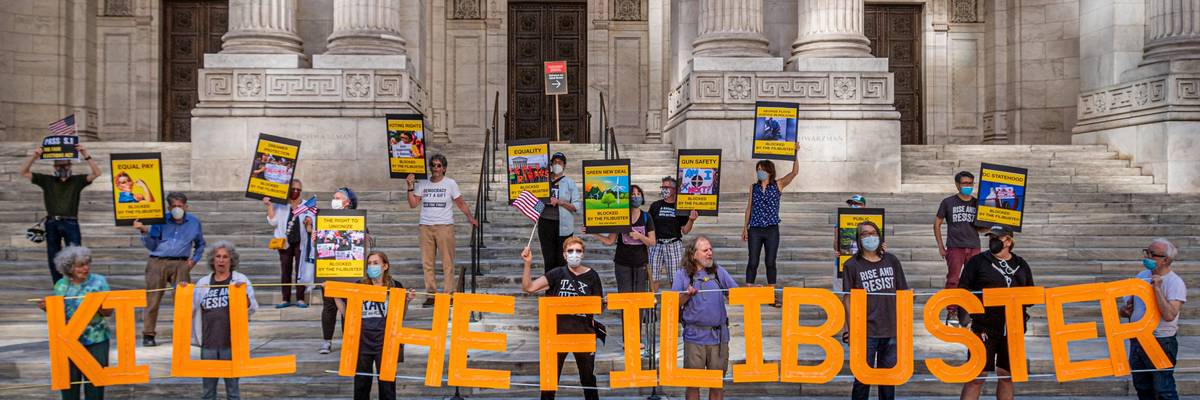
Protesters hold a banner reading, "Kill the filibuster" at a protest.
If Democrats want to show Americans that government can work for them, the minority party cannot be allowed to undermine the majority’s enactments.
The Democrats’ path to enduring power is clear: Demonstrate that they have the competence and commitment to confront the troubles that drove the blue tsunami—to attack inflation, corruption, affordability, and falling incomes. If Democrats can do this, they will secure the voters’ trust and their stewardship of the nation may endure. If they fail, sadly there will be another turn of the wheel in two years.
What should this strategy look like? The voters have told us loud and clear: Pass laws that address the problems. Confront President Donald Trump with the choice: Either sign them into law, showing that Democrats can indeed “get things done,” or veto them and make clear who is the problem.
But this strategy faces a colossal institutional barrier: the filibuster. Unless Democrats abolish that barrier, Congress will not enact new laws and President Trump will not be forced to accept or veto those enactments.
When a majority elected to “get things done” cannot do so, their failure undermines public confidence in democracy and supports the reactionary view that government is good for nothing.
In the new Congress that convenes on January 3, 2027, Democrats will hold at least 54 Senate seats against the Republicans’ 44. Their decisive margin reflects the voters’ determination that the Democrats should run Congress.
But hard as it is to believe, 54 to 44 isn’t good enough.
Under current Senate rules, a simple majority is not enough to pass legislation. The Senate’s “cloture” or filibuster rule requires the support of no fewer than 60 senators before the Senate can end debate and enact a proposed law. Otherwise the law dies stillborn. The filibuster turns our majority-rule democracy inside out and gives a minority party veto power.
The issue is simple: After the voters have said No to a party, does the party have the right to say No to the voters?
The minority veto is a perversion of the Framers’ constitutional design. Under the Constitution, a handful of matters require supermajorities: overriding a presidential veto, proposing constitutional amendments, removing an impeached president, ratifying treaties. Under the Constitution, ordinary legislation requires only a simple majority. That is as it should be.
Requiring a supermajority for ordinary legislation is a formula for gridlock. When a majority elected to “get things done” cannot do so, their failure undermines public confidence in democracy and supports the reactionary view that government is good for nothing. We can no longer tolerate the damage done by that viewpoint.
Victories in formerly red states are bringing to Washington new Democratic senators who campaigned as moderates and seek to promote bipartisanship and “reaching across the aisle” to Republicans.
Well and good, but that is no reason for preserving the anti-democracy filibuster.
First, few if any Republicans are willing to reciprocate. Rep. Steve Scalise (R-La.), one of the aspirants to replace exiting GOP leader Mike Johnson (R-La.), demands Republicans “stand united” to protect the “progress” supposedly made by President Trump, so they can win in 2028. Another, Jim Jordan (R-Ohio), touts his readiness to provide “battle-tested” leadership and calls for an “offensive” against Democratic “havoc.”
Does this sound like Republicans reaching across the aisle?
History shows that winning the support of a handful of Republicans to overcome the 60-vote supermajority hurdle requires compromises that harm the public and rob Democrats of credit for achieving what the public wants. Consider two examples from the Obama era.
Voters astonished most political pundits, the political class, and even themselves when they swept Republicans away and turned formerly deep red states blue. Now it is up to Democrats to protect this amazing achievement.
The sub-prime housing bubble and the Great Recession: In 2008, Barack Obama and the Democrats won a decisive electoral victory in the midst of a devastating national financial crisis. Many feared that another Great Depression was imminent. The rescue plan required (among other things) stimulating the economy with government spending to prevent mass unemployment. But Republicans had no interest in being part of the solution. As they later acknowledged, their number one goal was making President Obama a one-term president.
Obama compromised on the size of the stimulus in an effort to accommodate supposed moderate Republicans and overcome the filibuster. Nonetheless, not one GOP representative voted for the “bipartisan” plan to save the economy.
Three Republican senators—just enough to beat the filibuster—did vote Yes. But the compromised program led to an anemic recovery, in which millions remained unemployed or underemployed for over two years. Obama’s similar “moderacy” with regard to the housing crisis yielded equally disastrous compromises. Banks were bailed out, but not homeowners—and 10 million families lost their homes to foreclosures.
Democrats got little credit for the economic rescue because the filibuster-beating compromises created misery for millions of Americans, not relief.
Expanding health insurance: Passing the Affordable Care Act—Obamacare—also required undesirable and unpopular compromises because of the filibuster. The health insurance law should, for example, have included a “public option”—giving Americans the choice of a government-run insurance program, essentially Medicare for all—but it was eliminated to gain the extra votes needed to satisfy the filibuster supermajority. Other bad compromises included barring Medicare from negotiating with pharmaceutical companies over drug prices.
What was a great accomplishment—bringing medical insurance to tens of millions of Americans whose healthcare was inadequate—became a political liability.
Ending the filibuster would not prevent Democrats from trying to work with Republicans. If you see yourself as a moderate Democrat who wants to reach across the aisle, nothing stops you from doing so after repealing the filibuster.
Ending the filibuster just means that the agreement of the people who call Democrats jihadists, child abusers, crazy, communists, and Godless America-haters should not be needed to pass legislation.
Voters astonished most political pundits, the political class, and even themselves when they swept Republicans away and turned formerly deep red states blue. Now it is up to Democrats to protect this amazing achievement. The filibuster will allow Republicans to destroy what the people are clearly demanding.
Time to end the filibuster.
This country and this world are at a monumental crossroads. US voters have an opportunity to beat back the forces of fascism and confront the billionaires who are rigging the economy, our media system, and our democracy, making it increasingly impossible for ordinary people to get by. We’re not just talking about the election. We’re talking about what must be done once these fascist elements are vanquished from power. We need a bolder set of solutions than what either major party has so far been willing to offer and a working-class movement ready to fight like hell for it. Trump didn't emerge from nowhere. The conditions that fueled MAGA authoritarianism were created by decades of radical neoliberal economic policies and a corrupt political system dominated by corporate interests. They slashed taxes on the super-rich, promising that the benefits would trickle down. They said giveaways to the corporate titans would make life more affordable for the rest of us. It was all bullshit. And when a bitter, betrayed populace searches for someone to blame, right-wing demagogues have little trouble finding scapegoats. People know when they're being lied to, but you won't hear any of this from the corporate media. Only independent journalism—powered and funded by people who believe in building a better world—can deliver truly trustworthy daily news. If you share our vision, please contribute whatever you can to sustain our work. |
The Democrats’ path to enduring power is clear: Demonstrate that they have the competence and commitment to confront the troubles that drove the blue tsunami—to attack inflation, corruption, affordability, and falling incomes. If Democrats can do this, they will secure the voters’ trust and their stewardship of the nation may endure. If they fail, sadly there will be another turn of the wheel in two years.
What should this strategy look like? The voters have told us loud and clear: Pass laws that address the problems. Confront President Donald Trump with the choice: Either sign them into law, showing that Democrats can indeed “get things done,” or veto them and make clear who is the problem.
But this strategy faces a colossal institutional barrier: the filibuster. Unless Democrats abolish that barrier, Congress will not enact new laws and President Trump will not be forced to accept or veto those enactments.
When a majority elected to “get things done” cannot do so, their failure undermines public confidence in democracy and supports the reactionary view that government is good for nothing.
In the new Congress that convenes on January 3, 2027, Democrats will hold at least 54 Senate seats against the Republicans’ 44. Their decisive margin reflects the voters’ determination that the Democrats should run Congress.
But hard as it is to believe, 54 to 44 isn’t good enough.
Under current Senate rules, a simple majority is not enough to pass legislation. The Senate’s “cloture” or filibuster rule requires the support of no fewer than 60 senators before the Senate can end debate and enact a proposed law. Otherwise the law dies stillborn. The filibuster turns our majority-rule democracy inside out and gives a minority party veto power.
The issue is simple: After the voters have said No to a party, does the party have the right to say No to the voters?
The minority veto is a perversion of the Framers’ constitutional design. Under the Constitution, a handful of matters require supermajorities: overriding a presidential veto, proposing constitutional amendments, removing an impeached president, ratifying treaties. Under the Constitution, ordinary legislation requires only a simple majority. That is as it should be.
Requiring a supermajority for ordinary legislation is a formula for gridlock. When a majority elected to “get things done” cannot do so, their failure undermines public confidence in democracy and supports the reactionary view that government is good for nothing. We can no longer tolerate the damage done by that viewpoint.
Victories in formerly red states are bringing to Washington new Democratic senators who campaigned as moderates and seek to promote bipartisanship and “reaching across the aisle” to Republicans.
Well and good, but that is no reason for preserving the anti-democracy filibuster.
First, few if any Republicans are willing to reciprocate. Rep. Steve Scalise (R-La.), one of the aspirants to replace exiting GOP leader Mike Johnson (R-La.), demands Republicans “stand united” to protect the “progress” supposedly made by President Trump, so they can win in 2028. Another, Jim Jordan (R-Ohio), touts his readiness to provide “battle-tested” leadership and calls for an “offensive” against Democratic “havoc.”
Does this sound like Republicans reaching across the aisle?
History shows that winning the support of a handful of Republicans to overcome the 60-vote supermajority hurdle requires compromises that harm the public and rob Democrats of credit for achieving what the public wants. Consider two examples from the Obama era.
Voters astonished most political pundits, the political class, and even themselves when they swept Republicans away and turned formerly deep red states blue. Now it is up to Democrats to protect this amazing achievement.
The sub-prime housing bubble and the Great Recession: In 2008, Barack Obama and the Democrats won a decisive electoral victory in the midst of a devastating national financial crisis. Many feared that another Great Depression was imminent. The rescue plan required (among other things) stimulating the economy with government spending to prevent mass unemployment. But Republicans had no interest in being part of the solution. As they later acknowledged, their number one goal was making President Obama a one-term president.
Obama compromised on the size of the stimulus in an effort to accommodate supposed moderate Republicans and overcome the filibuster. Nonetheless, not one GOP representative voted for the “bipartisan” plan to save the economy.
Three Republican senators—just enough to beat the filibuster—did vote Yes. But the compromised program led to an anemic recovery, in which millions remained unemployed or underemployed for over two years. Obama’s similar “moderacy” with regard to the housing crisis yielded equally disastrous compromises. Banks were bailed out, but not homeowners—and 10 million families lost their homes to foreclosures.
Democrats got little credit for the economic rescue because the filibuster-beating compromises created misery for millions of Americans, not relief.
Expanding health insurance: Passing the Affordable Care Act—Obamacare—also required undesirable and unpopular compromises because of the filibuster. The health insurance law should, for example, have included a “public option”—giving Americans the choice of a government-run insurance program, essentially Medicare for all—but it was eliminated to gain the extra votes needed to satisfy the filibuster supermajority. Other bad compromises included barring Medicare from negotiating with pharmaceutical companies over drug prices.
What was a great accomplishment—bringing medical insurance to tens of millions of Americans whose healthcare was inadequate—became a political liability.
Ending the filibuster would not prevent Democrats from trying to work with Republicans. If you see yourself as a moderate Democrat who wants to reach across the aisle, nothing stops you from doing so after repealing the filibuster.
Ending the filibuster just means that the agreement of the people who call Democrats jihadists, child abusers, crazy, communists, and Godless America-haters should not be needed to pass legislation.
Voters astonished most political pundits, the political class, and even themselves when they swept Republicans away and turned formerly deep red states blue. Now it is up to Democrats to protect this amazing achievement. The filibuster will allow Republicans to destroy what the people are clearly demanding.
Time to end the filibuster.