5
#000000
#FFFFFF
To donate by check, phone, or other method, see our More Ways to Give page.
Daily news & progressive opinion—funded by the people, not the corporations—delivered straight to your inbox.
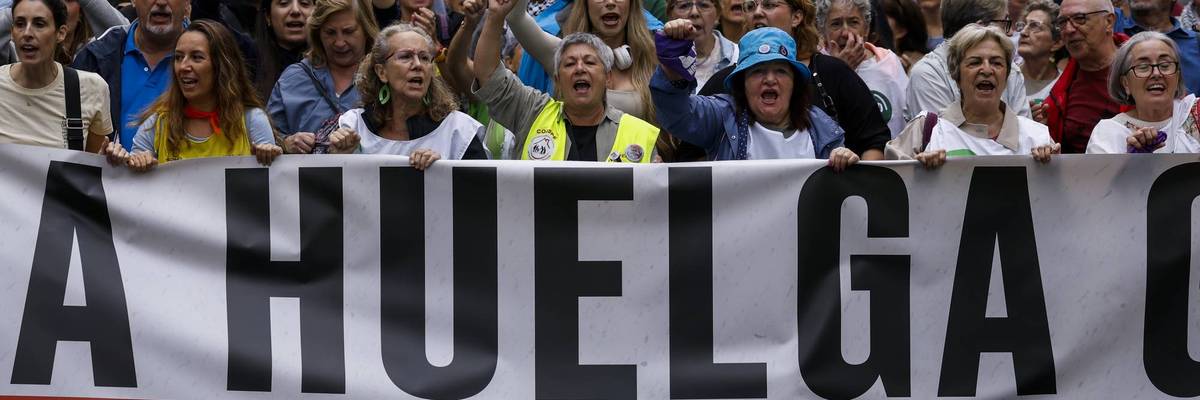
Protesters hold a banner reading "toward the general strike" along Gran Via street during a demonstration against the housing crisis on October 3, 2026 in Madrid, Spain.
What working people did with others outside the ballot box to improve their lives and those of their children and grandchildren is what secured the victories of the past.
The resounding Democratic Party candidates' victories over Republican opponents on November 3 begs the question of a new political moment in the US. Is it similar to Blue Waves of the recent past—meaning a change in political party but no improvement in the material conditions of the American population?
To ask the question means, in my view, to unpack the powerful actors that hold the reins of power, economically and politically. The actors are corporate America and the wealthy, the ruling class.
This class of owners was large and in charge before the November 3 midterm elections. Crucially, that anti-GOP vote failed to dislodge this class that controls the profit system.
Money shapes policies in ways that votes don't under the current imbalance of power between the rulers and the ruled.
It's a case of voting against President Donald Trump and GOP candidates. It's not the same thing, I suggest, as a vote for Democrats who allied with Republicans to coordinate and fund the daily operations of the American empire, or hegemon, arming and funding Israel's genocide of Palestinians in Gaza, before the November 3 midterm elections.
The franchise or the vote is necessary but not sufficient to alter the relationship of domination and subordination between the rulers and the ruled in America. What follows from that relationship is more of the same, war abroad, directly in Iran, and by proxy in Ukraine, to the detriment of living and working standards in the US.
The two-party monopoly, or duopoly, and its addiction to perpetual war, retains a stranglehold over American society. All is not lost.
Take heart. There are tactics and strategies that address this relationship beyond voting for Democrats.
And I am not talking about the 1960s and protests against the American War in Vietnam. As a youngster, I participated along with millions of others across the US.
Rather, I am talking about the here and now. Consider this.
People in Spain have gone on a general strike to protest the scarcity of affordable rental housing. Millions of Spanish people are participating.
Students in France and throughout Europe have taken to the streets to protest substandard education conditions and overall living situations against the backdrop of elected officials funding Ukraine's proxy war against Russia. European elites' animus toward Russia has a kind of parallel to how the ruling class of Israel and the US demonizes the nation of Iran.
In the US, there is a history of general strikes, one you don't learn about in school. There was a Seattle General Strike of 1919 and the Oakland General Strike of 1946, for instance.
It's been 80 years since a general strike in America. I recall talking to a friend passing out flyers to a No Kings rally earlier this year.
She mentioned talk of a general strike in the fall. Well, it's fall now, and a general strike seems nowhere near on the horizon.
Instead, there's euphoria about the landslide midterm vote against Republicans and for Democrats. Meanwhile, the robust voter mobilization is over, and danger looms as the population gets a green light to lapse back into observing national, state, and local politics.
This of course is in part what fuels the establishment of pay-for-play politics that sidelines the (non-)voting public. A symptom of this is that each election season is breaking fundraising records.
"In the 2026 midterms, the 40 biggest donors made more than $2.4 billion in campaign finance contributions through mid-October," according to the Brennan Center. "The top 40 have given more in every midterm since 2014, and the total from this cycle is eight times the giving of 2014’s top donors, even accounting for inflation."
The working class, to use the language of the marketplace, can't with its votes compete with that amount of money in pay-to-play politics. Money shapes policies in ways that votes don't under the current imbalance of power between the rulers and the ruled
That statement might appear strange. Americans are taught that voting defines democracy.
However, the transformational working class victories of the past—from abolishing chattel slavery to ending child labor—were not the outcomes of voting. What working people did with others outside the ballot box to improve their lives and those of their children and grandchildren is what secured such victories.
Time for new working-class tactics and strategies to forge an American movement politics that puts people first? If not now, then when?
This country and this world are at a monumental crossroads. US voters have an opportunity to beat back the forces of fascism and confront the billionaires who are rigging the economy, our media system, and our democracy, making it increasingly impossible for ordinary people to get by. We’re not just talking about the election. We’re talking about what must be done once these fascist elements are vanquished from power. We need a bolder set of solutions than what either major party has so far been willing to offer and a working-class movement ready to fight like hell for it. Trump didn't emerge from nowhere. The conditions that fueled MAGA authoritarianism were created by decades of radical neoliberal economic policies and a corrupt political system dominated by corporate interests. They slashed taxes on the super-rich, promising that the benefits would trickle down. They said giveaways to the corporate titans would make life more affordable for the rest of us. It was all bullshit. And when a bitter, betrayed populace searches for someone to blame, right-wing demagogues have little trouble finding scapegoats. People know when they're being lied to, but you won't hear any of this from the corporate media. Only independent journalism—powered and funded by people who believe in building a better world—can deliver truly trustworthy daily news. If you share our vision, please contribute whatever you can to sustain our work. |
The resounding Democratic Party candidates' victories over Republican opponents on November 3 begs the question of a new political moment in the US. Is it similar to Blue Waves of the recent past—meaning a change in political party but no improvement in the material conditions of the American population?
To ask the question means, in my view, to unpack the powerful actors that hold the reins of power, economically and politically. The actors are corporate America and the wealthy, the ruling class.
This class of owners was large and in charge before the November 3 midterm elections. Crucially, that anti-GOP vote failed to dislodge this class that controls the profit system.
Money shapes policies in ways that votes don't under the current imbalance of power between the rulers and the ruled.
It's a case of voting against President Donald Trump and GOP candidates. It's not the same thing, I suggest, as a vote for Democrats who allied with Republicans to coordinate and fund the daily operations of the American empire, or hegemon, arming and funding Israel's genocide of Palestinians in Gaza, before the November 3 midterm elections.
The franchise or the vote is necessary but not sufficient to alter the relationship of domination and subordination between the rulers and the ruled in America. What follows from that relationship is more of the same, war abroad, directly in Iran, and by proxy in Ukraine, to the detriment of living and working standards in the US.
The two-party monopoly, or duopoly, and its addiction to perpetual war, retains a stranglehold over American society. All is not lost.
Take heart. There are tactics and strategies that address this relationship beyond voting for Democrats.
And I am not talking about the 1960s and protests against the American War in Vietnam. As a youngster, I participated along with millions of others across the US.
Rather, I am talking about the here and now. Consider this.
People in Spain have gone on a general strike to protest the scarcity of affordable rental housing. Millions of Spanish people are participating.
Students in France and throughout Europe have taken to the streets to protest substandard education conditions and overall living situations against the backdrop of elected officials funding Ukraine's proxy war against Russia. European elites' animus toward Russia has a kind of parallel to how the ruling class of Israel and the US demonizes the nation of Iran.
In the US, there is a history of general strikes, one you don't learn about in school. There was a Seattle General Strike of 1919 and the Oakland General Strike of 1946, for instance.
It's been 80 years since a general strike in America. I recall talking to a friend passing out flyers to a No Kings rally earlier this year.
She mentioned talk of a general strike in the fall. Well, it's fall now, and a general strike seems nowhere near on the horizon.
Instead, there's euphoria about the landslide midterm vote against Republicans and for Democrats. Meanwhile, the robust voter mobilization is over, and danger looms as the population gets a green light to lapse back into observing national, state, and local politics.
This of course is in part what fuels the establishment of pay-for-play politics that sidelines the (non-)voting public. A symptom of this is that each election season is breaking fundraising records.
"In the 2026 midterms, the 40 biggest donors made more than $2.4 billion in campaign finance contributions through mid-October," according to the Brennan Center. "The top 40 have given more in every midterm since 2014, and the total from this cycle is eight times the giving of 2014’s top donors, even accounting for inflation."
The working class, to use the language of the marketplace, can't with its votes compete with that amount of money in pay-to-play politics. Money shapes policies in ways that votes don't under the current imbalance of power between the rulers and the ruled
That statement might appear strange. Americans are taught that voting defines democracy.
However, the transformational working class victories of the past—from abolishing chattel slavery to ending child labor—were not the outcomes of voting. What working people did with others outside the ballot box to improve their lives and those of their children and grandchildren is what secured such victories.
Time for new working-class tactics and strategies to forge an American movement politics that puts people first? If not now, then when?