SUBSCRIBE TO OUR FREE NEWSLETTER
Daily news & progressive opinion—funded by the people, not the corporations—delivered straight to your inbox.
5
#000000
#FFFFFF
To donate by check, phone, or other method, see our More Ways to Give page.
Daily news & progressive opinion—funded by the people, not the corporations—delivered straight to your inbox.
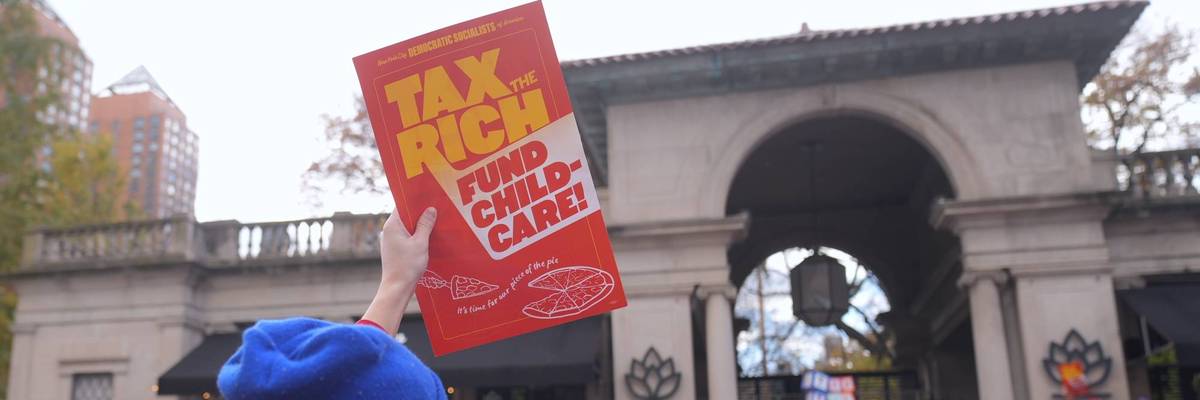
New York City Democratic Socialists (NYC-DSA) hold a rally in Union Square marking the start of a campaign to tax the rich and win universal childcare on November 16, 2025, in New York City, United States.
I'm a democrat and a socialist, but there are reasons I'm not a member of the Democratic Socialists of America.
I am a democrat and a socialist.
I am a democrat because I believe that everyone should be free and enabled to live lives of their own choosing in a society governed by and in the interests of all.
And I am a socialist because I believe that our work together should be democratically managed and its fruits equitably shared to maximize the prosperity of all and not just the profits of a few.
That makes me a democratic socialist. But I am not now a member of the Democratic Socialists of America, though I was once, decades ago. It has since become the largest organization of democratic socialists in the country. But for now, I have no interest in rejoining.
My reasons are simple and straight forward. The DSA has duly elected leaders and national spokespeople who are self-declared Leninists and not democratic by any reasonable definition of the term.
It also has declared itself in favor of the very top-down, centralized “socialism” built on “public ownership of the largest corporations and essential industries” that bears a stronger resemblance to the Soviet Union’s correctly derided “dictatorship of the proletariat” than it does to Sweden’s widely admired “People’s Home.”
I understand that DSA consists of several competing tendencies. I find many of them agreeable and applaud many of the goals outlined in the national program.
But if socialists have learned anything from the movement’s successes and failures over the last 150 years, it is that Leninism is not democratic and that monopolistic industries, whether private or public, do not lead to widely shared prosperity.
These organizational inconsistencies might seem unimportant, or even a virtuous sign of open-mindedness. They are neither. Instead, they raise serious questions about the organizations maturity and reliability. If it hasn’t learned anything from socialism’s past and can't figure out how to keep cuckoo birds from laying eggs in its nest, how mature and reliable can it be?
If we are serious about democracy and socialism, we need to be clear about what they are, how they work, and why they matter.
For example, many say that governing in the interests of all is impossible because no group of people can agree on everything. To which I would reply, true. But just because democracy is hard does not mean it is impossible.
Democracy does not demand conformity; it requires learning to live with difference. It is about learning to accept—to agree to disagree. There are very few things about which we can all agree and most are incontrovertible (the sun will come tomorrow). But there are a great many things we can all accept (even bad drivers try to obey the rules of the road).
Most people in my experience think "democracy" is about either procedure (elections, debates, laws, etc.), or power (the control of everything by everyone—or, at least, "the majority"). I think, on the contrary, that it is about freedom—the ability of everyone to lead lives of their own choosing.
Many also say that the best way to ensure prosperity is to encourage private property and free markets, and that public ownership and planned markets deliver not prosperity but poverty.
To which I would reply, not if the public options are envisioned as complements to private property and free markets rather than alternatives to them.
Private property and free markets are essential to prosperity. But when private property becomes concentrated in the hands of a very few people, markets become less free and prosperity becomes less widely shared, super-sized for some and doled out in teaspoonfuls for others.
Public property and social provision are essential counterweights to these baleful effects of private monopolies and ruinous competition.
I am a socialist thus for the same reason I am a democrat. Capitalism is a market economy run by and in the interests of capitalists; socialism is a market economy run by and in the interests of the whole society—wage earners and consumers as well as owners, managers, and investors.
An economy that best serves the interests of everyone is, as I understand the term, “socialist” by definition. It combines both private property and public enterprise to protect and maximize the profits of capital and the wages of labor, with each sharing equitably in the prosperity of all.
Some say that this sort of mixed economy is impossible, that the best we can do is to govern the private economy from the outside by imposing “rules of the road” that companies and other economic actors must obey.
But people don’t obey the rules of the road because they have to. They obey them because they choose to.
Hasn’t every driver driven over the speed limit, run a red light, or veered into the on-coming lane of traffic, when it suited them to do so? It isn’t the law that keeps us from doing so all the time. It is our self-interest.
Similarly, if we are going successfully to release the energies and simultaneously to restrain the excesses of private enterprise, we must have a countervailing system of public enterprises that can compete with the private by providing the goods and services required for a decent standard of living at prices everyone can afford.
Our public enterprises— think the post office, public schools, the transportation network, the national parks, the armed forces, etc., even the farm bill—thus represent a really existing, actually desirable socialism we already have. They provide affordable goods and services we need or want, not in the place of private provision, but as a complement and counterweight to it.
The best way to achieve the kind of democratic socialism we might want, or can at least accept, is not to make all private property public, but to expand the number and functioning of the affordable public options.
We don’t need to burn down the American People’s Home! We need to open it up, air it out, renovate the broken bits, extend it here and there, and make it the welcoming and comfortable place for everyone that the best of its founders wanted it to be.
This country and this world are at a monumental crossroads. US voters have an opportunity to beat back the forces of fascism and confront the billionaires who are rigging the economy, our media system, and our democracy, making it increasingly impossible for ordinary people to get by. We’re not just talking about the election. We’re talking about what must be done once these fascist elements are vanquished from power. We need a bolder set of solutions than what either major party has so far been willing to offer and a working-class movement ready to fight like hell for it. Trump didn't emerge from nowhere. The conditions that fueled MAGA authoritarianism were created by decades of radical neoliberal economic policies and a corrupt political system dominated by corporate interests. They slashed taxes on the super-rich, promising that the benefits would trickle down. They said giveaways to the corporate titans would make life more affordable for the rest of us. It was all bullshit. And when a bitter, betrayed populace searches for someone to blame, right-wing demagogues have little trouble finding scapegoats. People know when they're being lied to, but you won't hear any of this from the corporate media. Only independent journalism—powered and funded by people who believe in building a better world—can deliver truly trustworthy daily news. If you share our vision, please contribute whatever you can to sustain our work. |
Michael Merrill is an historian and research fellow with Rutgers LEARN. He was the dean of The Harry Van Arsdale Jr Center for Labor Studies at SUNY Empire from 2002-2016. He currently co-hosts a radio show, "Liberty and Justice for All," on KPFT Houston with Egberto Willies, which is archived on Substack and available on Spotify and other platforms.
I am a democrat and a socialist.
I am a democrat because I believe that everyone should be free and enabled to live lives of their own choosing in a society governed by and in the interests of all.
And I am a socialist because I believe that our work together should be democratically managed and its fruits equitably shared to maximize the prosperity of all and not just the profits of a few.
That makes me a democratic socialist. But I am not now a member of the Democratic Socialists of America, though I was once, decades ago. It has since become the largest organization of democratic socialists in the country. But for now, I have no interest in rejoining.
My reasons are simple and straight forward. The DSA has duly elected leaders and national spokespeople who are self-declared Leninists and not democratic by any reasonable definition of the term.
It also has declared itself in favor of the very top-down, centralized “socialism” built on “public ownership of the largest corporations and essential industries” that bears a stronger resemblance to the Soviet Union’s correctly derided “dictatorship of the proletariat” than it does to Sweden’s widely admired “People’s Home.”
I understand that DSA consists of several competing tendencies. I find many of them agreeable and applaud many of the goals outlined in the national program.
But if socialists have learned anything from the movement’s successes and failures over the last 150 years, it is that Leninism is not democratic and that monopolistic industries, whether private or public, do not lead to widely shared prosperity.
These organizational inconsistencies might seem unimportant, or even a virtuous sign of open-mindedness. They are neither. Instead, they raise serious questions about the organizations maturity and reliability. If it hasn’t learned anything from socialism’s past and can't figure out how to keep cuckoo birds from laying eggs in its nest, how mature and reliable can it be?
If we are serious about democracy and socialism, we need to be clear about what they are, how they work, and why they matter.
For example, many say that governing in the interests of all is impossible because no group of people can agree on everything. To which I would reply, true. But just because democracy is hard does not mean it is impossible.
Democracy does not demand conformity; it requires learning to live with difference. It is about learning to accept—to agree to disagree. There are very few things about which we can all agree and most are incontrovertible (the sun will come tomorrow). But there are a great many things we can all accept (even bad drivers try to obey the rules of the road).
Most people in my experience think "democracy" is about either procedure (elections, debates, laws, etc.), or power (the control of everything by everyone—or, at least, "the majority"). I think, on the contrary, that it is about freedom—the ability of everyone to lead lives of their own choosing.
Many also say that the best way to ensure prosperity is to encourage private property and free markets, and that public ownership and planned markets deliver not prosperity but poverty.
To which I would reply, not if the public options are envisioned as complements to private property and free markets rather than alternatives to them.
Private property and free markets are essential to prosperity. But when private property becomes concentrated in the hands of a very few people, markets become less free and prosperity becomes less widely shared, super-sized for some and doled out in teaspoonfuls for others.
Public property and social provision are essential counterweights to these baleful effects of private monopolies and ruinous competition.
I am a socialist thus for the same reason I am a democrat. Capitalism is a market economy run by and in the interests of capitalists; socialism is a market economy run by and in the interests of the whole society—wage earners and consumers as well as owners, managers, and investors.
An economy that best serves the interests of everyone is, as I understand the term, “socialist” by definition. It combines both private property and public enterprise to protect and maximize the profits of capital and the wages of labor, with each sharing equitably in the prosperity of all.
Some say that this sort of mixed economy is impossible, that the best we can do is to govern the private economy from the outside by imposing “rules of the road” that companies and other economic actors must obey.
But people don’t obey the rules of the road because they have to. They obey them because they choose to.
Hasn’t every driver driven over the speed limit, run a red light, or veered into the on-coming lane of traffic, when it suited them to do so? It isn’t the law that keeps us from doing so all the time. It is our self-interest.
Similarly, if we are going successfully to release the energies and simultaneously to restrain the excesses of private enterprise, we must have a countervailing system of public enterprises that can compete with the private by providing the goods and services required for a decent standard of living at prices everyone can afford.
Our public enterprises— think the post office, public schools, the transportation network, the national parks, the armed forces, etc., even the farm bill—thus represent a really existing, actually desirable socialism we already have. They provide affordable goods and services we need or want, not in the place of private provision, but as a complement and counterweight to it.
The best way to achieve the kind of democratic socialism we might want, or can at least accept, is not to make all private property public, but to expand the number and functioning of the affordable public options.
We don’t need to burn down the American People’s Home! We need to open it up, air it out, renovate the broken bits, extend it here and there, and make it the welcoming and comfortable place for everyone that the best of its founders wanted it to be.