SUBSCRIBE TO OUR FREE NEWSLETTER
Daily news & progressive opinion—funded by the people, not the corporations—delivered straight to your inbox.
5
#000000
#FFFFFF
To donate by check, phone, or other method, see our More Ways to Give page.


Daily news & progressive opinion—funded by the people, not the corporations—delivered straight to your inbox.

A petition calling for closure of the U.S. overseas military base described as the hub for the "war on terror" -- the Ramstein Air Base in southwestern Germany -- is set for presentation at the Pentagon on Monday morning (Sept. 26).
The petition, signed by more than 20,000 people, will also be presented to the German government in Berlin.
"The Ramstein Air Base's crucial role in relaying signals for drone strikes is binding the United States and Germany in an unconscionable program for extrajudicial killings," the petition says. "That program receives major help from German intelligence agencies, which assist with drone targeting as they share surveillance data with the U.S. government."
Demonstrators who will present the petition are scheduled to gather at 9 a.m. on Monday near the top of the Metro subway escalators at the Pentagon stop (next to the bus bay).
While U.S. activists will present the petition at the Pentagon, it will also be presented in Berlin by German activists along with two American veterans of the "war on terror." They are Cian Westmoreland, a former Air Force technician who worked on the drone program in Afghanistan, and Matthew Hoh, a former Marine who was an officer in Iraq and became the highest-ranking State Department official to resign in protest of the U.S. war in Afghanistan.
In addition to the Ramstein base's crucial role in the U.S. global drone program, "Ramstein is also central to many other military aspects of the 'war on terror' that continues to have such profoundly negative consequences in many nations," the petition notes.
Addressed to President Obama, German Chancellor Angela Merkel, the U.S. Congress and the German parliament, the petition says: "While urgently calling for the de-escalation of conflicts and for serious negotiations, we support nonviolent movements in opposition to the Ramstein Air Base and other U.S. military bases around the globe. We urge you to take immediate steps to close the Ramstein Air Base and not replace its functions at any other location."
The petition includes thousands of individual comments written by signers from all over the world. The comments are posted online.
Initiated by RootsAction.org, the petition's partners include 20 other organizations, which are listed on the petition's webpage.
Background:
* Norman Solomon, The Nation: "The Most Important U.S. Air Force Base You've Never Heard Of"
* Jeremy Scahill,The Intercept: "Germany Is the Tell-Tale Heart of America's Drone War"
RootsAction is dedicated to galvanizing people who are committed to economic fairness, equal rights for all, civil liberties, environmental protection -- and defunding endless wars. We mobilize on these issues no matter whether Democrats or Republicans control Washington D.C.
"Trump calls Spain a 'terrible partner' because it accepts neither blackmail nor threats. Because we are a sovereign, democratic country that defends multilateralism and peace."
US President Donald Trump's call on Wednesday to "cut off all trade with Spain" over what he said is the NATO ally's failure to pull its own weight in the alliance was shrugged off by Spanish Prime Minister Pedro Sánchez as "business as usual," but a member of the leftist leader's Cabinet responded to the largely infeasible threat by declaring that her government will not succumb to bullying.
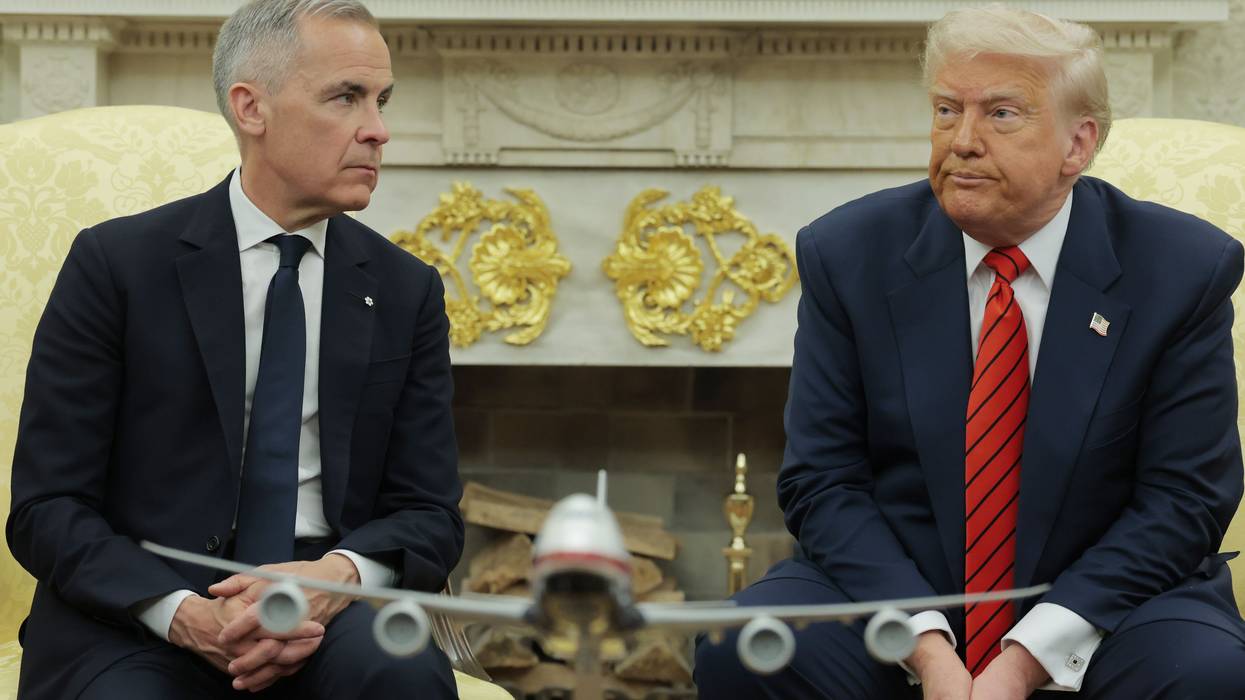
Sitting alongside NATO Secretary-General Mark Rutte at the alliance's summit in the Turkish capital Ankara, Trump told reporters that “Spain is a wasted cause."
"We don’t want to do any trade business with Spain anymore, by the way,” the Republican president continued. “Spain is a terrible partner in NATO. They don’t participate. They don’t pay. I don’t want anything to do with Spain. Cut off all trade with Spain, please, including visits. Watch them come running back. Oh, they’ll come running back."
President Trump says he is "not happy" with NATO and demands to cut trade ties with Spain: "I don't want anything to do with Spain... cut off all trade with Spain please, including visits... watch them come running back." pic.twitter.com/3WCTAZU5mA
— CSPAN (@cspan) July 8, 2026
According to NATO's official estimates for 2025, Spain spends 2% of its gross domestic product (GDP) on defense, equivalent to about $35.7 billion, the seventh-highest amount in the alliance. Five other NATO members—Belgium, Czechia, Luxembourg, North Macedonia, and Portugal—also spend 2% of their GDP on their militaries, the lowest percentage in the alliance. NATO members have agreed to meet a defense spending goal of 3.5% of GDP by 2035, while Trump has repeatedly urged alliance nations to budget 5%.
Sánchez brushed off Trump's tirade as "business as usual" while touting Spain's "excellent" trade relations with the United States and vowing to respond "with calm and patience" to the president's threat.
"When you step back a bit from these kinds of actions, what you see is that relations between the United States and Spain are very, very positive socially, culturally, economically, and politically," he said.
"Spain is a country that strives to maintain the best possible relations with all countries, especially allied countries, with whom we have very consolidated ties that have transcended the ideological orientation of the administrations that have governed Spain or the United States over the decades," Sánchez added.
Spanish Health Minister Mónica García was more blunt in her response to Trump's remarks.
"Trump calls Spain a 'terrible partner' because it accepts neither blackmail nor threats," she said on social media. "Because we are a sovereign, democratic country that defends multilateralism and peace. What's terrible is confusing diplomacy with bullying."
Experts say that while the International Emergency Economic Powers Act grants US presidents broad authority to block or limit trade with countries, they must prove that targeted nations pose an "unusual or extraordinary threat" to national or economic security, which Spain clearly does not. Furthermore, as a European Union member, any trade negotiations must be conducted via Brussels, not Madrid.
This isn't the first time that Trump has floated cutting off commercial relations with Spain. Earlier this year, he threatened a full trade embargo on Spain over its refusal to allow use of its military bases to wage the illegal US-Israeli war on Iran. Spain's rejection of Trump's call for NATO members to spend 5% of their GDPs on defense, its formal support for South Africa's Gaza genocide case against Israel at the International Court of Justice, and its broader pro-Palestine stance have also angered the US leader.
Responding to Trump's renewed airstrikes on Iran and apparent abandonment of a frayed three-month ceasefire, Sánchez said Wednesday that "what we want is to avoid war."
"Wars are always bad news," the prime minister added, "especially for civilians, particularly children and women."
"Children were murdered in the first days of Trump’s illegal, pointless war that has wreaked havoc across the world," said Rep. Yassamin Ansari.
The House Democrat who introduced articles of impeachment against Pentagon Secretary Pete Hegseth earlier this year revived her call for his removal on Wednesday following news that top US military commanders bypassed warnings about the reliability of their targeting information before authorizing the bombing of an Iranian school, killing more than 150 people—mostly young children.
"This is unconscionable," Rep. Yassamin Ansari (D-Ariz.), one of two Iranian Americans in Congress, wrote on social media in response to CNN's reporting on the US commanders' catastrophic decision. "Children were murdered in the first days of [President Donald] Trump’s illegal, pointless war that has wreaked havoc across the world. It is an abomination. It is a war crime. And it is why I’ve introduced articles of impeachment against Pete Hegseth."
Ansari urged her colleagues to support the Hegseth impeachment articles, which state that the Pentagon chief "has authorized, condoned, or failed to prevent the use of military force in a manner inconsistent with the law of armed conflict" and "demonstrated a willful disregard for the Constitution," among other alleged violations.
Currently, just 16 House Democrats are listed as co-sponsors of Ansari's impeachment articles against Hegseth, who dismantled the Pentagon's civilian harm mitigation programs before the Trump administration attacked Iran in late February. According to ProPublica, "Hegseth made deep cuts to the Civilian Harm Mitigation and Response programs and slashed CHMR staff at military commands by more than 90%."
"That included removing civilian harm specialists from target development strike teams and reducing the team of 10 at Central Command to only one full-time staffer," the outlet added.
CNN reported on Tuesday that senior US military commanders ignored warnings that intelligence pertaining to possible targets in Iran "was severely out of date and approved some strikes"—including the bombing of Shajareh Tayyebeh Elementary School in Minab, an attack that human rights groups say should be investigated as a war crime.
Months later, the Pentagon has not publicly released the findings of its investigation into the strike, and Trump recently said he doesn't believe the US was responsible for the Minab school attack, despite now-abundant evidence to the contrary. The attack is seen as one of the worst massacres of civilians in recent US military history.
Last week, The Associated Press reported that when news of the school bombing emerged on the first day of the US-Israeli assault on Iran, "the US military knew they had conducted strikes in the vicinity—though it took the military time to verify the Iranian claims that a school was struck and begin a formal investigation."
"One former Pentagon official, similarly speaking on condition of anonymity, said the bombing came as a natural result of changes made by the Trump administration to reduce staff to mitigate civilian harm and Hegseth’s emphasis on lethality," the outlet noted. "When Hegseth took charge, he slashed the size of an office called the Civilian Protection Center of Excellence, created at the direction of Congress in late 2022. That stopped the office’s work on updating 'no-strike lists,' which are lists of protected sites such as hospitals, schools, churches, and mosques, that the Pentagon keeps."
"These deals produce harm reliably enough that researchers can now count it."
Investigative journalist Ronan Farrow on Tuesday published a video on social media where he examines how private equity firms have been buying up hospitals throughout the US and saddling them with enormous debt burdens.
At the start of the video, Farrow notes that private equity firms such as The Carlyle Group, Cerberus, and Pinta have acquired hundreds of hospitals and nursing homes over the last 20 years.
"The pitch is generally: Infuse capital, cut inefficiency, and exit in five to seven years," Farrow explains. "And the deals work like this: A private equity firm puts some of its own money and borrows the rest. Typically, it'll borrow more than 70% of the purchase price."
"The twist is that debt doesn't sit on the firm's books," Farrow continues. "It gets placed on the facility itself, so the hospital or nursing home now carries the debt and the interest on it."
Studies now present a striking picture of what happens when private equity firms acquire hospitals and nursing homes: predictable increases in harm and deaths. One landmark study shows: patient deaths up about 11% after such acquisitions. pic.twitter.com/N6yfXJQIwW
— Ronan Farrow (@RonanFarrow) July 7, 2026
Farrow then cites research published by The Review of Financial Studies in 2023, which found healthcare facilities saw their interest payments more than triple after being acquired by private equity firms.
"In many cases," Farrow says, "private equity firms sold the nursing home's building shortly after acquiring it, returning the proceeds to investors, and then charging the facility rent on the building it used to own."
In addition to added debt burdens placed on hospitals and nursing homes, Farrow adds, the 2023 study found that private equity firms also cut staff hours after acquiring facilities, which has hurt patient care.
"The authors... found that private equity ownership can increase patient mortality by up to 11%," he says. "Over the study period, that translated to more than 20,000 lives lost."
Farrow then points to a 2025 study that found salaries of emergency room workers fall by an average of 18% in hospitals acquired by private equity firms, while hospital-acquired infections and complications rose by 25%.
Farrow concedes that not all private-equity deals turn out poorly and that some of the facilities are already in distress before being acquired.
However, he warns that "these deals produce harm reliably enough that researchers can now count it," adding that "so far, the industry has moved faster than the rules."
Research published Monday by the Private Equity Stakeholder Project (PESP) warned that private equity firms have been increasingly relying on nonprofit joint ventures to expand their reach throughout the US healthcare industry and "siphon profits from health systems and critical healthcare infrastructure."
"Private equity's healthcare playbook is evolving,” said Jim Baker, executive director of PESP. “Our research documents how private equity has increasingly relied on joint ventures with nonprofits to expand its presence in healthcare. These arrangements have received far less attention than traditional private equity buyouts, even as they become more common across hospitals and other healthcare sectors."