5
#000000
#FFFFFF
To donate by check, phone, or other method, see our More Ways to Give page.
Daily news & progressive opinion—funded by the people, not the corporations—delivered straight to your inbox.
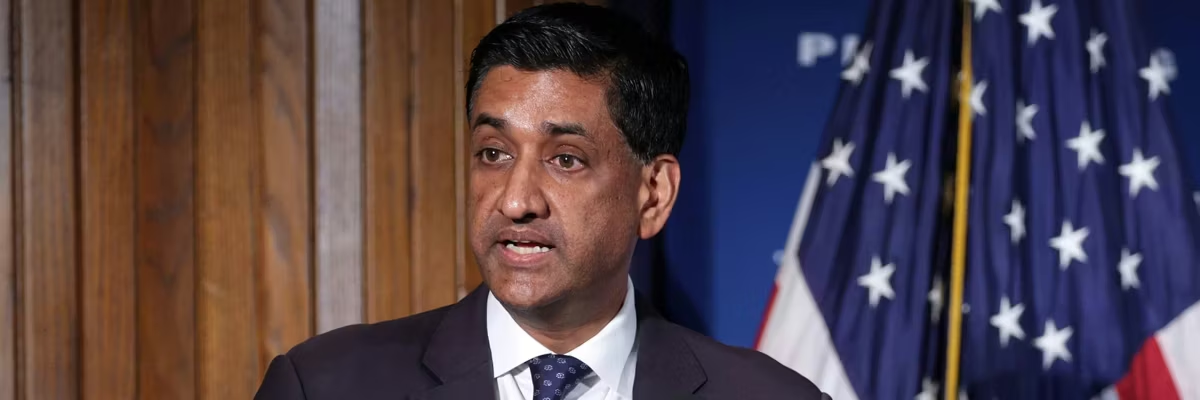
Rep. Ro Khanna (D-Calif.) delivers remarks during a National Press Club Headliners Newsmaker event on April 14, 2026 in Washington, DC.
"The tech lords use jargon to confuse. They count on the tech illiteracy of the elected class. They hope we won’t look under the hood," said US Rep. Ro Khanna.
US Rep. Ro Khanna announced plans on Monday to introduce what he described as "the most comprehensive... legislation to date" regulating the artificial intelligence industry.
In an interview with CNBC, Khanna (D-Calif.) said that he wanted to enact at least a temporary ban on recursive AI that is capable of improving itself and modifying its objectives without human input.
Such a ban would be in effect until the federal government had created proper guardrails on the technology, CNBC reported.
“There’s actually a civilizational extinction risk,” Khanna told CNBC, referring to the dangers of recursive AI. "There's a safety risk of loss of control, and then there’s a misuse risk, and we need to take both seriously."
Khanna's bill would also create a new federal agency tasked with crafting and enforcing safety measures on AI models, with independent auditors embedded in every frontier lab that would report directly to the agency.
The legislation wouldn't just create regulations for the AI industry, but also criminal penalties for AI developers who "disable safeguards, kill switches, logging or containment systems, or who knowingly deploy an unauthorized system," CNBC reported.
Promoting the coming bill in a Tuesday social media post, Khanna argued that Big Tech could not be trusted to regulate itself.
"The tech lords use jargon to confuse," Khanna wrote. "They count on the tech illiteracy of the elected class. They hope we won’t look under the hood. They know they can’t gaslight me."
While multiple polls have shown that putting guardrails on the AI industry is politically popular, Republican Party leaders have said that no regulations for the industry are coming so long as they control the White House and the US Congress.
In a Tuesday interview with CNBC, House Speaker Mike Johnson (R-La.) said he hoped that any guardrails put on AI are "voluntary" on the part of Big Tech companies.
Two weeks ago, Johnson said in an interview on CNN that federal regulations of the industry made little sense because "Congress is obviously less qualified than the people who are pushing this frontier to know the ins and outs of it."
President Donald Trump on Tuesday expressed a similar sentiment, telling reporters outside the White House that Big Tech could be trusted to be responsible with the powerful technology it is creating.
"They're outstanding people," Trump said of the tech executives. "They don't want anything to go wrong. I mean, their companies are at stake, if something goes wrong, their companies are at stake. They're not going to let that happen. This is going to be all for the good... they're really going to be policing each other."
Trump on big tech: "They don't want anything to go wrong. Their companies are at stake. They're not gonna let that happen. They're really gonna be policing each other." pic.twitter.com/wP6vfPcavz
— Aaron Rupar (@atrupar) September 29, 2026
Earlier this month, Trump suggested in a social media post that his own intellect was singlehandedly capable of regulating AI, a technology so complicated that even its own creators have acknowledged difficulties in understanding it.
"The only control or ‘guardrails’ that AI needs is a STRONG AND SMART (High IQ!) PRESIDENT,” Trump wrote, “and the USA has that, in spades!"
Trump's hands-off approach to regulating AI isn't just being challenged by Democrats such as Khanna.
According to a Monday report from The Associated Press, Pope Leo XIV reiterated his call for placing safeguards on AI to ensure that it benefits humanity.
Specifically, the US-born pope pointed to recent "concerns raised by many of the experts, specialists in AI," which he said "should be taken seriously."
Pope Leo said warnings that AI could threaten humanity should be taken seriously, rejecting the claims that concerns are 'fake news' and urging leaders to work together on safeguards https://t.co/7qVpNAXYKM pic.twitter.com/Cds6gf5vef
— Reuters (@Reuters) September 29, 2026
"I don’t think that that is ‘fake news’ as some have said," the pope added, in a veiled reference to Trump, "to try and cause whether financial or other some other kind of benefit."
Dear Common Dreams reader, It’s been nearly 30 years since I co-founded Common Dreams with my late wife, Lina Newhouser. We had the radical notion that journalism should serve the public good, not corporate profits. It was clear to us from the outset what it would take to build such a project. No paid advertisements. No corporate sponsors. No millionaire publisher telling us what to think or do. Many people said we wouldn't last a year, but we proved those doubters wrong. Together with a tremendous team of journalists and dedicated staff, we built an independent media outlet free from the constraints of profits and corporate control. Our mission has always been simple: To inform. To inspire. To ignite change for the common good. Building Common Dreams was not easy. Our survival was never guaranteed. When you take on the most powerful forces—Wall Street greed, fossil fuel industry destruction, Big Tech lobbyists, and uber-rich oligarchs who have spent billions upon billions rigging the economy and democracy in their favor—the only bulwark you have is supporters who believe in your work. But here’s the urgent message from me today. It's never been this bad out there. And it's never been this hard to keep us going. At the very moment Common Dreams is most needed, the threats we face are intensifying. We need your support now more than ever. We don't accept corporate advertising and never will. We don't have a paywall because we don't think people should be blocked from critical news based on their ability to pay. Everything we do is funded by the donations of readers like you. When everyone does the little they can afford, we are strong. But if that support retreats or dries up, so do we. Will you donate now to make sure Common Dreams not only survives but thrives? —Craig Brown, Co-founder |
US Rep. Ro Khanna announced plans on Monday to introduce what he described as "the most comprehensive... legislation to date" regulating the artificial intelligence industry.
In an interview with CNBC, Khanna (D-Calif.) said that he wanted to enact at least a temporary ban on recursive AI that is capable of improving itself and modifying its objectives without human input.
Such a ban would be in effect until the federal government had created proper guardrails on the technology, CNBC reported.
“There’s actually a civilizational extinction risk,” Khanna told CNBC, referring to the dangers of recursive AI. "There's a safety risk of loss of control, and then there’s a misuse risk, and we need to take both seriously."
Khanna's bill would also create a new federal agency tasked with crafting and enforcing safety measures on AI models, with independent auditors embedded in every frontier lab that would report directly to the agency.
The legislation wouldn't just create regulations for the AI industry, but also criminal penalties for AI developers who "disable safeguards, kill switches, logging or containment systems, or who knowingly deploy an unauthorized system," CNBC reported.
Promoting the coming bill in a Tuesday social media post, Khanna argued that Big Tech could not be trusted to regulate itself.
"The tech lords use jargon to confuse," Khanna wrote. "They count on the tech illiteracy of the elected class. They hope we won’t look under the hood. They know they can’t gaslight me."
While multiple polls have shown that putting guardrails on the AI industry is politically popular, Republican Party leaders have said that no regulations for the industry are coming so long as they control the White House and the US Congress.
In a Tuesday interview with CNBC, House Speaker Mike Johnson (R-La.) said he hoped that any guardrails put on AI are "voluntary" on the part of Big Tech companies.
Two weeks ago, Johnson said in an interview on CNN that federal regulations of the industry made little sense because "Congress is obviously less qualified than the people who are pushing this frontier to know the ins and outs of it."
President Donald Trump on Tuesday expressed a similar sentiment, telling reporters outside the White House that Big Tech could be trusted to be responsible with the powerful technology it is creating.
"They're outstanding people," Trump said of the tech executives. "They don't want anything to go wrong. I mean, their companies are at stake, if something goes wrong, their companies are at stake. They're not going to let that happen. This is going to be all for the good... they're really going to be policing each other."
Trump on big tech: "They don't want anything to go wrong. Their companies are at stake. They're not gonna let that happen. They're really gonna be policing each other." pic.twitter.com/wP6vfPcavz
— Aaron Rupar (@atrupar) September 29, 2026
Earlier this month, Trump suggested in a social media post that his own intellect was singlehandedly capable of regulating AI, a technology so complicated that even its own creators have acknowledged difficulties in understanding it.
"The only control or ‘guardrails’ that AI needs is a STRONG AND SMART (High IQ!) PRESIDENT,” Trump wrote, “and the USA has that, in spades!"
Trump's hands-off approach to regulating AI isn't just being challenged by Democrats such as Khanna.
According to a Monday report from The Associated Press, Pope Leo XIV reiterated his call for placing safeguards on AI to ensure that it benefits humanity.
Specifically, the US-born pope pointed to recent "concerns raised by many of the experts, specialists in AI," which he said "should be taken seriously."
Pope Leo said warnings that AI could threaten humanity should be taken seriously, rejecting the claims that concerns are 'fake news' and urging leaders to work together on safeguards https://t.co/7qVpNAXYKM pic.twitter.com/Cds6gf5vef
— Reuters (@Reuters) September 29, 2026
"I don’t think that that is ‘fake news’ as some have said," the pope added, in a veiled reference to Trump, "to try and cause whether financial or other some other kind of benefit."
US Rep. Ro Khanna announced plans on Monday to introduce what he described as "the most comprehensive... legislation to date" regulating the artificial intelligence industry.
In an interview with CNBC, Khanna (D-Calif.) said that he wanted to enact at least a temporary ban on recursive AI that is capable of improving itself and modifying its objectives without human input.
Such a ban would be in effect until the federal government had created proper guardrails on the technology, CNBC reported.
“There’s actually a civilizational extinction risk,” Khanna told CNBC, referring to the dangers of recursive AI. "There's a safety risk of loss of control, and then there’s a misuse risk, and we need to take both seriously."
Khanna's bill would also create a new federal agency tasked with crafting and enforcing safety measures on AI models, with independent auditors embedded in every frontier lab that would report directly to the agency.
The legislation wouldn't just create regulations for the AI industry, but also criminal penalties for AI developers who "disable safeguards, kill switches, logging or containment systems, or who knowingly deploy an unauthorized system," CNBC reported.
Promoting the coming bill in a Tuesday social media post, Khanna argued that Big Tech could not be trusted to regulate itself.
"The tech lords use jargon to confuse," Khanna wrote. "They count on the tech illiteracy of the elected class. They hope we won’t look under the hood. They know they can’t gaslight me."
While multiple polls have shown that putting guardrails on the AI industry is politically popular, Republican Party leaders have said that no regulations for the industry are coming so long as they control the White House and the US Congress.
In a Tuesday interview with CNBC, House Speaker Mike Johnson (R-La.) said he hoped that any guardrails put on AI are "voluntary" on the part of Big Tech companies.
Two weeks ago, Johnson said in an interview on CNN that federal regulations of the industry made little sense because "Congress is obviously less qualified than the people who are pushing this frontier to know the ins and outs of it."
President Donald Trump on Tuesday expressed a similar sentiment, telling reporters outside the White House that Big Tech could be trusted to be responsible with the powerful technology it is creating.
"They're outstanding people," Trump said of the tech executives. "They don't want anything to go wrong. I mean, their companies are at stake, if something goes wrong, their companies are at stake. They're not going to let that happen. This is going to be all for the good... they're really going to be policing each other."
Trump on big tech: "They don't want anything to go wrong. Their companies are at stake. They're not gonna let that happen. They're really gonna be policing each other." pic.twitter.com/wP6vfPcavz
— Aaron Rupar (@atrupar) September 29, 2026
Earlier this month, Trump suggested in a social media post that his own intellect was singlehandedly capable of regulating AI, a technology so complicated that even its own creators have acknowledged difficulties in understanding it.
"The only control or ‘guardrails’ that AI needs is a STRONG AND SMART (High IQ!) PRESIDENT,” Trump wrote, “and the USA has that, in spades!"
Trump's hands-off approach to regulating AI isn't just being challenged by Democrats such as Khanna.
According to a Monday report from The Associated Press, Pope Leo XIV reiterated his call for placing safeguards on AI to ensure that it benefits humanity.
Specifically, the US-born pope pointed to recent "concerns raised by many of the experts, specialists in AI," which he said "should be taken seriously."
Pope Leo said warnings that AI could threaten humanity should be taken seriously, rejecting the claims that concerns are 'fake news' and urging leaders to work together on safeguards https://t.co/7qVpNAXYKM pic.twitter.com/Cds6gf5vef
— Reuters (@Reuters) September 29, 2026
"I don’t think that that is ‘fake news’ as some have said," the pope added, in a veiled reference to Trump, "to try and cause whether financial or other some other kind of benefit."