

SUBSCRIBE TO OUR FREE NEWSLETTER
Daily news & progressive opinion—funded by the people, not the corporations—delivered straight to your inbox.
5
#000000
#FFFFFF
To donate by check, phone, or other method, see our More Ways to Give page.
Daily news & progressive opinion—funded by the people, not the corporations—delivered straight to your inbox.

"No one really wants it here," said one local resident who helped gather signatures in support of blocking the data center.
Residents of Eastport, Maine are set to attend a public hearing Monday evening on two proposed ordinances to halt the construction of large artificial intelligence data centers, with proponents of the proposals hoping the coastal city's planning board will be able to prevent the build-out of a 27-acre, $100 million facility that a Massachusetts-based developer aims to build underwater—right near Eastport's working waterfront.
The public hearing is being held days after President Donald Trump's Federal Energy Regulatory Commission (FERC) accepted a preliminary permit for DeepGreen Holdings, LLC, the firm managed by luxury real estate development Louis Wolfson, which aims to build the facility that would be powered by tidal energy.
The 48-month permit does not allow DeepGreen to start construction, but gives approval for engineering and environmental studies needed to secure funding and officially begin the project.
DeepGreen would use ocean water to cool the heat created by the facility's massive computer servers. The company has also proposed using ocean tides to power turbines that would generate up to 5 megawatts of electricity.
The approval came weeks after FERC asked DeepGreen to amend its application, lowering its energy output from 51 megawatts to 15 megawatts and creating scalable project phases.
The community has mobilized against the proposed data center since DeepGreen applied for the permit in February, with the Eastport City Council voting unanimously earlier this month in support of a 180-day moratorium halting all progress on the center.
The local policymakers said the moratorium would give the city time to consult with the planning board about the two citizen-led initiatives to pass new ordinances—one that would permanently ban data centers in Eastport, which the city's legal counsel has said could be put to voters with a minor formatting change to the question, and another that would require voter approval for any new industrial or commercial development larger than 10,000 square feet in the ocean or 25,000 square feet on land.
The second ordinance was found by the legal counsel to be "unenforceable and unlawful," as the town is not permitted to regulate elections via ordinance.
But residents, officials with the Sipayik Passamaquoddy community, and local groups like Eastport Coalition for Healthy Oceans are all pushing to stop DeepGreen and the development it incorporated a month before applying for the permit, DeepGreen Western Passage SPV, or special purpose vehicle.
DeepGreen has also applied for a permit to build an underwater data center in Cook Inlet, Alaska.
Opponents say thermal pollution from the project would be destructive to the habitat of lobsters off the coast of Eastport, which are crucial to the city's fishing economy and working waterfront. They have also raised concerns that a data center off the coast would harm tourism as well as whales and other marine wildlife.
One local opponent, commercial fisherman and renewable energy developer Nathan Curtis, said DeepGreen carries "unmitigated risks of thermal pollution.”
The proposed data center would "require continuous ocean cooling, converting Western Passage into an unmetered industrial heat sink," wrote Curtis in a letter to FERC before the commission issued the permit. "Continuous thermal discharge into the water column threatens local water temperatures, localized current dynamics, and critical benthic habitats that support Eastport’s commercial fisheries and working waterfront.”
Wolfson denied that the data center, which was approved for an energy output up to 15 megawatts, would harm the coastal region of Eastport.
"As a property manager and developer who has operated within coastal dynamics for 40 years, I have too much respect for working waterfronts to introduce a project that threatens them," said Wolfson in a letter to Monitor Local.
But Eastport resident Suellen Hendrix, who was part of a local effort to gather signatures in support for the proposed ordinances, told Maine Public that locals appear unconvinced by any assurances from the data center developer.
"Everyone was behind 'we don't want this data center,'" Hendrix told Maine Public. "Nobody was questioning, 'Well, we need the jobs.' Nobody was questioning why it should be here because no one really wants it here."
As Common Dreams reported last week, as the Trump administration and AI executives have aggressively pushed for the expansion of data centers, public support has collapsed, with 75% of respondents to a poll by Embold Research saying they would not support a data center near where they live.
"This has happened nationwide, folks, it's nothing new," Dwayne Tomah, a historian with the Sipayik Passamaquoddy community adjacent to Eastport, told a crowd of data center opponents at a recent rally on the town's waterfront. "We've got to resist."

"We truly urge policymakers, stakeholders, and the public to see these executive orders for what they truly are: an unnecessary and counterproductive retreat to outdated energy strategies."
On the first day of his second term, U.S. President Donald Trump announced he was fulfilling his campaign promise to "drill, baby, drill" by declaring a "national energy emergency." The declaration seeks to spur the "identification, leasing, development, production, transportation, refining, and generation" of every energy source except for wind, solar, battery storage, and improved efficiency.
But what exactly does this mean, and how much damage could it do to local communities, energy prices, the global climate, and the nation's leadership in the green energy transition? Quite a lot, a panel of energy policy experts warned on Wednesday.
"These executive orders and this administration are sending us down exactly the wrong path," said senior attorney at the Southern Environmental Law Center Megan Gibson. "By attempting to fabricate a national energy emergency, these orders set the stage toward increased fossil fuel extraction, transmission, use, and export. This is all over cleaner, more affordable technologies that we have and are commercially scalable."
Tyson Slocum, director of Public Citizen's Energy Program, warned that "the threat is extremely real, and here right now, that Trump is going to seek to push unneeded fossil fuel projects."
Trump gave himself a major tool to accomplish this in the declaration by evoking national security. Specifically, Section 7 orders Secretary of Defense Pete Hegseth to conduct an assessment of the department's access to the energy needed to "protect the homeland" and present it within 60 days, or by March 21. The report should examine any vulnerabilities, with a special emphasis on the Northeast and West Coast, where local and state Democratic governments have rejected new fossil fuel projects on climate grounds.
While Trump tried to use national security justifications to speed fossil fuel development during his first term, he was stymied in part by opposition within government agencies. That is less likely to be the case now.
"There is no question that when you add national security designations to civilian energy infrastructure projects, you're putting in the crosshairs any civil servant or citizen who seeks to deviate from Trump's line."
"He has now purged agencies of opposition and has much firmer control over the national security apparatus that he's going to need to use national security justifications for this energy emergency declaration," Slocum said.
Therefore, Hegseth's report could be used to, for example, claim that the energy needs of military bases in the Northeast require the revival of the Constitution pipeline that would bring fracked gas from Pennsylvania to New York, which state leaders had previously rejected.
"This is about a larger issue of attacking parts of the country that didn't vote for him and parts of the country that also have enacted a number of laws and regulations promoting action on climate change and promoting renewables," Slocum said. "And so this is part of a general attack on state leadership of those states that he sees as not being accommodating enough to fossil fuels."
At the same time, the emergency declaration could be used as part of a negotiating tactic with Democratic state leaders. To take New York as an example again, Trump might persuade Gov. Kathy Hochul to accept the Constitution pipeline in exchange for allowing offshore wind or ending opposition to congestion pricing.
"Trump will either force his agenda upon unwilling states, or he will use it as a club to bully them into doing it as part of a horse-trading maneuver," Slocum said.
Using the national security justification could also make it easier for the administration to crack down on not only civil society protests against these projects, but stubborn opposition from local leaders as well. Even elected officials who pushed back, Slocum warned, could be labeled terrorists.
"There is no question that when you add national security designations to civilian energy infrastructure projects, you're putting in the crosshairs any civil servant or citizen who seeks to deviate from Trump's line," he said.
Another provision of the emergency declaration being monitored by advocates is Section 4, which calls on heads of agencies to alert the Army Corps of Engineers to projects they want to see prioritized. The Corps plays an important role in issuing 404 permits for any infrastructure that is built through or beneath a body of water. It also has the authority to rush its permitting process—including by waving or truncating a National Environmental Policy Act (NEPA) review—in the case of an emergency.
Shortly after Trump's declaration, the Army Corps listed several "emergency"-designated projects on its website. However, David Bookbinder, director of law and policy at the Environmental Integrity Project, pointed out, "none of those projects, not a single one, meets the Corps' own definition of what an emergency is."
The Corps can rush a project through only if not doing so poses an immediate threat to life, property, or economic well-being, and it has historically only done so in the aftermath of natural disasters such as floods or hurricanes.
"In the long run, the question is how many times is the Corps going to make groups sue them?"
"No one has ever tried to speed up permitting on the basis of a national energy emergency, let alone a clearly fictitious one," Bookbinder said.
The Army Corps immediately removed the emergency designations of projects on its website once they were discovered, and groups including Bookbinder's have filed Freedom of Information Act requests with the Corps to find out what projects other agencies have told it to fast-track. Those requests are due around the beginning of April.
"As soon as they try permitting one of these projects, cutting the corners and speeding up a permit by designating it as, quote, an emergency, that permit will be challenged," Bookbinder said. "And in the long run, the question is how many times is the Corps going to make groups sue them?"
In the long-term, advocates say, the administration may attempt to use the Corps' ability to rush "emergency" projects in order to bypass NEPA altogether, ignore court orders that try to stop it, and undermine agencies that push back. While the Federal Energy Regulatory Commission (FERC) is supposed to be independent, for example, Trump on Tuesday fired the two Democratic commissioners on the Federal Trade Commission.
"We are very concerned that should Trump perceive any roadblocks at FERC to his energy emergency declaration that he would have no qualms forcibly removing independent FERC commissioners from their seats and replace them with compliant commissioners," Slocum said. "So this is not bluster."
Ultimately, Slocum added, "we are in an era right now where the only norm is Trump is going to violate it."
While the Trump administration is trying to rush through fossil fuel projects, the panelists were clear that his energy agenda will not benefit the majority of U.S. communities and ratepayers.
"If we continue down this path, this self-destructive path, we will miss out on an opportunity to build a vibrant, sustainable energy economy that benefits all Americans, that will actually secure our national energy independence, and would position our country for long-term economic success," Gibson said.
So who will benefit? The clue comes in part in a closed-door meeting the Trump administration held with oil and gas executives in the White House, also on Wednesday.
"Advocates must keep challenging approvals through litigation and public pressure—making the case that the project can and should be denied if there is no genuine need or if adverse impacts are overwhelming."
"After spending $450 million in the last election to elect Trump and install friendly lawmakers on Capitol Hill, fossil fuel executives are getting what they paid for," Slocum said in a statement about the meeting. "We know precisely what the oil industry will do with decreased costs stemming from Trump's deregulation: They will pocket the savings and shower executives and wealthy investors with bonuses and dividends."
"Under Trump, fossil fuel corporations will accelerate the transfer of wealth from consumers to billionaires while exposing millions of Americans to more pollution and delaying the transition to clean energy for as long as possible," he continued.
Slocum further told Common Dreams that "the fossil fuel industry's close ties to Trump and key Trump officials will play a role in decisions Trump has made and will continue to make on the energy emergency declaration and implementation."
Gibson said the emergency declaration was "perpetuating a pattern where major fossil fuel corporations reap substantial profits while the American public and communities have to deal with rising energy prices, higher utility bills, a weakened domestic energy system, not to mention extreme and lasting harms to our communities and our health."
In response, she called on "unlikely partners and coalitions to push for a modern, democratically grounded energy policy that benefits the public."
'It's essential that we continue to hold regulators accountable: Many of FERC's decisions have disregarded states' and communities' objections. Advocates must keep challenging approvals through litigation and public pressure—making the case that the project can and should be denied if there is no genuine need or if adverse impacts are overwhelming," she said.
"We truly urge policymakers, stakeholders, and the public to see these executive orders for what they truly are: an unnecessary and counterproductive retreat to outdated energy strategies," Gibson said. "The real emergency here isn't a lack of fossil fuel extraction, transmission, or export. It's lack of vision and courage, and competent governance to embrace the modern clean energy economy we know we need and deserve."
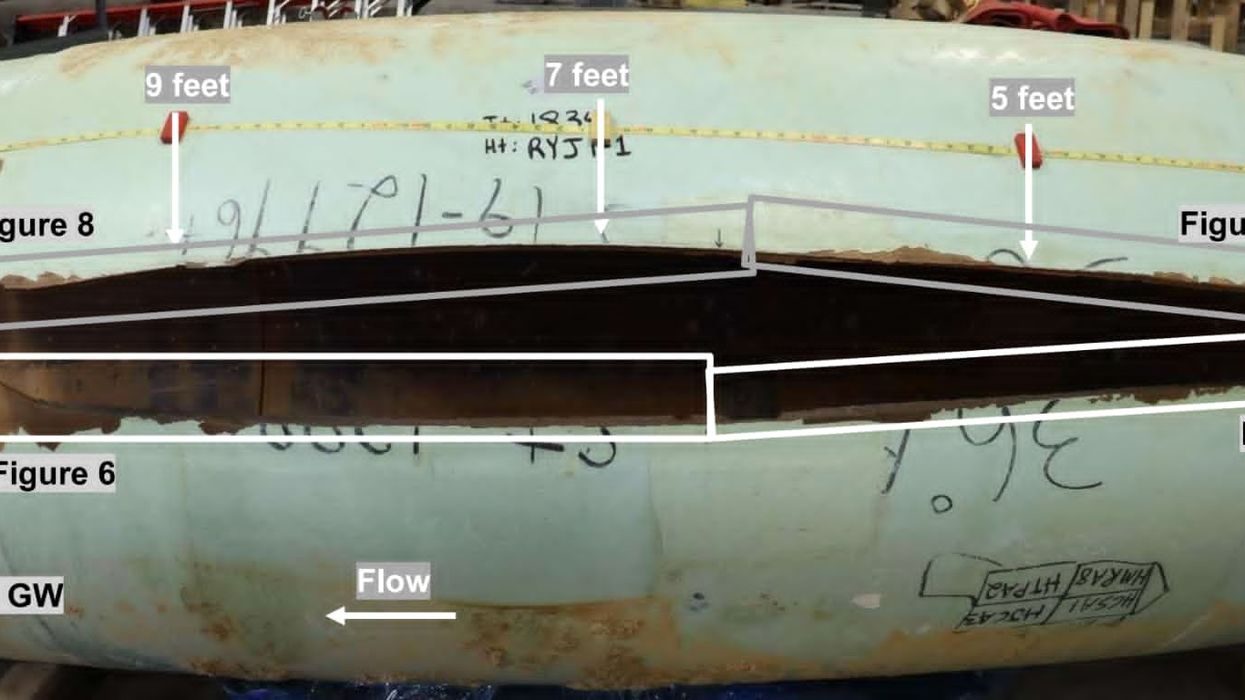
Faced with a troubling report that reveals multiple pipe defects, Mountain Valley Pipeline spins and misrepresents.
Almost four months after high-pressure water testing blew a
gaping hole in an elbow pipe fitting section of the Mountain Valley Pipeline on Bent Mountain in Virginia, the pipeline operator filed a report with the Federal Energy Regulatory Commission on August 29 addressing the cause of the pipe failure.
The incident, which occurred on May 1, roughly six weeks before MVP went into operation, was first noted by local land owners, who observed sediment in a nearby stream, reported it to the Virginia Department of Environmental Quality (DEQ), and then photographed the burst pipe as it was hauled away a day later.
MVP sent the 43-page report to the Pipeline and Hazardous Materials Safety Administration (PHMSA) on August 28, a day before the report was filed with FERC. In June, PHMSA and MVP entered into a consent agreement to resolve a 2023 notice of proposed safety order, which had alleged that conditions existed along MVP’s route through West Virginia and Virginia that posed “an integrity risk to public safety, property, or the environment.”
This fight will continue until MVP is held accountable and this ruinous disaster is stopped before the unthinkable happens.
MVP’s report—and the company’s reaction to it—leave more questions unanswered than answered.
But one thing is clear: MVP tried to mislead PHMSA and FERC, as well as the press and the public at large, by including with the report filing a two-page cover letter that downplayed the incident and omitted crucial information contained in the report.
Also troubling—and unexplained—the report went through three drafts, dated July 23, August 1, and August 21. It was prepared by risk management firm DNV GL USA, which described MVP as its “customer.”
MVP provided DNV with a 12.5-foot section of pipe that contained the burst elbow fitting as well as two smaller sections (1.5 feet and one foot) from a “sister fitting” from the same test section.
MVP claimed in its cover letter that the sister elbow fitting was the only piece of pipe along the 303-mile long pipeline that had a “matching pedigree.” It gave no supporting evidence, nor did it even describe what it meant by “matching pedigree,” and DNV did not address the claim, much less verify it.
DNV did tensile tests on the blown pipe and “duplicate tensile tests” on the two samples from the sister fitting. The purpose of the analysis was “to determine the metallurgical cause of the failure and identify any contributing factors.”
DNV concluded that “the elbow fitting failed at the longitudinal seam weld as a result of ductile overload.” Ductile overload is “the failure mode that occurs when a material is simply loaded to beyond its ultimate tensile strength.” That seems simple enough. Indeed, it is almost self-evident. Obviously, the pipe burst because pressure was put on it that was beyond its capacity to bear. But that does not tell you why there was ductile overload.
DNV reported that “a majority of the failure was at or near the fusion boundary of the seam weld metal and base metal, indicating a lower tensile strength at or near the fusion boundary compared to the base metal and weld metal.”
That brings us to the second goal of the testing: to determine contributing factors. And that’s where the report gets very interesting—and very scary:
Contributing factors to the lower tensile strength at or near the fusion boundary was (sic) softening of the base metal mid-thickness... and possibly a yield strength lower than the requirement as the base metal yield strength of the sister elbow fitting did not meet the yield strength requirement.
Here, DNV is talking about two different defects in the pipe that burst, and a different defect in the sister pipe.
First, there was inadequate tensile strength , which is the maximum stress that can be applied before an object breaks, in the pipe that burst.
Second, there was possibly also inadequate yield strength, which refers to the maximum stress before an object’s shape permanently changes, in the pipe that burst. The evidence for this is that “the base metal yield strength of the sister elbow fitting”—which MVP admitted had a “matching pedigree”—“did not meet the yield strength requirement.”
Of note, the inadequate yield strength of the sister fitting was not in a welded seam, but rather in the base metal of the pipe itself.
Two pipes tested.
Two pipes defective.
Two different defects.
Taking things further, DNV concluded that “the tensile properties of the sister elbow fitting (base metal) do not meet the tensile requirements for MSS SP75 Grade WPHY70 steel at the time of construction as the yield strength is lower than the required value of 70 ksi; the values are also lower than the MTR value of 70.9 ksi.”
As DNV noted, MSS SP-75 requires a minimum yield strength of 70 kilopounds per square inch (ksi). The two sister elbow samples had a yield strength of 63.5 and 66.8 ksi.
In plain English, the sister elbow would be expected to permanently deform at a level of stress below what was required by industry standards, and the elbow that burst would be expected to break at a level of stress below what is required by industry standards.
Presumably, it is not good for any section of MVP to be either susceptible to permanent alteration or, worse, a straight blow out, when subjected to high pressure. The tested pipes were subject to both. It is terrifying, when one considers that MVP carries explosive methane gas—which is pressurized at up to 1,480 psig—that people live well within the pipeline’s blast zone.
And it gets worse.
DNV reported that there was a separate problem altogether: The sister elbow pipe’s fracture appearance transition temperature (FATT) value, which is the temperature at which the steel’s fracture appearance goes from being mostly flexible to mostly brittle, was “higher (poorer) than typical when compared to 2018 vintage line pipe steel.” Simply put, this means that the sister elbow DNV tested was more susceptible to cracking as compared to other pipe steel made in the same time period.
Mountain Valley Pipeline’s cover letter did not mention any of these problems.
Instead, MVP simply said that its pipeline burst on May 1 “due to a manufacturer’s defective weld,” on one pipe elbow. MVP bragged that a sister fitting “was proactively removed… to provide material for a portion of the mechanical testing aspect of the failure analysis,” but conveniently omitted the fact that the second fitting suffered from multiple manufacturing defects. Incredibly, MVP then misleadingly stated that “a single failure,” when there actually were two defective pipes (out of only two tested), was “a negligible fitting failure rate.”
That’s not even accounting for the fact that this was not the only “failure” that MVP experienced during hydrostatic testing. On June 4, a “jumper pipe” burst, sending a geyser of water hundreds of feet into the nighttime sky and then into a stream that feeds into the Roanoke River. Local residents caught the incident on video. MVP has yet to provide a full explanation of exactly what occurred.
As to the May 1 pipe burst, MVP no doubt was betting that reporters would not dig through 43 pages of highly technical material and instead would rely on MVP’s two-page “summary.” And indeed, with one notable exception, virtually all media outlets did exactly that. Many simply reprinted a story circulated by The Associated Press, which parroted a separate blogpost from MVP that noted that the report found that “there was no evidence of external or internal corrosion.”
By highlighting that DNV found no evidence of corrosion, MVP was cleverly suggesting that widespread concern about corrosion of MVP’s pipes is unfounded. However, concerns about corrosion do not focus on pipes, like the ones at issue here, that were installed and buried in 2018. Rather, the danger of corrosion focuses on the fact that most of the pipeline was installed in 2023 and 2024 using pipes that had been baking in the sun for many years after construction was halted in 2018 and thereafter by federal courts and, in one brief instance, by the Virginia Department of Environmental Quality. In fact, according to federal court testimony from an MVP executive in 2018, the pipe needed to be installed within one year to avoid having the sun degrade its protective coating, which is designed to prevent corrosion.
All of this is very troubling. MVP has a long history of flouting the law, as evidenced by the fact that it has been fined millions of dollars and cited for hundreds of environmental violations as far back as 2018 and as recently as last month.
Now MVP wants those who live along the route and others concerned to accept their claim that the sister elbow fitting it gave to DNV for testing was the only pipe among the 2,500 fittings and thousands of other pipes along the route that had a “matching pedigree” with the pipe that burst, whatever that means, despite the fact that no one—not even DNV—has verified or even evaluated that claim.
MVP likewise does not want anyone to wonder why DNV produced three drafts of the report for its “customer,” MVP. Who knows what MVP asked to be added, deleted, or changed between July 23, when the first draft was completed, and August 21, when the final report was done? Nor is there any explanation as to why MVP waited until August 28 to provide the report to PHMSA.
In short, the people who live next to this polluting and dangerous nightmare, as well as the public at large, are left with many questions and very few answers. And regulatory agencies, whose job it is to protect the public, are simply asleep at the wheel.
As Russell Chisholm, co-director of the Protect Our Water, Heritage, Rights Coalition (POWHR), a local advocacy group, commented:
After four months of waiting, communities near the pipe rupture finally have details from MVP on what caused the pipe explosion during testing. The lab hired by MVP blames the rupture on weak steel and a defective weld. This is a pathetically predictable outcome; we know the MVP has used shoddy materials for their rushed construction job on this massive methane pipeline project. This is yet more evidence of the threat MVP poses to everyone along the route, and why the government never should have greenlit this corrupt project.
MVP continues to assault Appalachia. Week after week after week, MVP files environmental “compliance reports” that instead reveal environmental noncompliance, as sediment is deposited in once pristine and protected streams. This damage would be illegal but for the fact that Congress and the White House exempted this project from environmental laws by legislative fiat in June 2023. And just recently, MVP revealed that it is working to remedy an untold number of “slips,” a euphemism for landslides, that could rupture a pipeline that crosses 75 miles with slopes greater than 30%.
Being treated as a sacrifice zone, the people of Appalachia are left to protect themselves and each other.
It is the latest chapter in a centuries-old story.
But the people of Appalachia are strong—and they are not alone. This fight will continue until MVP is held accountable and this ruinous disaster is stopped before the unthinkable happens.
Because it is not just about tensile strength and hydrostatic testing.
It is about the people who live there. And the land they love.
And in the end, the people will win.
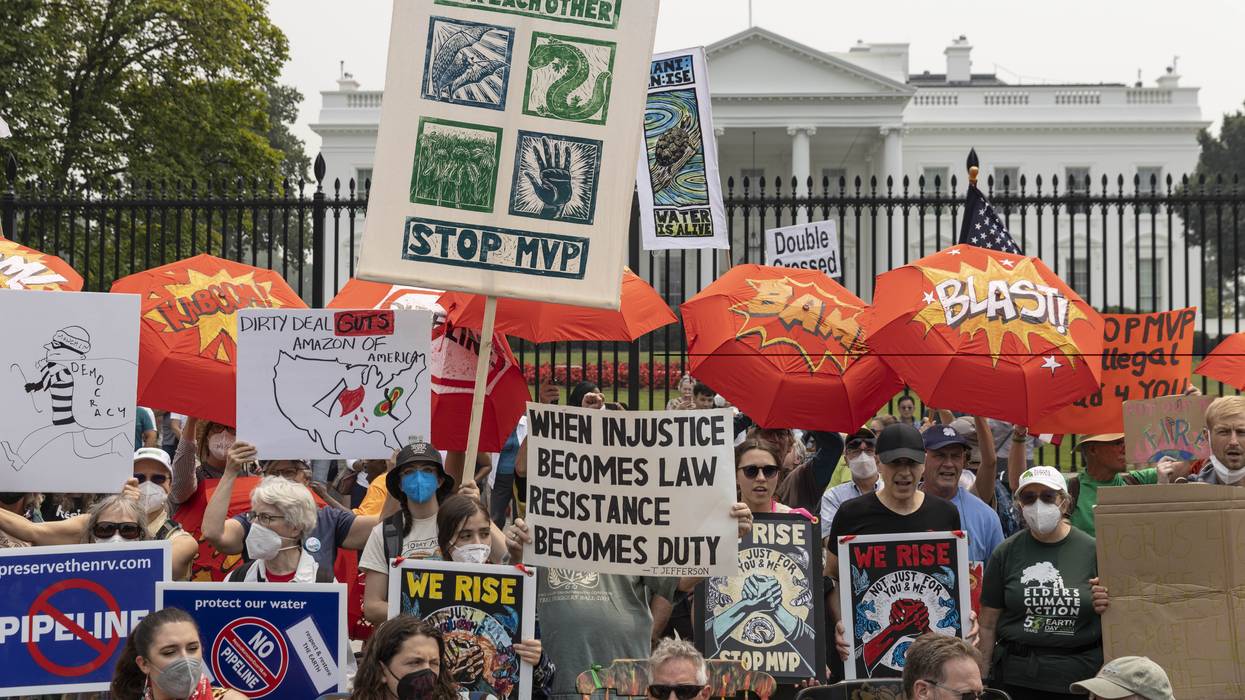
"Allowing this 303-mile disaster to move forward is a slap in the face to the communities who have fought tirelessly over the last decade to protect their land and water."
The Federal Energy Regulatory Commission on Tuesday gave the primary owner of the 303-mile Mountain Valley Pipeline a green light to begin operating the project after years of litigation and local opposition to the costly and destructive fracked gas infrastructure, a top priority of lawmakers bankrolled by the fossil fuel industry.
In a letter to the deputy general counsel of Equitrans, the director of FERC's Office of Energy Projects wrote that the federal agency has concluded that the Mountain Valley Pipeline (MVP) "has adequately stabilized the areas disturbed by construction and that restoration and stabilization of the construction work area is proceeding satisfactorily."
The letter came in response to the pipeline operators' request to allow gas to flow through the system, which runs from northwestern West Virginia to southern Virginia. An Equitrans spokesperson said Tuesday that the company is "pleased" with FERC's decision and that "final preparations are underway to begin commercial operations."
FERC's move drew immediate outrage from environmental groups that have been warning against the pipeline's approval for years, pointing to its projected emissions impact—the equivalent of dozens of new coal-fired power plants—and threat to water supplies and local communities.
"Since developers first proposed the ruinous Mountain Valley Pipeline, their disregard for community and environmental safety has been clear," said Jessica Sims, Virginia field coordinator of Appalachian Voices. "Community members and environmental watchdogs have pointed out the flaws in this project for years, and these fundamental problems with the pipeline remain. By allowing MVP to advance despite all these serious hazards, the system meant to protect our communities, land, and water has failed."
"When a fracked gas pipeline fails testing, literally explodes, fails to meet the safety standards its developers agreed to, what are communities on the ground left with?"
Sierra Club noted in a statement that "it has long been clear that the pipeline is unable to comply with basic environmental protections, with hundreds of water quality-related violations throughout the course of construction." Virginia's Department of Environmental Quality fined MVP's operators earlier this year for 29 separate violations along the pipeline's route through the state.
Last month, a segment of the pipeline in Virginia
ruptured during testing, amplifying opponents' concerns about future gas leaks.
"Allowing this 303-mile disaster to move forward is a slap in the face to the communities who have fought tirelessly over the last decade to protect their land and water," Patrick Grenter, Sierra Club's deputy chief energy officer, said Tuesday. "This pipeline has already marred private property and damaged countless water resources, and the gas it will transport will worsen the climate crisis. We will continue to fight back against the reckless expansion of dangerous, unnecessary fracked gas pipelines."
The decision by FERC—an agency increasingly beloved by Republican lawmakers and the fossil fuel industry—came a year after President Joe Biden signed into law a debt ceiling-related bill that included provisions requiring federal agencies to approve all permits necessary for the completion of the Mountain Valley Pipeline and preempting judicial review of the project.
The MVP-related provisions were inserted by retiring West Virginia Sen. Joe Manchin—who recently switched his party registration to Independent—and other allies of the oil and gas industry.
Dr. Crystal Cavalier-Keck, co-founder and director of 7 Directions of Service, said Tuesday that "this shameful and deadly decision by our establishment leaders and regulatory agencies to put MVP into service only reinforces what we've known all along: They do not care about our safety."
"When a fracked gas pipeline fails testing, literally explodes, fails to meet the safety standards its developers agreed to, what are communities on the ground left with?" Cavalier-Keck asked. "We will continue to demand safety and accountability, while ramping up our efforts to bring down such horrific corruption and instill ethical laws and policies, like the Rights of Nature, to prevent more loss of life and the climate crises from spiraling out of control."
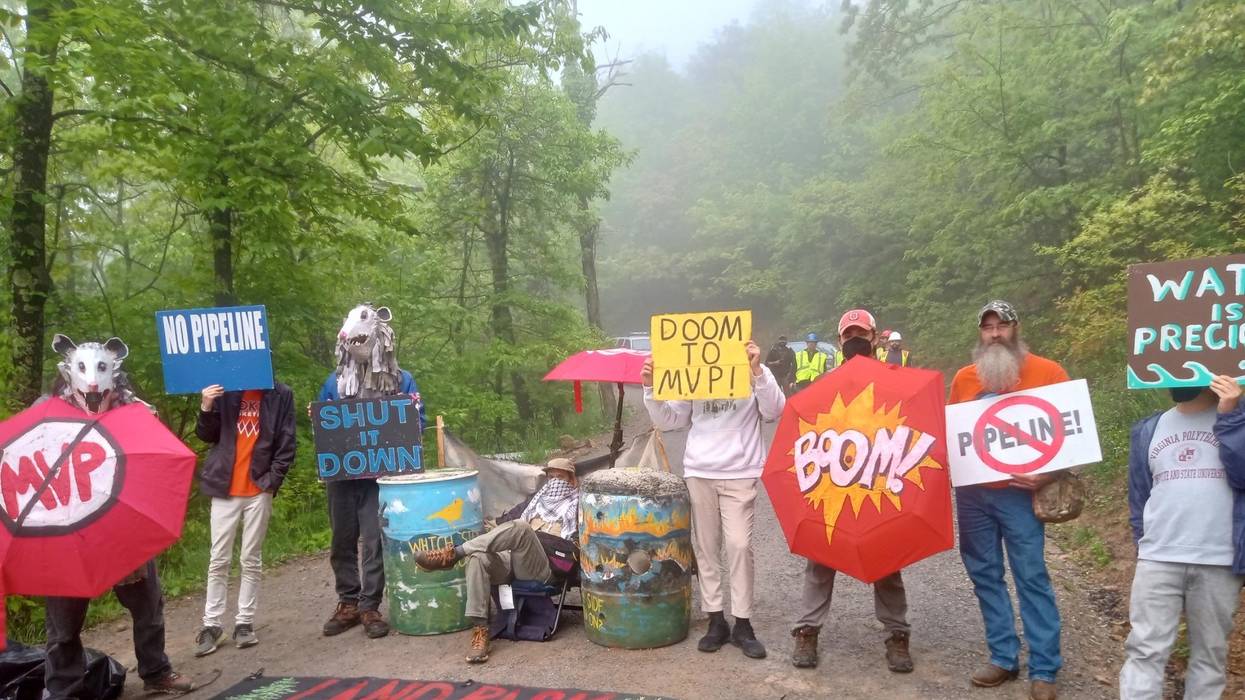
"I see no choice but to rebel against these systems in any small way I can," said a campaigner. "To choose to fight on the side of the mountains, the rivers, the critters, and the people. Against the extraction, empires, and all death-making institutions."
Decrying both the environmental harms and the U.S. fossil fuel industry's support of Israel's assault on Palestinian rights, a pipeline opponent on Thursday morning locked themself to two barrels in the middle of a road on Poor Mountain in Roanoke County, Virginia, blocking access to the Mountain Valley Pipeline easement.
The campaigner, who was supported by other demonstrators in the road, was identified by Appalachians Against Pipelines as Mullein. The protest took place close to where environmental protectors spent more than two and a half years holding the Yellow Finch Tree Sit protest, stopping the destruction of the last remaining trees in the MVP's path.
Mullein said they were driven to block the road by "the interlocking systems of colonization and capitalism," in light of Israel's U.S.-backed assault on Gaza, for which MVP would provide support.
"Today, as I sit in the road on so-called Poor Mountain, it is the day after Nakba Day," said Mullein, referring to the anniversary of more than 700,000 Palestinians' forced displacement when Israel declared statehood. "Today, through this ongoing genocide, Palestinians have been resisting colonization for over 76 years. MVP claims that this pipeline would supply fracked gas to various U.S. military locations including the Pentagon and the Radford Army Ammunition Plant, which is operated by BAE systems, a weapons company supplying weapons to 'Israel' during their genocidal campaign."
"The destruction of land and lifeways is interconnected, from Turtle Island to Palestine," said Mullein, using the Indigenous name for North America. "As a settler here, these systems have disconnected me from land, from others, from myself.
Appalachians Against Pipelines reported that the blockade went on for seven hours. Mullein was arrested and charged with two misdemeanors, with their bail set at $2,000.
The protest comes a week ahead of a deadline for the Federal Energy Regulatory Commission to grant MVP permission to place the pipeline in service, despite a recent citation by the Virginia Department of Environmental Quality for over a dozen violations. The fracked gas pipeline would stretch across at least 300 miles of the Appalachian region, and has been opposed by local and national environmental justice groups.
"I'm sitting locked to two barrels today because I see no choice but to rebel against these systems in any small way I can," said Mullein. "To choose to fight on the side of the mountains, the rivers, the critters, and the people. Against the extraction, empires, and all death-making institutions. Which side are you on?"
Experts celebrated the "critical step to ensuring our electric grid has the capacity and durability necessary to keep up with our clean energy ambition, meet climate goals, and guarantee affordable and equitable energy access for all."
Green groups on Monday praised U.S. regulators for finalizing rules that supporters say "will help accelerate the transition to a clean and equitable electric system by working to build more transmission capacity."
The two Democrats on the Federal Energy Regulatory Commission approved new transmission planning requirements. They and the sole GOP commissioner also advanced an order empowering FERC to greenlight permits for projects rejected or ignored by states.
"The new rules require utilities and regional grid operators to adopt 20-year plans that consider trends in technology and fuel costs, changes to resource mix and demand, more opportunities for state and utility collaboration, and extreme weather events, among other variables calculated by the 'best available data,'" the Union of Concerned Scientists (UCS) explained. The assessments must be revised every five years.
Sam Gomberg, the manager of transmission policy and a senior energy analyst at UCS, called the rules "a critical step to ensuring our electric grid has the capacity and durability necessary to keep up with our clean energy ambition, meet climate goals, and guarantee affordable and equitable energy access for all."
"I am pleased that FERC will require transmission planners to account for seven broadly recognized benefits of expanding transmission when determining whether to make investments," he said. "This, combined with FERC's inclusion of state-approved plans for utilities' changes in generation, moves the country to more just and reasonable planning standards."
Gomberg was far from alone in cheering the policy changes. Christine Powell, deputy managing attorney at Earthjustice and former commission adviser, said that "we applaud FERC for meeting the moment" and "look forward to engaging with FERC to center equity and environmental justice in transmission planning."
Cullen Howe, senior advocate with the Natural Resources Defense Council (NRDC) Sustainable FERC Project, stressed that "we urgently need every grid operator to determine where and what transmission lines to build. This rule brings everyone to the starting line for scaling up the clean energy transition."
"With climate-fueled disasters posing ever-greater challenges to the grid, this rule will help shape a power grid that optimizes the capabilities of clean energy while prioritizing reliability and affordability," Howe said. "In addition, FERC's backstop siting rule will help ensure that no one state can veto transmission lines that are in the general interest of the nation."
Quentin Scott, federal director for Chesapeake Climate Action Network, declared that "this announcement is a major leap forward to ease the bottlenecks that have slowed the clean energy revolution. These new federal rules will unleash the nearly 2000 gigawatts of clean energy in the transmission queue, putting us back on the pathway for 100% clean energy by 2035."
"When I talk with clean energy developers, their biggest challenge is certainty. The certainty of where they can build their projects, the certainty of how much their project will cost, and the certainty of their ability to connect to the grid. These latest FERC rules will provide that certainty," Scott added. He also urged Congress to "provide the financial incentives to expand transmission capacity."
"This rule will help shape a power grid that optimizes the capabilities of clean energy while prioritizing reliability and affordability."
Congress has already taken some action, as Sierra Club executive director Ben Jealous highlighted, pointing to the Inflation Reduction Act (IRA) signed by President Joe Biden in 2022. He said as that law "continues to usher in the clean energy future through deployment of solar, wind, and battery storage, this transmission standard will allow utilities to deliver Americans clean, affordable electricity, even in the face of rising demand and extreme weather caused by climate change."
Senate Majority Leader Chuck Schumer (D-N.Y.) and other top Democrats joined advocacy organizations in lauding the rules, enacted as global temperatures continue to soar, underscoring the need to transition away from planet-heating fossil fuels.
"The clean energy incentives included in the Inflation Reduction Act have been a huge success but much of that success would be lost without the ability to bring power from places that generate renewable energy to communities all across the country," said Schumer. "A new historic advancement in our transmission policies is desperately needed, and the rules released by FERC today will go a long way to solving that problem."
"Last year, I pushed FERC to deliver a historic advancement in transmission policies that will lower costs and improve reliability by getting clean energy from where it is produced to where people live," he continued. "This is exactly what we need to see the clean energy revolution we catalyzed with the Inflation Reduction Act come to fruition. FERC's actions will help to fundamentally improve our power grid in the wake of the IRA."
The Senate leader and green groups welcomed the rules, but "the commission's sole Republican member, former Virginia regulator Mark Christie, was not so effusive," noted Heatmap's Matthew Zeitlin. "He issued a harsh dissent to his colleagues' decision, likely previewing a judicial challenge from Republican-governed states."
"While the commission's chair, former District of Columbia Public Service Commissioner Willie Phillips, and its other member, NRDC alum Allison Clements, both Democrats, largely spoke about the rule in terms of reliability and reforming the planning process," Zeitlin reported, "Christie made it seem like a climate change policy in disguise that would function as a 'transfer of wealth' to wind, solar, and transmission developers."
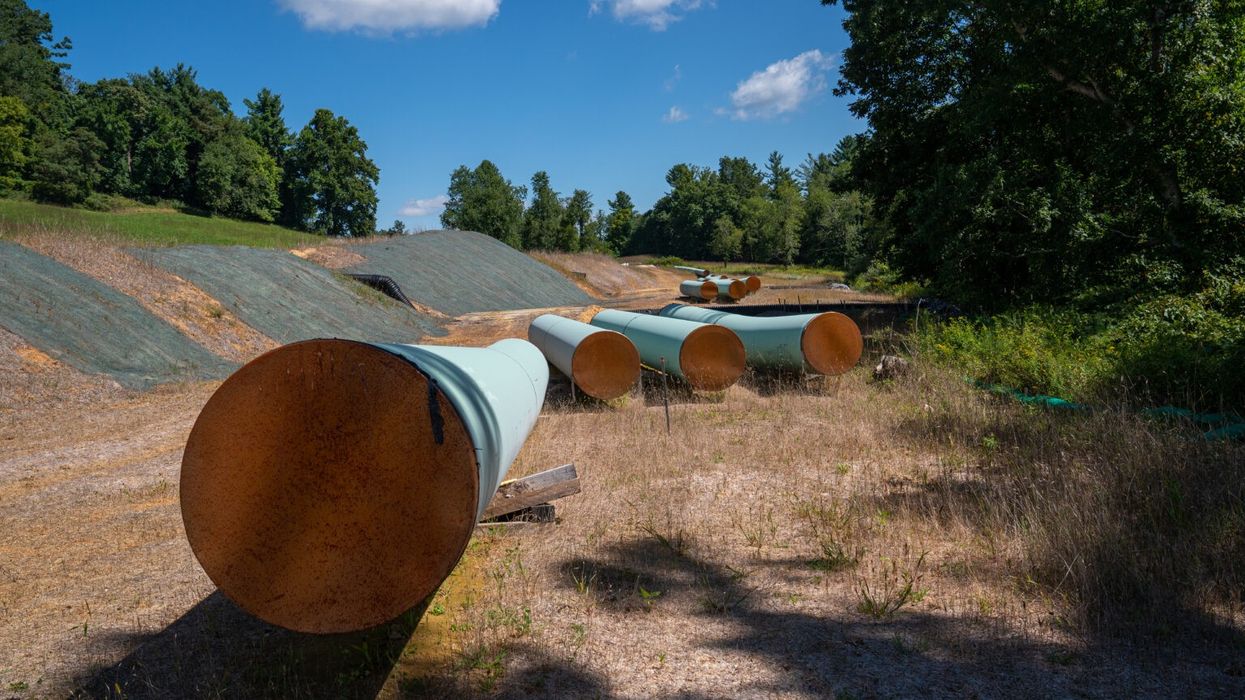
"The time to build more dirty and dangerous pipelines is over," said one environmental campaigner.
Environmental defenders on Tuesday ripped the company behind the Mountain Valley Pipeline for asking the federal government—on Earth Day—for permission to start sending methane gas through the 303-mile conduit despite a worsening climate emergency caused largely by burning fossil fuels.
Mountain Valley Pipeline LLC sent a letter Monday to Federal Energy Regulatory Commission (FERC) Acting Secretary Debbie-Anne Reese seeking final permission to begin operation on the MVP next month, even while acknowledging that much of the Virginia portion of the pipeline route remains unfinished and developers have yet to fully comply with safety requirements.
"In a manner typical of its ongoing disrespect for the environment, Mountain Valley Pipeline marked Earth Day by asking FERC for authorization to place its dangerous, unnecessary pipeline into service in late May," said Jessica Sims, the Virginia field coordinator for Appalachian Voices.
"MVP brazenly asks for this authorization while simultaneously notifying FERC that the company has completed less than two-thirds of the project to final restoration and with the mere promise that it will notify the commission when it fully complies with the requirements of a consent decree it entered into with the Pipeline and Hazardous Materials Safety Administration last fall," she continued.
"Requesting an in-service decision by May 23 leaves the company very little time to implement the safety measures required by its agreement with PHMSA," Sims added. "There is no rush, other than to satisfy MVP's capacity customers' contracts—a situation of the company's own making. We remain deeply concerned about the construction methods and the safety of communities along the route of MVP."
Russell Chisholm, co-director of the Protect Our Water, Heritage, Rights (POWHR) Coalition—which called MVP's request "reckless and impossible"—said in a statement that "we are watching our worst nightmare unfold in real-time: The reckless MVP is barreling towards completion."
"During construction, MVP has contaminated our water sources, destroyed our streams, and split the earth beneath our homes. Now they want to run methane gas through their degraded pipes and shoddy work," Chisholm added. "The MVP is a glaring human rights violation that is indicative of the widespread failures of our government to act on the climate crisis in service of the fossil fuel industry."
POWHR and activists representing frontline communities affected by the pipeline are set to take part in a May 8 demonstration outside project financier Bank of America's headquarters in Charlotte, North Carolina.
Appalachian Voices noted that MVP's request comes days before pipeline developer Equitrans Midstream is set to release its 2024 first-quarter earnings information on April 30.
MVP is set to traverse much of Virginia and West Virginia, with the Southgate extension running into North Carolina. Outgoing U.S. Sen. Joe Manchin (D-W.Va.) and other pipeline proponents fought to include expedited construction of the project in the debt ceiling deal negotiated between President Joe Biden and congressional Republicans last year.
On Monday, climate and environmental defenders also petitioned the U.S. Court of Appeals for the D.C. Circuit, challenging FERC's approval of the MVP's planned Southgate extension, contending that the project is so different from original plans that the government's previous assent is now irrelevant.
"Federal, state, and local elected officials have spoken out against this unneeded proposal to ship more methane gas into North Carolina," said Sierra Club senior field organizer Caroline Hansley. "The time to build more dirty and dangerous pipelines is over. After MVP Southgate requested a time extension for a project that it no longer plans to construct, it should be sent back to the drawing board for this newly proposed project."
David Sligh, conservation director at Wild Virginia, said: "Approving the Southgate project is irresponsible. This project will pose the same kinds of threats of damage to the environment and the people along its path as we have seen caused by the Mountain Valley Pipeline during the last six years."
"FERC has again failed to protect the public interest, instead favoring a profit-making corporation," Sligh added.
Others renewed warnings about the dangers MVP poses to wildlife.
"The endangered bats, fish, mussels, and plants in this boondoggle's path of destruction deserve to be protected from killing and habitat destruction by a project that never received proper approvals in the first place," Center for Biological Diversity attorney Perrin de Jong said. "Our organization will continue fighting this terrible idea to the bitter end."

"This move is intended to make sure policymakers continue to make bad bets on carbon capture ever working," said one critic.
CarbonCapture Inc. on Wednesday announced the appointment of Neil Chatterjee to its board of directors—sparking fresh criticism of technology to capture and store carbon dioxide, the former U.S. regulator, and the revolving door between government and industry.
Chatterjee was appointed to the Federal Energy Regulatory Commission in 2017 by then-President Donald Trump, now the presumptive Republican presidential nominee. Chatterjee served as FERC's chair twice before his term expired in 2021. Prior to joining the commission, he advised U.S. Senate Minority Leader Mitch McConnell (R-Ky.) on energy.
"After greenlighting oil and gas expansion at FERC, Chatterjee is now capitalizing off of attempts to undo those harms," Hannah Story Brown, a senior researcher in climate and governance at the Revolving Door Project, told Common Dreams. "It would have been far less costly to the public interest and the public purse if Chatterjee had helped stanch the flow of carbon pollution into our atmosphere when he was in the position to."
"After greenlighting oil and gas expansion at FERC, Chatterjee is now capitalizing off of attempts to undo those harms."
Food & Water Watch policy director Jim Walsh said that "the so-called 'carbon capture' industry relies on billions of dollars in giveaways from the federal government, so it should not be a surprise that a company like this would add a Beltway insider to its board of directors."
CarbonCapture Inc.'s statement on Chatterjee celebrates his "deep ties in Washington and across the industry," saying that "in his time on Capitol Hill and at FERC, he established a reputation as a bipartisan operator who built alliances and cut through red tape."
The company's CEO, Adrian Corless, said that Chatterjee's "deep understanding of the energy landscape in the U.S. and abroad will be incredibly important as we source large amounts of clean energy in the face of grid expansion challenges and bottlenecks."
The firm builds "deeply modular" direct air capture (DAC) machines, which "use solid sorbents that soak up atmospheric CO2 when cooled and release concentrated CO2 when heated," as its website details. "The captured CO2 can then be permanently stored underground or used to make synthetic fuels, low-carbon concrete, carbon black, or other industrial products that require clean CO2."
Stressing the need to "decarbonize the atmosphere as quickly as possible," Chatterjee said Wednesday that "CarbonCapture's groundbreaking, modular direct air capture machines have put our country on the fast track to scale a proven solution at the speed and cost necessary to make a meaningful impact."
Food & Water Watch agrees that the warming world requires swift and sweeping action on planet-heating pollution. Along with advocating for a rapid and just global phaseout of fossil fuels, the group prioritizes "calling foul on fake solutions" to the climate emergency.
"The fossil fuel industries are eager to tout carbon waste sequestration and direct air capture because they bolster the dominance of dirty energy sources like oil and gas," Walsh told Common Dreams. "This is why they are called 'false solutions'—they delay the necessary actions to get off fossil fuels."
Citing an International Energy Agency analyst in an article about the "major hurdles" that remain as DAC ramps up, Yale Environment 360 reported last week that "about three-quarters of all globally captured CO2 (which comes mainly from industrial flue stacks) is currently being used for enhanced oil recovery," which involves injecting CO2 into wells to bury it and extract more oil.
As a pair of Walsh's colleagues detailed for Food & Water Watch's website last year, other issues with DAC include the technology's high energy needs, toxic solvents, and risky storage options.
"Carbon capture has a long history of failure in the real world, but these companies have had great success in securing billions in government handouts."
"Carbon capture has a long history of failure in the real world, but these companies have had great success in securing billions in government handouts," Walsh said. In terms of Chatterjee's appointment, he added that "this move is intended to make sure policymakers continue to make bad bets on carbon capture ever working."
As Story Brown pointed out, "Neil Chatterjee's prototypical spin of the revolving door, moving from pro-industry regulator to regulated industry, comes with added irony."
"As a regulator, he positioned himself as preferring market-based 'solutions' over government mandates, subsidies, and regulations," she explained. "But all that skepticism apparently vanished when he joined the carbon capture business, whose only hope of profitability comes from government subsidies like those in the Inflation Reduction Act."
Corless was among those who welcomed what Time called a "bonanza for the carbon capture industry" in the 2022 legislation. Shortly before President Joe Biden signed the bill, the CEO said that "it's going to make it easy for us to raise the capital to build the project earlier and to build it faster."
However, it's not just the government that is bankrolling CarbonCapture Inc. and similar ventures, as Story Brown noted.
"Neil Chatterjee hasn't left the lure of market magic behind," she said. "His firm has pre-sold millions in carbon removal credits so that energy-guzzling firms from Amazon to Aramco can greenwash their operations."
"David Rosner was a paid cheerleader for the LNG boom before it was fashionable," said Friends of the Earth campaigner Lukas Ross.
The environmental group Friends of the Earth on Wednesday called on U.S. senators to oppose one of President Joe Biden's regulatory nominees, citing his "disturbing pattern of dirty energy advocacy."
Last month, Biden nominated West Virginia Solicitor-General Lindsay See, energy economics and policy expert Judy Chang, and Federal Energy Regulatory Commission analyst David Rosner to serve on FERC's five-member executive body. Chang and Rosner are Democrats. See is a Republican, as there can be no more than three commissioners from the same party.
Friends of the Earth (FOE)—which will publish an online ad urging senators to reject Rosner—noted that the nominee is a former staffer for Sen. Joe Manchin (D-W.Va.), one of the most fossil fuel-friendly members of Congress, and that he previously worked at the Bipartisan Policy Center (BPC), "where he sided with industry over consumers and the climate on multiple energy issues. BPC
funders include BP, Chevron, Conoco, and Shell."
"David Rosner was a paid cheerleader for the LNG boom before it was fashionable," said Lukas Ross, FOE's deputy climate and energy director, referring to the nominee's support for liquefied natural gas exports. "We're calling on Democrats not named Manchin to reject this nomination."
Noting the senator's decision to not seek reelection this year, Ross added that "letting Joe Manchin control FERC from beyond his political grave should be a nonstarter for every other Democrat in the caucus."
The Senate Energy and Natural Resources Committee is set to hold a heading for the FERC nominees on Thursday morning. Manchin, who chairs the committee, backs Rosner. Sen. John Barrasso (R-Wyo.), the ranking member on the committee, has voiced support for See, while praising Rosner, who "has worked constructively with my staff."
If See and Rosner are confirmed as commissioners, FERC would have a pro-fossil fuel majority. Democratic Chair Willie Phillips has led a wave of fossil fuel project approvals, while Republican Commissioner Mark Christie is a reliable booster for oil, gas, and coal.
Progressive lawmakers and environmental campaigners have been increasingly critical of FERC, with Sen. Jeff Merkley (D-Ore.) calling it a "completely captured agency."
"The commission is captured by the fossil fuel industry. There is no other explanation for how FERC could approve over 99% of the fossil fuel projects it reviews in the face of climate catastrophe," Merkley said after the body greenlighted TC Energy's proposed expansion of methane gas infrastructure in the Pacific Northwest. "FERC needs fundamental reform."
Roishetta Ozane, founder of Louisiana environmental justice group Vessel Project, wrote in an opinion piece published Wednesday by Common Dreams that "as we transition to a future without fossil fuels, it's clear that major change is needed at FERC."
"While the new commissioners at FERC go through the confirmation process, they must show they are dedicated to more than just the basic criteria of the job," Ozane added. "We hope to see the commissioners eager to pave a new path forward by prioritizing justice: environmental justice and climate justice."

One campaigner called out legislators for "acting quickly to protect a few big polluting industries while continuing to disregard the health, energy, and environment needs of entire families and neighborhoods."
Nine Democrats joined with all present Republicans in the U.S. House of Representatives on Thursday to pass a bill intended to reverse President Joe Biden's recent halt on approvals for all liquefied natural gas exports to non-fair trade agreement countries.
Democratic Reps. Yadira Caraveo (Colo.), Jim Costa (Calif.), Henry Cuellar (Texas), Jared Golden (Maine), Vincente Gonzalez (Texas), Rick Larsen (Wash.), Mary Peltola (Alaska), Marie Gluesenkamp Perez (Wash.), and Marc Veasey (Texas) helped the House GOP pass the Unlocking Our Domestic LNG Potential Act in a 224-200 vote.
Federal law requires the U.S. Department of Energy to authorize LNG exports to countries with which the United States does not have a free trade agreement. H.R. 7176, sponsored by GOP Rep. August Pfluger (Texas), would eliminate that requirement and give the Federal Energy Regulatory Commission (FERC) authority over LNG import and export decisions.
"Gas exports fuel the climate emergency, sacrifice Gulf communities and wildlife, and increase energy costs at home."
While Republican legislators and industry representatives celebrated the vote, H.R. 7176 isn't expected to be taken up in the Democrat-controlled Senate—and even then, it could be vetoed by the president, who made clear in a Tuesday statement that he strongly opposes the legislation.
Frontline and climate advocates who had welcomed the pause announcement last month still sounded the alarm about the bill's passage—an example of what could happen if Republicans gain more seats in Congress and control of the White House in November, when Biden is expected to face former GOP President Donald Trump.
"This vote shows House Republicans are as willing as ever to sacrifice our future in favor of the fossil fuel industry's bare greed," said Camden Weber, a policy specialist at the Center for Biological Diversity. "Gas exports fuel the climate emergency, sacrifice Gulf communities and wildlife, and increase energy costs at home. We should continue to pause LNG exports, and the Biden administration should use this time to develop a robust public interest test for all dangerous fossil fuel projects."
Elida Castillo, program director of Chispa Texas, part of the League of Conservation Voters, declared that "H.R. 7176 is terrible for many local communities already impacted by out-of-control LNG expansion all along our Texas Gulf coastline."
"Today's House vote represents some elected officials acting quickly to protect a few big polluting industries while continuing to disregard the health, energy, and environment needs of entire families and neighborhoods, often their own constituents," Castillo argued. "The impact of LNG facilities on local communities should be taken seriously, and our federal government has a responsibility to examine the impacts of LNG expansion on our environment and communities.
"Instead, this bill makes it irresponsibly easy for LNG exporters to build, extract, pollute, and then export," she stressed. "The Biden administration's pause on new LNG facilities should continue."
In addition to calling out those who voted for H.R. 7176, campaigners are applauding the Democrats who opposed it, with Fossil Free Media's Jamie Henn saying that "this is the type of fearless leadership we need!"
The House vote came as FERC greenlighted construction of the Saguaro Connector Pipeline, which would transport gas from Texas' Permian Basin to a planned LNG export facility on Mexico's coast.
"The commission's decision ignores the harm record methane gas exports have on raising Americans' energy bills and exacerbating climate change, all to prioritize feeding more gas to China," said Tyson Slocum, director of Public Citizen's Energy Program.
"The Saguaro export pipeline's only purpose is to bypass the log-jammed Panama Canal to send U.S. produced gas to planned LNG export terminals on Mexico's Pacific Coast," he added. "Public Citizen, as a legal intervenor in the FERC proceeding, will ask for rehearing of today's flawed FERC order."