

SUBSCRIBE TO OUR FREE NEWSLETTER
Daily news & progressive opinion—funded by the people, not the corporations—delivered straight to your inbox.
5
#000000
#FFFFFF
To donate by check, phone, or other method, see our More Ways to Give page.
Daily news & progressive opinion—funded by the people, not the corporations—delivered straight to your inbox.
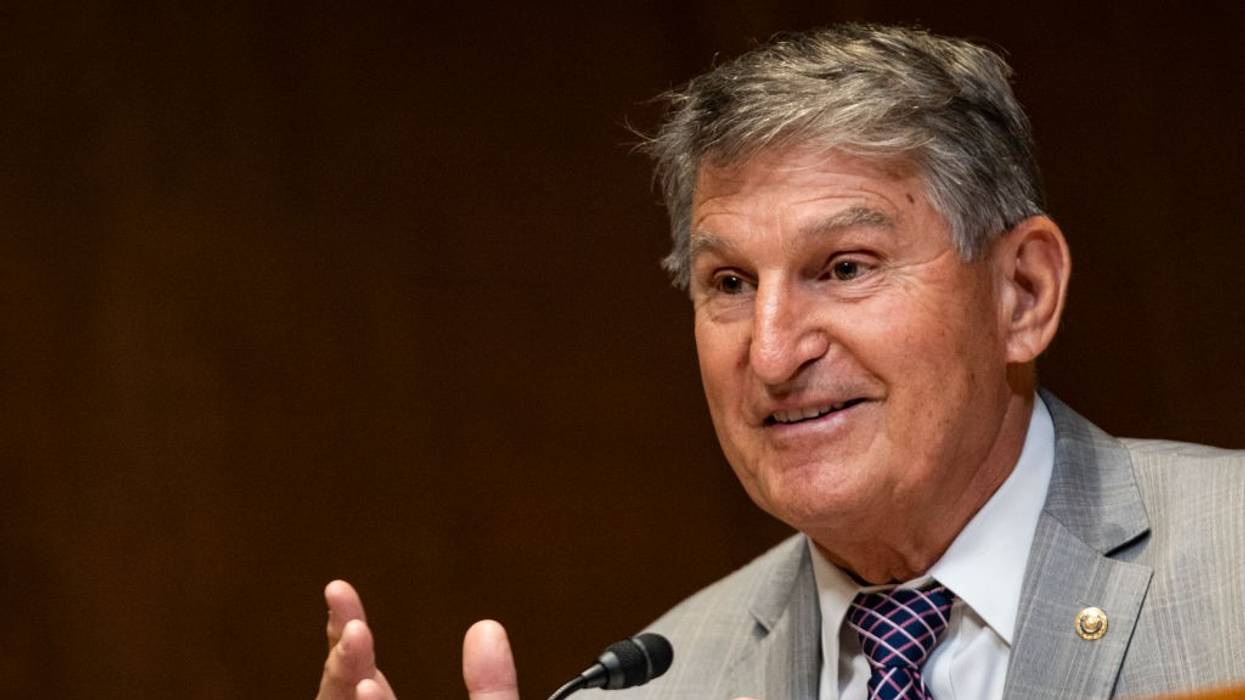
One campaigner called the Energy Permitting Reform Act "a shameless attempt by Sen. Joe Manchin to line the pockets of his fossil fuel donors, sacrifice communities, and endanger our climate."
A bipartisan energy permitting reform bill introduced last week in the U.S. Senate—and described by one campaigner as "the biggest giveaway in decades to the fossil fuel industry"—advanced Wednesday in a key vote that came over the objections of hundreds of green groups.
The Senate Energy and Natural Resources Committee passed the Energy Permitting Reform Act of 2024 in a 15-4 vote. Sens. Josh Hawley (R-Mo.), Mazie Hirono (D-Hawaii.), Bernie Sanders (I-Vt.), and Ron Wyden (D-Ore.) voted against advancing the bill.
The bill's co-sponsors, Sens. Joe Manchin (I-W.Va.) and John Barrasso (R-Wyo.), claim the proposal will "strengthen American energy security by accelerating the permitting process for critical energy and mineral projects of all types in the United States."
Critical lawmakers and climate campaigners warn that "this proposal includes a litany of fossil fuel giveaways, undermining potential climate benefits that might be attained by bringing renewable energy sources to the grid more quickly," as Tyson Slocum, director of Public Citizen's Energy Program, said in a statement Wednesday.
Echoing warnings from last week, Slocum stressed that the bill "is nothing short of the first steps to implement the radical corporate giveaway agenda espoused in 'Project 2025,'" a sweeping far-right initiative led by the Heritage Foundation.
"That agenda essentially calls for automatic approvals of liquefied natural gas (LNG) exports regardless of the impact on climate change, frontline communities suffering with environmental and health problems, and on prices for American families," he said. "The bill would also make it harder to build renewable energy on public lands, while making it easier to drill for oil and gas and to dump mining waste."
"Some Democrats who voted for the bill claim 'this is the best deal we can get,'" Slocum noted. "That is false. This legislation will only get worse if it advances to the floor and then heads to the GOP House. We call on Senate leadership to stop this misguided legislation."
Public Citizen was among the over 360 groups that sent a letter to senators on Tuesday urging them "to reject this proposal and instead, put forward real solutions to build a clean energy economy, and not pair those reforms with giveaways to the fossil fuel industry."
The letter has sections on LNG exports, the fossil fuel industry, federal mining law, and judicial review, emphasizing that the bill "guts bedrock environmental protections, endangers public health, opens up tens of millions of acres of public lands and hundreds of millions of acres of offshore waters to further oil and gas leasing, gives public lands to mining companies, and would defacto rubberstamp gas export projects that harm frontline communities and perpetuate the climate crisis."
Wyden was similarly critical in his comments to the committee on Wednesday. He acknowledged that the bill contains "useful provisions," specifically endorsing the transmission language, the encouragement of geothermal energy development, and the creation of the hardrock mining cleanup fund.
"If the bill contained these provisions alone, I'd give my support and recommend a parade down Main Street," Wyden said. "The big problem is the improvements in law I've just described are held hostage in this legislation to the outdated fossil fuel status quo that existed before our reforms of 2022 were enacted."
Two years ago, Biden signed the Inflation Reduction Act—a watered-down but still historic climate package that only got through Congress because Manchin, then a Democrat, had a backroom deal with Senate Majority Leader Chuck Schumer (D-N.Y.) to vote for it in exchange for passing permitting reforms.
Since then, climate-conscious campaigners and lawmakers have repeatedly blocked related proposals from Manchin, a longtime fossil fuel industry ally who leads the panel that voted Wednesday and is set to retire when this congressional session ends.
"The Senate Energy & Natural Resources Committee should be ashamed that it voted to advance the Energy Permitting Reform Act, a blatant, dirty deal to fast-track fossil fuels at any cost," declared Allie Rosenbluth, United States program manager at Oil Change International. "This outrageous bill would unleash more oil and gas drilling on federal lands and waters and recklessly rush the review of proposed LNG export projects equivalent to the greenhouse gas pollution of 165 new coal plants."
Rosenbluth highlighted that "the International Energy Agency and scientists worldwide have made it clear: No new fossil fuel project is compatible with a livable future. The United States, already the world leader in oil and gas production and expansion, is failing miserably to meet its climate commitments."
"We thank Sens. Ron Wyden, Bernie Sanders, and Mazie Hirono for voting 'no' and voicing their strong opposition to the fossil fuel giveaways in this bill," she added. "This bill is a shameless attempt by Sen. Joe Manchin to line the pockets of his fossil fuel donors, sacrifice communities, and endanger our climate. We demand the Senate reject this disastrous proposal and commit to real action to protect frontline communities from the devastating impacts of fossil fuel development and the ongoing climate crisis."
Experts celebrated the "critical step to ensuring our electric grid has the capacity and durability necessary to keep up with our clean energy ambition, meet climate goals, and guarantee affordable and equitable energy access for all."
Green groups on Monday praised U.S. regulators for finalizing rules that supporters say "will help accelerate the transition to a clean and equitable electric system by working to build more transmission capacity."
The two Democrats on the Federal Energy Regulatory Commission approved new transmission planning requirements. They and the sole GOP commissioner also advanced an order empowering FERC to greenlight permits for projects rejected or ignored by states.
"The new rules require utilities and regional grid operators to adopt 20-year plans that consider trends in technology and fuel costs, changes to resource mix and demand, more opportunities for state and utility collaboration, and extreme weather events, among other variables calculated by the 'best available data,'" the Union of Concerned Scientists (UCS) explained. The assessments must be revised every five years.
Sam Gomberg, the manager of transmission policy and a senior energy analyst at UCS, called the rules "a critical step to ensuring our electric grid has the capacity and durability necessary to keep up with our clean energy ambition, meet climate goals, and guarantee affordable and equitable energy access for all."
"I am pleased that FERC will require transmission planners to account for seven broadly recognized benefits of expanding transmission when determining whether to make investments," he said. "This, combined with FERC's inclusion of state-approved plans for utilities' changes in generation, moves the country to more just and reasonable planning standards."
Gomberg was far from alone in cheering the policy changes. Christine Powell, deputy managing attorney at Earthjustice and former commission adviser, said that "we applaud FERC for meeting the moment" and "look forward to engaging with FERC to center equity and environmental justice in transmission planning."
Cullen Howe, senior advocate with the Natural Resources Defense Council (NRDC) Sustainable FERC Project, stressed that "we urgently need every grid operator to determine where and what transmission lines to build. This rule brings everyone to the starting line for scaling up the clean energy transition."
"With climate-fueled disasters posing ever-greater challenges to the grid, this rule will help shape a power grid that optimizes the capabilities of clean energy while prioritizing reliability and affordability," Howe said. "In addition, FERC's backstop siting rule will help ensure that no one state can veto transmission lines that are in the general interest of the nation."
Quentin Scott, federal director for Chesapeake Climate Action Network, declared that "this announcement is a major leap forward to ease the bottlenecks that have slowed the clean energy revolution. These new federal rules will unleash the nearly 2000 gigawatts of clean energy in the transmission queue, putting us back on the pathway for 100% clean energy by 2035."
"When I talk with clean energy developers, their biggest challenge is certainty. The certainty of where they can build their projects, the certainty of how much their project will cost, and the certainty of their ability to connect to the grid. These latest FERC rules will provide that certainty," Scott added. He also urged Congress to "provide the financial incentives to expand transmission capacity."
"This rule will help shape a power grid that optimizes the capabilities of clean energy while prioritizing reliability and affordability."
Congress has already taken some action, as Sierra Club executive director Ben Jealous highlighted, pointing to the Inflation Reduction Act (IRA) signed by President Joe Biden in 2022. He said as that law "continues to usher in the clean energy future through deployment of solar, wind, and battery storage, this transmission standard will allow utilities to deliver Americans clean, affordable electricity, even in the face of rising demand and extreme weather caused by climate change."
Senate Majority Leader Chuck Schumer (D-N.Y.) and other top Democrats joined advocacy organizations in lauding the rules, enacted as global temperatures continue to soar, underscoring the need to transition away from planet-heating fossil fuels.
"The clean energy incentives included in the Inflation Reduction Act have been a huge success but much of that success would be lost without the ability to bring power from places that generate renewable energy to communities all across the country," said Schumer. "A new historic advancement in our transmission policies is desperately needed, and the rules released by FERC today will go a long way to solving that problem."
"Last year, I pushed FERC to deliver a historic advancement in transmission policies that will lower costs and improve reliability by getting clean energy from where it is produced to where people live," he continued. "This is exactly what we need to see the clean energy revolution we catalyzed with the Inflation Reduction Act come to fruition. FERC's actions will help to fundamentally improve our power grid in the wake of the IRA."
The Senate leader and green groups welcomed the rules, but "the commission's sole Republican member, former Virginia regulator Mark Christie, was not so effusive," noted Heatmap's Matthew Zeitlin. "He issued a harsh dissent to his colleagues' decision, likely previewing a judicial challenge from Republican-governed states."
"While the commission's chair, former District of Columbia Public Service Commissioner Willie Phillips, and its other member, NRDC alum Allison Clements, both Democrats, largely spoke about the rule in terms of reliability and reforming the planning process," Zeitlin reported, "Christie made it seem like a climate change policy in disguise that would function as a 'transfer of wealth' to wind, solar, and transmission developers."
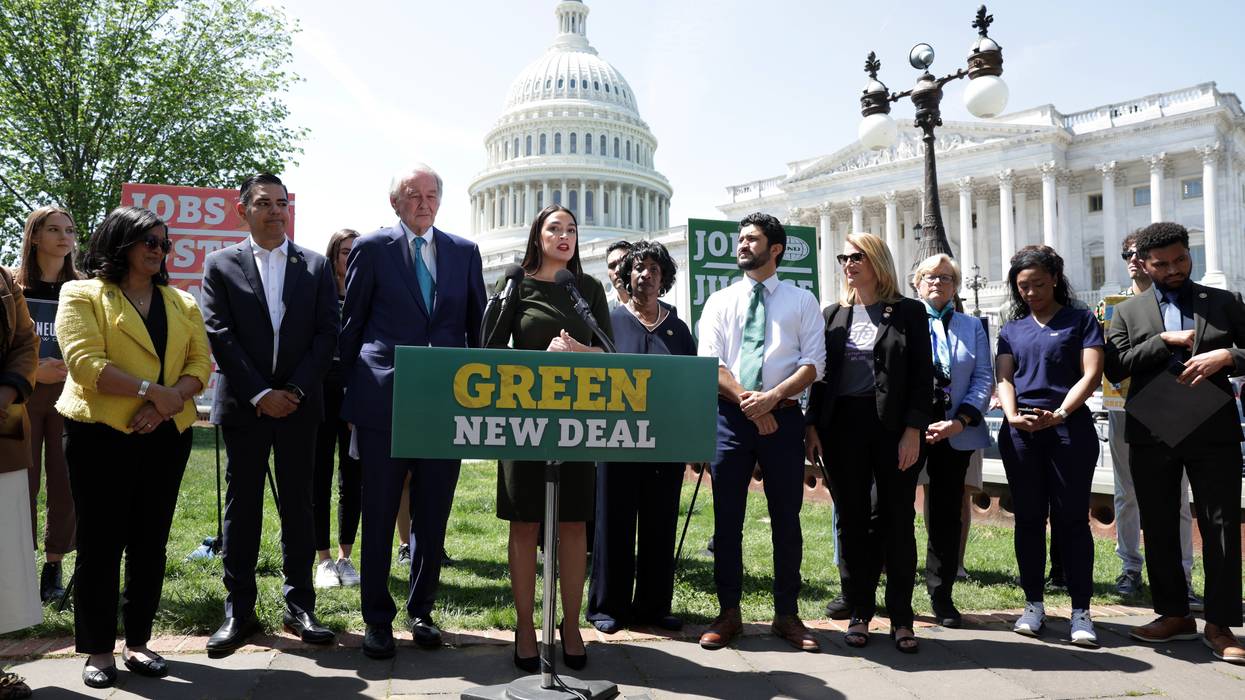
"To run on green energy, we have to build green infrastructure," said Sen. Ed Markey. "The clean energy revolution is here—but we need a 21st-century electric grid to support it."
U.S. Reps. Alexandria Ocasio-Cortez and Greg Casar joined Sen. Ed Markey on Thursday to reintroduce legislation that aims to "lay the groundwork for America's clean energy revolution by advancing critical electric infrastructure to strengthen reliability and lower costs for consumers."
Previously put forward by Markey (D-Mass.) last year, the Connecting Hard-to-Reach Areas With Renewably Generated Energy (CHARGE) Act would mandate reforms through the Federal Energy Regulatory Commission (FERC) to accelerate the energy transition by supporting the development of transmission networks.
The bill comes amid fierce debates over permitting reforms—with Republicans and right-wing Democrats trying to gut federal environmental protections and serve fossil fuel giants while claiming that their proposals will boost clean energy. It also comes as much of the Northern Hemisphere endures soaring temperatures, one consequence of humanity continuing to heat up the planet.
"For the United States to run on green energy, we first need to build green infrastructure," said Markey, who co-chairs the Senate Climate Change Task Force and has long led the fight for Green New Deal legislation with Ocasio-Cortez (D-N.Y.). "Right now, the United States relies on two-lane roads for our electricity traffic when we need a renewable energy superhighway."
"The CHARGE Act lays the groundwork for an energy grid that can support an explosion of electric-powered vehicles and buildings, while also improving energy reliability, lowering costs for consumers, and spurring economic competition," Markey explained. "My legislation will supply America with the tools and guidance needed to turn the clean energy revolution up a notch, accelerating our shift to true energy independence that breaks our nation's reliance on foreign oil from countries like Russia."
As a statement from Markey's office detailed, the bill would:
Ocasio-Cortez highlighted that "our patchwork transmission system is blocking billions of dollars in new renewable deployment," and it is "also increasingly vulnerable to widespread power outages in nearly every part of the country."
The combination of power outages and extreme temperatures can be deadly. British meteorologist Laura Tobin said during a Wednesday broadcast that Phoenix, Arizona has had a record-breaking 19 consecutive days of temperatures hitting at least 110°F and "is one of the first cities in the world to become uninhabitable unless they have air conditioning."
As the Phoenix-based KJZZ noted Wednesday, a study published in May in the journal Environmental Science & Technology found that if an extended blackout cut off AC for everyone in the city of about 1.6 million people during a heatwave, almost half of them would need emergency care and nearly 13,000 would die.
"In hot cities, air conditioning is a critical lifeline in the summer," study co-author David Hondula, director of Phoenix's Office of Heat Response and Mitigation, told the radio station. He also stressed that an event like the study warns of is unlikely—as he put it, "We're talking about slivers of a fraction of a percent of possibility."
Still, the dangers of the current high temperatures in many places have fueled fresh calls for climate action—including and especially rapidly switching from fossil fuels to renewable energy.
"As the climate crisis worsens, we must do everything we can to increase grid reliability across the country. That's why we must pass the CHARGE Act," said Casar (D-Texas). "Every single family should be able to rely on their utilities."
Groups backing the measure—including the Center for Biological Diversity, Clean Energy Grid Action (CEGA), Earthjustice, Natural Resources Defense Council, and Public Citizen—concurred.
"Our clean energy transition depends on building new high-capacity transmission lines," said CEGA executive director Christina Hayes. "We need legislation that will accelerate this development, unlocking new domestic energy resources and making sure the lights stay on during severe weather episodes like the intense heatwaves we've experienced across America this summer."
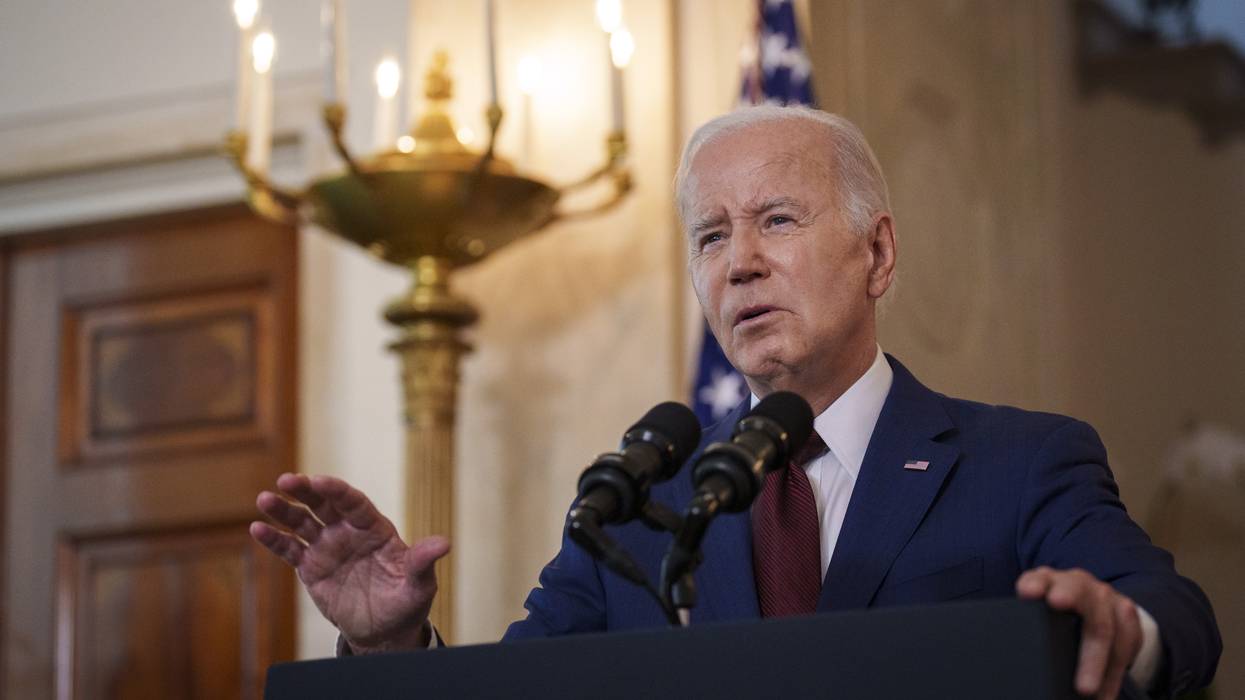
"These dangerous and dirty permitting deals are a matter of life and death for millions of people across our country who are already overburdened by decades of fossil fuel pollution," warned one campaigner.
Climate action advocates responded with outraged alarm Thursday to reporting that U.S. President Joe Biden and congressional Republicans may try to strike a "dirty deal" on permitting reforms as part of an agreement to raise the debt ceiling.
The deliberations continue as fears of an economically catastrophic default are growing, with just a week until the U.S. government could run out of money to pay its bills if Congress doesn't increase the debt limit, according to Treasury Secretary Janet Yellen.
"We should not be throwing people and the planet under a gas-guzzling bus just so that polluters can more easily build destructive projects."
Citing two unnamed sources close to the talks, The Washington Post reported:
The emerging deal would ease the process of building the interstate transmission lines needed to carry clean electricity across the country—a top priority for Democrats and a boon for President Biden's climate agenda, said the two individuals, who spoke on the condition of anonymity to describe the private negotiations.
To sweeten the deal for Republicans, the agreement would make modest changes to the National Environmental Policy Act, a 1970 law that requires the federal government to analyze the environmental impact of its proposed actions. GOP lawmakers have long blamed the bedrock environmental law for the yearslong delays that plague new highways, pipelines, and other infrastructure projects nationwide.
The transmission policy would be based on the forthcoming Building Integrated Grids With Inter-Regional Energy Supply (BIG WIRES) Act from Rep. Scott Peters (D-Calif.) and Sen. John Hickenlooper (D-Colo.), the newspaper noted, adding that the agreement "would include only incremental changes" sought by House Speaker Kevin McCarthy (R-Calif.) and fellow Republicans.
House Republicans notably included H.R. 1—their fossil fuel-friendly energy package—in the so-called Limit, Save, Grow Act, the "debt ceiling scam" the GOP passed last month and which established the party's priorities for the ongoing negotiations.
In response to the Post's reporting, Friends of the Earth government and political affairs director Ariel Moger said that "once again, lawmakers are expected to make the unconscionable decision to tack unpopular and environmentally harmful policies onto a must-pass bill. This deal will put communities already suffering from environmental racism at further risk by gutting essential laws."
"We should not be throwing people and the planet under a gas-guzzling bus just so that polluters can more easily build destructive projects," Moger argued. "Biden and congressional Democrats should stand up for environmental justice, reject this dirty deal, and pass a clean debt limit increase."
Oil Change International U.S. program co-manager Allie Rosenbluth stressed that "these dangerous and dirty permitting deals are a matter of life and death for millions of people across our country who are already overburdened by decades of fossil fuel pollution, the impacts of climate change, and compromised public health."
"The increased exposure to oil spills, gas leaks, air pollution, and water contamination would exacerbate existing environmental injustices and the climate crisis," Rosenbluth continued. "We must draw a red line and say no to Republicans taking our economy hostage to line the pockets of the fossil fuel industry."
“President Biden must enforce a clean debt ceiling package that does not allow for any rollbacks to National Environmental Policy Act (NEPA) or other bedrock environmental laws," she added. "While his recent climate track record has been nothing short of disastrous, it is not too late for him to turn it around and hold true to his environmental justice campaign promises."
The Biden administration has recently come under fire for backing ConocoPhillips' Willow oil project and a liquified natural gas (LNG) proposal, both in Alaska, as well as the incomplete Mountain Valley Pipeline (MVP) in Virginia and West Virginia.
The MVP is a longtime priority of Sen. Joe Manchin (D-W.Va.), a "coal baron" and recipient of fossil fuel industry campaign cash who only supported the Inflation Reduction Act last year in exchange for Senate Majority Leader Chuck Schumer (D-N.Y.) agreeing to push through permitting reforms friendly to the coal, gas, and oil companies.
Although opposition from frontline communities and progressives in Congress blocked versions of Manchin's "dirty deal" three times last year, he has since renewed his effort, introducing the Building American Energy Security Act—which calls for completing the MVP—earlier this month. A Biden aide said the White House backs the bill.
House Natural Resources Committee Democrats and the League of Conservation Voters highlighted Thursday that 83 lawmakers have signed a letter urging Biden, Schumer, and House Minority Leader Hakeem Jeffries (D-N.Y.) "to oppose ongoing attempts to attach H.R. 1 or any other extreme proposals that gut our bedrock environmental and public laws to must-pass legislation."
The panel's ranking member, Rep. Raúl Grijalva (D-Ariz.), led the letter and congressional opposition to last year's dirty deals.
"The growing list of my Democratic colleagues and I couldn't be more clear: Our environment and health are not the GOP's bargaining chips," Grijalva said in a statement Wednesday. "Gutting our bedrock environmental laws isn't permitting reform—it's a polluter payout. Speaker McCarthy and his extremist faction need to end this reckless scheme to force their MAGA-manufactured, polluters-over-people agenda on the American people now."
Though Jeffries is on the receiving end of the letter, he made clear Thursday that his caucus won't automatically support a Biden-backed deal, telling reporters that "it's a miscalculation to assume that simply any agreement that House Republicans are able to reach will, by definition, trigger a sufficient number of Democratic votes—if that agreement undermines our values."
Meanwhile, the Roosevelt Institute this week published an issue brief by Jamie Pleune, associate professor of law at the University of Utah, debunking the claim that reviews required by NEPA are hampering the transition to renewable energy.
"After examining 41,000 NEPA decisions conducted by the Forest Service over 16 years, we found limited correlation between the intensity of the NEPA process in question and the existence of delays," said Pleune. "Furthermore, some projects that were eligible for expedited analyses encountered delays, while some intensely studied projects were completed quickly. This indicated that the true causes of delay were external to the regulatory requirements of NEPA."
"Reducing analytical rigor or weakening environmental standards, which are some of the permitting reforms on the table in debt ceiling talks, won't address the true blockages to the buildout of renewables," she added. "In my brief, I provide progressive permitting reform, with demonstrated effectiveness, that will strengthen and improve NEPA processes while preserving community engagement and environmental protections."