

SUBSCRIBE TO OUR FREE NEWSLETTER
Daily news & progressive opinion—funded by the people, not the corporations—delivered straight to your inbox.
5
#000000
#FFFFFF
To donate by check, phone, or other method, see our More Ways to Give page.
Daily news & progressive opinion—funded by the people, not the corporations—delivered straight to your inbox.
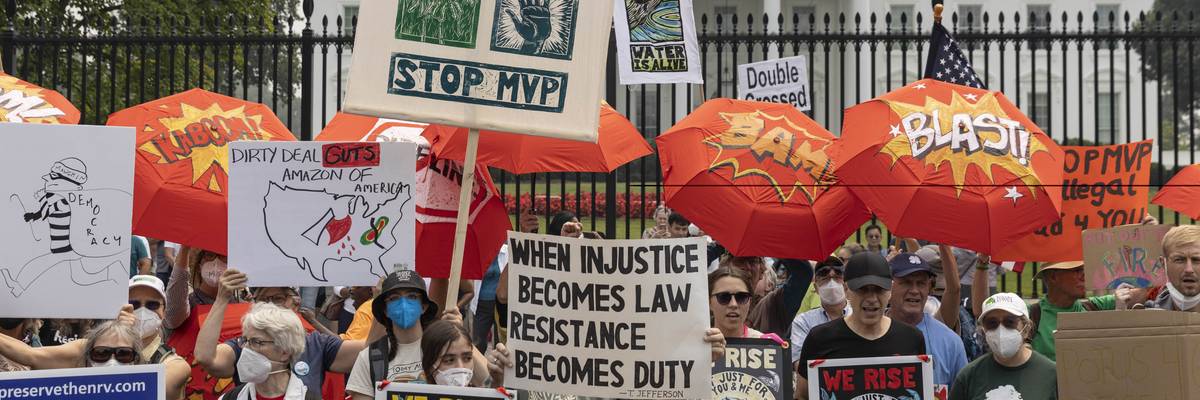
Demonstrators held a rally against the Mountain Valley Pipeline in front of the White House on June 8, 2023.
"Allowing this 303-mile disaster to move forward is a slap in the face to the communities who have fought tirelessly over the last decade to protect their land and water."
The Federal Energy Regulatory Commission on Tuesday gave the primary owner of the 303-mile Mountain Valley Pipeline a green light to begin operating the project after years of litigation and local opposition to the costly and destructive fracked gas infrastructure, a top priority of lawmakers bankrolled by the fossil fuel industry.
In a letter to the deputy general counsel of Equitrans, the director of FERC's Office of Energy Projects wrote that the federal agency has concluded that the Mountain Valley Pipeline (MVP) "has adequately stabilized the areas disturbed by construction and that restoration and stabilization of the construction work area is proceeding satisfactorily."
The letter came in response to the pipeline operators' request to allow gas to flow through the system, which runs from northwestern West Virginia to southern Virginia. An Equitrans spokesperson said Tuesday that the company is "pleased" with FERC's decision and that "final preparations are underway to begin commercial operations."
FERC's move drew immediate outrage from environmental groups that have been warning against the pipeline's approval for years, pointing to its projected emissions impact—the equivalent of dozens of new coal-fired power plants—and threat to water supplies and local communities.
"Since developers first proposed the ruinous Mountain Valley Pipeline, their disregard for community and environmental safety has been clear," said Jessica Sims, Virginia field coordinator of Appalachian Voices. "Community members and environmental watchdogs have pointed out the flaws in this project for years, and these fundamental problems with the pipeline remain. By allowing MVP to advance despite all these serious hazards, the system meant to protect our communities, land, and water has failed."
"When a fracked gas pipeline fails testing, literally explodes, fails to meet the safety standards its developers agreed to, what are communities on the ground left with?"
Sierra Club noted in a statement that "it has long been clear that the pipeline is unable to comply with basic environmental protections, with hundreds of water quality-related violations throughout the course of construction." Virginia's Department of Environmental Quality fined MVP's operators earlier this year for 29 separate violations along the pipeline's route through the state.
Last month, a segment of the pipeline in Virginia
ruptured during testing, amplifying opponents' concerns about future gas leaks.
"Allowing this 303-mile disaster to move forward is a slap in the face to the communities who have fought tirelessly over the last decade to protect their land and water," Patrick Grenter, Sierra Club's deputy chief energy officer, said Tuesday. "This pipeline has already marred private property and damaged countless water resources, and the gas it will transport will worsen the climate crisis. We will continue to fight back against the reckless expansion of dangerous, unnecessary fracked gas pipelines."
The decision by FERC—an agency increasingly beloved by Republican lawmakers and the fossil fuel industry—came a year after President Joe Biden signed into law a debt ceiling-related bill that included provisions requiring federal agencies to approve all permits necessary for the completion of the Mountain Valley Pipeline and preempting judicial review of the project.
The MVP-related provisions were inserted by retiring West Virginia Sen. Joe Manchin—who recently switched his party registration to Independent—and other allies of the oil and gas industry.
Dr. Crystal Cavalier-Keck, co-founder and director of 7 Directions of Service, said Tuesday that "this shameful and deadly decision by our establishment leaders and regulatory agencies to put MVP into service only reinforces what we've known all along: They do not care about our safety."
"When a fracked gas pipeline fails testing, literally explodes, fails to meet the safety standards its developers agreed to, what are communities on the ground left with?" Cavalier-Keck asked. "We will continue to demand safety and accountability, while ramping up our efforts to bring down such horrific corruption and instill ethical laws and policies, like the Rights of Nature, to prevent more loss of life and the climate crises from spiraling out of control."
Dear Common Dreams reader, It’s been nearly 30 years since I co-founded Common Dreams with my late wife, Lina Newhouser. We had the radical notion that journalism should serve the public good, not corporate profits. It was clear to us from the outset what it would take to build such a project. No paid advertisements. No corporate sponsors. No millionaire publisher telling us what to think or do. Many people said we wouldn't last a year, but we proved those doubters wrong. Together with a tremendous team of journalists and dedicated staff, we built an independent media outlet free from the constraints of profits and corporate control. Our mission has always been simple: To inform. To inspire. To ignite change for the common good. Building Common Dreams was not easy. Our survival was never guaranteed. When you take on the most powerful forces—Wall Street greed, fossil fuel industry destruction, Big Tech lobbyists, and uber-rich oligarchs who have spent billions upon billions rigging the economy and democracy in their favor—the only bulwark you have is supporters who believe in your work. But here’s the urgent message from me today. It's never been this bad out there. And it's never been this hard to keep us going. At the very moment Common Dreams is most needed, the threats we face are intensifying. We need your support now more than ever. We don't accept corporate advertising and never will. We don't have a paywall because we don't think people should be blocked from critical news based on their ability to pay. Everything we do is funded by the donations of readers like you. When everyone does the little they can afford, we are strong. But if that support retreats or dries up, so do we. Will you donate now to make sure Common Dreams not only survives but thrives? —Craig Brown, Co-founder |
The Federal Energy Regulatory Commission on Tuesday gave the primary owner of the 303-mile Mountain Valley Pipeline a green light to begin operating the project after years of litigation and local opposition to the costly and destructive fracked gas infrastructure, a top priority of lawmakers bankrolled by the fossil fuel industry.
In a letter to the deputy general counsel of Equitrans, the director of FERC's Office of Energy Projects wrote that the federal agency has concluded that the Mountain Valley Pipeline (MVP) "has adequately stabilized the areas disturbed by construction and that restoration and stabilization of the construction work area is proceeding satisfactorily."
The letter came in response to the pipeline operators' request to allow gas to flow through the system, which runs from northwestern West Virginia to southern Virginia. An Equitrans spokesperson said Tuesday that the company is "pleased" with FERC's decision and that "final preparations are underway to begin commercial operations."
FERC's move drew immediate outrage from environmental groups that have been warning against the pipeline's approval for years, pointing to its projected emissions impact—the equivalent of dozens of new coal-fired power plants—and threat to water supplies and local communities.
"Since developers first proposed the ruinous Mountain Valley Pipeline, their disregard for community and environmental safety has been clear," said Jessica Sims, Virginia field coordinator of Appalachian Voices. "Community members and environmental watchdogs have pointed out the flaws in this project for years, and these fundamental problems with the pipeline remain. By allowing MVP to advance despite all these serious hazards, the system meant to protect our communities, land, and water has failed."
"When a fracked gas pipeline fails testing, literally explodes, fails to meet the safety standards its developers agreed to, what are communities on the ground left with?"
Sierra Club noted in a statement that "it has long been clear that the pipeline is unable to comply with basic environmental protections, with hundreds of water quality-related violations throughout the course of construction." Virginia's Department of Environmental Quality fined MVP's operators earlier this year for 29 separate violations along the pipeline's route through the state.
Last month, a segment of the pipeline in Virginia
ruptured during testing, amplifying opponents' concerns about future gas leaks.
"Allowing this 303-mile disaster to move forward is a slap in the face to the communities who have fought tirelessly over the last decade to protect their land and water," Patrick Grenter, Sierra Club's deputy chief energy officer, said Tuesday. "This pipeline has already marred private property and damaged countless water resources, and the gas it will transport will worsen the climate crisis. We will continue to fight back against the reckless expansion of dangerous, unnecessary fracked gas pipelines."
The decision by FERC—an agency increasingly beloved by Republican lawmakers and the fossil fuel industry—came a year after President Joe Biden signed into law a debt ceiling-related bill that included provisions requiring federal agencies to approve all permits necessary for the completion of the Mountain Valley Pipeline and preempting judicial review of the project.
The MVP-related provisions were inserted by retiring West Virginia Sen. Joe Manchin—who recently switched his party registration to Independent—and other allies of the oil and gas industry.
Dr. Crystal Cavalier-Keck, co-founder and director of 7 Directions of Service, said Tuesday that "this shameful and deadly decision by our establishment leaders and regulatory agencies to put MVP into service only reinforces what we've known all along: They do not care about our safety."
"When a fracked gas pipeline fails testing, literally explodes, fails to meet the safety standards its developers agreed to, what are communities on the ground left with?" Cavalier-Keck asked. "We will continue to demand safety and accountability, while ramping up our efforts to bring down such horrific corruption and instill ethical laws and policies, like the Rights of Nature, to prevent more loss of life and the climate crises from spiraling out of control."
The Federal Energy Regulatory Commission on Tuesday gave the primary owner of the 303-mile Mountain Valley Pipeline a green light to begin operating the project after years of litigation and local opposition to the costly and destructive fracked gas infrastructure, a top priority of lawmakers bankrolled by the fossil fuel industry.
In a letter to the deputy general counsel of Equitrans, the director of FERC's Office of Energy Projects wrote that the federal agency has concluded that the Mountain Valley Pipeline (MVP) "has adequately stabilized the areas disturbed by construction and that restoration and stabilization of the construction work area is proceeding satisfactorily."
The letter came in response to the pipeline operators' request to allow gas to flow through the system, which runs from northwestern West Virginia to southern Virginia. An Equitrans spokesperson said Tuesday that the company is "pleased" with FERC's decision and that "final preparations are underway to begin commercial operations."
FERC's move drew immediate outrage from environmental groups that have been warning against the pipeline's approval for years, pointing to its projected emissions impact—the equivalent of dozens of new coal-fired power plants—and threat to water supplies and local communities.
"Since developers first proposed the ruinous Mountain Valley Pipeline, their disregard for community and environmental safety has been clear," said Jessica Sims, Virginia field coordinator of Appalachian Voices. "Community members and environmental watchdogs have pointed out the flaws in this project for years, and these fundamental problems with the pipeline remain. By allowing MVP to advance despite all these serious hazards, the system meant to protect our communities, land, and water has failed."
"When a fracked gas pipeline fails testing, literally explodes, fails to meet the safety standards its developers agreed to, what are communities on the ground left with?"
Sierra Club noted in a statement that "it has long been clear that the pipeline is unable to comply with basic environmental protections, with hundreds of water quality-related violations throughout the course of construction." Virginia's Department of Environmental Quality fined MVP's operators earlier this year for 29 separate violations along the pipeline's route through the state.
Last month, a segment of the pipeline in Virginia
ruptured during testing, amplifying opponents' concerns about future gas leaks.
"Allowing this 303-mile disaster to move forward is a slap in the face to the communities who have fought tirelessly over the last decade to protect their land and water," Patrick Grenter, Sierra Club's deputy chief energy officer, said Tuesday. "This pipeline has already marred private property and damaged countless water resources, and the gas it will transport will worsen the climate crisis. We will continue to fight back against the reckless expansion of dangerous, unnecessary fracked gas pipelines."
The decision by FERC—an agency increasingly beloved by Republican lawmakers and the fossil fuel industry—came a year after President Joe Biden signed into law a debt ceiling-related bill that included provisions requiring federal agencies to approve all permits necessary for the completion of the Mountain Valley Pipeline and preempting judicial review of the project.
The MVP-related provisions were inserted by retiring West Virginia Sen. Joe Manchin—who recently switched his party registration to Independent—and other allies of the oil and gas industry.
Dr. Crystal Cavalier-Keck, co-founder and director of 7 Directions of Service, said Tuesday that "this shameful and deadly decision by our establishment leaders and regulatory agencies to put MVP into service only reinforces what we've known all along: They do not care about our safety."
"When a fracked gas pipeline fails testing, literally explodes, fails to meet the safety standards its developers agreed to, what are communities on the ground left with?" Cavalier-Keck asked. "We will continue to demand safety and accountability, while ramping up our efforts to bring down such horrific corruption and instill ethical laws and policies, like the Rights of Nature, to prevent more loss of life and the climate crises from spiraling out of control."

