

SUBSCRIBE TO OUR FREE NEWSLETTER
Daily news & progressive opinion—funded by the people, not the corporations—delivered straight to your inbox.
5
#000000
#FFFFFF
To donate by check, phone, or other method, see our More Ways to Give page.
Daily news & progressive opinion—funded by the people, not the corporations—delivered straight to your inbox.
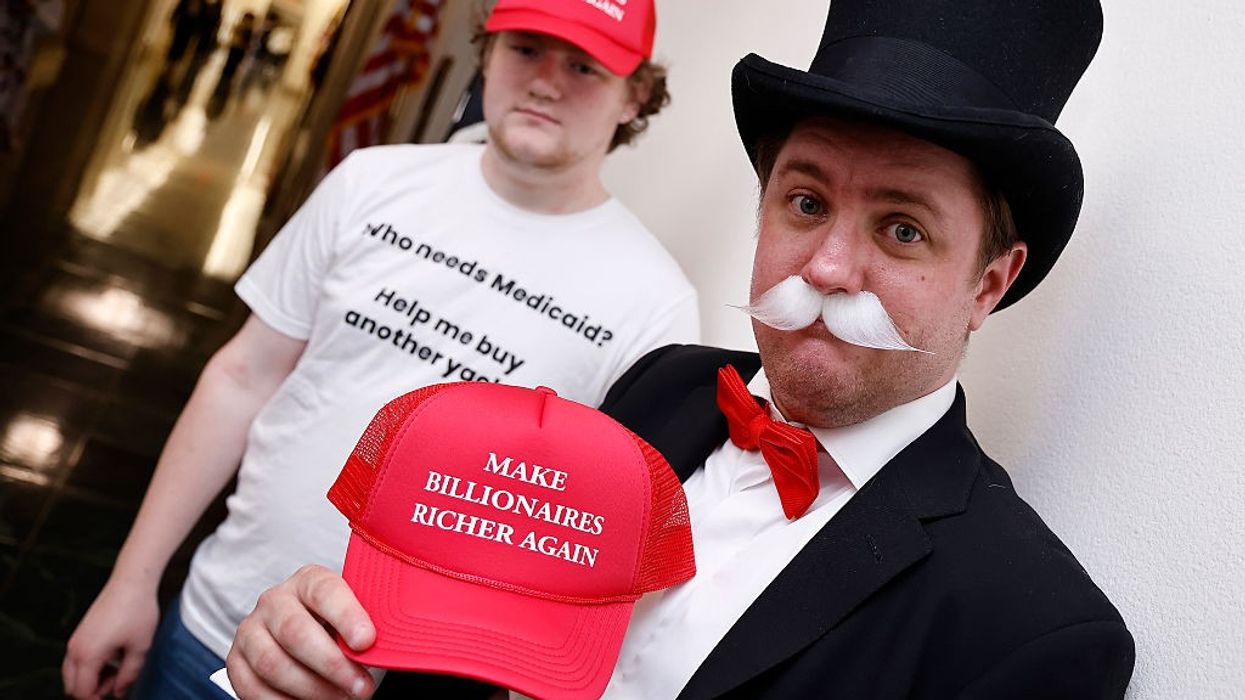
The real crisis is America is not the deep political cultural divisions among its citizens as much as the concerted efforts of both political parties to play on imagined differences, while orchestrating a massive shift in wealth from working people to the super-rich.
At this year’s National Football League Super Bowl, the Trump regime could not resist politicizing the event by attacking the halftime performance of Bad Bunny, a celebration of Puerto Rican musical culture conducted entirely in the Spanish language. President Donald Trump endorsed an alternative country western streamed halftime program of Kid Rock, which was dedicated to the conservative icon Charlie Kirk. It was the president and his party inciting the MAGA base to campaign for congressional Republicans.
The two shows represent two radically different cultural streams in America, roughly approximating the struggle over ethnic, gender, and racial representation in public life. On a more material level, however, the unfulfilled day to day needs of working people caught up in this ideological divide suggests that rhetorical claims about the culture wars are not grounded in the quotidian realities and material demands of most people.
The real crisis is America is not the deep political cultural divisions among its citizens as much as the concerted efforts of both political parties to play on imagined differences, while orchestrating a massive shift in wealth from working people to the super-rich class, which includes the congressional millionaire unrepresentatives. At least two-thirds of the Senate membership and more than half the House are millionaires, compared to 9% of Americans overall.
Diminishing access to basic human needs, a news topic that does not attract advertising revenue, except perhaps from Big Pharma, has a huge impact on the quality and very meaning of democracy. The real crisis of the working class is not on the MSM agenda.
True to its propaganda mission of creating legitimacy for the hegemonic state, the mainstream corporate media fails to help Americans understand that in their individual family struggles to survive or just about make ends meet, they are not alone.
In the midst of the Civil War, President Abraham Lincoln referred to an ideal America as a country of, by, and for the people. Looking at the political and civic participation and well-being of people, all the people, as a proxy for democracy, it is clear that the legitimacy of the democratic state is at a dangerously low level and in inverse correspondence with the degree of American military or police aggression at home and abroad. The largest injuries of wars fall on the working class.
The lower the trust the public invests in the state, the more the ruling apparatuses are compelled to distract public attention. Trump apparently believes he can override constitutional restraints on his power mandate, ignore public opinion, and function as a quasi-autocrat. He also hopes to deflect attention from his failed economic policies by redirecting the public gaze toward a constructed enemy threat.
In 2016, Hillary Clinton melded her identity politics strategy to neoconservative, pro-Israeli, and Russophobic rhetoric bereft of any vision or coherence, in the process losing the working class, 52% to 44%, to a faux pro-labor campaigner. Her “basket of deplorables” gaffe directed at the white working class didn’t help her chances. The Democrats under the neoliberal Clinton wing of the party turned away from the New Deal and toward neoliberal, anti-welfare, corporate-friendly, austerity, and tough-on-crime policies.
In 2024, a disunited working class voted overwhelmingly in favor of Donald Trump, who was anything but a pro-labor politician. According to the Pew Research Center, 67% of Trump voters were without a college degree, a proxy for working class, compared with 51% for Harris. Clinton protégé Kamala Harris captured just 42% of working-class voters, while Trump carried 56%.
Clinton-Obama acolyte Joe Biden, often identified as progressive, cut federal food stamp and childcare benefits during his presidency and allowed child poverty to nearly triple, while millions of Americans lost Medicaid and CHIP (Children's Health Insurance Program) support. On the international front, as Barack Obama’s vice president, Biden acted like an imperial proconsul in Ukraine, forsaking even token gestures of diplomacy in dealing with the Russian head of state, whom he publicly dismissed as “a thug.” His unconditional military assistance that enabled the Israeli genocide lost him and his stand-in much of the youth vote in 2024 prior to his decision to drop out of the presidential race.
The Democrats have followed the same militaristic, hegemonic foreign policy approach as Republicans. As secretary of state, Clinton, following John Foster Dulles’ style of “brinkmanship,” promised to confront Russia in Ukraine with a “no-fly zone” that she proposed would halt Russian aid to the rebellious Donbas region in eastern Ukraine. Overall, her identity-based politics campaign strategy in 2016 lost out to a faux labor-friendly campaigner, who took 52% of the working class vote to Clinton’s 44%.
Perhaps the only thing worse than a party of the billionaire class led by a real estate tycoon is another party of the billionaire class pretending to be an alternative. In reality, the well-being of Americans has continually declined for nearly 50 years under neoliberal governments of both parties. As a result, public trust of governing institutions by 2024 had reached a near all-time low in the post-war period. Today, Democrat voters are only marginally more trusting of the federal government, 35%, than Republicans, 11%.
The purported polarization of Democrat versus Republican voters has been constructed as an ideological trope to hide the more substantive economic and class basis of the great divide, which is the public’s recognition of the corruption of the state on the one hand and the concentration of wealth and power that has hollowed out the democratic status of citizens, especially workers and urban minorities, on the other.
In November 2025, the Kettering Foundation found a new low, 24%, in its tracking of American adults who believe that democracy is working in the country. The relatively weak organic character of American democracy measured in terms of social distribution corresponds to the perception of diminished state legitimacy that is documented in several studies of public trust in state institutions. Of all public institutions in America surveyed by Gallup in 2024, the very lowest regard is held for the one body that constitutes the essence of a representative democracy, the legislature. Gallup found that trust in Congress registered a “great deal” or “quite a lot” for a total of a meager 9% of respondents.
Trust in the presidency registered 26%, the Supreme Court 30%, newspapers 18%, television news 12%, and internet news 16%. Big business was trusted by 16% and, crucially, the medical system by a minority 36%. Indeed, 80% of Americans, including 91% of Democrats, 82% of Independents, and 67% of Republicans, see the rich as wielding too much power in American politics, according to a January 2026 YouGov poll. It identified a broad public perception that the economic system works primarily on behalf of powerful interests and that members of Congress, governors, and federal officials, moreover, are likely to accept bribes.
The public is indeed very skeptical about the conduct of electoral politics: 87% of Republicans and 85% of Democrats believe the parties "are more focused on fighting each other than on solving problems.” Per Max Weber, it was the charismatic and caudillo style of Trump that served as the last though shaky refuge of public confidence in government. That lasted about one year. In March 2026, enmeshed in a brutal war without real objectives in Iran, Trump’s approval rating reached an all-time low for presidents.
A “government of the people, by the people, for the people,” to use Lincoln’s felicitous phrasing, captures the essence of democracy–over and above the right to vote, nominal free speech, or the existence of relatively independent news media, all of which in fact are under the threat or capture of partisan control. In this regard, the US has greatly declined as a democracy, even as measured by the conservative NGO Freedom House, and more closely resembles an oligarchy dominated by the billionaire class, with extremely wide income gaps and among the highest concentrations of wealth (Gini coefficient) among the Organisation for Economic Co-operation and Development (OECD) countries. Compared to the European welfare states (e.g., Nordic countries, France, Germany, and Netherlands), the US is more of a warfare state, drawing much of its wealth from military interventions, military aid (which is largely recycled back to the US), and alliances with repressive political leaders such as the Gulf autocrats.
Looking at the material and social status of working Americans as the true measure of democratic empowerment, one finds a depressed state of well-being and social economic freedom for most citizens.
A few of the indicators of social demise (a fuller list is found in my book cited, below) that has fed distrust and material polarization in America:
These are the actual data of polarization in the US, intensified in the era of neoliberalism. True to its propaganda mission of creating legitimacy for the hegemonic state, the mainstream corporate media fails to help Americans understand that in their individual family struggles to survive or just about make ends meet, they are not alone. The MSM instead misleads the public by portraying political conflict as cultural warfare rather than class warfare, thereby dividing the people and protecting the system’s class repression and small minority of billionaires controlling the most critical affairs of the state and its propaganda apparatuses.
Democracy here is defined by the equality of citizenship. In practice, this means universal access to healthcare; quality housing; higher education; clean environment; equitable income; union empowerment; racial, gender, and ethnic justice; cultural amenities for all; and other core objectives pushed by public advocacy groups. Indeed, in a more genuinely democratic society there would far less need for public advocacy, and electoral and political activities would no longer be controlled by corporate and other undemocratic institutions. The role of progressive intellectuals is to struggle for democracy along this understanding of a democratic and just society.
Donald Trump, Ron DeSantis, Marjorie Taylor Greene, and other Republican culture warriors don’t represent “forgotten Americans;” they’ve championed the very policies that have caused these Americans to be forgotten.
Over the past week, Oliver Anthony’s video of his song “Rich Men North of Richmond” has gone viral, clocking more than 20 million views on YouTube. As it’s risen to the top of the streaming charts, it’s also become a theme song for reactionary conservatives (Marjorie Taylor Greene calls it “the anthem of the forgotten Americans”).
“Rich Men North of Richmond” expresses class resentment with words and music evocative of Woody Guthrie. But Guthrie aimed his fire at economic elites who oppressed hardworking Americans. Anthony is aiming at cultural elites who have reduced the status of white American-born men.
America is in a new populist age, but the new populism comes in two radically different forms: cultural and economic.
Today’s Republicans are wielding cultural populism on behalf of so-called “forgotten Americans” who are white, male, Christian, and nationalist.
“I’ve been sellin’ my soul, workin’ all day / Overtime hours for bullshit pay,” Anthony sings. Yes, you have—but not because cultural elites have replaced white Christian nationalist men with people of other races, genders, nationalities, and creeds.
For seven years, Donald Trump has rarely missed a day to blame all America’s problems on immigrants, Democrats, socialists, the mainstream media, the “Deep State” (including the FBI, Justice Department, prosecutors, and unfriendly judges), “coastal elites,” and, wherever possible (and usually indirectly), women and people of color.
Florida’s Ron DeSantis is basing his inchoate presidential campaign on a war against what he calls America’s “ruling class,” which includes bureaucrats, journalists, educators, and other supposed “woke” experts who, as DeSantis told the audience attending his campaign kickoff in Iowa in May, “are not enacting an agenda to represent us. They’re imposing their agenda on us, via the federal government, via corporate America, and via our own education system.” DeSantis is shipping undocumented immigrants out of Florida, barring teaching about sex or America’s history of racism, blocking abortions after 12 weeks, and requiring Trans young people to use bathrooms according to their gender at birth.
For Republican politicians these days, the culture wars are the central struggle of American public life. Why? Because cultural populism’s underlying political agenda is white male Christian nationalism. It aims to resurrect the social and racial hierarchy that dominated American life before the 1960s.
This not only fuels the Republicans’ mostly white, male, Christian, American-born base. It also reassures the fat cats bankrolling the GOP that working-class resentments are channeled away from economic populism—which could threaten the fat cats’ wealth.
What are Democrats doing with economic populism?
Some Democrats continue to talk about “forgotten Americans” who have been left behind economically. And President Joe Biden and his allies in Congress have made a good start at helping these Americans—even though most of the working middle class doesn’t seem to be aware of it.
But few Democrats are willing to blame what’s happened on economic elites. (When Bernie Sanders tried in 2016, the Democratic establishment squashed his presidential ambitions.)
Yet the Republicans’ cultural populism is bogus. The biggest change over the last three decades—the change lurking behind the insecurities and resentments of the working middle class—has nothing to do with identity politics, “woke”ism, Critical Race Theory, transgender kids, or any other current Republican bogeymen. It has directly to do with a huge shift in the distribution of income and wealth.
The nonpartisan Congressional Budget Office has just released a report showing changes in the distribution of family wealth from 1989 to 2019 (the first and the most recent years for which comparable survey data on family wealth are available).
Families in the top 10% of the distribution now hold more than two-thirds of all wealth. Families in the bottom half of the distribution hold only 2% of total wealth. (Families in the bottom quarter have negative net wealth—they’re in debt. Families in the top 1%—indeed, the top one-tenth of 1%—have a disproportionate share of the wealth of the top 10%.)
Look at the dramatic change over the last three decades. Although total wealth is much greater now than it was then, the distribution of that wealth is far more unequal. The bottom 50% hasn’t budged. Wealth at the top has exploded.
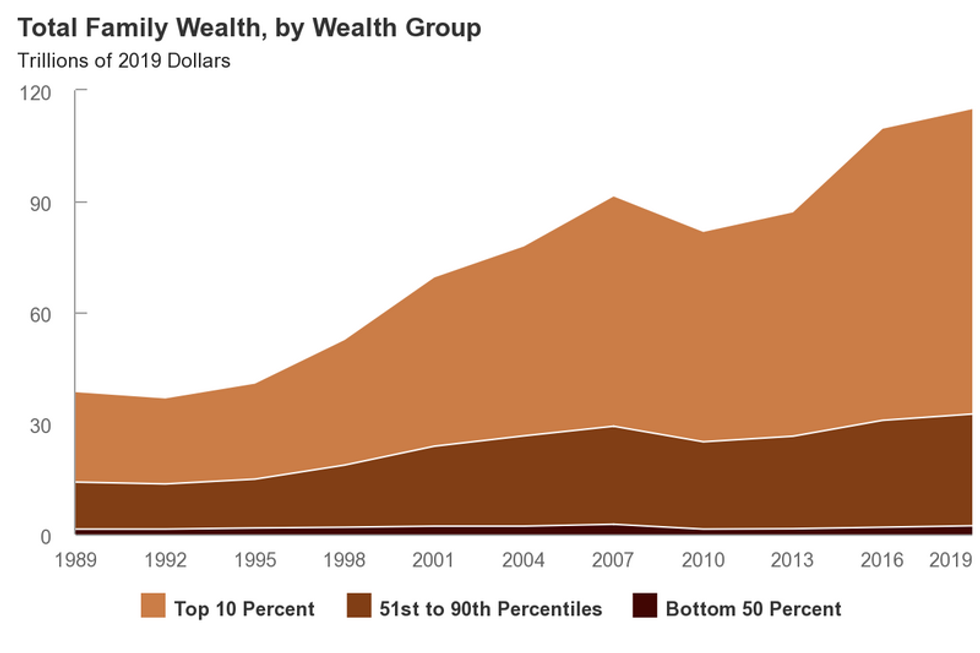
A chart showing changes in distribution to family wealth in the U.S. from 1989 to 2019.
(Photo: Congressional Budget Office)
This change didn’t happen because of so-called “neutral market forces.” It happened because of policy decisions made over the last three decades.
What sort of decisions? To open the borders wide to imports from China. To deregulate Wall Street and allow it to make bets with other people’s money. To dramatically cut taxes on the rich. To let corporations bash unions and fire workers who try to organize. To encourage private equity to take over “underperforming” companies and then promptly fire workers and sell off assets. To allow big corporations to buy or merge with other big corporations. To bail out the biggest banks but not homeowners who get caught in the downdrafts. To encourage corporations to buy back their shares of stock rather than reinvest profits. To privatize higher education and push students into taking out massive college loans. And so on.
These policy decisions didn’t just happen, either. They were pushed by wealthy elites on Wall Street and in corporate C-suites, who made mammoth donations to politicians on both sides of the aisle—mostly but not exclusively Republican—to ensure that their wishes would be honored.
Donald Trump, Ron DeSantis, Marjorie Taylor Greene, and other Republican culture warriors don’t represent “forgotten Americans.” They’ve championed the very policies that have caused these Americans to be forgotten.
Biden and most Democratic lawmakers in Congress are advocating policies that will make the nation more equitable, such as student-loan forgiveness and negotiated drug prices. But they’re reluctant to push very hard for higher taxes on the wealthy, or labor laws that make it easier to organize, or to roll back any of the other big structural changes that wealthy elites have put in place over the last 30 years.
And they don’t want to blame the rich for what’s happened.
“I’ve been sellin’ my soul, workin’ all day / Overtime hours for bullshit pay,” Anthony sings.
Yes, you have—but not because cultural elites have replaced white Christian nationalist men with people of other races, genders, nationalities, and creeds.
It’s because America’s wealthy have turned their growing wealth into increasing political power to change the rules of the game in ways that further enlarge their wealth and power, while shafting the bottom half.
If Democrats don’t tell the economic truth about what’s happened and place the blame squarely where it’s deserved, the lies of Republican cultural populists will fill the void—not just with faux-populist lyrics, but with bad laws.
Republican and Democratic “trifecta” states are barreling in opposite directions at an astounding rate
If you want to understand the American political economy today, you need only look at what’s happening in the growing number of “trifecta” states — states where the same party controls the governorships and both chambers of state legislatures.
We don’t need a civil war. We’re already separating into two nations.
As Americans segregate geographically by education and political values, the number of trifectas has been increasing. Democrats now have 17 — the most they’ve had since 1994 — while Republicans have 22, about the same number they’ve had since 2011.
These Democratic and Republican trifectas are moving in opposite directions at an astounding pace —Democratic trifectas rapidly becoming more progressive and inclusive; Republican, more regressive and reactionary.
We’re splitting into two nations. But are we really?
A few weeks ago, Washington state became the 10th state in the nation to ban assault rifles and handguns. Colorado has enacted a longer waiting period for firearm sales and increased the minimum age to purchase a gun. Maryland will soon prohibit gun owners from bringing guns to schools and other sensitive locations.
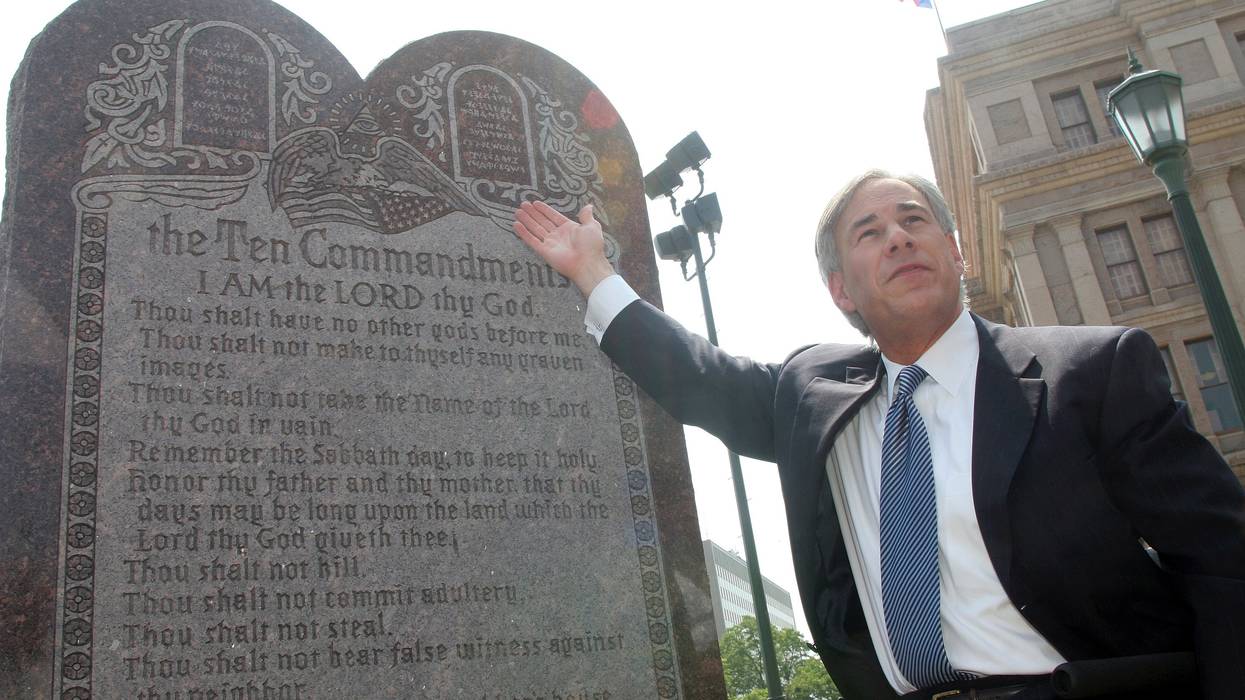
Republican trifectas are moving as quickly as they can in the other direction. They’re making it next to impossible to have abortions and far easier to obtain guns. They’re banning books that discuss gender identity or sexual orientation, prohibiting gender-affirming care for young people even when parents approve, enacting prison terms for librarians whose shelves hold banned books, preventing teachers from discussing the nation’s history of racism — but allowing (if not requiring) the posting of the Ten Commandments and the teaching of religion.
They’re simultaneously making it more difficult for likely Democrats to vote — engaging in some of the most elaborate gerrymanders in the nation’s history and stripping from cities (almost all solidly Democratic) various home-rule rights. A bill in Texas even allows the state to declare elections invalid in Harris County, home to reliably Democratic Houston.
We’re splitting into two nations.
But are we really? When it comes to issues that affect people directly, it turns out that voters in Republican trifectas are not all that different from anyone else — as evidenced by their support for initiatives and referenda that preserve the right to an abortion, raise the minimum wage, expand Medicaid, and make it easier to form unions. (More than 70 percent of the public, including about half of self-declared Republicans, have favorable views of unions.)
So how have Republicans gained and kept power in the red trifectas? Suppressing Democratic votes and demagoguing culture-war issues. They’ve been telling voters that their real enemies are cultural elites, rather than economic ones; and that their problems arise from the cultural norms of the oligarchy instead of from the oligarchy’s power.
Wrong, of course. But the only way voters in these states will learn the truth is if progressives and Democrats — at both state and national levels — tell them the truth and offer them a clear alternative to the BS they’re getting from the GOP.
Our public schools shouldn't be pawns for politicians' ambitions. Or defunded and destroyed by ideologues. We are at a crossroads: Fear and division, or hope and opportunity. A great nation does not fear people being educated.
The following are the prepared remarks by American Federation of Teachers president Randi Weingarten delivered on Tuesday, March 28, 2023 at the National Press Club.
Today, we once again grieve for families shattered by senseless gun violence. Please join me in a moment of silence for the lives lost at the Covenant School in Nashville, and for all victims of gun violence.
Today we renew our call for commonsense gun safety legislation including a ban on assault weapons. This is an epidemic that our great nation must solve.
There's a saying: You don't have to love everything about someone to love them. I'm sure my wife doesn't love everything about me, but she loves me. (I, on the other hand, love everything about her.) Nothing is perfect. Banks aren't. Congress isn't. And neither are our public schools—not even our most well-resourced and highest-performing schools. Those of us involved in public schools work hard to strengthen them to be the best they can be. But only public schools have as their mission providing opportunity for all students. And by virtually any measure—conversations, polls, studies and elections—parents and the public overwhelmingly like public schools, value them, need them, support them—and countless Americans love them.
Public schools are more than physical structures. They are the manifestation of our civic values and ideals: The ideal that education is so important for individuals and for society that a free education must be available to all. That all young people should have opportunities to prepare for life, college, career and citizenship. That, in a pluralistic society such as the United States, people with different beliefs and backgrounds must learn to bridge differences. And that, as the founders believed, an educated citizenry is essential to protect our democracy from demagogues.
Thomas Jefferson argued general education was necessary to "enable every man to judge for himself what will secure or endanger his freedom." Franklin D. Roosevelt said: "The real safeguard of democracy … is education." And Martin Luther King Jr., in accepting the United Federation of Teachers' John Dewey Award, made clear, "Education is the road to equality and citizenship."
When kids go to school together, they become part of a community; their families become part of a community. That community comes together at school concerts, basketball games and science fairs, and for shelter and comfort, when people are displaced by natural disasters or, far too often, at vigils for victims of gun violence. In good times and bad, public schools are cornerstones of community, of our democracy, our economy and our nation.
But some people want that cornerstone to crumble—and they're wielding the sledgehammers.
Attacks on public education are not new. The difference today is that the attacks are intended to destroy it. To make it a battlefield, a political cudgel. After former President Trump lost re-election, Steve Bannon, his key ally, declared that their fight goes through school boards. In a speech last year, culture war operative and Governor Ron DeSantis' appointee Christopher Rufo put it bluntly, "To get to universal school choice, you really need to operate from a premise of universal public school distrust." To this end, he says, his side has "to be ruthless and brutal."
And, I would add, well-funded, which it is. The DeVos, Bradley, Koch, Uihlein and Walton family foundations and others have poured many millions of dollars into anti-public education, pro-privatization groups like the American Federation for Children and EdChoice.
The Betsy DeVos wing of the school privatization movement is methodically working its plan: Starve public schools of the funds they need to succeed. Criticize them for their shortcomings. Erode trust in public schools by stoking fear and division, including attempting to pit parents against teachers. Replace them with private, religious, online and home schools. All toward their end goal of destroying public education as we know it, atomizing and balkanizing education in America, bullying the most vulnerable among us and leaving the students with the greatest needs in public schools with the most meager resources.
It's an extremist scheme by a very vocal minority of Americans. It's hurting our efforts to do the work we need to do, which is educating the nearly 50 million kids who attend America's public schools. And the urgent work of helping kids recover from learning loss, sadness, depression and other effects of the pandemic.
And it's not what parents or the public want.
Let's start with defunding: This year alone, 29 state legislatures are considering bills to either create or expand existing voucher programs.[i] This is on top of the 72 voucher and tax credit programs in 33 states already subsidizing private and home schooling, costing billions every year.[ii] Voucher programs are proliferating even though research shows that, on average, vouchers negatively affect achievement—the declines are worse than pandemic learning loss. In fact, vouchers have caused "some of the largest academic drops ever measured in the research record."
Proponents of vouchers used to argue that they were a way for low-income and minority families to transfer out of low-performing schools. No longer. Today most vouchers go to families who already send their kids to private schools. And private schools are not required to follow most federal civil rights laws protecting students, so they can—and many do—discriminate, especially against LGBTQ students and students with special needs.
The universal voucher program signed by Florida Gov. DeSantis yesterday will divert $4 billion from the state's public schools. Florida ranks 44th in the nation in per pupil spending, and 48th in average teacher salaries. DeSantis is sending taxpayers' dollars in the wrong direction.
And then there are the culture wars. What started as fights over pandemic-era safety measures has morphed into fearmongering: False claims that elementary and secondary schools are teaching critical race theory; disgusting, unfounded claims that teachers are grooming and indoctrinating students; and pronouncements that public schools push a "woke" agenda, even though they can't or won't define what they mean. Banning books and bullying vulnerable children. School board meetings descending into screaming matches. This is an organized and dangerous effort to undermine public schools.
Over the last three years, legislators in 45 states proposed hundreds of laws placing public schools at the center of culture wars: laws seeking to ban books from school libraries—even books about Ruby Bridges and Anne Frank and Roberto Clemente; laws restricting what teachers can teach and students can learn—particularly about about race, gender, LGBTQ issues, current events and American history; and laws attacking kids who are transgender. Students and staff should feel welcome, safe and respected in school—but the culture wars are fueling hostility and fear.
A torrent of enacted and proposed legislation targeting even the mention of "controversial" topics—sweeping and open-ended restrictions on what can be taught—has teachers teaching on eggshells. In Florida, the Department of Education has threatened teachers and librarians with felony prosecution if they provide students with books that the state later decides are inappropriate.[iii] If Florida lawmakers have their way, colleges will no longer have diversity, equity or inclusion policies; or tenure; or academic freedom. And AP courses and the mere utterance of LGBTQIA+ will be banned in all K-12 schools. And forget about facts. Many laws and pending bills allow any individual to sue schools and teachers for perceived violations. The intent and effect are to create a climate of fear and intimidation.
This takes a toll on the quality of education teachers can provide our students, and on the trust and connection that are so important. Shouldn't teachers be free to talk with students who are withdrawn or in distress, and to answer students' questions? Don't we want students to learn both our nation's achievements that make us proud and the failings that make us strive to do better? Isn't that our job?
Teachers should have the freedom to teach. And students should have the freedom to learn.
These same governors who are pushing vouchers and culture wars are also trying to defund and weaken teachers unions, so educators don't have the wherewithal to fight back against censorship, attacks on their academic freedom, threats to their livelihoods and criminal prosecution.
These attacks aren't about protecting kids. If they were, they would be working with us to address learning loss and the youth mental health crisis. They would be working with us to take on social media companies for contributing to that crisis.
If these attacks were about protecting kids, they would be working with us to fight against the leading cause of death for American children—gun violence.
If this were about protecting kids, instead of putting LGBTQ youth at risk and banning books about Black people and by Black authors, they would give a damn about these kids' safety and well-being, including the youth suicide crisis.
Forty-five percent of LGBTQ youth seriously considered suicide in the last year. And the suicide rate among Black youth of all sexual orientations has been increasing as well.
This is literally a matter of life and death. These attacks on public education make it increasingly difficult to create the welcoming, safe environment that our students need and deserve.
It is a fraught time in our country. The effects of COVID-19; the climate of conflict; drug abuse; gun violence; economic insecurity; and the youth mental health crisis have all taken a heavy toll. Hate crimes have surged against many Americans—Asian, Black, Latino, Jewish and Muslim Americans.
School staff report a rise in bullying, verbal altercations and physical violence among students, as well as this behavior directed at them.
I recall a teacher saying that when her students are disruptive, it's not because they are bad; it's because they're sad.
So many students have experienced isolation and trauma. They need help. But there weren't enough mental health specialists before the pandemic, and they are in critically short supply now.
The persistent demonization and disrespect of teachers—from screaming matches at school board meetings to the former secretary of state saying teachers teach "filth"—have contributed to a culture of disrespect that seeps into our schools.
I just got a report from Florida. In Flagler County, a 17-year-old student with special needs pushed a paraprofessional so hard she went airborne and was knocked unconscious. A teacher in Osceola County was monitoring students in the hallway when a student sucker-punched him. And there are others. The educators who were hurt all cited lack of staff in the schools and lack of mental health support for students as the main reasons leading to the attacks.
And this crisis will only get worse as Gov. DeSantis' universal voucher bill kicks in. What will the loss of $4 billion do to safety in Florida's public schools? What will that do to the quality of academics, to the condition of school buildings, to teacher pay, to staffing shortages?
Even before the pandemic, there were steep declines in teachers' satisfaction. The percent of teachers who were "very satisfied" fell from 62 percent in 2008 to just 12 percent in 2022.
The stresses of the COVID-19 era—plus the culture wars, attacks on teachers, inadequate pay, poor teaching and learning conditions, and the threat of school shootings—have made recent years the toughest in modern times for educators.
Despite it all, teachers have thrown themselves into the mission of helping students recover academically, socially and emotionally. You heard Tamara (Simpson). I witness these acts of teaching, of nation-building, every day. Yet, according to our critics, we're responsible for all the woes of society.
Even before the pandemic, nearly 300,000 teachers were leaving the profession each year. Now, it's closer to 400,000.
And the teacher pipeline has collapsed as college students and career-changers choose not to go into education. How are we going to recruit and retain the staff schools need in this climate?
Our teaching profession is in crisis.
It's in crisis because of the poor teaching and learning conditions created by inadequate funding for public schools. It's teacher pay, which has been falling relative to other college graduates' pay for the last 40 years. It's giving teachers all the blame and little authority. And it's the de-professionalization of teaching that demoralizes an already beleaguered profession.
I hear it all the time—teachers just want to teach.
So where do we go from here?
The American Rescue Plan, and the programs it spawned, particularly the tutoring programs, have really helped. And we are grateful to President Joe Biden, Education Secretary Miguel Cardona and the last Congress for the much-needed resources. Of course we will continue to fight this defunding of our public schools and this dividing of our communities. But we also must do better to address the learning loss and disconnection we are seeing in our young people. And we can. We can make every public school a school where parents want to send their kids, educators want to work and all students thrive.
Four strategies can help transform our schools to realize the promise and purpose of public education. Not just to overcome learning loss or get back to normal, but to truly help us prepare all children with the knowledge and skills they need for their lives, for college, for career and for citizenship. These strategies can help us create safe and welcoming environments and bring joy back to learning. And in tandem, they have a catalytic effect. I have seen it work. But we need to do these strategies at scale—for every child and in every school. These four strategies are expanding community schools, scaling experiential learning, addressing staff shortages, and deepening the partnerships between families and educators.
First and foremost, we need to make sure our kids are OK. That's why we need community schools, which are hubs for neighborhoods, combining academics with extended learning opportunities, family and community events, and an infusion of medical, mental health and other social services. They are the best system I know to connect students and families to the support they need to learn, live and thrive.
A recent University of Calgary study found that youth suicide attempts increased 22 percent during the pandemic. According to the Centers for Disease Control and Prevention, nearly 1 in 3 teen girls seriously considered suicide in 2021—up nearly 60 percent from a decade ago. More than 42 percent of high school students reported persistent feelings of sadness or hopelessness.
What helps? The Calgary report found that "school connectedness, defined as feeling close to people at school, has a long-lasting, protective impact for adolescents well into adulthood."
Our schools must be equipped to support and connect with students, and there is no better model for this than community schools. There is another tragic reality in the United States: Half the students in America's public schools live in poverty. Community schools mitigate the effects of poverty by providing essential services right where students are and where families can be.
Once kids' physical and emotional needs are met, they are ready to learn, and teachers can focus on their primary role—which is to teach.
A few weeks ago I went back to Wolfe Street Academy, a community school in Baltimore, to see how they were doing.
Ninety-six percent of the students there qualify for free- or reduced-price lunch. Since converting to a community school nearly 20 years ago, Wolfe Street has gone from the 77th-most successful elementary school in Baltimore (out of 80) to the second-most successful. And, like other community schools, when COVID-19 hit it was a matter of ramping up services, not having to start from scratch.
Students have access to medical checkups, clothing and mental health services. Families have food assistance, language support and legal aid.
And this school is fun! Wolfe Street offers a wide variety of after-school programs, including chess club, robotics club, Mexican folkloric dance, orchestra, a soccer league and more.
And, by the way, Wolfe Street is a unionized public charter school.
There are successful community schools in rural and suburban areas, as well.
The Rome (New York) Teachers Association started a community school with help from the AFT in 2016. Today its Connected Model has spread to 14 school districts and provides everything from access to mental health services and dental care, to food packages for weekends and holidays, and prom dresses!
A recent Rand Corp. study of community schools in New York City found positive impacts on both attendance and graduation rates. In New Mexico, community schools in operation for five or more years have better-than-average student achievement growth and higher attendance rates, and employed more highly effective teachers. And Robeson High School in Philadelphia went from nearly closing to a 95 percent graduation rate after implementing the community school model.
AFT members have helped create 700 community schools across the country, and we see how they meet kids' needs. From Kimball Elementary School in Washington, D.C., to the Oyler School in Cincinnati, to Roybal-Allard Elementary in Los Angeles. That's why the AFT is calling for 25,000 community schools by 2025 and our call is gaining steam. California just approved another $45 million to make 1 in every 3 schools in the state a community school. And President Biden's budget doubles federal community school investment. We need to make this happen everywhere.
Second, we can re-engage students through experiential learning, transforming their educational experiences. Why do kids skip school, or slump in the back of the classroom? They may feel unsafe or unseen. Or just uninterested. We must do better. And we can.
Of course, fundamental academic subjects are important. But so is how we teach them. Experiential learning engages students through problem-solving, critical-thinking, teamwork, and learning by doing. We need to help kids engage with the world, with ideas and with each other—not just with their devices.
Experiential learning embeds the things that make kids want to be in school: The excitement of learning that is deeply engaging, and the joy of being together, especially after the isolation of the last few years. The camaraderie and responsibility of working together on a team.
And in the age of AI and chatGPT, this type of learning is critical to being able to think and write, solve problems, apply knowledge and discern fact from fiction.
Experiential learning can be applied to any content area from math to computer science to social studies, and often weaves subjects together in powerful interdisciplinary instruction. It can be adapted to any grade level. It can take place in rural, urban and suburban schools. And it nurtures kids' natural curiosity and creativity. That is what robotics and debate teachers do all the time. It's what I did as an AP government teacher at Clara Barton High School. These opportunities need to be the norm not the exception.
This type of learning makes clear just how outmoded the standardized test-based accountability system is. Of course, the country needs data on how our kids are doing, but if we are talking about student success, research shows classroom grades, not tests, are the best predictor of that. And experiential learning takes the classroom to a new level.
Experiential learning is assessed by teachers in their classrooms and focuses on mastery of the skill. It can include capstone projects that allow students to research a topic they're passionate about and present it to their teachers and peers. It can include nature-based pre-K, where youngsters learn by exploring natural surroundings while building social skills with other kids. It can include students working together to code and build robotics projects; service-learning projects to support community members; and summer learning on a farm caring for crops or animals; or reporting for and producing a neighborhood newsletter. And it can start with field trips, during and after school.
Experiential learning has long been embedded in career and technical education programs where students use their minds and their hands to learn everything from auto repair, to nursing, IT, graphic design, welding, culinary skills and hospitality. CTE students learn skills that give them a head start when they go to college or start their careers. Shouldn't every student have that opportunity?
It's also a proven strategy. Ninety-four percent of young people who concentrate in CTE graduate from high school, and 72 percent of them go on to college.
Talk to any employer about the skills and knowledge they look for in a successful employee, be it a plumber, a nurse or a lawyer, and you're bound to hear similarities—employees who are creative, self-starters, critical-thinkers, problem-solvers; have empathy; and can build relationships. This type of learning provides every student with more options to develop those skills and to find their passion, their purpose and their pathway to good jobs and fulfilling careers.
Carpentry students use math when they're figuring out the right cuts to make and how the pieces will all fit together. They're using their hands and their minds to construct something. They're acquiring literacy, technology and writing skills in developing business plans or a website. They're building self-confidence and public speaking skills when they explain plans and work with customers or their peers. They have a sense of pride in the finished product. When a project doesn't turn out as expected, they have to problem-solve what went wrong and try a new approach.
On Governors Island in New York City, students attending the Harbor School pursue industry certification in specialties like marine science and oceanography. In Louisiana, the Teaching and Reaching initiative is a two-year dual enrollment program that gives high school juniors and seniors the opportunity to earn credits and get a head start on pursuing a degree in education. In Peoria, Ill., CTE programs are preparing students for green energy jobs. And the Rio Rancho, N.M., public schools partner with the local college to provide stackable microcredentials in robotics, coding and automotive technology.
President Biden's remaking of the economy through the CHIPS and Science Act, the Bipartisan Infrastructure Law, and the climate provisions of the Inflation Reduction Act will create millions of new high-paying jobs in renewable energy, broadband, semiconductors, construction, cybersecurity, transportation, small business, entrepreneurship and so much more. Then there's healthcare and education, which have huge staffing crises right now. There are so many incredible opportunities for our young people in the job markets of today and tomorrow. They need to be ready to seize them. This dynamic new economic vision requires a dynamic new workforce vision.
We are all in, but this requires more than educators. And doing this at scale will require new approaches. We need to start by high school. We need employers to partner with us, giving students internships and apprenticeships, including paid opportunities so students who need to work can afford to participate. That's why the AFT donated stipends for high school kids in Newark, N.J.'s Red Hawks Rising teacher pathway program. Teachers need experiential learning, too, and more externship opportunities in industry.
The potential for all of this is in our grasp, but we all need to do better on the alignment of people, preparation and professions. And it means all of us making changes. That is why we are working with the AFL-CIO, Commerce Secretary Gina Raimondo, Education Secretary Miguel Cardona, Acting Labor Secretary Julie Su, and the Bloomberg Philanthropies on this work. We are reaching out to business groups large and small, as experiential learning can take place in the private sector, the public sector and nonprofits. The formula of starting by high school and identifying school-to-career pathways, including community colleges, partnering with employers, and ensuring the opportunities are paid, can be replicated everywhere.
Third, for us to meet the needs of the 50 million children in our public schools, we need to revive and restore the teaching profession. That starts with addressing the teacher and school staff shortage crisis. And taking care of the educators we still have.
We know how to solve this. At our 2022 convention, AFT members unanimously approved the report our Teacher and School Staff Shortage Task Force had been working on for seven months. That report is a blueprint with scalable solutions that every district and state in the nation can implement. But it boils down to treating educators like the professionals they are, with appropriate pay and time to prepare for classes, the chance to collaborate with colleagues, the opportunity to participate in meaningful professional development, and the authority to make day-to-day classroom decisions. And ensuring they have the conditions that help students learn like buildings in good repair, with safe ventilation and smaller class size.
The Kansas City Federation of Teachers and School-Related Personnel recently negotiated a new contract, and they used the AFT staffing shortage report as their blueprint. Now, every first- and second-year teacher will be mentored by an exemplary teacher, who will be paid for serving as a mentor. The union secured the highest starting teacher salaries in the region and increases to keep teachers in the profession. They won paid family leave for any parent, making them the first district in the state having this essential family benefit. Where there's a will, there's a way. Thank you, Jason Roberts, the KCFT president, for being with us today.
I'm really worried about the well-being of teachers and school staff. We are working with groups like Educators Thriving on strategies that address well-being. Their program has helped teachers reduce emotional exhaustion, a leading indicator of burnout. And as a union, we are providing a trauma benefit to all our members and have worked hard to reduce student debt and make the bipartisan Public Service Loan Forgiveness program work. That's been life-changing for those who qualify. But I am asking politicians to do their part as well.
A word to politicians—rather than using educators as cannon fodder, why not work with us? Like New Mexico Gov. Michelle Lujan Grisham, who enacted a $10,000 raise for teachers in that state. And Michigan Gov. Gretchen Whitmer, who signed a bipartisan education budget that will make the highest state investment in Michigan history, investing in school infrastructure, teacher recruitment, school safety and mental health resources. And Sen. Bernie Sanders and Florida Rep. Frederica Wilson, whose bills would raise teacher salaries. And New York Rep. Jamaal Bowman, who has introduced a bill to reduce federally mandated standardized tests.
Fourth, the pandemic proved what we always knew: In-person learning is essential for kids, and public schools are centers of their communities.
It's beyond obvious that the school-family connection, the parent-teacher connection, is vital to children's success. But as others are trying to drive a wedge in that connection, we need to deepen it.
PTAs are remarkable organizations; so are so many parent groups and parent-teacher groups like Red Wine and Blue, Parents Together, MomsRising and the Campaign for Our Shared Future. And we are honored to work with them and others. But we know we need to create this muscle of working together everywhere.
That's why the AFT created the Powerful Partnerships Institute, which supports family and community engagement. In our inaugural year, the institute has given out 27 grants to AFT locals across the country. Montana is engaging thousands of public education-supporting families and educators across the state. New Haven is working with educators, families and students on fair school funding. And you just heard a little about our partnership in Houston.
Let's be role models for how we deal with conflicts and disagreement. During the pandemic, we met via Zoom with parent groups that often disagreed with us on COVID-19 safety measures and school closures. We heard each other out and talked things through. We need more of that in America.
Two years ago, the AFT increased our legal defense fund, so we could help if a member was put in jeopardy for teaching honest history or answering a student's question. But in too many places, there are no unions, or educational associations, or parent groups. People feel alone and isolated. Teachers. Parents. Children.
That's why, in conjunction with the Campaign for Our Shared Future, we are launching a new Freedom to Teach and Learn hotline for teachers, parents or students to use if they need support. It's a place to call if you've been told to remove a book from the curriculum or from the library, or that there are topics that can't be discussed in your classes, or that you cannot teach honestly and appropriately, or if politicians in your district or state are targeting vulnerable student groups to score political points. The Freedom to Teach and Learn hotline number is 888-873-7227.
These four strategies are worthy on their own. Together, they are transformative. Community schools will help young people not just recover from these punishing years and the scourge of poverty, but thrive. Experiential learning will prepare our youth with the knowledge and skills to seize the opportunities in our changing economy. To nurture and educate our young people, we need an educator workforce that is supported, respected and compensated befitting their vital role. And we need students' circle of care—family, educators and community members—to be united in their support.
This is our agenda. But this can't just be the work of our union or of school staff and schools alone. This is the work of a great nation—to ensure that our children's basic human needs are met so they are ready to learn to their full potential. To exchange outmoded and test-driven ways of teaching and learning for effective and engaging approaches that excite students and prepare them to live their dreams and aspirations.
Our public schools shouldn't be pawns for politicians' ambitions. Or defunded and destroyed by ideologues.
We are at a crossroads: Fear and division, or hope and opportunity.
A great nation does not fear people being educated.
A great nation does not fear pluralism.
A great nation chooses freedom, democracy, equality and opportunity.
All of that starts in our public schools. We are that great nation, and we must act together—to defend, support and strengthen our public schools. And we must do that now.
Our children deserve no less.
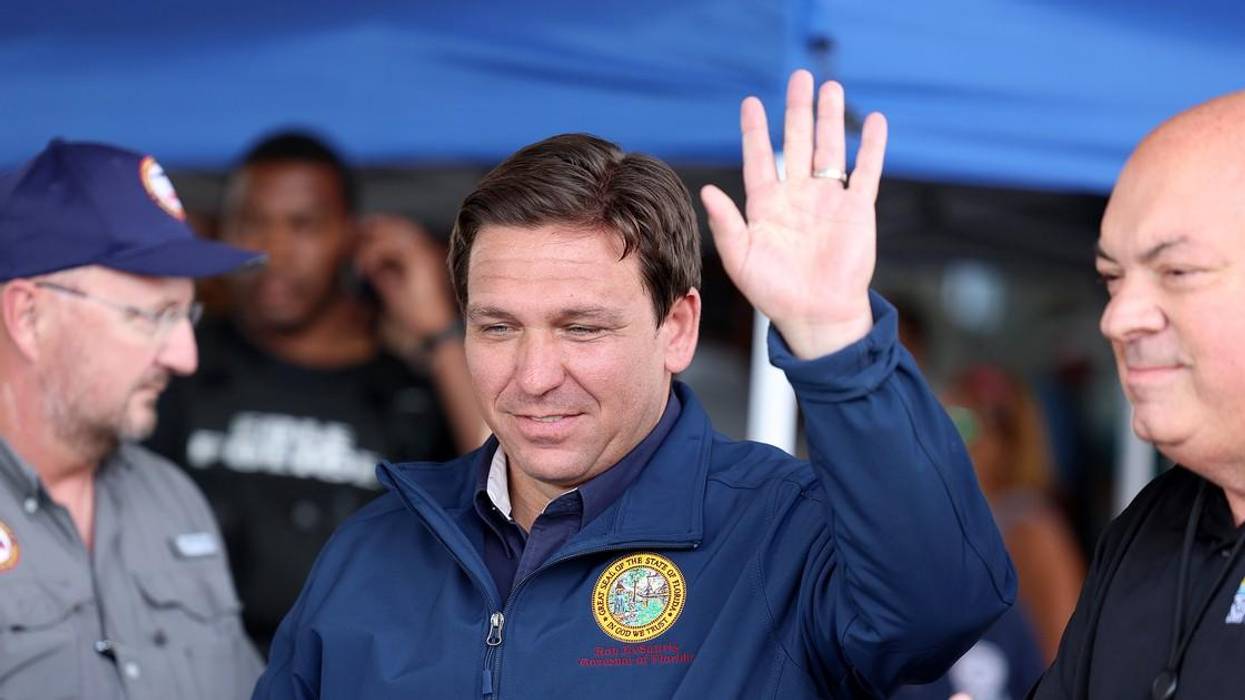
Playing the wannabe tough guy, he wants to troll his way to the White House as America's premiere culture warrior.
Ideological attacks on public education are central to the politics of Florida Gov. Ron DeSantis, who is carving out a brand as a book-burning, gay-phobic, transphobic, racist authoritarian. A Fauci-hater and anti-vax hero of right-wing media, DeSantis restricted instruction on gender identity and sexual orientation with his "Don't Say Gay" law. He limited what schools can teach about racism and diversity with his "Stop WOKE" law. He rejected math textbooks en masse for what the state called "prohibited topics," such as critical race theory; and he banned an Advanced Placement course in African-American studies for high school students on the grounds that it is a tool for "political indoctrination." Playing the wannabe tough guy, he wants to troll his way to the White House as America's premiere culture warrior.
His Trump-style, pugilistic approach was rewarded by Florida voters who reelected him by 19 percentage points. "Florida is where 'woke' goes to die" was DeSantis's sinister declaration in his inauguration speech, weaponizing "woke" to denounce any disliked policy from climate change to transgender rights, critical race theory, and the Black Lives Matter movement. He successfully appealed to the bigotries of the state's aging population, who were sadly bamboozled with racist culture war stunts like shipping legal migrants from Texas to Martha's Vineyard. They voted for a Trump poseur who performs cruelty for their enjoyment but wants to cut off Social Security and steal their nest eggs from under them.
As governor, DeSantis has failed to expand Medicaid, leaving hundreds of thousands of Floridians without health insurance. As a three-term congressman, DeSantis was a fierce opponent not just of the Affordable Care Act, but Social Security and Medicare. He voted to strip a quarter trillion dollars from programs that allow retired Americans to survive. Like most other Republicans in 2017, he voted to cut taxes on corporations, high-earners, and wealthy heirs. As president, he likely would slash what's left of the social safety net and use the proceeds to help the rich stay rich.
Single-minded about using the blunt-force gears of state to troll "the libs," DeSantis's anti-education crusade is doubly authoritarian—most obviously in its use of state power to suppress ideas and information, but also in its more subtle assumption that teaching is ultimately about imposing doctrines of one sort or another. As if he's auditioning for an anchor job, DeSantis is all over Fox News propagandizing the homophobic and racist laws he engineered.
"Gov. DeSantis understands culture war as public policy," barked Christopher Rufo, a DeSantis attack dog. Rufo—a MAGA activist who advised the DeSantis policy team on "Stop WOKE"—is essentially a chatbot who spews out an endless stream of culture war nonsense. A mini-DeSantis, he views anything related to addressing racism and diversity as "woke" while denouncing American schools as "hunting grounds" for pedophile teachers and suggesting that "parents have good reason" to worry about "grooming" in public schools.
Part of the "Stop WOKE" agenda pushed by DeSantis and Rufo, the "Individual Freedom" bill, bans the teaching of anything that might cause students to feel "guilt, anguish, or other forms of psychological distress." Yet the "freedom" it peddles is achieved by detaching Black children from knowledge of their own heritage and by "freeing" White children from dangerous feelings of solidarity with maltreated people. What DeSantis calls "psychological distress" is the spark of empathy children and adults feel from learning about the oppression of others. Even worse in the eyes of DeSantis, children might feel a sense of injustice and—inspired by the history of civil rights activists—want to better the world.
The legislation is part of a wave of "educational gag orders" banning the teaching of "divisive concepts"—all designed to chill classroom discussion of race and gender. Violations can trigger disciplinary action against faculty and enormous fines for their universities. But the gravest threat to academic freedom comes from a legal argument Florida has advanced in defense of the "Stop WOKE" Act.
In a brief filed in federal court, Florida's lawyers contend that faculty at public universities are government employees, in-classroom speech is "government speech," and the state "has simply chosen to regulate its own speech" with the "Stop WOKE" Act. Calling Florida's argument "positively dystopian" and noting it would give Florida "unfettered authority to muzzle its professors," the district court temporarily barred enforcement of the statute. But Florida has appealed, and the ultimate outcome of the case is uncertain.
With the various provisions of the "Stop WOKE" bill, "Don't Say Gay" bill, and now the rejection of the College Board's Advanced Placement African-American history, Florida leads an unrelenting, country-wide assault on truth and freedom of expression. Following Florida, other states want to suppress disfavored viewpoints in the form of laws that censor the histories and experiences of marginalized groups, especially Black and LGBTQ+ communities.
At least 18 states, for example, have laws or policies that restrict the teaching of race and gender. Typical prohibitions include outlawing "indoctrination"—viewed as teaching the history of slavery, racism, and Jim Crow—and forbidding discussions of gender identity, gender orientation, or critical race theory—the view that systemic racism is ingrained into American law and institutions. Along with promoting homophobia and hatred, this widespread attack on Black perspectives helps fuel the racial divisions that enable white supremacy, which serves to maintain the systemic racism that these laws try to ignore.
More than just "trolling the libs," these Florida laws have coerced librarians into becoming the reading police. DeSantis has made it clear that he doesn't want schools to acknowledge that LGBTQ+ people exist. He's banned the teaching of Black history classes on the grounds that lessons on people like Frederick Douglass or Rosa Parks "have no educational value." District officials there have launched reviews of the appropriateness of teachers' books as part of House Bill 1467, the state law mandating that school books be age-appropriate, free from pornography, and "suited to student needs." With the threat of legal action, Florida's Duval County Public Schools urged educators to "err on the side of caution" in determining whether a book "is developmentally appropriate for student use."
Some school districts even closed their libraries until all their books can be vetted to make sure they are in compliance and avoid felony charges. When a teacher raised concerns about such book removals, a school official warned the teacher that violating the state law could lead to third-degree felony charges for distributing "harmful materials" to minors. Students arrived in some Florida public school classrooms this month to find their teachers' bookshelves wrapped in paper. A Florida teacher was fired last week after posting a video of empty bookshelves that DeSantis called "a fake narrative." The efforts to conceal titles have stirred outrage from educators and parents, many of whom also shared images of bare wooden shelves or books veiled behind sheets of colored paper.
In his maniacal search for manufactured culture war assaults and new "libs to own," DeSantis has a bully's knack for finding easy targets among marginalized groups.
In his maniacal search for manufactured culture war assaults and new "libs to own," DeSantis has a bully's knack for finding easy targets among marginalized groups. He has fired the latest salvo in his educational culture war on New College—a tiny liberal arts school in Sarasota with a large LGBTQ+ population. Inaugurating a plan to remake Florida's educational system in his image and build his MAGA legitimacy ahead of a likely presidential run, DeSantis wants to fundamentally change the character of New College, which describes itself as "a community of free thinkers."
DeSantis's education commissioner has expressed a desire to transform the school into "Hillsdale of the South," referencing the conservative, Christian private college in Michigan that is a feeder school for right-wing politics and has close ties to both DeSantis and Trump. In response to a political assault on their academic freedom, New College students say they feel like they've been turned into guinea pigs in a right-wing social experiment.
The governor appointed a hard-right board of trustees that includes DeSantis' ventriloquist dummy Christopher Rufo, who decried what he called, "gender, grooming, and trans ideology in schools" and bragged on Twitter: "We are now over the walls and ready to transform higher education from within. Under the leadership of Gov. DeSantis, our all-star board will demonstrate that the public universities, which have been corrupted by woke nihilism, can be recaptured, restructured, and reformed."
The trustees promptly fired the school president and installed the former Republican state House Speaker and former DeSantis education commissioner Richard Corcoran as interim president. Corcoran told a Hillsdale National Leadership Seminar last summer that education was "100% ideological. Education is our sword. That's our weapon. Our weapon is education."
After ousting the college president, DeSantis unveiled higher education policies to weaken faculty tenure protections, eliminate diversity and equity programs, and mandate Western civilization courses. "The core curriculum must be grounded in actual history, the actual philosophy that has shaped Western civilization," said DeSantis. "We don't want students to go through, at taxpayer expense, and graduate with a degree in Zombie studies." Eliminating Zombie studies means students would not be able to explore the mysterious, malignant driving force of DeSantis's brain-dead voters.
Deepening a chill that had already taken hold across Florida's public schools and universities, the state asked students and faculty to fill out a survey about their political leanings and requested information about resources for transgender students. DeSantis' mouthpiece Rufo also targeted Florida State University, saying the school was led by a "sprawling bureaucracy dedicated to promoting left-wing narratives" that condemned American society as structurally racist, which FSU business professor Jack Fiorito called "exaggerated rubbish."
DeSantis attacks education as "indoctrination" to chase the votes of the most reactionary segment of the public. While claiming that the educational system is biased against conservatives, Christians, and white people and that teachers are pushing extreme leftist agendas, DeSantis legislates a system of right-wing indoctrination under the guise of fairness and impartiality. Aside from denouncing elite education, DeSantis—a graduate of Yale and Harvard—bashes the usual Fox News scourges and appeals to the grievance-fueled MAGA crowd. Like Trump, DeSantis harbors grudges and seeks revenge on enemies, real or perceived. In this, he echoes the MAGA mob's desire to punish and destroy immigrants, non-whites, and "woke" elites. The Trump-averse Republicans rallying to DeSantis are calculating that his synthetic, performative version of Trumpism will serve as an adequate substitute for the MAGA base.
The 2022 midterms hopefully showed that most people are sick of the MAGA clown show, the conspiracy theories, and the hate for its own sake. When voters get a whiff of DeSantis' boring act that strangely mimics Trump's gestures like a programmed automaton, they will find him as repulsive as Trump himself. His speech on Monday to the Fraternal Order of Police in a Chicago suburb provoked a fierce flurry of condemnations and criticism from the Illinois governor and Chicago mayoral contenders. Embattled incumbent mayor Lori Lightfoot got it right in her characterization: "Ron DeSantis has perfected being a bigoted, racist demagogue."