April, 19 2021, 12:00am EDT

Carbon Offset Scams Facing Broad Opposition
Ahead of the reintroduction of Growing Climate Solutions Act, farmers join with environmental justice, worker and clean energy advocates to oppose false climate solution.
WASHINGTON
As the Biden Administration gears up for a global climate summit and Congress begins negotiations on an infrastructure package, agricultural-based offsets for polluters are attracting considerable criticism as a false solution that will do little to reduce emissions.
A cadre of organizations recently sent a letter to Congress, coordinated by Food & Water Watch, that focuses on the Growing Climate Solutions Act, legislation that would lay the foundation for a federally certified carbon offset program. Senate Agriculture, Nutrition and Forestry Chairwoman Debbie Stabenow (D-MI) and Rep. Abigail Spanberger (D-VA-7) are leading this effort in Congress, and are expected to reintroduce the bill in the days ahead.
While supporters of the Growing Climate Solutions Act (including powerful fossil fuel and agribusiness interests) portray offsets as a win-win for farmers and the climate, critics point out that offsets undermine efforts to create a more sustainable and regenerative farming system, weaken efforts to address climate change and increase pollution in environmental justice communities while also not eliminating existing pollution at source..
"Family farmers must be part of any solution to the climate crisis, but are also justifiably dubious of relying upon corporate controlled market schemes to do so. Farmers have long been denied a fair (parity) price for their commodities due to price rigging by the food giants, and this same abuse will happen with carbon trading. Privatized pollution speculation is a false climate solution -- a much better option is to encourage family farmers to switch towards more agroecological practices by expanding existing publicly funded conservation programs," said John E. Peck Executive Director Family Farm Defenders.
Those opposed to the bill also outline existing USDA programs such as the Environmental Quality Incentives Program and Conservation Stewardship Program that are oversubscribed, and with more funding could actually help build soil health, protect water quality, and avoid greenhouse gas emissions while boosting farm income. In addition to increasing funding for these programs, the groups point to the need to close loopholes that fund factory farming, which are inundating environmental justice and rural communities with air and water pollution and perpetuating dangerous occupational conditions for farmworkers.
"Farmworker frontline communities bear the direct consequences and are the primary victims of the pollution caused by CAFOs and factory farms by diminishing air quality and often contaminating the water on which these communities rely for their daily needs," said Nezahualcoyotl Xiuhtecutli, General Coordinator, Farmworker Association of Florida.
The pollution concerns with offsets do not end with factory farming; as the letter points out, offsets are actually increasing pollution in environmental justice communities where power plants and other polluters are already relying on offsets to continue the status quo.
"My water-rich, life giving homelands are under attack. A new oil pipeline by Enbridge Energy will carry nearly a million barrels of the world's dirtiest oil through our tribal territories, threatening our traditional foods, our waters, our ways of life, in fact our very lives. And not just here in Northern Minnesota; the effects on the climate threaten the entire world. Enbridge's Line 3 will contribute the equivalent of the carbon produced by 50 coal fired power plants, while being able to claim net-zero emissions through scams like carbon offsets," said Simone Senogles, a member of the Red Lake Band of Chippewa Indians and Indigenous Environmental Network.
Climate advocates have also voiced opposition to offsets, based on numerous studies that raise serious concerns about their actual impact on reducing emissions derived from the extraction and burning of fossil fuels.
"Offsets don't stop climate change because they don't stop emissions. The whole point of an offset is that one entity gets to keep emitting greenhouse gases. Major oil companies are claiming to be greening their operations by purchasing offsets, while at the same time expanding operations for the continued extraction and burning of fossil fuels. That fact alone should leave no doubt that the emperor is truly naked. Offsets are not a climate solution and continued emissions lead to continued warming," said Doreen Stabinsky, professor of global environmental politics, College of the Atlantic.
Food & Water Watch mobilizes regular people to build political power to move bold and uncompromised solutions to the most pressing food, water, and climate problems of our time. We work to protect people's health, communities, and democracy from the growing destructive power of the most powerful economic interests.
(202) 683-2500LATEST NEWS

Finnish Petition Demands Data Center Regulation After Google Felled 250,000 Trees to Make Way for AI Project
“It has been done in the wrong way," said one resident of the Finnish town of Muhos. "American style. No sense. No sense at all."
Oct 22, 2026
A petition calling for more regulation of data centers in Finland has gathered more than 96,400 signatures—nearly twice the amount needed to force the Finnish Parliament to formally take up the petition for a debate—after Google infuriated residents and officials of two towns where the tech giant illegally chopped down an estimated 250,000 trees across 815 acres of forest after purchasing the land area.
The company felled the trees and stripped the entire area of its top soil without conducting a legally required environmental impact assessment, prompting the Finnish Licensing and Supervision Authority (LVV) to order Google to suspend all "measures that significantly change the environment."
The company was given a deadline of October 23 to halt the work in the rural towns of Muhos and Otanmäki, and LVV said it would consider enforcement proceedings and fines if Google does not comply.
Google's Finland country manager, Antti Järvinen, said last week that the company had acted “on the best understanding we had of the legislation at the time" as it cleared the land for its €13 billion ($14.5 billion) artificial intelligence infrastructure projects.
With 145 new data centers planned in Finland, where vast swaths of uninhabited land and the cool climate have attracted AI companies looking to rapidly build out the massive facilities, the petition proposed by citizens calls on Parliament to draft legislation that would ensure data centers are subject to "conditions and restrictions [in] connection to the electricity network."
The legislation must take "into account the capacity of the electricity network, mandatory reserve power, and the utilization of waste heat," reads the petition. "The aim of the legislative drafting is to ensure the adequacy and affordability of electricity for households and other industries."
Citizens are also calling for a "data center fee" to be imposed, "the basis for which must correspond to the environmental damage caused by the operation and the resources used (e.g. electricity, water, land use) to act as a system that compensates for these disadvantages."
Across the US and in other countries, the rapid AI data center build-out pushed by President Donald Trump, tech CEOs, and other leaders has prompted outcry in numerous communities, where residents have led grassroots efforts to block the construction of the centers.
Public approval for data centers has plummeted as residents have raised concerns about the facilities hiking household energy bills, guzzling water supplies, and providing few, if any, long-term jobs.
But Finnish Prime Minister Petteri Orpo of the conservative National Coalition Party has called attracting investment from AI firms a "top priority" for the Nordic country and has promised that Google's development will “deliver lasting benefits for both parties."
Speaking to The Guardian Thursday, Jussi Kangasharju, a computer science expert at the University of Helsinki, was skeptical of those claims.
“Really, for Finland, there are no benefits,” he told the outlet. “They are international companies serving international customers. Very little corporate taxes go to Finland. Data centers ultimately have very little benefit for others except the data center operator.”
Hanna Halmeenpää, chair of the Finnish Association for Nature Conservation (SLL), expressed disbelief over Google's destruction of the country's prized forests.
“I have never heard that any company has done anything like this in Finland," Halmeenpää told The Guardian Thursday. “They bought the vast land area, and they just started to cut it, just like that... It’s pure arrogance."
Another SLL official, Vesa Hyyryläinen, told the newspaper that wildlife in the forest that used to surround Otanmäki, including nesting woodpeckers, had been pushed out, while a resident whose family has lived in the town for generations explained how Google may have endangered locals by cutting down the biodiverse forest.
“We had wolves coming into the village because all the wild animals moved out of the forest,” Anni Ranta told The Guardian.
Conservationists were unimpressed Thursday with Google's pledge to plant trees across 130 hectares in the Muhos area and to work to protect water quality in the town following the destruction of the forest.
“It has been done in the wrong way," Muhos resident Aantti Jakonen told The Guardian. "American style. No sense. No sense at all."
Keep ReadingShow Less
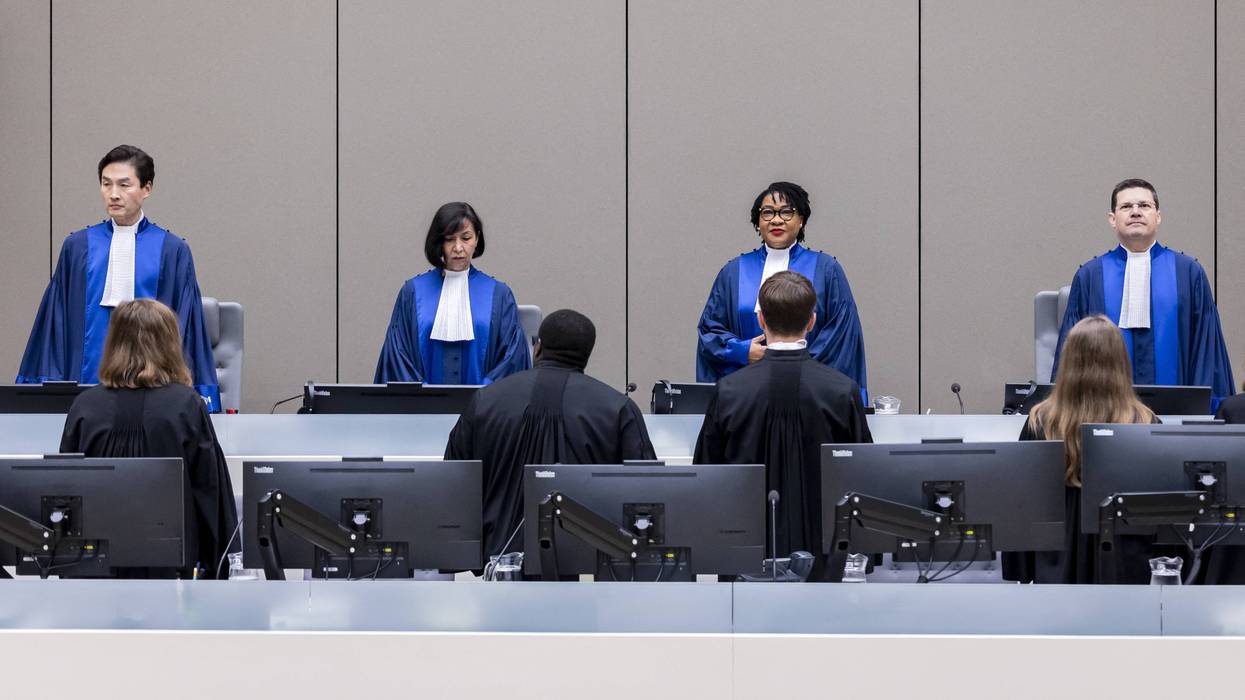
Under Assault From Trump, Embattled ICC Wins Top Human Rights Prize in Europe
Yannis Maniatis, whose bloc nominated the court to receive the award, said it was meant to demonstrate "that no one is above the law."
Oct 22, 2026
The European Union on Thursday awarded its most prestigious human rights prize to the International Criminal Court and its officials in a rebuke to President Donald Trump’s efforts to destroy the institution.
The EU’s Sakharov Prize for Freedom of Thought—previously awarded to figures such as Nelson Mandela and Malala Yousafzai—follows another international honor this month for a former ICC judge. Earlier in October, Navi Pillay, a former judge for the war crimes court, received the Nobel Peace Prize.
“The European Union is built on respect for multilateralism and international institutions," said European Parliament President Roberta Metsola as she announced the award on Thursday. “With the award of the Sakharov Prize to the International Criminal Court and its officials, the European Parliament recognizes the court’s important work in upholding international law and justice.”
Welcoming the award, which will be presented in December, ICC president Tomoko Akane noted that it “comes at a time when the court and its officials face unprecedented challenges.” She added, “There is no peace without justice and no security without law.”
In retaliation for the ICC’s 2024 arrest warrant for Israeli Prime Minister Benjamin Netanyahu, the Trump administration has declared war on the court, with Secretary of State Marco Rubio saying the goal was to “dismantle” it.
The US and Israel have not ratified the Rome Statute that created the ICC in 2002, and they claim that the court therefore has no power to hold their citizens accountable for war crimes. Supporters of the body argue that it has jurisdiction over crimes committed by Americans or Israelis in member states, such as Afghanistan and Palestine.
At last month's United Nations General Assembly meeting in New York, Trump raged against the court as an "evil group of people" and declared that he would "never allow US service members or anyone else to be investigated or given show trials by an anti-American tribunal with no jurisdiction over us." During the same speech, he threatened to "annihilate" Iran and bragged about seizing Venezuela's oil as "spoils" of war.
After sanctioning individual judges, UN experts, and human rights organizations that provided evidence of Israeli war crimes in Gaza, the Trump administration earlier this month sanctioned the court as a whole—threatening to cut it off from financial services and technology it needs to function. Human rights organizations have decried the sanctions as a fundamental assault on international law itself and a declaration of impunity by the United States.
Yannis Maniatis, a Greek lawmaker and vice president for foreign affairs of the European Parliament’s Socialists and Democrats bloc, which nominated the ICC for the prize, said the honor was meant to reinforce the idea “that no one is above the law.”
“We stand by the ICC and its officials, and we are committed to safeguarding its work," he said Monday. "We must guarantee that the ICC is able to operate independently, free from pressure or external interference."
"The court ensures that victims around the world have access to justice," he added. "It is a people-based organization, not a political one. If the aggressors become the victims, and if we stand by helplessly as international justice erodes, we risk allowing those who believe themselves above the law to prevail."
Ursula von der Leyen, the president of the European Commission, likewise welcomed the award.
"For victims of the world's gravest crimes, justice means a voice," she said. “The [ICC] must be free to pursue its mission independently and without pressure or intimidation.”
Some European lawmakers have warned that expressions of solidarity with the ICC will mean little unless the EU takes decisive action to shield the court from US sanctions.
Earlier this month, the chairs of five European Parliament bodies said that "targeting the court as an institution crosses a fundamental red line, one that threatens the independence and integrity of a tribunal established to uphold accountability for the gravest crimes of concern to the international community."
"The European Union must now demonstrate unwavering solidarity with the ICC and its personnel—not only with words but also with concrete acts," they said. "The European Commission must immediately trigger the EU Blocking Statute, shielding the court and European actors from the extraterritorial reach of these sanctions. Europe must stand firm in defense of international law and the rule of law.”
On Monday, European Commission spokesperson Siobhan McGarry confirmed that the measure remained under consideration but announced no decision or timeline for activating it.
The Left, a coalition of socialist and other left-wing parties in the European Parliament, said awarding the Sakharov Prize to the ICC sent a “strong signal to the European Commission to immediately invoke the Blocking Statute and protect international justice from US sanctions and intimidation.”
Keep ReadingShow Less
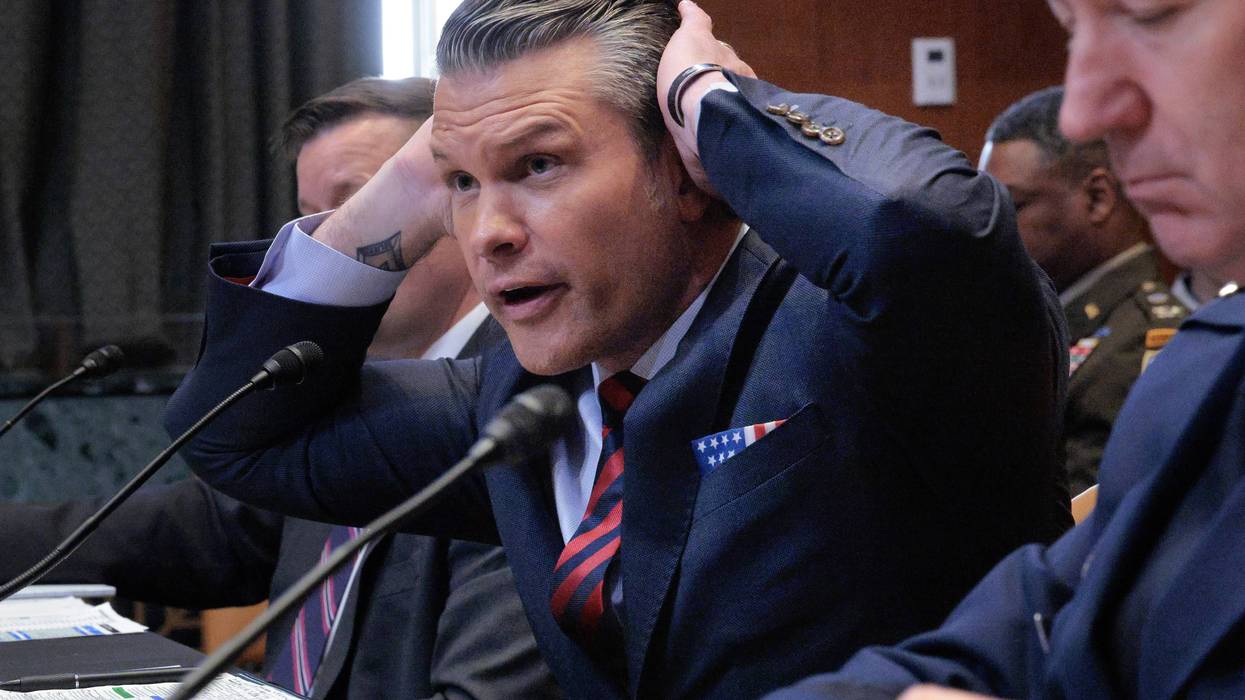
'A Perfect Metaphor': Hegseth Staffers Broke Historic Globe After Pentagon Chief Demanded It for His Office
"I cannot think of a more apt metaphor for Pete Hegseth’s DoD," said one critic.
Oct 22, 2026
Staffers for US Defense Secretary Pete Hegseth broke a globe used by Gen. Dwight Eisenhower during World War II after the Trump Cabinet official demanded that it be moved to his office in the Pentagon.
The Washington Post reported on Thursday that Hegseth wanted the historic 30-inch globe delivered to his office because he found its historical significance "attractive."
The Post noted that while moving historical items such as the globe is normally "a deliberate process overseen by trained curators," Hegseth's staff dispensed with such formalities and attempted to move it by themselves.
The staffers subsequently dropped the globe, cracking its shell and creating a gash several inches wide.
While the US Department of Defense denied requests from Post reporters to inspect the globe in person, the newspaper nonetheless obtained photos of the artifact, which revealed a large hole at its base.
After the globe was damaged, the staffers abandoned plans to bring it to Hegseth's office.
Ty Seidule, a retired brigadier general who taught history at the US Military Academy at West Point, told the Post that it appears Hegseth "wants an Eisenhower totem to be like Ike, brilliant in war and peace."
"Hegseth is no Ike," Seidule continued. "The globe won’t give him Ike’s attributes of humility, intellect, and judgment."
Other critics of Hegseth drew attention to the symbolism of the defense secretary breaking a historic artifact while eschewing expert assistance.
"They broke Eisenhower’s globe because they didn’t want to wait for a team of specialist historians to move it," wrote weapons systems expert John Ridge in a social media post. "I cannot think of a more apt metaphor for Pete Hegseth’s DoD."
Drop Site reporter Ryan Grim remarked that "Hegseth’s frat brothers breaking Eisenhower’s globe is a bit too on the nose."
Pod Save America co-host Tommy Vietor argued that the globe incident was "a perfect metaphor" for Hegseth's reign at the Pentagon, as it was "stupid, impulsive, driven by vanity, and the result is destruction."
Yale historian Joanne Freeman wrote that the symbolism of Hegseth's team breaking the globe "is too much to bear."
"And of course, they ignored the TRAINED EXPERTS WHO HANDLE HISTORICAL ITEMS," Freeman added. "Because EDUCATION? EXPERTISE? WHO NEEDS IT?"
Writer David Simon, creator of hit TV series The Wire, said the symbolism of the globe debacle was too heavy-handed even for a Hollywood drama.
"This metaphor is ridiculously obvious and unsubtle," Simon wrote. "Fire the writers. They're hacks."
Keep ReadingShow Less

'This Is Huge,' Economist Says as Filing Shows Zuckerberg Getting Ready to Pay CA Billionaire Tax
"This SEC filing is proof that the campaign for Proposition 40 is working," said Gabriel Zucman. "We are at a turning point."
Oct 22, 2026
Federal filings released Wednesday reveal how Meta CEO Mark Zuckerberg, one of the richest men in the world, is getting ready to potentially pay a billionaire wealth tax that is on California's November midterm ballot—an indication of the grassroots campaign's impact.
"This is huge," economist Gabriel Zucman, an outspoken supporter of the proposed tax, wrote on social media in response to Meta's new filing with the US Securities and Exchange Commission. "We are witnessing a global turning point unfold before our eyes."
The New York Times reported Wednesday that the filing discloses the outcome of tense, months-long negotiations between Zuckerberg and Meta's board. Meta is headquartered in California, and Zuckerberg lives in a sprawling compound in Palo Alto.
According to the Times, Zuckerberg threatened to sell his home and leave California if board members didn't agree to a deal that would allow him to sell shares to cover his possible tax bill without relinquishing any control of Meta.
"On Wednesday, the company unveiled the result: In January, it will issue a new class of stock to shareholders, which Mr. Zuckerberg can sell to pay the potential wealth tax without cutting into his 60.6% voting power at the Silicon Valley firm," the Times reported. "Mr. Zuckerberg’s decision to preemptively restructure his stock holdings shows how fearful Silicon Valley is that the tax measure, Proposition 40, might pass in the midterm election on November 3."
WOW. New SEC filing: Zuckerberg is preparing to pay California’s billionaire tax, AND has signed an agreement to stay in the state for 8 years.Two myths down: no, billionaires won’t all flee, and yes, they can pay their fair share without losing their companies.Just 12 days left to win this! Holy shit this could be historic.
— Rutger Bregman (@rutgerbregman) October 22, 2026
If California voters approve Proposition 40 and defeat competing initiatives that would cancel it out, billionaires living in California as of January 1, 2026 would face 5% tax on their wealth, which they could pay all at once or over a five-year period.
The tax would raise an estimated $100 billion in revenue, funds that would help offset federal Medicaid cuts and fund California's education system. Prominent billionaires, led by Google cofounder Sergey Brin, have spent aggressively against the proposed tax, but Zuckerberg is not known to have donated to the opposition efforts.
Zucman, a world-renowned expert on inequality, noted that Meta's CEO would face a roughly $10 billion tax bill under Proposition 40. Zucman has argued the tax could serve as a model for broader efforts to rein in wealth inequality.
"Until now, Mark Zuckerberg has paid very little in taxes relative to the staggering growth of his fortune," the economist wrote on Wednesday. "Proposition 40—the California billionaire tax—would change that."
"This SEC filing is proof that the campaign for Proposition 40 is working," Zucman added. "Mark Zuckerberg is preparing to pay the wealth tax if California voters decide to approve Prop 40. Voting is already underway, and it ends in just 12 days. We are at a turning point. California is closer than ever to enacting the first billionaire wealth tax in history. This is a historic moment."
Keep ReadingShow Less
Judge Blocks Error-Riddled Effort by Trump DHS to Crack Down on Vanishingly Rare Voting by Noncitizens
"It was clear from the start that DHS built its lists on bad data, never checked how often it was wrong, and recklessly sent agents to people's homes weeks before an election," said one voting rights advocate.
Oct 22, 2026
A federal judge in California ruled late Wednesday that the US Department of Homeland Security has violated the Voting Rights Act by sending agents door-to-door and demanding information from people about their immigration status and whether they've voted in recent elections—part of President Donald Trump's perennial effort to prove the baseless claim that noncitizens are committing mass voter fraud to secure Democratic victories.
In the US District Court of the Northern District of California, District Judge Araceli Martinez-Olguin ordered federal agents to end their "elections-related field operations and field interviews" in nine states, including California, New York, Missouri, Connecticut, Georgia, Nevada, Pennsylvania, Washington, and Wisconsin.
DHS can no longer carry out the operations if they are likely to involve interrogations of people whom agency officials "know, suspect, or should reasonably know or suspect are US citizens," said the judge.
Because the Trump administration has been turned away by state and local agencies when officials have demanded access to voter data, DHS has been forced to compile its lists of targets using commercially available information and comparing it with federal records.
That method has resulted in target lists that are "voluminous and unreliable," wrote Martinez-Olguin.
In Nevada last month, for example, Homeland Security Secretary Markwayne Mullin asserted that his agency had determined there were close to 16,000 noncitizens on the state voter rolls. DHS sent the state a list of 185 people from that list, whom it claimed had been improperly permitted to register to vote.
But a deputy attorney general for the state tersely informed Mullin that records indicated all 185 people DHS was targeting were citizens.
“You have provided nothing of substance to suggest otherwise," he wrote.
Martinez-Olguin suggested she would not tolerate more large-scale errors that threaten the voting rights of thousands of Americans, and said the Trump administration's so-called "Unlawful Voter Initiative" violates a section of the Voting Rights Act that makes it illegal to "intimidate, threaten, or coerce" people and groups that contribute to voter mobilization efforts or assist with voting.
"Plaintiffs do not claim, nor does the court find, that it is unlawful for federal officials to undertake investigations into unlawful voting in federal elections," the judge said in her ruling. "Rather, plaintiffs seek to stop DHS from continuing to investigate US citizens, who have a legal right to vote, in a way that intimidates and threatens the participation" of National Nurses United and California Nurses Association, which have been involved in voter mobilization and sued DHS over its policy.
Martinez-Olguin added that "the public’s interest in safe elections, free from interference or intimidation... far exceed defendants’ purported interest in combating unlawful voting by non-US citizens.”
The Department of Justice has indicated that a tiny fraction of registered voters in the US—156 people—have been charged with offenses related to "voter fraud," despite Trump's claims that voting by noncitizens, which is illegal, is rampant in the US.
In California, federal authorities this week said they had identified 28 immigrants who were suspected of voting before they became naturalized citizens. They all denied knowingly registering to vote or voting, and the group represented about 0.0001% of registered voters in California.
"It was clear from the start that DHS built its lists on bad data, never checked how often it was wrong, and recklessly sent agents to people's homes weeks before an election," Beau Tremitiere, counsel at Protect Democracy, which also sued over the policy, told CBS News. "Today's ruling should remind us that American citizens hold the ultimate power in our democracy, not the government—no matter what the administration says otherwise."
Keep ReadingShow Less
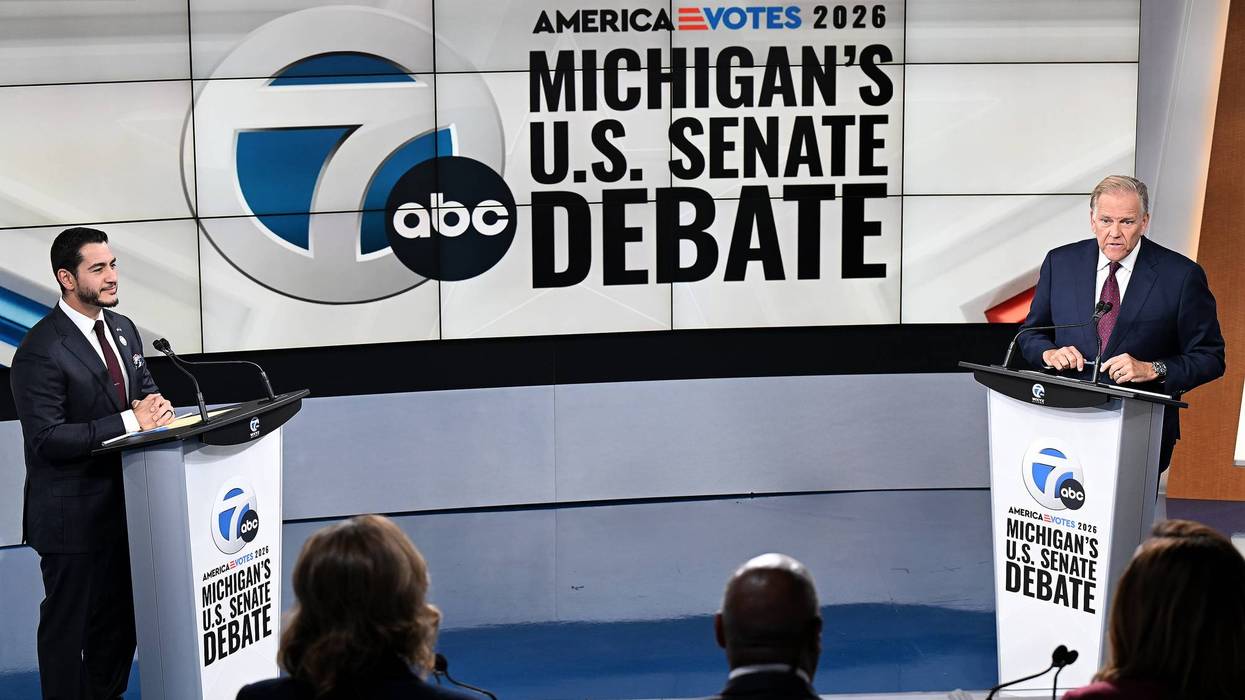
'He's in Bed With Big Insurance': In Final Debate, El-Sayed Targets Rogers' Votes Against Healthcare
"Nobody knows more about taking away your health insurance than he does," Abdul El-Sayed said of former Rep. Mike Rogers.
Oct 22, 2026
In the final debate of Michigan's critical US Senate race late Wednesday, Democratic nominee Abdul El-Sayed targeted his Republican opponent's record of voting against healthcare expansion and promoted his own vision of a country in which everyone receives coverage as a right.
Asked whether he would work to "expand, modify, or roll back policies of the Affordable Care Act," El-Sayed reiterated his support for Medicare for All, which he characterized as "building on the incredible success" of the 2010 law. The Democratic candidate pointed out that former US Rep. Mike Rogers (R-Mich.) voted against the ACA and repeatedly opposed earlier efforts to expand health coverage for children in low-income families.
"He's in bed with Big Insurance," El-Sayed, the former executive director of Detroit's health department, said of Rogers. "Nobody knows more about taking away your health insurance than he does."
Rogers said the ACA "needs reform"—without spelling out what that would entail—and attacked El-Sayed's support for Medicare for All, which the Republican falsely said would "destroy Medicare for seniors." A study published in August by experts at Yale University found that a single-payer system like the one proposed in Sen. Bernie Sanders' (I-Vt.) Medicare for All Act would save around 68,000 lives and $650 billion per year compared to the status quo.
Survey data released last week by Progress Michigan and Public Policy Polling shows that the cost of insurance is the top healthcare-related issue for Michigan voters heading into the midterm elections, as ACA marketplace premiums surge as a result of congressional Republicans' decision not to extend enhanced subsidies.
Families in Michigan and across the country are also losing care in large numbers due to unprecedented Medicaid cuts included in the GOP's 2025 budget law. Rogers celebrated that law as "a monumental victory for working families."
"Michiganders are taking note and are getting fed up with the mess that Republicans created," said Justin Mendoza, executive director of Progress Michigan. "This is further proof that we need a single-payer universal healthcare system, where insurance costs don’t constantly increase and leave families struggling. In the short term, lawmakers must act to help Michigan families afford the healthcare they need."
Keep ReadingShow Less

'Flat-Out Lying,' Israel Claims Palestinian Farmers, Brad Lander Entered Restricted Area Before Detention
Aside from the indignity of Israel forcing Palestinians to get permission to work their own land, the farmers and those with them—including a US congressional candidate—were not even in an area requiring coordination.
Oct 21, 2026
An official Israeli military map belies claims made Wednesday by Israel's government that Palestinian olive harvesters accompanied by activists and US congressional candidate Brad Lander had entered a restricted area of the illegally occupied West Bank prior to their detention earlier in the day.
Israeli occupation forces detained Lander and scores of other people—including Israeli leftists, members of Rabbis for Human Rights, and Jewish American activists—near the town of Nahalin as they accompanied Palestinians who sought to harvest the olives that provide economic and cultural sustenance to their families and communities.
Lander, the Democratic nominee for New York's 10th Congressional District, was released after roughly three hours with what he called a "warning." Many of the other detainees remained in custody, according to The Times of Israel.
The Israel Defense Forces (IDF) and Israeli Foreign Ministry initially said that harvesting in the area required prior coordination with the authorities. But a map distributed to Palestinian farmers by Israel's Civil Administration, the military's administrative arm in the occupied territory, showed that the location did not require coordination.
The discrepancy prompted questions about why the farmers and their supporters were detained at all—and condemnation of an illegal occupation and apartheid system that forces Palestinians to get permission to work their own land.
"The Israeli Foreign Ministry is lying. No coordination was required, and we were never told that it was," Lander said on X. "We were not in a restricted security area. We did not pass any checkpoints. Palestinian farmers do not—and should not—need permits to harvest their own olive fields. But they fear doing so, because the IDF doesn’t protect them from settler violence."
Responding to an Israeli Foreign Ministry social media post claiming "Brad Lander's latest stunt" was "not about harvesting olives," but rather "harvesting headlines," Palestinian human rights activist Ihab Hassan retorted, "If you stopped Israeli settler terrorists from storming Palestinian villages and communities, murdering civilians, stealing olives, setting homes on fire, and seizing land, there would be no headlines to harvest."
Hassab said in a separate post: "The Israeli Foreign Ministry is flat-out lying about Lander and the other activists entering a restricted area. The IDF’s own map shows they were not in a restricted area."
Some observers responded with mockery, like Jerusalem attorney Daniel Seidemann, who quipped that the apprehended Palestinians were guilty of "aggravated harvesting in the first degree."
New York social worker David Grossman posted a photo of an SUV belonging to World Central Kitchen that was bombed by Israeli forces in Gaza in one of multiple Israeli massacres of workers and volunteers for the food charity during the ongoing genocide.
Israeli journalist Haim Goldich acknowledged on X that "there's a chance there's a big mess here and 80 people were detained for no reason."
Wednesday's events took place against a backdrop of a particularly violent olive harvest season. The United Nations Office for the Coordination of Humanitarian Affairs (OCHA) said Monday that between September 1 and October 12, Israeli settlers carried out 199 attacks connected to the harvest, killing one Palestinian, injuring 124, and damaging more than 2,500 trees and saplings.
OCHA documented more than 2,060 settler attacks resulting in Palestinian death, injury, or property damage across the occupied West Bank since the beginning of 2026—an average of seven attacks a day.
According to OCHA, at least 1,138 Palestinians—at least 250 of them children—have been killed by Israeli soldiers and settlers in the West Bank since October 2023.
While Israeli leaders have sometimes condemned individual attacks—even while casting aspersions on victims like US photojournalist Heidi Levine—critics argue that the state's broader policies enable the violence. Settlements receive state infrastructure and protection, while Palestinians face restrictions on movement, land access, construction, and agricultural activity.
The result is a system in which Palestinians can face military detention for attempting to harvest their own trees, even as settlers attack Palestinian farmers and destroy their livelihood with impunity.
“The harvest orders tell the story of the government’s criminal policy: Settlers are illegally seizing more and more hilltops with government encouragement and support, while the military, for its part, closes off vast areas to Palestinians under the pretext of defending those illegal outposts," the Israeli group Peace Now said last week.
"This is a system of dispossession and plunder," the group continued, "and it is a disgrace to the State of Israel.”
Keep ReadingShow Less
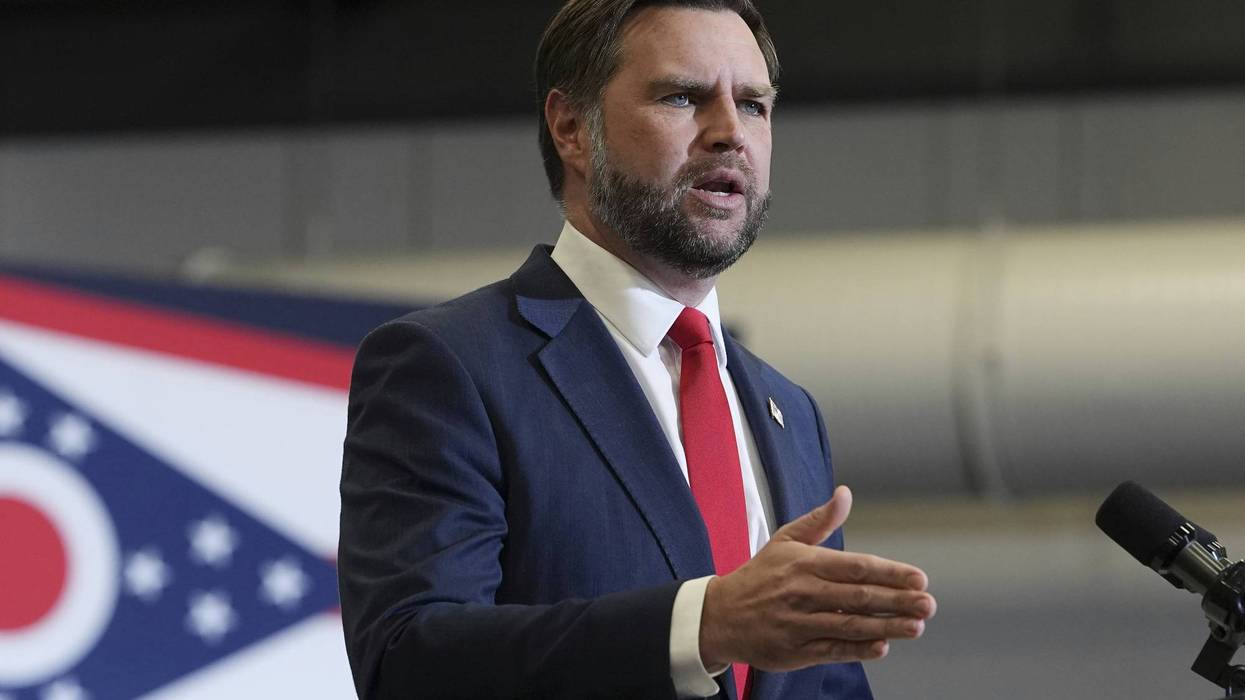
Vance Defends 'Vile' Ramaswamy Ad, Offering Preview of 'Venom' He's Likely to Deploy in 2028 Race
Vivek Ramaswamy's ad exposed him as "digusting, vile, and unfit," said one former Republican lawmaker, but "JD Vance arrives to show there’s someone even worse."
Oct 21, 2026
A day after the Republican gubernatorial candidate in Ohio, Vivek Ramaswamy, stunned political observers by releasing an ad that featured the estranged mother of his opponent, Amy Acton, calling Acton "a liar," Vice President JD Vance told reporters during an appearance in the state that he was "disgusted."
But the vice president, widely viewed as the likely heir to President Donald Trump's far-right MAGA movement, wasn't disturbed by the content of the ad, in which Acton's biological mother, Donna Arthur, accused Acton of lying about experiencing homelessness as a child.
He wasn't troubled by the fact that Ramaswamy's campaign had enlisted the help of Arthur even though she lost custody of her children and hadn't seen Acton since 1978, when the Democratic candidate was 12 and testified in court that her stepfather, Arthur's husband, had raped Acton. And he didn't express horror over the fact that Arthur fled the state with her husband to avoid legal liability and stayed married to him until his death in 2004 despite his alleged abuse of her daughter, only to be featured in an ad attacking Acton more than two decades later.
Instead, Vance reserved his "disgust" for Republicans who condemned the ad, which Ramaswamy's campaign is now planning to spend $4 million streaming ahead of Election Day.
While the ad has been called "the most disgusting, pathetic ad ever created in the history of political ads" by one observer and has resulted in calls for an end to Ramaswamy's political career, Vance shrugged off the content of the 60-second video by saying, "Politics is a tough business."
He called on his fellow Republicans, some of whom have denounced the ad, to put aside concerns about attacking Acton, whose allegations are backed up by court records—and to focus instead on the dangers posed by Democratic candidates like Acton who have called to expand healthcare access, lower costs for working Americans, and support workers' rights.
"My message to my fellow elected Republicans is if you actually believe in the things you say you believe in, stop whining about an advertisement and go win the race in 13 days," Vance told reporters in Cincinnati.
WOW -- Vance *defends* Ramaswamy's reprehensible ad 👇Q: Ramaswamy's campaign put out a controversial ad featuring his opponent's mother. Some Republicans are backing away from that. Do you think that ad was appropriate?JD VANCE: Well, I'll be honest with you. Whether the ad was appropriate or not is not really my concern. My concern is who is gonna govern. I have to admit I'm a little bit disgusted when I see Republicans who are whining more about that ad than they are about what the Democrats want to do.
— Aaron Rupar (@atrupar) October 21, 2026
The vice president added that "whether the ad was appropriate or not is not really my concern" and said he was "disgusted" to see Republicans "who are whining more about that advertisement than they are about what the congressional Democrats and other Democrats want to do to the United States of America."
Vance's position on Ramaswamy's tactics—deployed as Acton was leading him by seven points in one poll by Marist College—brought to mind, for some observers, his comments in 2024 about the Trump campaign's spreading of racist, baseless lies about the Haitian population of Springfield, Ohio eating their neighbors' pets during the presidential race.
Vance told CNN at the time that he was willing “to create stories so that the... media actually pays attention to the suffering of the American people."
"Vance's earlier Haitian pet-eating lie and his current embrace of Vivek's weaponization of child abuse are providing a pretty ugly picture of what the Vance 2028 presidential campaign is going to look like," said Jessica Reidl of the Brookings Institution. "Just venom, lies, and smears all the way down."
Republicans who have attempted to distance themselves from Ramaswamy's ad include US Sen. John Husted of Ohio and the state's secretary of state, Frank LaRose, both of whom said they would not have chosen to run such an advertisement. LaRose said his office was reviewing complaints about the video.
An aide for Sen. Mike Lee (R-Utah) deleted a social media post sharing the video and apologized for amplifying it “after researching it, and the disturbing allegations.” Casey Putsch, who ran against Ramaswamy in the GOP primary, said he would cross party lines to "vote for Amy and end Vivek's political future in America" in light of the ad, while former United Nations Ambassador Nikki Haley, who sparred with Ramaswamy during the 2024 race, also denounced the video.
After Vance's press conference, former US Rep. Barbara Comstock (R-Va.) said that while the ad had exposed Ramaswamy as "digusting, vile, and unfit, JD Vance arrives to show there’s someone even worse."
In addition to the press conference, Vance spoke about the ad and doubled down on attacking Acton at a rally in his home state on Wednesday.
"Now the media and the Democrats in the state of Ohio are obsessed because guess what, Vivek Ramaswamy had the audacity to run a TV commercial which calls it out like it is and calls Amy Acton a liar," said Vance.
WOW -- Vance *defends* Ramaswamy's reprehensible ad 👇Q: Ramaswamy's campaign put out a controversial ad featuring his opponent's mother. Some Republicans are backing away from that. Do you think that ad was appropriate?
JD Vance: "Now the media and the Democrats in the state of Ohio are obsessed because Vivek Ramaswamy had the audacity to run a TV commercial which calls it out like it is and calls Amy Acton a liar" https://t.co/iWKrOKclmW
— Aaron Rupar (@atrupar) October 21, 2026
He then said that Ohio voters "see through" Acton's "fraudulent activity" before egging on an audience member who suggested the Democratic candidate is an alcoholic.
"Somebody said alcohol," the vice president said with a grin. "You can say it sir, I can't."
Gillian Branstetter, a communications strategist with the ACLU, said that with less than two weeks to go until Election Day, Vance's closing midterm argument amounts to "please help us smear a child rape victim to overcome the electoral hurdle of our failing president."
As families across the US struggle with rising prices at the gas pump, grocery store, and doctor's office—linked to Trump's war on Iran, tariff policy, and Republicans' healthcare cuts—the president's approval rating stands at 32%, according to a recent Reuters poll.
Ryan Grim of Drop Site News called Vance's attacks on Acton "truly despicable given JD’s own upbringing" by his mother, who struggled with substance use disorder, which he wrote about in the memoir Hillbilly Elegy.
"JD Vance doubling down on the claim that Amy Acton and her brother are lying about being abused as children. If he is so sure, then why did the state strip custody?" said Grim. "What if his mom was still an addict and did an ad calling JD a liar for his book? Would he be ok with that? Soulless behavior."
The vice president, said journalist Pedro L. Gonzalez, is giving voters a choice "between a party that downplays child sexual abuse and attempts to discredit the victims or the party that doesn’t do that."
"That is his closing pitch," said Gonzalez, "and I hope the only thing people remember him for."
Keep ReadingShow Less
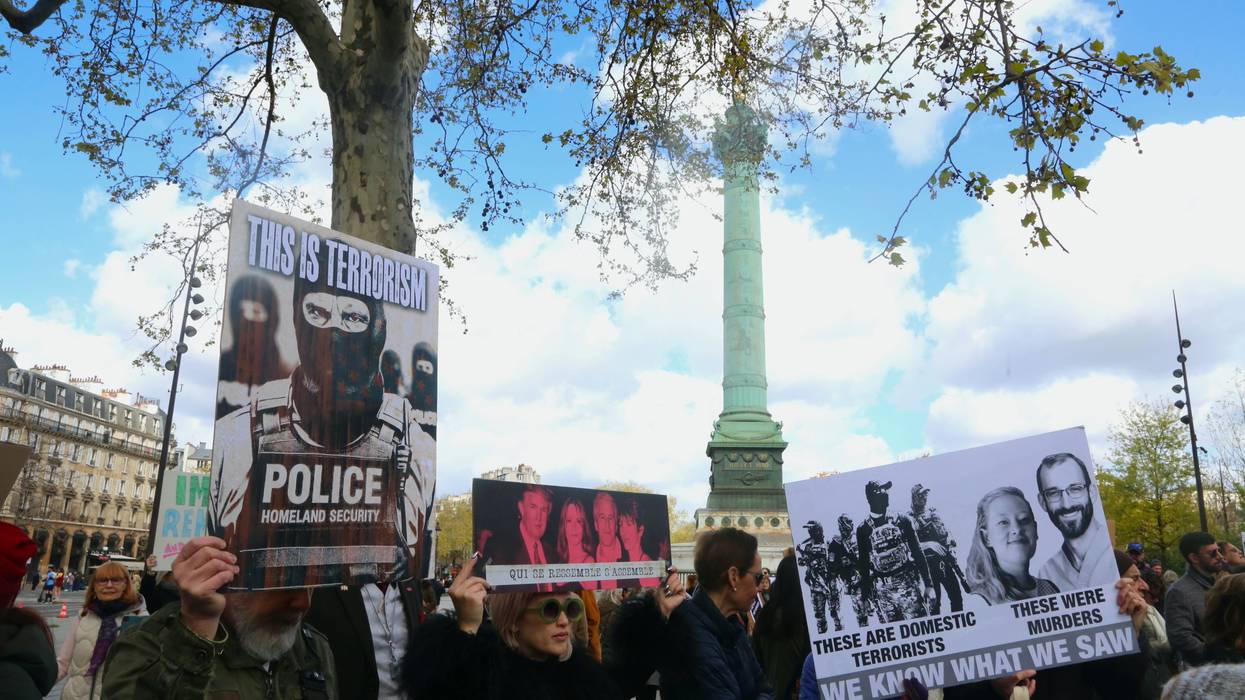
'Nothing and No One Is Off the Table for NSPM-7,' Warns Analysis of Trump Crackdown on Dissent
“The NSPM-7 blueprint enables efficient coordination across federal agencies to disrupt our democracy and go after the greatest number of people through surveillance, investigation, and prosecution."
Oct 21, 2026
The Trump administration is using a sweeping "national security" framework to investigate and potentially prosecute political opponents, civil society groups, and people engaged in constitutionally protected activities, according to an analysis published Wednesday warning that the crackdown on dissent could intensify ahead of next month's midterm elections.
The report, “Enemies of the State: NSPM-7 and the Trump Plan to Crush Dissent,” was co-authored by Shilpa Jindia and Nora Benavidez at the advocacy group Free Press. The publication examines the yearlong implementation of President Donald Trump’s National Security Presidential Memorandum 7 (NSPM-7), which ostensibly targets domestic terrorism and organized political violence.
Over 28 pages, the analysis examines how the administration is coordinating federal agencies to target people whose political beliefs or activism conflict with Trump’s agenda. Activities potentially caught up in the crackdown include protesting immigration enforcement, distributing information about constitutional rights, monitoring immigration officials, and supporting election integrity.
“The NSPM-7 blueprint enables efficient coordination across federal agencies to disrupt our democracy and go after the greatest number of people through surveillance, investigation, and prosecution,” said Jindia, who is Free Press' policy counsel. “The aim is to levy the heaviest penalties across agencies to achieve the harshest sentences."
"While the methods, severity, and application of the blueprint are explicit, the framework sets no standards for application—whether physical, geographic, thematic, or constitutional," she added. "As a result, nothing and no one is off the table for NSPM-7 to sweep up and target.”
Although NSPM-7 by itself does not grant the government new legal powers, the report contends that the framework enables more aggressive coordination among existing agencies, empowering prosecutors and investigators to work together against perceived political adversaries.
Benavidez, Free Press' senior counsel, warned that the approaching midterm elections—whose integrity Trump has baselessly attacked in a similar manner to his "Big Lie" that Democrats "stole" the 2020 presidential contest—offer particularly dangerous opening for the administration to intensify its crackdown on dissent.
“The midterm elections are at our doorstep; the president is eagerly pursuing election-fraud narratives, telling voters he will pay them off if they vote for Republicans—and leveraging his executive power to sway election results if he can,” she said. “Already [Department of] Homeland Security officials have investigated more than 150 nonprofit organizations under the guise of ‘election integrity.’"
"It’s by no means outside the realm of possibility that NSPM-7 becomes the vehicle to shut down civic engagement and political expression in the weeks and months to come," Benavidez added.
The analysis urges Congress and civil society groups to take action to defend constitutional freedoms and prevent further expansion of the crackdown.
Earlier this year, dozens of Democrats in the House of Representatives launched an inquiry into the US State Department's "ideologically driven visa restriction policy" and the Treasury Department's "pledged financial enforcement mechanisms directed against civil society."
"Trump has made clear his intentions to interfere in the November midterm elections," Jindia and Benavidez wrote. "Losing control of Congress could subject the administration to investigations and hearings, including potential impeachment hearings of Trump and his Cabinet officials."
Keep ReadingShow Less
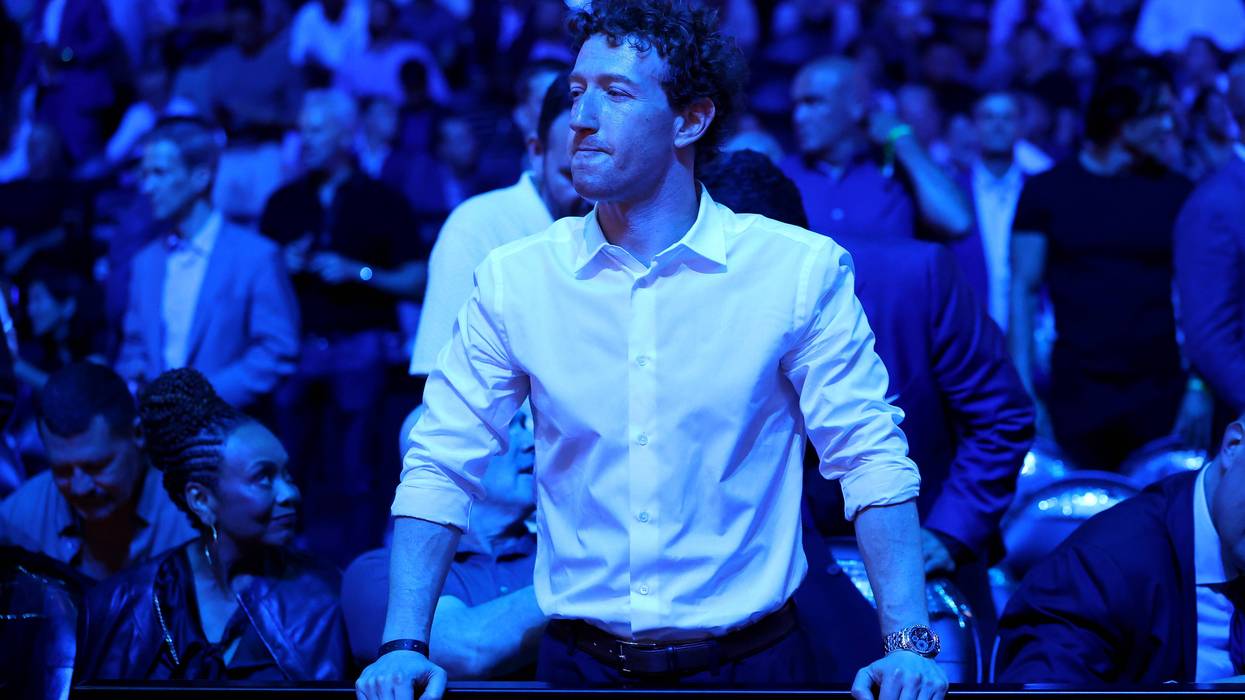
'Historic Day': New Mexico Judge Orders Meta to Pay $25 Billion in Data Privacy Case
"For too long, powerful technology companies have operated as though their size and influence put them beyond the reach of the law," the attorney general said.
Oct 21, 2026
A New Mexico judge on Wednesday ordered Meta to pay $25 billion for misleading users about data privacy—and while state Attorney General Raúl Torrez's office touted it as "one of the largest financial penalties against a corporation in US history," it's also just a fraction of the $219.5 billion warranted under the law.
The case stems from the Cambridge Analytica scandal, over which New Mexico sued in 2021. The New York Times reported that the order from Judge Francis J. Mathew of the State District Court in Santa Fe "is the biggest blow yet to Meta, which owns Facebook, Instagram, and WhatsApp, as it has racked up court losses over the harms that its social media platforms have caused users."
Reuters noted that "in 2019, the company was hit with a $5 billion penalty by the US Federal Trade Commission stemming from the same scandal. Six other states settled their lawsuits related to Cambridge Analytica for $459.2 million as part of a $17.1 billion multistate settlement Meta reached in August to resolve states' claims that the company's platforms had harmed teen mental health."
However, Torrez's state wasn't part of that settlement—and last month, a jury found that Meta had committed over 43 million violations of the New Mexico Unfair Practices Act.
That led to the order in which Mathew wrote that "the extraordinary number of willful violations found by the jury, the duration and repetition of the conduct, the breadth of subjects on which violations occurred, the involvement of senior Facebook leadership, the size of New Mexico audiences reached, and the clear intentional and systematic nature of Facebook's repeated misstatements established in the trial record support the highest level of penalty allowed by the New Mexico Unfair Practices Act—$5,000 per violation found by the jury."
Although the judge ultimately reduced the penalty to just over 11% of what Meta could have faced, the tech giant is still trying to dodge it. Chief legal officer CJ Mahoney said in a statement that the company is "confident" that it will "prevail on appeal."
"This ruling, and the attorney general’s approach to this enforcement, makes it all but impossible to do business in the state of New Mexico," Mahoney said. "At its core, this lawsuit seeks to impose a tax on speech to enforce new rules for what people can say online."
Meanwhile, Torrez celebrated "a historic day for New Mexico and for consumers across the country."
"For too long, powerful technology companies have operated as though their size and influence put them beyond the reach of the law," the attorney general said. "A New Mexico jury found nearly 44 million violations of our consumer protection statute, and this penalty order demonstrates that those violations carry real consequences. We took on one of the largest companies in the world because New Mexicans deserve honesty, accountability, and the protection of their personal information. Today’s result makes clear that no corporation is too powerful to be held accountable."
"This case has always been about more than one company or one scandal,” Torrez stressed. "It is about whether corporations can mislead consumers about what happens to their personal information without facing meaningful consequences. New Mexico stood its ground, took this case to trial, and secured a verdict establishing millions of violations of our law. This outcome reinforces a fundamental principle, companies that do business in our state must follow our laws and respect the rights of our people."
It isn't Torrez's first victory against Meta. In August, Judge Bryan Biedscheid of the State District Court in Santa Fe tacked on $567 million in damages for a state case in which the company already faced $375 million in civil penalties for enabling harm to youth.
Keep ReadingShow Less
See More
Most Popular