SUBSCRIBE TO OUR FREE NEWSLETTER
Daily news & progressive opinion—funded by the people, not the corporations—delivered straight to your inbox.
5
#000000
#FFFFFF
To donate by check, phone, or other method, see our More Ways to Give page.
Daily news & progressive opinion—funded by the people, not the corporations—delivered straight to your inbox.
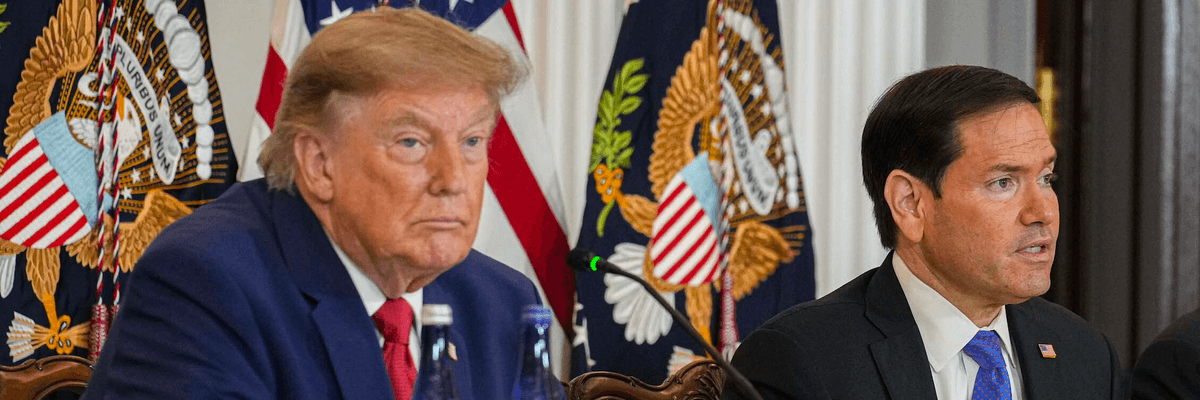
In what the Democratic senator called an effort at “obstructing investigations of Netanyahu’s war crimes,” the Trump administration is planning a dramatic escalation of its sanctions against the court.
As the United Nations General Assembly prepared to meet, a US senator said President Donald Trump and Secretary of State Marco Rubio should face sanctions for their role in trying to destroy the International Criminal Court in order to protect Israeli Prime Minister Benjamin Netanyahu.
"If European countries and other signatories to the International Criminal Court (ICC) have any self-respect, they'd sanction Rubio and Trump for obstructing investigations of Netanyahu's war crimes," wrote Sen. Chris Van Hollen (D-Md.) Monday on social media.
He was responding to a report from the Wall Street Journal detailing "a sharp escalation" in the Trump administration's efforts to, in Rubio's words, "dismantle" the ICC, which issued an arrest warrant for Netanyahu in 2024. The body accused the prime minister and then-Defense Minister Yoav Gallant of war crimes and crimes against humanity in Gaza, including the deliberate use of starvation as a weapon of war.
The ICC has also reportedly launched investigations into two other far-right ministers in Netanyahu's cabinet, Finance Minister Bezalel Smotrich and National Security Minister Itamar Ben-Gvir, for their roles in aggressively expanding Israeli settlements in the occupied West Bank, which are considered illegal under international law.
The Trump administration had already aggressively sanctioned ICC officials involved in efforts to prosecute Americans or Israelis, including then-chief prosecutor Karim Khan and several judges and prosecutors. It had also sanctioned UN special rapporteur on Palestine Francesca Albanese and several Palestinian human rights organizations that had brought evidence of alleged Israeli crimes before the tribunal.
Now, The Journal reports that:
The Trump administration is preparing to impose sweeping sanctions on the [ICC]...
The sanctions would forbid most transactions with the ICC after a grace period of six to seven months... That could potentially cripple the court by prohibiting it from conducting transactions in US dollars, cutting it off from much of the global financial system.
It is unclear when a final decision and announcement might come, though some US officials said the move could be finalized as soon as this week during the United Nations General Assembly meeting or in the following days.
Several world leaders have been vocally critical of the US attack on the ICC, though they've stopped short of calling for sanctions against US officials.
Responding to Rubio's sanctions in August, European Commission President Ursula von der Leyen and European Council President António Costa said that the ICC's "judges and officials must be able to act independently and without external pressure."
Dutch Foreign Minister Tom Berendsen, whose nation is home to the ICC, said the Netherlands disapproves of efforts to sanction the court, adding that Dutch officials were actively working with the EU to protect the court from institution-wide US sanctions. Possible protective measures reportedly include alternative banking and payment arrangements outside the US dollar system.
There have also been calls within the European Parliament, including from Spanish socialist politician Iratxe García Pérez and others, to activate the EU's so-called "blocking statute," which would prohibit European companies from complying with the US sanctions.
Dear Common Dreams reader, It’s been nearly 30 years since I co-founded Common Dreams with my late wife, Lina Newhouser. We had the radical notion that journalism should serve the public good, not corporate profits. It was clear to us from the outset what it would take to build such a project. No paid advertisements. No corporate sponsors. No millionaire publisher telling us what to think or do. Many people said we wouldn't last a year, but we proved those doubters wrong. Together with a tremendous team of journalists and dedicated staff, we built an independent media outlet free from the constraints of profits and corporate control. Our mission has always been simple: To inform. To inspire. To ignite change for the common good. Building Common Dreams was not easy. Our survival was never guaranteed. When you take on the most powerful forces—Wall Street greed, fossil fuel industry destruction, Big Tech lobbyists, and uber-rich oligarchs who have spent billions upon billions rigging the economy and democracy in their favor—the only bulwark you have is supporters who believe in your work. But here’s the urgent message from me today. It's never been this bad out there. And it's never been this hard to keep us going. At the very moment Common Dreams is most needed, the threats we face are intensifying. We need your support now more than ever. We don't accept corporate advertising and never will. We don't have a paywall because we don't think people should be blocked from critical news based on their ability to pay. Everything we do is funded by the donations of readers like you. When everyone does the little they can afford, we are strong. But if that support retreats or dries up, so do we. Will you donate now to make sure Common Dreams not only survives but thrives? —Craig Brown, Co-founder |
As the United Nations General Assembly prepared to meet, a US senator said President Donald Trump and Secretary of State Marco Rubio should face sanctions for their role in trying to destroy the International Criminal Court in order to protect Israeli Prime Minister Benjamin Netanyahu.
"If European countries and other signatories to the International Criminal Court (ICC) have any self-respect, they'd sanction Rubio and Trump for obstructing investigations of Netanyahu's war crimes," wrote Sen. Chris Van Hollen (D-Md.) Monday on social media.
He was responding to a report from the Wall Street Journal detailing "a sharp escalation" in the Trump administration's efforts to, in Rubio's words, "dismantle" the ICC, which issued an arrest warrant for Netanyahu in 2024. The body accused the prime minister and then-Defense Minister Yoav Gallant of war crimes and crimes against humanity in Gaza, including the deliberate use of starvation as a weapon of war.
The ICC has also reportedly launched investigations into two other far-right ministers in Netanyahu's cabinet, Finance Minister Bezalel Smotrich and National Security Minister Itamar Ben-Gvir, for their roles in aggressively expanding Israeli settlements in the occupied West Bank, which are considered illegal under international law.
The Trump administration had already aggressively sanctioned ICC officials involved in efforts to prosecute Americans or Israelis, including then-chief prosecutor Karim Khan and several judges and prosecutors. It had also sanctioned UN special rapporteur on Palestine Francesca Albanese and several Palestinian human rights organizations that had brought evidence of alleged Israeli crimes before the tribunal.
Now, The Journal reports that:
The Trump administration is preparing to impose sweeping sanctions on the [ICC]...
The sanctions would forbid most transactions with the ICC after a grace period of six to seven months... That could potentially cripple the court by prohibiting it from conducting transactions in US dollars, cutting it off from much of the global financial system.
It is unclear when a final decision and announcement might come, though some US officials said the move could be finalized as soon as this week during the United Nations General Assembly meeting or in the following days.
Several world leaders have been vocally critical of the US attack on the ICC, though they've stopped short of calling for sanctions against US officials.
Responding to Rubio's sanctions in August, European Commission President Ursula von der Leyen and European Council President António Costa said that the ICC's "judges and officials must be able to act independently and without external pressure."
Dutch Foreign Minister Tom Berendsen, whose nation is home to the ICC, said the Netherlands disapproves of efforts to sanction the court, adding that Dutch officials were actively working with the EU to protect the court from institution-wide US sanctions. Possible protective measures reportedly include alternative banking and payment arrangements outside the US dollar system.
There have also been calls within the European Parliament, including from Spanish socialist politician Iratxe García Pérez and others, to activate the EU's so-called "blocking statute," which would prohibit European companies from complying with the US sanctions.
As the United Nations General Assembly prepared to meet, a US senator said President Donald Trump and Secretary of State Marco Rubio should face sanctions for their role in trying to destroy the International Criminal Court in order to protect Israeli Prime Minister Benjamin Netanyahu.
"If European countries and other signatories to the International Criminal Court (ICC) have any self-respect, they'd sanction Rubio and Trump for obstructing investigations of Netanyahu's war crimes," wrote Sen. Chris Van Hollen (D-Md.) Monday on social media.
He was responding to a report from the Wall Street Journal detailing "a sharp escalation" in the Trump administration's efforts to, in Rubio's words, "dismantle" the ICC, which issued an arrest warrant for Netanyahu in 2024. The body accused the prime minister and then-Defense Minister Yoav Gallant of war crimes and crimes against humanity in Gaza, including the deliberate use of starvation as a weapon of war.
The ICC has also reportedly launched investigations into two other far-right ministers in Netanyahu's cabinet, Finance Minister Bezalel Smotrich and National Security Minister Itamar Ben-Gvir, for their roles in aggressively expanding Israeli settlements in the occupied West Bank, which are considered illegal under international law.
The Trump administration had already aggressively sanctioned ICC officials involved in efforts to prosecute Americans or Israelis, including then-chief prosecutor Karim Khan and several judges and prosecutors. It had also sanctioned UN special rapporteur on Palestine Francesca Albanese and several Palestinian human rights organizations that had brought evidence of alleged Israeli crimes before the tribunal.
Now, The Journal reports that:
The Trump administration is preparing to impose sweeping sanctions on the [ICC]...
The sanctions would forbid most transactions with the ICC after a grace period of six to seven months... That could potentially cripple the court by prohibiting it from conducting transactions in US dollars, cutting it off from much of the global financial system.
It is unclear when a final decision and announcement might come, though some US officials said the move could be finalized as soon as this week during the United Nations General Assembly meeting or in the following days.
Several world leaders have been vocally critical of the US attack on the ICC, though they've stopped short of calling for sanctions against US officials.
Responding to Rubio's sanctions in August, European Commission President Ursula von der Leyen and European Council President António Costa said that the ICC's "judges and officials must be able to act independently and without external pressure."
Dutch Foreign Minister Tom Berendsen, whose nation is home to the ICC, said the Netherlands disapproves of efforts to sanction the court, adding that Dutch officials were actively working with the EU to protect the court from institution-wide US sanctions. Possible protective measures reportedly include alternative banking and payment arrangements outside the US dollar system.
There have also been calls within the European Parliament, including from Spanish socialist politician Iratxe García Pérez and others, to activate the EU's so-called "blocking statute," which would prohibit European companies from complying with the US sanctions.