
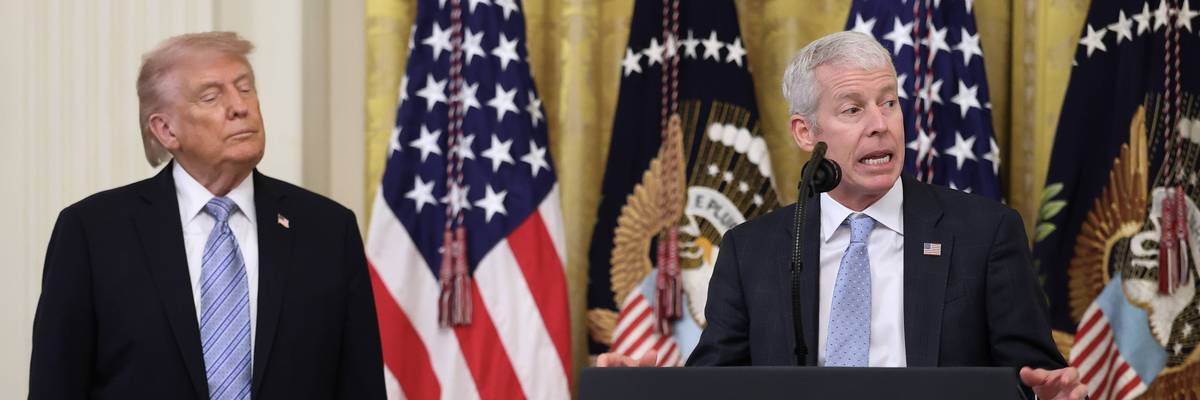
US Secretary of Energy Chris Wright speaks as he and President Donald Trump address a small business summit in the East Room of the White House on May 4, 2026 in Washington, DC.
Electricity Costs Up 18% as Trump's Self-Imposed Deadline to Cut Household Bills in Half Passes
"Time’s up, and so is your bill."
President Donald Trump's trade war, demand for the rapid expansion of energy-sucking artificial intelligence data centers, and cancellation of renewable energy projects have all gotten in the way of his ability to deliver on his promise to slash household electricity costs, according to US Energy Information Administration data released as the president's self-imposed deadline for cutting rates by 50% came and went this week.
The latest data from the EIA shows residential rates as recent as this past April, and finds that households paid an average of 18.83 cents per kilowatt-hour (kWh) that month compared with 17.55 cents in April 2025.
Since January 2025, when Trump entered office for his second term, prices have gone up by more than 18%, according to the EIA.
The data comes as the president reached the 18-month mark of his second administration—the deadline he gave himself to cut electricity rates in half.
"Under my leadership, the United States will commit to the ambitious goal of slashing energy and electricity prices by half at least,” Trump said at a campaign rally in North Carolina in August 2024. “We intend to slash prices by half within 12 months—at a maximum 18 months.”
"Every single thing that I promised, I produced," he added.
As Democratic research group American Bridge 21st Century said Tuesday, "Time's up, and so is your bill."
The 7.3% increase in the average electricity bill over the past 12 months alone shows costs soaring at roughly double the rate of inflation, reported 24/7 Wall Street.
The largest grid operator in the country, PJM Interconnection, reported a capacity price of $16.4 billion for power delivery in the 2028-29 period, according to the outlet. Reason also reported that data centers' electricity use added $6 billion to PJM's capacity auction, which utilities pay to guarantee future power supplies, with the costs flowing to ratepayers.
In the second quarter of 2026, utilities filed $9.2 billion in requests for rate hikes, up 26% from the same period in 2025, according to 24/7 Wall Street.
The EIA projected in May that residential electricity prices would rise by about 5% this year, with costs soaring the most in East Coast states.
Trump's deadline for slashing prices—a promise he made as families were also struggling with rising grocery and housing prices—came as The Century Foundation (TCF) released a report titled "Power Failure: Rising Energy Debt Is Climbing into the Middle Class."
According to the report, energy bills have increased three times faster than the inflation rate since Trump took office for the second time, with the national average utility bill reaching $280 in early 2026—a 12% increase since the end of 2024.
The average household in 18 states is now paying more than $280 per month for utilities, and average costs have gone up by more than 20% in 10 states since Trump began his second term.
In March 2026, the national average overdue utility balance for a household was $817, said TCF.
"The Trump administration’s policies are actively contributing to and worsening the energy cost crisis," reads TCF's report. "The effects of the Iran war will only further increase household utility costs, while runaway data center expansions account for 63 percent of electricity generation capacity costs in the nation’s largest power market. Meanwhile, the One Big Beautiful Bill Act repealed clean-energy tax credits that would have lowered household electricity bills and aid programs to help low-income families afford their energy bills."
Without citing evidence, Trump's energy secretary, Chris Wright, claimed last week that AI data centers "are the greatest tool we have right now to stop the rise of electricity prices," but numerous analyses have tied the rapid growth of the sector—pushed by the White House—to higher household costs, as a typical "hyperscale" data center can use as much as 100 megawatts, the same amount of electricity as 100,000 households.
Trump has also made components of energy infrastructure more expensive, while the think tank Energy Innovation found in a recent analysis that the president's cancellation of solar and other renewable energy projects could leave households paying an additional $460 per year in energy costs by 2035.
"The bottom line is what the data shows," wrote Joel South at 24/7 Wall Street. "The specific promise, cheaper power by mid-2026, was not met."
We are at a crossroads
This country and this world are at a monumental crossroads. In a few short weeks, US voters will have an opportunity to beat back the forces of fascism and confront the billionaires who are rigging the economy, our media system, and our democracy, making it increasingly impossible for ordinary people to get by. We’re not just talking about the election. We’re talking about what must be done once these fascist elements are vanquished from power. We need a bolder set of solutions than what either major party has so far been willing to offer and a working-class movement ready to fight like hell for it. Trump didn't emerge from nowhere. The conditions that fueled MAGA authoritarianism were created by decades of radical neoliberal economic policies and a corrupt political system dominated by corporate interests. They slashed taxes on the super-rich, promising that the benefits would trickle down. They said giveaways to the corporate titans would make life more affordable for the rest of us. It was all bullshit. And when a bitter, betrayed populace searches for someone to blame, right-wing demagogues have little trouble finding scapegoats. People know when they're being lied to, but you won't hear any of this from the corporate media. Only independent journalism—powered and funded by people who believe in building a better world—can deliver truly trustworthy daily news. Our Fall Campaign is underway, and we need your help. To power our newsroom through the rest of the year, we need to raise $125,000 by midnight on October 31. So if you share our vision, please contribute whatever you can to sustain our work. |
President Donald Trump's trade war, demand for the rapid expansion of energy-sucking artificial intelligence data centers, and cancellation of renewable energy projects have all gotten in the way of his ability to deliver on his promise to slash household electricity costs, according to US Energy Information Administration data released as the president's self-imposed deadline for cutting rates by 50% came and went this week.
The latest data from the EIA shows residential rates as recent as this past April, and finds that households paid an average of 18.83 cents per kilowatt-hour (kWh) that month compared with 17.55 cents in April 2025.
Since January 2025, when Trump entered office for his second term, prices have gone up by more than 18%, according to the EIA.
The data comes as the president reached the 18-month mark of his second administration—the deadline he gave himself to cut electricity rates in half.
"Under my leadership, the United States will commit to the ambitious goal of slashing energy and electricity prices by half at least,” Trump said at a campaign rally in North Carolina in August 2024. “We intend to slash prices by half within 12 months—at a maximum 18 months.”
"Every single thing that I promised, I produced," he added.
As Democratic research group American Bridge 21st Century said Tuesday, "Time's up, and so is your bill."
The 7.3% increase in the average electricity bill over the past 12 months alone shows costs soaring at roughly double the rate of inflation, reported 24/7 Wall Street.
The largest grid operator in the country, PJM Interconnection, reported a capacity price of $16.4 billion for power delivery in the 2028-29 period, according to the outlet. Reason also reported that data centers' electricity use added $6 billion to PJM's capacity auction, which utilities pay to guarantee future power supplies, with the costs flowing to ratepayers.
In the second quarter of 2026, utilities filed $9.2 billion in requests for rate hikes, up 26% from the same period in 2025, according to 24/7 Wall Street.
The EIA projected in May that residential electricity prices would rise by about 5% this year, with costs soaring the most in East Coast states.
Trump's deadline for slashing prices—a promise he made as families were also struggling with rising grocery and housing prices—came as The Century Foundation (TCF) released a report titled "Power Failure: Rising Energy Debt Is Climbing into the Middle Class."
According to the report, energy bills have increased three times faster than the inflation rate since Trump took office for the second time, with the national average utility bill reaching $280 in early 2026—a 12% increase since the end of 2024.
The average household in 18 states is now paying more than $280 per month for utilities, and average costs have gone up by more than 20% in 10 states since Trump began his second term.
In March 2026, the national average overdue utility balance for a household was $817, said TCF.
"The Trump administration’s policies are actively contributing to and worsening the energy cost crisis," reads TCF's report. "The effects of the Iran war will only further increase household utility costs, while runaway data center expansions account for 63 percent of electricity generation capacity costs in the nation’s largest power market. Meanwhile, the One Big Beautiful Bill Act repealed clean-energy tax credits that would have lowered household electricity bills and aid programs to help low-income families afford their energy bills."
Without citing evidence, Trump's energy secretary, Chris Wright, claimed last week that AI data centers "are the greatest tool we have right now to stop the rise of electricity prices," but numerous analyses have tied the rapid growth of the sector—pushed by the White House—to higher household costs, as a typical "hyperscale" data center can use as much as 100 megawatts, the same amount of electricity as 100,000 households.
Trump has also made components of energy infrastructure more expensive, while the think tank Energy Innovation found in a recent analysis that the president's cancellation of solar and other renewable energy projects could leave households paying an additional $460 per year in energy costs by 2035.
"The bottom line is what the data shows," wrote Joel South at 24/7 Wall Street. "The specific promise, cheaper power by mid-2026, was not met."
- 'Another Trump Lie': Despite Campaign Pledges, Electricity Costs Up $100 Per Family ›
- Trump Promised to Lower Energy Prices for Americans. He's Done the Exact Opposite ›
- New Inflation Numbers Prove 'Catastrophic Mismanagement of Our Economy' by Trump | Common Dreams ›
President Donald Trump's trade war, demand for the rapid expansion of energy-sucking artificial intelligence data centers, and cancellation of renewable energy projects have all gotten in the way of his ability to deliver on his promise to slash household electricity costs, according to US Energy Information Administration data released as the president's self-imposed deadline for cutting rates by 50% came and went this week.
The latest data from the EIA shows residential rates as recent as this past April, and finds that households paid an average of 18.83 cents per kilowatt-hour (kWh) that month compared with 17.55 cents in April 2025.
Since January 2025, when Trump entered office for his second term, prices have gone up by more than 18%, according to the EIA.
The data comes as the president reached the 18-month mark of his second administration—the deadline he gave himself to cut electricity rates in half.
"Under my leadership, the United States will commit to the ambitious goal of slashing energy and electricity prices by half at least,” Trump said at a campaign rally in North Carolina in August 2024. “We intend to slash prices by half within 12 months—at a maximum 18 months.”
"Every single thing that I promised, I produced," he added.
As Democratic research group American Bridge 21st Century said Tuesday, "Time's up, and so is your bill."
The 7.3% increase in the average electricity bill over the past 12 months alone shows costs soaring at roughly double the rate of inflation, reported 24/7 Wall Street.
The largest grid operator in the country, PJM Interconnection, reported a capacity price of $16.4 billion for power delivery in the 2028-29 period, according to the outlet. Reason also reported that data centers' electricity use added $6 billion to PJM's capacity auction, which utilities pay to guarantee future power supplies, with the costs flowing to ratepayers.
In the second quarter of 2026, utilities filed $9.2 billion in requests for rate hikes, up 26% from the same period in 2025, according to 24/7 Wall Street.
The EIA projected in May that residential electricity prices would rise by about 5% this year, with costs soaring the most in East Coast states.
Trump's deadline for slashing prices—a promise he made as families were also struggling with rising grocery and housing prices—came as The Century Foundation (TCF) released a report titled "Power Failure: Rising Energy Debt Is Climbing into the Middle Class."
According to the report, energy bills have increased three times faster than the inflation rate since Trump took office for the second time, with the national average utility bill reaching $280 in early 2026—a 12% increase since the end of 2024.
The average household in 18 states is now paying more than $280 per month for utilities, and average costs have gone up by more than 20% in 10 states since Trump began his second term.
In March 2026, the national average overdue utility balance for a household was $817, said TCF.
"The Trump administration’s policies are actively contributing to and worsening the energy cost crisis," reads TCF's report. "The effects of the Iran war will only further increase household utility costs, while runaway data center expansions account for 63 percent of electricity generation capacity costs in the nation’s largest power market. Meanwhile, the One Big Beautiful Bill Act repealed clean-energy tax credits that would have lowered household electricity bills and aid programs to help low-income families afford their energy bills."
Without citing evidence, Trump's energy secretary, Chris Wright, claimed last week that AI data centers "are the greatest tool we have right now to stop the rise of electricity prices," but numerous analyses have tied the rapid growth of the sector—pushed by the White House—to higher household costs, as a typical "hyperscale" data center can use as much as 100 megawatts, the same amount of electricity as 100,000 households.
Trump has also made components of energy infrastructure more expensive, while the think tank Energy Innovation found in a recent analysis that the president's cancellation of solar and other renewable energy projects could leave households paying an additional $460 per year in energy costs by 2035.
"The bottom line is what the data shows," wrote Joel South at 24/7 Wall Street. "The specific promise, cheaper power by mid-2026, was not met."
- 'Another Trump Lie': Despite Campaign Pledges, Electricity Costs Up $100 Per Family ›
- Trump Promised to Lower Energy Prices for Americans. He's Done the Exact Opposite ›
- New Inflation Numbers Prove 'Catastrophic Mismanagement of Our Economy' by Trump | Common Dreams ›