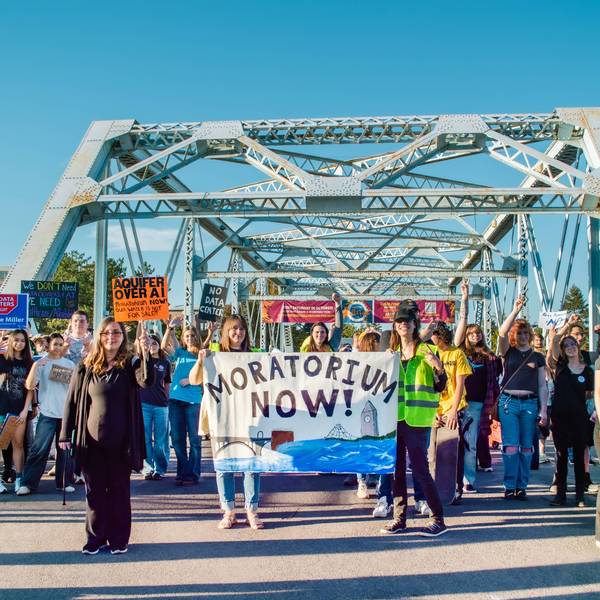

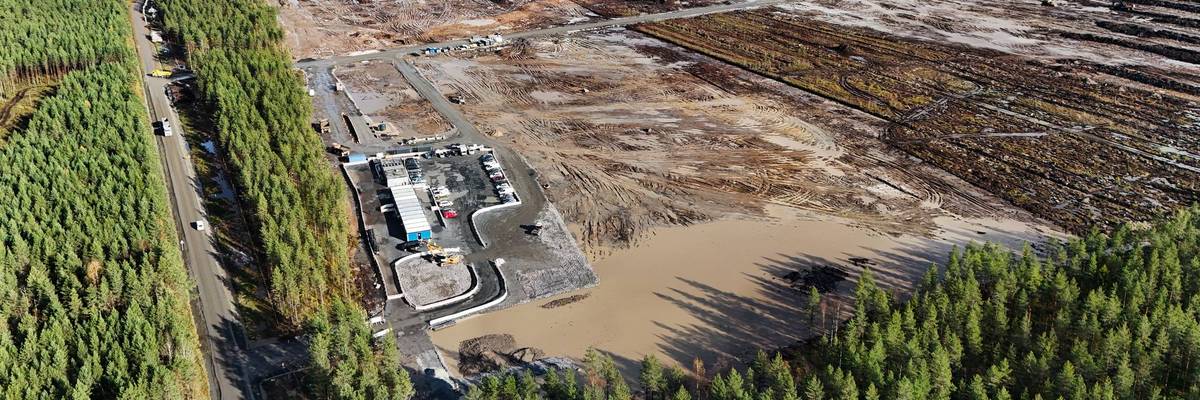
An aerial view shows the site where Google's data center is set to be built in Muhos, Finland, on September 29, 2026.
Finnish Petition Demands Data Center Regulation After Google Felled 250,000 Trees to Make Way for AI Project
“It has been done in the wrong way," said one resident of the Finnish town of Muhos. "American style. No sense. No sense at all."
A petition calling for more regulation of data centers in Finland has gathered more than 96,400 signatures—nearly twice the amount needed to force the Finnish Parliament to formally take up the petition for a debate—after Google infuriated residents and officials of two towns where the tech giant illegally chopped down an estimated 250,000 trees across 815 acres of forest after purchasing the land area.
The company felled the trees and stripped the entire area of its top soil without conducting a legally required environmental impact assessment, prompting the Finnish Licensing and Supervision Authority (LVV) to order Google to suspend all "measures that significantly change the environment."
The company was given a deadline of October 23 to halt the work in the rural towns of Muhos and Otanmäki, and LVV said it would consider enforcement proceedings and fines if Google does not comply.
Google's Finland country manager, Antti Järvinen, said last week that the company had acted “on the best understanding we had of the legislation at the time" as it cleared the land for its €13 billion ($14.5 billion) artificial intelligence infrastructure projects.
With 145 new data centers planned in Finland, where vast swaths of uninhabited land and the cool climate have attracted AI companies looking to rapidly build out the massive facilities, the petition proposed by citizens calls on Parliament to draft legislation that would ensure data centers are subject to "conditions and restrictions [in] connection to the electricity network."
The legislation must take "into account the capacity of the electricity network, mandatory reserve power, and the utilization of waste heat," reads the petition. "The aim of the legislative drafting is to ensure the adequacy and affordability of electricity for households and other industries."
Citizens are also calling for a "data center fee" to be imposed, "the basis for which must correspond to the environmental damage caused by the operation and the resources used (e.g. electricity, water, land use) to act as a system that compensates for these disadvantages."
Across the US and in other countries, the rapid AI data center build-out pushed by President Donald Trump, tech CEOs, and other leaders has prompted outcry in numerous communities, where residents have led grassroots efforts to block the construction of the centers.
Public approval for data centers has plummeted as residents have raised concerns about the facilities hiking household energy bills, guzzling water supplies, and providing few, if any, long-term jobs.
But Finnish Prime Minister Petteri Orpo of the conservative National Coalition Party has called attracting investment from AI firms a "top priority" for the Nordic country and has promised that Google's development will “deliver lasting benefits for both parties."
Speaking to The Guardian Thursday, Jussi Kangasharju, a computer science expert at the University of Helsinki, was skeptical of those claims.
“Really, for Finland, there are no benefits,” he told the outlet. “They are international companies serving international customers. Very little corporate taxes go to Finland. Data centers ultimately have very little benefit for others except the data center operator.”
Hanna Halmeenpää, chair of the Finnish Association for Nature Conservation (SLL), expressed disbelief over Google's destruction of the country's prized forests.
“I have never heard that any company has done anything like this in Finland," Halmeenpää told The Guardian Thursday. “They bought the vast land area, and they just started to cut it, just like that... It’s pure arrogance."
Another SLL official, Vesa Hyyryläinen, told the newspaper that wildlife in the forest that used to surround Otanmäki, including nesting woodpeckers, had been pushed out, while a resident whose family has lived in the town for generations explained how Google may have endangered locals by cutting down the biodiverse forest.
“We had wolves coming into the village because all the wild animals moved out of the forest,” Anni Ranta told The Guardian.
Conservationists were unimpressed Thursday with Google's pledge to plant trees across 130 hectares in the Muhos area and to work to protect water quality in the town following the destruction of the forest.
“It has been done in the wrong way," Muhos resident Aantti Jakonen told The Guardian. "American style. No sense. No sense at all."
We are at a crossroads
This country and this world are at a monumental crossroads. In a few short weeks, US voters will have an opportunity to beat back the forces of fascism and confront the billionaires who are rigging the economy, our media system, and our democracy, making it increasingly impossible for ordinary people to get by. We’re not just talking about the election. We’re talking about what must be done once these fascist elements are vanquished from power. We need a bolder set of solutions than what either major party has so far been willing to offer and a working-class movement ready to fight like hell for it. Trump didn't emerge from nowhere. The conditions that fueled MAGA authoritarianism were created by decades of radical neoliberal economic policies and a corrupt political system dominated by corporate interests. They slashed taxes on the super-rich, promising that the benefits would trickle down. They said giveaways to the corporate titans would make life more affordable for the rest of us. It was all bullshit. And when a bitter, betrayed populace searches for someone to blame, right-wing demagogues have little trouble finding scapegoats. People know when they're being lied to, but you won't hear any of this from the corporate media. Only independent journalism—powered and funded by people who believe in building a better world—can deliver truly trustworthy daily news. Our Fall Campaign is underway, and we need your help. To power our newsroom through the rest of the year, we need to raise $125,000 by midnight on October 31. So if you share our vision, please contribute whatever you can to sustain our work. |
A petition calling for more regulation of data centers in Finland has gathered more than 96,400 signatures—nearly twice the amount needed to force the Finnish Parliament to formally take up the petition for a debate—after Google infuriated residents and officials of two towns where the tech giant illegally chopped down an estimated 250,000 trees across 815 acres of forest after purchasing the land area.
The company felled the trees and stripped the entire area of its top soil without conducting a legally required environmental impact assessment, prompting the Finnish Licensing and Supervision Authority (LVV) to order Google to suspend all "measures that significantly change the environment."
The company was given a deadline of October 23 to halt the work in the rural towns of Muhos and Otanmäki, and LVV said it would consider enforcement proceedings and fines if Google does not comply.
Google's Finland country manager, Antti Järvinen, said last week that the company had acted “on the best understanding we had of the legislation at the time" as it cleared the land for its €13 billion ($14.5 billion) artificial intelligence infrastructure projects.
With 145 new data centers planned in Finland, where vast swaths of uninhabited land and the cool climate have attracted AI companies looking to rapidly build out the massive facilities, the petition proposed by citizens calls on Parliament to draft legislation that would ensure data centers are subject to "conditions and restrictions [in] connection to the electricity network."
The legislation must take "into account the capacity of the electricity network, mandatory reserve power, and the utilization of waste heat," reads the petition. "The aim of the legislative drafting is to ensure the adequacy and affordability of electricity for households and other industries."
Citizens are also calling for a "data center fee" to be imposed, "the basis for which must correspond to the environmental damage caused by the operation and the resources used (e.g. electricity, water, land use) to act as a system that compensates for these disadvantages."
Across the US and in other countries, the rapid AI data center build-out pushed by President Donald Trump, tech CEOs, and other leaders has prompted outcry in numerous communities, where residents have led grassroots efforts to block the construction of the centers.
Public approval for data centers has plummeted as residents have raised concerns about the facilities hiking household energy bills, guzzling water supplies, and providing few, if any, long-term jobs.
But Finnish Prime Minister Petteri Orpo of the conservative National Coalition Party has called attracting investment from AI firms a "top priority" for the Nordic country and has promised that Google's development will “deliver lasting benefits for both parties."
Speaking to The Guardian Thursday, Jussi Kangasharju, a computer science expert at the University of Helsinki, was skeptical of those claims.
“Really, for Finland, there are no benefits,” he told the outlet. “They are international companies serving international customers. Very little corporate taxes go to Finland. Data centers ultimately have very little benefit for others except the data center operator.”
Hanna Halmeenpää, chair of the Finnish Association for Nature Conservation (SLL), expressed disbelief over Google's destruction of the country's prized forests.
“I have never heard that any company has done anything like this in Finland," Halmeenpää told The Guardian Thursday. “They bought the vast land area, and they just started to cut it, just like that... It’s pure arrogance."
Another SLL official, Vesa Hyyryläinen, told the newspaper that wildlife in the forest that used to surround Otanmäki, including nesting woodpeckers, had been pushed out, while a resident whose family has lived in the town for generations explained how Google may have endangered locals by cutting down the biodiverse forest.
“We had wolves coming into the village because all the wild animals moved out of the forest,” Anni Ranta told The Guardian.
Conservationists were unimpressed Thursday with Google's pledge to plant trees across 130 hectares in the Muhos area and to work to protect water quality in the town following the destruction of the forest.
“It has been done in the wrong way," Muhos resident Aantti Jakonen told The Guardian. "American style. No sense. No sense at all."