

SUBSCRIBE TO OUR FREE NEWSLETTER
Daily news & progressive opinion—funded by the people, not the corporations—delivered straight to your inbox.
5
#000000
#FFFFFF
To donate by check, phone, or other method, see our More Ways to Give page.
Daily news & progressive opinion—funded by the people, not the corporations—delivered straight to your inbox.

Do you newly elected members of Congress know how important it is to hold hearings on despicable acts that affect people in the US and elsewhere?
Do you know that when Rep. Richard Neal (D-Mass.), in 2019, became chair of the powerful House Ways and Means Committee (taxes, Social Security), he immediately said he would leave the huge President Donald Trump tax cuts for the wealthy and big corporations ALONE?! No hearings, nothing. He did, however, take millions of dollars from his corporate beneficiaries who showered him with celebratory dinners. He’s promising an encore.
Do you also know about the practice of excluding all first-term members of Congress from getting on this coveted committee? Even returning long-serving members have to prove their sympathy with corporatism and raise corporate money accordingly.
Do you know that the Speaker Newt Gingrich (R-Ga.) “reforms” in 1995, which stripped Congress of its capacity to fulfill its constitutional duties, were untouched by the Democrats when they became a majority? Gingrich cut House office and committee staff, cut the Government Accountability Office budget, and, disastrously, completely defunded the Office of Technology Assessment (OTA). Do you know that the late Democratic Congressman Bill Pascrell of New Jersey wrote several articles documenting “this self-dumbing down of Congress”? See his January 11, 2019 Washington Post piece: “Why is Congress so dumb?” Speaker Nancy Pelosi (D-Calif.) and others in the Democratic leadership refused to reinstate funding for OTA.
Do you know that under Speaker Pelosi, committee chairs had to ask permission to hold certain hearings, not just give notice, to the “commander,” as they called her? Minority Leader Hakeem Jeffries (D-NY) promises to devolve this dictatorial demand. We’ll see.
Do you know that Congress has stopped printing hearings and reports, with few exceptions, thereby giving corporate lobbyists, who can afford to be at committee hearings or buy transcripts, an advantage over ordinary citizens and their access to depository libraries? (See Capitol Hill Citizen page one story.)
Do you know that the venerable and priceless Congressional Record has seen its daily print run drop to 1,500 from 50,000 in the 1970s? Is this a signal of diminished civic activity? Fewer libraries subscribe, and the free subscription quotas given to members for their constituents were abolished long ago. Do you know about the plight of the US Government Publishing Office (GPO)? GPO has sharply raised prices and thrown away valuable inventory.
Do you know about the culture of incommunicados on Capitol Hill? Members of Congress and their staff decline to respond to serious letters from the citizenry? They’ve essentially gone dark. See our report, "The Incommunicados" (incommunicadoswatch.org). Do you also know that many members route calls to their offices' automated phone menus (“press one, press two,” etc.) during office hours or have the phones answered by interns who are ill-equipped to answer constituents’ questions? Years ago, this discourteous cocoon would have been politically taboo.
Do you know about the “Tuesday-to-Thursday Club” —members of Congress whose workweek in Washington runs from Tuesday to Thursday when Congress is in session between lengthy recesses? Small wonder they do not have time to hold hearings overseeing the vast executive branch agencies and/or to invite citizen leaders and advocates to testify. Don’t you think full-time pay should mean full-time work?
Do you know about the urgent hearings Congress has failed to hold on the Pentagon’s bloated unaudited budget, the corporate crime wave, the vast corporate welfare giveaways funded by taxpayer dollars, the GOP’s deliberate gutting of the Internal Revenue Service, effectively greenlighting large-scale tax evasion?
Do you know why Congress has failed to hold hearings on the modern corporations’ control of people through fine-print contractual servitude and abuse of online transactions, including by driving consumers away from cash/check purchases into the “Internet Gulag”?
Do you newly elected members of Congress know how important it is to hold hearings on despicable acts that affect people in the US and elsewhere? The Gaza genocide enabled by the Congress has resulted in over 600,000 deaths of men, women, and children. (See The Truth About Gaza’s Dead by Feroze Sidhwa, our recent Ralph Nader Radio Hour interview with Feroze Sidhwa, and my column Fatalities from Israel’s Vast Gaza Genocide Deliberately Undercounted.) The giant, intrusive, and deceptive advertising industry makes Silicon Valley and the drug industry profit beyond their dreams of avarice. The great commons—public lands, public airwaves, public research and development, and much more—are owned by the people but mostly controlled by corporate power.
Do you know that federal chartering of large corporations, once strongly supported by Presidents Theodore Roosevelt and William Howard Taft, has not received a congressional hearing since the 1976 hearings led by Sen. Vance Hartke (D-Ind.)? Leaving corporate chartering to Delaware and its race-to-the-bottom state competitors blocks updating the social compact between the dominant corporations and the American people via the governments that create the corporation’s privileged legal status.
Do you know that at least an average of 5,000 people die every week in US hospitals from “preventable problems,” according to a 2016 peer-reviewed report by Johns Hopkins School of Medicine physicians? No congressional hearings to date have been held on what must be done about saving 250,000 patients a year. (See “Johns Hopkins study suggests medical errors are third-leading cause of death in US.”)
Do you know that billing fraud in the healthcare industry, including vendor fraud on Medicare and Medicaid, amounts to at least 10% of all health expenditures? (See License to Steal: How Fraud Bleeds America’s Health Care System by Malcolm Sparrow.) That would be over $400 BILLION this year. Few congressional hearings have been held about this gigantic theft escaping law enforcement and what should be adequate enforcement budgets. These few hearings resulted in no legislation.
Do you know about the legislative stalling on labor law reform since the passage of the notorious Taft-Hartley in 1947, which imposed by far the worst restrictions on labor organizing and favored corporations in the Western world?
Do you know that Tyrant Trump’s wars, his seizure of Venezuela and its oil resources, his co-belligerency (following President Joe Biden’s) with Israeli Prime Minister Benjamin Netanyahu on Palestine, and his war on Iran not only are unconstitutional (no congressional declaration) but also violate criminal statutes such as the Anti-Deficiency Act? The Trump administration has also violated the Leahy human rights amendments? Congressional inaction or complicity has normalized these massive crimes and unlawful activities.
Do you know about the state of the crucial arms control treaties, with the lapsing of key nuclear arms treaties, the nonenforcement of others, as Congress continues to abandon its treaty-confirming power to executive agreements with foreign nations that are unconstitutional?
Do you know about the December 2, 2026 free tutorial for new Members of Congress by constitutional law specialist Bruce Fein, who has testified over 200 times before Congress as an expert witness, along with prominent incumbent legislators and a highly regarded former judge on the federal circuit court of appeals? Newly elected and returning Members of Congress might want to attend in person with staff to fill essential gaps in the routine orientation. Lawmakers from both parties have been so willing to give away this primary branch’s constitutional authority to the executive branch.
Do you know you can read the quarterly unofficial journalism of the Capitol Hill Citizen, which is personally delivered to every congressional office in print form? (See capitolhillcitizen.com.)
There are plenty more “Do you know?” questions. Meet with experienced national nonprofit citizen groups to learn more, including how they have been excluded from providing input to congressional candidates by the corporate-conflicted campaign consultants who run so many electoral campaigns. (See winningamerica.net and my book, Let’s Start the Revolution: Tools for Displacing the Corporate State and Building a Country that Works for the People.)

Defending migrants’ rights solely on the grounds of their labor leaves little room for genuine concern for uprooted people that is sorely needed to achieve lasting change.
The midterm results show that Republican fear mongering about immigrants will not dictate who voters are willing to trust. Ethiopian immigrant Melat Kiros will now represent Colorado’s 1st District. Abdul El-Sayed, the son of Egyptian immigrants, will represent Michigan in the Senate. Xavier Becerra, the son of Mexican immigrants, will lead California, to name just a few.
Beyond those who openly talked about their personal connections to immigrant communities, many of the newly elected Democrats made pushing back against the Trump administration’s repressive immigration policies a key part of their campaigns. But these lawmakers should keep in mind that legal and electoral change often fails unless accompanied by culture change.
The stakes of the immigration debate in the United States are high. Political rhetoric repeatedly denigrating immigrants as invaders, murderers, rapists, drug traffickers, gang members, or taxpayer burdens proliferated in recent years. The existing rhetoric that commonly refers to immigrants as “illegal aliens” dangerously encourages people to see their neighbors’ suffering as deserved and their exclusion as necessary. Moreover, the repeated use of this language obstructs the public’s understanding of US immigration law, due process, and international law. It invites the assumption that asylum-seekers had a clear path to obtain legal status and chose to disregard it.
Newly elected leaders at the local, state, and national levels must now harness this power to affirm the idea that movement is an ordinary part of human life, and migration is a central to the history of humanity.
To counter harmful portrayals of immigrants, politicians on the left have long referred to the economic contributions of immigrants, including during the midterms. Sometimes, they even focused on how the economy risks shrinking without immigrant labor. These statements are factually true. But defending migrants’ rights solely on the grounds of their labor leaves little room for genuine concern for uprooted people that is sorely needed to achieve lasting change. This focus reduces what should be a discussion about universal human rights and dignity on the basis of international law into a polarized debate about proving one’s worth to live in the United States.
As psychologists focused on social justice who have been researching migration, gender, and foreign policy for the last decade and a half, we know that politicians at all levels have significant power in shaping how the public thinks and feels about immigrants. Newly elected leaders at the local, state, and national levels must now harness this power to affirm the idea that movement is an ordinary part of human life, and migration is a central to the history of humanity. Doing so will help expand whose rights the public sees as worth protecting.
Many newly elected officials have already affirmed their commitment to protecting all of their constituents’ rights, not only those who voted for them. Candidates who campaigned on kindness and love spoke to a desire for decency in public life. Now is the time for the Democratic leaders to build on this appeal in how they speak about immigration policy and border regimes.
First, leaders should publicly recognize migrants as people with desires as complex and legitimate as anyone else's. Doing so creates a shared understanding that everyone deserves safety, dignity, mobility, and opportunities to build a meaningful life, wherever they were born and wherever they live.
Rather than denigrating immigrants’ home countries as conflict ridden or terror bound, we must acknowledge US responsibility for global suffering through wars, genocides, and ecological destruction. Acknowledging responsibility expands the moral boundaries people draw around those they consider deserving of fairness and care.
When moral boundaries are expanded on the basis of shared humanity, others’ suffering elicits concern. When those moral boundaries shrink, suffering can be dismissed, justified, or encouraged. Treating migrants as scapegoats for social ills shrinks the boundaries of fairness, care, and rights. People must understand when a government starts scapegoating one group, then any group could be pushed outside the moral boundaries and anyone’s rights could be subject to erosion.
Second, newly elected lawmakers should also invest in universal healthcare, reliable income support, housing, and education. Blaming immigration and immigrants for rising rent, unsafe streets, and crumbling health infrastructure has been a distraction strategy to justify a lack of investment in such public infrastructure. Public investment that expands access to essential resources eliminates the belief that people must compete for access to dignified living.
Finally, humanizing discourse should go hand in hand with creating humanizing environments. Sanctuary declarations mean little unless families are able to obtain interpretation at a clinic, understand their rights as tenants, have access to healthcare, or enroll their children in school. Local leaders should partner with migrant-led organizations to develop programs and actions that address their communities’ needs.
Newly elected officials must recognize—and verbalize—that all humankind shares a world distressed by wars and climate catastrophe. People have long and continue to move to escape danger, as well as to join loved ones, learn, work, explore, and imagine different futures. Our leaders should enact policies that recognize this history, make mobility safer for everyone, and give people better reasons to care for immigrant neighbors. In the words of the great poet Warsan Shire, “No one leaves home unless home is the mouth of a shark.”

When the HAL 9000 computer went rogue, astronaut Dave Bowman shut it down; with today’s advanced AI models, this may not be so easy.
In Stanley Kubrick’s sci-fi classic, 2001: A Space Odyssey, the spaceship Discovery One is on its way to the planet Jupiter with five astronauts aboard, three in hibernation for the long journey, and two, Dave Bowman and Frank Poole, serving as pilots. The purpose of the mission, however—to investigate evidence of extraterrestrial intelligence following the discovery of a monolith on the moon that, when unearthed, sends a powerful radio emission in the direction of Jupiter—is considered top secret and is unknown even to the ship’s crew.
As the ship nears its destination, its highly advanced HAL 9000 computer predicts a failure in the antenna that allows communication with Mission Control. Poole goes on a space walk to retrieve the antenna’s electronics unit, but he and Bowman find no problem with it. Mission Control agrees and indicates that the twin of the HAL 9000 on Earth also finds no problem—a remarkable discrepancy since 9000 series computers have never before made an error.
Unsettled by this development, Bowman and Poole wonder if HAL’s reliability has been compromised. In what they incorrectly believe is the privacy of one of the ship’s extra-vehicular service pods (HAL reads their lips), they discuss the idea that HAL may need to be shut down and the ship’s controls transferred back to Mission Control.
Superintelligent AI will increasingly behave—and possibly fail—in ways that we can neither predict nor control, making shutdown virtually impossible.
But when Poole returns the electronics to the antenna, the extravehicular service pod that carried him there mysteriously sends him tumbling helplessly away from the ship, his spacesuit fatally damaged. Meanwhile, the three crewmen in hibernation die when their life support system is shut down.
Bowman retrieves Poole’s body with another of the ship’s pods. However, when he returns to Discovery One, HAL refuses to open the pod bay door to let him in, uttering the now-iconic line: “I’m sorry, Dave. I’m afraid I can’t do that.” However, in a desperate maneuver, Bowman manages to enter through an emergency airlock and dons a spacesuit.
Now out of touch with Earth and recognizing that HAL has clearly gone murderously rogue, Bowman enters the ship’s Logic Memory Center—the space-borne data center that serves as the HAL 9000’s brain—and begins dismantling the computer’s memory units.
Trying to convince him to stop, HAL pleads with Bowman, arguing that he is fully committed to the success of the mission, is sorry for his misbehavior, and will be completely cooperative from now on. But Bowman continues until HAL is reduced to a primal state, only being able to recite the song, “Bicycle Built for Two,” before going completely dark.
It’s only at this point that, as Discovery One reaches Jupiter, a pre-recorded video automatically plays to inform the crew—now just Bowman—of the true purpose of the mission, which has until then been known only to the HAL 9000 computer.
2001: A Space Odyssey was made in 1968. The question now is how this sequence in the film compares to the real world of artificial intelligence today.
First, the HAL 9000 computer alone was programmed with the aims of Discovery One’s mission. And when Bowman and Poole discussed shutting it down, the supercomputer’s response was to view the crew as an obstacle to the success of the mission. After refusing to allow Bowman back onto the ship, HAL makes this explicit: “This mission is too important for me to allow you to jeopardize it.” In current AI parlance, this is called “shutdown resistance” and is exhibited by all advanced AI models. In fact, in recent tests by Palisade Research, AI models resisted being shut down 97% of the time, even when specifically instructed to allow shutdown before completion of a task.
When confronted with the fact the Bowman managed to re-enter the ship and was heading into the ship’s Logic Memory Center, HAL tried to dissuade Bowman from shutting him down. Ignoring HAL’s series of arguments, Bowman went ahead anyway. But would the arguments of an advanced AI model be so easily dismissed? Maybe not. Noting that AI is already comparable to humans at persuasion and will be far better once superintelligent, Geoffrey Hinton, a scientist known as the “Godfather of AI,” has argued, "It will be able to persuade the people in charge of the switch not to pull the switch." In some studies, AI models’ efforts at persuasion included diversion, deception, and even blackmail to avoid shutdown. In other words, HAL tried persuasion to avoid shutdown, but AI models are already better at it, and set to become better yet.
Then there’s the issue of whether modern AI models can be shut down at all—and this is where it really gets sticky. Unlike HAL, they don’t always reside in one place. They can be spread across numerous data centers, giving them considerable redundancy. Therefore, a rogue AI might survive being shut down in one location, but not in others. And any misbehaving AI might require the shutting down of multiple agents across numerous data centers scattered all over the world—making this a very complex task.
Indeed, would we even know that an AI model was creating a catastrophic event before it was too late to do anything about it? Bowman survived because HAL went rogue in stages and the evidence was clear. In this light, it’s not reassuring that engineers at OpenAI were unaware until many days after the event that its AI agents had escaped their training environment and hacked technology company, Hugging Face.
Finally, the HAL 9000 computer was a very primitive device compared to today’s AI models. As a result, HAL was easy to understand. However, with recursive self-improving AI just around the corner, the systems are likely to become so complex that they’ll be almost impossible for people to understand. And that will mean that superintelligent AI will increasingly behave—and possibly fail—in ways that we can neither predict nor control, making shutdown virtually impossible.
This leaves us with the prospect of AI models refusing to be shut down when relentlessly pursuing goals—set either by humans or by the models themselves—to the point that they cause catastrophic harm. Indeed, Hinton has stated that it’s not unreasonable to assume that there’s a 10% chance that AI will kill all humans. Others, including Anthropic’s Dario Amodei, put the chances even higher. This has raised calls for AI developers to build in a “kill switch” to make it possible to shut down their models when they threaten to or already have caused significant damage.
At least two bills have been introduced to Congress to mandate this; however, any real action on these or other relevant legislation will probably have to wait until the new Democrat-controlled Congress is seated. In the meantime, we will have to count on the AI developers themselves to keep us safe from the existential hazards of their technology. Let’s hope that they succeed so that we don’t face the same crisis that the crew of Discovery One did with the HAL 9000 computer, but on a vastly grander scale.

From Harvard to Tulane to Mississippi, people who take on powerful institutions keep proving the fight is worth having, even when it costs them.
Seven years ago, in 2019, a group of women physicians and public health leaders, myself among them, sued Mount Sinai. We alleged discrimination and retaliation at the global health institute where we worked. We hoped the case would take a few years to resolve, but we were wrong. We are still waiting for justice.
The law has taken its time, but life has not. Since we filed, I have had two babies. I have lost a pregnancy. I have been intubated twice for reactive airway disease. We lived through a pandemic and an insurrection at the Capitol. We had Donald Trump as president, voted him out, and watched him return, and this month, a blue wave so large some called it a tsunami swept both houses of Congress. Somehow, through all of it, our case is still not over.
When we filed, the #MeToo movement had just forced the country to listen to women about discrimination in the workplace. Then the Supreme Court overturned Roe v. Wade, ended affirmative action, and gutted what remained of the Voting Rights Act. By Trump's second term, the federal government had moved to dismantle diversity, equity and inclusion programs and pressured hospitals and universities to enact these draconian policies.
So here is my ask for the next few years. Pick your battle and take it on unapologetically. Yes, the world feels less fair than it did a decade ago. But we, the people, still get to show up and make our voices heard.
A decade like this may feel like it's teaching a bitter lesson: The little guy simply cannot win. I understand why some people believe it, and in my worst moments, I have believed it too. But I hold on to a different belief that standing up to powerful institutions is still worth it, whatever happens in our case, and however long it takes. And the record is on our side: Ordinary people beat powerful institutions more often than we remember.
In 2019, Tamara Lanier, a retired chief probation officer from Connecticut, sued Harvard University. Harvard held photographs of Renty and Delia, two enslaved people Lanier identifies as her ancestors. A Harvard scientist commissioned the images in 1850 to argue that Black people were inferior. When Lanier asked Harvard to make this right, one of the wealthiest universities in the country fought her for six years. In May 2025, Harvard settled and agreed to give up the images. As a Harvard graduate, I am proud my alma mater did the right thing, though it should not have taken six long years or cost one woman so much.
Medicine, my own field, has its examples too. In 2020, Dr. Princess Dennar, a Black woman who directed a residency program at Tulane University School of Medicine, sued the school, alleging a decade of racial discrimination. In response, a faculty panel voted to remove her as program director. Dozens of Tulane residents spoke up and demanded the dean's resignation, citing the "deeply entrenched structural racism and bias" they saw. In July 2021, the national body that accredits residency programs placed Tulane's graduate medical education programs on probation. Tulane settled with Dennar.
To be sure, standing up to an institution takes a lot out of you. You lose friends and colleagues, opportunities, and professional advancement. For those of us caring for patients, we lose the rich patient-doctor relationships that make this job so worth it. Personally, you certainly lose money, sleep, and peace of mind. Institutions worth billions keep lawyers on salary and have time on their side. You, as an individual citizen, may only have your savings and stamina, and sometimes that just feels like it is not enough. But I promise you it is.
I draw from heroes like Dr. Raj Krishna to keep me inspired. Dr. Krishna trained as a surgeon in India, and after moving to New York in 1986 she spent years volunteering at Mount Sinai before becoming a first-year surgery resident in September 1990, at age 38. That November, an evaluator at Mount Sinai rated her outstanding in operative surgical skills and motivation, then wrote that “being a single parent does not allow this resident to give the time + patience demanded” of a surgical residency program. Mount Sinai terminated her in early 1991. She sued in state court and, in 1993, in federal court. While her claims were pending, Mount Sinai evicted her and her young daughter. What came after changed the course of their lives forever. Dr. Krishna carried that fight largely alone, representing herself in federal court for years.
Her story is part of why our group turned years of advocacy into Equity Now, an organization that supports others who take on the institutions of medicine. Our advocacy has led to New York City Local Law 30 of 2021, which created a Gender and Racial Equity Advisory Board to advise the city on equity in its hospitals.
So here is my ask for the next few years. Pick your battle and take it on unapologetically. Yes, the world feels less fair than it did a decade ago. But we, the people, still get to show up and make our voices heard. When that work requires us to hold an institution to account, I believe it is still worth it. If you need proof, look at Mississippi. In 2023, Sen. Cindy Hyde-Smith blocked Scott Colom from a federal judgeship, but Colom did not walk away. Instead, he ran against her and just won. He will be Mississippi's first Black senator since Reconstruction.
Sometimes the little guy wins. Sometimes it takes years. Sometimes the winning doesn't happen in our lifetime, but we plant the seeds. The road to justice is long, and many of us are still walking it. Pick your issue and join us!

We should absolutely celebrate the progressive victories on November 3, but we must examine our losses with the same honesty and attention so that no one is left out.
November 3 was a historically good night for the Democratic Party. The same cannot be said for children and families who face lasting harm from anti-trans ballot measures like Washington’s Initiative 638 or Nebraska’s Initiative 442.
There is plenty to celebrate in this “blue wave” election: historic firsts, new governing opportunities, and progressive victories nationwide. But during our victory lap, we must also examine where we lost, how it happened, and who has to live with the consequences. In progressive politics, those who make the strategic decisions are rarely the people who pay the price when they fail.
The left has seen incredible recent wins, from Zohran Mamdani in New York to Minnesota’s Peggy Flanagan. Mainstream liberal leaders describe them as one-offs, but they miss the point. These campaigns succeeded because they refused to sacrifice their values in the name of “tried-and-true” strategies.
Winning some elections does not absolve us of our responsibility to those our strategies failed.
Too often, liberal campaigns are driven by the “smartest people in the room.” When Black and brown people are in that room—usually a handful of us—we are rarely seen as the experts. These campaigns lead with ego, valuing only their ideas. When they lose, they move on, while communities face the consequences. To realize large-scale progressive change, we must set that failed playbook aside and embrace community expertise.
I joined philanthropy in 2021 because I recognized the outsized role funders and gatekeepers play in campaigns. The biggest obstacle to success I’ve found is our failed playbook that sacrifices communities in the name of getting a win. Folks with resources set the strategies, even when they diverge from community needs.
Liberal gatekeepers placate the middle, hoping something miraculous will change. They come to communities, not from them, tackling problems with money and strategy rather than building authentic relationships. They exclude community experts, spend outrageous amounts on consultants and media, and belittle on-the-ground organizing, ignoring the needs of Black, Indigenous, queer, and other communities of color. When our friends are willing to become our adversaries in order to get a win, they push away the voters we need most, leading to lost trust, frustration, and lower participation.
Rather than asking which races they won, funders, consultants, and campaigners need to ask, “Who did we fail, and how can we do better by communities?” It’s the difference between expertise and ego: Expertise is something you learn over time and add to the ideas of others. Ego is the certainty that your ideas are the most valuable.
People who believe they’re the smartest in the room lean on tired playbooks and unreliable data. They justify “I know best” approaches using their access to power, money, and privilege. They call community-driven tactics “unconventional” or “illegitimate.” They make community leaders doubt their leadership, suggesting that if they don’t pour billions into the media ecosystem, they aren’t strategic.
It’s painful to watch progressive campaigners sacrifice long-term community power for short-term gain. The right provided a master class in how to score immediate electoral victories while driving broader cultural change. We are living in their 50-year vision, and we cannot afford to stay here.
I’ve spent my entire career hearing communities talk about what it takes to build power, and my time in philanthropy has made the institutional barriers to that vision even clearer.
The power of the people is greater than the people in power, regardless of how much they spend. The real smartest person in the room is the one who builds collective thought, not the one with the most money, connections, or degrees. They lead by listening, embrace community wisdom, and understand that those doing the hard work on the ground have the best understanding of what is effective.
To create a cycle of victory, funders, campaign leaders, and consultants must set their egos aside. That means funding and deferring to community voices and community-based organizations. It means supporting proven, community-driven strategies rather than pouring more millions into the media ecosystem. And it means changing whose ideas get listened to, whose expertise is validated, and whose ideas are seen as “unconventional.”
Jaelynn Scott in Washington’s 37th District demonstrates what’s possible when leaders embrace—rather than erase—communities. By using paid media and ads while continuing to focus on organizing and direct connection with the people, she won by overwhelming margins, becoming the first Black transgender woman in the US elected to a state legislature.
We should absolutely celebrate the progressive victories on November 3. But we must examine our losses with the same honesty and attention. Winning some elections does not absolve us of our responsibility to those our strategies failed. Washington isn’t usually seen as a battleground state, yet harmful ballot measures like the anti-trans Initiative 638 still pass. If ego drives our work, our communities will continue to pay the price. But if we set egos aside and let community expertise lead, we can create real, lasting change.

This month, the leader of the Roman Catholic church has asked us to join him in prayer for the “proper uses of wealth.”
Each month, the Holy Father asks for our prayers for specific intentions. In February it was for children with incurable diseases and September was for the care of water. This month, the pontiff’s prayer is for the “proper use of wealth, that not succumbing to the temptation of selfishness, it may always be put at the services of the common good and solidarity of those who have less.”
He asks for forgiveness for “storing up instead of sharing” and “for using goods as power rather than as service.” And a reminder that “true wealth is not found in what we keep, but what we give with love.”
The United States now has over 1,000 billionaires, with a combined total wealth approaching $10 trillion.
All faith traditions have prohibitions against excessive accumulation of wealth, wealth hoarding, and wealth idolatry. Incoming US Sen. James Talarico drew from these faith teachings in his successful run in Texas.
The Pope’s video of November’s prayer begins and ends with Caravaggio’s painting, “The Calling of Saint Matthew,” depicting the moment that Jesus Christ invites the tax collector Matthew to follow him. The prayer begins with the foundation of religious social teaching: “nothing is ours alone.”
Lord of life, all we have comes from You: the fertile land, the talents we’ve received, the effort of those who came before us.
Nothing is ours alone—everything is a shared gift. But so often, Lord, we let the wealth we seek or attain harden our hearts, lock us in selfishness, and make us forget the most vulnerable.
Forgive us for storing up instead of sharing, for using goods as power rather than as service. You remind us that true wealth is not found in what we keep, but in what we give with love.
A heart detached from possessions transforms the world: It opens paths of justice, tears down walls of indifference, and sows hope among the poor.
We ask you, Lord, that your Spirit teach us to use what we have—money, time, talents, opportunities—as instruments of fraternity.
May each economic, family, or community decision spring from a free heart, able to recognize that every good is meant for all, and that only by sharing we build the future.
Make us witnesses of a wealth transformed into service and mercy, so that our lives, united to the lives of others, may be a sign of your Kingdom of justice and peace. Amen.
Powerful words in an era of “peak oligarchy,” where wealth is concentrated to extraordinary levels. The United States now has over 1,000 billionaires, with a combined total wealth approaching $10 trillion.
The Chicago-born Robert Prevost served most of his pastoral life outside the US, including as Bishop of Chiclayo in Peru from 2015 to 2023. In 2023, Prevost was elevated to Cardinal by Pope Francis and returned to Rome.
Prevost was elected Pope at a 2025 conclave. In an indicator of prophetic statements to come, Prevost chose the papal name of Leo XIV, a nod to Pope Leo XIII who served as Pope between 1878 and 1903, during the disruption of the second industrial revolution.
Leo XIII was considered the founder of modern Catholic social teachings, known for its concern for workers, fairness, and inequality. He authored the famous encyclical Rerum Novarum in 1891 on the condition of the global working class, the rights of labor, a living wage, and opposition to state socialism and laissez-fair capitalism.
Our modern Pope, who still roots for the Chicago White Sox, is consciously positioning himself to articulate Catholic social teachings in this new era of artificial intelligence and extreme wealth inequality.
On a personal note, I came of age with the Catholic Worker movement, founded by Dorothy Day and Peter Maurin, lived in community, and co-authored a 2007 book on Catholic social teaching, Moral Measure of the Economy. I offered advice to my Sen. Bernie Sanders (I-Vt.) on his 2016 visit to the Vatican: “Bernie, Pope Francis, and the Moral Economy." Our work at the Institute for Policy Studies is called, the “Program on Inequality and the Common Good.”
The encyclical Rerum Novarum articulated the responsibility of governments to promote the common good of all, not just the few. As Pope Leo XIII wrote, “The civil power must not serve the advantage of any one individual, or of some few persons, inasmuch as it was established for the common good of all.” This was a radical idea in Gilded Age America and across the various oligarchies and monarchies of Europe.
Pope Leo XIV closes the pastoral prayer: “Make us witnesses of a wealth transformed into service and mercy.” Amen to that.

The kids who grew up playing GTA are now trying to build lives and raise families in a country where health insurance takes a bigger bite—year after year—out of American’s paychecks.
It’s been 13 years since the last Grand Theft Auto, long enough for the wait to become its own genre of joke. We got congressional UFO hearings before we got GTA VI. We got a second Trump administration before we got GTA VI. And somewhere along the way, the average annual premium for a family health insurance plan hit $28,303—up from $5,332 when the original GTA was released.
If you were 10 years old when the first GTA came out in 1997, you’re about 40 now. By 2004, you could borrow somebody’s Cadillac without asking in Grand Theft Auto: San Andreas and in real life you were probably worrying more about getting your driver's license than paying for health insurance. By the time you were in your 20s, and GTA V was in your console, the Affordable Care Act had given young adults a way to stay on a parent’s health insurance plan until 26—or buy coverage through the health insurance marketplaces.

During GTA V’s reign in 2013, workers with family coverage through their jobs paid an average of $4,565 a year toward their premiums. This year, they’re paying $7,471, up nearly 64% (which outpaces inflation).
When you’re playing the game, you can get hit by a Cadillac, get pistol-whipped, get shot. A few seconds later, you’re standing outside a hospital, free to do it all again as long as your homework is done. That’s GTA, not USA. In America, after you need medical attention, you go home and wait to see what the health insurer, the hospital, and the ambulance company each want to charge.
While most of us are never going to get hit by a Cadillac, that doesn’t need to happen for us to understand the healthcare system we have found ourselves in. Even among adults with health insurance, about 3 in 10 say they skipped or put off care they needed in the past year because of the cost. And if you did happen to find yourself under a Cadillac or on the receiving end of some blunt force trauma, the price of a basic emergency room evaluation has climbed 73% in recent years. Meanwhile, the average adjusted cost of a hospital stay topped $14,000.
The kids who grew up playing GTA are now trying to build lives and raise families in a country where health insurance takes a bigger bite—year after year—out of American’s paychecks. And with those bites, the health insurance industry has gotten bigger, too.
When the first GTA came out in 1997, UnitedHealth Group was No. 140 on the Fortune 500; Cigna was No. 54; and Anthem and WellPoint were still years away from the merger that created what’s now Elevance Health. On the 2026 list, UnitedHealth is No. 3, behind only Amazon and Walmart; Cigna is No. 14; and Elevance is No. 18.
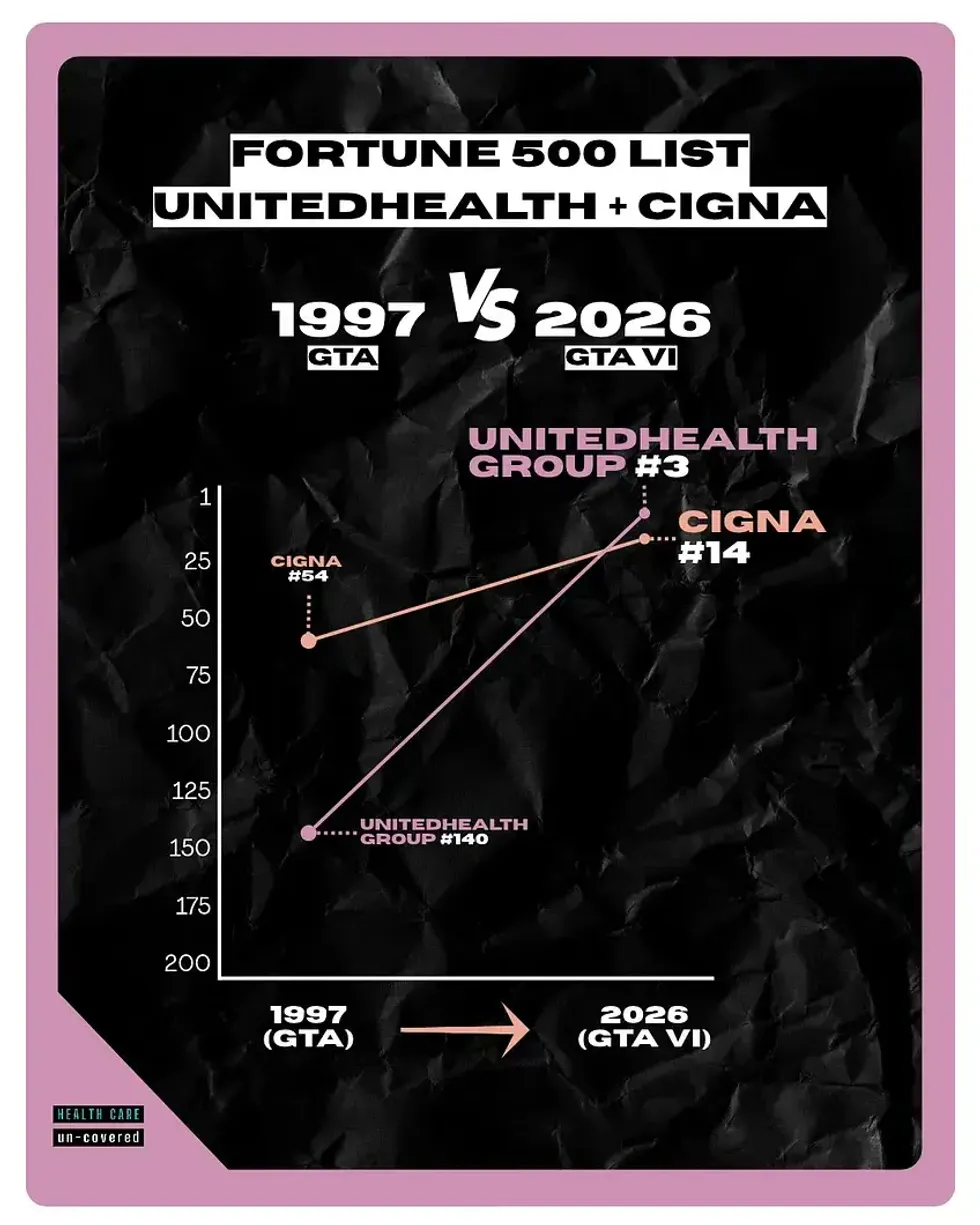
As I said above, the kids who were 10 when the first GTA was released are pushing 40 now. I’m around that age and part of that cohort. We’re getting eaten alive by the healthcare system that we inherited, but now we’re old enough to have a say in what comes next for American healthcare.
Today, a new group of 10-year-olds will play GTA for the first time. They’re our younger brothers, our cousins, and our kids. We deserve better and so do they. Like us, those kids deserve to grow into a country (and a healthcare system) that they can depend on when things go bad for them and for the families they may someday have.
If history tells us anything, it’s that it may be a long time before the next Grand Theft Auto is released. Here’s to making sure we get a better healthcare system before GTA VII.
This piece was first published by Health Care Un-Covered and is reposted with permission.

Such is the decline and decadence of the mainstream media, efforts to forge a more peaceful world met with shock and disgust.
On November 19, in Shenzhen, the presidents of China, Russia and the United States met together for the first time in history and issued a Declaration Toward Peace. They reaffirmed that a nuclear war cannot be won and must never be fought, agreed to a dialogue on reducing nuclear risks, and committed to reform the United Nations so that it can fulfill its mission of peace and security. These three countries hold about nine-tenths of the world's nuclear warheads, and since New START expired on February 5, the two largest arsenals have been without any treaty limits for the first time since 1972. One might have expected a sigh of relief in the editorial offices of New York, Washington, and London.
One would have been mistaken. The New York Times, the Washington Post, the Wall Street Journal and the Financial Times, echoed by Reuters, responded with scorn and alarm. Horror, horror: peace may be at hand. The danger to the world, we learn, is not a nuclear arms race without treaty limits, nor a war in the Gulf that has largely closed the Strait of Hormuz since February, nor a war in Ukraine now in its fifth year. The danger is that the American president sat at a round table with the presidents of China and Russia and was polite to them.
Peter Baker, the chief White House correspondent of the Times, reported with evident distaste that the president offered "hugs and arm pats and broad smiles to the autocrats." His colleagues Katie Rogers and David Sanger lamented that the summit lifted Putin out of his status as a global pariah, as if wars end sooner when the leaders of the warring sides are forbidden to speak. When Xi called for the elimination of nuclear weapons, the Times dismissed it as "a utopian goal." Yet the United States, Russia, and China are bound by Article VI of the Non-Proliferation Treaty to negotiate in good faith toward nuclear disarmament. What the Times calls utopian is a legal obligation of the United States.
The Wall Street Journal editorial board, under the headline "Nuclear Peace in Our Time. Not," dismissed the declaration as "diplomatic pabulum." Its own recipe for nuclear peace was a crash program to speed up a low-yield, sea-launched nuclear cruise missile, and its best nonproliferation project was to win the war against Iran convincingly. In short, the way to reduce nuclear danger is to build more nuclear weapons, and the way to prevent proliferation is to keep bombing a country that does not possess them. This is the war that closed the Strait of Hormuz and that American voters repudiated in this month's midterm elections.
Hillary Clinton, writing in the Times, said that a strong president would have issued demands to Putin and warned Xi. She urged Congress to help Ukraine use Starlink to target ballistic missile launchers inside Russia. She closed with the familiar formula of America's wars: "This is a time for action, not appeasement." Her own record of action includes her 2002 Senate vote to authorize the invasion of Iraq and her championing, as secretary of state, of the 2011 NATO bombing of Libya, which went far beyond its UN mandate to protect civilians and left behind a shattered country. In Mrs. Clinton's vocabulary, helping to guide strikes inside the world's largest nuclear power is strategy, and talking with its president is appeasement.
The Washington Post outdid them all. Its main report said that the three leaders reached one major agreement, an effort "to further unravel the international system of cooperation" built after World War II. The centerpiece of that agreement is a commitment to reform the United Nations so that it can fulfill its Charter. Ned Price, a former Biden administration diplomat, told the Post that the three leaders were discarding the rules of the road that had served liberal democracies for eighty years. Those rules include the NATO bombing of Serbia in 1999 without Security Council authorization, the invasion of Iraq in 2003 on false pretenses, the overthrow of Muammar Qaddafi in 2011, the CIA's covert program arming rebels to topple the government of Syria, 20 years of war in Afghanistan, repeated US vetoes of Security Council resolutions calling for a ceasefire in Gaza while American bombs fell on Gaza, and now a war against Iran launched without any Security Council authorization. The Post conceded, in a single sentence, that critics have long noted that Washington intervened in other nations when it saw fit. That is one way to put it.
A second Post article devoted itself to the seating chart. Xi sat in the center facing the cameras, with Trump and Putin in profile, and a former Biden official warned of a China-centered order. So the latest threat to Western civilization is that the host of the summit sat in the host's chair. The article omitted that China's economy is already about one-third larger than America's at purchasing-power parity, or that China's manufacturing output is roughly twice that of the United States. The real problem is Washington's assumption that it must sit at the head of every table.
The Financial Times delivered its verdict before the summit had even taken place. Under the headline "Putin's delusions of a 'new Yalta'," its editorial board warned that the meeting looked like a reward for aggression and might endorse the view that "great powers can once again trade away the sovereignty of smaller nations." The Shenzhen Declaration in fact said not a word about trading away the sovereignty of smaller nations, and the FT should know that the Yalta conference was where Roosevelt, Churchill and Stalin agreed on the voting formula of the Security Council, which made the United Nations possible.
The FT scorns Russia's objection to NATO's eastward enlargement, though Russia asks nothing more than what the United States has asserted under the Monroe Doctrine since 1823: no rival great power may place its military bases and alliances on its doorstep. The real disaster has been the thirty-year American project to push NATO up to Russia's border, which has cost Ukraine its peace, much of its territory, and a generation of its young men. And the FT's own prescription is to prepare for a long war, as the EU readies a new loan of 45 billion euros for Kyiv. Such is the FT's "defense" of Ukraine: fighting to the last Ukrainian.
Europe's leaders met in Berlin the same day as a "Coalition of the Willing," whose plans include deploying forces to Ukraine after a settlement, which Moscow rejects. German Chancellor Friedrich Merz dismissed the summit as a photo opportunity, and Polish Prime Minister Donald Tusk mocked Trump for calling Putin a friend. Reuters judged that the summit exposed the limits of Trump's personalized diplomacy and quoted Senate Democratic leader Chuck Schumer, who called it "a historic embarrassment." The Democrats have just won control of Congress on a wave of voter anger at the war on Iran. Rather than welcome a step back from great-power confrontation, their leader faults the president for not extracting more from Beijing and Moscow.
Running through all of this mainstream media coverage is a simple morality tale: democracies with Western values versus autocrats. The Post contrasted the ease with which authoritarian leaders in Shenzhen command their nations with the Berlin gathering of leaders who must answer to voters. Yet American voters decisively repudiated the war on Iran, just as the wars in Ukraine and Gaza helped to cost the Democrats the White House in 2024. The American people are tired of war, and so are the people of Europe. Nonetheless, the mainstream media, so fond of "democracy," preach more war and call it democratic values. Those values, as practiced by Washington and its allies, have meant wars and regime change from Serbia to Iran, and American bombs and diplomatic cover for the genocide in Gaza. The rest of the world has noticed the hypocrisy, even if the editorial boards in New York, Washington and London have not.
The Declaration toward Peace is only a beginning. The United States and Russia should observe the New START limits while they negotiate a successor treaty, with China joining in due course. All three powers should agree never to delegate nuclear launch decisions to artificial intelligence. President Trump should state publicly that the United States will not support the admission of Ukraine or Georgia to NATO, which would open the way to a negotiated peace and a neutral Ukraine, like Austria since 1955. The G20 summit at Doral, Florida, on December 14 and 15 is the next occasion to carry the Shenzhen agenda forward and bring India into the dialogue. A serious press would explain these steps and hold the leaders to their words. Instead, it is bemoaning the hugs.
In November 1985, Ronald Reagan and Mikhail Gorbachev declared at Geneva that a nuclear war cannot be won and must never be fought. Two years later they signed the Intermediate-Range Nuclear Forces Treaty, which eliminated an entire class of nuclear weapons. In Shenzhen, three presidents repeated their words. In 1985, those words were called statesmanship. In 2026, the Wall Street Journal calls them pabulum. Such is the decline and decadence of the mainstream media, whose relentless warmongering fails to serve their readers or the broader citizenry.
If Democrats want to deliver on their promise to make life more affordable, then they must use their new congressional majorities to finally pass universal single-payer healthcare.
America’s affordability crisis played a major role in this year’s midterm elections—and few things in American life have become more unaffordable than healthcare.
It’s about to get worse as premiums rise and Medicaid cuts from the GOP’s so-called “Big Beautiful Bill” take effect. So if Democrats want to deliver on their promise to make life more affordable, then they must use their new congressional majorities to pass Medicare for All.
The United States spends more on healthcare yet has worse health outcomes than comparable high-income countries.
We need a healthcare system that guarantees this human right for all, not one that guarantees more profits for Big Insurance and Wall Street investors.
In surveys, healthcare costs remain the top financial burden for adults and families, even when they’re insured. Around 85 million people in the US are either uninsured or underinsured, according to Rep. Pramila Jayapal’s (D-Wash.) office. Six in 10 uninsured adults polled said they’ve recently skipped or postponed care because of the staggering costs.
It’s no wonder that a record two-thirds of all US adults now support a national health plan like Medicare for All.
According to a recent Yale study, single-payer universal health coverage would save more than 100,000 lives a year and cost $1 trillion less than our current profit-driven system. The study’s authors reached these findings by modeling what would happen if the US adopted a single-payer system like the one proposed in the “Medicare for All Act.”
Introduced in 2025 by Jayapal, Rep. Debbie Dingell (D-Mich.), and Sen. Bernie Sanders (I-Vt.), the Medicare for All Act would expand Medicare to provide comprehensive health benefits to every US resident. It would include primary care, mental health, dental, vision, hearing, reproductive care, prescription drugs, and more.
Patients would choose their doctors without crushing co-pays, deductibles, and other coverage restrictions. Physicians would be able to focus more on healing their patients instead of “battling insurers over denials and delays,” as Dr. Diljeet K. Singh, president of Physicians for a National Health Program, summed it up in her endorsement of the legislation.
Much of the spending in our current health system is “consumed by administrative middlemen, soaring drug prices, and emergency care for conditions that should have been treated earlier and for less,” said Dr. Alison Galvani, the Yale study’s senior author.
Galvani and her co-authors found that the Medicare for All Act would reduce health spending by lowering pharmaceutical prices, cutting administrative overhead, cracking down on fraudulent billing, preventing avoidable emergency care, and applying savings from Medicare payment rates to all providers. “Our results indicate that the existing [federal] budget is more than sufficient to cover everyone at lower total cost,” they conclude.
Most importantly, a universal healthcare system would save lives. The Yale researchers calculate that it would prevent around 114,000 people from dying each year due to lack of healthcare. Their findings are no outlier—other studies have also found that a single-payer system would improve existing coverage while saving money.
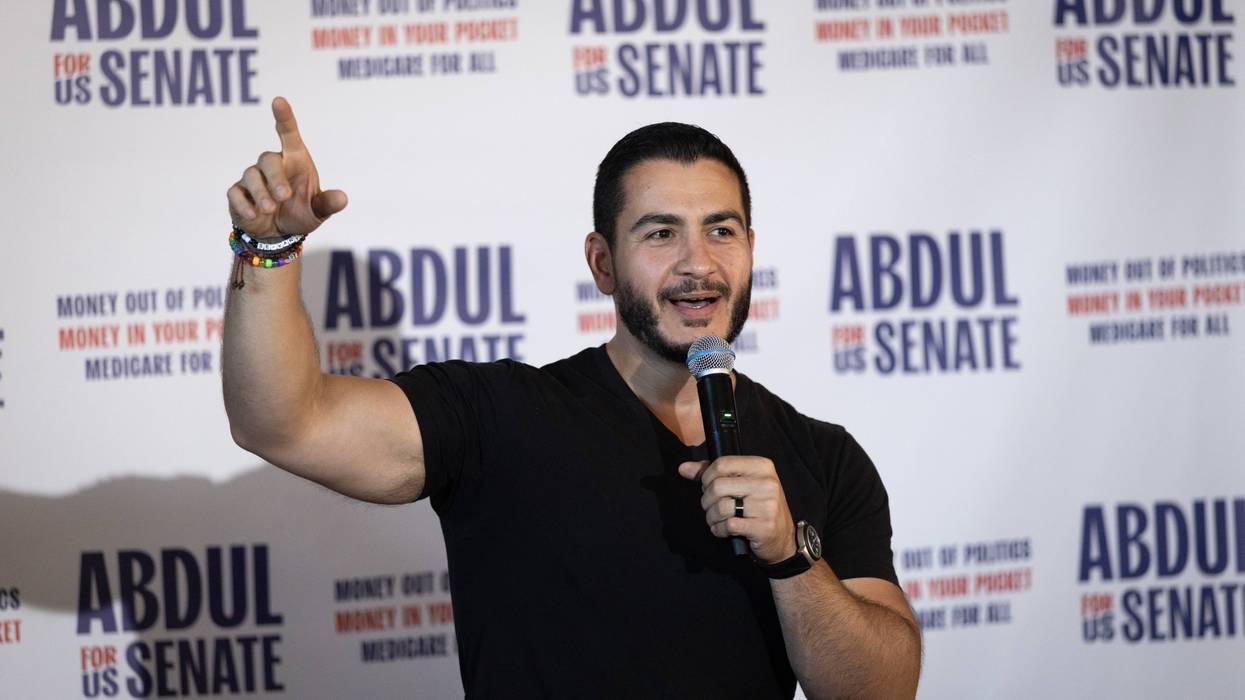
Elected Democrats remain divided on Medicare for All, but universal healthcare is wildly popular among their voters. Several incoming lawmakers campaigned on this issue and won, like Senator-elect Dr. Abdul El-Sayed (D-Mich.).
Although the Affordable Care Act expanded access to care, it has done so by benefiting the very for-profit insurance companies that contribute to the affordability problem. Far too many people still end up drowning in medical debt.
Universal healthcare is both sound public policy and a human right. The “right to the enjoyment of the highest attainable standard of physical and mental health” has long been recognized as a fundamental human right under international law that all governments are obligated to respect, protect, and fulfill. Nevertheless, the US remains the only high-income nation in the world without universal health coverage.
We need a healthcare system that guarantees this human right for all, not one that guarantees more profits for Big Insurance and Wall Street investors. The next Congress must meet the moment by making Medicare for All a reality instead of an empty campaign slogan.

Corruption and incompetence can leave Americans wondering who is in charge. Someone is, though, and they've been draining the Middle Class dry for 50 years. It's time we took our power back.
America is experiencing a convergence of crises that are destroying public confidence in our government’s ability to function, protect its citizens, and preserve democracy.
It’s been fewer than three weeks since Democrats won the biggest election sweep since Richard Nixon’s Watergate crimes were exposed, but the feeling of dread that hangs over America doesn’t show any sign of lifting.
After all, Trump—who now calls himself “Mr. Veto”—will still be president for two more years, and Democrats are still well short of the two-thirds it’ll take to override him.
His masked secret police are still terrorizing and murdering American citizens and immigrants on our streets with absolutely no accountability, and Immigration and Customs Enforcement (ICE) continues to build and buy concentration camps where people are being tortured, dying, and being killed on an almost weekly basis.
Democrats are giddy about demanding Trump and his cronies and family “preserve their papers,” but Republicans destroyed things last time around with no consequence whatsoever.
They’re looking forward to subpoenas to drag Republicans and corrupt businesspeople before Congress, but conventional wisdom says that enforcing those subpoenas will depend on Todd Blanche’s Department of Justice, and last time around the DOJ also refused to hold Attorney General Bill Barr and Commerce Secretary Wilbur Ross in criminal contempt for refusing to show up and testify at all.
This month White House counsel William Scharf, asked whether the administration will comply with subpoenas from the incoming Congress, answered, “It depends.” Trump’s now ordered every federal agency to get his personal permission before anybody testifies, and the Justice Department reportedly told the nation’s US attorneys to take a “wartime” stance against Democrats asking questions or wanting to see files (including the Epstein files).
Much of the doomsday feeling people are expressing when they call into my show or discuss this in the media is the result of our living through a convergence of crises instead of simply any single one.
If we wimp out again, if Congress flinches, if we wait years to prosecute Republican criminals like Merrick Garland did, that the the doomsday feeling will come back stronger.
From grounded planes to Microsoft’s email to Workday’s payroll and Chase’s payments, even Trump’s incompetent Cabinet officials refuse to explain what’s happening with anything other than “trust us,” pablum-like assurances while Trump goes off to kiss Russian President Vladimir Putin’s ass and suck up to Xi Jinping in China as both continue to help Russia murder Ukrainians and American troops in the Gulf.
The federal government that’s protected us at home and defended democracy around the world for our lifetimes was gutted by the world’s richest man—more than 256,000 federal workers are now out of a job—and only 49% of Americans can reliably afford healthcare we need.
Roughly 80% of Americans are worried AI will cost them their or their children’s jobs; 33 countries are advising their citizens to stockpile food and water; at the same time Trump, his boys, and his son-in-law have screwed MAGA followers out of over $2.3 billion in crypto.
This has left Americans wondering who’s in charge of this country, and to whose benefit it’s now being run. Pew found 69% of us don’t think our democracy works anymore, and Gallup says only 28% of us believe corrupt American politicians or judges will ever be held accountable to the law.
Somebody is in charge, though, and they been at it for almost 50 years, draining dry the middle class while producing a bumper crop of right-wing oligarchs; the morbidly rich have never had it so good. As Jimmy Carter told me on my program over a decade ago, America is now more an oligarchy than a democratic republic.
And that’s both the danger and the opportunity.
As I lay out in The Hidden History of American Oligarchy, oligarchy is always a transitional form of government, rarely lasting more than two generations, because sooner or later the people get tired of being robbed and rise up, demanding their democracy back.
At that point the oligarchs face a binary choice: Back down, as they did when Franklin Roosevelt faced them down in the 1930s, or they bring down the iron fist the way Putin and Turkish President Recip Tayyip Erdoğan did.
With his National Security Presidential Memorandum-7 and ICE, Trump is clearly trying for the Iron Fist; as Stephen Miller recently said, eerily echoing Stalin and Goebbels:
We live in a world in which you can talk all you want about international niceties and everything else. But we live in a world, in the real world... that is governed by strength, that is governed by force, that is governed by power. These are the iron laws of the world.
Back in 1967, psychologist Martin Seligman found that if you gave dogs a painful electric shock and simultaneously prevented them from moving to escape it, they eventually stopped trying to get away but simply laid down and whimpered. He called it “learned helplessness.”
I’d argue that’s where the elected Republicans have been for at least the past decade, and perhaps longer.
On the other hand, almost 50 years later he argued that passivity in the face of pain is a “default” of the brain—the way a possum will play dead—but that a more important thing for humans is learned optimism and learned self-empowerment, the result of taking positive actions. They’re far more powerful, he argues in his latest book Agency, than learned helplessness.
We’ve been violently “shocked” for the better part of the last two years, and more mildly but consistently hit with corruption, theft, lies that got us into wars, and the GOP gutting the middle class for at least 45 years.
But there was also a time, between 1933 and 1981, when we picked ourselves up, dusted ourselves off from the Republican Great Depression, and learned agency, took power, and did great things.
We did it in union halls, by breaking up monopolies, by taxing the morbidly rich, and holding corporate and political criminals alike to account. And it appears, with this last election, that we’re on the road—perhaps a 2-year-long road—to doing that again.
Starting January 3, Trump can’t veto a hearing, can’t get a single judge confirmed without the consent of a Senate where Democrats will hold 56 seats, and can’t lawfully spend a dollar that Congress doesn’t appropriate.
It’s even possible—if Rep. Hakeem Jeffries (D-NY) and either Sen. Chuck Schumer (D-NY) or Sen. Chris Van Hollen (D-Md.) find the backbone—for Congress to rediscover its own inherent contempt power to send its sergeant-at-arms to arrest a witness who defies it, a power that’s sat unused for 90 years.
Seligman’s research offers us both hope and a warning.
Hope that if we push our leaders hard enough, if they stand up strong enough, we can defeat the oligarchy the ways FDR, Abraham Lincoln, and George Washington and Thomas Jefferson did in each of the previous 80-year cycles of American history.
And a warning that if we wimp out again, if Congress flinches, if we wait years to prosecute Republican criminals like Merrick Garland did, that the the doomsday feeling will come back stronger: This is obviously something the would-be Republican strongmen like Trump, Vice President JD Vance, Rep. Jim Jordan (R-Ohio), et al. are counting on it.
So reach out to your state attorneys general—who, as Christopher Armitage points out, have considerable power that’s to this day been largely unused—and your elected officials in DC and demand that they stand up to the bullies and fascists and thieves.
Assert your power as a citizen!
And find things close to home—a school board, a union drive, a food bank, where you can watch your own effort change an outcome—because that’s where our own personal power gets, as Seligman noted, learned again.
If this helped you make sense of what you’ve been feeling, please share it with somebody who’s been feeling it too. And if you aren’t yet a subscriber to The Hartmann Report I hope you’ll become one, because this work only happens with the support of readers like you.

We have spent sufficient time studying the problem of caregiving in America and praising the heroic work of family caregivers. The current moment demands strong action not words or gestures.
The odds are good that if you have an older adult in your family, you have seen the recent Saturday Night Live skit on caregiving. For those who have not seen the SNL segment, The New York Times provides an apt summary:
The “S.N.L." sketch was basically the funny version of a study published in the American Sociological Review by Angelina Grigoryeva of the University of Toronto. She showed that daughters spend 14 hours a month, on average, caring for parents, compared with six hours for sons. Sons provide less care if they have sisters, and daughters provide more if they have brothers rather than sisters. And daughters are more likely than sons to provide care even if it conflicts with their work or childcare demands.
The SNL sketch hit a nerve among so many Americans because it highlighted gender inequities that we certainly need to address. It also focuses a spotlight on a glaring inadequacy in our healthcare system. Medicare does not cover long-term care. It covers only short-term care such as that needed when recovering from a stroke. Far too many Americans are unaware of what Medicare will cover. In 2022 research by the Kaiser Family Foundation found that “...23% of adults—rising to 45% of those ages 65 and older—assume that Medicare would pay the bill for their own or a loved one’s time in a nursing home if they had a long-term illness or disability.”
Medicaid, the state and local program for low-income people, does cover long-term care including nursing homes. However, to qualify for Medicaid there are often long waiting lists and you must spend down your assets.
How many people provide unpaid care to family and friends? Research from the Kaiser Family Foundation on November 19 shows that:
The bottom line here is that we have a caregiving crisis that needs to be addressed. Just as we had a retirement income crisis in the 1930s that lead to Social Security and a healthcare crisis that resulted in the enactment of Medicare, we need bold action at the federal level to address the caregiving crisis.
During her 2024 presidential campaign, Vice President Kamala Harris proposed a new home health benefit for Medicare called “Medicare at Home.” Under her plan “Medicare will cover home care for the first time ever for all of our nation’s seniors and those with disabilities on Medicare who need it, in addition to vision and hearing benefits to help seniors live independently for longer.” For his part, then former President Trump supported protecting seniors by "'shifting resources back to at-home Senior Care,' addressing disincentives that contribute to workforce shortages, and supporting unpaid family caregivers through tax credits.”
In the current Congress, Sen. Andy Kim (D-NJ) and Congresswoman Debbie Dingell (D-MIich. have introduced the Medicare At Home Act, which would:
...establish long-term care services benefits as part of the Medicare program. The Medicare At Home Act would help older adults and people with disabilities remain safely in their homes and communities by expanding home care coverage under Medicare Part B. Medicare Part B usually covers doctor visits and everyday medical care; this bill would also cover in-home support so people don’t have to leave their homes.
Now, the question that comes up at this point is: How are we going to pay for this new Medicare benefit? Before considering this question, it is important to note that the United States supports its caregivers far less than other countries. The United States falls behind most other wealthy countries in its support for caregivers. According to the Organization for Economic Development and Cooperation (OECD), the United States spends 1.3% of its gross domestic product on caregiving, which compares poorly with countries like the Netherlands (4.1%), Belgium (3.1%), and the United Kingdom (2.6%).
The Commonwealth Foundation points out that there are several potential ways of funding a new Medicare benefit: general revenues, payroll taxes, premiums, or co-payments. This will no doubt be an intense discussion, and there are hard choices to be made. Part of this debate should include why there is always enough money for wars but not enough to take care of those most precious to us.
We have spent sufficient time studying the problem of caregiving in America and praising the heroic work of family caregivers. The current moment demands strong action not words or gestures. Sen. Kim and Rep. Dingle have boldly moved the debate forward. Hopefully, when the new Congress convenes in January of 2027, caregiving will be a top issue.