

SUBSCRIBE TO OUR FREE NEWSLETTER
Daily news & progressive opinion—funded by the people, not the corporations—delivered straight to your inbox.
5
#000000
#FFFFFF
To donate by check, phone, or other method, see our More Ways to Give page.
Daily news & progressive opinion—funded by the people, not the corporations—delivered straight to your inbox.
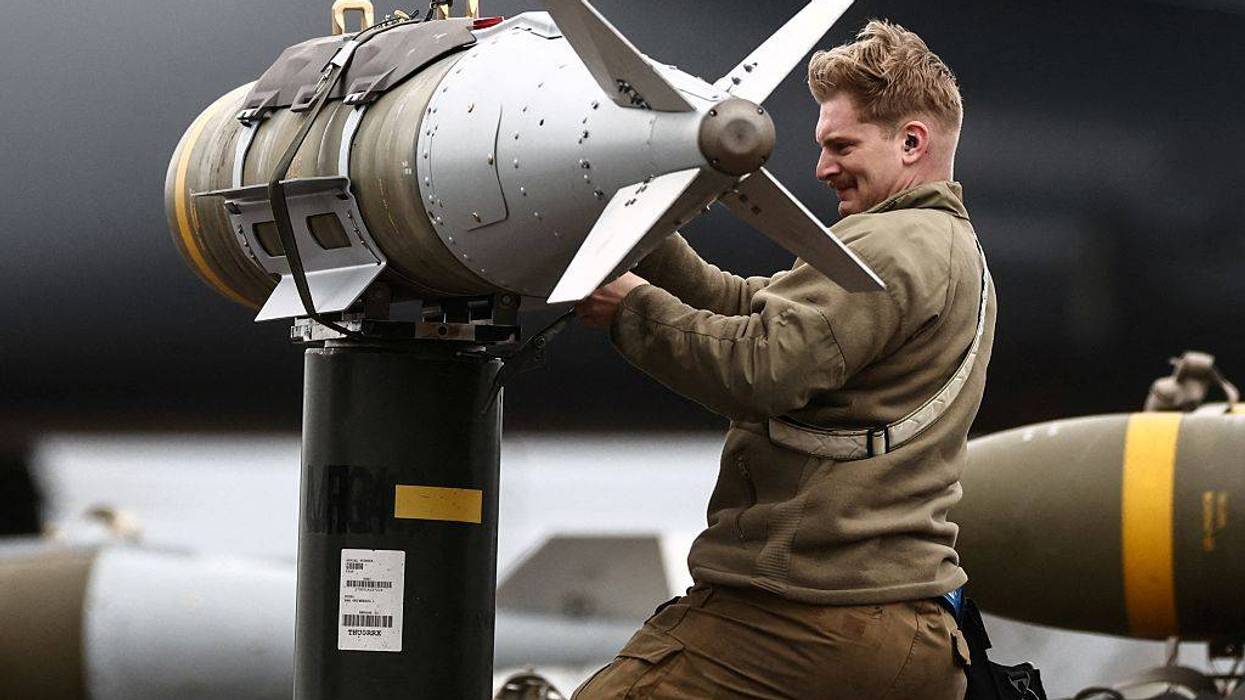
"Given the range of current crises, as well as many states’ long-term military spending targets, this growth will probably continue through 2026 and beyond," said one researcher.
Global military spending around the world surged in 2025 in response to further eroding geopolitical stability, the Stockholm International Peace Research Institute revealed in a report released Monday.
In its annual report on trends in global military expenditures, SIPRI found that global military spending in 2025 totaled nearly $2.9 trillion, a 2.9% increase over defense spending in 2024. Global defense spending now accounts for 2.5% of global gross domestic product (GDP), the highest level since 2009.
Despite the Pentagon's ballooning budget, overall defense defense spending in the US actually decreased in 2025, as the Trump administration and the Republican-controlled US Congress stopped sending new military aid to Ukraine, which had received nearly $130 billion in military aid under President Joe Biden over the previous three years after it was invaded by Russia in 2022.
Even without additional US involvement, spending on the Russia-Ukraine conflict grew significantly in 2025, as Russia increased its defense spending by 6% and Ukraine increased its military expenditures by 20%.
"In 2025 military expenditure as a share of government spending reached the highest level ever recorded in both Russia and Ukraine," said Lorenzo Scarazzato, researcher with the SIPRI Military Expenditure and Arms Production Program. "Their spending is likely to keep growing in 2026 if the war continues, with revenues from Russia’s oil sales increasing and a major European Union loan expected by Ukraine."
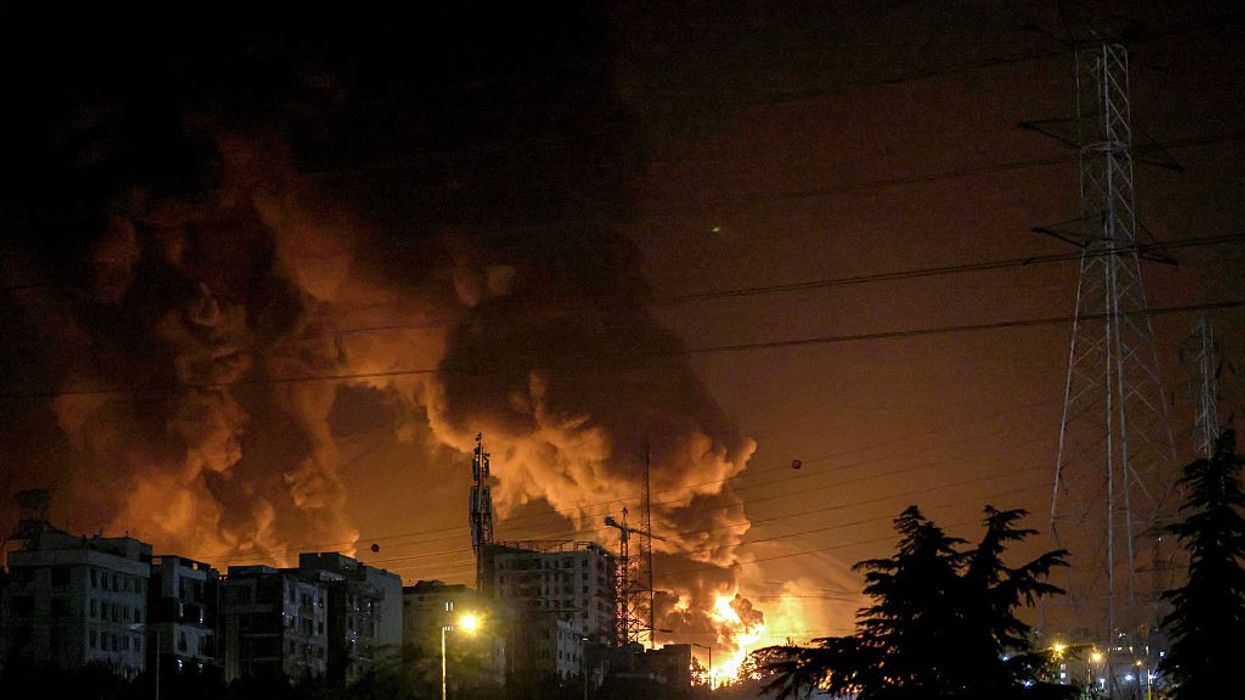
The dip in US defense spending may not last long given that President Donald Trump has proposed a record $1.5 trillion military budget and the president's unauthorized war of choice with Iran has already cost US taxpayers an estimated $63 billion.
Both Israel and Iran spent less on defense in 2025 than the year before, although both countries are similarly likely to see a surge in spending given the conflict between the two countries that began when the US and Israel attacked Iran in late February.
Elsewhere in the world, the SIPRI report finds that defense spending in Europe grew by 14% in 2025, while growing just over 8% in Asia and Oceania.
The US, China, and Russia were the three biggest military spenders, and their combined spending of $1.48 trillion represented more than half of the global total.
Xiao Liang, researcher with SIPRI’s Military Expenditure and Arms Production Program, said that the big increases in defense spending came in response to "another year of wars, uncertainty, and geopolitical upheaval with large-scale armament drives."
"Given the range of current crises, as well as many states’ long-term military spending targets," the researcher added, "this growth will probably continue through 2026 and beyond."
One SIPRI expert said the weapons "come with immense risks of escalation and catastrophic miscalculation—particularly when disinformation is rife—and may end up making a country's population less safe."
As Israel's assault on Iran generates global alarm, an international watchdog on Monday released an annual report warning that "a dangerous new nuclear arms race is emerging at a time when arms control regimes are severely weakened."
The Stockholm International Peace Research Institute's SIPRI Yearbook 2025 begins by acknowledging the 80th anniversary of the only times that nuclear weapons have been used in war: the U.S. bombing of the Japanese cities of Hiroshima and Nagasaki in 1945.
"In those eight decades, a great deal of death and destruction has been meted out in war but the taboo against using nuclear weapons has survived and grown stronger," the yearbook says. "This is, as the Nobel Peace Prize Committee noted when awarding the 2024 Peace Prize to the movement of Japanese nuclear survivors (hibakusha), Nihon Hidankyo, 'an encouraging fact.' Nonetheless, new risks mean it is worth reviewing today's nuclear challenge."
In addition to the United States, the confirmed nuclear-armed nations are China, France, India, Israel, North Korea, Pakistan, Russia, and the United Kingdom. The global inventory is an estimated 12,241 warheads, most of which belong to the U.S. and Russia, according to SIPRI. As of January, about 9,614 of the weapons were in military stockpiles for potential use, including 3,912 deployed with missiles and aircraft.
"There needs to be a new, general understanding that nuclear weapons do not buy security and their existence demands balanced behavior by political leaders."
"In 2024, global security showed no overall improvement and some deterioration compared to the previous year. Several armed conflicts—not least in Ethiopia, Gaza, Myanmar, and Sudan—continued to escalate," the report states. "Russia's war of aggression against Ukraine continued, confrontation over Taiwan deepened, tensions on the Korean peninsula sharpened, and global politics were marked by increasing divisiveness and polarization sown by, among other causes of disputation, Israel's devastating offensive in Gaza."
The yearbook flags "new uncertainties" stemming from the November 2024 election of U.S. President Donald Trump, pointing out how "both allies and adversaries of the USA and all those in between found themselves navigating uncharted geopolitical and economic waters" in the wake of the Republican's return to office in January.
"Bilateral nuclear arms control between Russia and the USA entered crisis some years ago and is now almost over," the document details. "The one remaining bilateral U.S.-Russian nuclear arms control agreement is the New Strategic Arms Reduction Treaty (New START), agreed in 2010 and entering force in 2011, with a 10-year duration, extendable by five years upon mutual agreement."
Within days of U.S. President Joe Biden's 2021 inauguration, he and Russian President Vladimir Putin extended the treaty, now set to expire early next year—and, as the report notes, "there is no sign of negotiations to renew or replace it, and no sign on either side of wanting to do so."
Concerns extend beyond the U.S. and Russia. Although "the world's nuclear weapon inventory has been shrinking for almost 40 years," the yearbook explains, "in the last few years, the number of nuclear weapons in military stockpiles (deployed warheads and those in central storage available for use) has started to increase," specifically in China and India.
Earlier this year, India and Pakistan engaged in armed conflict—which Matt Korda, associate senior researcher with SIPRI's Weapons of Mass Destruction Program and associate director for the Nuclear Information Project at Federation of American Scientists, pointed to in a Monday statement.
"The combination of strikes on nuclear-related military infrastructure and third-party disinformation risked turning a conventional conflict into a nuclear crisis," Korda said. "This should act as a stark warning for states seeking to increase their reliance on nuclear weapons."
"It is critical to remember that nuclear weapons do not guarantee security," said Korda. "As the recent flare-up of hostilities in India and Pakistan amply demonstrated, nuclear weapons do not prevent conflict. They also come with immense risks of escalation and catastrophic miscalculation—particularly when disinformation is rife—and may end up making a country’s population less safe, not more."
Highlighting signs of a new nuclear arms race "gearing up," the publication warns that "compared to the last one, the risks are likely to be more diverse and more serious. Among the key points of competition will be technological capacities in cyberspace, outer space, and ocean space. Thus, the arms race may be more qualitative rather than quantitative, and the idea of who is ahead in the race will be even more elusive and intangible than it was last time round. In this context, the old largely numerical formulas of arms control will no longer suffice."
The report asserts that "there needs to be a new, general understanding that nuclear weapons do not buy security and their existence demands balanced behavior by political leaders. There also needs to be more training for diplomats in matters of nuclear arms control. This can make possible initial small steps towards reducing risk: hotlines, transparency, even informal understandings and formal agreements, such as no first use of nuclear weapons and nuclear weapon free zones."
"These will form guardrails against disaster," SIPRI stressed. "Together with the voices of an informed public, they could also be part of building the pressure for the three great powers to take the next steps in reducing their nuclear arsenals."
The publication was released after the International Campaign to Abolish Nuclear Weapons (ICAN) reported last week that "in 2024, the nine nuclear-armed states spent more than $100 billion or $190,151 per minute—on their nuclear arsenals—an increase of 11% from the previous year."
SIPRI's report also comes as Israel faced global criticism for targeting Iranian nuclear power facilities and scientists.
Trump—who sabotaged the Iran nuclear deal during his first term—suggested Sunday that American forces "could get involved" to support Israel in the conflict, which has killed civilians in both countries. U.S. Sen. Tim Kaine (D-Va.) on Monday introduced a war powers resolution intended to prevent the president from attacking Iran without congressional debate and authorization.
Meanwhile, the Iranian Foreign Ministry said Monday that the nation's legislative body is now drafting a bill to withdraw from the landmark 1968 Treaty on the Nonproliferation of Nuclear Weapons.
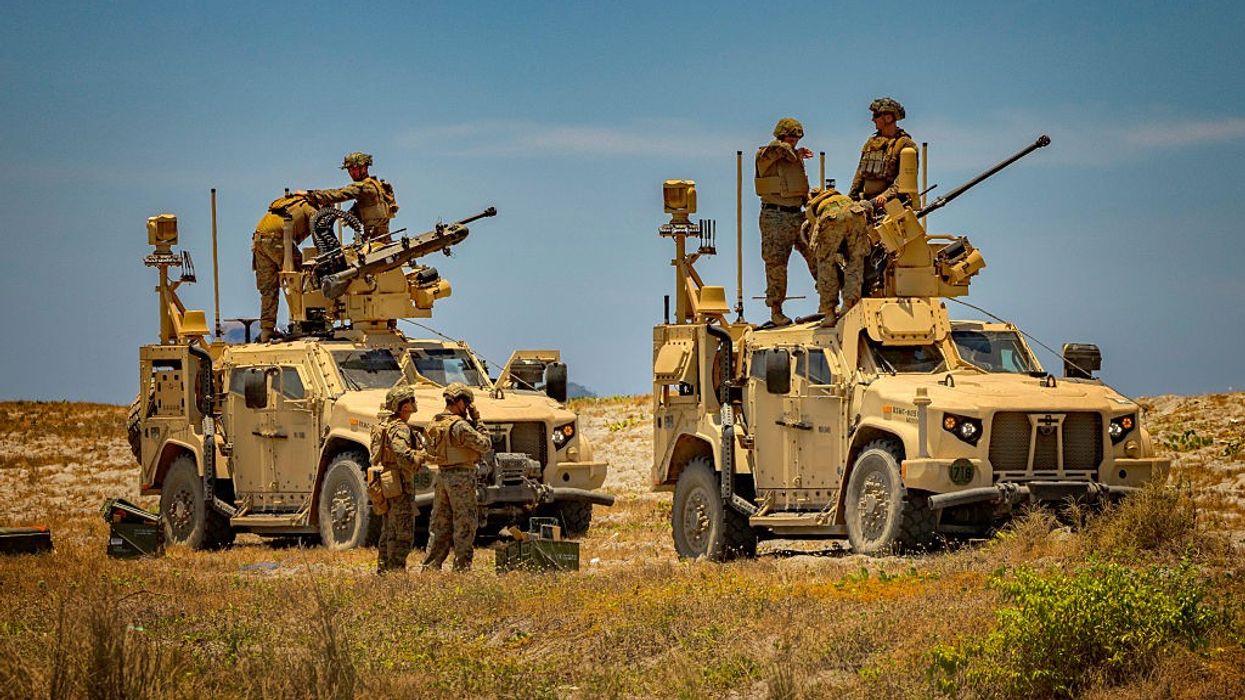
"As governments increasingly prioritize military security, often at the expense of other budget areas, the economic and social trade-offs could have significant effects on societies for years to come," said one expert.
Military spending worldwide soared to $2.718 trillion last year, meaning it "has increased every year for a full decade, going up by 37% between 2015 and 2024," according to an annual report released Monday.
The Stockholm International Peace Research Institute (SIPRI) has tracked conflict, disarmament, and weapons for nearly six decades. Its 2024 spending report states that "for the second year in a row, military expenditure increased in all five of the world's geographical regions, reflecting heightened geopolitical tensions across the globe."
In a Monday statement, Xiao Liang, a researcher with the SIPRI Military Expenditure and Arms Production Program, highlighted that "over 100 countries around the world raised their military spending in 2024."
"It was the highest year-on-year increase since the end of the Cold War."
"This was really unprecedented... It was the highest year-on-year increase since the end of the Cold War," Liang told Agence France-Press, while acknowledging that there may have been larger jumps during the Cold War but Soviet Union data is not available.
Liang warned that "as governments increasingly prioritize military security, often at the expense of other budget areas, the economic and social trade-offs could have significant effects on societies for years to come."
The United States—whose Republican lawmakers are currently cooking up a plan to give even more money to a Pentagon that's never passed an audit—led all countries, with $997 billion in military spending. The report points out that the U.S. not only allocated "3.2 times more than the second-largest spender," but also "accounted for 37% of global military expenditure in 2024 and 66% of spending by North Atlantic Treaty Organization (NATO) members."
In the second spot was China, with an estimated $314 billion in spending. Nan Tian, director of the SIPRI Military Expenditure and Arms Production Program, raised the alarm about spending in Asia.
"Major military spenders in the Asia-Pacific region are investing increasing resources into advanced military capabilities," said Tian. "With several unresolved disputes and mounting tensions, these investments risk sending the region into a dangerous arms-race spiral."
In third place was Russia, with an estimated $149 billion in spending. Russia remains at war after launching a full-scale invasion of Ukraine in February 2022. Rounding out the top five were Germany ($88.5 billion) and India ($86.1 billion).
They were followed by the United Kingdom, Saudi Arabia, Ukraine, France, Japan, South Korea, Israel, Poland, Italy, and Australia. The report says that "together, the top 15 spenders in 2024 accounted for 80% of global military spending ($2,185 billion) and for 79% of the total increase in spending over the year. All 15 increased their military spending in 2024."
"The two largest year-on-year percentage increases among this group were in Israel (+65%) and Russia (+38%), highlighting the effect of major conflicts on spending trends in 2024," the publication continues. Israel has been engaged in a U.S.-backed military assault on the Gaza Strip—globally condemned as genocide—since October 2023.
"Russia once again significantly increased its military spending, widening the spending gap with Ukraine," noted SIPRI researcher Diego Lopes da Silva. "Ukraine currently allocates all of its tax revenues to its military. In such a tight fiscal space, it will be challenging for Ukraine to keep increasing its military spending."
Russian President Vladimir Putin on Monday announced an upcoming three-day truce to celebrate the 80th anniversary of the end of World War II in Europe. In response, Ukrainian President Volodymyr Zelenskyy called for an immediate monthlong cease-fire.
All NATO members boosted military spending last year, which SIPRI researcher Jade Guiberteau Ricard said was "driven mainly by the ongoing Russian threat and concerns about possible U.S. disengagement within the alliance."
"It is worth saying that boosting spending alone will not necessarily translate into significantly greater military capability or independence from the USA," the expert added. "Those are far more complex tasks."
Another SIPRI researcher, Lorenzo Scarazzato, highlighted that "for the first time since reunification Germany became the biggest military spender in Western Europe, which was due to the €100 billion special defense fund announced in 2022."
"The latest policies adopted in Germany and many other European countries suggest that Europe has entered a period of high and increasing military spending that is likely to continue for the foreseeable future," Scarazzato said.
As for the Middle East, SIPRI researcher Zubaida Kari said that "despite widespread expectations that many Middle Eastern countries would increase their military spending in 2024, major rises were limited to Israel and Lebanon."
In addition to slaughtering at least tens of thousands of Palestinians in Gaza over the past nearly 19 months, Israel has killed thousands of people in Lebanon while allegedly targeting the political and paramilitary group Hezbollah. Kari said that elsewhere in the region, "countries either did not significantly increase spending in response to the war in Gaza or were prevented from doing so by economic constraints."
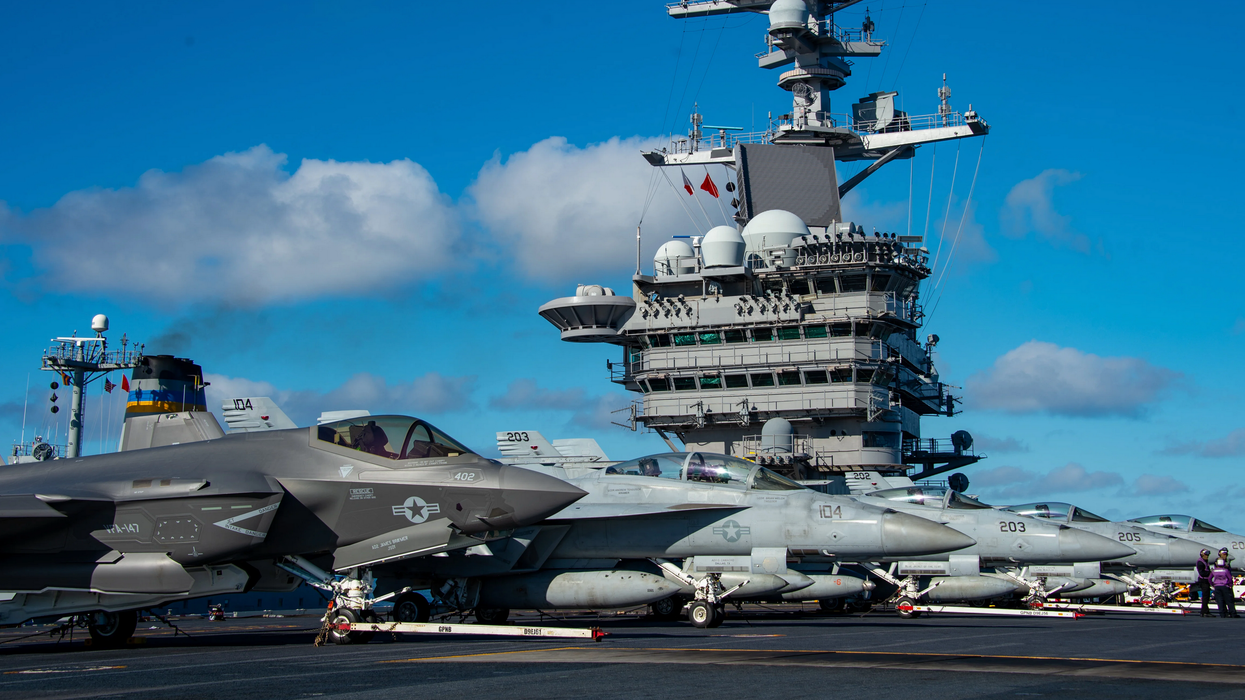
"More must be invested in eradicating poverty and fostering peace and development, not fueling war and destruction," said one campaigner.
Despite historic levels of forced displacement due to armed conflict, Group of Seven member countries have increased their military expenditures to record highs while they slash spending on humanitarian aid for people affected by wars that these powerful nations often started or stoked, an analysis published Friday revealed.
According to Birmingham, England-based Islamic Relief Worldwide, military spending by G7 members Canada, France, Italy, Germany, Japan, the United Kingdom, and the United States—which wrapped up Friday in Puglia, Italy—rose to $1.2 trillion last year, the overwhelming bulk of that amount attributable to the U.S.' $886.3 billion Pentagon budget.
"Too many governments are putting far more resources towards acquiring weapons of war than helping those suffering the deadly impacts of conflict."
That's a 7.3% increase over 2022 levels, and 62 times what those countries spent on all humanitarian aid in response to wars and disasters.
"From Gaza to Sudan, Ukraine to Myanmar, we see millions of lives destroyed by war," Islamic Relief head of global advocacy Shahin Ashraf said in a statement. "The humanitarian needs today are greater than ever before, so it's scandalous that many wealthy G7 nations are cutting aid while spending more than ever before on weapons."
It's not just the G7. According to this year's Stockholm International Peace Research Institute annual analysis, global military spending increased 6.8% to a record $2.4 trillion in 2023.
"Too many governments are putting far more resources towards acquiring weapons of war than helping those suffering the deadly impacts of conflict," Ashraf asserted. "More must be invested in eradicating poverty and fostering peace and development, not fueling war and destruction."
Islamic Relief Worldwide said:
While some of the discussions at the G7 summit focus on restricting immigration into rich developed nations, most people displaced by conflict remain in war-torn countries and impoverished neighbouring countries. After more than a year of brutal war, Sudan is now the world's biggest displacement crisis with over 10 million people—about a quarter of the population—now forced from their homes. The vast majority of people fleeing the violence in Sudan remain in the country, with many receiving aid from local communities, youth groups, and mosques.
"As rich nations increasingly shut their borders and cut aid, in places like Sudan it is heartening to see the generosity of some of the world's poorest communities taking displaced people into their homes and sharing their food and water with them," said Ashraf. "But they need more international support, especially from the wealthiest countries."
Another analysis published ahead of the G7 summit by Oxfam International revealed that just 3% of the seven countries' 2023 military expenditures would be enough to "help end world hunger and solve the debt crisis in the Global South."
A new analysis on Monday showing that the world's military spending surpassed $1.9 trillion last year, once again led by the United States under President Donald Trump, provoked demands that governments across the globe prioritize peace and the health of people as the coronavirus pandemic continues to ravage the planet.
The latest annual report from the Stockholm International Peace Research Institute (SIPRI) found that the top military spenders after the U.S. were China, India, Russia, and Saudi Arabia. Total spending in 2019 was 3.6% higher than in the previous year and accounted for 2.2% of global gross domestic product (GDP).
"Global military expenditure was 7.2% higher in 2019 than it was in 2010, showing a trend that military spending growth has accelerated in recent years," SIPRI researcher Nan Tian said in a statement. "This is the highest level of spending since the 2008 global financial crisis and probably represents a peak in expenditure."
The report was released Monday as the global number of confirmed COVID-19 cases climbed toward three million and the pandemic's death toll stood at over 207,000. Highlighting the new SIPRI data in the midst of the outbreak Monday, the U.K.-based Campaign Against Arms Trade (CAAT) declared on Twitter that "out of this crisis we must build a world where real human needs are prioritized."
In a statement responding to the analysis, the International Peace Bureau (IPB) also pointed to the public health crisis as evidence of the need for a worldwide shift in priorities.
"The COVID-19 crisis has made clearer than ever the flaws in our system, one that prioritizes military spending and global instability over the well-being of our people," IPB said. "Indeed, global priorities are wrong; it is time for a new era of peace, a global ceasefire as called for by the U.N. and people around the globe. Let us demilitarize the world and invest in global peace and diplomacy."
Sharing a SIPRI infographic, IPB co-president Philip Jennings tweeted: "The military industry complex is raking it in and we don't feel safer. Time to halt this madness."
The SIPRI findings, as the statement from Jennings' group noted, were published during IPB's Global Days of Action on Military Spending (GDAMS), which run from April 10 to May 9 and "highlight the need to reallocate military expenditure to confront COVID-19 and the urgent social and environmental crises."
The new analysis followed a National Priorities Project report from last week that warned against a global pandemic response which aims to return to an old normal "defined by unfettered capitalism that thrives on the devastation of our planet, the devaluation of human life, and the use of military force to perpetuate both."
The SIPRI report also came after a bipartisan group of U.S. congressmembers were lambasted by progressives in late March for pressuring their fellow federal lawmakers to approve the purchasing of 19 more F-35 fighters than the Pentagon requested in an upcoming defense bill. The anti-war group Peace Pledge Union responded by criticizing the "outrageous priorities of militarists during the coronavirus pandemic."
Military spending by the United States--which has been the global epicenter of the pandemic for the past month--soared to $732 billion in 2019, accounting for 38% of the global military expenditure and representing a rise of 5.3% from the previous year. SIPRI senior researcer Pieter D. Wezeman said that "the recent growth in U.S. military spending is largely based on a perceived return to competition between the great powers."
"There were increases in military spending by China (5.1%), India (6.8%), and Russia (4.5%). Spending fell in Saudi Arabia by 16%," according to SIPRI. China, in the second spot behind the U.S., spent $261 billion in 2019, and India, which ranked third globally, spent $71.1 billion.
"India's tensions and rivalry with both Pakistan and China are among the major drivers for its increased military spending," explained Siemon T. Wezeman, another SIPRI senior researcher.
Although, as the SIPRI statement pointed out, "the increase in U.S. spending in 2019 alone was equivalent to the entirety of Germany's military expenditure for that year," the European country's spending still rose by 10% last year to $49.3 billion, which was the largest increase among the top 15 ranked countries.
"The growth in German military spending can partly be explained by the perception of an increased threat from Russia, shared by many North Atlantic Treaty Organization (NATO) member states," said SIPRI researcher Diego Lopes da Silva. "At the same time, however, military spending by France and the United Kingdom remained relatively stable."
Russia, ranked fourth globally, boosted its military spending by 4.5% to $65.1 billion in 2019. SIPRI researcher Alexandra Kuimova noted that "at 3.9% of its GDP, Russia's military spending burden was among the highest in Europe in 2019."

Global military spending reached its highest level since the records began two decades ago, according to a new analysis released Monday--an increase led by the United States and China.
The Stockholm International Peace Research Institute (SIPRI) revealed in its latest annual report that countries around the world collectively poured $1.82 trillion into their militaries in 2018, a 2.6 percent rise from the previous year. Together, the top two spenders, the United States and China, accounted for about half of all spending.
"The increase in U.S. spending was driven by the implementation from 2017 of new arms procurement program under the Trump administration," Aude Fleurant, director of SIPRI's Arms and Military Expenditure (AMEX) program, said in a statement.
Last year, the U.S. military expenditure--which represents more than a third of global spending--increased for the first time in seven years. It rose by 4.6 percent, hitting $649 billion.
SIPRI researcher Nan Tian told German broadcaster Deutsche Welle that trend is expected to continue.
"They have started to implement a new modernization program of the military that will start in 2019 or 2020," Tian explained. "This is in the region of $1.8 trillion over the next 20 years. It is a massive amount of money being spent by the U.S.--and it ranges from conventional weapons to nuclear capabilities."
Progressives continue to criticize President Donald Trump for his focus on military spending--particularly in contrast with his lack of investment elsewhere, from education and housing to clean air and water.
Trump's recent budget proposal "finds vast billions for militarization, while it cuts much smaller poverty and other programs," Lindsay Koshgarian of the National Priorities Project and Rev. Drs. William J. Barber II and Liz Theoharis wrote for The Guardian last month.
"For too long, we have had budgets that provide security for a wealthy and powerful few rather than the poor and disenfranchised many," they added, acknowledging previous presidents' contributions to military expansion. "Real security means establishing peace, justice, and promoting the material wellbeing and liberty of all, including future generations."
China, which secured the second spot for SIPRI's analysis, spent $250 billion on its military in 2018.
"Growth in Chinese military spending tracks the country's overall economic growth," Tian said in a statement. "China has allocated 1.9 percent of its GDP to the military every year since 2013."
Other big spenders, per the report, included Saudi Arabia ($67.6 billion), India ($66.5 billion), France ($63.8 billion), Russia ($61.4 billion), the United Kingdom ($50 billion), Germany ($49.5 billion), Japan ($46.6 billion), and South Korea ($43.1 billion).
Although Saudi Arabia decreased its military spending from the previous year, the kingdom--which, along with the United Arab Emirates, is leading a U.S. and U.K.-backed war on Yemen--still led the world as the biggest spender per capita. The United States ranked second.
Overall, SIPRI found that military expenditure rose in Central America and the Caribbean, Central Europe, Central and South Asia, East Asia, North America, South America, and Western Europe, but declined in Eastern Europe, North Africa, Oceania, South East Asia, sub-Saharan Africa, and the countries in the Middle East for which data is available.
As a fact sheet (pdf) explains, SIPRI calculates a country's total military expenditure by considering what is spent on armed forces, defense ministries and related government agencies, para-military forces, and military space activities. That includes salaries and pensions for all relevant personnel "as well as expenditure related to operations and maintenance, procurement, military research and development, and military aid."
Nearly half of the 15 biggest spenders--Canada, France, Germany, Italy, Turkey, the United Kingdom, and the United States--are members of NATO, an international military alliance of 29 North American and European countries. NATO nations put a total of $963 billion toward their militaries in 2018--over half of global spending.
During the mid-1930s, a best-selling expose of the international arms trade, combined with a U.S. Congressional investigation of munitions-makers led by Senator Gerald Nye, had a major impact on American public opinion. Convinced that military contractors were stirring up weapons sales and war for their own profit, many people grew critical of these "merchants of death."
Today, some eight decades later, their successors, now more politely called "defense contractors," are alive and well. According to a study by the Stockholm International Peace Research Institute, sales of weapons and military services by the world's largest 100 corporate military purveyors in 2016 (the latest year for which figures are available) rose to $375 billion. U.S. corporations increased their share of that total to almost 58 percent, supplying weapons to at least 100 nations around the world.
The dominant role played by U.S. corporations in the international arms trade owes a great deal to the efforts of U.S. government officials. "Significant parts of the government," notes military analyst William Hartung, "are intent on ensuring that American arms will flood the global market and companies like Lockheed and Boeing will live the good life. From the president on his trips abroad to visit allied world leaders to the secretaries of state and defense to the staffs of U.S. embassies, American officials regularly act as salespeople for the arms firms." Furthermore, he notes, "the Pentagon is their enabler. From brokering, facilitating, and literally banking the money from arms deals to transferring weapons to favored allies on the taxpayers' dime, it is in essence the world's largest arms dealer."
In 2013, when Tom Kelly, the deputy assistant secretary of the State Department's Bureau of Political Affairs was asked during a Congressional hearing about whether the Obama administration was doing enough to promote American weapons exports, he replied: "[We are] advocating on behalf of our companies and doing everything we can to make sure that these sales go through. . . and that is something we are doing every day, basically [on] every continent in the world . . . and we're constantly thinking of how we can do better." This proved a fair enough assessment, for during the first six years of the Obama administration, U.S. government officials secured agreements for U.S. weapons sales of more than $190 billion around the world, especially to the volatile Middle East. Determined to outshine his predecessor, President Donald Trump, on his first overseas trip, bragged about a $110 billion arms deal (totaling $350 billion over the next decade) with Saudi Arabia.
The greatest single weapons market remains the United States, for this country ranks first among nations in military spending, with 36 percent of the global total. Trump is a keen military enthusiast, as is the Republican Congress, which is currently in the process of approving a 13 percent increase in the already astronomical U.S. military budget. Much of this future military spending will almost certainly be devoted to purchasing new and very expensive high-tech weapons, for the military contractors are adept at delivering millions of dollars in campaign contributions to needy politicians, employing 700 to 1,000 lobbyists to nudge them along, claiming that their military production facilities are necessary to create jobs, and mobilizing their corporate-funded think tanks to highlight ever-greater foreign "dangers."
They can also count upon a friendly reception from their former executives now holding high-level posts in the Trump administration, including: Secretary of Defense James Mattis (a former board member of General Dynamics); White House Chief of Staff John Kelly (previously employed by several military contractors); Deputy Secretary of Defense Patrick Shanahan (a former Boeing executive); Secretary of the Army Mark Esper (a former Raytheon vice president); Secretary of the Air Force Heather Wilson (a former consultant to Lockheed Martin); Undersecretary of Defense for Acquisition Ellen Lord (a former CEO of an aerospace company); and National Security Council Chief of Staff Keith Kellogg (a former employee of a major military and intelligence contractor).
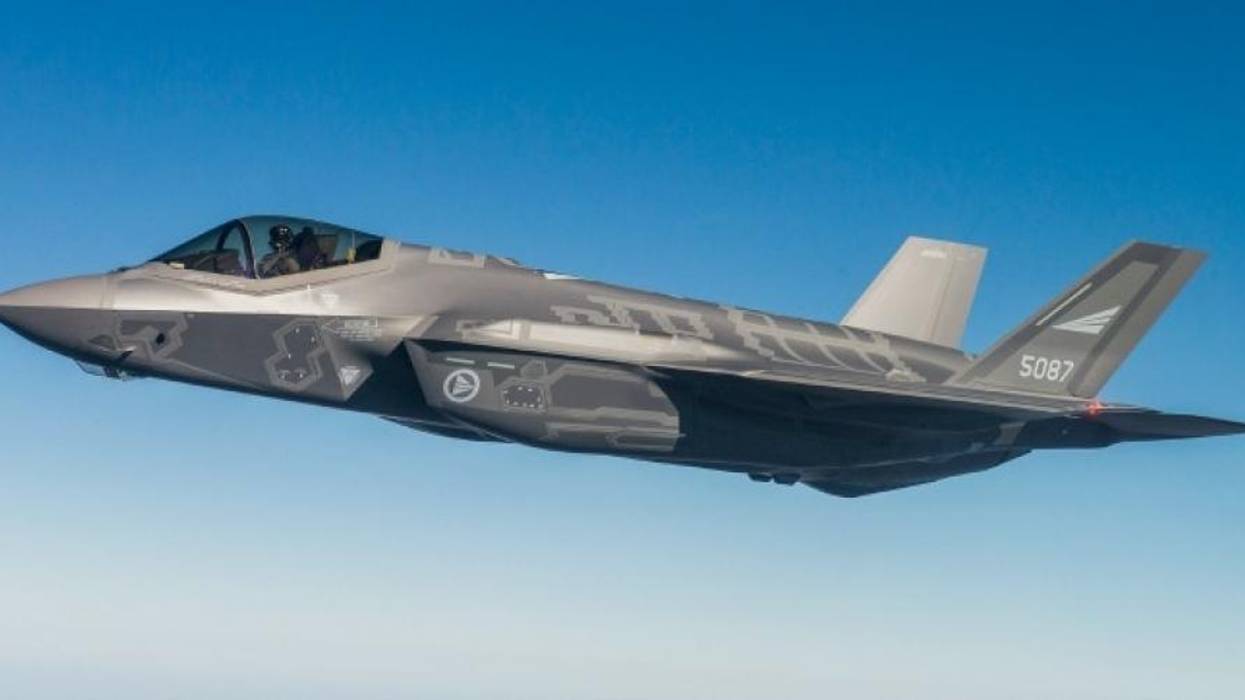
This formula works very well for U.S. military contractors, as illustrated by the case of Lockheed Martin, the largest arms merchant in the world. In 2016, Lockheed's weapons sales rose by almost 11 percent to $41 billion, and the company is well on its way to even greater affluence thanks to its production of the F-35 fighter jet. Lockheed began work on developing the technologically-advanced warplane in the 1980s and, since 2001, the U.S. government has expended over $100 billion for its production. Today, estimates by military analysts as to the total cost to taxpayers of the 2,440 F-35s desired by Pentagon officials range from $1 trillion to $1.5 trillion, making it the most expensive procurement program in U.S. history.
The F-35's enthusiasts have justified the enormous expense of the warplane by emphasizing its projected ability to make a quick liftoff and a vertical landing, as well as its adaptability for use by three different branches of the U.S. military. And its popularity might also reflect their assumption that its raw destructive power will help them win future wars against Russia and China. "We can't get into those aircraft fast enough," Lieutenant General Jon Davis, the Marine Corps' aviation chief, told a House Armed Services subcommittee in early 2017. "We have a game changer, a war winner, on our hands."
Even so, aircraft specialists point out that the F-35 continues to have severe structural problems and that its high-tech computer command system is vulnerable to cyberattack. "This plane has a long way to go before it's combat-ready," remarked a military analyst at the Project on Government Oversight. "Given how long it's been in development, you have to wonder whether it'll ever be ready."
Startled by the extraordinary expense of the F-35 project, Donald Trump initially derided the venture as "out of control." But, after meeting with Pentagon officials and Lockheed CEO Marilynn Hewson, the new president reversed course, praising "the fantastic" F-35 as a "great plane" and authorizing a multi-billion dollar contract for 90 more of them.
In retrospect, none of this is entirely surprising. After all, other giant military contractors--for example, Nazi Germany's Krupp and I.G. Farben and fascist Japan's Mitsubishi and Sumitomo--prospered heavily by arming their nations for World War II and continued prospering in its aftermath. As long as people retain their faith in the supreme value of military might, we can probably also expect Lockheed Martin and other "merchants of death" to continue profiting from war at the public's expense.

With U.S. weapons makers leading the way, and after five consecutive years of decline, sales among the world's 100 largest arms producers rose in 2016, garnering nearly $375 billion in profits, according to a new analysis of industry data by the Stockholm International Peace Research Institute (SIPRI).
"The growth in arms sales was expected and was driven by the implementation of new national major weapon programs, ongoing military operations in several countries, and persistent regional tensions that are leading to an increased demand for weapons," according to a SIPRI fact sheet (pdf).
Considering more than half of SIPRI's top 20 weapons sellers are based in the United States--including Lockheed Martin, Boeing, Raytheon, and Northrop Grumman in the top five--the report declares the U.S. has a "decisive influence on the global trend." Sales by U.S. companies grew by four percent last year, totaling more than $217 billion. Among the top 100 companies, U.S. producers claimed the largest share of sales by a notable margin--nearly 58 percent.

The surge in sales by U.S. companies was in large part thanks to Lockheed Martin, the world's top weapons producer. Lockheed Martin's sales grew by 10.7 percent last year, which report co-author Aude Fleurant, who directs of SIPRI's Arms and Military Expenditures Program, attributed to "the acquisition of helicopter producer Sikorsky in late 2015 and higher delivery volumes of the F-35 combat aircraft."
In Europe, SIPRI found "there were overall decreases in the arms sales of Trans-European, French, and Italian companies, while companies in the U.K. and Germany recorded overall increases," with eight British companies ranking in the top 20. Although sales also rose among Russian companies, the rate of increase fell for the second year in a row, which researchers said was due to "major economic difficulties experienced by Russia in 2016."
Among those designated as "emerging producers"--companies based in Brazil, India, South Korea, and Turkey--South Korea saw the most notable rise, with sales increasing by more than 20 percent.
"Continuing and rising threat perceptions drive South Korea's acquisitions of military equipment, and it is increasingly turning to its own arms industry to supply its demand for weapons," said SIPRI senior researcher and report co-author Siemon Wezeman, pointing to the mounting nuclear tensions between North Korea and the United States, a long-time ally of South Korea. "At the same time," Wezeman added, "South Korea is aiming to realize its goal of becoming a major arms exporter."
Overall, global sales of arms and military services have increased 38 percent since SIPRI began analyzing the data in 2002. Although the researchers do not consider sales by Chinese companies due to lack of data, they note in the report that China's military spending "has increased almost threefold between 2002 and 2016," and estimate that nine or 10 Chinese companies likely would be included in the top 100 list--with four to six in the top 20--if the data were publicly available.
Despite the global rise in arms sales, researchers suggest the increase could have been even higher if traditional weapons importers hadn't run out of funds. Fleurant told Deutsche Welle that "the falling commodity prices for oil and gas have put such a strain on the public finances of many African and South American countries that they bought fewer weapons than planned."
Amid raging conflicts and historic human displacement, U.S.-based companies are still leading the world in arms sales--dominating the list of the top 100 weapons-producers and accounting for 54.4 percent of total revenues, the Stockholm International Peace Research Institute (SIPRI) revealed Monday.
Examining data from the 100 largest "arms-producing and military services" firms in the globe, SIPRI found that U.S. and Western European companies together account for 80.3 percent of the arms revenue for the top 100 giants worldwide.
This is a large slice of a giant pie. Last year, sales of arms by the top 100 totaled $401 billion, SIPRI finds.
The report notes that worldwide weapons sales have seen a slight decline of 1.5 percent between 2013 and 2014, due to a moderate reduction in arms sales for North American and Western European producers.
However, the sales by the prominent U.S.-based firm Lockheed Martin are off the charts. A report summary notes, "One company bucking the downward trend is Lockheed Martin, which has occupied the first position in the Top 100 since 2009. Its arms sales grew by 3.9 percent in 2014 to $37.5 billion."
In addition, Boeing, which is ranked just below Lockheed, saw a $4.4 billion increase in arms sales in 2014 and $28.3 billion total.
Both Boeing and Lockheed are among the U.S. companies that have recently faced global criticism after respectively selling bombs and warships to Saudi Arabia, which faces numerous charges of war crimes and human rights violations for its military assault and naval blockade of Yemen.
Beyond the U.S. and Western Europe, SIPRI notes, Russia is seeing rising arms sales, now accounting for 11 of the top 100 companies. In addition, two Turkish weapons companies are also rising on the list.
However, the U.S. arms industry remains squarely in first place, amid warnings that such weapons sales--in addition to direct American military aggression--are fueling conflicts and wars across the world.
SIPRI's findings follow an Amnesty International report earlier this month which concluded that the atrocities of ISIS, also known as Daesh and the Islamic State, are fueled by "decades of reckless arms trading." As a result, the study finds, ISIS is now using arms originally manufactured and designed in dozens of countries, including the United States.
CAPE TOWN - Peruse a few reports on global military expenditure and you will not be able to shake the image of the planet as one massive army camp, patrolled by heavily weaponised guards in a plethora of uniforms.
Last year, the world spent about 1.76 trillion dollars on military activity according to the Stockholm International Peace Research Institute (SIPRI). The year before, arms sales among SIPRI's 'Top 100' companies touched 410 billion dollars. It is estimated that 1,000 people die from gun violence every single day.
But scattered amongst the barracks of this planetary war zone are scores of white flags, wielded daily by the many millions of people engaged in nonviolent resistance to the forces that threaten their existence.
Nearly 120 of these peace activists are currently assembled in Cape Town's City Hall, for the quadrennial meeting of the 93-year-old War Resister's International (WRI), a global network of activists from far-flung regions fighting on every imaginable front, from anti-trafficking in Australia to peace and reconciliation in Rwanda.
Returning to the very pulpit from where he led the historic 1989 March for Peace, Archbishop Desmond Tutu addressed the forum's participants Saturday night by invoking memories of the long and bloody struggle against apartheid.
"Take our thanks back to your countries," he told the audience, "even the poorest of which stood ready to receive South African exiles and refugees." Drawing on the conference's theme 'Small Actions - Big Movements: the continuum of nonviolence', he urged greater collaboration between disparate movements, in order to find strength in unity.
"The U.S. Command in Africa (AFRICOM) has now expanded to approximately 2,000 troops on the continent, covering 38 countries," WRI Conference Coordinator Matt Meyer told IPS.
"With almost no money but a lot of passion and an understanding of the need for unity in the face of militarism, violence, and a re-colonisation of the land, we brought together people from every continent and 33 African countries to say: 'We will continue to resist. We will build a beautiful new tomorrow.'"
Running from Jul. 4-8, the gathering offers a bird's eye view of the life-affirming campaigns that often get pushed off front pages in favour of headlines proclaiming death and war.
While not often on the news, the efficacy of the peace movement is being documented elsewhere. Analysing a century's worth of data, the World Peace Foundation found that between 1900 and 2006, nonviolent movements had a 53-percent success rate, compared to a 22-percent success rate for violent movements.
Other tangible successes include the long list of victories recently secured by the Palestinian Boycott, Divestment and Sanctions (BDS) movement, according to Omar Barghouti, a founding committee member of the Palestinian Campaign for the Academic and Cultural Boycott of Israel (PACBI).
With three basic demands (ending the occupation as defined by the 1967 borders; ending Israel's system of legal discrimination against Palestinians; and enforcing the right of return for Palestinian refugees), the civil society initiative calls for the same global solidarity that erupted during the fight against apartheid in South Africa, and urges companies to withdraw their investments from firms that directly profit from the occupation of Palestine.
In the last three years alone, many major pension funds in Europe have divested from Israeli banks, including the 200-billion-dollar financial giant PGGM, the second-largest pension manager in the Netherlands.
In addition, the 810-billion-dollar sovereign wealth fund of Norway decided this year to pull investments from Israeli firms operating in the West Bank; the Luxembourg Pension Fund followed suit, citing ethical concerns over the building of settlements on occupied Palestinian land.
In addition, said Barghouti, "Bill Gates, the richest man in the world, recently divested from the British-Danish-owned G4S, one of the largest private security companies in the world; the United Methodist Church - one of the richest in the U.S. - pulled its 18-billion-dollar fund out of companies operating on occupied Palestinian land; and the Presbyterian church has divested from companies like Caterpillar, HP and Motorola Solutions because of their involvement in the occupation."
With its 15-billion-dollar defense budget, the Israeli government is not taking this lightly, and has identified the BDS movement as a strategic, rather than societal, threat.
"Israel recently shifted overall responsibility for fighting BDS from the ministry of foreign affairs to the ministry of strategic affairs," Barghouti said Monday, "the same ministry that deals with the Iranian threat, and Israel's relationship with the U.S."
Elsewhere, too, authoritarian regimes are recognising the legitimate power of nonviolent resistance. A South Sudanese activist, wishing to be identified only as Karbash A M, told IPS that the Sudanese government in Khartoum has issued a blanket ban on NGOs conducting nonviolence trainings among refugee communities.
But in the face of a political crisis that has claimed tens of thousands of lives since South Sudan declared independence in 2011, Marmoun said, a handful of organisations continue to train hundreds of community leaders and youth activists in the tactics of nonviolence, even as a wave of arms and ammunition threatens to drown the country.
Documenting over 14 case studies of peaceful resistance, the second edition of WRI's Handbook for Nonviolent Campaigns, released here Sunday, offers a tip-of-the-iceberg analysis of the proliferation of nonviolent movements around the world, from protests against the Indonesian military in West Papua, to the diaspora solidarity movement for Eritrea.
Recognising a continuum between the moral commitment to nonviolence adopted by Gandhi, the strategic decision to exercise nonviolence in Eastern Europe in the 1980s, and a "willingness to use nonviolent methods [...] but no commitment to avoid low-level physical violence," the Handbook offers practical advice to activists and organisers from Colombia to South Korea and beyond.
Another major development here this week was the founding of the Pan African Network on Nonviolence and Peacebuilding, the first regional initiative of its kind dedicated to connecting African grassroots organisers around nonviolent resistance.
"I am delighted we have been able to give birth to this network here in Cape Town," Nozizwe Madlala-Routledge, executive director of the South Africa-based organisation Embrace Dignity - which fights to end sex trafficking and the commercial exploitation of women - told IPS.
"At the last count, 33 African countries are represented in the network, with a 16-member steering committee, each from a different country.
"We are also making an effort to ensure representation from island states like Mauritius and the Canary Islands," she stated, adding that the network will play a crucial role in elevating the voices of civil society on issues of governance, development and corruption.
Experts here say such a network could be hugely important in combating the U.S.' increased military presence in Africa, such as plans to construct a 220-million-dollar Special Operations compound at the base of the U.S.' Camp Lemonnier in Djibouti.
The actions may be small, but their impacts are felt at the highest level.
"We can now call ourselves the 'three percent people'," Anand Mazgaonkar, a representative of the National Alliance of Peoples' Movements (NAPM) in Gujarat, India, said at a plenary session Monday, "because a recent intelligence report in India has named all of us involved in movements as collectively responsible for a three percent damage to the country's gross domestic product (GDP)."