SUBSCRIBE TO OUR FREE NEWSLETTER
Daily news & progressive opinion—funded by the people, not the corporations—delivered straight to your inbox.
5
#000000
#FFFFFF
To donate by check, phone, or other method, see our More Ways to Give page.
Daily news & progressive opinion—funded by the people, not the corporations—delivered straight to your inbox.
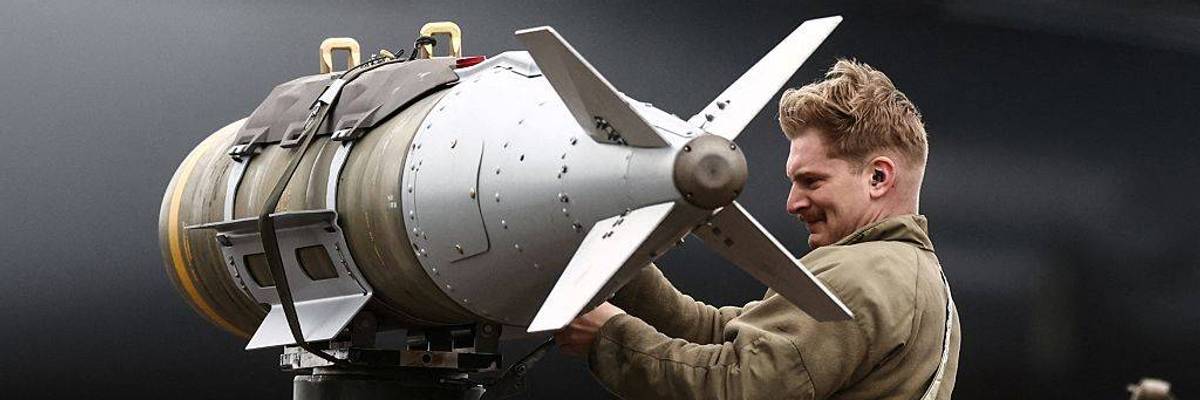
USAF military ground personnel prepare Joint Direct Attack Munitions (JDAM) for a US Air Force (USAF) B-1 Lancer bomber on the tarmac at RAF Fairford in south-west England on March 12, 2026.
"Given the range of current crises, as well as many states’ long-term military spending targets, this growth will probably continue through 2026 and beyond," said one researcher.
Global military spending around the world surged in 2025 in response to further eroding geopolitical stability, the Stockholm International Peace Research Institute revealed in a report released Monday.
In its annual report on trends in global military expenditures, SIPRI found that global military spending in 2025 totaled nearly $2.9 trillion, a 2.9% increase over defense spending in 2024. Global defense spending now accounts for 2.5% of global gross domestic product (GDP), the highest level since 2009.
Despite the Pentagon's ballooning budget, overall defense defense spending in the US actually decreased in 2025, as the Trump administration and the Republican-controlled US Congress stopped sending new military aid to Ukraine, which had received nearly $130 billion in military aid under President Joe Biden over the previous three years after it was invaded by Russia in 2022.
Even without additional US involvement, spending on the Russia-Ukraine conflict grew significantly in 2025, as Russia increased its defense spending by 6% and Ukraine increased its military expenditures by 20%.
"In 2025 military expenditure as a share of government spending reached the highest level ever recorded in both Russia and Ukraine," said Lorenzo Scarazzato, researcher with the SIPRI Military Expenditure and Arms Production Program. "Their spending is likely to keep growing in 2026 if the war continues, with revenues from Russia’s oil sales increasing and a major European Union loan expected by Ukraine."
The dip in US defense spending may not last long given that President Donald Trump has proposed a record $1.5 trillion military budget and the president's unauthorized war of choice with Iran has already cost US taxpayers an estimated $63 billion.
Both Israel and Iran spent less on defense in 2025 than the year before, although both countries are similarly likely to see a surge in spending given the conflict between the two countries that began when the US and Israel attacked Iran in late February.
Elsewhere in the world, the SIPRI report finds that defense spending in Europe grew by 14% in 2025, while growing just over 8% in Asia and Oceania.
The US, China, and Russia were the three biggest military spenders, and their combined spending of $1.48 trillion represented more than half of the global total.
Xiao Liang, researcher with SIPRI’s Military Expenditure and Arms Production Program, said that the big increases in defense spending came in response to "another year of wars, uncertainty, and geopolitical upheaval with large-scale armament drives."
"Given the range of current crises, as well as many states’ long-term military spending targets," the researcher added, "this growth will probably continue through 2026 and beyond."
Dear Common Dreams reader, It’s been nearly 30 years since I co-founded Common Dreams with my late wife, Lina Newhouser. We had the radical notion that journalism should serve the public good, not corporate profits. It was clear to us from the outset what it would take to build such a project. No paid advertisements. No corporate sponsors. No millionaire publisher telling us what to think or do. Many people said we wouldn't last a year, but we proved those doubters wrong. Together with a tremendous team of journalists and dedicated staff, we built an independent media outlet free from the constraints of profits and corporate control. Our mission has always been simple: To inform. To inspire. To ignite change for the common good. Building Common Dreams was not easy. Our survival was never guaranteed. When you take on the most powerful forces—Wall Street greed, fossil fuel industry destruction, Big Tech lobbyists, and uber-rich oligarchs who have spent billions upon billions rigging the economy and democracy in their favor—the only bulwark you have is supporters who believe in your work. But here’s the urgent message from me today. It's never been this bad out there. And it's never been this hard to keep us going. At the very moment Common Dreams is most needed, the threats we face are intensifying. We need your support now more than ever. We don't accept corporate advertising and never will. We don't have a paywall because we don't think people should be blocked from critical news based on their ability to pay. Everything we do is funded by the donations of readers like you. When everyone does the little they can afford, we are strong. But if that support retreats or dries up, so do we. Will you donate now to make sure Common Dreams not only survives but thrives? —Craig Brown, Co-founder |
Global military spending around the world surged in 2025 in response to further eroding geopolitical stability, the Stockholm International Peace Research Institute revealed in a report released Monday.
In its annual report on trends in global military expenditures, SIPRI found that global military spending in 2025 totaled nearly $2.9 trillion, a 2.9% increase over defense spending in 2024. Global defense spending now accounts for 2.5% of global gross domestic product (GDP), the highest level since 2009.
Despite the Pentagon's ballooning budget, overall defense defense spending in the US actually decreased in 2025, as the Trump administration and the Republican-controlled US Congress stopped sending new military aid to Ukraine, which had received nearly $130 billion in military aid under President Joe Biden over the previous three years after it was invaded by Russia in 2022.
Even without additional US involvement, spending on the Russia-Ukraine conflict grew significantly in 2025, as Russia increased its defense spending by 6% and Ukraine increased its military expenditures by 20%.
"In 2025 military expenditure as a share of government spending reached the highest level ever recorded in both Russia and Ukraine," said Lorenzo Scarazzato, researcher with the SIPRI Military Expenditure and Arms Production Program. "Their spending is likely to keep growing in 2026 if the war continues, with revenues from Russia’s oil sales increasing and a major European Union loan expected by Ukraine."
The dip in US defense spending may not last long given that President Donald Trump has proposed a record $1.5 trillion military budget and the president's unauthorized war of choice with Iran has already cost US taxpayers an estimated $63 billion.
Both Israel and Iran spent less on defense in 2025 than the year before, although both countries are similarly likely to see a surge in spending given the conflict between the two countries that began when the US and Israel attacked Iran in late February.
Elsewhere in the world, the SIPRI report finds that defense spending in Europe grew by 14% in 2025, while growing just over 8% in Asia and Oceania.
The US, China, and Russia were the three biggest military spenders, and their combined spending of $1.48 trillion represented more than half of the global total.
Xiao Liang, researcher with SIPRI’s Military Expenditure and Arms Production Program, said that the big increases in defense spending came in response to "another year of wars, uncertainty, and geopolitical upheaval with large-scale armament drives."
"Given the range of current crises, as well as many states’ long-term military spending targets," the researcher added, "this growth will probably continue through 2026 and beyond."
Global military spending around the world surged in 2025 in response to further eroding geopolitical stability, the Stockholm International Peace Research Institute revealed in a report released Monday.
In its annual report on trends in global military expenditures, SIPRI found that global military spending in 2025 totaled nearly $2.9 trillion, a 2.9% increase over defense spending in 2024. Global defense spending now accounts for 2.5% of global gross domestic product (GDP), the highest level since 2009.
Despite the Pentagon's ballooning budget, overall defense defense spending in the US actually decreased in 2025, as the Trump administration and the Republican-controlled US Congress stopped sending new military aid to Ukraine, which had received nearly $130 billion in military aid under President Joe Biden over the previous three years after it was invaded by Russia in 2022.
Even without additional US involvement, spending on the Russia-Ukraine conflict grew significantly in 2025, as Russia increased its defense spending by 6% and Ukraine increased its military expenditures by 20%.
"In 2025 military expenditure as a share of government spending reached the highest level ever recorded in both Russia and Ukraine," said Lorenzo Scarazzato, researcher with the SIPRI Military Expenditure and Arms Production Program. "Their spending is likely to keep growing in 2026 if the war continues, with revenues from Russia’s oil sales increasing and a major European Union loan expected by Ukraine."
The dip in US defense spending may not last long given that President Donald Trump has proposed a record $1.5 trillion military budget and the president's unauthorized war of choice with Iran has already cost US taxpayers an estimated $63 billion.
Both Israel and Iran spent less on defense in 2025 than the year before, although both countries are similarly likely to see a surge in spending given the conflict between the two countries that began when the US and Israel attacked Iran in late February.
Elsewhere in the world, the SIPRI report finds that defense spending in Europe grew by 14% in 2025, while growing just over 8% in Asia and Oceania.
The US, China, and Russia were the three biggest military spenders, and their combined spending of $1.48 trillion represented more than half of the global total.
Xiao Liang, researcher with SIPRI’s Military Expenditure and Arms Production Program, said that the big increases in defense spending came in response to "another year of wars, uncertainty, and geopolitical upheaval with large-scale armament drives."
"Given the range of current crises, as well as many states’ long-term military spending targets," the researcher added, "this growth will probably continue through 2026 and beyond."