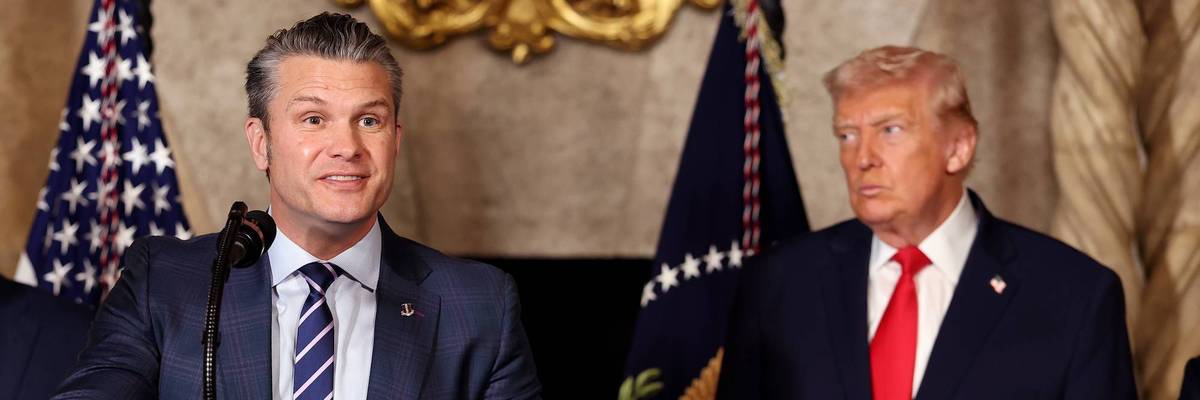
US Defense Secretary Pete Hegseth speaks alongside President Donald Trump on December 22, 2025 in Palm Beach, Florida.
Anyone Still Arguing Trump's Iran War Isn't Illegal Will Soon Be Out of Excuses: Legal Scholar
“The courts should simply hold that the War Powers Resolution requires the president to end our involvement in the war with Iran unless and until Congress authorizes it."
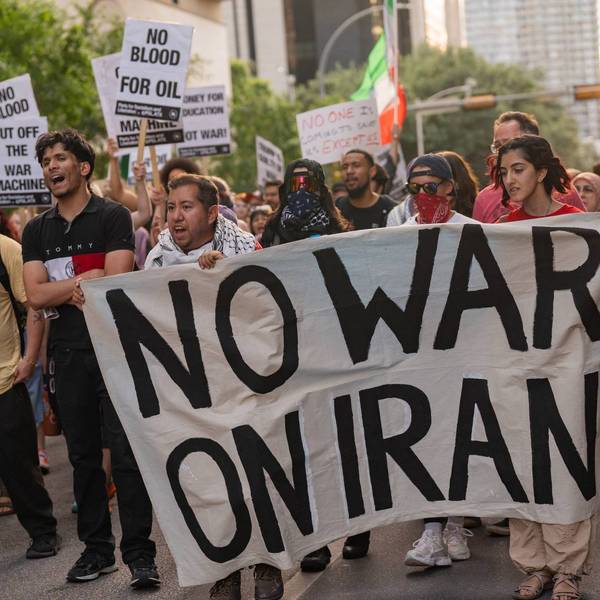
In late February, President Donald Trump launched a war of choice with Iran that many legal scholars have called illegal for numerous reasons, including that the president received no authorization from Congress or the United Nations Security Council before carrying out the attack, and that the invasion was not started in self-defense.
Defenders of the war have nevertheless claimed that Trump's decision to attack Iran is covered by the 1973 War Powers Resolution, which allows the president to deploy military forces for up to 60 days so long as he provides the US Congress with notification within 48 hours of launching strikes.
With the Iran war set to surpass the 60-day threshold by the end of this week, legal scholar Erwin Chemerinsky, dean of the University of California Berkeley School of Law, argued in an editorial published by The New York Times on Monday that time is about to run out for defenders of the deeply unpopular war.
The US attacks will “clearly be illegal” should they continue without any congressional approval, said Chemerinsky.
Chemerinsky predicted that Trump and Republicans in Congress will shrug off this deadline, even though the War Powers Resolution "doesn't come with a check box for opting out."
This would then put the onus on courts to declare the war illegal and demand its end, Chemerinsky continued, although he acknowledged that the chances of a court enforcing the War Powers Resolution were slim, given a long history of courts dismissing claims brought under the 1973 law.
Even so, he encouraged opponents of the war to file lawsuits aimed at ending the conflict, given that the alternative is to simply grant the president unchecked powers to launch wars of choice.
"The courts should simply hold that the War Powers Resolution requires the president to end our involvement in the war with Iran unless and until Congress authorizes it," Chemerinsky concluded. "This shouldn’t be—and isn't—different than any other injunction on any administration to comply with the law. Mr. Trump might disregard such an order. But that isn’t a reason for the federal judiciary to abandon its duty to enforce the law."
Congressional Democrats have repeatedly forced votes on war powers resolutions that would end the Iran War, but each time have fallen short of the votes needed in the Republican-controlled Congress.
An April 16 war powers resolution in the US House of Representatives came one vote short of passing, with Rep. Jared Golden (D-Maine) joining nearly all Republicans in voting against it.
Chemerinsky pointed to the unwillingness of Congress to take responsibility for war powers as a reason for courts to intervene, and warned of dire consequences should they fail to declare the war illegal.
"In the face of congressional inaction, and without judicial enforcement, there are realistically no checks on the president’s ability to unilaterally wage war," wrote Chemerinsky. "If the federal judiciary, up to and including the Supreme Court, won’t uphold its responsibility here, it will nullify our Constitution’s design that two branches of government should be involved when our country goes to war."
We are at a crossroads
This country and this world are at a monumental crossroads. In a few short weeks, US voters will have an opportunity to beat back the forces of fascism and confront the billionaires who are rigging the economy, our media system, and our democracy, making it increasingly impossible for ordinary people to get by. We’re not just talking about the election. We’re talking about what must be done once these fascist elements are vanquished from power. We need a bolder set of solutions than what either major party has so far been willing to offer and a working-class movement ready to fight like hell for it. Trump didn't emerge from nowhere. The conditions that fueled MAGA authoritarianism were created by decades of radical neoliberal economic policies and a corrupt political system dominated by corporate interests. They slashed taxes on the super-rich, promising that the benefits would trickle down. They said giveaways to the corporate titans would make life more affordable for the rest of us. It was all bullshit. And when a bitter, betrayed populace searches for someone to blame, right-wing demagogues have little trouble finding scapegoats. People know when they're being lied to, but you won't hear any of this from the corporate media. Only independent journalism—powered and funded by people who believe in building a better world—can deliver truly trustworthy daily news. Our Fall Campaign is underway, and we need your help. To power our newsroom through the rest of the year, we need to raise $125,000 by midnight on October 31. So if you share our vision, please contribute whatever you can to sustain our work. |
In late February, President Donald Trump launched a war of choice with Iran that many legal scholars have called illegal for numerous reasons, including that the president received no authorization from Congress or the United Nations Security Council before carrying out the attack, and that the invasion was not started in self-defense.
Defenders of the war have nevertheless claimed that Trump's decision to attack Iran is covered by the 1973 War Powers Resolution, which allows the president to deploy military forces for up to 60 days so long as he provides the US Congress with notification within 48 hours of launching strikes.
With the Iran war set to surpass the 60-day threshold by the end of this week, legal scholar Erwin Chemerinsky, dean of the University of California Berkeley School of Law, argued in an editorial published by The New York Times on Monday that time is about to run out for defenders of the deeply unpopular war.
The US attacks will “clearly be illegal” should they continue without any congressional approval, said Chemerinsky.
Chemerinsky predicted that Trump and Republicans in Congress will shrug off this deadline, even though the War Powers Resolution "doesn't come with a check box for opting out."
This would then put the onus on courts to declare the war illegal and demand its end, Chemerinsky continued, although he acknowledged that the chances of a court enforcing the War Powers Resolution were slim, given a long history of courts dismissing claims brought under the 1973 law.
Even so, he encouraged opponents of the war to file lawsuits aimed at ending the conflict, given that the alternative is to simply grant the president unchecked powers to launch wars of choice.
"The courts should simply hold that the War Powers Resolution requires the president to end our involvement in the war with Iran unless and until Congress authorizes it," Chemerinsky concluded. "This shouldn’t be—and isn't—different than any other injunction on any administration to comply with the law. Mr. Trump might disregard such an order. But that isn’t a reason for the federal judiciary to abandon its duty to enforce the law."
Congressional Democrats have repeatedly forced votes on war powers resolutions that would end the Iran War, but each time have fallen short of the votes needed in the Republican-controlled Congress.
An April 16 war powers resolution in the US House of Representatives came one vote short of passing, with Rep. Jared Golden (D-Maine) joining nearly all Republicans in voting against it.
Chemerinsky pointed to the unwillingness of Congress to take responsibility for war powers as a reason for courts to intervene, and warned of dire consequences should they fail to declare the war illegal.
"In the face of congressional inaction, and without judicial enforcement, there are realistically no checks on the president’s ability to unilaterally wage war," wrote Chemerinsky. "If the federal judiciary, up to and including the Supreme Court, won’t uphold its responsibility here, it will nullify our Constitution’s design that two branches of government should be involved when our country goes to war."
- US Military Told Mideast Ally That Trump Attack on Iran is 'Imminent': Report ›
- US, Israel, and Iran Agree to 2-Week Ceasefire Hours After Trump's Genocidal Threat ›
- Trump Declares Iran War 'Very Complete, Pretty Much' Days After Demanding 'Total Surrender' ›
- 'It Needs to End. Now': Trump and Allies Ripped for Lying to Dodge Iran War Powers Deadline | Common Dreams ›
- Trump Halts Iran Attack at Gulf Monarchs' Request as Democrats Renew War Powers Push | Common Dreams ›
- Trump Bombs Iran for Second Night After Complaining Talks Have 'Taken Too Long' | Common Dreams ›
- 'We Are in a Constitutional Crisis': Congress Urged to Sue Trump to End Iran War | Common Dreams ›
In late February, President Donald Trump launched a war of choice with Iran that many legal scholars have called illegal for numerous reasons, including that the president received no authorization from Congress or the United Nations Security Council before carrying out the attack, and that the invasion was not started in self-defense.
Defenders of the war have nevertheless claimed that Trump's decision to attack Iran is covered by the 1973 War Powers Resolution, which allows the president to deploy military forces for up to 60 days so long as he provides the US Congress with notification within 48 hours of launching strikes.
With the Iran war set to surpass the 60-day threshold by the end of this week, legal scholar Erwin Chemerinsky, dean of the University of California Berkeley School of Law, argued in an editorial published by The New York Times on Monday that time is about to run out for defenders of the deeply unpopular war.
The US attacks will “clearly be illegal” should they continue without any congressional approval, said Chemerinsky.
Chemerinsky predicted that Trump and Republicans in Congress will shrug off this deadline, even though the War Powers Resolution "doesn't come with a check box for opting out."
This would then put the onus on courts to declare the war illegal and demand its end, Chemerinsky continued, although he acknowledged that the chances of a court enforcing the War Powers Resolution were slim, given a long history of courts dismissing claims brought under the 1973 law.
Even so, he encouraged opponents of the war to file lawsuits aimed at ending the conflict, given that the alternative is to simply grant the president unchecked powers to launch wars of choice.
"The courts should simply hold that the War Powers Resolution requires the president to end our involvement in the war with Iran unless and until Congress authorizes it," Chemerinsky concluded. "This shouldn’t be—and isn't—different than any other injunction on any administration to comply with the law. Mr. Trump might disregard such an order. But that isn’t a reason for the federal judiciary to abandon its duty to enforce the law."
Congressional Democrats have repeatedly forced votes on war powers resolutions that would end the Iran War, but each time have fallen short of the votes needed in the Republican-controlled Congress.
An April 16 war powers resolution in the US House of Representatives came one vote short of passing, with Rep. Jared Golden (D-Maine) joining nearly all Republicans in voting against it.
Chemerinsky pointed to the unwillingness of Congress to take responsibility for war powers as a reason for courts to intervene, and warned of dire consequences should they fail to declare the war illegal.
"In the face of congressional inaction, and without judicial enforcement, there are realistically no checks on the president’s ability to unilaterally wage war," wrote Chemerinsky. "If the federal judiciary, up to and including the Supreme Court, won’t uphold its responsibility here, it will nullify our Constitution’s design that two branches of government should be involved when our country goes to war."
- US Military Told Mideast Ally That Trump Attack on Iran is 'Imminent': Report ›
- US, Israel, and Iran Agree to 2-Week Ceasefire Hours After Trump's Genocidal Threat ›
- Trump Declares Iran War 'Very Complete, Pretty Much' Days After Demanding 'Total Surrender' ›
- 'It Needs to End. Now': Trump and Allies Ripped for Lying to Dodge Iran War Powers Deadline | Common Dreams ›
- Trump Halts Iran Attack at Gulf Monarchs' Request as Democrats Renew War Powers Push | Common Dreams ›
- Trump Bombs Iran for Second Night After Complaining Talks Have 'Taken Too Long' | Common Dreams ›
- 'We Are in a Constitutional Crisis': Congress Urged to Sue Trump to End Iran War | Common Dreams ›