SUBSCRIBE TO OUR FREE NEWSLETTER
Daily news & progressive opinion—funded by the people, not the corporations—delivered straight to your inbox.
5
#000000
#FFFFFF
To donate by check, phone, or other method, see our More Ways to Give page.
Daily news & progressive opinion—funded by the people, not the corporations—delivered straight to your inbox.
According to a study by the Stockholm International Peace Research Institute, sales of weapons and military services by the world's largest 100 corporate military purveyors in 2016--the latest year for which figures are available--rose to $375 billion.
During the mid-1930s, a best-selling expose of the international arms trade, combined with a U.S. Congressional investigation of munitions-makers led by Senator Gerald Nye, had a major impact on American public opinion. Convinced that military contractors were stirring up weapons sales and war for their own profit, many people grew critical of these "merchants of death."
Today, some eight decades later, their successors, now more politely called "defense contractors," are alive and well. According to a study by the Stockholm International Peace Research Institute, sales of weapons and military services by the world's largest 100 corporate military purveyors in 2016 (the latest year for which figures are available) rose to $375 billion. U.S. corporations increased their share of that total to almost 58 percent, supplying weapons to at least 100 nations around the world.
The dominant role played by U.S. corporations in the international arms trade owes a great deal to the efforts of U.S. government officials. "Significant parts of the government," notes military analyst William Hartung, "are intent on ensuring that American arms will flood the global market and companies like Lockheed and Boeing will live the good life. From the president on his trips abroad to visit allied world leaders to the secretaries of state and defense to the staffs of U.S. embassies, American officials regularly act as salespeople for the arms firms." Furthermore, he notes, "the Pentagon is their enabler. From brokering, facilitating, and literally banking the money from arms deals to transferring weapons to favored allies on the taxpayers' dime, it is in essence the world's largest arms dealer."
In 2013, when Tom Kelly, the deputy assistant secretary of the State Department's Bureau of Political Affairs was asked during a Congressional hearing about whether the Obama administration was doing enough to promote American weapons exports, he replied: "[We are] advocating on behalf of our companies and doing everything we can to make sure that these sales go through. . . and that is something we are doing every day, basically [on] every continent in the world . . . and we're constantly thinking of how we can do better." This proved a fair enough assessment, for during the first six years of the Obama administration, U.S. government officials secured agreements for U.S. weapons sales of more than $190 billion around the world, especially to the volatile Middle East. Determined to outshine his predecessor, President Donald Trump, on his first overseas trip, bragged about a $110 billion arms deal (totaling $350 billion over the next decade) with Saudi Arabia.
The greatest single weapons market remains the United States, for this country ranks first among nations in military spending, with 36 percent of the global total. Trump is a keen military enthusiast, as is the Republican Congress, which is currently in the process of approving a 13 percent increase in the already astronomical U.S. military budget. Much of this future military spending will almost certainly be devoted to purchasing new and very expensive high-tech weapons, for the military contractors are adept at delivering millions of dollars in campaign contributions to needy politicians, employing 700 to 1,000 lobbyists to nudge them along, claiming that their military production facilities are necessary to create jobs, and mobilizing their corporate-funded think tanks to highlight ever-greater foreign "dangers."
They can also count upon a friendly reception from their former executives now holding high-level posts in the Trump administration, including: Secretary of Defense James Mattis (a former board member of General Dynamics); White House Chief of Staff John Kelly (previously employed by several military contractors); Deputy Secretary of Defense Patrick Shanahan (a former Boeing executive); Secretary of the Army Mark Esper (a former Raytheon vice president); Secretary of the Air Force Heather Wilson (a former consultant to Lockheed Martin); Undersecretary of Defense for Acquisition Ellen Lord (a former CEO of an aerospace company); and National Security Council Chief of Staff Keith Kellogg (a former employee of a major military and intelligence contractor).
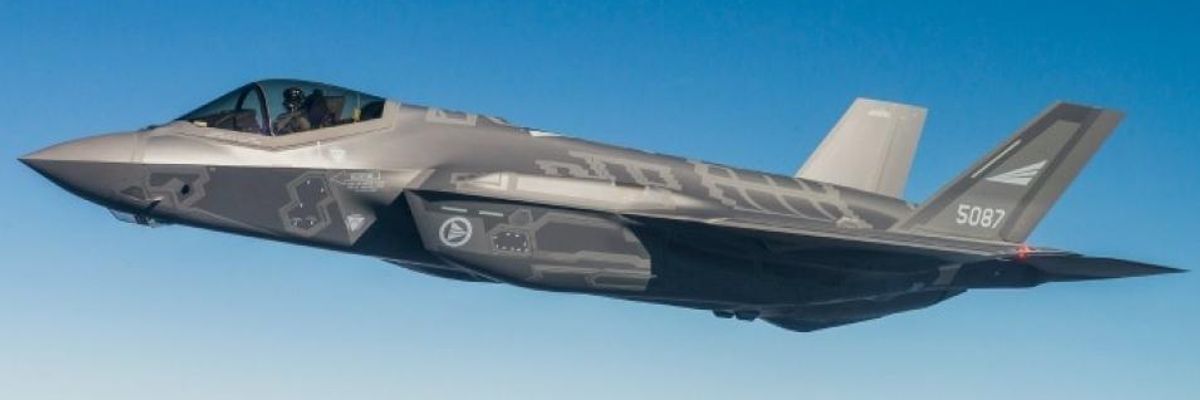
This formula works very well for U.S. military contractors, as illustrated by the case of Lockheed Martin, the largest arms merchant in the world. In 2016, Lockheed's weapons sales rose by almost 11 percent to $41 billion, and the company is well on its way to even greater affluence thanks to its production of the F-35 fighter jet. Lockheed began work on developing the technologically-advanced warplane in the 1980s and, since 2001, the U.S. government has expended over $100 billion for its production. Today, estimates by military analysts as to the total cost to taxpayers of the 2,440 F-35s desired by Pentagon officials range from $1 trillion to $1.5 trillion, making it the most expensive procurement program in U.S. history.
The F-35's enthusiasts have justified the enormous expense of the warplane by emphasizing its projected ability to make a quick liftoff and a vertical landing, as well as its adaptability for use by three different branches of the U.S. military. And its popularity might also reflect their assumption that its raw destructive power will help them win future wars against Russia and China. "We can't get into those aircraft fast enough," Lieutenant General Jon Davis, the Marine Corps' aviation chief, told a House Armed Services subcommittee in early 2017. "We have a game changer, a war winner, on our hands."
Even so, aircraft specialists point out that the F-35 continues to have severe structural problems and that its high-tech computer command system is vulnerable to cyberattack. "This plane has a long way to go before it's combat-ready," remarked a military analyst at the Project on Government Oversight. "Given how long it's been in development, you have to wonder whether it'll ever be ready."
Startled by the extraordinary expense of the F-35 project, Donald Trump initially derided the venture as "out of control." But, after meeting with Pentagon officials and Lockheed CEO Marilynn Hewson, the new president reversed course, praising "the fantastic" F-35 as a "great plane" and authorizing a multi-billion dollar contract for 90 more of them.
In retrospect, none of this is entirely surprising. After all, other giant military contractors--for example, Nazi Germany's Krupp and I.G. Farben and fascist Japan's Mitsubishi and Sumitomo--prospered heavily by arming their nations for World War II and continued prospering in its aftermath. As long as people retain their faith in the supreme value of military might, we can probably also expect Lockheed Martin and other "merchants of death" to continue profiting from war at the public's expense.
This country and this world are at a monumental crossroads. US voters have an opportunity to beat back the forces of fascism and confront the billionaires who are rigging the economy, our media system, and our democracy, making it increasingly impossible for ordinary people to get by. We’re not just talking about the election. We’re talking about what must be done once these fascist elements are vanquished from power. We need a bolder set of solutions than what either major party has so far been willing to offer and a working-class movement ready to fight like hell for it. Trump didn't emerge from nowhere. The conditions that fueled MAGA authoritarianism were created by decades of radical neoliberal economic policies and a corrupt political system dominated by corporate interests. They slashed taxes on the super-rich, promising that the benefits would trickle down. They said giveaways to the corporate titans would make life more affordable for the rest of us. It was all bullshit. And when a bitter, betrayed populace searches for someone to blame, right-wing demagogues have little trouble finding scapegoats. People know when they're being lied to, but you won't hear any of this from the corporate media. Only independent journalism—powered and funded by people who believe in building a better world—can deliver truly trustworthy daily news. If you share our vision, please contribute whatever you can to sustain our work. |
During the mid-1930s, a best-selling expose of the international arms trade, combined with a U.S. Congressional investigation of munitions-makers led by Senator Gerald Nye, had a major impact on American public opinion. Convinced that military contractors were stirring up weapons sales and war for their own profit, many people grew critical of these "merchants of death."
Today, some eight decades later, their successors, now more politely called "defense contractors," are alive and well. According to a study by the Stockholm International Peace Research Institute, sales of weapons and military services by the world's largest 100 corporate military purveyors in 2016 (the latest year for which figures are available) rose to $375 billion. U.S. corporations increased their share of that total to almost 58 percent, supplying weapons to at least 100 nations around the world.
The dominant role played by U.S. corporations in the international arms trade owes a great deal to the efforts of U.S. government officials. "Significant parts of the government," notes military analyst William Hartung, "are intent on ensuring that American arms will flood the global market and companies like Lockheed and Boeing will live the good life. From the president on his trips abroad to visit allied world leaders to the secretaries of state and defense to the staffs of U.S. embassies, American officials regularly act as salespeople for the arms firms." Furthermore, he notes, "the Pentagon is their enabler. From brokering, facilitating, and literally banking the money from arms deals to transferring weapons to favored allies on the taxpayers' dime, it is in essence the world's largest arms dealer."
In 2013, when Tom Kelly, the deputy assistant secretary of the State Department's Bureau of Political Affairs was asked during a Congressional hearing about whether the Obama administration was doing enough to promote American weapons exports, he replied: "[We are] advocating on behalf of our companies and doing everything we can to make sure that these sales go through. . . and that is something we are doing every day, basically [on] every continent in the world . . . and we're constantly thinking of how we can do better." This proved a fair enough assessment, for during the first six years of the Obama administration, U.S. government officials secured agreements for U.S. weapons sales of more than $190 billion around the world, especially to the volatile Middle East. Determined to outshine his predecessor, President Donald Trump, on his first overseas trip, bragged about a $110 billion arms deal (totaling $350 billion over the next decade) with Saudi Arabia.
The greatest single weapons market remains the United States, for this country ranks first among nations in military spending, with 36 percent of the global total. Trump is a keen military enthusiast, as is the Republican Congress, which is currently in the process of approving a 13 percent increase in the already astronomical U.S. military budget. Much of this future military spending will almost certainly be devoted to purchasing new and very expensive high-tech weapons, for the military contractors are adept at delivering millions of dollars in campaign contributions to needy politicians, employing 700 to 1,000 lobbyists to nudge them along, claiming that their military production facilities are necessary to create jobs, and mobilizing their corporate-funded think tanks to highlight ever-greater foreign "dangers."
They can also count upon a friendly reception from their former executives now holding high-level posts in the Trump administration, including: Secretary of Defense James Mattis (a former board member of General Dynamics); White House Chief of Staff John Kelly (previously employed by several military contractors); Deputy Secretary of Defense Patrick Shanahan (a former Boeing executive); Secretary of the Army Mark Esper (a former Raytheon vice president); Secretary of the Air Force Heather Wilson (a former consultant to Lockheed Martin); Undersecretary of Defense for Acquisition Ellen Lord (a former CEO of an aerospace company); and National Security Council Chief of Staff Keith Kellogg (a former employee of a major military and intelligence contractor).
This formula works very well for U.S. military contractors, as illustrated by the case of Lockheed Martin, the largest arms merchant in the world. In 2016, Lockheed's weapons sales rose by almost 11 percent to $41 billion, and the company is well on its way to even greater affluence thanks to its production of the F-35 fighter jet. Lockheed began work on developing the technologically-advanced warplane in the 1980s and, since 2001, the U.S. government has expended over $100 billion for its production. Today, estimates by military analysts as to the total cost to taxpayers of the 2,440 F-35s desired by Pentagon officials range from $1 trillion to $1.5 trillion, making it the most expensive procurement program in U.S. history.
The F-35's enthusiasts have justified the enormous expense of the warplane by emphasizing its projected ability to make a quick liftoff and a vertical landing, as well as its adaptability for use by three different branches of the U.S. military. And its popularity might also reflect their assumption that its raw destructive power will help them win future wars against Russia and China. "We can't get into those aircraft fast enough," Lieutenant General Jon Davis, the Marine Corps' aviation chief, told a House Armed Services subcommittee in early 2017. "We have a game changer, a war winner, on our hands."
Even so, aircraft specialists point out that the F-35 continues to have severe structural problems and that its high-tech computer command system is vulnerable to cyberattack. "This plane has a long way to go before it's combat-ready," remarked a military analyst at the Project on Government Oversight. "Given how long it's been in development, you have to wonder whether it'll ever be ready."
Startled by the extraordinary expense of the F-35 project, Donald Trump initially derided the venture as "out of control." But, after meeting with Pentagon officials and Lockheed CEO Marilynn Hewson, the new president reversed course, praising "the fantastic" F-35 as a "great plane" and authorizing a multi-billion dollar contract for 90 more of them.
In retrospect, none of this is entirely surprising. After all, other giant military contractors--for example, Nazi Germany's Krupp and I.G. Farben and fascist Japan's Mitsubishi and Sumitomo--prospered heavily by arming their nations for World War II and continued prospering in its aftermath. As long as people retain their faith in the supreme value of military might, we can probably also expect Lockheed Martin and other "merchants of death" to continue profiting from war at the public's expense.