

SUBSCRIBE TO OUR FREE NEWSLETTER
Daily news & progressive opinion—funded by the people, not the corporations—delivered straight to your inbox.
5
#000000
#FFFFFF
To donate by check, phone, or other method, see our More Ways to Give page.
Daily news & progressive opinion—funded by the people, not the corporations—delivered straight to your inbox.
We can’t afford to let these lies go down the memory hole, like we have the other wars we were lied into.
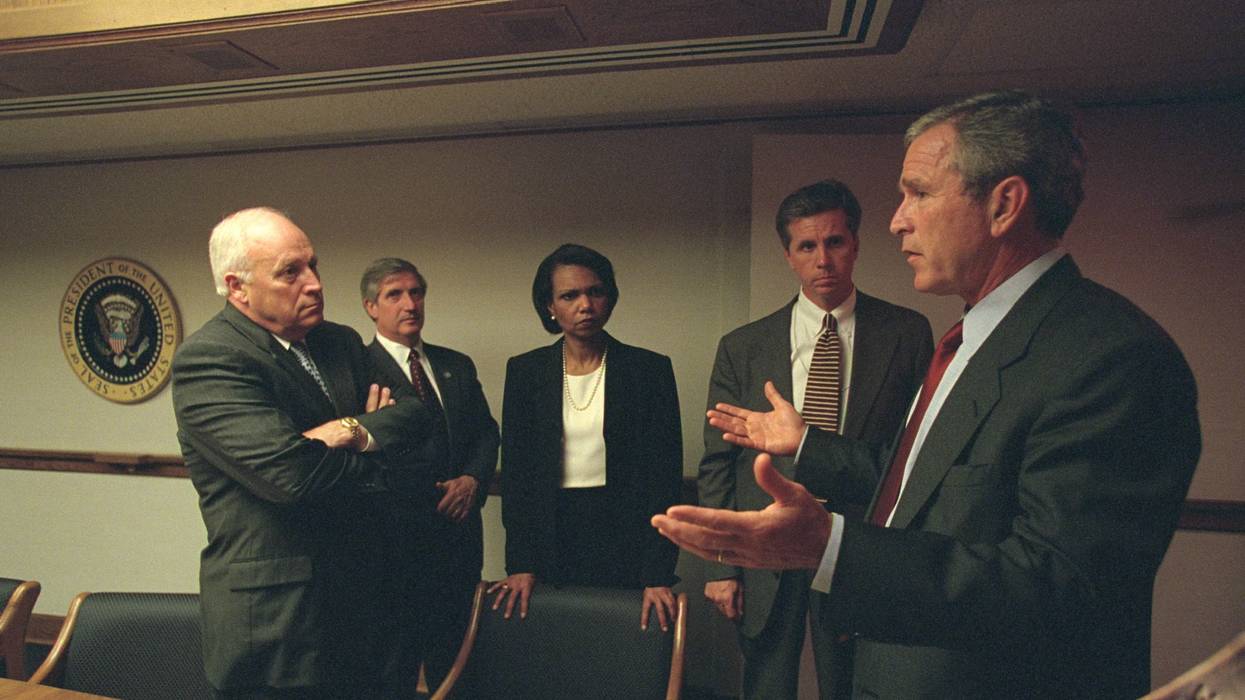
Today is 9/11, the event that first brought America together and then was cynically exploited by George W. Bush and Dick Cheney to have a war against Iraq, followed by their illegal invasion of Afghanistan just a bit more than a year earlier.
Yet the media today (so far, anyway) is curiously silent about Bush and Cheney’s lies.
Given the costs of both these wars—and the current possibility of our being drawn deeper into conflict in both Ukraine and Taiwan—it’s an important moment to discuss our history of wars, both illegal and unnecessary, and those that are arguably essential to the survival of democracy in the world.
To be clear, I support U.S. involvement—and even an expanded U.S. involvement—in the defense of the Ukrainian democracy against Vladimir Putin’s Adolf-Hitler-grabs-Poland-like attack and mass slaughter of Ukrainian civilians. Had the world mobilized to stop Hitler when he invaded the Sudetenland in Czechoslovakia in 1938 there almost certainly wouldn’t have been either the Holocaust or World War II, which is why Europe is so united in this effort.
Today’s reporting on the chaos in Afghanistan and the war to seize the Iraqi oil fields almost never mentions Bush’s and Cheney’s lies and ulterior motives in getting us into those wars in the first place.
If Putin succeeds in taking Ukraine, his administration has already suggested that both Poland and Moldova are next, with the Baltic states (Latvia, Lithuania, Estonia) also on the menu. That would almost certainly lead to war in Europe.
And China is watching: a Putin victory in Ukraine will encourage Xi Jinping to try to take Taiwan. Between the two—war in both Europe and the Pacific—we could find ourselves in the middle of World War III if Putin isn’t stopped now.
That said, essentially defensive military involvement like with Ukraine or in World War II has been the exception rather than the rule in American history. We’ve been far more likely to have presidents lie us into wars for their own personal and political gain than to defend ourselves or other democracies.
For example, after 9/11 in 2001 the Taliban that then ran Afghanistan offered to arrest Osama bin Laden, but Bush turned them down because he wanted to be a “wartime president” to have a “successful presidency.”
The Washington Post headline weeks after 9/11 put it succinctly: “Bush Rejects Taliban Offer On Bin Laden.” With that decision not to arrest and try bin Laden for his crime but instead to go to war, George W. Bush set the U.S. and Afghanistan on a direct path to disaster (but simultaneously set himself up for reelection in 2004 as a “wartime president”).
To further complicate things for Bush and Cheney, the 9/11 attacks were not planned, hatched, developed, practiced, expanded, worked out, or otherwise devised in Afghanistan or by even one single citizen of Afghanistan.
That country and its leadership in 2001, in fact, had nothing whatsoever to do with 9/11, as I detailed in depth here on August 15 of last year. The actual planning and management of the operation was done out of Pakistan and Germany, mostly by Khalid Sheik Mohammed.
The Taliban were bad guys, trashing the rights of women and running a tinpot dictatorship, but they represented no threat whatsoever to America or our allies.
Almost two decades later, though, then-President Donald Trump and Mike Pompeo gave the Taliban everything they wanted—power, legitimacy, shutting down 9 of the 10 U.S. air bases in that country to screw incoming President Joe Biden, and the release of 5,000 of Afghanistan’s worst Taliban war criminals—all over the strong objections of the democratically elected Afghan government in 2019.
Trump did this so he could falsely claim, heading into the 2020 election, that he’d “negotiated peace” in Afghanistan, when in fact he’d set up the debacle that happened around President Biden’s withdrawal from that country.
”The relationship I have with the Mullah is very good,” Trump proclaimed—after ordering the mullah, who then named himself president of Afghanistan, freed from prison over the furious objection of Afghan’s government, which Trump had cut out of the negotiations.
Following that betrayal of both Afghanistan and America, Trump and the GOP scrubbed the record of their embrace of the Taliban from their websites, as noted here and here.
And the conservative Boris Johnson administration in the U.K. came right out and said that Trump’s “rushed” deal with the Taliban—without involvement of the Afghan government or the international community—set up the difficulties Biden faced.
“The die was cast,” Defense Minister Ben Wallace told the BBC, “when the deal was done by Donald Trump, if you want my observation.”
So, Republican George W. Bush lied us into both the Afghanistan and Iraq wars, and then Donald Trump tried to lie us out of at least one of them.
But this was far from the first time a president has lied us into a war.
— Vietnam wasn’t the first time an American president and his buddies in the media lied us into a war when Defense Secretary Robert McNamara falsely claimed that an American warship had come under attack in the Gulf of Tonkin and Lyndon B. Johnson went along with the lie.
— Neither was President William McKinley lying us into the Spanish-American war in 1898 by falsely claiming that the USS Maine had been blown up in Havana harbor (it caught fire all by itself).
— The first time we were lied into a major war by a president was probably the Mexican-American war of 1846 when President James Polk lied that we’d been invaded by Mexico. Even Abraham Lincoln, then a congressman from Illinois, called him out on that lie.
— You could also argue that when President Andrew Jackson signed the Indian Removal Act in 1830 leading to the Trail of Tears slaughter and forced relocation of the Cherokee under President James Buchanan (among other atrocities) it was all based on a series of lies.
Bush’s lies that took us into Afghanistan and, a bit over a year later into Iraq, are particularly egregious, however, given his and Cheney’s reasons for those lies.
In 1999, when George W. Bush decided he was going to run for president in the 2000 election, his family hired Mickey Herskowitz to write the first draft of Bush’s autobiography, A Charge To Keep.
Although Bush had gone AWOL for about a year during the Vietnam War and was thus apparently no fan of combat, he’d concluded (from watching his father’s “little three-day war” with Iraq) that being a “wartime president” was the most consistently surefire way to get reelected (if you did it right) and have a two-term presidency.
“I’ll tell you, he was thinking about invading Iraq in 1999,” Herskowitz told reporter Russ Baker in 2004.
“One of the things [Bush] said to me,” Herskowitz said, “is: ‘One of the keys to being seen as a great leader is to be seen as a commander-in-chief. My father had all this political capital built up when he drove the Iraqis out of (Kuwait) and he wasted it.’”
“[Bush] said, ‘If I have a chance to invade Iraq, if I had that much capital, I’m not going to waste it. I’m going to get everything passed I want to get passed and I'm going to have a successful presidency.’”
The attack on 9/11 gave Bush his first chance to “be seen as a commander-in-chief” when our guy Osama bin Laden, who the Reagan/Bush administration had spent $3 billion building up in Afghanistan, engineered an attack on New York and D.C.
The crime was planned in Germany and Florida and on 9/11 bin Laden was, according to CBS News, not even in Afghanistan:
“CBS Evening News has been told that the night before the September 11 terrorists attack, Osama bin Laden was in Pakistan. He was getting medical treatment with the support of the very military that days later pledged its backing for the U.S. war on terror in Afghanistan.”
When the Obama administration finally caught and killed bin Laden, he was back in Pakistan, the home base for the Taliban.
But attacking our ally Pakistan in 2001 would have been impossible for Bush, and, besides, nearby Afghanistan was an easier target, being at that time the second-poorest country in the world with an average annual per-capita income of $700 a year. Bin Laden had run terrorist training camps there—unrelated to 9/11—but they made a fine excuse for Bush’s first chance to “be seen as a commander-in-chief” and get some leadership cred.
Cheney, meanwhile, was in a world of trouble because of a huge bet he’d made as CEO of Halliburton in 1998. Dresser Industries was big into asbestos and about to fall into bankruptcy because of asbestos lawsuits that the company was fighting through the court system.
Cheney bet Dresser would ultimately win the suits and had Halliburton buy the company on the cheap, but a year later, in 1999, Dresser got turned down by the courts and Haliburton’s stock went into freefall, crashing 68% in a matter of months.
Bush had asked Cheney—who’d worked in his father’s White House as secretary of defense—to help him find a suitable candidate for VP.
Cheney, as his company was collapsing, recommended himself for the job. In July of 2000, Cheney walked away with $30 million from the troubled company, and the year after that, as VP, Halliburton subsidiary KBR received one of the first no-bid no-ceiling (no accountability and no limit on how much they could receive) multibillion-dollar military contracts.
Bush and Cheney both had good reason to want to invade Afghanistan in October 2001. Bush was seen as an illegitimate president at the time because his father’s corrupt appointee on the Supreme Court, Clarence Thomas, had cast the deciding vote in the Bush v. Gore lawsuit that made him president; a war that gave him legitimacy and the aura of leadership.
Cheney’s company was in a crisis, and Afghanistan War no-bid contracts helped turn around Halliburton from the edge of bankruptcy into one of the world’s largest defense contractors today.
Even Trump had to get into the “let’s lie about Afghanistan” game, in his case to have bragging rights that he’d “ended the war in Afghanistan.”
In 2019, Trump went around the Afghan government (to their outrage: he even invited the Taliban to Camp David in a move that disgusted the world) to cut a so-called “peace deal” that sent thousands of newly empowered Taliban fighters back into the field, and then drew down our troops to the point where today’s chaos in that country was absolutely predictable.
Trump’s deal was the signal to the 300,000+ Afghan army recruits we’d put together and paid that America no longer had their back and if the Taliban showed up they should just run away. Which, of course, is what happened on Trump’s watch. As Susannah George of The Washington Post noted:
“The Taliban capitalized on the uncertainty caused by the [Trump] February 2020 agreement reached in Doha, Qatar, between the militant group and the United States calling for a full American withdrawal from Afghanistan. Some Afghan forces realized they would soon no longer be able to count on American air power and other crucial battlefield support and grew receptive to the Taliban’s approaches.”
Jon Perr’s article at Daily Kos did a great summary, with the title: “Trump put 5,000 Taliban fighters back in battle and tied Biden’s hands in Afghanistan.”
Trump schemed and lied to help his own reelection efforts, and the people who worked with our military and the U.S.-backed Afghan government paid a terrible price for it.
As President Biden told America:
“When I came to office, I inherited a deal cut by my predecessor—which he invited the Taliban to discuss at Camp David on the eve of 9/11 of 2019—that left the Taliban in the strongest position militarily since 2001 and imposed a May 1, 2021 deadline on U.S. forces. Shortly before he left office, he also drew U.S. forces down to a bare minimum of 2,500.
“Therefore, when I became president, I faced a choice—follow through on the deal, with a brief extension to get our forces and our allies’ forces out safely, or ramp up our presence and send more American troops to fight once again in another country’s civil conflict. I was the fourth president to preside over an American troop presence in Afghanistan—two Republicans, two Democrats. I would not, and will not, pass this war onto a fifth.”
America has been lied into too many wars. It’s cost us too much in money, credibility, and blood. We must remember the lies, and tell our children about them so that memory isn’t lost.
When President Gerald Ford withdrew U.S. forces from Vietnam (I remember it well), there was barely a mention of McNamara’s and LBJ’s lies that got us into that war.
Similarly, today’s reporting on the chaos in Afghanistan and the war to seize the Iraqi oil fields almost never mentions Bush’s and Cheney’s lies and ulterior motives in getting us into those wars in the first place.
George Santayana famously noted, “Those who cannot remember the past are condemned to repeat it.”
We can’t afford to let these lies go down the memory hole, like we have the other wars we were lied into that I mentioned earlier. Sadly, it’s clear now that neither Bush nor Cheney will be held accountable for their lies or for the American, Afghan, and Iraqi blood and treasure they cost.
But both should be subject to a clear and public airing of the crimes they committed in office and required—at the very least—to apologize to the thousands of American families destroyed by the loss of their soldier children, parents, and spouses, as well as to the people of both Afghanistan and Iraq.
If the media refuses to mention the Bush/Cheney lies on this anniversary of 9/11, it’s all the more important that the rest of us use this opportunity to do so. Pass it on.
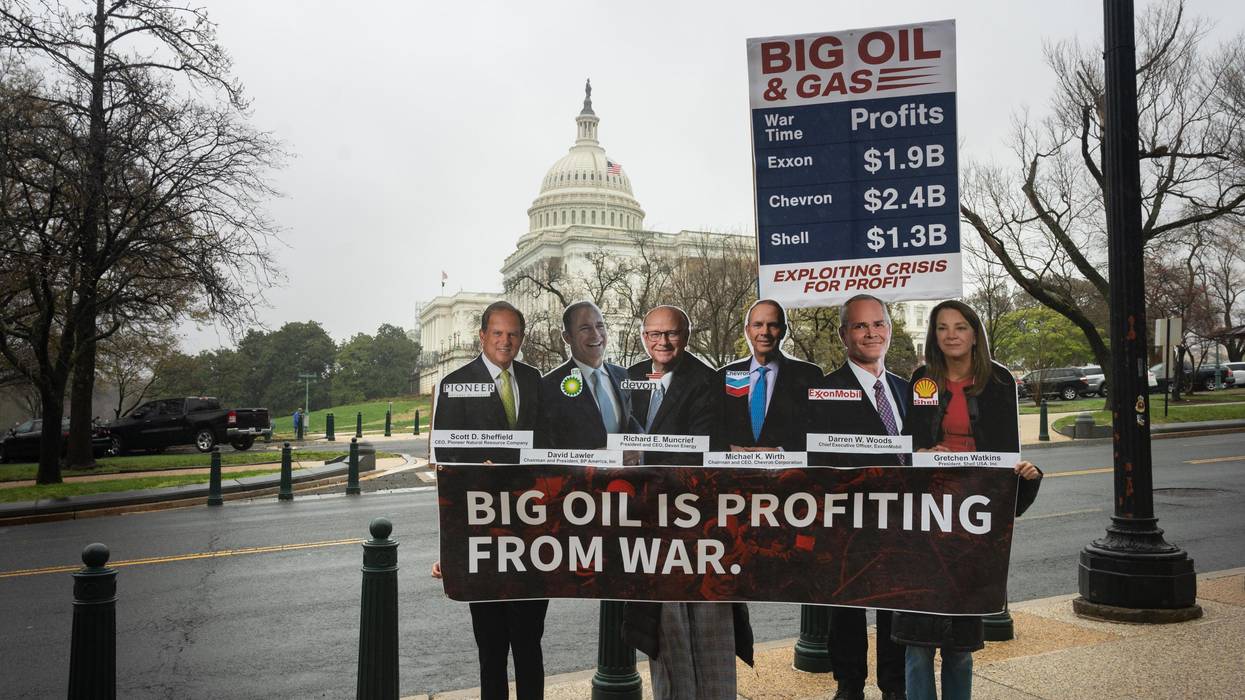
Amid record gas prices and fossil fuel industry profits, Big Oil is "trying to squeeze even more cash out of American consumers," according to a report published Wednesday by the watchdog group Accountable.US.
"Unfortunately for consumers, good news for Big Oil's bottom line never seems to be good news for them."
The report--entitled High Prices Make Big Oil Profits Soar--details how "in the first three months of the year, 21 oil and gas companies made over $41 billion in profits, more than doubling profits from just a year ago. This is, on average, $1.2 billion more per company than the same time last year thanks to--as the companies themselves say--high oil prices and the crisis in Ukraine."
Accountable.US energy and environment director Jordan Schreiber said in a statement that "this year is shaping up to be even better than the last for the oil and gas industry. Unfortunately for consumers, good news for Big Oil's bottom line never seems to be good news for them."
"Make no mistake," she added, "these oil and gas companies would rather take their billions in profits and pass them on to wealthy industry executives than do anything to stabilize gas prices for consumers."
According to Accountable.US, Shell led all fossil fuel companies with more than $7.1 billion in first quarter profits, followed by Chevron with $6.3 billion, and ConocoPhillips and ExxonMobil, which each earned over $5.7 billion.
The report notes that Jeff Miller, CEO of the oil services giant Halliburton--which is responsible for most of the world's fracking operations--boasted during a quarterly earnings call that a "perpetual threat of undersupply that is supportive to commodity prices" is "great" for business.
Another CEO, Hess Corporation's John Hess, said the company is "positioned to fully benefit" from a "significant increase in volatility and liquidity risk in the oil markets following Russia's invasion of Ukraine."
Related Content

The report also details how, despite "raking in sky-high profits," fossil fuel corporations are "giving all their 'excess' cash to investors with plans to give even more as the year goes on."
"Big Oil is using its windfall profits from high prices to shower $11.8 billion in dividends and $14 billion in stock buybacks onto shareholders," it states, noting that ExxonMobil raised its share buyback program by $20 billion to $30 billion through 2023, and Chevron repurchased a record $10 billion in stock in one quarter.
"And who benefits from massive shareholder payouts? Wealthy oil and gas CEOs," the report continues. "Stocks heavily pad the paychecks of top oil and gas CEOs with the heads of companies like Exxon and Chevron receiving more than 50% of their over-$22 million compensations from stock."
A separate Accountable.US analysis published last month revealed that CEOs from 28 leading fossil fuel companies enjoyed a combined $394 million in total compensation in 2021.
Even with such record-breaking profits, shareholder rewards, and executive pay and bonuses, oil and gas companies including Chevron still attempted to exploit the war in Ukraine to secure long-term commitments from the Biden administration to support the domestic fossil fuel industry.
According to a 2021 analysis by the Washington, D.C.-based Environmental and Energy Study Institute, "U.S. direct subsidies to the fossil fuel industry are estimated at roughly $20.5 billion per year, including $14.7 billion from federal subsidies and $5.8 billion from state subsidies."
Amid soaring corporate profits and growing societal inequality, progressive advocates have been increasingly calling for a corporate windfall tax.
Related Content

In March, Sen. Bernie Sanders (I-Vt.) introduced the Ending Corporate Greed Act, which aims to end corporate price gouging by imposing up to a 95% windfall tax, a temporary emergency measure that proponents say could raise an estimated $400 billion in one year from 30 of the largest corporations alone.
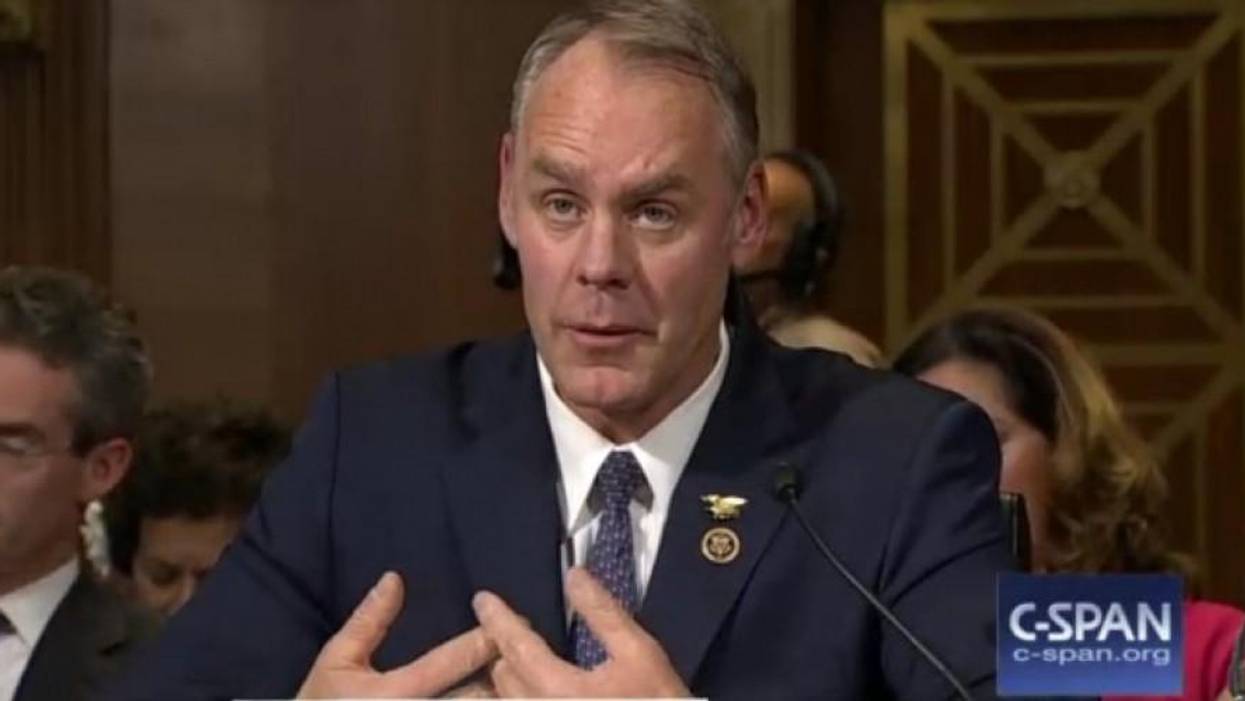
Former Interior Secretary Ryan Zinke left office Wednesday following a Trump administration tenure characterized by aggressive environmental regulatory rollbacks as well as 18 federal investigations into his ethics, spending, and conduct while in office--but his resignation has not saved him from a Justice Department probe into potentially criminal violations.
The Washington Post reported Thursday that the DOJ has opened a probe into whether Zinke lied to his own agency's investigators about his involvement in a land deal in Montana and the blocking of a casino project proposed by First Nations tribes in Connecticut.
After questioning Zinke about the incidents, the Interior Department inspector general "came to believe Zinke had lied...[and] referred the matter to the Justice Department to consider whether any laws were violated," according to the Post.
"The Justice Department's interest in the matter is significant, signaling prosecutors felt Zinke's account was suspect and warranted further scrutiny," the Post continued. "Department officials have not yet decided, though, whether he should face charges."
Critics of Zinke celebrated in December when his impending resignation was announced, with Friends of the Earth saying, "Zinke's days of plundering our lands and enriching himself and his friends are over."
But as Sen. Ron Wyden (D-Ore.) tweeted a day before the DOJ's new investigation was reported, Zinke's departure won't necessarily stop him from being held accountable for his actions while in office.

Following former EPA administrator Scott Pruitt's resignation last summer amid numerous scandals regarding his lavish spending and extreme secrecy, Interior Secretary Ryan Zinke holds the dubious honor of being the Trump administration official under the most scrutiny by federal investigators--a fact one climate action group drew attention to in a comedic video this weekend.
Introducing an actor dressed in a Zinke mask as the "corrupt grifter-cowboy-friend-of-Halliburton," Friends of the Earth (FOE) shredded President Donald Trump's unsurprising selection of an Interior Secretary who has demonstrated loyalty to fossil fuel companies over groups that aim to protect U.S. public lands.
Inspired by the show "Billy on the Street" featuring comedian Billy Eichner, the Zinke stand-in wondered aloud "How the hell I'm still in office" before aggressively asking passersby on Capitol Hill: "Why won't anyone fire me?"
Watch:
As FOE's stand-in boasted in the video, Zinke's conduct in office has sparked 17 federal investigations. The Interior Department's inspector general has opened probes into Zinke's censorship of climate crisis data; his decision to block a casino project proposed by two Native American tribes after meeting with lobbyists; his involvement in a land deal with an executive at oil giant Halliburton; and his use of taxpayer funds for his wife's travel as well as decor for his office--among other allegations.
As Common Dreams reported last month, at least one investigation has been referred to the Justice Department, indicating that the government suspects potentially criminal behavior by Zinke.
FOE's Zinke shrugged off the investigations, shouting, "What's the big deal?" at one bystander who suggested he should be "very worried" that his own agency referred him to the DOJ.
According to the Washington Post, the Halliburton deal investigation is the one Inspector General Mary Kendall referred to the DOJ. In it, Zinke continued his involvement in a development project backed by the Halliburton executive in Montana after he was appointed head of the Interior--despite the fact that Halliburton's business is significantly affected by the department's policies and decisions.
The actor in the video referenced the deal several times, yelling at a large group of people, "Are you big oil? I'm looking for a new land deal!"
Following the Democratic takeover of the House, White House officials have grown concerned that Zinke could be vulnerable to a probe by House Democrats in addition to the federal investigations, according to the Post.
As the incoming chairman of the House Natural Resources Committee, Rep. Raul M. Grijalva (D-Ariz.) is "gearing up to grill Zinke on his personal conduct and management decisions."
"This is our check and balance, our constitutional obligation and our jurisdiction," Grijalva told the Post.
When it comes to the ruling elite's corporate plunder and crimes against humanity, the U.S. national memory's short and no one, not even its political henchmen, assume blame or suffer real consequences: take Halliburton and former chief executive and U.S. Vice President Dick Cheney for example. Not only did Cheney plan and justify the invasion, occupation and pilferage of Iraq's oil, gold bars and national museum treasures under treasonous false pretenses, but its subsidiary, Kellogg Brown & Root (KBR Inc.), overcharged the U.S. taxpayer to a tune of more than $2 billion due to collusion engendered by sole source contracting methods and shoddy accounting procedures. It's even forgotten that Cheney received a $34 million payout from Halliburton when he joined the Vice President ticket in 2000, in advance of his unscrupulous maneuvers, according to news commentator, Chris Matthews; because on November 5th 2018, in celebration of its 100-year anniversary, its chief executives rang the New York Stock Exchange's (NYSE) opening bell.
Sadly, as a nation, the U.S. doesn't recall Cheney's lies, or his role in planning the contemptible "Shock and Awe" saturation bombing campaign that destroyed a sovereign nation, which posed no threat to the United States, and left the world's cradle of civilization in ruins. Conveniently, it doesn't recall the over 500,000 deaths from war related causes, as reported by the Huffington Post in its 2017 updated article; nor does it recall that obliterating Iraq's government created a sociopolitical vacuum that enabled the exponential growth of the CIA's unique brand of Islamofascism and its resulting terrorism, which has culminated in war-torn Syria and Yemen.
Iraq's only "crime" against the United States, if you want to call it that, was being hogtied by Washington's sanctions and embargo against it - in what can only be called a Catch 22 situation. Iraq couldn't do business with U.S. corporations not because Saddam Hussein was unwilling to, but because the U.S. government effectively barred Iraq from doing so. This Catch 22 situation is presently being repeated in Venezuela and Iran in advance of its planned invasion and occupation.
Then there is the cost of war itself: according to The Costs of War project at the Watson Institute for International and Public Affairs at Brown University, "The wars in Afghanistan, Pakistan, and Iraq (the war in Pakistan refers to U.S. counterterrorism efforts there, such as drone strikes and other efforts against al Qaeda) cost $4.4 trillion. Included in the cost are: direct Congressional war appropriations; war-related increases to the Pentagon base budget; veterans care and disability; increases in the homeland security budget; interest payments on direct war borrowing; foreign assistance spending; and estimated future obligations for veterans' care. By 2053, interest payments on the debt alone could reach over $7 trillion."
Keep in mind that the U.S. taxpayer directly subsidizes the profits of the military industrial complex, and oil & gas industries. Yet, no U.S. protests against Halliburton are found in the media later than 2007. And, there are no organized disinvestment campaigns of record.
So Wall Street celebrates Halliburton's 100-year anniversary with a clear conscience, because no one has graffitied it's large four column wide sign or is disinvested from its stock. The nation only recalls, according to IBTimes, in their 2013 article on Iraq war contracts, that Halliburton's subsidiary, KBR, had the most: KBR's war contracts totaled $39.5 billion in just a decade.
Other than the Kuala Lumpur War Crimes Commission, which found Cheney and President Bush et al guilty of war crimes in absentia for the illegal invasion of Iraq, there remains no lasting acknowledgement in the U.S. consciousness of Cheney's evil doings. Cheney had recent book deals and continues to ramble on with speaking engagements. He was scheduled by Cornell University to issue a keynote address as recent as May 2018. In short, the ruling elite protects those engaged in their dirty work until they prove unnecessary. In this regard, consider the fact that Saddam Hussein was a former CIA asset and a good corporate customer - as the weapons of mass destruction (WMD), he once possessed, were sold to him by the U.S. and Britain. However, according to the former United Nations (UN) chief weapon inspector, Scott Ritter, the UN destroyed Iraq's stockpiles after the Persian Gulf War (1990-1991)--well before the 2003 invasion. This report was ignored because it contradicted the prevailing narrative that justified the invasion, occupation and looting of Iraq.
Just as the ruling elite engineered Saddam Hussein rise to power when he was useful, they ensured Cheney's political ascent, and the success of his campaign against Iraq. To illustrate the persuasive power of the oil & gas industry in politics, note that according to Open Secrets.org, oil & gas lobbyists spent over $175M in 2009 (Obama's first year in office). Of that amount, ExxonMobil spent the most at $27.4M and Chevron Corp., in second place, spent $20.8M. For the record, ExxonMobil and Chevron are successors of Rockefeller's Standard Oil Company. Prior to President Obama & Vice President Biden, the Oil & Gas Industry lobbyists spent approximately half that amount at $86.5M in 2007. Thus, Bush & Cheney represented a 50% savings for oil & gas lobbyists.
When seeking to "out" the elite, keep in mind that the Rockefeller clan describe themselves "as ExxonMobil's longest continuous shareholders". In Iraq, ExxonMobil has a 60% share of a $50 billion market contract developing the 9-billion-barrels southern West Qurna Phase I field, and ExxonMobil is expanding its oil & gas holdings into the semiautonomous Kurdish region in the country's north.
Within this context, the enemy is not a corporate office, an oilrig, pipeline or refinery; it's the ruling elite that own and control the means of production. If people of conscience don't hold them accountable for their crimes, they will continue to commit them in countries such as Venezuela and Iran, which are presently locked in their sights. While henchmen change, the ruling elite remains. Why should the U.S. allow its military and secret service to be pimped out as corporate stooges and glorified security guards?
Imperialism is insatiable and fascism expedient. The time to hold the ruling elite accountable is now before another invasion and occupation is executed against a fake enemy that just so happens to coincidentally have a large desirable oil reserve. Let's follow Iceland's lead and seek the prosecution of white-collar criminals that hide behind a facade of corporate stock holdings now, before its too late and they strike again in Venezuela and Iran.
So for Halliburton's 100-year anniversary wish, let's wish its stock tanks and that its guilty are remembered, held accountable, and that justice is ultimately served.

President Donald Trump's Department of Justice has been tasked with examining evidence of wrongdoing by Interior Secretary Ryan Zinke, following the referral of one of several probes into the Trump appointee's conduct by his department's own Inspector General.
As the Washington Post reported, the development suggests that a criminal investigation into Zinke's conduct could be imminent--but the exact conduct being examined by the DOJ remains unknown.
The inspector general, Mary Kendall, has opened a number of cases involving Zinke, and it was unclear as of Tuesday afternoon which investigation she has referred to the DOJ.
In June, Kendall began investigating Zinke's continued involvement in a land development deal in Whitefish, Montana, even after he was appointed Interior Secretary. The deal, involving a retail development, was backed by the chairman of oil company Halliburton--whose business is significantly affected by policies enacted by the Interior Department. Zinke owns several properties near the planned development, according to the Post.
"The American people must be able to trust that Department of the Interior decisions that affect the nation's welfare on a daily basis are not compromised by individual self-enrichment," wrote Reps. Raul M. Grijalva (D-Ariz.), A. Donald McEachin (D-Va.), and Jared Huffman (D-Calif.) in a letter earlier this year, urging Kendall to investigate the deal.
Kendall has also probed Zinke's travel since he took office in March 2017, releasing a report this month showing that ethics officials within his agency had grown concerned over the fact that Zinke's wife traveled with him on taxpayer-funded trips. The Trump administration is currently searching for its own appointee to replace Kendall, who has worked in the department since 1999.
Another ongoing investigation involving the secretary deals with a casino deal in Connecticut which he stopped from being completed after two Nevada senators lobbied against the project, which had been proposed by two Native American tribes. The casino would have competed with an MGM casino across the state border in Massachusetts, according to the groups that lobbied against it.
The Mashantucket Pequot and Mohegan tribes, which are hoping to reopen a lawsuit against Zinke, argued in a court filing earlier this month that Zinke's decision not to approve the project was the result of "improper political influence."
Despite the fact that Zinke's case has been referred by an official in an independent, nonpartisan position--who has worked in the federal government under Republican and Democratic presidents since 1986--Zinke hastily denounced the investigation as "politically driven" on Tuesday, drawing criticism on social media.

Ethics experts as well as environmental and veterans advocates expressed alarm Tuesday over an exclusive Politico report that a foundation founded by Interior Secretary Ryan Zinke--the man charged with making rules about fossil fuel production on public lands--and now run by his wife is set to benefit from a Montana real estate project funded by the chairman of Halliburton, one of the world's largest oil companies.
Detailing the Zinke family's involvement with the multimillion-dollar project, which ethics experts say "is rife with conflicts of interest," Politico reports:
A group funded by David Lesar, the Halliburton chairman, is planning a large commercial development on a former industrial site near the center of the Zinkes' hometown of Whitefish, a resort area that has grown increasingly popular with wealthy tourists. The development would include a hotel and retail shops. There also would be a microbrewery--a business first proposed in 2012 by Ryan Zinke and for which he lobbied town officials for half a decade.
...Meanwhile, a foundation created by Ryan Zinke is providing crucial assistance. Lola Zinke pledged in writing to allow the Lesar-backed developer to build a parking lot for the project on land that was donated to the foundation to create a Veterans Peace Park for citizens of Whitefish. The 14-acre plot, which has not been significantly developed as a park, is still owned by the foundation. Lola Zinke is its president, a role her husband gave up when he became interior secretary.
The Zinkes stand to benefit from the project in another way: They own land on the other side of the development, and have long sparred with neighbors about their various plans for it. If the new hotel, retail stores and microbrewery go through, real estate agents say, the Zinke-owned land next door would stand to increase substantially in value.
As Craig Holman, an expert in federal ethics law at the advocacy group Public Citizen, explained to Politico: "Clearly, any substantial development project next to the vacant lot owned by Zinke's foundation would significantly boost the value of the lot. The conflict-of-interest statute would be invoked if even the nonprofit on which Zinke or his spouse serves as an officer, as either paid or unpaid officers, derives a financial benefit."
Garett Reppenhagen, Western states director for the Vet Voice Foundation, concluded, "This is all a perfect encapsulation of how Ryan Zinke has operated at Interior--being deceitful about intent, and always seeing how he can personally benefit."
"The number of #ZinkeScandals in this single story is astounding," tweeted the Sierra Club.
Friends of the Earth connected the report to Zinke's efforts to roll back rules about drilling for fossil fuels on public lands or in U.S. coastal waters.
"Secretary Zinke's foundation appears to be nothing more than a P.O. Box in Whitefish and now he's apparently using it to help a private developer at our expense," responded Chris Saeger, executive director of the Whitefish-based Western Values Project. "This is just the latest example of Zinke attempting to personally benefit from a resource that should benefit the public. There should be an investigation into this swampy relationship."
Marilyn Glynn, who served as acting director of the Office of Government Ethics under former President George W. Bush, told Politico that Zinke should "recuse himself from anything involving Halliburton," and suggested that such blatant disregard for ethics conflicts is unique to the Trump administration.
Zinke, in a statement to Politico, declined to address questions about the microbrewery or Lesar's involvement with the project, but said, "The mission remains to provide a children's sledding park and community open space in a setting that recognizes the contributions of the railroad and the veterans to the community." He added that although his wife has been in contact with the developer about building a parking lot, "no formal proposal or documents have been submitted or agreed upon."

Holding a banner reading "We won't stop--There's too much at stake," demonstrators shut down morning traffic at an office park outside Pittsburgh on Monday, in protest of the harmful effects 15 energy companies in the complex have on the environment.
The protesters set up two tripod structures in the middle fn a main intersection leading to Southpointe, a 589-acre property in suburban Washington County, Pennsylvania--home to companies including Halliburton, Chesapeake Energy, and Range Resources, all of which participate in fracking and mining.
Two community members climbed onto the tripods while three others sat between them with their arms in lockboxes for about four hours before police broke up the demonstration, according to Rising Tide North America, a grassroots environmental group.
A woman who was seated between the structures said the companies that operate at Southpointe are "impacting our lives every day in our communities. I've been run off the road twice because of truck traffic. I have to wonder about the health of my daughter every day living within a half mile of gas wells."
She added that "the coal operator here is also destroying our only state park," referring to the efforts of Consol Energy, another company at Southpointe, to obtain a mining permit for Ryerson Station State Park.
A community member named Patrick Young said that the disruption of traffic into the office park can't be compared to the damage being done by the companies.
Energy companies have flocked to Southpointe in recent years as the gas and oil industries have sought to capitalize on the Marcellus shale, the sprawling rock formation underneath western New York and Pennsylvania, over which thousands of wells have been set up for fracking and mining. Last year, Pennsylvania's Department of Environmental Protection found more than 250 cases of contamination and other negative impacts of fracking in private water supplies in the state.
Environmental activist Ruth Breech described the scene as the protest successfully stopped traffic and police arrived to break up the protest.
The grassroots organization Rising Tide tweeted at about 10:00am that police had begun arresting the protesters, linking to a legal defense fund for the community members.
This past Saturday, Aug. 8, marked a notable 10th anniversary. But it was certainly nothing to celebrate. President George W. Bush signed the Energy Policy Act of 2005 ten years ago. The giant energy bill included massive giveaways for the fossil fuel, nuclear, and ethanol industries and provided only token incentives for renewables and improved energy efficiency. But the most infamous piece of the law was what is now commonly known as the "Halliburton Loophole," an egregious regulatory exemption that ushered in the disastrous era of widespread oil and gas fracking that currently grips our nation.
Fracking - the extreme oil and gas extraction method that involves blasting millions of gallons of water mixed with toxic chemicals underground at enormous pressures to break apart subterranean rock - has exploded in the last decade. More than 270,000 wells have been fracked in 25 states throughout the nation. More than 10 million Americans live within a mile of a fracking site. This means that 10 million Americans - and truly many more - have been placed directly in harm's way. Hundreds of peer-reviewed studies have connected fracking to serious human health effects, including cancer, asthma, and birth defects.
We can thank the Energy Policy Act of 2005, the law that holds the Halliburton Loophole. Named after Dick Cheney and the notorious corporation he led before becoming vice president, the law (championed by Cheney and disgraced Enron founder Kenneth Lay, among others) explicitly exempted fracking operations from key provisions of the Safe Drinking Water Act. These exemptions from one of America's most fundamental environmental protection laws provided the oil and gas industry the immunity it required to develop a highly polluting process on a grand national scale.
One of the most troubling repercussions is how fracking companies hide the contents of their toxic water and chemical solutions pumped into the ground. Contamination of underground drinking water sources from fracking fluids is a glaring threat to public health and safety. Yet even doctors responding to fracking-related health complaints can't access data on what particular chemicals their patients may have been exposed to.
But the Halliburton Loophole wasn't the only fracking enabler in the Energy Policy Act. The act granted the Federal Energy Regulatory Commission (FERC) sweeping new authority to supersede state and local decision-making about the citing of fracked gas pipelines and infrastructure. It also shifted to FERC industry oversight and compliance responsibility for the National Environmental Policy Act of 1969, another key law. This was akin to putting the fox in charge of the hen house.
As it stands, FERC is entirely unaccountable to the public will. It is unaccountable to Congress and even the White House. Commissioners are appointed to five-year terms and can do as they please. Until a law reigning in FERC is passed, the commission will continue to act as a rubber stamp for the fossil fuel industry.
The Energy Policy Act also repealed an important anti-monopoly law, the Public Utility Holding Company Act of 1935 (PUHCA). PUHCA safeguarded consumers from the overreach of the oil and gas industry and banks that did business with those companies. It prevented the formation of giant state and regional energy cartels that could manipulate energy costs, engage in profiteering, and exert undue influence over political debate. The Energy Policy Act transferred most of this oversight to FERC. Since then, the largest American energy companies have grown significantly more powerful and spent almost a billion dollars on federal lobbying, according to OpenSecrets.org.
The 10th anniversary of the Energy Policy Act is a sad occasion. Still, it provides us with a ripe opportunity to reexamine our nation's disastrous policy of doubling down on fossil fuels over the last decade, thanks to the extreme process of fracking. For the sake of countless Americans who are currently suffering health effects caused by fracking and the countless more who will suffer in the future, we must immediately curtail our dependence on oil and gas and turn decisively toward a truly clean, renewable energy future.
The need for greater linkages between the environmental, peace and Wall Street reform movements grow by the day in the face of the epic oil spill caused by British Petroleum, a multinational firm tied to Goldman Sachs and Halliburton in oil wars from the Gulf of Mexico to the Persian Gulf.
Peter Sutherland, chairman of BP's board for the past decade, had headed Goldman Sachs International and, in the 1990s, was a director of the World Trade Organization.
The need for greater linkages between the environmental, peace and Wall Street reform movements grow by the day in the face of the epic oil spill caused by British Petroleum, a multinational firm tied to Goldman Sachs and Halliburton in oil wars from the Gulf of Mexico to the Persian Gulf.
Peter Sutherland, chairman of BP's board for the past decade, had headed Goldman Sachs International and, in the 1990s, was a director of the World Trade Organization.
Last year Sutherland touted BP's founders as the "cream of Edwardian society" who organized the Anglo-Persian oil company in 1909 with a concession from the Shah of Persia.
Kicked out of Iraq by former president Saddam Hussein in the 1960s, BP recently has been rewarded with the concession to exploit what "could be one of the largest expansions of crude-oil production ever achieved anywhere", according to the Wall Street Journal.
The BP-Halliburton connection was not only forged in Iraq, but in underwater catastrophes in 2009 in Australia's sea of Timor and explosion two weeks ago of the Deepwater Horizon drilling rig off the southern US coast. Halliburton performed the concrete work that preceded both spills, and the New York Times reports a Halliburton employee has acknowledged "that he made the problem worse" during the Australian spill. As for the recent disaster, Halliburton officials claim it would be "premature and irresponsible to speculate" on the cause.
The Goldman Sachs connection remains to be investigated, but it appears Sutherland had a conflict of interest in his dual roles at BP and the Wall Street giant. BP and Goldman were involved heavily in the 1990 and in 2000 in achieving deregulation of energy futures trades from the previous oversight of the Commodities Futures and Exchange Commission (CFTC). As most crude oil futures trades became deregulated, the price of oil skyrocketed from $18 per barrel in 1988 to $36 in 2000, to $110 in 2008. BP's environmental crimes also include the use of Colombian paramilitaries to protect its jungle pipelines and thousands of air pollution violations at its Carson oil refinery in Los Angeles. BP has asserted that the goal of global warming initiatives should be to stabilize emissions at 500-550 ppm, levels considered shocking by most environmental experts.
And yet despite its status as a serial and dangerous polluter, BP has attempted to cultivate a reputation as a "responsible" oil company, famously rebranding itself as BP "Beyond Petroleum" with a $200 million Ogilvy and Mather advertising campaign in 2000, and known for encouraging "dialogues" and "partnerships" with mainstream environmental organizations like the National Wildlife Federation.
The current oil spill invites a coming together of many social movements, including those inspired by the recent indigenous gathering in Bolivia and mainstream groups with a new opportunity for principled battle against the Obama administration's embarrassing energy legislation which green-lights more off-shore drilling. It remains for progressives to move beyond a single-issue focus to make the connections between Wall Street, war, and environmental destruction.