SUBSCRIBE TO OUR FREE NEWSLETTER
Daily news & progressive opinion—funded by the people, not the corporations—delivered straight to your inbox.
5
#000000
#FFFFFF
To donate by check, phone, or other method, see our More Ways to Give page.


Daily news & progressive opinion—funded by the people, not the corporations—delivered straight to your inbox.
Members of the House and Senate must act to ensure the US does not go to war without the people's consent.
This is not a call for spectacle. It is not a public declaration. It is a sober appeal, written for those among you who still recognize the fragile architecture of our Republic and the danger that comes when its foundation is ignored. It is written for those who remember why Congress—not the Executive—is entrusted with the solemn power to send this nation to war.
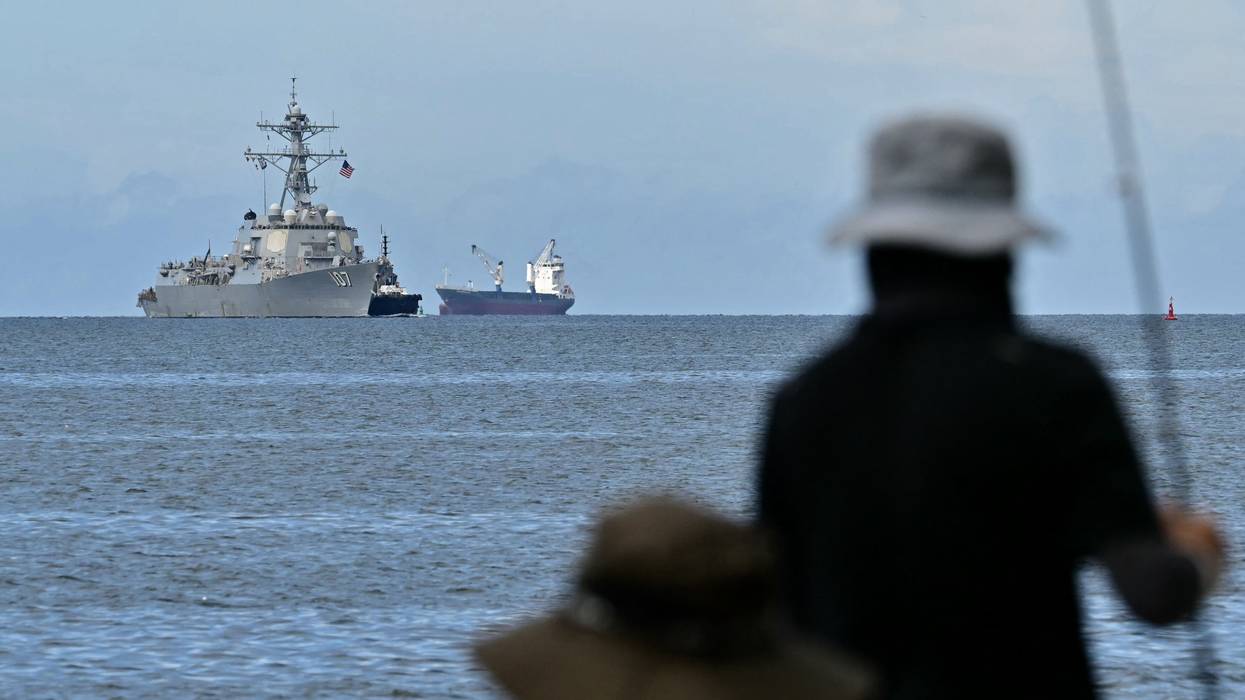
Today, the United States Navy maintains a forward-deployed combat fleet off the coast of Venezuela. At least 12 warships now patrol waters once governed by diplomacy, now steered by executive will alone. And still, Congress has issued no declaration of war. No authorization of force. No public debate. No roll-call vote. The War Powers Resolution lies dormant—its reporting mandates ignored, its withdrawal timeline untriggered, its constraints publicly mocked.
This is no abstract concern. The precedent is Syria.
For over a decade, US troops have operated in Syria under the shifting pretexts of counterterrorism, chemical weapons enforcement, and later, oil field protection. All of it unfolded without a single Syria-specific authorization from Congress. The executive claimed continuity under the 2001 Authorization for the Use of Military Force, invoked Article II powers, and redefined “hostilities” so narrowly that armed conflict somehow ceased to qualify as war. Congress, through passivity or political caution, allowed this to become precedent. That precedent now extends to the Caribbean.
This is not just about Venezuela, or Syria, or this presidency. It is about whether Congress still holds the power the Constitution gave it—or whether that power has already been quietly surrendered.
The danger off Venezuela’s coast is not theoretical. Intelligence assessments confirm that anti-ship missile systems have already been deployed by foreign actors in response to US naval activity. We are, at this moment, one miscalculation away from open conflict. And we are there without legal cover, without strategic necessity, and, most concerningly, without your consent.
Some of you may be asking—why now? Why Venezuela? The official answer is narcotics. But the record speaks otherwise. The 2025 National Drug Threat Assessment does not list Venezuela as a major conduit for fentanyl or cocaine. Expert testimony, including from senior Drug Enforcement Administration officials, confirms that the overwhelming flow of narcotics originates elsewhere—Mexico, Colombia. The rationale, in short, does not withstand scrutiny.
So what then is the real purpose of this deployment?
The answer many of you already suspect—but may hesitate to say aloud—is political theater. A projection of military might as domestic performance. A maneuver meant not to protect the homeland, but to flex power unbound by law. This is war making as messaging, and that messaging is not to foreign governments—it is to political opponents here at home. The weaponization of the military for electoral ends is no longer a distant fear. It is present, palpable, and accelerating.
This moment bears a dangerous resemblance to the final phases of past democratic declines elsewhere—when legislatures abdicated their constitutional duties in the face of strongman rule, often for fear of public reprisal, partisan division, or political cost. But no cost compares to the one history will impose if this is allowed to proceed unchecked.
The truth is stark. The president has refused to honor a submission of a War Powers report as required by §4(a)(1). He has dismissed the 60-day withdrawal trigger under §5(b), where such a dismissal is deemed unconstitutional by the Justice Department’s Office of Legal Counsel since 1980. He has redefined “hostilities” to exclude the use of lethal force against targets unable to return fire—effectively nullifying the Resolution itself. He has removed independent legal advisers within the military who might challenge unconstitutional orders. He has promoted false pretexts for war. And he has called for the execution of members of Congress who questioned these actions.
These are not simply impeachable acts—they are an attempt to reorder the structure of government itself.
To those among you who still believe in deliberation, in institutional balance, in constitutional restraint—this is your moment. Congress must compel the executive to honor any submitted legal reports, as required. Failing that, it must move to demand withdrawal of US forces from Venezuelan waters absent a new authorization. This will require bipartisan courage, legislative resolve, and leadership that can transcend factionalism. But it can be done—quietly if necessary, firmly if unavoidable.
And if the president continues to deploy the military in open defiance of congressional authority, uses force under fabricated pretexts, retaliates against lawmakers for performing oversight, and purges legal constraints on command—then impeachment is not optional. It is the only lawful recourse left.
Neither path is easy. Both carry risk. But continued inaction carries more.
Consider the cascading consequences if this is not addressed now: a lethal escalation with foreign adversaries in the Caribbean, the collapse of US deterrence credibility, the internal fracturing of civil-military relations, and a precedent that may outlive us all—a presidency that may wage war without ever seeking the people’s consent.
Some of you may hope the moment will pass, that the ships will eventually turn around, that the next crisis will distract. But this time, the moment must not pass. The gravity is too great. The erosion has gone too far. This is not just about Venezuela, or Syria, or this presidency. It is about whether Congress still holds the power the Constitution gave it—or whether that power has already been quietly surrendered.
The decisive moment is before us. Once crossed, it cannot be undone. But there is still time.
Stand together. Speak through action. Enforce the law you swore to uphold. The Constitution does not protect itself. It relies on you.
One foreign policy expert said these congressional authorizations "have become like holy writ, documents frozen in time yet endlessly reinterpreted to justify new military action."
Almost exactly 24 years after the September 11, 2001 attacks, the US House of Representatives voted Tuesday to finally repeal a pair of more than two-decade-old congressional authorizations that have allowed presidents to carry out military attacks in the Middle East and elsewhere.
In a 261-167 vote, with 49 Republicans joining all Democrats, the House passed an amendment to the next military spending bill to rescind the Authorizations for the Use of Military Force (AUMF) passed by Congress in the leadup to the 1991 Persian Gulf War and 2003 War in Iraq.
The decision is a small act of resistance in Congress after what the Quincy Institute's Adam Weinstein described in Foreign Policy magazine as "years of neglected oversight" by Congress over the "steady expansion of presidential war-making authority."
As Weinstein explains, these AUMFs, originally meant to give presidents narrow authority to target terrorist organizations like al-Qaeda and use military force against Saddam Hussein, "have been stretched far beyond their original purposes" by presidents to justify the use of unilateral military force across the Middle East.
President George W. Bush used the 2002 authorization, which empowered him to use military force against Iraq, to launch a full invasion and military occupation of the country. Bush would stretch its purview throughout the remainder of his term to apply the AUMF to any threat that could be seen as stemming from Iraq.
After Congress refused to pass a new authorization for the fight against ISIS—an offshoot of al-Qaeda—President Barack Obama used the ones passed during the War on Terror to expand US military operations in Syria. They also served as the basis of his use of drone assassinations in the Middle East and North Africa throughout his term.
During his first term, President Donald Trump used those authorizations as the legal justification to intensify the drone war and to launch attacks against Hezbollah in Iraq and Syria. He then used it to carry out the reckless assassination of Iranian General Qassem Soleimani in Iraq.
And even while calling for the repeal of the initial 2001 and 2002 authorizations, former President Joe Biden used them to continue many of the operations started by Trump.
"These AUMFs," Weinstein said, "have become like holy writ, documents frozen in time yet endlessly reinterpreted to justify new military action."
The amendment to repeal the authorizations was introduced by Rep. Gregory Meeks (D-N.Y.) and Rep. Chip Roy (R-Texas).
Meeks described the authorizations as "long obsolete," saying they "risk abuse by administrations of either party."
Roy described the repeal of the amendment as something "strongly opposed by the, I'll call it, defense hawk community." But, he said, "the AUMF was passed in '02 to deal with Iraq and Saddam Hussein, and that guy's been dead... and we're now still running under an '02 AUMF. That's insane. We should repeal that."
"For decades, presidents abused these AUMFs to send Americans to fight in forever wars in the Middle East," said Rep. Chris Deluzio (D-Pa.) shortly before voting for the amendment. "Congress must take back its war powers authority and vote to repeal these AUMFs."
Although this House vote theoretically curbs Trump's war-making authority, it comes attached to a bill that authorizes $893 billion worth of new war spending, which 17 Democrats joined all but four Republicans Republicans in supporting Wednesday.
The vote will also have no bearing on the question of President Donald Trump's increasing use of military force without Congressional approval to launch unilateral strikes—including last week's bombing of a vessel that the administration has claimed, without clear evidence, was trafficking drugs from Venezuela and strikes conducted in June against Iran, without citing any congressional authorization.
Alexander McCoy, a Marine veteran and public policy advocate at Public Citizen, said, "the 1991 and 2002 AUMFs" are "good to remove," but pointed out that it's "mostly the 2001 AUMF that is exploited for forever wars."
"Not to mention, McCoy added, "we have reached a point where AUMFs almost seem irrelevant, because Congress has shown no willingness whatsoever to punish the president for just launching military actions without one, against Iran, and now apparently against Venezuela."
In the wake of Trump's strikes against Iran, Democrats introduced resolutions in the House and Senate aimed at requiring him to obtain Congressional approval, though Republicans and some Democratic war hawks ultimately stymied them.
However, Dylan Williams, the vice president of the Center for International Policy, argued that the repeal of the AUMF was nevertheless "a major development in the effort to finally rein in decades of unchecked use of military force by presidents of both parties."
The vote, Williams said, required lawmakers "to show where they stand on restraining US military adventurism."
On issues ranging from the Vietnam War and the War on Terror to the genocide in Gaza and Trump's authoritarianism, progressives have a history of being prematurely, fruitlessly right.
I spent the summer of 1965 arguing about the Vietnam War. I was 13, and my interlocutor was my 18-year-old camp counselor in Vermont. She was headed for UC Berkeley in the fall, where she would, as she later described it, “major in history and minor in rioting.” Meanwhile, I was headed back to junior high school. I was already convinced that our government was lying about why we were fighting in Vietnam (supposedly to protect our sworn ally, the South Vietnamese government, in response to a trumped-up "incident" in the Gulf of Tonkin). I was also convinced that the war was unjustified and wrong. She seemed less certain about the war but was similarly convinced that expending energy opposing it would distract activists from supporting the civil rights movement.
As it turned out, we were both right.
Our summer camp subscribed to the Boston Globe, which I read daily, probably when I was supposed to be doing something more physically edifying like playing tennis. I remember the day the Globe ran a story quoting an informal adviser to President Lyndon B. Johnson—it might have been Dean Acheson—suggesting that, even if the South Vietnamese government were to ask the United States to withdraw its forces, it wouldn’t do so. I cut the article out (property damage is not violence!) and ran to show her. “See? I was right. They’re lying about the war.”
It’s been 60 years since that summer, and she and I are still arguing about politics, now as life partners of more than four decades. (Don’t worry: it took me another 14 years to convince her I was a grown-up and therefore a legitimate object of romantic affection.)
Although she and I are indeed still arguing about politics, like millions of people in this country and around the world, we were right then about Vietnam. We may not have foreseen it all—the assassinations, carpet bombings, tiger cages, and the Phoenix Program (the Central Intelligence Agency’s first mass torture scheme)—but we were hardly surprised when it all finally came out. Today, there’s a consensus in this country that the Vietnam War was more than a mistake; it was a decade-long exercise in overreach and overkill.
That war would eventually result in the deaths of 58,000 members of the American military and millions of Vietnamese, both soldiers and civilians. We’d see a generation of Vietnam veterans come home with visible (and invisible) injuries: amputations; cancers born of exposure to the herbicide Agent Orange, used by the U.S. Air Force to defoliate jungle terrain; heroin habits; the illness we now know as post-traumatic stress disorder, or PTSD; and moral injuries caused by following orders to murder civilians. It tells you something about that war that Vietnam vets would prove more likely to become homeless than the veterans of previous or later wars. They would also suffer contempt from many of their fellow Americans for having been drafted into a vicious and ultimately pointless conflict.
I sometimes think it’s the fate of many progressives for once in our lives to be right—over and over.
Many who actively opposed the war also suffered. I knew young men who went to jail for resisting the draft. Others took on false identities—it was easier in those pre-internet days—or moved to Canada to avoid being drafted. My college boyfriend never registered for the draft (also easier before networked computers permeated the country and when you had to apply for a Social Security number rather than being assigned one at birth). Since many employers demanded to see your draft exemption or, after the war ended, your discharge papers, he worked for his housepainter father until President Jimmy Carter’s 1977 amnesty for draft evaders.
A friend I came to know during the 1980s had spent nine months in the women’s federal prison in Alderson, West Virginia, for pouring blood on draft board records. Thousands were beaten bloody during the police riots outside the 1968 Democratic Party convention in Chicago, where activists had gone to protest the nomination of pro-war presidential candidate Vice President Hubert Humphrey. And on May 4, 1970, four students were shot and killed by National Guard soldiers at Kent State University during antiwar protests. They were all right about the war, but too few Americans believed them—until decades later, when just about everyone did.
My father had a few sayings he thought were pretty funny. On meeting a child for the first time he’d ask, “How old are you? 10? When I was your age,” he’d continue, “I was 21!” A favorite of his was: “For once in my life, I’m right again.” He’d make that joke whenever he’d been proven right about anything. I sometimes think it’s the fate of many progressives for once in our lives to be right—over and over. This isn’t because we’re particularly good people, although some of my heroes are indeed good people. It’s at least in part because we are people with good luck. It’s been our good luck that, at some time in our lives, somebody offered us a place to stand, a viewpoint, an ethical way of grasping the world.
I think for example of Barbara Lee, the only member of Congress to vote against giving President George W. Bush the authority to invade Afghanistan just days after the terror attacks of September 11, 2001. On the House floor, she got up and responded to the almost universal calls for revenge with these words: “Some of us must say, ‘Let’s step back for a moment, let’s just pause, just for a minute, and think through the implications of our actions today, so that this does not spiral out of control.’”
As I wrote about her courage at the start of the Biden years:
The legislation she opposed then, the Authorization for the Use of Military Force (AUMF), has indeed allowed “this”to spiral out of control. It has been used to justify an ever-metastasizing series of wars, spreading from Afghanistan in central Asia throughout the Middle East, south to Yemen, leaping to Africa—Libya, Djibouti, Somalia, and who knows where else. Despite multiple attempts to repeal it, that AUMF remains in effect today, ready for the next president with aspirations to military adventures.
And four years later, it’s still in effect, providing legal cover for a once-isolationist Donald Trump to drop bombs on Iran and threaten Russia with US nuclear submarines.
Back in 2001, Lee was excoriated for her vote against that war. The Wall Street Journal called her a “clueless liberal” and the Washington Times claimed that she was “a long-practicing supporter of America’s enemies.”
Twenty years later, the Washington Post celebrated her courage, noting that no one in Congress—not even Joe Biden or Bernie Sanders—had shared her prescience at the time.
The best response to the horror of September 11 was never a military one. The attacks were a criminal act best prosecuted as such, both in this country and in the International Court of Justice and the International Criminal Court. It was clear to anyone who remembered Vietnam that the Afghan war would become a murderous quagmire, and some of us said so at the time.
We were similarly right that the Iraq War that followed would never be the “cakewalk” Bush administration officials promised. We knew that Bush speechwriter David Frum, who invented the phrase “axis of evil” for Iran, Iraq, and North Korea, was deluded when he said, “The shooting should be over within just a very few days from when it starts.” We were convinced at the time that President Bush and Vice President Dick Cheney were lying about Iraq’s supposed possession of weapons of mass destruction. We knew, in part at least, because Hans Blix, the head of the United Nations Monitoring, Verification, and Inspection Commission (UNMOVIC) in Iraq, had told the UN Security Council so on February 14, 2003, writing in part, “So far, UNMOVIC has not found any such weapons [of mass destruction], only a small number of empty chemical munitions…”
Twenty years later, and remembering the US response to the 9/11 attacks, some of us had an inkling of what October 7, 2023, portended for Gaza. On October 25, 2023, just a few weeks into the now almost-complete destruction of that tiny strip of land, journalist Omar El Akkad tweeted this sentence: “One day, when it’s safe, when there’s no personal downside to calling a thing what it is, when it’s too late to hold anyone accountable, everyone will have always been against this.” (He has since published a memoir of his reporting life, covering everything from the “war on terror” prison at Guantánamo Bay, Cuba, to the war on Black people in Ferguson, Missouri.)
In June 2024, I wrote that both the Democrats and Republicans were offering uncritical support for the demolition of Gaza. Here’s what I said then:
Right now, it’s not too hard to foresee the approaching catastrophe in Gaza. Indeed, at my own university and across the country and the world, even in Israel, students are desperately trying to prevent a genocide already in progress. While the “grown-ups” debate the legal definition of genocide, those young people continue to point to the murderous reality still unfolding in Gaza and demand that it be stopped before it’s too late.
Now that it is too late, it’s no longer forbidden to use the word “genocide” in polite company. Now, as Gazans starve, as they are shot by soldiers from the Israel Defense Forces while seeking food aid at sites run by the farcically-named Gaza Humanitarian Foundation, the world has decided it is, after all, “against this.” Only recently, in fact, two Israeli human rights organizations used the word “genocide” for the first time to describe their own government’s attempts to rid Gaza of Palestinian life.
France, the United Kingdom, and Canada have all called for the recognition of a Palestinian state, again many years too late. No contiguous land remains where such a state could be constructed. The world looked passively on for decades as Israel fulfilled Prime Minister Ariel Sharon’s dream of turning the occupied West Bank into a “pastrami sandwich.” Back in the 1970s, he explained the plan to Winston Churchill’s grandson. “We’ll insert a strip of Jewish settlements,” he said, “in between the Palestinians, and then another strip of Jewish settlements right across the West Bank, so that in 25 years’ time, neither the United Nations nor the United States, nobody, will be able to tear it apart.” Over 20 years ago, The Nation magazine reported that Sharon’s mission had already essentially been accomplished. And now? This past May, the Israeli parliament the Knesset approved another 22 settlements there, a move that, as the country’s defense minister explained, “prevents establishment of a Palestinian state that would endanger Israel.”
Recent weeks have seen increased attacks on Palestinians, not only in Gaza, but on the West Bank. The UN Office of the High Commissioner for Human Rights recorded 757 such settler attacks by mid-July. As the newspaper Al-Jazeera reports, “The violence also includes the demolitions of hundreds of homes and forced mass displacement of Palestinians as well as annexations of more land in violation of international law.”
During the Spanish civil war of the 1930s, a group of Americans formed the Abraham Lincoln Brigade to help defend the Spanish Republic against the forces of fascist General Francisco Franco (aided by Adolf Hitler’s military forces). Almost a quarter of the Brigade died, the Spanish partisans lost the war, and Franco’s dictatorship lasted until he died in 1975. I knew a few of those Lincoln Brigade members in their later years, including Commander Milt Wolff, who was also a staunch member of the movement in solidarity with the 1979 Nicaraguan revolution.
In the 1950s, when this country was gripped by an anti-communist fervor, the Lincoln Brigade members and others who had opposed Franco came to be known as “premature antifascists.” Unlike the good (and timely?) antifascists who fought the Axis powers in World War II, they had recognized the dangers of fascism too early—before, that is, the United States had decided to enter the war on the side of France, Britain, and the Soviet Union. Those Americans who’d jumped too early for the Allies were derided as communists (as indeed, many of them were) rather than being congratulated for seeing the danger ahead of everyone else.
The 2024 election cycle contained what some might call a resurgence of premature antifascism: those of us who warned that electing Donald Trump (and by proxy, his coterie of anti-democratic monarchists) would bring a dictator into the White House and fascism to the nation. During the first Trump administration, of course, many people could already discern his despotic trajectory. And yet, in August 2017, the New York Times ran an op-ed headlined, “Trump Isn’t a Threat to Our Democracy. Hysteria Is.” Its authors ridiculed the (presumably premature) opposition to Trump’s authoritarianism as “tyrannophobia,” which they defined as “the belief that the overwhelmingly important political issue is the threat to our liberal freedoms and institutions.”
Well, yes, some of us did see that threat as an, if not the, overwhelmingly important political issue. There’s no joy in saying, “We told you so.” Sadly, the first six months of Trump’s second term have proved us—disastrously—right again.
Isn’t it time to free the country up to focus on truly pressing national concerns instead of letting the aberrations of the past continue to haunt the present moment?
September marked the 23rd anniversary of al Qaeda’s 2001 attacks on the United States, which left nearly 3,000 people dead. For the two decades since then, I’ve been writing, often for TomDispatch, about the ways the American response to 9/11, which quickly came to be known as the Global War on Terror, or GWOT, changed this country. As I’ve explored in several books, in the name of that war, we transformed our institutions, privileged secrecy over transparency and accountability, side-stepped and even violated longstanding laws and constitutional principles, and basically tossed aside many of the norms that had guided us as a nation for two centuries-plus, opening the way for a country now in Trumpian-style difficulty at home.
Even today, more than two decades later, the question remains: Will the war on terror ever end?
Certainly, one might be inclined to answer in the affirmative following the recent unexpected endorsement of presidential candidate Kamala Harris by two leading members of the George W. Bush administration which, in response to those attacks, launched the GWOT. First, Bush’s vice president, Dick Cheney, who, after September 11, sought to take the country down the path to what he called “the dark side” and was a chief instigator of the misguided and fraudulently justified invasion of Iraq in 2003, endorsed Vice President Harris. Then, so did Alberto Gonzales who, while serving as White House counsel to George W. Bush and then as his attorney general, was intricately involved in crafting that administration’s grim torture policy. (You remember, of course, those “enhanced interrogation techniques.”) He was similarly involved in creating the overreaching surveillance policy designed and implemented during the first years of the war on terror.
Consider those surprising endorsements by former Bush war hawks a possible coda for the war on terror as a major factor in American politics. In fact, for almost a decade and a half now, there have been signs suggesting that the denouement of that war might be at hand (though it never quite was). Those markers included the May 2011 lethal raid on the hideout of al Qaeda leader Osama bin Laden; President Barack Obama’s December 2011 authorization for the “final” withdrawal of American troops from Iraq (though a cadre of 2,500 military personnel are stationed there presently and another 900 are in neighboring Syria). In August 2021, 10 years after the killing of bin Laden, the U.S. did finally exit, however disastrously, from its lost war in Afghanistan. And in 2022, a U.S. drone strike killed bin Laden’s successor, Ayman al-Zawahiri.
The counterterrorism measures have had an impact on the American threat environment. As reported in the Department of Homeland Security’s 2024 Homeland Threat Assessment, in 2022, “Only one attack in the United States was conducted by an individual inspired by a foreign terrorist organization” such as al Qaeda or ISIS.
Notably, prosecutions of alleged international terrorists have declined precipitously since the Bush administration years (and some of the convictions then have been reversed or altered). In a 2009 report, the Justice Department stated that, “since September 11, 2001, the Department has charged 512 individuals with terrorism or terrorism-related crimes and convicted or obtained guilty pleas in 319 terrorism-related and anti-terrorism cases.” Soon after that, however, the decline began. TRAC, a database that monitors such cases, reported that, in October 2014, “[t]here were no prosecutions recorded that involved international terrorism.” By 2022, TRAC was reporting that the number of domestic terrorism prosecutions far outnumbered international terrorism cases, due in large part to the charges leveled against those involved in the January 6th insurrection. And that trend has only continued. This year, as TRAC indicated, “Overall, the data show that convictions of this type are down 28.6 percent from levels reported in 2019.”
And when it comes to terrorism prosecutions, something unthinkable not so long ago has now happened. Several judges have recently given early release or simply overturned cases involving individuals convicted and sentenced in jihadi-inspired terrorism cases during the first decade of the war on terror. In July 2024, Eastern District of Virginia Judge Leonie Brinkema threw out 3 of 10 charges against and overturned a conviction carrying a life sentence for Ali Al-Timimi, a U.S.-born computational biology scholar sentenced in 2004 for soliciting treason by inspiring his followers to commit acts of violence abroad to defend Islam. Judge Brinkema reversed her decision following a 2019 U.S. Supreme Court decision that found the term “crime of violence” to be “unconstitutionally vague.” Al-Timimi’s fate on the other counts is now on appeal. Having been released to home confinement after the onset of the Covid-19 pandemic, he now no longer faces a life sentence, though, as The Associated Press reports, he could potentially see “decades of prison time beyond the 15 years he already served.”
Nor was this Brinkema’s first reversal in a terrorism case. In 2018, she ordered the release of two prisoners convicted in what was known as the Virginia “Paintball Jihad” case following two Supreme Court rulings that held the charges in those cases to be similarly unconstitutionally vague.
If only in acting to restore a balance between punishment and the law, even when it comes to post-9/11 terrorism cases, Judges MacMahon and Brinkema had set an example for others.
And Judge Brinkema was not alone in reviewing and reversing post-9/11 terrorism convictions. This year, in two controversial cases, judges reassessed rulings they had once made, releasing from prison those they had sentenced in the war on terror years. Judge Colleen MacMahon granted “compassionate release” to James Cromitie, after six months earlier ordering the release of his three codefendants, commonly referred to collectively as the “Newburgh Four.” At sentencing, MacMahon had indicated her disagreement with the initial outcome of the case which led to 25-year sentences for the defendants convicted on charges that involved plotting to bomb synagogues and shoot down American planes with stinger missiles, describing their crime as that of “allegedly planting ‘bombs’ that were packed with inert explosives supplied by the FBI.” She further chastised the FBI in her compassionate release ruling, claiming, “Nothing about the crimes of conviction was of defendants’ own making. The FBI invented the conspiracy, identified the targets, manufactured the ordnance, federalized what would otherwise have been a state crime…, and picked the day for the ‘mission.’”
Four years earlier, in late 2019, a federal judge in Lodi, California overturned the conviction of Hamid Hayat, convicted in 2006 for attending a terrorist training camp in Pakistan and plotting an attack on this country, on the grounds that his counsel had ineffectively assisted him. Following that vacated conviction, the National Security Division at the Department of Justice reviewed the case and decided against filing new charges concluding “that the passage of time and the interests of justice counsel against resurrecting this 15-year-old case.” Having served 14 years of a 24-year sentence, Hayat was released.
The “passage of time” in these cases had led to a rethinking of the uses of justice and law after 9/11. Sadly enough, it has not resulted in sunsetting two of the major initiatives of the war on terror—the authorization for the initial military response to the 9/11 attacks that led to this country’s disastrous military engagements in Afghanistan and elsewhere, and the creation of the Guantánamo Bay Detention Facility.
One glaring element of the war on terror that has defied any sense of ending is the 2001 Authorization for the Use of Military Force, or AUMF, passed by Congress in the days just after 9/11, which initially green-lit the invasion of Afghanistan. It’s still on the books.
Unlike prior authorizations for war, the 2001 authorization included no temporal limits, no geographical boundaries, and no named enemy. It was a classic blank check for launching attacks anywhere in the name of the war on terror and has indeed been used to justify attacks in dozens of countries throughout the Middle East and Africa, including against “unspecified organizations and individuals connected to international terrorism,” as a Council on Foreign Relations overview reports. As Georgetown professor Rosa Brooks has pointed out, the temporal open-endedness of that AUMF defied international law and norms in which “a state’s right to respond to an armed attack is clearly subject to some temporal limitations; it does not last indefinitely.” Or at least it shouldn’t.
Year after year, Congress has indeed considered sunsetting that 2001 AUMF, as well as the 2002 authorization for war in Iraq. After all, the landscape of international terrorism has changed vastly since the post-9/11 years. While the threat hasn’t disappeared, it has been transfigured. As the 2024 Annual Threat Assessment issued by the Office of the Director of National Intelligence points out, “While al Qaeda has reached an operational nadir in Afghanistan and Pakistan and ISIS has suffered cascading leadership losses in Iraq and Syria, regional affiliates will continue to expand.”
The war in Gaza has, of course, further changed the terrorism landscape. According to FBI Director Chris Wray, Hamas’ October 7th attack on Israel took the threat of foreign terrorism to “a whole ‘nother level.”
However, the 2001 authorization for the war on terror that remains in place is not an apt authorization for the new brand of terrorism or for the war in Gaza. It has so far made no difference that a 2022 National Security Strategy issued by the Biden White House pledged “to work with the Congress to replace outdated authorizations for the use of military force with a narrow and specific framework appropriate to ensure that we can continue to protect Americans from terrorist threats.” To date, no such narrowed framework has come into existence. And while Congress has repeatedly tried to sunset that piece of legislation, largely under the leadership of California Democratic Congresswoman Barbara Lee (the sole member of Congress who insightfully opposed it in 2001 on the grounds of its expansive overreach), such efforts have failed year after year after year. With Lee’s departure from office this coming January, the possibility of such a sunset will lose its most ardent proponent.
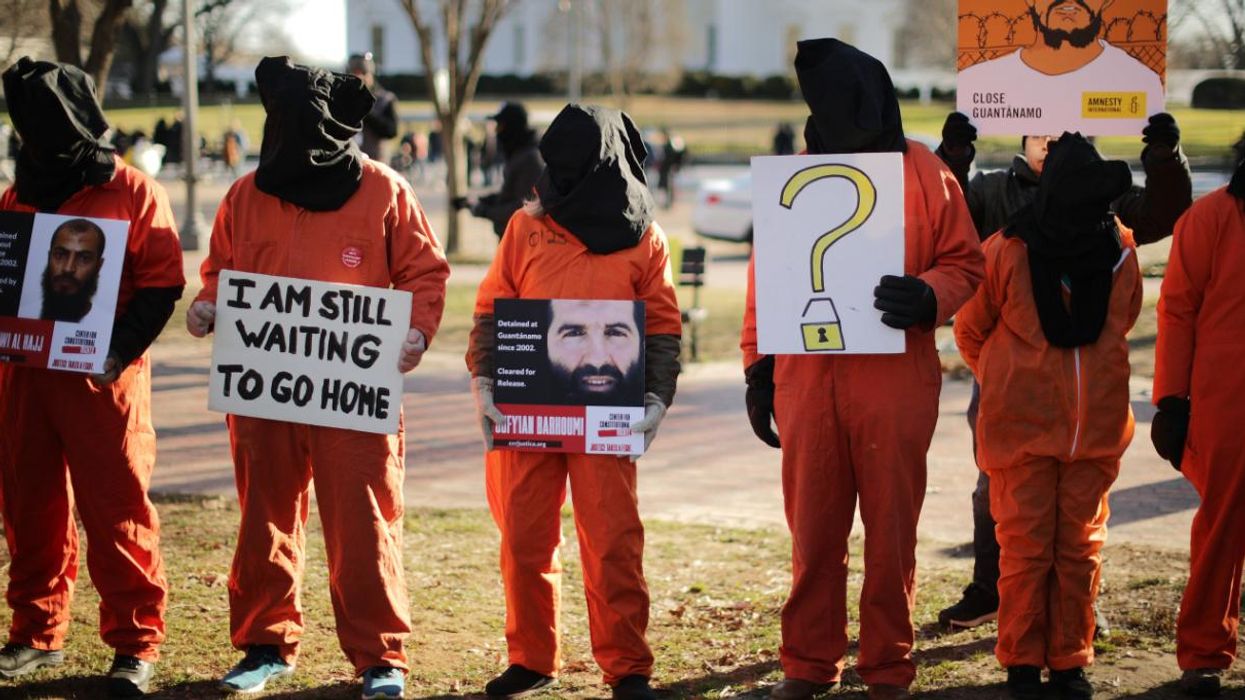
By far the most egregious relic of the war on terror is undoubtedly that forever war’s forever prison at Guantánamo Bay, Cuba. True, the number of detainees still held there—30—is down dramatically from the “roughly 780 detainees” in 2002. And 16 of those detainees have now been cleared for release (a review board having determined that they no longer pose a threat to the United States), while three remain in indefinite detention, and 11 others are in the military commissions system either facing charges or convicted. And true, President Joe Biden’s administration has made some progress in those commissions, arranging plea deals to resolve the cases of those who have been charged, as in that of two detainees who had been tortured and who pleaded guilty to charges related to terrorist bombings in Bali, Indonesia.
But whatever progress has been made during this administration, there have been two major setbacks.
First, early in the fall of 2023, the Biden administration reportedly arranged for the transfer of 11 Yemeni detainees to Oman. As The New York Times‘s Carol Rosenberg reported, thanks to Hamas’ October 7th attack on Israel, “A military cargo plane was already on the runway at Guantánamo Bay ready to airlift the group of Yemeni prisoners to Oman when the trip was called off.” Had that transfer occurred, the prison population would have dwindled to 19. But worries about a newly unstable Middle East left members of Congress uneasy and, according to Rosenberg, they expressed their concerns to the State Department and so succeeded in halting the transfer.
Twenty-three years later, there is arguably no greater reminder of both the need to put the war on terror behind us and an all-American inability to do so than the continued existence of Guantánamo.
In July, however, a momentous forward step did take place. Brigadier General Susan Escallier, the Pentagon’s Convening Authority for Guantánamo, the person in charge of the military commissions there, finally authorized a plea deal that had been in the works for years. It involved three of five defendants in that prison’s signature case, the prosecution of those accused of conspiring in and abetting the 9/11 attacks, including their alleged mastermind Khalid Sheikh Mohammed. The grim years of torture of those five codefendants at CIA “black sites” around the globe had long made it impossible to bring the case to court.
However, a deal was finally reached. As Chief Prosecutor Rear Admiral Aaron Rugh explained, “In exchange for the removal of the death penalty as a possible punishment, these three accused have agreed to plead guilty to all of the charged offenses, including the murder of the 2,976 people listed in the charge sheet.” Other parts of the agreement remain secret, but it still seemed like a huge step forward had been taken in bringing justice to the perpetrators of the 9/11 attacks. After endless pretrial hearings, filings, and motions—and no trial—there seemed at least to be a glimmer of light at the end of the tunnel. In the words of Sen. Dick Durbin (D-Ill.), the plea deal “was the best path forward to finality and justice.”
Unfortunately, only two days after the announced deal, Secretary of Defense Lloyd Austin mysteriously revoked it, issuing a two-page memorandum that managed to provide no explanation whatsoever for his decision.
Twenty-three years later, there is arguably no greater reminder of both the need to put the war on terror behind us and an all-American inability to do so than the continued existence of Guantánamo. There, at an estimated expense of more than $13 million per prisoner per year, judges and lawyers, many of whom favor plea deals, continue to play their roles as if a trial in the 9/11 case will ever be possible; as if the passage of time without resolution is an acceptable solution; and as if the example of indefinite detention, the use of torture, and a system that can’t adjudicate justice doesn’t continue to undermine the American promise of justice for all.
If only, in acting to restore a balance between punishment and the law, even when it comes to post-9/11 terrorism cases, Judges MacMahon and Brinkema had set an example for others. Certainly, at this truly late date, President Biden and Secretary of Defense Austin should have accepted—and should now reconsider and accept—the plea deal for those 9/11 co-defendants as a way of helping this country finally move past the 9/11 era and those endless, disastrous wars on terror. Isn’t it time to free the country up to focus on truly pressing national concerns instead of letting the aberrations of the past continue to haunt the present moment? Along these lines, perhaps it’s also the moment for Congress to sunset the 9/11 authorization for open-ended all-American global warfare.
Isn’t it truly time to move on from the war on terror’s lingering and painful legacy?
Wars of choice in Vietnam and Iraq have not led to peaceful American-style democracies, as those can never be imposed from the outside.
Recently, the US Senate voted on a bipartisan basis to rescind the Authorization for the Use of Military Force (AUMF) in Iraq. President Biden, who voted for that AUMF in 2003, has said he will sign it if it gets to his desk.
At this writing, it is unclear if the U.S. House will post the rescission for a vote and, if so, whether it will pass in that chamber. I fervently hope that it will, so one of the most notorious episodes in U.S. history can be peacefully laid to rest.
If that does happen, it would be a strong parallel to the rescission of the Gulf of Tonkin resolution by the U.S. Senate in 2009. That AUMF in 1964 was also based on deception and authorized the U.S. military intervention in Vietnam, which became the greatest American debacle of that era.
But far more important, rescinding the Iraq AUMF would repudiate deception and manipulation by any Presidential Administration as happened with the George W. Bush Administration in getting Congress to support it. It would also discourage open-ended Congressional AUMFs with no expiration date, which so far has allowed the one in Iraq to continue for two decades. In short, it would re-establish the Constitutional principle that only Congress can declare war, and repudiate the decades-long trend toward an imperial US presidency.
In the lead-up to the U.S. attack on Iraq 20 years ago, as the executive director of the Princeton-based Coalition for Peace Action, I helped lead intensive organizing to try to prevent it.
We organized numerous demonstrations opposing the Bush administration's campaign to start a war with Iraq, including joining a demonstration of over 1 million in New York City shortly before the March 19, 2003 invasion. With demonstrations worldwide attended by tens of millions, it was the largest anti-war mobilization in history to try to prevent a war.
We also did intensive lobbying in opposition to the Bush Administration’s AUMF to authorize the war. I remember being in a delegation that met with the late Sen. Frank Lautenberg shortly before the vote, at which he shared that he couldn’t justify sending his own son to that war so had decided to vote against it.
Starting in August 2002, there was an intense mobilization by the Bush Administration with neoconservatives like Vice President Dick Cheney, Defense Secretary Donald Rumsfeld, and National Security Advisor Condoleezza Rice to promote the war based on the deception that it was needed to prevent Iraq from using Weapons of Mass Destruction (WMD).
That culminated with a presentation by Secretary of State Colin Powell to the UN Security Council in February 2003 asserting the same supposed danger. The Council didn’t vote to support it. We put forward compelling evidence that the Bush Administration was deceiving the American people into supporting the war, but it began anyway.
Years later, I had an in-person conversation with the Chief UN Weapons Inspector in Iraq, Dr. Hans Blix. He told me he had met in person with President Bush before he launched the war, and certified to him that Iraq had no nuclear weapons. He said he told him that if he were given just a few more months, he could certify that it also didn’t have Chemical or Biological Weapons. But Blix said Bush simply retorted that he had made the decision, and the US invasion happened shortly after.
Peace-loving citizens in the U.S. and across the world organized intensively to end the war. I’m proud that the Coalition for Peace Action played a leading role in that effort in our region. But it wasn’t ended until 2011 when the US finally withdrew its last remaining troops as part of an agreement in 2008, before Bush finished his second term. Over 5,000 U.S. Servicemembers were killed, and tens of thousands wounded—including countless returning US Servicemembers who suffer from PTSD to this day. And up to one million Iraqis died.
The U.S. House needs to complete rescission of this deceptive and extremely damaging AUMF. In January 2020, the Trump Administration invoked it to conduct a drone assassination of a top Iranian military leader who was in Bagdad, creating a grave danger of major war with Iran. Iran did a retaliatory strike against a U.S. base in Iraq. But thankfully, no U.S. troops were killed—though a considerable number were injured.
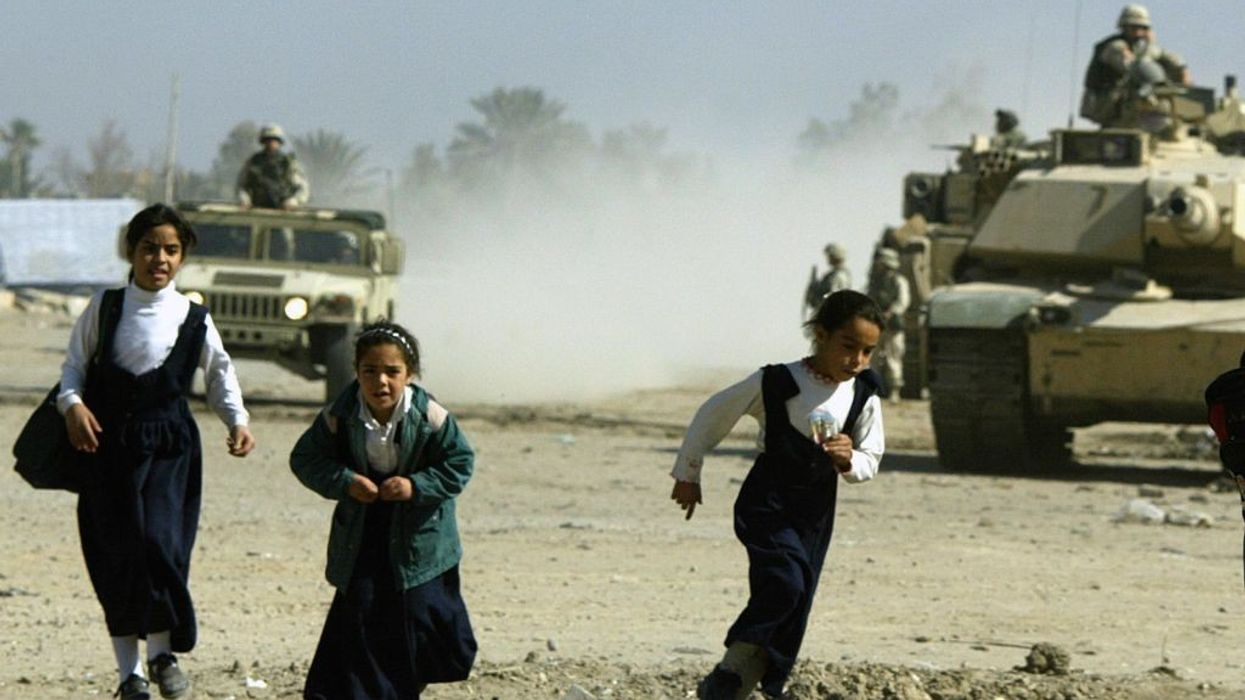
Wars of choice in Vietnam and Iraq have not led to peaceful American-style democracies, as those can never be imposed from the outside. We need to rescind the AUMF for the Iraq War, as we did with the Tonkin Gulf AUMF that green-lighted the Vietnam War. Readers wanting to support that goal can visit peacecoalition.org.
America's longest war continues to drag on with no end in sight. More than 14 years since the invasion of Afghanistan, our highly capable men and women in uniform have gone above and beyond the call of duty. They have done enough; it's past time to bring them home.
On 15 October, we saw the ramifications of Congress's blank check for endless war when President Obama announced that thousands of US troops would remain in Afghanistan through the end of his term and into 2017.
This war has already cost our nation so much: 2,350 of our brave servicemen and women have made the ultimate sacrifice, more than 20,000 have been wounded, and thousands more bear invisible scars. This war has also taken the lives of thousands of Afghans and soldiers from our coalition partners and Nato allies.
Continuing this war has not made us any safer. Our protracted engagement in Afghanistan undermines our national security by sparking global resentment against the US and spurring unsustainable Pentagon spending. The war's price tag totals more than $716bn, which continues to prevent much-needed investments in critical domestic priorities.
It's time to bring our armed forces home to their families and keep our nation's sacred promise to care for them. The American people agree: a December Washington Post-ABC News poll found that a 56% majority of Americans believe this war has not been worth fighting, a trend that dates back to 2010. Yet despite the strong objections of the American people, this war continues with no end in sight.
In the dark days following the attacks on September 11, I cast Congress's sole vote against the authorization for military force (AUMF) that started the war in Afghanistan. I voted against the AUMF because it was so broadly written that it empowered any president to wage endless war in any place at any time without congressional oversight.
In addition to starting the longest war in US history, the 2001 AUMF has emboldened presidential administrations to intervene around the world without a debate in Congress. According to a report from the Congressional Research Service, the 2001 AUMF has been used more than 30 times to justify military action, troop deployments, drone strikes, and indefinite detentions at Guantanamo Bay. And that count only includes unclassified uses - meaning there could be many other instances where Congress has been left in the dark.
Since that lonely vote in 2001, many members of Congress have realized that the blanket war authorization opened a Pandora's box. My bill, HR 1303, would repeal the limitless AUMF, end this war on a reasonable timeline, and restore Congress's constitutional responsibility to debate future wars; it has supporters on both sides of the aisle.
As members of Congress, we take an oath to protect and uphold the US Constitution. Yet, for too long, Congress has abdicated its vital role to authorize and supervise our nation's military actions. The American people deserve a vote, through their congressional representatives, on matters of war and peace.
While Afghanistan and the region still face significant challenges, history has shown that there is no effective military solution. As John Isaacs, a senior fellow at Council for a Livable World, wrote: "More troops, more time, more money, more casualties will simply not bring the war to a close."
Only an inclusive political solution can bring peace, stability, and prosperity to Afghanistan and the region. The future of Afghanistan must be in the hands of the Afghan people. It's time to bring America's longest war to a close.
U.S. lawmakers sent the message on Thursday that they do not want to touch the war on ISIS, let alone engage in real debate.
In a 196-231 vote, the House defeated an amendment attached to the defense spending bill that would have forced lawmakers to vote on authorization of the war on ISIS, which has already been waged for ten months.
Introduced by Rep. Adam Schiff (D-Calif.), the legislation would have required Congress to hold a vote on a new authorization for the use of military force (AUMF) by the end of March 2016 by tying Pentagon funding to lawmakers' explicit approval.
"Ten months into an undeclared war against ISIS, Congress yet again dodged its responsibility to authorize the use of force," declared Schiff during Wednesday's debate on the House floor. "If we are going to ask service members to risk their lives, we ought to have the courage ourselves to take a vote on this war."
However, Schiff made it clear that he backs the war the war on ISIS: "If this is worth fighting ISIS, and I believe it is, it's worth having Congress do its job."
In a climate where even pro-war AUMF proposals can't get a vote, real debate over the war itself is almost completely absent.
The two AUMF requests submitted so far--by President Barack Obama in mid-February and bipartisan senators this week--both call for open-ended and geographically-limitless war against a broadly-defined enemy.
As Congress continues to pass the buck on those proposals, the war on ISIS is escalating, seemingly unaffected by lawmakers' actions--or lack thereof.
The White House revealed this week it is planning to deploy up to 450 more troops to Iraq, adding to the roughly 3,000 already there, and establish a military base in eastern Anbar Province. Gen. Martin Dempsey, chairman of the Joint Chiefs of Staff, said Thursday that the base could serve as a model for "lily pad" hubs across Iraq.