SUBSCRIBE TO OUR FREE NEWSLETTER
Daily news & progressive opinion—funded by the people, not the corporations—delivered straight to your inbox.
5
#000000
#FFFFFF
To donate by check, phone, or other method, see our More Ways to Give page.
Daily news & progressive opinion—funded by the people, not the corporations—delivered straight to your inbox.
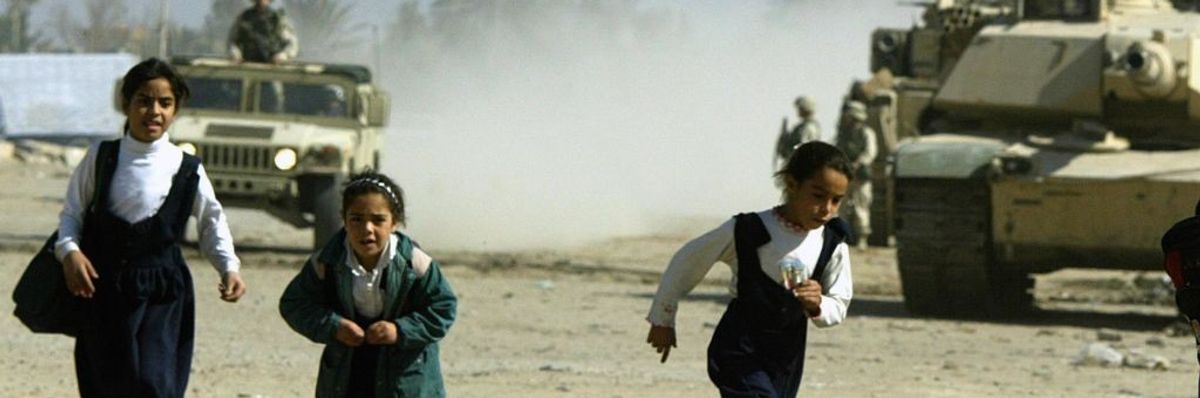
Iraqi schoolgirls flee an approaching US army patrol in the Baghdad suburb of Abu Gharib on November 5, 2003.
Wars of choice in Vietnam and Iraq have not led to peaceful American-style democracies, as those can never be imposed from the outside.
Recently, the US Senate voted on a bipartisan basis to rescind the Authorization for the Use of Military Force (AUMF) in Iraq. President Biden, who voted for that AUMF in 2003, has said he will sign it if it gets to his desk.
At this writing, it is unclear if the U.S. House will post the rescission for a vote and, if so, whether it will pass in that chamber. I fervently hope that it will, so one of the most notorious episodes in U.S. history can be peacefully laid to rest.
If that does happen, it would be a strong parallel to the rescission of the Gulf of Tonkin resolution by the U.S. Senate in 2009. That AUMF in 1964 was also based on deception and authorized the U.S. military intervention in Vietnam, which became the greatest American debacle of that era.
But far more important, rescinding the Iraq AUMF would repudiate deception and manipulation by any Presidential Administration as happened with the George W. Bush Administration in getting Congress to support it. It would also discourage open-ended Congressional AUMFs with no expiration date, which so far has allowed the one in Iraq to continue for two decades. In short, it would re-establish the Constitutional principle that only Congress can declare war, and repudiate the decades-long trend toward an imperial US presidency.
In the lead-up to the U.S. attack on Iraq 20 years ago, as the executive director of the Princeton-based Coalition for Peace Action, I helped lead intensive organizing to try to prevent it.
We organized numerous demonstrations opposing the Bush administration's campaign to start a war with Iraq, including joining a demonstration of over 1 million in New York City shortly before the March 19, 2003 invasion. With demonstrations worldwide attended by tens of millions, it was the largest anti-war mobilization in history to try to prevent a war.
We also did intensive lobbying in opposition to the Bush Administration’s AUMF to authorize the war. I remember being in a delegation that met with the late Sen. Frank Lautenberg shortly before the vote, at which he shared that he couldn’t justify sending his own son to that war so had decided to vote against it.
Starting in August 2002, there was an intense mobilization by the Bush Administration with neoconservatives like Vice President Dick Cheney, Defense Secretary Donald Rumsfeld, and National Security Advisor Condoleezza Rice to promote the war based on the deception that it was needed to prevent Iraq from using Weapons of Mass Destruction (WMD).
That culminated with a presentation by Secretary of State Colin Powell to the UN Security Council in February 2003 asserting the same supposed danger. The Council didn’t vote to support it. We put forward compelling evidence that the Bush Administration was deceiving the American people into supporting the war, but it began anyway.
Years later, I had an in-person conversation with the Chief UN Weapons Inspector in Iraq, Dr. Hans Blix. He told me he had met in person with President Bush before he launched the war, and certified to him that Iraq had no nuclear weapons. He said he told him that if he were given just a few more months, he could certify that it also didn’t have Chemical or Biological Weapons. But Blix said Bush simply retorted that he had made the decision, and the US invasion happened shortly after.
Peace-loving citizens in the U.S. and across the world organized intensively to end the war. I’m proud that the Coalition for Peace Action played a leading role in that effort in our region. But it wasn’t ended until 2011 when the US finally withdrew its last remaining troops as part of an agreement in 2008, before Bush finished his second term. Over 5,000 U.S. Servicemembers were killed, and tens of thousands wounded—including countless returning US Servicemembers who suffer from PTSD to this day. And up to one million Iraqis died.
The U.S. House needs to complete rescission of this deceptive and extremely damaging AUMF. In January 2020, the Trump Administration invoked it to conduct a drone assassination of a top Iranian military leader who was in Bagdad, creating a grave danger of major war with Iran. Iran did a retaliatory strike against a U.S. base in Iraq. But thankfully, no U.S. troops were killed—though a considerable number were injured.
Wars of choice in Vietnam and Iraq have not led to peaceful American-style democracies, as those can never be imposed from the outside. We need to rescind the AUMF for the Iraq War, as we did with the Tonkin Gulf AUMF that green-lighted the Vietnam War. Readers wanting to support that goal can visit peacecoalition.org.
Dear Common Dreams reader, It’s been nearly 30 years since I co-founded Common Dreams with my late wife, Lina Newhouser. We had the radical notion that journalism should serve the public good, not corporate profits. It was clear to us from the outset what it would take to build such a project. No paid advertisements. No corporate sponsors. No millionaire publisher telling us what to think or do. Many people said we wouldn't last a year, but we proved those doubters wrong. Together with a tremendous team of journalists and dedicated staff, we built an independent media outlet free from the constraints of profits and corporate control. Our mission has always been simple: To inform. To inspire. To ignite change for the common good. Building Common Dreams was not easy. Our survival was never guaranteed. When you take on the most powerful forces—Wall Street greed, fossil fuel industry destruction, Big Tech lobbyists, and uber-rich oligarchs who have spent billions upon billions rigging the economy and democracy in their favor—the only bulwark you have is supporters who believe in your work. But here’s the urgent message from me today. It's never been this bad out there. And it's never been this hard to keep us going. At the very moment Common Dreams is most needed, the threats we face are intensifying. We need your support now more than ever. We don't accept corporate advertising and never will. We don't have a paywall because we don't think people should be blocked from critical news based on their ability to pay. Everything we do is funded by the donations of readers like you. When everyone does the little they can afford, we are strong. But if that support retreats or dries up, so do we. Will you donate now to make sure Common Dreams not only survives but thrives? —Craig Brown, Co-founder |
Recently, the US Senate voted on a bipartisan basis to rescind the Authorization for the Use of Military Force (AUMF) in Iraq. President Biden, who voted for that AUMF in 2003, has said he will sign it if it gets to his desk.
At this writing, it is unclear if the U.S. House will post the rescission for a vote and, if so, whether it will pass in that chamber. I fervently hope that it will, so one of the most notorious episodes in U.S. history can be peacefully laid to rest.
If that does happen, it would be a strong parallel to the rescission of the Gulf of Tonkin resolution by the U.S. Senate in 2009. That AUMF in 1964 was also based on deception and authorized the U.S. military intervention in Vietnam, which became the greatest American debacle of that era.
But far more important, rescinding the Iraq AUMF would repudiate deception and manipulation by any Presidential Administration as happened with the George W. Bush Administration in getting Congress to support it. It would also discourage open-ended Congressional AUMFs with no expiration date, which so far has allowed the one in Iraq to continue for two decades. In short, it would re-establish the Constitutional principle that only Congress can declare war, and repudiate the decades-long trend toward an imperial US presidency.
In the lead-up to the U.S. attack on Iraq 20 years ago, as the executive director of the Princeton-based Coalition for Peace Action, I helped lead intensive organizing to try to prevent it.
We organized numerous demonstrations opposing the Bush administration's campaign to start a war with Iraq, including joining a demonstration of over 1 million in New York City shortly before the March 19, 2003 invasion. With demonstrations worldwide attended by tens of millions, it was the largest anti-war mobilization in history to try to prevent a war.
We also did intensive lobbying in opposition to the Bush Administration’s AUMF to authorize the war. I remember being in a delegation that met with the late Sen. Frank Lautenberg shortly before the vote, at which he shared that he couldn’t justify sending his own son to that war so had decided to vote against it.
Starting in August 2002, there was an intense mobilization by the Bush Administration with neoconservatives like Vice President Dick Cheney, Defense Secretary Donald Rumsfeld, and National Security Advisor Condoleezza Rice to promote the war based on the deception that it was needed to prevent Iraq from using Weapons of Mass Destruction (WMD).
That culminated with a presentation by Secretary of State Colin Powell to the UN Security Council in February 2003 asserting the same supposed danger. The Council didn’t vote to support it. We put forward compelling evidence that the Bush Administration was deceiving the American people into supporting the war, but it began anyway.
Years later, I had an in-person conversation with the Chief UN Weapons Inspector in Iraq, Dr. Hans Blix. He told me he had met in person with President Bush before he launched the war, and certified to him that Iraq had no nuclear weapons. He said he told him that if he were given just a few more months, he could certify that it also didn’t have Chemical or Biological Weapons. But Blix said Bush simply retorted that he had made the decision, and the US invasion happened shortly after.
Peace-loving citizens in the U.S. and across the world organized intensively to end the war. I’m proud that the Coalition for Peace Action played a leading role in that effort in our region. But it wasn’t ended until 2011 when the US finally withdrew its last remaining troops as part of an agreement in 2008, before Bush finished his second term. Over 5,000 U.S. Servicemembers were killed, and tens of thousands wounded—including countless returning US Servicemembers who suffer from PTSD to this day. And up to one million Iraqis died.
The U.S. House needs to complete rescission of this deceptive and extremely damaging AUMF. In January 2020, the Trump Administration invoked it to conduct a drone assassination of a top Iranian military leader who was in Bagdad, creating a grave danger of major war with Iran. Iran did a retaliatory strike against a U.S. base in Iraq. But thankfully, no U.S. troops were killed—though a considerable number were injured.
Wars of choice in Vietnam and Iraq have not led to peaceful American-style democracies, as those can never be imposed from the outside. We need to rescind the AUMF for the Iraq War, as we did with the Tonkin Gulf AUMF that green-lighted the Vietnam War. Readers wanting to support that goal can visit peacecoalition.org.
Recently, the US Senate voted on a bipartisan basis to rescind the Authorization for the Use of Military Force (AUMF) in Iraq. President Biden, who voted for that AUMF in 2003, has said he will sign it if it gets to his desk.
At this writing, it is unclear if the U.S. House will post the rescission for a vote and, if so, whether it will pass in that chamber. I fervently hope that it will, so one of the most notorious episodes in U.S. history can be peacefully laid to rest.
If that does happen, it would be a strong parallel to the rescission of the Gulf of Tonkin resolution by the U.S. Senate in 2009. That AUMF in 1964 was also based on deception and authorized the U.S. military intervention in Vietnam, which became the greatest American debacle of that era.
But far more important, rescinding the Iraq AUMF would repudiate deception and manipulation by any Presidential Administration as happened with the George W. Bush Administration in getting Congress to support it. It would also discourage open-ended Congressional AUMFs with no expiration date, which so far has allowed the one in Iraq to continue for two decades. In short, it would re-establish the Constitutional principle that only Congress can declare war, and repudiate the decades-long trend toward an imperial US presidency.
In the lead-up to the U.S. attack on Iraq 20 years ago, as the executive director of the Princeton-based Coalition for Peace Action, I helped lead intensive organizing to try to prevent it.
We organized numerous demonstrations opposing the Bush administration's campaign to start a war with Iraq, including joining a demonstration of over 1 million in New York City shortly before the March 19, 2003 invasion. With demonstrations worldwide attended by tens of millions, it was the largest anti-war mobilization in history to try to prevent a war.
We also did intensive lobbying in opposition to the Bush Administration’s AUMF to authorize the war. I remember being in a delegation that met with the late Sen. Frank Lautenberg shortly before the vote, at which he shared that he couldn’t justify sending his own son to that war so had decided to vote against it.
Starting in August 2002, there was an intense mobilization by the Bush Administration with neoconservatives like Vice President Dick Cheney, Defense Secretary Donald Rumsfeld, and National Security Advisor Condoleezza Rice to promote the war based on the deception that it was needed to prevent Iraq from using Weapons of Mass Destruction (WMD).
That culminated with a presentation by Secretary of State Colin Powell to the UN Security Council in February 2003 asserting the same supposed danger. The Council didn’t vote to support it. We put forward compelling evidence that the Bush Administration was deceiving the American people into supporting the war, but it began anyway.
Years later, I had an in-person conversation with the Chief UN Weapons Inspector in Iraq, Dr. Hans Blix. He told me he had met in person with President Bush before he launched the war, and certified to him that Iraq had no nuclear weapons. He said he told him that if he were given just a few more months, he could certify that it also didn’t have Chemical or Biological Weapons. But Blix said Bush simply retorted that he had made the decision, and the US invasion happened shortly after.
Peace-loving citizens in the U.S. and across the world organized intensively to end the war. I’m proud that the Coalition for Peace Action played a leading role in that effort in our region. But it wasn’t ended until 2011 when the US finally withdrew its last remaining troops as part of an agreement in 2008, before Bush finished his second term. Over 5,000 U.S. Servicemembers were killed, and tens of thousands wounded—including countless returning US Servicemembers who suffer from PTSD to this day. And up to one million Iraqis died.
The U.S. House needs to complete rescission of this deceptive and extremely damaging AUMF. In January 2020, the Trump Administration invoked it to conduct a drone assassination of a top Iranian military leader who was in Bagdad, creating a grave danger of major war with Iran. Iran did a retaliatory strike against a U.S. base in Iraq. But thankfully, no U.S. troops were killed—though a considerable number were injured.
Wars of choice in Vietnam and Iraq have not led to peaceful American-style democracies, as those can never be imposed from the outside. We need to rescind the AUMF for the Iraq War, as we did with the Tonkin Gulf AUMF that green-lighted the Vietnam War. Readers wanting to support that goal can visit peacecoalition.org.