SUBSCRIBE TO OUR FREE NEWSLETTER
Daily news & progressive opinion—funded by the people, not the corporations—delivered straight to your inbox.
5
#000000
#FFFFFF
To donate by check, phone, or other method, see our More Ways to Give page.
Daily news & progressive opinion—funded by the people, not the corporations—delivered straight to your inbox.
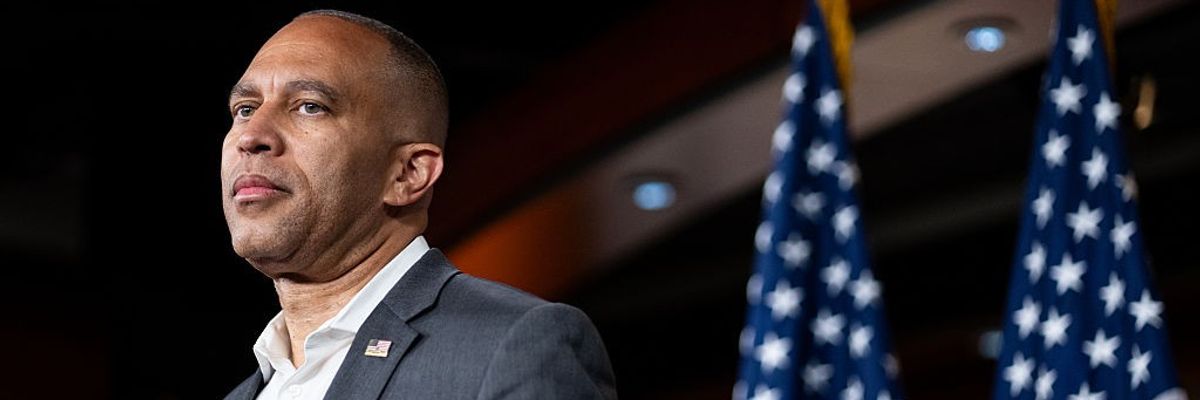
House Minority Leader Hakeem Jeffries (D-N.Y.) holds a news conference in the U.S. Capitol on June 23, 2025.
"Who is going to primary this guy?" said one critic. "Please. I am begging someone to step up."
U.S. House Minority Leader Hakeem Jeffries shocked war opponents Monday when he told reporters he had not looked at a bipartisan resolution that would require congressional approval for military action against Iran.
As U.S. President Donald Trump has beat the drums for war with Iran in recent weeks, Reps. Ro Khanna (D-Calif.) and Thomas Massie (R-Ky.) introduced a resolution to invoke the War Powers Act of 1973, which would require the president to seek congressional approval before taking military action.
The resolution to put a check on Trump's war-making powers in Iran had 59 Democratic co-sponsors. A group of 12 House Democrats—all military veterans, most of whom had not been initial co-sponsors—also voiced their support for the resolution in a letter on Monday. A similar resolution, introduced by Sen. Tim Kaine (D-Va.), has gained traction in the Senate.
In a press conference Monday, Jeffries (D-N.Y.) agreed that the Trump administration should "have to come before Congress and explain their justification" for its "offensive military strike" against Iran over the weekend. But when a reporter asked whether he supported Khanna and Massie's resolution, Jeffries brushed off the question.
"I haven't taken a look at it," Jeffries said, before quickly moving to the next question.
The resolution was released six days before Jeffries' comment and is less than 400 words long.
Conflict with Iran is extraordinarily unpopular with the public. A YouGov poll conducted Sunday—hours after Trump announced strikes on Iranian nuclear facilities—found that 85% of American adults, including 92% of Democrats, did not want the U.S. to be at war with Iran.
Jeffries was already facing criticism for what many viewed as a weak response to Trump's push to war. His failure to address the War Powers proposal only fueled that anger.
"Look at my opposition party dawg," wrote independent journalist Ken Klippenstein, who posted the viral clip on social media.
Jeffries' answer quickly drew more angry rebukes from war critics.
"Hey, not like this is an urgent matter with lives on the line. He'll get to it," quipped Reason Magazine commentator Zach Weissmueller.
Krystal Ball, the left-wing co-host of the Breaking Points podcast, was dismayed, calling for new Democratic leadership.
"Who is going to primary this guy?" Ball tweeted. "Please. I am begging someone to step up."
She noted that even Senate Minority Leader Chuck Schumer (D-N.Y.)—one of the Democratic Party's staunchest defenders of Israel—had also voiced support for using the War Powers Act following Trump's strikes.
Jeffries' response also reignited scrutiny on his support from the America-Israel Public Affairs Committee (AIPAC), which has been one of the strongest advocates for Trump's aggressive actions against Iran.
Commenting on the video, the group Track AIPAC, which monitors donations by pro-Israel lobbyists, shared a graphic showing the large sums Jeffries has received from such groups.
According to OpenSecrets, Jeffries was the top recipient of money from pro-Israel lobbying groups in the House of Representatives during the 2023-24 election cycle, receiving more than $1.1 million. AIPAC was also Jeffries' top contributor.
As Michael Arria wrote for Mondoweiss Monday, many of Jeffries' comments have closely mirrored AIPAC's talking points, including reiterating that U.S. support for Israel is "ironclad" and his claim that Iran "poses a grave threat to the entire free world."
"Many prominent Democrats who have expressed concerns about Trump’s process have effectively endorsed his rationale," Arria wrote.
Dear Common Dreams reader, It’s been nearly 30 years since I co-founded Common Dreams with my late wife, Lina Newhouser. We had the radical notion that journalism should serve the public good, not corporate profits. It was clear to us from the outset what it would take to build such a project. No paid advertisements. No corporate sponsors. No millionaire publisher telling us what to think or do. Many people said we wouldn't last a year, but we proved those doubters wrong. Together with a tremendous team of journalists and dedicated staff, we built an independent media outlet free from the constraints of profits and corporate control. Our mission has always been simple: To inform. To inspire. To ignite change for the common good. Building Common Dreams was not easy. Our survival was never guaranteed. When you take on the most powerful forces—Wall Street greed, fossil fuel industry destruction, Big Tech lobbyists, and uber-rich oligarchs who have spent billions upon billions rigging the economy and democracy in their favor—the only bulwark you have is supporters who believe in your work. But here’s the urgent message from me today. It's never been this bad out there. And it's never been this hard to keep us going. At the very moment Common Dreams is most needed, the threats we face are intensifying. We need your support now more than ever. We don't accept corporate advertising and never will. We don't have a paywall because we don't think people should be blocked from critical news based on their ability to pay. Everything we do is funded by the donations of readers like you. When everyone does the little they can afford, we are strong. But if that support retreats or dries up, so do we. Will you donate now to make sure Common Dreams not only survives but thrives? —Craig Brown, Co-founder |
U.S. House Minority Leader Hakeem Jeffries shocked war opponents Monday when he told reporters he had not looked at a bipartisan resolution that would require congressional approval for military action against Iran.
As U.S. President Donald Trump has beat the drums for war with Iran in recent weeks, Reps. Ro Khanna (D-Calif.) and Thomas Massie (R-Ky.) introduced a resolution to invoke the War Powers Act of 1973, which would require the president to seek congressional approval before taking military action.
The resolution to put a check on Trump's war-making powers in Iran had 59 Democratic co-sponsors. A group of 12 House Democrats—all military veterans, most of whom had not been initial co-sponsors—also voiced their support for the resolution in a letter on Monday. A similar resolution, introduced by Sen. Tim Kaine (D-Va.), has gained traction in the Senate.
In a press conference Monday, Jeffries (D-N.Y.) agreed that the Trump administration should "have to come before Congress and explain their justification" for its "offensive military strike" against Iran over the weekend. But when a reporter asked whether he supported Khanna and Massie's resolution, Jeffries brushed off the question.
"I haven't taken a look at it," Jeffries said, before quickly moving to the next question.
The resolution was released six days before Jeffries' comment and is less than 400 words long.
Conflict with Iran is extraordinarily unpopular with the public. A YouGov poll conducted Sunday—hours after Trump announced strikes on Iranian nuclear facilities—found that 85% of American adults, including 92% of Democrats, did not want the U.S. to be at war with Iran.
Jeffries was already facing criticism for what many viewed as a weak response to Trump's push to war. His failure to address the War Powers proposal only fueled that anger.
"Look at my opposition party dawg," wrote independent journalist Ken Klippenstein, who posted the viral clip on social media.
Jeffries' answer quickly drew more angry rebukes from war critics.
"Hey, not like this is an urgent matter with lives on the line. He'll get to it," quipped Reason Magazine commentator Zach Weissmueller.
Krystal Ball, the left-wing co-host of the Breaking Points podcast, was dismayed, calling for new Democratic leadership.
"Who is going to primary this guy?" Ball tweeted. "Please. I am begging someone to step up."
She noted that even Senate Minority Leader Chuck Schumer (D-N.Y.)—one of the Democratic Party's staunchest defenders of Israel—had also voiced support for using the War Powers Act following Trump's strikes.
Jeffries' response also reignited scrutiny on his support from the America-Israel Public Affairs Committee (AIPAC), which has been one of the strongest advocates for Trump's aggressive actions against Iran.
Commenting on the video, the group Track AIPAC, which monitors donations by pro-Israel lobbyists, shared a graphic showing the large sums Jeffries has received from such groups.
According to OpenSecrets, Jeffries was the top recipient of money from pro-Israel lobbying groups in the House of Representatives during the 2023-24 election cycle, receiving more than $1.1 million. AIPAC was also Jeffries' top contributor.
As Michael Arria wrote for Mondoweiss Monday, many of Jeffries' comments have closely mirrored AIPAC's talking points, including reiterating that U.S. support for Israel is "ironclad" and his claim that Iran "poses a grave threat to the entire free world."
"Many prominent Democrats who have expressed concerns about Trump’s process have effectively endorsed his rationale," Arria wrote.
U.S. House Minority Leader Hakeem Jeffries shocked war opponents Monday when he told reporters he had not looked at a bipartisan resolution that would require congressional approval for military action against Iran.
As U.S. President Donald Trump has beat the drums for war with Iran in recent weeks, Reps. Ro Khanna (D-Calif.) and Thomas Massie (R-Ky.) introduced a resolution to invoke the War Powers Act of 1973, which would require the president to seek congressional approval before taking military action.
The resolution to put a check on Trump's war-making powers in Iran had 59 Democratic co-sponsors. A group of 12 House Democrats—all military veterans, most of whom had not been initial co-sponsors—also voiced their support for the resolution in a letter on Monday. A similar resolution, introduced by Sen. Tim Kaine (D-Va.), has gained traction in the Senate.
In a press conference Monday, Jeffries (D-N.Y.) agreed that the Trump administration should "have to come before Congress and explain their justification" for its "offensive military strike" against Iran over the weekend. But when a reporter asked whether he supported Khanna and Massie's resolution, Jeffries brushed off the question.
"I haven't taken a look at it," Jeffries said, before quickly moving to the next question.
The resolution was released six days before Jeffries' comment and is less than 400 words long.
Conflict with Iran is extraordinarily unpopular with the public. A YouGov poll conducted Sunday—hours after Trump announced strikes on Iranian nuclear facilities—found that 85% of American adults, including 92% of Democrats, did not want the U.S. to be at war with Iran.
Jeffries was already facing criticism for what many viewed as a weak response to Trump's push to war. His failure to address the War Powers proposal only fueled that anger.
"Look at my opposition party dawg," wrote independent journalist Ken Klippenstein, who posted the viral clip on social media.
Jeffries' answer quickly drew more angry rebukes from war critics.
"Hey, not like this is an urgent matter with lives on the line. He'll get to it," quipped Reason Magazine commentator Zach Weissmueller.
Krystal Ball, the left-wing co-host of the Breaking Points podcast, was dismayed, calling for new Democratic leadership.
"Who is going to primary this guy?" Ball tweeted. "Please. I am begging someone to step up."
She noted that even Senate Minority Leader Chuck Schumer (D-N.Y.)—one of the Democratic Party's staunchest defenders of Israel—had also voiced support for using the War Powers Act following Trump's strikes.
Jeffries' response also reignited scrutiny on his support from the America-Israel Public Affairs Committee (AIPAC), which has been one of the strongest advocates for Trump's aggressive actions against Iran.
Commenting on the video, the group Track AIPAC, which monitors donations by pro-Israel lobbyists, shared a graphic showing the large sums Jeffries has received from such groups.
According to OpenSecrets, Jeffries was the top recipient of money from pro-Israel lobbying groups in the House of Representatives during the 2023-24 election cycle, receiving more than $1.1 million. AIPAC was also Jeffries' top contributor.
As Michael Arria wrote for Mondoweiss Monday, many of Jeffries' comments have closely mirrored AIPAC's talking points, including reiterating that U.S. support for Israel is "ironclad" and his claim that Iran "poses a grave threat to the entire free world."
"Many prominent Democrats who have expressed concerns about Trump’s process have effectively endorsed his rationale," Arria wrote.