SUBSCRIBE TO OUR FREE NEWSLETTER
Daily news & progressive opinion—funded by the people, not the corporations—delivered straight to your inbox.
5
#000000
#FFFFFF
To donate by check, phone, or other method, see our More Ways to Give page.
Daily news & progressive opinion—funded by the people, not the corporations—delivered straight to your inbox.
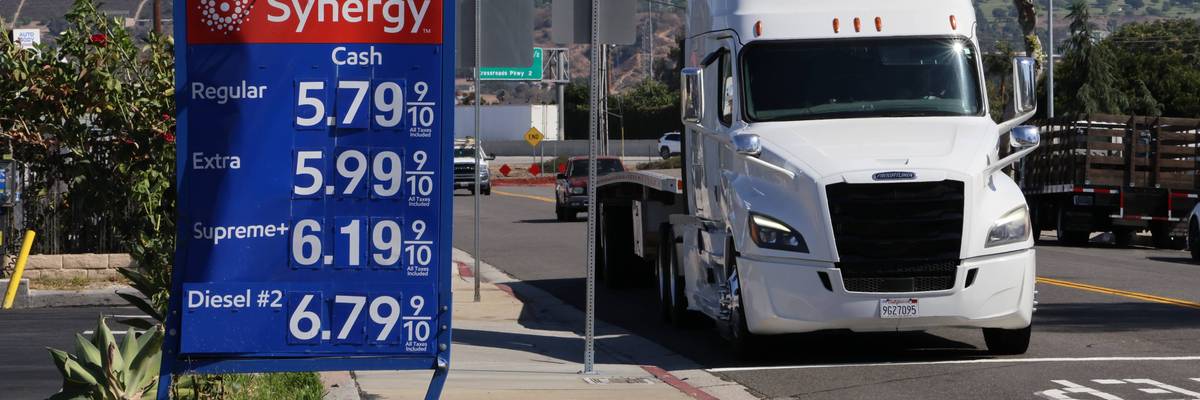
Gasoline and diesel prices are displayed at a gas station in El Monte, California on August 26, 2026.
"Labor Day weekend travelers are facing the highest gas prices ever for this time of year," said the American Automobile Association.
The average price for a gallon of diesel fuel in the United States hit an all-time high average price of $5.85 on Friday as the Trump administration's war on Iran and its resulting disruptions to the global energy market showed no signs of ending.
"Trump did it! Diesel hits a new record high!" economist Dean Baker wrote sardonically on social media.
The Associated Press noted that "because diesel is used for many freight and delivery networks, higher diesel prices mean higher transportation costs for a long list of everyday goods."
According to the American Automobile Association (AAA), the national average price for a gallon of regular gasoline was just under $4.15 on Friday—up from $3.20 a year ago and an increase of nearly 40% since the US and Israel started bombing Iran in late February, prompting the Middle East country to retaliate by closing the Strait of Hormuz, a critical waterway for the global oil trade.
"Labor Day weekend travelers are facing the highest gas prices ever for this time of year," AAA said on Thursday. "The national average has never been above $4 per gallon on Labor Day. The current Labor Day record is $3.82, set on September 3, 2012. Even though gasoline demand decreases this time of year, typically bringing down gas prices, this year is different due to the high cost of crude oil."
Kendall Witmer, rapid response director for the Democratic National Committee, said in a statement Friday that "working families deserve to enjoy their hard-earned holiday weekends, but Trump and Republicans’ agenda has made everything from gas to groceries more expensive and left families with no breathing room."
"It’s no wonder Americans are rejecting Trump and Republicans," Witmer added, "forcing Trump’s approval ratings to fall to embarrassing lows."
President Donald Trump's White House has thus far responded dismissively to concerns about surging gas prices, even as they appear to pose a significant threat to the Republican Party's chances of retaining control of Congress in the upcoming midterm elections.
At a rally in New York last month, Trump told Americans that paying "a tiny little bit more for your gasoline" is worth the price for waging the Iran war, which is historically unpopular with the US public.
During a press conference on Thursday, US Vice President JD Vance suggested Americans should be grateful that gas prices aren't even higher.
"Gas, frankly, could’ve been much, much higher were it not for our efforts," said Vance, referring to the administration's attempts to reopen the Strait of Hormuz.
The New Republic's Hafiz Rashid observed that Vance's remarks "belie the fact that the Iran war was arbitrarily and unnecessarily started by the Trump administration."
"There was no threat to the flow of oil and gas or other maritime traffic traversing through the Strait of Hormuz prior to the war," Rashid wrote. "If not for the efforts of President Trump, gas would in fact be much, much, lower."
While the administration claims the Strait is now open and that dozens of vessels carrying millions of barrels of oil are transiting the critical waterway daily, analysts have cast doubt on the assertion. Al Jazeera noted Thursday that "according to marine analytics firm Kpler, just six vessels crossed the Strait on Wednesday, 11 on Tuesday, and five on Monday. It put the 10-day average at 13 vessels per day."
Dear Common Dreams reader, It’s been nearly 30 years since I co-founded Common Dreams with my late wife, Lina Newhouser. We had the radical notion that journalism should serve the public good, not corporate profits. It was clear to us from the outset what it would take to build such a project. No paid advertisements. No corporate sponsors. No millionaire publisher telling us what to think or do. Many people said we wouldn't last a year, but we proved those doubters wrong. Together with a tremendous team of journalists and dedicated staff, we built an independent media outlet free from the constraints of profits and corporate control. Our mission has always been simple: To inform. To inspire. To ignite change for the common good. Building Common Dreams was not easy. Our survival was never guaranteed. When you take on the most powerful forces—Wall Street greed, fossil fuel industry destruction, Big Tech lobbyists, and uber-rich oligarchs who have spent billions upon billions rigging the economy and democracy in their favor—the only bulwark you have is supporters who believe in your work. But here’s the urgent message from me today. It's never been this bad out there. And it's never been this hard to keep us going. At the very moment Common Dreams is most needed, the threats we face are intensifying. We need your support now more than ever. We don't accept corporate advertising and never will. We don't have a paywall because we don't think people should be blocked from critical news based on their ability to pay. Everything we do is funded by the donations of readers like you. When everyone does the little they can afford, we are strong. But if that support retreats or dries up, so do we. Will you donate now to make sure Common Dreams not only survives but thrives? —Craig Brown, Co-founder |
The average price for a gallon of diesel fuel in the United States hit an all-time high average price of $5.85 on Friday as the Trump administration's war on Iran and its resulting disruptions to the global energy market showed no signs of ending.
"Trump did it! Diesel hits a new record high!" economist Dean Baker wrote sardonically on social media.
The Associated Press noted that "because diesel is used for many freight and delivery networks, higher diesel prices mean higher transportation costs for a long list of everyday goods."
According to the American Automobile Association (AAA), the national average price for a gallon of regular gasoline was just under $4.15 on Friday—up from $3.20 a year ago and an increase of nearly 40% since the US and Israel started bombing Iran in late February, prompting the Middle East country to retaliate by closing the Strait of Hormuz, a critical waterway for the global oil trade.
"Labor Day weekend travelers are facing the highest gas prices ever for this time of year," AAA said on Thursday. "The national average has never been above $4 per gallon on Labor Day. The current Labor Day record is $3.82, set on September 3, 2012. Even though gasoline demand decreases this time of year, typically bringing down gas prices, this year is different due to the high cost of crude oil."
Kendall Witmer, rapid response director for the Democratic National Committee, said in a statement Friday that "working families deserve to enjoy their hard-earned holiday weekends, but Trump and Republicans’ agenda has made everything from gas to groceries more expensive and left families with no breathing room."
"It’s no wonder Americans are rejecting Trump and Republicans," Witmer added, "forcing Trump’s approval ratings to fall to embarrassing lows."
President Donald Trump's White House has thus far responded dismissively to concerns about surging gas prices, even as they appear to pose a significant threat to the Republican Party's chances of retaining control of Congress in the upcoming midterm elections.
At a rally in New York last month, Trump told Americans that paying "a tiny little bit more for your gasoline" is worth the price for waging the Iran war, which is historically unpopular with the US public.
During a press conference on Thursday, US Vice President JD Vance suggested Americans should be grateful that gas prices aren't even higher.
"Gas, frankly, could’ve been much, much higher were it not for our efforts," said Vance, referring to the administration's attempts to reopen the Strait of Hormuz.
The New Republic's Hafiz Rashid observed that Vance's remarks "belie the fact that the Iran war was arbitrarily and unnecessarily started by the Trump administration."
"There was no threat to the flow of oil and gas or other maritime traffic traversing through the Strait of Hormuz prior to the war," Rashid wrote. "If not for the efforts of President Trump, gas would in fact be much, much, lower."
While the administration claims the Strait is now open and that dozens of vessels carrying millions of barrels of oil are transiting the critical waterway daily, analysts have cast doubt on the assertion. Al Jazeera noted Thursday that "according to marine analytics firm Kpler, just six vessels crossed the Strait on Wednesday, 11 on Tuesday, and five on Monday. It put the 10-day average at 13 vessels per day."
The average price for a gallon of diesel fuel in the United States hit an all-time high average price of $5.85 on Friday as the Trump administration's war on Iran and its resulting disruptions to the global energy market showed no signs of ending.
"Trump did it! Diesel hits a new record high!" economist Dean Baker wrote sardonically on social media.
The Associated Press noted that "because diesel is used for many freight and delivery networks, higher diesel prices mean higher transportation costs for a long list of everyday goods."
According to the American Automobile Association (AAA), the national average price for a gallon of regular gasoline was just under $4.15 on Friday—up from $3.20 a year ago and an increase of nearly 40% since the US and Israel started bombing Iran in late February, prompting the Middle East country to retaliate by closing the Strait of Hormuz, a critical waterway for the global oil trade.
"Labor Day weekend travelers are facing the highest gas prices ever for this time of year," AAA said on Thursday. "The national average has never been above $4 per gallon on Labor Day. The current Labor Day record is $3.82, set on September 3, 2012. Even though gasoline demand decreases this time of year, typically bringing down gas prices, this year is different due to the high cost of crude oil."
Kendall Witmer, rapid response director for the Democratic National Committee, said in a statement Friday that "working families deserve to enjoy their hard-earned holiday weekends, but Trump and Republicans’ agenda has made everything from gas to groceries more expensive and left families with no breathing room."
"It’s no wonder Americans are rejecting Trump and Republicans," Witmer added, "forcing Trump’s approval ratings to fall to embarrassing lows."
President Donald Trump's White House has thus far responded dismissively to concerns about surging gas prices, even as they appear to pose a significant threat to the Republican Party's chances of retaining control of Congress in the upcoming midterm elections.
At a rally in New York last month, Trump told Americans that paying "a tiny little bit more for your gasoline" is worth the price for waging the Iran war, which is historically unpopular with the US public.
During a press conference on Thursday, US Vice President JD Vance suggested Americans should be grateful that gas prices aren't even higher.
"Gas, frankly, could’ve been much, much higher were it not for our efforts," said Vance, referring to the administration's attempts to reopen the Strait of Hormuz.
The New Republic's Hafiz Rashid observed that Vance's remarks "belie the fact that the Iran war was arbitrarily and unnecessarily started by the Trump administration."
"There was no threat to the flow of oil and gas or other maritime traffic traversing through the Strait of Hormuz prior to the war," Rashid wrote. "If not for the efforts of President Trump, gas would in fact be much, much, lower."
While the administration claims the Strait is now open and that dozens of vessels carrying millions of barrels of oil are transiting the critical waterway daily, analysts have cast doubt on the assertion. Al Jazeera noted Thursday that "according to marine analytics firm Kpler, just six vessels crossed the Strait on Wednesday, 11 on Tuesday, and five on Monday. It put the 10-day average at 13 vessels per day."