SUBSCRIBE TO OUR FREE NEWSLETTER
Daily news & progressive opinion—funded by the people, not the corporations—delivered straight to your inbox.
5
#000000
#FFFFFF
To donate by check, phone, or other method, see our More Ways to Give page.
Daily news & progressive opinion—funded by the people, not the corporations—delivered straight to your inbox.
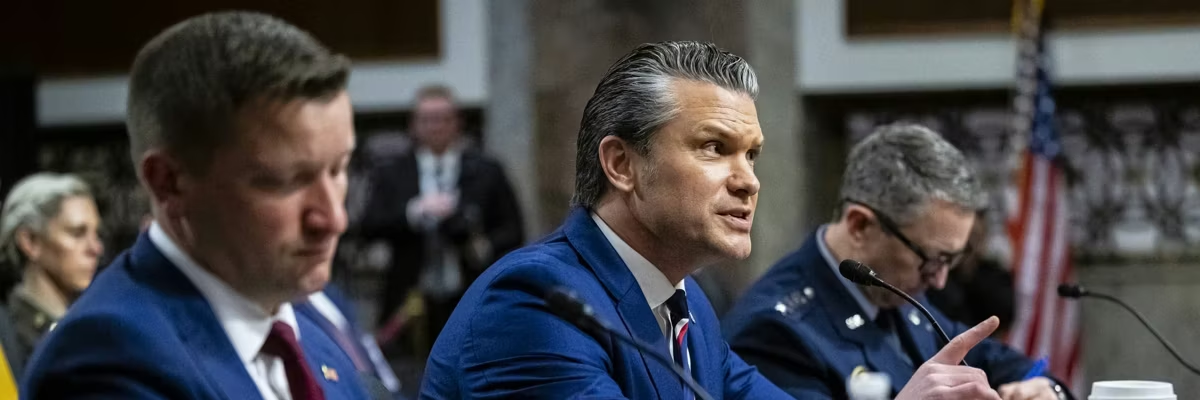
Pentagon Secretary Pete Hegseth testifies during a Senate Armed Services Committee hearing on April 30, 2026.
"These funds were provided for lifesaving medical research, not as extra money for the Department of Defense," said Rep. Rosa DeLauro.
US President Donald Trump's Department of Defense is reportedly working to divert billions of dollars in federal funding from the National Institutes of Health to bolster the Pentagon's budget as the administration wages a costly, destructive, and open-ended war on Iran.
Rep. Rosa DeLauro (D-Conn.), the top House Democratic appropriator, revealed late Thursday that the Pentagon—without notifying lawmakers or the public—signed an interagency agreement that could give the Defense Department "access to billions of dollars that Congress provided to NIH for critical biomedical research."
Under the deal, which the Trump administration disclosed to Congress under pressure from Democrats on the House Appropriations Committee, the Pentagon would pull funds from the National Institute of Allergy and Infectious Diseases, whose annual budget is around $7 billion. It is unclear whether NIH has signed the agreement.
"This secretive attempt to siphon research funds away from NIH is outrageous. The interagency agreement needs to be terminated immediately,” DeLauro said in a statement. “These funds were provided for lifesaving medical research, not as extra money for the Department of Defense. It is no secret that the Department of Defense is facing enormous financial pressure because of President Trump’s war of choice with Iran. But the Trump administration cannot make American patients, families, and scientists pay the price."
"Circumventing Congress to divert money intended to help Americans who are exposed to HIV, influenza, tuberculosis, and other deadly diseases—and directing those funds to the Department of Defense—is beyond the pale," DeLauro added. "DoD already has programs, funded by Congress, to research and develop medical countermeasures to chemical, biological, and nuclear threats, and does not need NIH funding to do so. The administration must provide Congress with a full accounting of how this interagency agreement was developed and exactly how much taxpayer money it is trying to transfer to DoD.”
Military spending accounts for roughly half of the federal discretionary budget, but the Pentagon in recent months has said it is facing a cash shortfall in large part due to the illegal war on Iran. The Pentagon has said publicly that the Iran war has cost the US around $37.5 billion so far, though the agency—which has never passed an independent audit—has not released a full accounting of the conflict, and experts say the figure is likely a gross undercount.
On top of pursuing an annual military budget exceeding $1.1 trillion, the Trump administration is pushing lawmakers to approve a $67 billion supplemental funding package to cover some of the Iran war's costs.
"Trump chose to start a costly war with Iran after giving billionaires and big corporations trillions of dollars in tax breaks—and now wants American patients to unknowingly foot the Defense Department’s bills," Leslie Dach, chair of the advocacy group Protect Our Care, said in a statement Thursday. "Not a single dollar Congress appropriated for life-saving disease research should go into the bumbling hands of Defense Secretary Pete Hegseth for any claimed purpose."
A Trump administration spokesperson told The Hill that the Pentagon-NIH deal would "enable nimble multi-agency resources to collaboratively respond to public health emergencies, such as the recent Ebola outbreak."
Dach argued that no one should take the Trump administration "at its word about the military research they supposedly plan to fund with taxpayer money that was meant to find cures for diseases here at home."
"Given Secretary Hegseth’s history of lying through his teeth about our national security and the fact this budgetary sleight of hand was reluctantly revealed to Congress, would anyone be surprised if these raided NIH funds were actually intended to buy more bombs?" Dach asked. "This backroom deal at the expense of public health needs to be revoked immediately, followed by a serious congressional investigation into the extent of and motives behind the Trump administration’s taxpayer money shell game.”
Sen. Patty Murray (D-Wash.), Senate Democrats' top appropriator, also called for the immediate termination of the agreement.
“As if canceling lifesaving medical research and clinical trials and firing cancer researchers en masse were not bad enough, the Trump administration is now trying to rob NIH of billions of dollars that Congress provided for medical research so that it can pad the Pentagon’s budget," said Murray. "We cannot allow this administration to shred patients’ hopes of new, lifesaving cures and treatments so that President Trump and Secretary Hegseth can secretively fund their own priorities in defiance of Congress."
Dear Common Dreams reader, It’s been nearly 30 years since I co-founded Common Dreams with my late wife, Lina Newhouser. We had the radical notion that journalism should serve the public good, not corporate profits. It was clear to us from the outset what it would take to build such a project. No paid advertisements. No corporate sponsors. No millionaire publisher telling us what to think or do. Many people said we wouldn't last a year, but we proved those doubters wrong. Together with a tremendous team of journalists and dedicated staff, we built an independent media outlet free from the constraints of profits and corporate control. Our mission has always been simple: To inform. To inspire. To ignite change for the common good. Building Common Dreams was not easy. Our survival was never guaranteed. When you take on the most powerful forces—Wall Street greed, fossil fuel industry destruction, Big Tech lobbyists, and uber-rich oligarchs who have spent billions upon billions rigging the economy and democracy in their favor—the only bulwark you have is supporters who believe in your work. But here’s the urgent message from me today. It's never been this bad out there. And it's never been this hard to keep us going. At the very moment Common Dreams is most needed, the threats we face are intensifying. We need your support now more than ever. We don't accept corporate advertising and never will. We don't have a paywall because we don't think people should be blocked from critical news based on their ability to pay. Everything we do is funded by the donations of readers like you. When everyone does the little they can afford, we are strong. But if that support retreats or dries up, so do we. Will you donate now to make sure Common Dreams not only survives but thrives? —Craig Brown, Co-founder |
US President Donald Trump's Department of Defense is reportedly working to divert billions of dollars in federal funding from the National Institutes of Health to bolster the Pentagon's budget as the administration wages a costly, destructive, and open-ended war on Iran.
Rep. Rosa DeLauro (D-Conn.), the top House Democratic appropriator, revealed late Thursday that the Pentagon—without notifying lawmakers or the public—signed an interagency agreement that could give the Defense Department "access to billions of dollars that Congress provided to NIH for critical biomedical research."
Under the deal, which the Trump administration disclosed to Congress under pressure from Democrats on the House Appropriations Committee, the Pentagon would pull funds from the National Institute of Allergy and Infectious Diseases, whose annual budget is around $7 billion. It is unclear whether NIH has signed the agreement.
"This secretive attempt to siphon research funds away from NIH is outrageous. The interagency agreement needs to be terminated immediately,” DeLauro said in a statement. “These funds were provided for lifesaving medical research, not as extra money for the Department of Defense. It is no secret that the Department of Defense is facing enormous financial pressure because of President Trump’s war of choice with Iran. But the Trump administration cannot make American patients, families, and scientists pay the price."
"Circumventing Congress to divert money intended to help Americans who are exposed to HIV, influenza, tuberculosis, and other deadly diseases—and directing those funds to the Department of Defense—is beyond the pale," DeLauro added. "DoD already has programs, funded by Congress, to research and develop medical countermeasures to chemical, biological, and nuclear threats, and does not need NIH funding to do so. The administration must provide Congress with a full accounting of how this interagency agreement was developed and exactly how much taxpayer money it is trying to transfer to DoD.”
Military spending accounts for roughly half of the federal discretionary budget, but the Pentagon in recent months has said it is facing a cash shortfall in large part due to the illegal war on Iran. The Pentagon has said publicly that the Iran war has cost the US around $37.5 billion so far, though the agency—which has never passed an independent audit—has not released a full accounting of the conflict, and experts say the figure is likely a gross undercount.
On top of pursuing an annual military budget exceeding $1.1 trillion, the Trump administration is pushing lawmakers to approve a $67 billion supplemental funding package to cover some of the Iran war's costs.
"Trump chose to start a costly war with Iran after giving billionaires and big corporations trillions of dollars in tax breaks—and now wants American patients to unknowingly foot the Defense Department’s bills," Leslie Dach, chair of the advocacy group Protect Our Care, said in a statement Thursday. "Not a single dollar Congress appropriated for life-saving disease research should go into the bumbling hands of Defense Secretary Pete Hegseth for any claimed purpose."
A Trump administration spokesperson told The Hill that the Pentagon-NIH deal would "enable nimble multi-agency resources to collaboratively respond to public health emergencies, such as the recent Ebola outbreak."
Dach argued that no one should take the Trump administration "at its word about the military research they supposedly plan to fund with taxpayer money that was meant to find cures for diseases here at home."
"Given Secretary Hegseth’s history of lying through his teeth about our national security and the fact this budgetary sleight of hand was reluctantly revealed to Congress, would anyone be surprised if these raided NIH funds were actually intended to buy more bombs?" Dach asked. "This backroom deal at the expense of public health needs to be revoked immediately, followed by a serious congressional investigation into the extent of and motives behind the Trump administration’s taxpayer money shell game.”
Sen. Patty Murray (D-Wash.), Senate Democrats' top appropriator, also called for the immediate termination of the agreement.
“As if canceling lifesaving medical research and clinical trials and firing cancer researchers en masse were not bad enough, the Trump administration is now trying to rob NIH of billions of dollars that Congress provided for medical research so that it can pad the Pentagon’s budget," said Murray. "We cannot allow this administration to shred patients’ hopes of new, lifesaving cures and treatments so that President Trump and Secretary Hegseth can secretively fund their own priorities in defiance of Congress."
US President Donald Trump's Department of Defense is reportedly working to divert billions of dollars in federal funding from the National Institutes of Health to bolster the Pentagon's budget as the administration wages a costly, destructive, and open-ended war on Iran.
Rep. Rosa DeLauro (D-Conn.), the top House Democratic appropriator, revealed late Thursday that the Pentagon—without notifying lawmakers or the public—signed an interagency agreement that could give the Defense Department "access to billions of dollars that Congress provided to NIH for critical biomedical research."
Under the deal, which the Trump administration disclosed to Congress under pressure from Democrats on the House Appropriations Committee, the Pentagon would pull funds from the National Institute of Allergy and Infectious Diseases, whose annual budget is around $7 billion. It is unclear whether NIH has signed the agreement.
"This secretive attempt to siphon research funds away from NIH is outrageous. The interagency agreement needs to be terminated immediately,” DeLauro said in a statement. “These funds were provided for lifesaving medical research, not as extra money for the Department of Defense. It is no secret that the Department of Defense is facing enormous financial pressure because of President Trump’s war of choice with Iran. But the Trump administration cannot make American patients, families, and scientists pay the price."
"Circumventing Congress to divert money intended to help Americans who are exposed to HIV, influenza, tuberculosis, and other deadly diseases—and directing those funds to the Department of Defense—is beyond the pale," DeLauro added. "DoD already has programs, funded by Congress, to research and develop medical countermeasures to chemical, biological, and nuclear threats, and does not need NIH funding to do so. The administration must provide Congress with a full accounting of how this interagency agreement was developed and exactly how much taxpayer money it is trying to transfer to DoD.”
Military spending accounts for roughly half of the federal discretionary budget, but the Pentagon in recent months has said it is facing a cash shortfall in large part due to the illegal war on Iran. The Pentagon has said publicly that the Iran war has cost the US around $37.5 billion so far, though the agency—which has never passed an independent audit—has not released a full accounting of the conflict, and experts say the figure is likely a gross undercount.
On top of pursuing an annual military budget exceeding $1.1 trillion, the Trump administration is pushing lawmakers to approve a $67 billion supplemental funding package to cover some of the Iran war's costs.
"Trump chose to start a costly war with Iran after giving billionaires and big corporations trillions of dollars in tax breaks—and now wants American patients to unknowingly foot the Defense Department’s bills," Leslie Dach, chair of the advocacy group Protect Our Care, said in a statement Thursday. "Not a single dollar Congress appropriated for life-saving disease research should go into the bumbling hands of Defense Secretary Pete Hegseth for any claimed purpose."
A Trump administration spokesperson told The Hill that the Pentagon-NIH deal would "enable nimble multi-agency resources to collaboratively respond to public health emergencies, such as the recent Ebola outbreak."
Dach argued that no one should take the Trump administration "at its word about the military research they supposedly plan to fund with taxpayer money that was meant to find cures for diseases here at home."
"Given Secretary Hegseth’s history of lying through his teeth about our national security and the fact this budgetary sleight of hand was reluctantly revealed to Congress, would anyone be surprised if these raided NIH funds were actually intended to buy more bombs?" Dach asked. "This backroom deal at the expense of public health needs to be revoked immediately, followed by a serious congressional investigation into the extent of and motives behind the Trump administration’s taxpayer money shell game.”
Sen. Patty Murray (D-Wash.), Senate Democrats' top appropriator, also called for the immediate termination of the agreement.
“As if canceling lifesaving medical research and clinical trials and firing cancer researchers en masse were not bad enough, the Trump administration is now trying to rob NIH of billions of dollars that Congress provided for medical research so that it can pad the Pentagon’s budget," said Murray. "We cannot allow this administration to shred patients’ hopes of new, lifesaving cures and treatments so that President Trump and Secretary Hegseth can secretively fund their own priorities in defiance of Congress."