

SUBSCRIBE TO OUR FREE NEWSLETTER
Daily news & progressive opinion—funded by the people, not the corporations—delivered straight to your inbox.
5
#000000
#FFFFFF
To donate by check, phone, or other method, see our More Ways to Give page.
Daily news & progressive opinion—funded by the people, not the corporations—delivered straight to your inbox.

Carlson's account of his conversation with the president days before the US and Israel attacked Iran was "extremely disturbing," said one journalist.
New revelations from right-wing political commentator Tucker Carlson about President Donald Trump's push to wage war on Iran earlier this year prompted the latest calls for Cabinet members to invoke the 25th Amendment and force Trump out of office on the grounds that he is unable to fulfill the duties of the office—namely, to protect the security of the people of the United States.
"Days before the war began," Carlson told Steve Inskeep of NPR on Thursday, the president explicitly said that the outcome of the conflict didn't matter, because "in the end we all die, anyway."
Carlson revealed that he visited Trump in the Oval Office of the White House in late February, after having gone to Tel Aviv and interviewed Mike Huckabee, the US ambassador to Israel.
Trump expressed annoyance at Carlson, an on-and-off ally of the president over the years who claimed in April that he had "regrets" about supporting him, for challenging Huckabee on the US relationship with Israel.
Carlson had pressed Huckabee on his comment that "it would be fine if Israel took" over huge swaths of the Middle East, including parts of Lebanon, Syria, Iraq, Jordan, and Türkiye.
The host of "The Tucker Carlson Show" said he told Trump he had come away from his two-hour discussion with Huckabee understanding that the unprovoked war the US and Israel was days away from started was not aimed at ending Iran's nuclear program—which the president had claimed was taken out of commission in June 2025 by US strikes.
The Israeli threats against Iran, said Carlson, were actually aimed at ending Iran's "regional power," "diminishing the power" of the Gulf Cooperation Council, and ultimately "getting the US out of the Middle East because we constrain their ambitions" by maintaining a presence in countries in the region.
As the podcaster warned the president not to be manipulated by the Israeli government into taking military action against Iran, according to Carlson, "he looked at me and said, 'Yes, you're right, but in the end we all die, anyway, so it doesn't matter."
This is also 25th Amendment stuff. Extremely disturbing. pic.twitter.com/SnyqCwI3fL
— Ryan Grim (@ryangrim) September 25, 2026
"That's exactly what he said," said Carlson. "I said to him, shocked, ''But what about our kids and our grandkids, and like, our country?' And he goes, 'Argh!'... That's a verbatim exchange."
"I was shocked by that," he added. "Who lives or dies does matter, the future does matter."
The president's assertion that allowing Israel to push the US into war—something Secretary of State Marco Rubio also openly acknowledged had happened after the conflict began—could be disastrous for the US and lead to an untold number of American deaths, was called "extremely disturbing" by Drop Site News journalist Ryan Grim, who suggested Carlson's revelation should prompt the use of the 25th Amendment.
Journalist Pedro L. Gonzalez expressed wariness at the thought of taking Carlson at his word regarding his exchange with Trump and his current opposition to the president, while Carlson said he believed the need for Cabinet members to push Trump out of office predated the interview.
He said that Trump's threat of nuclear war in April, when he threatened to annihilate the "whole civilization" of Iran, "never to be brought back again," was grounds for invoking the 25th Amendment, with a majority of his Cabinet members voting to remove him from office.
Tucker Carlson: Trump should have been removed from office immediately when he threatened nuclear war pic.twitter.com/eYPbYBRsta
— FactPost (@factpostnews) September 24, 2026
"He should have been bundled up and taken out," said Carlson. "That's a crime."
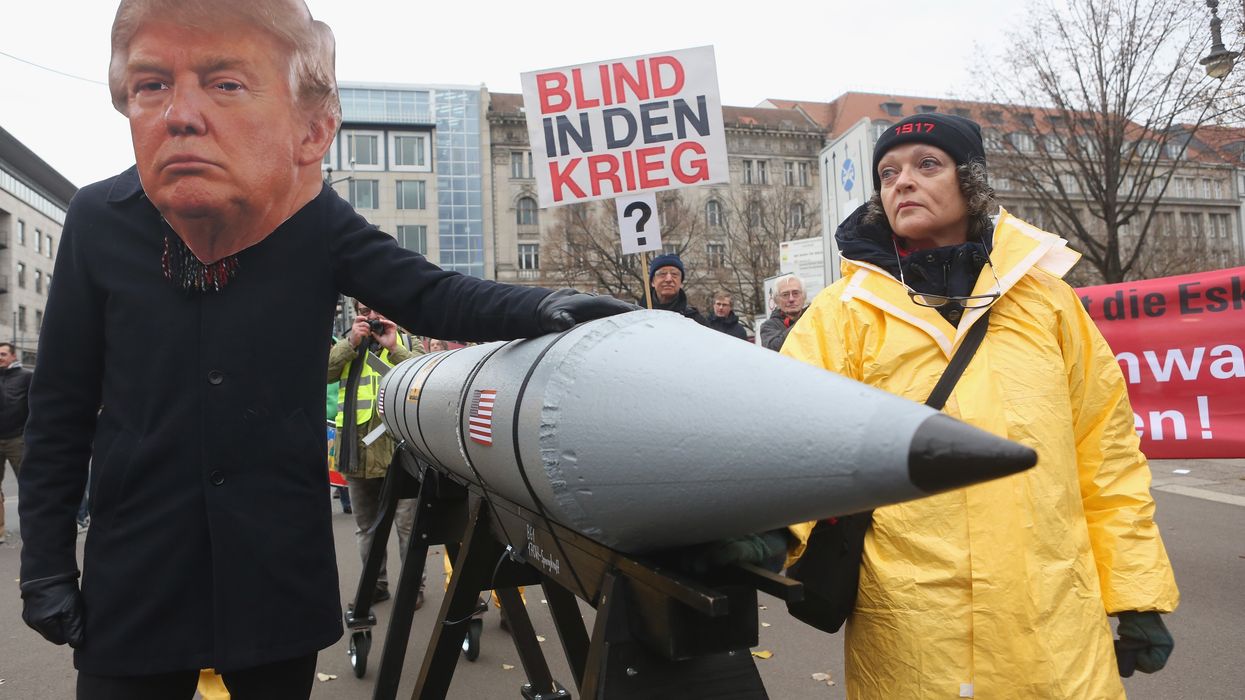
President Donald J. Trump’s “sole authority” to launch the US nuclear arsenal, which could kill billions of people and destroy life on Earth as we know it, means that he is the most powerful man ever; this should be of profound concern.
As William Perry, former secretary of defense under Bill Clinton, and Tom Collina state in The Button: “Within minutes, with just one phone call, President Trump could unleash up to a thousand nuclear weapons, each one many times more powerful than the Hiroshima bomb. It would be the end of civilization... For President Trump, starting nuclear war is about as easy as sending a tweet.”
US policy, which invests “sole authority” in the president to launch nuclear weapons, crystallizes the utter absurdity of the nuclear predicament that we have lived under for 81 years. Contrary to popular belief, there is no “button.” Instead, there is a military aide, who carries a 40-plus pound briefcase, referred to as the “nuclear football” (officially called the Presidential Emergency Satchel), which follows the president 24/7/365, whenever he is away from fixed command centers. The fact that the president can use the football to launch US nuclear weapons at any moment, day or night—without having to consult or listen to anyone—beggars belief. Clearly, the ability to start a nuclear war that could destroy most life on Earth should not be entrusted to one person, especially one known to be erratically capriciousness and highly unstable.
Inside the nuclear football is a secure communications device that allows the president to order a launch, as well as a “Black Book,” outlining pre-planned presidential options for targets, delivery systems, and estimated casualties. It originally contained a heavy set of war plans, but after Jimmy Carter complained that it was too complicated for the extremely short time frame, it was simplified into a menu of strike options for either limited strikes or full retaliation, presented as a “one-page, cartoon-like menu.” One of Clinton’s aides quipped that it was like a “Denny’s breakfast menu.”
There is also a small laminated card, called the “biscuit,” with unique codes which are used to establish the president’s identity. If the president were to decide on a nuclear launch, he would read the codes over secure communications to the National Military Command Center at the Pentagon or one of its alternates. Once authenticated, the president's will is converted into a “highly encrypted, time-sensitive message called the Emergency Action Message, which includes the authentication codes, the strike option, timing details, and the codes to unlock the weapons.” It is then transmitted by the US Strategic Command Headquarters located in a bunker under the Offutt Air Force Base in Nebraska, again by secure communication, to land-based intercontinental ballistic missile launch control centers, ballistic missile submarines, and air force strategic bombers, each with their own authentication and launch procedures. A full nuclear launch order can be executed in 5-15 minutes.
The only way to truly overcome the total absurdity of the incredibly reckless situation that we have created for ourselves during the nuclear age is to recognize the danger and to collectively “get our act together” to work toward the abolition of nuclear weapons.
Presidents often keep the biscuit in a pocket, which has presented problems: Carter inadvertently sent his to the dry cleaners in a suit pocket; Clinton lost it altogether for several months. When Ronald Reagan was taken to hospital after an assassination attempt, he was stripped of clothing and the biscuit was later found by the FBI in a hospital trash can.
Once the nuclear football is opened, the president would have less than 10 minutes to absorb the information inside, review the options, and make a decision. Other sources suggest it would be six minutes. As Reagan lamented: “Six minutes to decide how to respond to a blip on a radar scope and decide whether to unleash Armageddon? How could anyone apply reason at a time like that?”
Indeed, there have been concerns about several presidents during the nuclear age: John F. Kennedy was on heavy pain medication for back pain; Richard Nixon was drinking too much due to the strain of the Watergate investigations. (At one point, he threatened, “I can go back in my office and pick up the telephone and in 25 minutes, 70 million people will be dead.”) Lyndon B. Johnson alternated between manic energy and bouts of gloominess. At the end of their terms, Reagan had early-stage Alzheimer’s and Joe Biden’s clarity of thinking has also been questioned. But of all the 14 presidents who have been in office in the nuclear age, Trump’s stability has been the most extensively questioned. As reported by The New York Times, “Never before in modern times has the stability of a president been so publicly and forensically debated—and with such profound consequences.”
Most presidents had previous experience with nuclear issues: 9 of 14 had military experience before taking office; five served as vice president; several served in other parts of the executive branch; and more than half, in Congress. Trump had none of this prior experience.
When Trump took charge of the nuclear football for a second time in 2025, Sen. Edward Markey (D-Mass.) and Congressman Ted Lieu (D-Calif.), who had previously introduced legislation to Congress against “sole authority,” stated:
As Donald Trump returns to the White House, it is more important than ever to take the power to start a nuclear war out of the hands of a single individual and ensure that Congress’ constitutional role is respected and fulfilled. We must put guardrails on presidential authority to start nuclear war. We must never again entrust the fate of the world to just one fallible human.
Upon receiving a nuclear briefing just before their inauguration, presidents are often horrified by the awesome responsibility. Dwight D. Eisenhower was “visibly shaken”; Kennedy asked, “And we call ourselves the human race?” Carter recounted that, as president, the horror “was constantly on my mind.” George H.W. Bush stated, “I had no idea we had so many weapons... What do we need them for?” Barack Obama told a close adviser, it was “one of the most sobering experiences of my life.” Trump said, “a very sobering moment... very, very scary.” But as Perry and Collina comment, “While that statement might sound reassuring, Trump also asked, on several occasions [during his first term] ‘If we have nuclear weapons, why can’t we use them?’”
Indeed, during both terms, Trump has occasionally appeared to threaten their use. In 2017, when he and the North Korean leader, Kim Jong-un, were in a tense standoff, Trump said: “North Korea, best not make any more threats to the United States. They will be met with fire and fury like the world has never seen.” When Kim boasted that his nuclear button is “always on my table,” Trump tweeted in return, “Will someone from his depleted and food starved regime please inform him that I too have a Nuclear Button, but it is much bigger & more powerful than his, and my Button works!”
During the current ongoing war with Iran, Trump has also made a number of extremely ominous threats, the worst of which was probably on April 7 when he posted on Truth Social: “A whole civilization will die tonight, never to be brought back again.”
Following this post, Rep. Jamie Raskin (D-Md.) wrote to the White House physician on April 10, citing the above comments and requesting an evaluation of Trump due to “signs consistent with dementia and cognitive decline” and “increasingly incoherent, volatile, profane, deranged, and threatening tantrums.” No answer was received.
On April 14, Raskin submitted legislation to Congress to establish a nonpartisan “Commission on Presidential Capacity to Discharge the Powers and Duties of Office.” Such a mechanism is allowed by the 25th Amendment as an alternative to the vice president and Cabinet deciding whether the president should be removed from office (which is currently unlikely since Trump’s Cabinet members were selected because of their extreme loyalty). The legislation is still in committee.
On June 18, Raskin again wrote to the White House physician demanding that he comply with his previous request; provide a complete list of all medications and dosages; identify each of the 22 medical providers and their specialty that Trump saw during his May 26 examination at Walter Reed; and publicly release the complete results of this visit—again, without response.
Although the American Psychiatric Association’s “Goldwater Rule” forbids psychiatrists from offering public opinions about the diagnosis and mental health status of public figures they have not examined, many have argued that the rule is poorly conceived and that there is an overriding “duty to warn.” In this spirit, a group of 36 senior neurologists, forensic psychiatrists, general psychiatrists, and mental health professionals experienced in the diagnosis of cognitive disorders and evaluation of dangerousness, who had signed an earlier statement in 2024, issued an update on April 30 of this year.
They cited examples of Trump’s “marked deterioration in cognitive functioning, evidenced by disorganized and tangential speech, rambling digressions, factual confusions, unexplained sudden changes of course in strategic matters, both national and international, episodes of apparent somnolence during crucial public proceeding. Grandiose and delusional beliefs, including assertions of infallibility... claims that his decision-making authority is unlimited—with no need to consider domestic and international laws and constrained only by his ‘own morality.’ Severely impaired judgment and impulse control... Significant loss of self-control (disinhibition) and getting stuck on the same thoughts or actions, unable to let go or move on (perseveration), including seemingly compulsive, manic-like late-night communications—e.g., 150 social media posts in one night.”
They conclude:
It is our professional opinion that the behaviors of Donald Trump, tragically, are neither momentary lapses nor political theater. It is our professional opinion that they reflect a rapidly worsening, reality-untethered, increasingly dangerous decline... For the reasons cited above, emphasizing that he presents a clear and present danger to our country and to the world, it is our expert opinion that Donald J. Trump is mentally unfit to be the president of the United States, and that steps to remove him from office must be undertaken with the greatest urgency.
On six occasions since 2016, Markey and Lieu have introduced legislation entitled the Restricting First Use of Nuclear Weapons Act, which would reallocate the responsibility for launching nuclear weapons from the president to Congress when the US is not being attacked. It would require Congress to explicitly approve any first nuclear strike by the US before federal money could be spent on the attack. So far it has not been adopted.
If the Democratic Party wins a majority in the next Congress, the Markey and Lieu bill or Raskin’s bill could be passed. If the latter is adopted, the use of Article 25 might become politically possible. Alternatively, it is also remotely conceivable that Trump could be impeached, convicted, and removed from office. But the concern remains as to whether this is soon enough to spare the world the possible use of Trump’s “sole authority”—given his deteriorating cognitive abilities.
Of course, the only way to truly overcome the total absurdity of the incredibly reckless situation that we have created for ourselves during the nuclear age is to recognize the danger and to collectively “get our act together” to work toward the abolition of nuclear weapons.
As Jonathan Schell sums up in The Fate of the Earth: “The machinery of destruction is complete, poised on a hair trigger, waiting for the ‘button’ to be ‘pushed’ by some misguided or deranged human being or for some faulty computer chip to send out the instruction to fire. That so much should be balanced on so fine a point—that the fruit of four and a half billion years can be undone in a careless moment—is a fact against which belief rebels.”
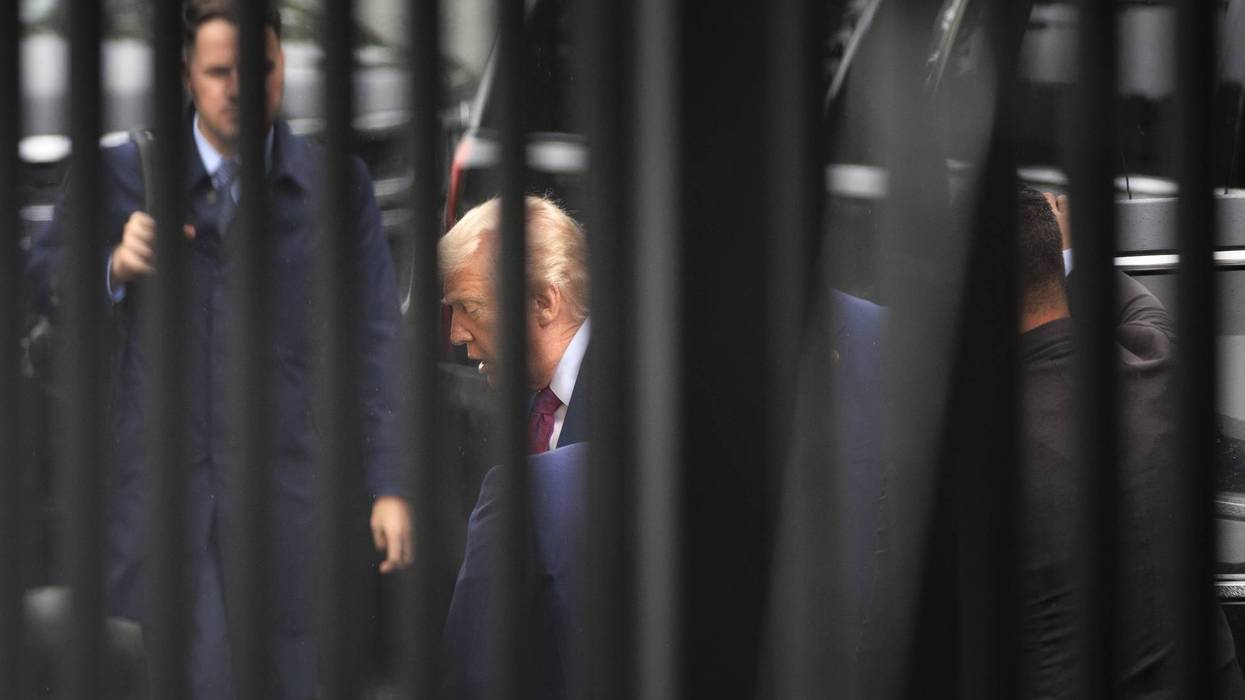
Trump is not in office despite being out of his fucking mind—he occupies the seat of supreme power precisely because he is off the charts berserk and the only people who matter in the Crumbling States of America are making bank on it.
In a famous fable a group of mice discuss the catastrophic death toll from the local cat. One mouse has an epiphany—“We simply have to put a collar with a bell on the cat, and we’ll be warned every time she draws near.” The mice erupt in celebration. But suddenly one doleful rodent interrupts the celebrants with a shy question: "Who’s going to bell the cat?"
As an avid reader of lefty alternative media essays, I would venture that “bell the cat” polemics have become a prominent strategy employed by far too many writers. We bell cats in our daydreams, and then write about it with a triumphant brushing of the hands. How many pieces have we all read that call for removing President Donald Trump via the 25th Amendment?
I, personally, am easily convinced that Donald J Trump is... uh... unfit. His twitchy little evil finger on the so-called nuclear button defines a new plateau of dystopian absurdity that no past writer of dark fiction could have ever imagined. Do we need to clarify just how close to the stroke of doomsday this vapid monster brings us daily? His genocidal intent; his criminal impulses; his senseless drivel; his delusional narcissism; his racism; his sexism; and his urge to brag, attack, and threaten ought to make him a prime candidate for a golden sunset behind bars.
Most of the calls for the 25th Amendment rather coalesce around the aesthetics of Trump’s alleged mental decline—his malapropisms; his stumbling gait; his ridiculous boasting about “acing” a dementia screening exam; his late-night posting binges of misspelled, all-caps incoherent rage; his nodding off to sleep in meetings; and the sheer sight of his grotesque, sneering, confused, melting jowls seem to be enough of an argument.
In the Numbed States of America we have gravely limited capacity to respond to extinction threats. Some atavistic fantasy of reprieve keeps people mutely indoors.
Some calls for the 25th Amendment solution merely focus on Trump’s dwindling physical health—his mysterious hospital visits; his bruises; his enormously swollen ankles; his tiny eye slits peering in a senile, comatose manner from the drooping folds of a face that precariously hovers somewhere between a living visage and a death mask.
It seems odd, however, to argue that Trump ought to be seen as a broken shell of a man, eaten from the inside by diseases associated with aging. Do we really want him removed from office because of illness, or because he has spearheaded an assault against the environment, a new age of unregulated capitalist plunder, a total commitment to eviscerate human rights, and the intent to wage war as a matter of reflexive masculinist expression? Where have US bombs fallen, and where will they imminently rain down on hapless civilians?
Are Mogadishu and Copenhagen on the list? Havana? Have we blown Cuba up yet, or is that just a coming attraction scheduled for August or November? Donald J Trump’s trembling, tiny phallic finger nuzzling the button of eternal extinction seems like a surefire image to summon massive levels of public panic, to send hysterical crowds into the streets as if the Chicxulub Meteor had been scheduled for an encore. But in the Numbed States of America we have gravely limited capacity to respond to extinction threats. Some atavistic fantasy of reprieve keeps people mutely indoors. We have guardrails, constitutional guarantees—like the oft mentioned 25th Amendment. Why go crazy in an existential panic, when the Constitution has our back?
The 25th Amendment is not some hoary remnant of our overly esteemed Founding Fathers. No such Revolutionary War icons stared wisely into the crystal ball of future contingencies, and asked the question, “What do we do when a batshit lunatic captures the presidency?” No, the Founding Fathers had not imagined a president as being anything other than a generic advocate for the interests of the wealthy—a role that carried an implicit assumption of sanity in their constitutional eyes. The 25th Amendment was passed by congress in 1965, and ratified in 1967, perhaps inspired by the unraveling, warmongering man of the moment, Lyndon Baines Johnson. But more likely, the amendment shuffled itself into the Constitution as a matter of legislative busywork, a footnote barely acknowledged at the time. The 25th gives some clarity as to when the vice president steps into a presidential role, usually for a day or two when a presidential colonoscopy creates a window of momentary confusion. Congress voted on the amendment only two years after JFK’s assassination—fearful politicians had, one imagines, a lurking sense of unpredictable events.
The 25th Amendment, however, also creates a new protocol for the permanent removal of an unfit president—the vice-president along with the members of the Cabinet must vote to toss the leader out of office with a simple majority. From there, the decision to remove an unfit president passes to both houses of Congress where a two-thirds majority of each chamber must vote to remove the spiraling executive. In other words (at least in Trump’s case), a collection of morally deformed misfits must pool their distaste for the unravelling psychopath who appointed them. And then a collection of party sycophants must rise up against the leader who fills their trembling hearts with utter terror.
Maybe you believe that Trump should be removed because he is: 1) corrupt, 2) demented, 3) insane, 4) stupid, and 5) evil. Obviously, while all of these allegations rest on mountains of evidence; none of it resonates with a single cabinet member. The 25th Amendment is not a public plebiscite. You and I might easily agree that tearing up the White House to build a ballroom-bomb-shelter for a nuclear fetishizing war criminal might be an awful idea. But so what? The 25th Amendment is a private matter, a means of protection for the ruling class. If a president goes cuckoo for coco-puffs, the oligarchs can set things right. One might aptly assume that none of Trump’s shenanigans trouble the billionaire class.
So you and I do not get a vote according to 25th Amendment protocol. Here is an abbreviated list of those authorized to vote: 1) RFK Jr., 2) Linda McMahon, 3) Howard Lutnick, 4) Doug Burgum, 5) Chris Wright, 6) Pete Hegseth, 7) Marco Rubio... and so forth. If you believe that any of these names might vote to remove Trump, I suggest that you hurry (if you still have medical insurance) to take The Montreal Cognitive Assessment.
Trump is not in office despite being out of his fucking mind—he occupies the seat of supreme power precisely because he is off the charts berserk. The only people who matter in the Crumbling States of America make bank on Trump’s presidency. The oil executives, nuclear weapons manufacturers, planet destroying Big Tech moguls, insurance profiteers, and chemical poisoners are carving up the Earth like famished vultures alighting on a putrid carcass. If these predators don’t care about Trump’s decaying brain, it really doesn’t matter what you and I believe.
There is a means of removal—a real one, not a self-indulgent fantasy. It is called The 3.5% Rule, a theory that argues that regime change requires massive resistance involving 3.5% of the population taking to the streets until a resolution has been reached. It involves daily mobilization, not a two hour street festival every two months. In the US that means at least 11 million angry, undeterred resistors willing to endure a measure of personal inconvenience. It involves blocking traffic, getting arrested, boycotts, strikes, and international connections. We should be calling for foreign nationals to boycott and divest from US corporations. Or we can day dream about the 25th Amendment until Trump dies and hands over the throne to JD Vance.
As a general theme, we US citizens have far too much faith in alleged democratic process, and far too little passion for collective agency.
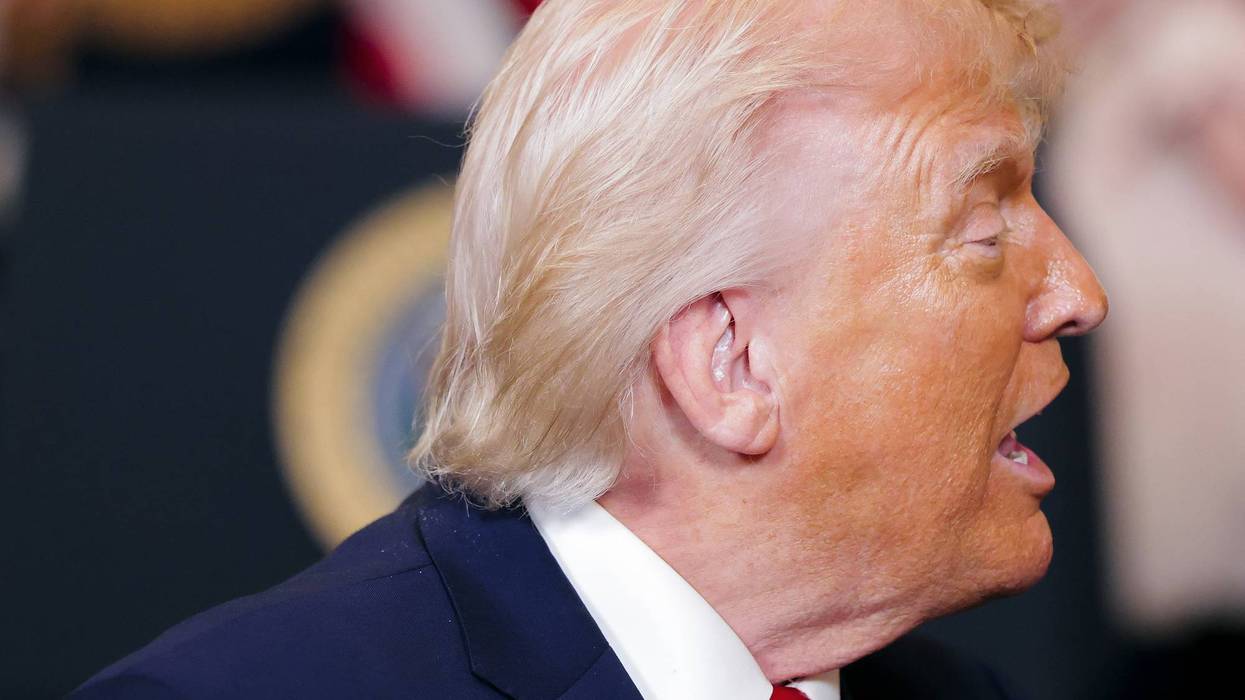
Instead of looking for a magic bullet in the Constitution to bring Trump down, progressives and anti-Trumpers should concentrate on building a lasting, broad-based, and genuine pro-democracy movement.
The United States Constitution provides two paths for removing a sitting president from office: impeachment and the procedures outlined in the 25th Amendment. Both approaches are being raised again, and with increasing fervor, as ways to bring an early end to Donald Trump’s second term of chaos, incompetence, and corruption. Both are clearly warranted, but structural hurdles built into both render them legally infeasible.
Instead of looking for a magic bullet in the Constitution to bring Trump down, progressives and anti-Trumpers should concentrate on building a lasting, broad-based, and genuine pro-democracy movement. Impeachment hearings and calls for invoking the 25th can play a role in that process, but only an ancillary one.
Here’s why.
The Founding Fathers were well aware of the dangers of unbridled one-man rule. Along with removing the yoke of King George III, they sought to prevent the rise of homegrown tyrants driven by ambition, greed, and vanity.
In a rational country with leaders committed to the rule of law, the resolution would swiftly lead to Trump’s demise. But we are not that country today.
At the Constitutional Convention in 1787, after prolonged debate about the extent of presidential powers and whether the new federal charter should include a provision authorizing the impeachment and removal of the president, the delegates adopted the now-famous clause inscribed in Article II, Section 4 of the Constitution that provides, “The President, Vice President, and all civil Officers of the United States, shall be removed from Office on Impeachment for, and Conviction of, Treason, Bribery, or other high Crimes and Misdemeanors.”
To strike a balance between a strong chief executive and what the antifederalists dreaded would eventually devolve into monarchy, they created a two-step process for impeachment. As set forth in Article I of the Constitution, the House of Representatives holds the sole power of impeachment, akin to a grand jury’s authority to return an indictment against a criminal defendant. A simple majority vote is all that is needed to accuse federal officers of committing an impeachable act and send their cases to the Senate, which is given the sole power to try cases of impeachment. In the upper chamber, however, a two-thirds vote (67 senators today if all are present) is needed to sustain a guilty verdict and remove a defendant from office.
As it was designed to do, the two-thirds requirement has drastically curtailed the frequency and impact of impeachment. Including Trump, only 21 federal officials have been impeached in our history. Fifteen were judges, two were Cabinet members, and one was a senator. The other three were presidents—Andrew Johnson in 1868, Bill Clinton in 1998, and Trump in 2019 and 2021. All were acquitted by the Senate. To date, there have only been eight impeachment convictions, all handed down against federal judges.
Trump is often compared to Richard Nixon for his abuse of power, ruthlessness, paranoia, and relentless pursuit of revenge against real and imaginary enemies. Both men have also been accused of believing in the “madman theory” of the presidency—the idea that if the president appears to be temperamentally extreme and unhinged, he will be seen as willing to do anything, no matter how vile or illegal, to impose his will.
But the conventional thinking that Trump will eventually suffer Nixon’s fate has been proven wrong. The Republican Party of the 1970s was tethered to constitutional governance. Today’s GOP has degenerated into a neofascist political cult. Trump has given the party control of all three branches of government, and he has given party leaders permission to be the most authoritarian versions of themselves. The party did not abandon Trump even when presented with overwhelming evidence in his second impeachment trial that he had incited the January 6 insurrection. There is no reason to believe it will abandon him now.
Still, hope springs eternal. On April 6, Democratic Rep. John Larson of Connecticut introduced a resolution to initiate impeachment proceedings against Trump. Drafted by Ralph Nader and constitutional scholar Bruce Fein, the resolution consists of 13 articles that charge Trump with, among other derelictions, violating Congress’ war powers by unconstitutionally initiating wars as a belligerent or co-belligerent against Iran, Venezuela, Yemen, Lebanon, Syria, Nigeria, and Gaza; militarizing domestic law enforcement with deployments of the National Guard; and using Immigration and Customs Enforcement to racially profile citizens and suspected immigrants.
In a rational country with leaders committed to the rule of law, the resolution would swiftly lead to Trump’s demise. But we are not that country today.
Ratified in 1967, the 25th Amendment was drafted in the aftermath of the assassination of John F. Kennedy to clarify the law of succession when the president becomes disabled. According to the first paragraph of Section 4 of the amendment:
Whenever the Vice President and a majority of either the principal officers of the executive departments [the Cabinet] or of such other body as Congress may by law provide, transmit to the President pro tempore of the Senate and the Speaker of the House of Representatives their written declaration that the President is unable to discharge the powers and duties of his office, the Vice President shall immediately assume the powers and duties of the office as Acting President.
As Trump continues to unravel, invoking Allah in threats to obliterate Iranian civilization and attacking the pope as too liberal and weak on crime, calls to invoke Section 4 have accelerated. But Section 4 is an even weaker remedy than impeachment.
The second and final paragraph of Section 4 instructs that the president can attempt to override a declaration of disability by notifying the Senate and House leadership that no such disability exists. Thereafter, the vice president, with the support of either a majority of the Cabinet or “the other body” of the first paragraph, can contest the president’s override. To resolve the conflict and place the vice president in charge, a two-thirds vote of both houses of Congress—not just the Senate—is required to confirm that the president is, in fact, “unable to discharge the powers and duties of his office.”
The procedures outlined in Section 4 have never been invoked, and it strains credulity to think they will be used against Trump as long as JD Vance is the vice president and the Cabinet is staffed by sycophants and grifters who routinely pledge their loyalty to their dear leader.
This is not to say that agitating for impeachment or calling for Trump’s removal on 25th Amendment grounds is pointless. But we should not view the avenues for forcing Trump’s early exit as ends in themselves. Rather, they are best seen as organizing tools that can be useful in drawing Americans into a broad-based movement to restore democracy. In Hungary last week, 16 years of authoritarian rule ended with the defeat of Viktor Orbán. It can and must happen here.
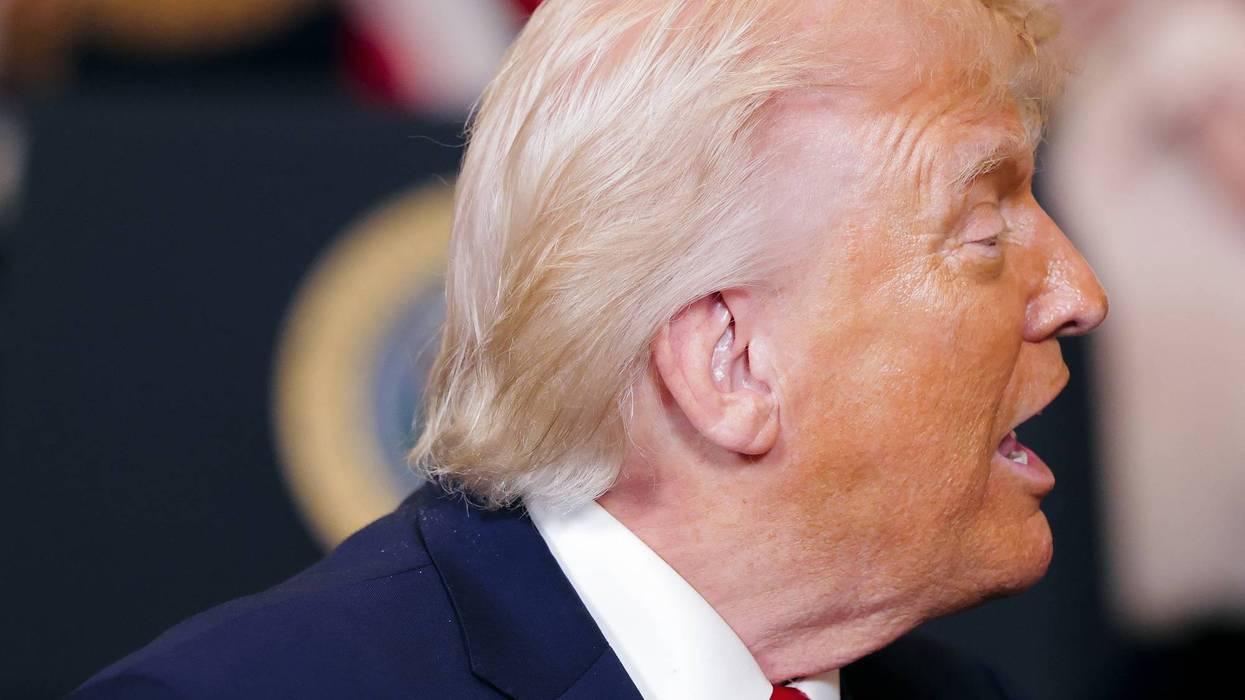
He’s been losing it for a while now, but in the last few months it’s become far worse.
It’s a catastrophe on the way to becoming a cataclysm.
Trump is rapidly going stark-raving mad. He’s a clear and present danger to the United States and the world.
Earlier this week he lashed out at The New York Times after its chief White House correspondent questioned his mental health and stability and pointed to his “erratic behavior and extreme comments.”
“HAVE THEY NO SHAME? HAVE THEY NO SENSE OF DECENCY?” Trump posted in CAPITAL LETTERS about the Times, inadvertently echoing the famous words of Joseph Welch when standing up to Joseph McCarthy during the Army-McCarthy hearings of 1954. Trump went on to take issue with the Times’s coverage of his war in Iran rather than his mental state, as if to prove the Times’s point.
He keeps saying he’s “won” the war with Iran, although he’s never said what “winning” means. At one moment his goal is to free Iran’s people. At another, it’s to end Iran’s capacity to produce a nuclear weapon. At another, to destroy Iran’s missiles. At another, to achieve “regime change.” At another, to open the Strait of Hormuz (which was open before Trump started his war). At another, he says he’ll know the U.S. military operation in Iran is over when he feels it "[in] my bones.”
We are all endangered. What happens if, in a demented rage, he hurls a nuclear bomb? Who is watching the “football” with the nuclear codes? Who’s ready to stop him to save the world?
He can’t even stay on the same subject for more than a few minutes. In the middle of a high-level Cabinet meeting about the war, he spends five minutes talking about his preference for Sharpie pens. He interrupts another Iran war update to praise the White House drapes.
He threatens that if Iran doesn’t reopen the strait, “a whole civilization will die tonight.” Then he says America doesn’t need the strait reopened. Then he says: “Open the Fuckin’ Strait, you crazy bastards, or you’ll be living in Hell - JUST WATCH! Praise be to Allah. President DONALD J. TRUMP.”
He calls the Pope “WEAK on Crime, and terrible for Foreign Policy” because the Pope wants peace. He posts an AI-generated picture of himself as Jesus, then says he was only depicting himself as a physician.
He won’t give up on his illegal and dangerous (for the economy) criminal investigation of Fed Chief Jerome Powell, claiming it’s not just about Powell’s renovations at the Fed but also a “probe on incompetence,” adding he’ll fire Powell if he doesn’t resign after his term as chair ends.
He claims that the United States “needs” Greenland. He confuses Greenland with Iceland. He says whales are being killed by windmills. He claims that he won all 50 states in 2020. That he defeated Barack Obama in 2016. He says the former chair of the Joint Chiefs of Staff should be executed. He goes on an eight-minute ramble about poisonous snakes in Peru. He boasts of ending a fictional war between Cambodia and Armenia.
After Robert Mueller’s death, he says, “Good, I’m glad he’s dead.” He blames the murders of Rob Reiner and his wife Michelle on “the anger [Rob Reiner] caused others through his massive, unyielding, and incurable affliction with a mind crippling disease known as TRUMP DERANGEMENT SYNDROME.” After Joe Biden is diagnosed with an aggressive form of Stage 4 prostate cancer, Trump says, “I’m surprised that the public wasn’t notified a long time ago because to get to Stage 9, that’s a long time” (there is no Stage 9 cancer).
He’s been losing it for a while now, but in the last few months it’s become far worse.
In 2017, 27 psychiatrists, psychologists, and other mental health professionals concluded in The Dangerous Case of Donald Trump that Trump’s mental condition posed a “clear and present danger” to the nation.
In 2021, members of Trump’s own Cabinet — horrified by the January 6, 2021, violence at the Capitol and Trump’s lack of urgency in stopping it — discussed whether to invoke the 25th Amendment to remove him from office due to mental incompetence.
During his 2024 campaign, he attacked Kamala Harris and then went into the stratosphere of his bonkers mind:
“She destroyed the city of San Francisco, it’s – and I own a big building there – it’s no – I shouldn’t talk about this, but that’s OK, I don’t give a damn because this is what I’m doing. I should say it’s the finest city in the world – sell and get the hell out of there, right? But I can’t do that. I don’t care, you know? I lost billions of dollars, billions of dollars. You know, somebody said, ‘What do you think you lost?’ I said, ‘Probably two, three billion. That’s OK, I don’t care.’ They say, ‘You think you’d do it again?’ And that’s the least of it. Nobody. They always say, I don’t know if you know. Lincoln was horribly treated. Uh, Jefferson was pretty horribly. Andrew Jackson, they say, was the worst of all, that he was treated worse than any other president. I said, ‘Do that study again, because I think there’s nobody close to Trump.’ I even got shot! And who the hell knows where that came from, right?”
It’s no longer possible to overlook his conspiracy-obsessed paranoia, his uncontrolled rage, his emotional volatility, his delusional claims, his vengeful rantings, his foul-mouthed posturing, his increasing detachment from reality.
Yet his Cabinet members and aides keep their heads down. Republican members of Congress pretend not to notice. His billionaire supporters dare not speak of his rapid decline. The media tries to “sanewash” his growing incoherence.
But some voices on the right — people who have long been supporters of Trump — have had enough.
Former Representative Marjorie Taylor Greene says Trump’s threat to destroy Iran’s civilization is “not tough rhetoric, it’s insanity.” Far-right podcaster Candace Owens calls him “a genocidal lunatic.” Conspiracy theorist Alex Jones says Trump “does babble and sounds like the brain’s not doing too hot.” A White House lawyer in Trump’s first term, Ty Cobb, says Trump is “clearly insane.” Former Trump White House press secretary Stephanie Grisham says “he’s clearly not well.”
The public is catching on. Fully 61 percent of Americans think he’s become more erratic with age, while just 45 percent say he is “mentally sharp and able to deal with challenges” (down from 54 percent in 2023).
For the good of the nation and the world, it’s time we face the reality: The most powerful man in the world does not have the mental capacity to do the job. Donald Trump — who has a family history of dementia — is increasingly unhinged.
We are all endangered. What happens if, in a demented rage, he hurls a nuclear bomb? Who is watching the “football” with the nuclear codes? Who’s ready to stop him to save the world?
Don’t wait. Impeach him now.
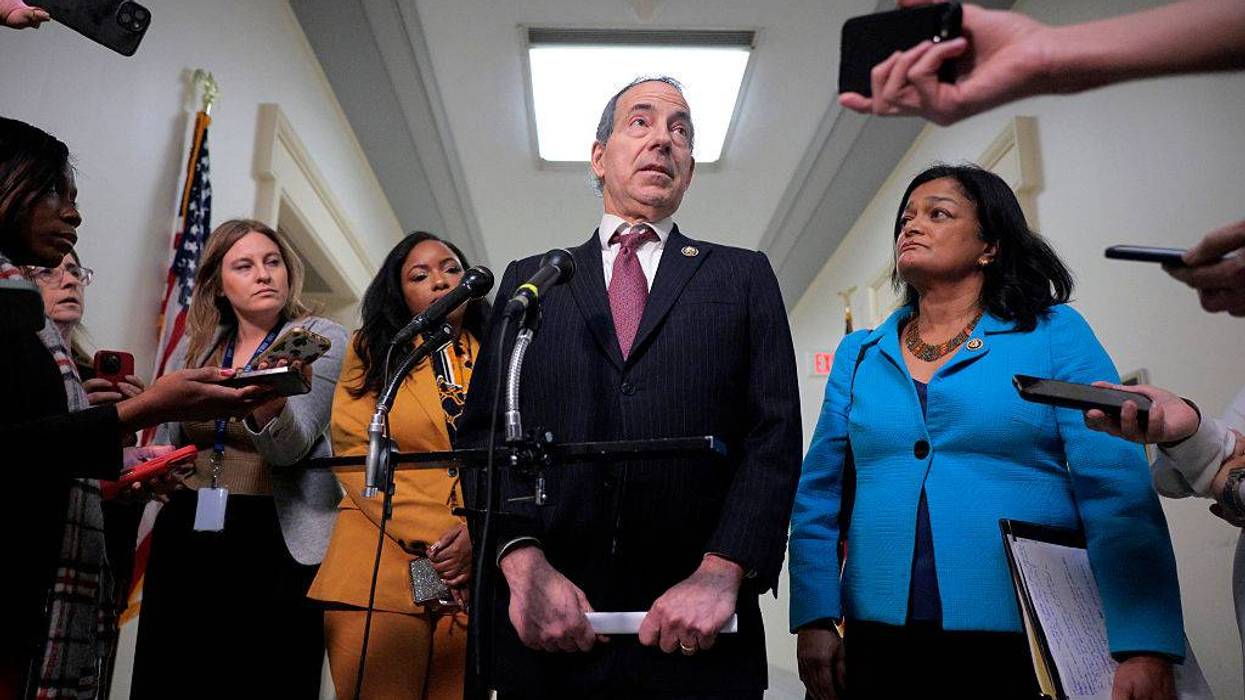
"We have a solemn duty to play our defined role under the 25th Amendment by setting up this body to act alongside the vice president and the Cabinet."
Rep. Jamie Raskin (D-Md.) on Tuesday unveiled legislation that would establish a congressional commission tasked with determining whether the president is able to continue executing the duties of the office.
The bill, titled the Commission on Presidential Capacity Act, would also set up "expedited" emergency procedures under which Congress could activate the newly created commission and fast-track its consideration of presidential fitness.
As envisioned by Raskin, this commission would act as a legislative counterpart to the US vice president and the president's Cabinet, which the text of the 25th Amendment grants the power to declare the president incapacitated. The 25th Amendment also gives that power to a majority "of such other body as Congress may by law provide."
"The Constitution explicitly vests Congress with the authority to create a body that will guarantee the successful continuity of government by responding to presidential incapacity to discharge the powers and duties of office," said Raskin. "We have a solemn duty to play our defined role under the 25th Amendment by setting up this body to act alongside the vice president and the Cabinet."
Raskin pointed to Trump's recent erratic behavior to argue that Congress needed to take a more assertive role in determining whether he has the mental capacity to serve in the most powerful office in the federal government.
"Public trust in Donald Trump’s ability to meet the duties of his office has dropped to unprecedented lows," the Maryland Democrat said, "as he threatens to destroy entire civilizations, unleashes chaos in the Middle East while violating Congressional war powers, aggressively insults the pope of the Catholic Church, and sends out artistic renderings online likening himself to Jesus Christ."
Raskin went on to warn that "we are at a dangerous precipice, and it is now a matter of national security for Congress to fulfill its responsibilities under the 25th Amendment to protect the American people from an increasingly volatile and unstable situation."
Fifty House Democrats signed on as original co-sponsors of Raskin's bill, which is unlikely to pass the Republican-controlled US House of Representatives.
Calls for invoking the 25th Amendment to remove Trump from office grew louder last week after Trump declared that "a whole civilization will die tonight, never to be brought back again," unless Iran agreed to meet his demands.
In a letter sent to congressional leaders on Monday, four psychiatrists warned that Trump's "behavior and rhetoric... have crossed a threshold that demands the immediate and bipartisan attention of Congress."
The psychiatrists added that Trump "exhibits what forensic mental health experts have, across dozens of independent assessments, identified as the 'Dark Triad' of personality traits: narcissism, Machiavellianism, and psychopathy."
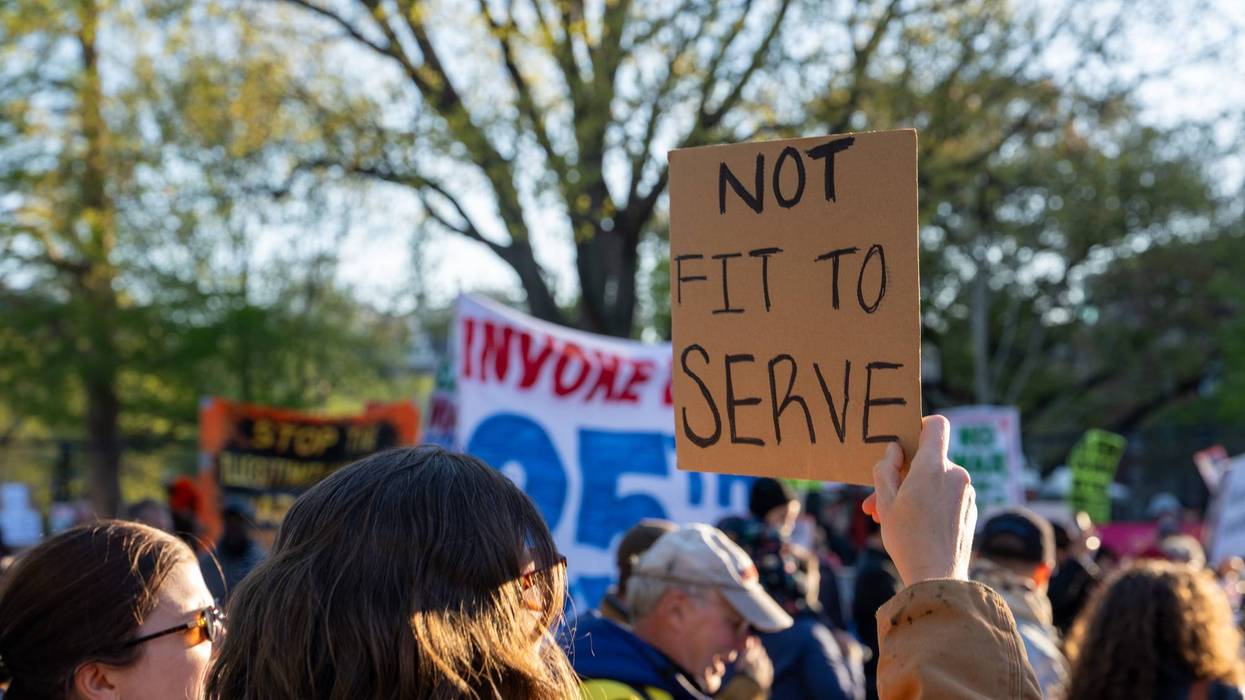
“We recognize the gravity of what we are asking. We ask it because the gravity of the situation demands it."
A group of four psychiatrists warned congressional leaders on Monday that US President Donald Trump has recently exhibited "every behavioral sign of a personality in acute crisis," presenting a "constitutional emergency" that demands immediate action from lawmakers and members of the administration.
In a letter to the top Republican and Democratic lawmakers in both chambers of Congress, the psychiatrists and Columbia University professor Jeffrey Sachs—who helped organize the letter—pointed to Trump's recent genocidal threats to wipe out Iran's "whole civilization" and bomb the country "back to the stone ages" as examples of rhetoric that has "crossed a threshold."
"President Trump exhibits what forensic mental health experts have, across dozens of independent assessments, identified as the 'Dark Triad' of personality traits: narcissism, Machiavellianism, and psychopathy," the letter states. "Rather than constituting a clinical diagnosis, this trait-based assessment is grounded in behavioral observation and is particularly useful for assessing the level of danger an individual poses in a political leadership position. We do not offer this as a clinical verdict. We offer it as the considered judgment of a substantial body of professional opinion, based on well-researched evidence that is consistent, accumulating, and impossible to dismiss."
The psychiatrists who signed the letter are James Gilligan, clinical professor of psychiatry at New York University; Prudence Gourguechon, former president of the American Psychoanalytic Association and former vice president of the World Mental Health Coalition; Bandy Lee, president of the World Mental Health Coalition and former professor at Yale School of Medicine; and James Merikangas, clinical professor of psychiatry and behavioral science at George Washington University.
The experts' letter came amid growing calls from congressional Democrats for Trump's removal from office, whether through the impeachment process or the pathways offered by the 25th Amendment.
The psychiatrists stop short of demanding Trump's immediate removal. Rather, they urge Congress to reestablish its constitutional authority over war in response to the president's unauthorized assault on Iran; convene "urgent consultations" with top administration officials to prevent Trump from escalating "toward catastrophe, including the potential use of nuclear weapons"; and "formally initiate consultation" with Vice President JD Vance and Cabinet members "regarding the president’s fitness for office under Section 4 of the 25th Amendment."
"We recognize the gravity of what we are asking. We ask it because the gravity of the situation demands it," the letter states. "A president who publicly threatens to destroy a foreign civilization, who launches a bombing campaign and then imposes a naval blockade without congressional authorization, and who shows every behavioral sign of a personality in acute crisis is not merely a political problem. He is a constitutional emergency. The mechanisms for addressing such an emergency exist. They were placed in the Constitution and its amendments for moments precisely like this one."
The letter was released days after Rep. Jamie Raskin (D-Md.), the top Democrat on the House Judiciary Committee, wrote to White House physician Sean Barbabella requesting an "immediate and comprehensive cognitive and neurological evaluation of President Donald Trump, along with full public disclosure of the findings," in response to his "increasingly volatile, incoherent, and alarming public statements," specifically regarding the war on Iran.
"This is plainly out of the realm of normal politics," Raskin wrote. "When the president of the United States threatens to extinguish a civilization on social media, rants about combat missions with children at the Easter Egg Roll, and drops profane tirades on Easter morning, we have indisputably entered the realm of profound medical difficulty and concern."

President Trump exhibits what forensic mental health experts have identified as the “Dark Triad” of personality traits: narcissism, Machiavellianism, and psychopathy. What this represents is a constitutional emergency.
Editor's note: The following letter was sent to the bipartisan leadership of Congress on Monday, April 13, 2026 in regard to recent rhetoric and actions taken by US President Donald J. Trump.
Senator John Thune
Senate Majority Leader, US Senate
Senator Charles E. Schumer
Senate Minority Leader, US Senate
Representative Mike Johnson
Speaker of the House, USHouse of Representatives
Representative Hakeem Jeffries
House Minority Leader, US House of Representatives
Dear Senate Majority Leader Thune, Senate Minority Leader Schumer, Speaker Johnson, and House Minority Leader Jeffries:
We write to you today with a sense of urgency that we do not use lightly. The behavior and rhetoric of President Donald Trump have crossed a threshold that demands the immediate and bipartisan attention of Congress. This is not a partisan assessment. It is a judgment grounded in observable fact, consistent professional assessment, and the constitutional responsibilities that your offices carry.
President Trump exhibits what forensic mental health experts have, across dozens of independent assessments, identified as the “Dark Triad” of personality traits: narcissism, Machiavellianism, and psychopathy. Rather than constituting a clinical diagnosis, this trait-based assessment is grounded in behavioral observation and is particularly useful for assessing the level of danger an individual poses in a political leadership position. We do not offer this as a clinical verdict. We offer it as the considered judgment of a substantial body of professional opinion, based on well-researched evidence that is consistent, accumulating, and impossible to dismiss.
What makes this more than an academic matter is what predictably happens when this personality structure collides with immovable obstacles. The clinical literature is clear: individuals with Dark Triad profiles, when confronted with situations they cannot control or escape, do not recalibrate. They escalate. The psychological imperative to relieve narcissistic collapse overrides strategic calculation, concern for consequences, and ordinary self-restraint. Rage surges to domination. Impulsivity overrides caution. The urgent need to extinguish psychological pain eclipses every other consideration.
We are watching this dynamic unfold in real time.
The President’s recent public communications have been, by any normal standard of political discourse, alarming. His posts demanding that Iran “open the fuckin’ strait, you crazy bastards” and his threat to bomb Iran “back to the stone ages,” adding that “a whole civilization will die tonight, never to be brought back again,” are not the rhetoric of calculated geopolitical pressure. They are the expressions of a man in profound psychological distress who is reaching for the most extreme retaliatory threats available to him. That these statements were addressed to an adversary in the context of an active military confrontation makes them not merely shocking but profoundly dangerous.
President Trump has now ordered a US naval blockade of Iran — an action that has sent world oil prices soaring and placed the United States in direct opposition to the international community. His ongoing actions carry the potential to trigger a global economic catastrophe, draw in regional and great powers, and ignite a wider conflict with consequences that no one can bound. These orders are being issued without adequate deliberation, without congressional authorization, and in a context in which the President’s judgment is, by every visible measure, severely compromised.
We urge three specific actions.
First, Congress must immediately retake its constitutional authority over war. The bombing of Iran and the initiation of a naval blockade — acts of war under both US and international law — cannot be authorized by presidential fiat. Article I of the Constitution vests in Congress the sole power to declare war and to regulate commerce with foreign nations. The Framers intended Congress to deliberate upon and be accountable for precisely such consequential actions. Congress must assume its constitutional authority now, before further escalation renders the question moot.
Second, congressional leadership — on a bipartisan basis — must convene urgent consultations with senior administration officials, including the Secretary of Defense, the Chairman of the Joint Chiefs, the Secretary of State, and the Director of National Intelligence. The purpose is not routine oversight. It is to create a circuit breaker capable of preventing escalation toward catastrophe, including the potential use of nuclear weapons. Those officials have their own constitutional and statutory obligations. Congress should insist on those obligations and provide a forum in which they can be exercised.
Third, Congress should formally initiate consultation with the Vice President and Cabinet regarding the President’s fitness for office under Section 4 of the Twenty-Fifth Amendment. We do not prejudge the outcome. We are not calling for the President’s immediate removal. We are calling for the process that the Constitution itself provides for this contingency: when a President’s capacity to discharge the duties of office is in question and poses a potential imminent danger to the nation. The Amendment exists because those who drafted it recognized that the question of presidential incapacity would occasionally arise, and that it required a constitutional answer rather than a political improvisation.
He is a constitutional emergency. The mechanisms for addressing such an emergency exist. They were placed in the Constitution and its amendments for moments precisely like this one.
We recognize the gravity of what we are asking. We ask it because the gravity of the situation demands it.
A President who publicly threatens to destroy a foreign civilization, who launches a bombing campaign and then imposes a naval blockade without congressional authorization, and who shows every behavioral sign of a personality in acute crisis is not merely a political problem. He is a constitutional emergency. The mechanisms for addressing such an emergency exist. They were placed in the Constitution and its amendments for moments precisely like this one.
The war with Iran will not wait. The escalation dynamics of this active military confrontation will not wait. The psychological conditions driving the President’s decisions will not improve under pressure — they will worsen.
We urge you to act without delay. The Constitution gives you the tools. Your oath of office assigns you the responsibility.
Respectfully,
James Gilligan, M.D.
Clinical Professor of Psychiatry, New York University School of Medicine
Adjunct Professor of Law, New York University School of Law
Former Faculty of Psychiatry, Harvard Medical School
Former President, International Association of Forensic Psychotherapy
Prudence L. Gourguechon, M.D.
Former President, American Psychoanalytic Association
Former Vice President, World Mental Health Coalition
Bandy X. Lee, M.D., M.Div.
President, World Mental Health Coalition
Co-Founder, Preventing Violence Now
Former Faculty of Social Medicine, Harvard Medical School
Former Faculty of Law and Psychiatry, Yale School of Medicine
James R. Merikangas, M.D.
Clinical Professor of Psychiatry and Behavioral Science, George Washington University
Research Consultant, National Institute of Mental Health
Co-Founder, American Neuropsychiatric Association
Former President, American Academy of Clinical Psychiatrists
Jeffrey D. Sachs, Ph.D.
University Professor, Columbia University

The president of the United States is stark-raving mad. He’s a clear and present danger to America and the world. We’ve got to do whatever we legally can to remove him from office. And that means organizing without a moment to lose.
Speaking at a January 6 retreat for House Republicans, Trump stated, “You gotta win the midterms ‘cause, if we don’t win the midterms, it’s just gonna be — I mean, they’ll find a reason to impeach me. I’ll get impeached.”
This was before Trump’s agents murdered Renee Good and Alex Pretti in Minneapolis, before the Justice Department released more Epstein files, before Trump’s disastrous war in Iran, before Trump threatened death to the entire Iranian civilization, before a gallon of gas hit $4 or more, before other prices also began rising because of the blockage of the Strait of Hormuz, and before additional price hikes associated with Trump’s tariffs had kicked in.
It was also before Trump’s polls slid to record lows, before the MAGA faithful began complaining that Trump had betrayed his promise to avoid foreign entanglements, and before a slew of special elections in which Democratic candidates have won Republican districts (and even when they didn’t win, lost by far smaller margins than Trump won by in 2024).
Until recently I thought impeaching Trump and convicting him in the Senate was a pipe dream. I was concerned that even talk of impeachment at this stage might distract attention from the affordability crisis brought on by Trump and could even fortify Republican charges of Democratic “extremism.”
No longer.
The president of the United States is stark-raving mad. He’s a clear and present danger to America and the world. The American public is beginning to see it.
We’ve got to do whatever we legally can to remove him from office. The 25th Amendment would be useful if Trump’s Cabinet and key advisers had any integrity, but they don’t. They’re ambitious, unprincipled traitors.
Which leaves impeachment.
You may be skeptical. After all, he’s already been impeached twice, to no avail. How can the third time be the charm?
Until recently I thought impeaching Trump and convicting him in the Senate was a pipe dream.... No longer.
Because it seems likely that Democrats will retake control of the House and the Senate in this fall’s midterm elections (unless Trump prevents free and fair elections).
And because it’s also possible that there will be enough votes in the Senate starting next January to convict Trump of impeachable offenses and send him packing.
I understand how difficult this may seem. Both times Trump was impeached in the House, he was saved by the Constitution’s requirement that two-thirds of the Senate (67 senators, assuming all 100 are present) convict in order to remove a president.
The highest Senate vote count against Trump came in 2021, and it was 10 votes short of the constitutional requirement. Fifty-seven senators, including seven Republicans, voted to convict him of inciting an insurrection at the U.S. Capitol. It was the most bipartisan impeachment vote in U.S. Senate history, but it still fell well short of the 67 votes needed to convict Trump.
So why do I think it’s possible now? Because public sentiment has swung further against Trump now than it was in 2021. And it’s likely to swing even further against him, because he’s going out of his mind at a rapid rate.
The way to accomplish this is to defeat enough incumbent Republican senators who are up for reelection in 2026 to create a Democratic majority in that chamber, totaling some 54 votes, and pressure at least 13 Republicans up for reelection in 2028 to vote to convict him.
That’s not impossible. In the upcoming midterms it’s likely that Maine Republican Senator Susan Collins will be replaced by a Democrat (either Janet Mills or Graham Platner). I also assume that former North Carolina Governor Roy Cooper will replace Republican Senator Thom Tillis, who’s retiring.
And I’d like to believe that the good people of Ohio will see the light and reelect Sherrod Brown over Jon Husted, the dullard who was appointed to fill the remainder of JD Vance’s term.
James Talarico could take the Texas Republican Senate seat now occupied by John Cornyn. In Alaska, I’d put odds on Mary Peltola defeating incumbent Republican Senator Dan Sullivan. In Nebraska, assume that Dan Osborn prevails over incumbent Republican Senator Pete Ricketts. And so on.
Republican senators last elected in 2022 who will be on the ballot in November 2028 include some who are vulnerable because they’re in swing states, such as North Carolina’s Ted Budd and Wisconsin’s Ron Johnson; or are in states that could be competitive, such as Indiana’s Todd Young; or are vulnerable to internal party shifts, such as Louisiana’s John Kennedy and South Carolina’s Tim Scott.
Those vulnerabilities mean that their constituents could push them to vote to convict Trump in an impeachment, or else threaten to vote against them in 2028.
So it’s possible to get the 67 Senate votes, my friends. And it’s absolutely necessary that we try.
The vast No Kings demonstrations should be considered a prelude to targeting enough Republican Senate incumbents and open races to flip the Senate this fall, and pressuring Republicans up for reelection in 2028 to do their constitutional duty.
Now is the time to show the size and intensity of America’s commitment to removing Trump from office, for the good of us all.
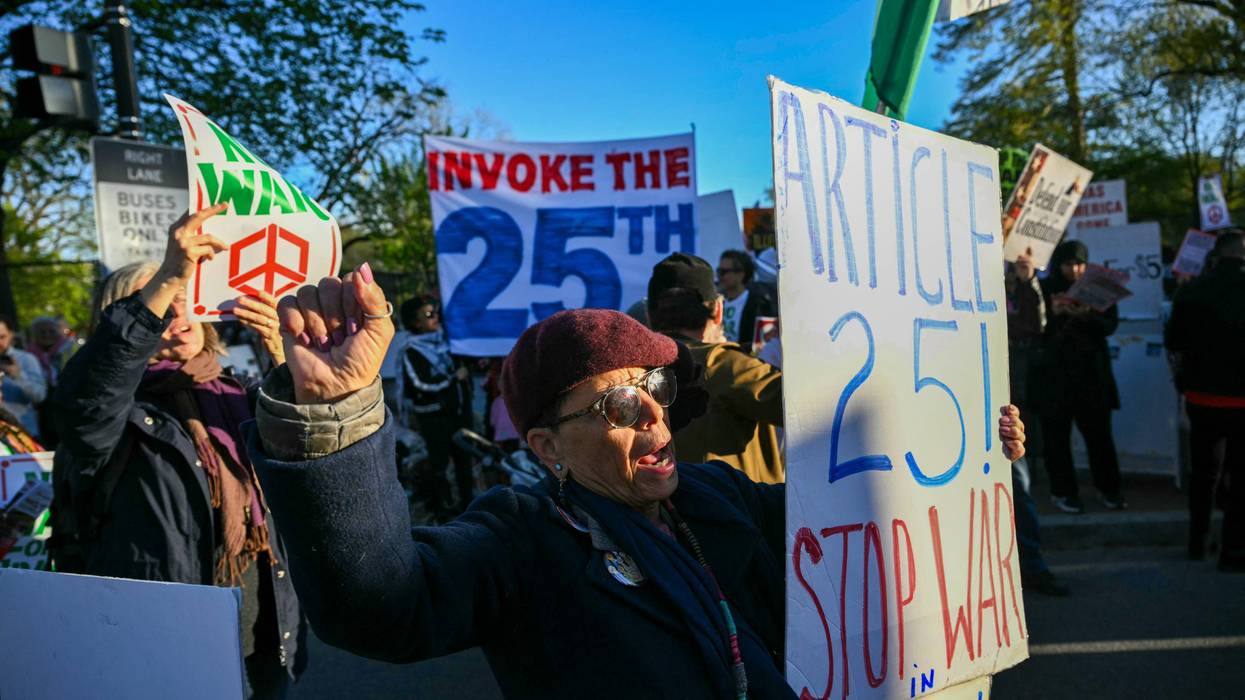
The cost of inaction is simply too high.
Come senators, congressmen
Please heed the call
Don’t stand in the doorway
Don’t block up the hall…
―Bob Dylan
A shaky two-week truce; we’ve temporarily slipped from the hangman’s noose. There’s still a madman president on the loose.
We are living in an Upside Down moment, and the danger is no longer metaphorical. You don’t need to have watched Stranger Things to recognize that the threat is real, not lurking in another dimension. It’s prowling in the White House, and no blinking lights are spelling out SOS.
This is what an Upside Down world looks like: a president openly threatening catastrophic violence against another nation’s civilian infrastructure, while those with the constitutional authority to stop him hesitate, equivocate, or remain silent.
No matter what happens next, history will remember: On Easter Sunday 2026, Donald Trump posted a message so reckless, so unhinged, that it would be disqualifying in any functioning democracy. Threatening the destruction of Iran’s power plants and bridges, invoking apocalyptic language, and wrapping it all in bravado, he revealed not just poor judgment but a fundamental disregard for human life and the rule of law. Two days later, this warning: “A whole civilization will die tonight, never to be brought back again. I don’t want that to happen, but it probably will.”
The response was immediate—but not where it matters most.
Sen. Chris Murphy, the Democrat from Connecticut, spoke out about the Easter threat. If he were in Trump’s Cabinet, Murphy said he would be calling constitutional lawyers about invoking the 25th Amendment. Others echoed the alarm. Even some of Trump’s most reliable allies on the far right voiced scathing criticism.
For a brief moment, it seemed possible that outrage might translate into action. But it hasn’t...yet.
There is no credible evidence that the vice president and a majority of the Cabinet are engaged in serious discussions about removing Trump under the 25th Amendment. Vice President JD Vance has shown no sign of breaking ranks. How is it possible that loyalty—political, ideological, or personal—continues to outweigh constitutional responsibility?
And Congress? Missing in action. Despite clear authority under the War Powers Resolution, a Republican-controlled Congress has done nothing to rein Trump in—and has shown no signs of changing direction.
Why is it falling to the American people to do what elected officials are failing to do: unseat a president unfit to serve?
Activists in organizations like CodePink mobilized emergency protests in Washington and across the country, integrating opposition to the Iran war into the broader pro-democracy resistance.
Protests against the war need to be as ubiquitous as daffodils in Spring—visible, sustained, and impossible to ignore. The anti-Vietnam War movement did not stop the war overnight, but it changed the political calculus until continuing it became untenable.
What about the military? Senior officers and military lawyers understand what’s at stake. Orders to deliberately target civilian infrastructure—power grids, bridges, and population centers are war crimes.
The law of armed conflict is not optional. It applies to those who carry out orders, not just those who give them, creating a tension within the chain of command. Last year, six members of Congress posted a video reminding service members, “you can refuse to carry out illegal orders.”
Meanwhile, the judiciary, often imagined as a final safeguard, has—for now—remained largely silent. Courts do not move at the speed of crisis. They require time. And time is an enemy of this moment.
So where does that leave us? With a reality both sobering and clarifying. The formal mechanisms of restraint—Congress, the Cabinet, and the judiciary branch—are stalled, reactive, or unwilling. The most immediate pressure is coming from two places: people in the streets, and professionals inside the system trying to hold the line. Neither is sufficient on its own.
The millions at No Kings rallies have been doing their part, but only to a degree. Now, perhaps, they’ll take a new tack. Imagine citizens moving from street protests into the halls of Congress, confronting their representatives in their Washington offices and home districts. Asking, insisting, refusing to leave without an answer to a simple question: What are you doing—right now—to stop him? To stop the madness?
We know this Congress can’t be counted on to act on its own. Apparently, it will only act when the cost of inaction becomes too high—politically, publicly, unmistakably.
The people have begun doing their part. Congress must now do its. Much more must be done—and with great urgency—to bring this madness to an end.