SUBSCRIBE TO OUR FREE NEWSLETTER
Daily news & progressive opinion—funded by the people, not the corporations—delivered straight to your inbox.
5
#000000
#FFFFFF
To donate by check, phone, or other method, see our More Ways to Give page.
Daily news & progressive opinion—funded by the people, not the corporations—delivered straight to your inbox.
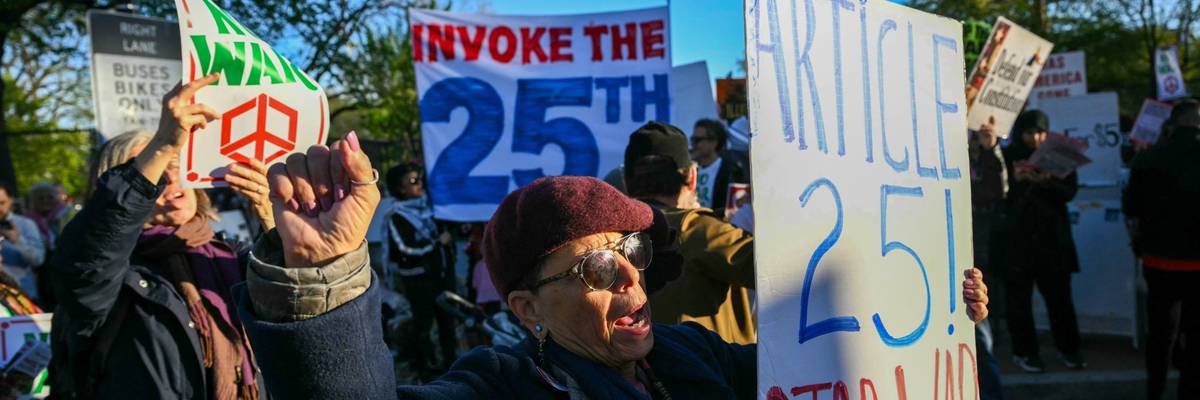
A protester holds a sign with a reference to the 25th Amendment to the US Constitution, that cites procedures for a presidential disability, during a demonstration against US military action in Iran near the White House in Washington, DC, on April 7, 2026.
The cost of inaction is simply too high.
Come senators, congressmen
Please heed the call
Don’t stand in the doorway
Don’t block up the hall…
―Bob Dylan
A shaky two-week truce; we’ve temporarily slipped from the hangman’s noose. There’s still a madman president on the loose.
We are living in an Upside Down moment, and the danger is no longer metaphorical. You don’t need to have watched Stranger Things to recognize that the threat is real, not lurking in another dimension. It’s prowling in the White House, and no blinking lights are spelling out SOS.
This is what an Upside Down world looks like: a president openly threatening catastrophic violence against another nation’s civilian infrastructure, while those with the constitutional authority to stop him hesitate, equivocate, or remain silent.
No matter what happens next, history will remember: On Easter Sunday 2026, Donald Trump posted a message so reckless, so unhinged, that it would be disqualifying in any functioning democracy. Threatening the destruction of Iran’s power plants and bridges, invoking apocalyptic language, and wrapping it all in bravado, he revealed not just poor judgment but a fundamental disregard for human life and the rule of law. Two days later, this warning: “A whole civilization will die tonight, never to be brought back again. I don’t want that to happen, but it probably will.”
The response was immediate—but not where it matters most.
Sen. Chris Murphy, the Democrat from Connecticut, spoke out about the Easter threat. If he were in Trump’s Cabinet, Murphy said he would be calling constitutional lawyers about invoking the 25th Amendment. Others echoed the alarm. Even some of Trump’s most reliable allies on the far right voiced scathing criticism.
For a brief moment, it seemed possible that outrage might translate into action. But it hasn’t...yet.
There is no credible evidence that the vice president and a majority of the Cabinet are engaged in serious discussions about removing Trump under the 25th Amendment. Vice President JD Vance has shown no sign of breaking ranks. How is it possible that loyalty—political, ideological, or personal—continues to outweigh constitutional responsibility?
And Congress? Missing in action. Despite clear authority under the War Powers Resolution, a Republican-controlled Congress has done nothing to rein Trump in—and has shown no signs of changing direction.
Why is it falling to the American people to do what elected officials are failing to do: unseat a president unfit to serve?
Activists in organizations like CodePink mobilized emergency protests in Washington and across the country, integrating opposition to the Iran war into the broader pro-democracy resistance.
Protests against the war need to be as ubiquitous as daffodils in Spring—visible, sustained, and impossible to ignore. The anti-Vietnam War movement did not stop the war overnight, but it changed the political calculus until continuing it became untenable.
What about the military? Senior officers and military lawyers understand what’s at stake. Orders to deliberately target civilian infrastructure—power grids, bridges, and population centers are war crimes.
The law of armed conflict is not optional. It applies to those who carry out orders, not just those who give them, creating a tension within the chain of command. Last year, six members of Congress posted a video reminding service members, “you can refuse to carry out illegal orders.”
Meanwhile, the judiciary, often imagined as a final safeguard, has—for now—remained largely silent. Courts do not move at the speed of crisis. They require time. And time is an enemy of this moment.
So where does that leave us? With a reality both sobering and clarifying. The formal mechanisms of restraint—Congress, the Cabinet, and the judiciary branch—are stalled, reactive, or unwilling. The most immediate pressure is coming from two places: people in the streets, and professionals inside the system trying to hold the line. Neither is sufficient on its own.
The millions at No Kings rallies have been doing their part, but only to a degree. Now, perhaps, they’ll take a new tack. Imagine citizens moving from street protests into the halls of Congress, confronting their representatives in their Washington offices and home districts. Asking, insisting, refusing to leave without an answer to a simple question: What are you doing—right now—to stop him? To stop the madness?
We know this Congress can’t be counted on to act on its own. Apparently, it will only act when the cost of inaction becomes too high—politically, publicly, unmistakably.
The people have begun doing their part. Congress must now do its. Much more must be done—and with great urgency—to bring this madness to an end.
Dear Common Dreams reader, It’s been nearly 30 years since I co-founded Common Dreams with my late wife, Lina Newhouser. We had the radical notion that journalism should serve the public good, not corporate profits. It was clear to us from the outset what it would take to build such a project. No paid advertisements. No corporate sponsors. No millionaire publisher telling us what to think or do. Many people said we wouldn't last a year, but we proved those doubters wrong. Together with a tremendous team of journalists and dedicated staff, we built an independent media outlet free from the constraints of profits and corporate control. Our mission has always been simple: To inform. To inspire. To ignite change for the common good. Building Common Dreams was not easy. Our survival was never guaranteed. When you take on the most powerful forces—Wall Street greed, fossil fuel industry destruction, Big Tech lobbyists, and uber-rich oligarchs who have spent billions upon billions rigging the economy and democracy in their favor—the only bulwark you have is supporters who believe in your work. But here’s the urgent message from me today. It's never been this bad out there. And it's never been this hard to keep us going. At the very moment Common Dreams is most needed, the threats we face are intensifying. We need your support now more than ever. We don't accept corporate advertising and never will. We don't have a paywall because we don't think people should be blocked from critical news based on their ability to pay. Everything we do is funded by the donations of readers like you. When everyone does the little they can afford, we are strong. But if that support retreats or dries up, so do we. Will you donate now to make sure Common Dreams not only survives but thrives? —Craig Brown, Co-founder |
Come senators, congressmen
Please heed the call
Don’t stand in the doorway
Don’t block up the hall…
―Bob Dylan
A shaky two-week truce; we’ve temporarily slipped from the hangman’s noose. There’s still a madman president on the loose.
We are living in an Upside Down moment, and the danger is no longer metaphorical. You don’t need to have watched Stranger Things to recognize that the threat is real, not lurking in another dimension. It’s prowling in the White House, and no blinking lights are spelling out SOS.
This is what an Upside Down world looks like: a president openly threatening catastrophic violence against another nation’s civilian infrastructure, while those with the constitutional authority to stop him hesitate, equivocate, or remain silent.
No matter what happens next, history will remember: On Easter Sunday 2026, Donald Trump posted a message so reckless, so unhinged, that it would be disqualifying in any functioning democracy. Threatening the destruction of Iran’s power plants and bridges, invoking apocalyptic language, and wrapping it all in bravado, he revealed not just poor judgment but a fundamental disregard for human life and the rule of law. Two days later, this warning: “A whole civilization will die tonight, never to be brought back again. I don’t want that to happen, but it probably will.”
The response was immediate—but not where it matters most.
Sen. Chris Murphy, the Democrat from Connecticut, spoke out about the Easter threat. If he were in Trump’s Cabinet, Murphy said he would be calling constitutional lawyers about invoking the 25th Amendment. Others echoed the alarm. Even some of Trump’s most reliable allies on the far right voiced scathing criticism.
For a brief moment, it seemed possible that outrage might translate into action. But it hasn’t...yet.
There is no credible evidence that the vice president and a majority of the Cabinet are engaged in serious discussions about removing Trump under the 25th Amendment. Vice President JD Vance has shown no sign of breaking ranks. How is it possible that loyalty—political, ideological, or personal—continues to outweigh constitutional responsibility?
And Congress? Missing in action. Despite clear authority under the War Powers Resolution, a Republican-controlled Congress has done nothing to rein Trump in—and has shown no signs of changing direction.
Why is it falling to the American people to do what elected officials are failing to do: unseat a president unfit to serve?
Activists in organizations like CodePink mobilized emergency protests in Washington and across the country, integrating opposition to the Iran war into the broader pro-democracy resistance.
Protests against the war need to be as ubiquitous as daffodils in Spring—visible, sustained, and impossible to ignore. The anti-Vietnam War movement did not stop the war overnight, but it changed the political calculus until continuing it became untenable.
What about the military? Senior officers and military lawyers understand what’s at stake. Orders to deliberately target civilian infrastructure—power grids, bridges, and population centers are war crimes.
The law of armed conflict is not optional. It applies to those who carry out orders, not just those who give them, creating a tension within the chain of command. Last year, six members of Congress posted a video reminding service members, “you can refuse to carry out illegal orders.”
Meanwhile, the judiciary, often imagined as a final safeguard, has—for now—remained largely silent. Courts do not move at the speed of crisis. They require time. And time is an enemy of this moment.
So where does that leave us? With a reality both sobering and clarifying. The formal mechanisms of restraint—Congress, the Cabinet, and the judiciary branch—are stalled, reactive, or unwilling. The most immediate pressure is coming from two places: people in the streets, and professionals inside the system trying to hold the line. Neither is sufficient on its own.
The millions at No Kings rallies have been doing their part, but only to a degree. Now, perhaps, they’ll take a new tack. Imagine citizens moving from street protests into the halls of Congress, confronting their representatives in their Washington offices and home districts. Asking, insisting, refusing to leave without an answer to a simple question: What are you doing—right now—to stop him? To stop the madness?
We know this Congress can’t be counted on to act on its own. Apparently, it will only act when the cost of inaction becomes too high—politically, publicly, unmistakably.
The people have begun doing their part. Congress must now do its. Much more must be done—and with great urgency—to bring this madness to an end.
Come senators, congressmen
Please heed the call
Don’t stand in the doorway
Don’t block up the hall…
―Bob Dylan
A shaky two-week truce; we’ve temporarily slipped from the hangman’s noose. There’s still a madman president on the loose.
We are living in an Upside Down moment, and the danger is no longer metaphorical. You don’t need to have watched Stranger Things to recognize that the threat is real, not lurking in another dimension. It’s prowling in the White House, and no blinking lights are spelling out SOS.
This is what an Upside Down world looks like: a president openly threatening catastrophic violence against another nation’s civilian infrastructure, while those with the constitutional authority to stop him hesitate, equivocate, or remain silent.
No matter what happens next, history will remember: On Easter Sunday 2026, Donald Trump posted a message so reckless, so unhinged, that it would be disqualifying in any functioning democracy. Threatening the destruction of Iran’s power plants and bridges, invoking apocalyptic language, and wrapping it all in bravado, he revealed not just poor judgment but a fundamental disregard for human life and the rule of law. Two days later, this warning: “A whole civilization will die tonight, never to be brought back again. I don’t want that to happen, but it probably will.”
The response was immediate—but not where it matters most.
Sen. Chris Murphy, the Democrat from Connecticut, spoke out about the Easter threat. If he were in Trump’s Cabinet, Murphy said he would be calling constitutional lawyers about invoking the 25th Amendment. Others echoed the alarm. Even some of Trump’s most reliable allies on the far right voiced scathing criticism.
For a brief moment, it seemed possible that outrage might translate into action. But it hasn’t...yet.
There is no credible evidence that the vice president and a majority of the Cabinet are engaged in serious discussions about removing Trump under the 25th Amendment. Vice President JD Vance has shown no sign of breaking ranks. How is it possible that loyalty—political, ideological, or personal—continues to outweigh constitutional responsibility?
And Congress? Missing in action. Despite clear authority under the War Powers Resolution, a Republican-controlled Congress has done nothing to rein Trump in—and has shown no signs of changing direction.
Why is it falling to the American people to do what elected officials are failing to do: unseat a president unfit to serve?
Activists in organizations like CodePink mobilized emergency protests in Washington and across the country, integrating opposition to the Iran war into the broader pro-democracy resistance.
Protests against the war need to be as ubiquitous as daffodils in Spring—visible, sustained, and impossible to ignore. The anti-Vietnam War movement did not stop the war overnight, but it changed the political calculus until continuing it became untenable.
What about the military? Senior officers and military lawyers understand what’s at stake. Orders to deliberately target civilian infrastructure—power grids, bridges, and population centers are war crimes.
The law of armed conflict is not optional. It applies to those who carry out orders, not just those who give them, creating a tension within the chain of command. Last year, six members of Congress posted a video reminding service members, “you can refuse to carry out illegal orders.”
Meanwhile, the judiciary, often imagined as a final safeguard, has—for now—remained largely silent. Courts do not move at the speed of crisis. They require time. And time is an enemy of this moment.
So where does that leave us? With a reality both sobering and clarifying. The formal mechanisms of restraint—Congress, the Cabinet, and the judiciary branch—are stalled, reactive, or unwilling. The most immediate pressure is coming from two places: people in the streets, and professionals inside the system trying to hold the line. Neither is sufficient on its own.
The millions at No Kings rallies have been doing their part, but only to a degree. Now, perhaps, they’ll take a new tack. Imagine citizens moving from street protests into the halls of Congress, confronting their representatives in their Washington offices and home districts. Asking, insisting, refusing to leave without an answer to a simple question: What are you doing—right now—to stop him? To stop the madness?
We know this Congress can’t be counted on to act on its own. Apparently, it will only act when the cost of inaction becomes too high—politically, publicly, unmistakably.
The people have begun doing their part. Congress must now do its. Much more must be done—and with great urgency—to bring this madness to an end.