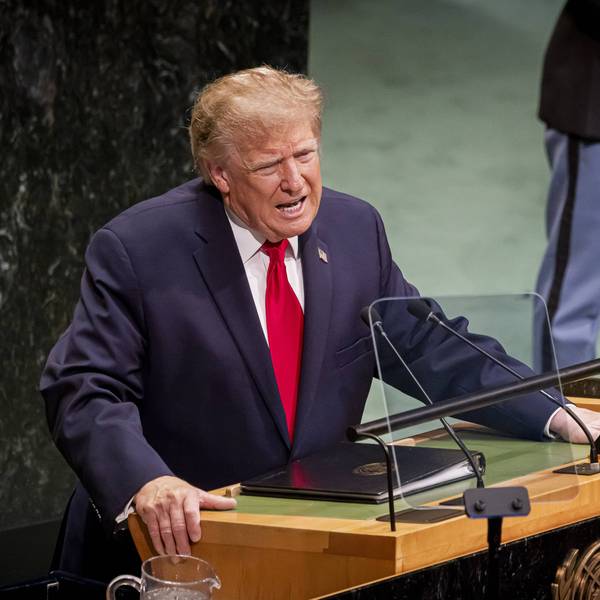
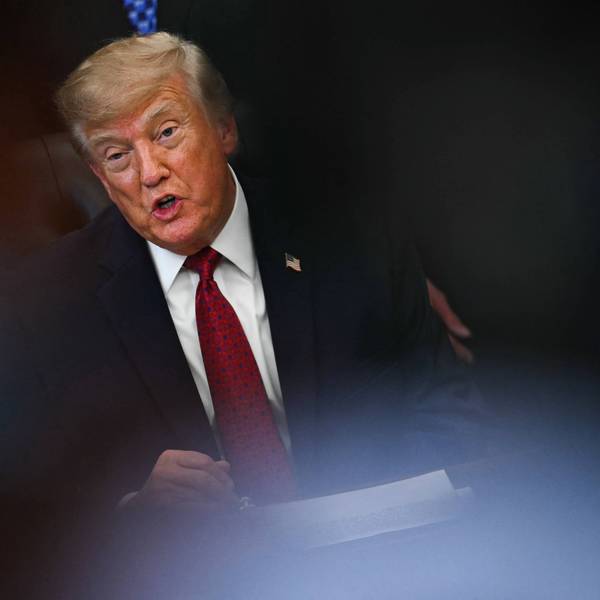

An activist with a mask of US President Donald Trump marches with a model of a nuclear rocket during a demonstration against nuclear weapons on November 18, 2017 in Berlin, Germany.
Trump Says He’s the Most Powerful Man Ever: He Is, and That’s a Big Worry
President Donald J. Trump’s “sole authority” to launch the US nuclear arsenal, which could kill billions of people and destroy life on Earth as we know it, means that he is the most powerful man ever; this should be of profound concern.
As William Perry, former secretary of defense under Bill Clinton, and Tom Collina state in The Button: “Within minutes, with just one phone call, President Trump could unleash up to a thousand nuclear weapons, each one many times more powerful than the Hiroshima bomb. It would be the end of civilization... For President Trump, starting nuclear war is about as easy as sending a tweet.”
US policy, which invests “sole authority” in the president to launch nuclear weapons, crystallizes the utter absurdity of the nuclear predicament that we have lived under for 81 years. Contrary to popular belief, there is no “button.” Instead, there is a military aide, who carries a 40-plus pound briefcase, referred to as the “nuclear football” (officially called the Presidential Emergency Satchel), which follows the president 24/7/365, whenever he is away from fixed command centers. The fact that the president can use the football to launch US nuclear weapons at any moment, day or night—without having to consult or listen to anyone—beggars belief. Clearly, the ability to start a nuclear war that could destroy most life on Earth should not be entrusted to one person, especially one known to be erratically capriciousness and highly unstable.
Inside the nuclear football is a secure communications device that allows the president to order a launch, as well as a “Black Book,” outlining pre-planned presidential options for targets, delivery systems, and estimated casualties. It originally contained a heavy set of war plans, but after Jimmy Carter complained that it was too complicated for the extremely short time frame, it was simplified into a menu of strike options for either limited strikes or full retaliation, presented as a “one-page, cartoon-like menu.” One of Clinton’s aides quipped that it was like a “Denny’s breakfast menu.”
There is also a small laminated card, called the “biscuit,” with unique codes which are used to establish the president’s identity. If the president were to decide on a nuclear launch, he would read the codes over secure communications to the National Military Command Center at the Pentagon or one of its alternates. Once authenticated, the president's will is converted into a “highly encrypted, time-sensitive message called the Emergency Action Message, which includes the authentication codes, the strike option, timing details, and the codes to unlock the weapons.” It is then transmitted by the US Strategic Command Headquarters located in a bunker under the Offutt Air Force Base in Nebraska, again by secure communication, to land-based intercontinental ballistic missile launch control centers, ballistic missile submarines, and air force strategic bombers, each with their own authentication and launch procedures. A full nuclear launch order can be executed in 5-15 minutes.
The only way to truly overcome the total absurdity of the incredibly reckless situation that we have created for ourselves during the nuclear age is to recognize the danger and to collectively “get our act together” to work toward the abolition of nuclear weapons.
Presidents often keep the biscuit in a pocket, which has presented problems: Carter inadvertently sent his to the dry cleaners in a suit pocket; Clinton lost it altogether for several months. When Ronald Reagan was taken to hospital after an assassination attempt, he was stripped of clothing and the biscuit was later found by the FBI in a hospital trash can.
Once the nuclear football is opened, the president would have less than 10 minutes to absorb the information inside, review the options, and make a decision. Other sources suggest it would be six minutes. As Reagan lamented: “Six minutes to decide how to respond to a blip on a radar scope and decide whether to unleash Armageddon? How could anyone apply reason at a time like that?”
Indeed, there have been concerns about several presidents during the nuclear age: John F. Kennedy was on heavy pain medication for back pain; Richard Nixon was drinking too much due to the strain of the Watergate investigations. (At one point, he threatened, “I can go back in my office and pick up the telephone and in 25 minutes, 70 million people will be dead.”) Lyndon B. Johnson alternated between manic energy and bouts of gloominess. At the end of their terms, Reagan had early-stage Alzheimer’s and Joe Biden’s clarity of thinking has also been questioned. But of all the 14 presidents who have been in office in the nuclear age, Trump’s stability has been the most extensively questioned. As reported by The New York Times, “Never before in modern times has the stability of a president been so publicly and forensically debated—and with such profound consequences.”
Most presidents had previous experience with nuclear issues: 9 of 14 had military experience before taking office; five served as vice president; several served in other parts of the executive branch; and more than half, in Congress. Trump had none of this prior experience.
When Trump took charge of the nuclear football for a second time in 2025, Sen. Edward Markey (D-Mass.) and Congressman Ted Lieu (D-Calif.), who had previously introduced legislation to Congress against “sole authority,” stated:
As Donald Trump returns to the White House, it is more important than ever to take the power to start a nuclear war out of the hands of a single individual and ensure that Congress’ constitutional role is respected and fulfilled. We must put guardrails on presidential authority to start nuclear war. We must never again entrust the fate of the world to just one fallible human.
Upon receiving a nuclear briefing just before their inauguration, presidents are often horrified by the awesome responsibility. Dwight D. Eisenhower was “visibly shaken”; Kennedy asked, “And we call ourselves the human race?” Carter recounted that, as president, the horror “was constantly on my mind.” George H.W. Bush stated, “I had no idea we had so many weapons... What do we need them for?” Barack Obama told a close adviser, it was “one of the most sobering experiences of my life.” Trump said, “a very sobering moment... very, very scary.” But as Perry and Collina comment, “While that statement might sound reassuring, Trump also asked, on several occasions [during his first term] ‘If we have nuclear weapons, why can’t we use them?’”
Indeed, during both terms, Trump has occasionally appeared to threaten their use. In 2017, when he and the North Korean leader, Kim Jong-un, were in a tense standoff, Trump said: “North Korea, best not make any more threats to the United States. They will be met with fire and fury like the world has never seen.” When Kim boasted that his nuclear button is “always on my table,” Trump tweeted in return, “Will someone from his depleted and food starved regime please inform him that I too have a Nuclear Button, but it is much bigger & more powerful than his, and my Button works!”
During the current ongoing war with Iran, Trump has also made a number of extremely ominous threats, the worst of which was probably on April 7 when he posted on Truth Social: “A whole civilization will die tonight, never to be brought back again.”
Following this post, Rep. Jamie Raskin (D-Md.) wrote to the White House physician on April 10, citing the above comments and requesting an evaluation of Trump due to “signs consistent with dementia and cognitive decline” and “increasingly incoherent, volatile, profane, deranged, and threatening tantrums.” No answer was received.
On April 14, Raskin submitted legislation to Congress to establish a nonpartisan “Commission on Presidential Capacity to Discharge the Powers and Duties of Office.” Such a mechanism is allowed by the 25th Amendment as an alternative to the vice president and Cabinet deciding whether the president should be removed from office (which is currently unlikely since Trump’s Cabinet members were selected because of their extreme loyalty). The legislation is still in committee.
On June 18, Raskin again wrote to the White House physician demanding that he comply with his previous request; provide a complete list of all medications and dosages; identify each of the 22 medical providers and their specialty that Trump saw during his May 26 examination at Walter Reed; and publicly release the complete results of this visit—again, without response.
Although the American Psychiatric Association’s “Goldwater Rule” forbids psychiatrists from offering public opinions about the diagnosis and mental health status of public figures they have not examined, many have argued that the rule is poorly conceived and that there is an overriding “duty to warn.” In this spirit, a group of 36 senior neurologists, forensic psychiatrists, general psychiatrists, and mental health professionals experienced in the diagnosis of cognitive disorders and evaluation of dangerousness, who had signed an earlier statement in 2024, issued an update on April 30 of this year.
They cited examples of Trump’s “marked deterioration in cognitive functioning, evidenced by disorganized and tangential speech, rambling digressions, factual confusions, unexplained sudden changes of course in strategic matters, both national and international, episodes of apparent somnolence during crucial public proceeding. Grandiose and delusional beliefs, including assertions of infallibility... claims that his decision-making authority is unlimited—with no need to consider domestic and international laws and constrained only by his ‘own morality.’ Severely impaired judgment and impulse control... Significant loss of self-control (disinhibition) and getting stuck on the same thoughts or actions, unable to let go or move on (perseveration), including seemingly compulsive, manic-like late-night communications—e.g., 150 social media posts in one night.”
They conclude:
It is our professional opinion that the behaviors of Donald Trump, tragically, are neither momentary lapses nor political theater. It is our professional opinion that they reflect a rapidly worsening, reality-untethered, increasingly dangerous decline... For the reasons cited above, emphasizing that he presents a clear and present danger to our country and to the world, it is our expert opinion that Donald J. Trump is mentally unfit to be the president of the United States, and that steps to remove him from office must be undertaken with the greatest urgency.
On six occasions since 2016, Markey and Lieu have introduced legislation entitled the Restricting First Use of Nuclear Weapons Act, which would reallocate the responsibility for launching nuclear weapons from the president to Congress when the US is not being attacked. It would require Congress to explicitly approve any first nuclear strike by the US before federal money could be spent on the attack. So far it has not been adopted.
If the Democratic Party wins a majority in the next Congress, the Markey and Lieu bill or Raskin’s bill could be passed. If the latter is adopted, the use of Article 25 might become politically possible. Alternatively, it is also remotely conceivable that Trump could be impeached, convicted, and removed from office. But the concern remains as to whether this is soon enough to spare the world the possible use of Trump’s “sole authority”—given his deteriorating cognitive abilities.
Of course, the only way to truly overcome the total absurdity of the incredibly reckless situation that we have created for ourselves during the nuclear age is to recognize the danger and to collectively “get our act together” to work toward the abolition of nuclear weapons.
As Jonathan Schell sums up in The Fate of the Earth: “The machinery of destruction is complete, poised on a hair trigger, waiting for the ‘button’ to be ‘pushed’ by some misguided or deranged human being or for some faulty computer chip to send out the instruction to fire. That so much should be balanced on so fine a point—that the fruit of four and a half billion years can be undone in a careless moment—is a fact against which belief rebels.”
We are at a crossroads
This country and this world are at a monumental crossroads. In a few short weeks, US voters will have an opportunity to beat back the forces of fascism and confront the billionaires who are rigging the economy, our media system, and our democracy, making it increasingly impossible for ordinary people to get by. We’re not just talking about the election. We’re talking about what must be done once these fascist elements are vanquished from power. We need a bolder set of solutions than what either major party has so far been willing to offer and a working-class movement ready to fight like hell for it. Trump didn't emerge from nowhere. The conditions that fueled MAGA authoritarianism were created by decades of radical neoliberal economic policies and a corrupt political system dominated by corporate interests. They slashed taxes on the super-rich, promising that the benefits would trickle down. They said giveaways to the corporate titans would make life more affordable for the rest of us. It was all bullshit. And when a bitter, betrayed populace searches for someone to blame, right-wing demagogues have little trouble finding scapegoats. People know when they're being lied to, but you won't hear any of this from the corporate media. Only independent journalism—powered and funded by people who believe in building a better world—can deliver truly trustworthy daily news. Our Fall Campaign is underway, and we need your help. To power our newsroom through the rest of the year, we need to raise $125,000 by midnight on October 31. So if you share our vision, please contribute whatever you can to sustain our work. |
As William Perry, former secretary of defense under Bill Clinton, and Tom Collina state in The Button: “Within minutes, with just one phone call, President Trump could unleash up to a thousand nuclear weapons, each one many times more powerful than the Hiroshima bomb. It would be the end of civilization... For President Trump, starting nuclear war is about as easy as sending a tweet.”
US policy, which invests “sole authority” in the president to launch nuclear weapons, crystallizes the utter absurdity of the nuclear predicament that we have lived under for 81 years. Contrary to popular belief, there is no “button.” Instead, there is a military aide, who carries a 40-plus pound briefcase, referred to as the “nuclear football” (officially called the Presidential Emergency Satchel), which follows the president 24/7/365, whenever he is away from fixed command centers. The fact that the president can use the football to launch US nuclear weapons at any moment, day or night—without having to consult or listen to anyone—beggars belief. Clearly, the ability to start a nuclear war that could destroy most life on Earth should not be entrusted to one person, especially one known to be erratically capriciousness and highly unstable.
Inside the nuclear football is a secure communications device that allows the president to order a launch, as well as a “Black Book,” outlining pre-planned presidential options for targets, delivery systems, and estimated casualties. It originally contained a heavy set of war plans, but after Jimmy Carter complained that it was too complicated for the extremely short time frame, it was simplified into a menu of strike options for either limited strikes or full retaliation, presented as a “one-page, cartoon-like menu.” One of Clinton’s aides quipped that it was like a “Denny’s breakfast menu.”
There is also a small laminated card, called the “biscuit,” with unique codes which are used to establish the president’s identity. If the president were to decide on a nuclear launch, he would read the codes over secure communications to the National Military Command Center at the Pentagon or one of its alternates. Once authenticated, the president's will is converted into a “highly encrypted, time-sensitive message called the Emergency Action Message, which includes the authentication codes, the strike option, timing details, and the codes to unlock the weapons.” It is then transmitted by the US Strategic Command Headquarters located in a bunker under the Offutt Air Force Base in Nebraska, again by secure communication, to land-based intercontinental ballistic missile launch control centers, ballistic missile submarines, and air force strategic bombers, each with their own authentication and launch procedures. A full nuclear launch order can be executed in 5-15 minutes.
The only way to truly overcome the total absurdity of the incredibly reckless situation that we have created for ourselves during the nuclear age is to recognize the danger and to collectively “get our act together” to work toward the abolition of nuclear weapons.
Presidents often keep the biscuit in a pocket, which has presented problems: Carter inadvertently sent his to the dry cleaners in a suit pocket; Clinton lost it altogether for several months. When Ronald Reagan was taken to hospital after an assassination attempt, he was stripped of clothing and the biscuit was later found by the FBI in a hospital trash can.
Once the nuclear football is opened, the president would have less than 10 minutes to absorb the information inside, review the options, and make a decision. Other sources suggest it would be six minutes. As Reagan lamented: “Six minutes to decide how to respond to a blip on a radar scope and decide whether to unleash Armageddon? How could anyone apply reason at a time like that?”
Indeed, there have been concerns about several presidents during the nuclear age: John F. Kennedy was on heavy pain medication for back pain; Richard Nixon was drinking too much due to the strain of the Watergate investigations. (At one point, he threatened, “I can go back in my office and pick up the telephone and in 25 minutes, 70 million people will be dead.”) Lyndon B. Johnson alternated between manic energy and bouts of gloominess. At the end of their terms, Reagan had early-stage Alzheimer’s and Joe Biden’s clarity of thinking has also been questioned. But of all the 14 presidents who have been in office in the nuclear age, Trump’s stability has been the most extensively questioned. As reported by The New York Times, “Never before in modern times has the stability of a president been so publicly and forensically debated—and with such profound consequences.”
Most presidents had previous experience with nuclear issues: 9 of 14 had military experience before taking office; five served as vice president; several served in other parts of the executive branch; and more than half, in Congress. Trump had none of this prior experience.
When Trump took charge of the nuclear football for a second time in 2025, Sen. Edward Markey (D-Mass.) and Congressman Ted Lieu (D-Calif.), who had previously introduced legislation to Congress against “sole authority,” stated:
As Donald Trump returns to the White House, it is more important than ever to take the power to start a nuclear war out of the hands of a single individual and ensure that Congress’ constitutional role is respected and fulfilled. We must put guardrails on presidential authority to start nuclear war. We must never again entrust the fate of the world to just one fallible human.
Upon receiving a nuclear briefing just before their inauguration, presidents are often horrified by the awesome responsibility. Dwight D. Eisenhower was “visibly shaken”; Kennedy asked, “And we call ourselves the human race?” Carter recounted that, as president, the horror “was constantly on my mind.” George H.W. Bush stated, “I had no idea we had so many weapons... What do we need them for?” Barack Obama told a close adviser, it was “one of the most sobering experiences of my life.” Trump said, “a very sobering moment... very, very scary.” But as Perry and Collina comment, “While that statement might sound reassuring, Trump also asked, on several occasions [during his first term] ‘If we have nuclear weapons, why can’t we use them?’”
Indeed, during both terms, Trump has occasionally appeared to threaten their use. In 2017, when he and the North Korean leader, Kim Jong-un, were in a tense standoff, Trump said: “North Korea, best not make any more threats to the United States. They will be met with fire and fury like the world has never seen.” When Kim boasted that his nuclear button is “always on my table,” Trump tweeted in return, “Will someone from his depleted and food starved regime please inform him that I too have a Nuclear Button, but it is much bigger & more powerful than his, and my Button works!”
During the current ongoing war with Iran, Trump has also made a number of extremely ominous threats, the worst of which was probably on April 7 when he posted on Truth Social: “A whole civilization will die tonight, never to be brought back again.”
Following this post, Rep. Jamie Raskin (D-Md.) wrote to the White House physician on April 10, citing the above comments and requesting an evaluation of Trump due to “signs consistent with dementia and cognitive decline” and “increasingly incoherent, volatile, profane, deranged, and threatening tantrums.” No answer was received.
On April 14, Raskin submitted legislation to Congress to establish a nonpartisan “Commission on Presidential Capacity to Discharge the Powers and Duties of Office.” Such a mechanism is allowed by the 25th Amendment as an alternative to the vice president and Cabinet deciding whether the president should be removed from office (which is currently unlikely since Trump’s Cabinet members were selected because of their extreme loyalty). The legislation is still in committee.
On June 18, Raskin again wrote to the White House physician demanding that he comply with his previous request; provide a complete list of all medications and dosages; identify each of the 22 medical providers and their specialty that Trump saw during his May 26 examination at Walter Reed; and publicly release the complete results of this visit—again, without response.
Although the American Psychiatric Association’s “Goldwater Rule” forbids psychiatrists from offering public opinions about the diagnosis and mental health status of public figures they have not examined, many have argued that the rule is poorly conceived and that there is an overriding “duty to warn.” In this spirit, a group of 36 senior neurologists, forensic psychiatrists, general psychiatrists, and mental health professionals experienced in the diagnosis of cognitive disorders and evaluation of dangerousness, who had signed an earlier statement in 2024, issued an update on April 30 of this year.
They cited examples of Trump’s “marked deterioration in cognitive functioning, evidenced by disorganized and tangential speech, rambling digressions, factual confusions, unexplained sudden changes of course in strategic matters, both national and international, episodes of apparent somnolence during crucial public proceeding. Grandiose and delusional beliefs, including assertions of infallibility... claims that his decision-making authority is unlimited—with no need to consider domestic and international laws and constrained only by his ‘own morality.’ Severely impaired judgment and impulse control... Significant loss of self-control (disinhibition) and getting stuck on the same thoughts or actions, unable to let go or move on (perseveration), including seemingly compulsive, manic-like late-night communications—e.g., 150 social media posts in one night.”
They conclude:
It is our professional opinion that the behaviors of Donald Trump, tragically, are neither momentary lapses nor political theater. It is our professional opinion that they reflect a rapidly worsening, reality-untethered, increasingly dangerous decline... For the reasons cited above, emphasizing that he presents a clear and present danger to our country and to the world, it is our expert opinion that Donald J. Trump is mentally unfit to be the president of the United States, and that steps to remove him from office must be undertaken with the greatest urgency.
On six occasions since 2016, Markey and Lieu have introduced legislation entitled the Restricting First Use of Nuclear Weapons Act, which would reallocate the responsibility for launching nuclear weapons from the president to Congress when the US is not being attacked. It would require Congress to explicitly approve any first nuclear strike by the US before federal money could be spent on the attack. So far it has not been adopted.
If the Democratic Party wins a majority in the next Congress, the Markey and Lieu bill or Raskin’s bill could be passed. If the latter is adopted, the use of Article 25 might become politically possible. Alternatively, it is also remotely conceivable that Trump could be impeached, convicted, and removed from office. But the concern remains as to whether this is soon enough to spare the world the possible use of Trump’s “sole authority”—given his deteriorating cognitive abilities.
Of course, the only way to truly overcome the total absurdity of the incredibly reckless situation that we have created for ourselves during the nuclear age is to recognize the danger and to collectively “get our act together” to work toward the abolition of nuclear weapons.
As Jonathan Schell sums up in The Fate of the Earth: “The machinery of destruction is complete, poised on a hair trigger, waiting for the ‘button’ to be ‘pushed’ by some misguided or deranged human being or for some faulty computer chip to send out the instruction to fire. That so much should be balanced on so fine a point—that the fruit of four and a half billion years can be undone in a careless moment—is a fact against which belief rebels.”
- The Trumpian Nightmare Has a Long Way to Go Before It's Over ›
- Trump's Most Sinister Legacy: He's Brought Out the Worst in America ›
- President Trump Is an Apocalypse ›
- Trump Is the Most Dangerous Criminal in US History ›
- The US Under Trump Is Demonstrably the Most Dangerous Nation in the World ›
- Trump Is the Most Dangerous Man in the World ›
As William Perry, former secretary of defense under Bill Clinton, and Tom Collina state in The Button: “Within minutes, with just one phone call, President Trump could unleash up to a thousand nuclear weapons, each one many times more powerful than the Hiroshima bomb. It would be the end of civilization... For President Trump, starting nuclear war is about as easy as sending a tweet.”
US policy, which invests “sole authority” in the president to launch nuclear weapons, crystallizes the utter absurdity of the nuclear predicament that we have lived under for 81 years. Contrary to popular belief, there is no “button.” Instead, there is a military aide, who carries a 40-plus pound briefcase, referred to as the “nuclear football” (officially called the Presidential Emergency Satchel), which follows the president 24/7/365, whenever he is away from fixed command centers. The fact that the president can use the football to launch US nuclear weapons at any moment, day or night—without having to consult or listen to anyone—beggars belief. Clearly, the ability to start a nuclear war that could destroy most life on Earth should not be entrusted to one person, especially one known to be erratically capriciousness and highly unstable.
Inside the nuclear football is a secure communications device that allows the president to order a launch, as well as a “Black Book,” outlining pre-planned presidential options for targets, delivery systems, and estimated casualties. It originally contained a heavy set of war plans, but after Jimmy Carter complained that it was too complicated for the extremely short time frame, it was simplified into a menu of strike options for either limited strikes or full retaliation, presented as a “one-page, cartoon-like menu.” One of Clinton’s aides quipped that it was like a “Denny’s breakfast menu.”
There is also a small laminated card, called the “biscuit,” with unique codes which are used to establish the president’s identity. If the president were to decide on a nuclear launch, he would read the codes over secure communications to the National Military Command Center at the Pentagon or one of its alternates. Once authenticated, the president's will is converted into a “highly encrypted, time-sensitive message called the Emergency Action Message, which includes the authentication codes, the strike option, timing details, and the codes to unlock the weapons.” It is then transmitted by the US Strategic Command Headquarters located in a bunker under the Offutt Air Force Base in Nebraska, again by secure communication, to land-based intercontinental ballistic missile launch control centers, ballistic missile submarines, and air force strategic bombers, each with their own authentication and launch procedures. A full nuclear launch order can be executed in 5-15 minutes.
The only way to truly overcome the total absurdity of the incredibly reckless situation that we have created for ourselves during the nuclear age is to recognize the danger and to collectively “get our act together” to work toward the abolition of nuclear weapons.
Presidents often keep the biscuit in a pocket, which has presented problems: Carter inadvertently sent his to the dry cleaners in a suit pocket; Clinton lost it altogether for several months. When Ronald Reagan was taken to hospital after an assassination attempt, he was stripped of clothing and the biscuit was later found by the FBI in a hospital trash can.
Once the nuclear football is opened, the president would have less than 10 minutes to absorb the information inside, review the options, and make a decision. Other sources suggest it would be six minutes. As Reagan lamented: “Six minutes to decide how to respond to a blip on a radar scope and decide whether to unleash Armageddon? How could anyone apply reason at a time like that?”
Indeed, there have been concerns about several presidents during the nuclear age: John F. Kennedy was on heavy pain medication for back pain; Richard Nixon was drinking too much due to the strain of the Watergate investigations. (At one point, he threatened, “I can go back in my office and pick up the telephone and in 25 minutes, 70 million people will be dead.”) Lyndon B. Johnson alternated between manic energy and bouts of gloominess. At the end of their terms, Reagan had early-stage Alzheimer’s and Joe Biden’s clarity of thinking has also been questioned. But of all the 14 presidents who have been in office in the nuclear age, Trump’s stability has been the most extensively questioned. As reported by The New York Times, “Never before in modern times has the stability of a president been so publicly and forensically debated—and with such profound consequences.”
Most presidents had previous experience with nuclear issues: 9 of 14 had military experience before taking office; five served as vice president; several served in other parts of the executive branch; and more than half, in Congress. Trump had none of this prior experience.
When Trump took charge of the nuclear football for a second time in 2025, Sen. Edward Markey (D-Mass.) and Congressman Ted Lieu (D-Calif.), who had previously introduced legislation to Congress against “sole authority,” stated:
As Donald Trump returns to the White House, it is more important than ever to take the power to start a nuclear war out of the hands of a single individual and ensure that Congress’ constitutional role is respected and fulfilled. We must put guardrails on presidential authority to start nuclear war. We must never again entrust the fate of the world to just one fallible human.
Upon receiving a nuclear briefing just before their inauguration, presidents are often horrified by the awesome responsibility. Dwight D. Eisenhower was “visibly shaken”; Kennedy asked, “And we call ourselves the human race?” Carter recounted that, as president, the horror “was constantly on my mind.” George H.W. Bush stated, “I had no idea we had so many weapons... What do we need them for?” Barack Obama told a close adviser, it was “one of the most sobering experiences of my life.” Trump said, “a very sobering moment... very, very scary.” But as Perry and Collina comment, “While that statement might sound reassuring, Trump also asked, on several occasions [during his first term] ‘If we have nuclear weapons, why can’t we use them?’”
Indeed, during both terms, Trump has occasionally appeared to threaten their use. In 2017, when he and the North Korean leader, Kim Jong-un, were in a tense standoff, Trump said: “North Korea, best not make any more threats to the United States. They will be met with fire and fury like the world has never seen.” When Kim boasted that his nuclear button is “always on my table,” Trump tweeted in return, “Will someone from his depleted and food starved regime please inform him that I too have a Nuclear Button, but it is much bigger & more powerful than his, and my Button works!”
During the current ongoing war with Iran, Trump has also made a number of extremely ominous threats, the worst of which was probably on April 7 when he posted on Truth Social: “A whole civilization will die tonight, never to be brought back again.”
Following this post, Rep. Jamie Raskin (D-Md.) wrote to the White House physician on April 10, citing the above comments and requesting an evaluation of Trump due to “signs consistent with dementia and cognitive decline” and “increasingly incoherent, volatile, profane, deranged, and threatening tantrums.” No answer was received.
On April 14, Raskin submitted legislation to Congress to establish a nonpartisan “Commission on Presidential Capacity to Discharge the Powers and Duties of Office.” Such a mechanism is allowed by the 25th Amendment as an alternative to the vice president and Cabinet deciding whether the president should be removed from office (which is currently unlikely since Trump’s Cabinet members were selected because of their extreme loyalty). The legislation is still in committee.
On June 18, Raskin again wrote to the White House physician demanding that he comply with his previous request; provide a complete list of all medications and dosages; identify each of the 22 medical providers and their specialty that Trump saw during his May 26 examination at Walter Reed; and publicly release the complete results of this visit—again, without response.
Although the American Psychiatric Association’s “Goldwater Rule” forbids psychiatrists from offering public opinions about the diagnosis and mental health status of public figures they have not examined, many have argued that the rule is poorly conceived and that there is an overriding “duty to warn.” In this spirit, a group of 36 senior neurologists, forensic psychiatrists, general psychiatrists, and mental health professionals experienced in the diagnosis of cognitive disorders and evaluation of dangerousness, who had signed an earlier statement in 2024, issued an update on April 30 of this year.
They cited examples of Trump’s “marked deterioration in cognitive functioning, evidenced by disorganized and tangential speech, rambling digressions, factual confusions, unexplained sudden changes of course in strategic matters, both national and international, episodes of apparent somnolence during crucial public proceeding. Grandiose and delusional beliefs, including assertions of infallibility... claims that his decision-making authority is unlimited—with no need to consider domestic and international laws and constrained only by his ‘own morality.’ Severely impaired judgment and impulse control... Significant loss of self-control (disinhibition) and getting stuck on the same thoughts or actions, unable to let go or move on (perseveration), including seemingly compulsive, manic-like late-night communications—e.g., 150 social media posts in one night.”
They conclude:
It is our professional opinion that the behaviors of Donald Trump, tragically, are neither momentary lapses nor political theater. It is our professional opinion that they reflect a rapidly worsening, reality-untethered, increasingly dangerous decline... For the reasons cited above, emphasizing that he presents a clear and present danger to our country and to the world, it is our expert opinion that Donald J. Trump is mentally unfit to be the president of the United States, and that steps to remove him from office must be undertaken with the greatest urgency.
On six occasions since 2016, Markey and Lieu have introduced legislation entitled the Restricting First Use of Nuclear Weapons Act, which would reallocate the responsibility for launching nuclear weapons from the president to Congress when the US is not being attacked. It would require Congress to explicitly approve any first nuclear strike by the US before federal money could be spent on the attack. So far it has not been adopted.
If the Democratic Party wins a majority in the next Congress, the Markey and Lieu bill or Raskin’s bill could be passed. If the latter is adopted, the use of Article 25 might become politically possible. Alternatively, it is also remotely conceivable that Trump could be impeached, convicted, and removed from office. But the concern remains as to whether this is soon enough to spare the world the possible use of Trump’s “sole authority”—given his deteriorating cognitive abilities.
Of course, the only way to truly overcome the total absurdity of the incredibly reckless situation that we have created for ourselves during the nuclear age is to recognize the danger and to collectively “get our act together” to work toward the abolition of nuclear weapons.
As Jonathan Schell sums up in The Fate of the Earth: “The machinery of destruction is complete, poised on a hair trigger, waiting for the ‘button’ to be ‘pushed’ by some misguided or deranged human being or for some faulty computer chip to send out the instruction to fire. That so much should be balanced on so fine a point—that the fruit of four and a half billion years can be undone in a careless moment—is a fact against which belief rebels.”
- The Trumpian Nightmare Has a Long Way to Go Before It's Over ›
- Trump's Most Sinister Legacy: He's Brought Out the Worst in America ›
- President Trump Is an Apocalypse ›
- Trump Is the Most Dangerous Criminal in US History ›
- The US Under Trump Is Demonstrably the Most Dangerous Nation in the World ›
- Trump Is the Most Dangerous Man in the World ›