

SUBSCRIBE TO OUR FREE NEWSLETTER
Daily news & progressive opinion—funded by the people, not the corporations—delivered straight to your inbox.
5
#000000
#FFFFFF
To donate by check, phone, or other method, see our More Ways to Give page.
Daily news & progressive opinion—funded by the people, not the corporations—delivered straight to your inbox.
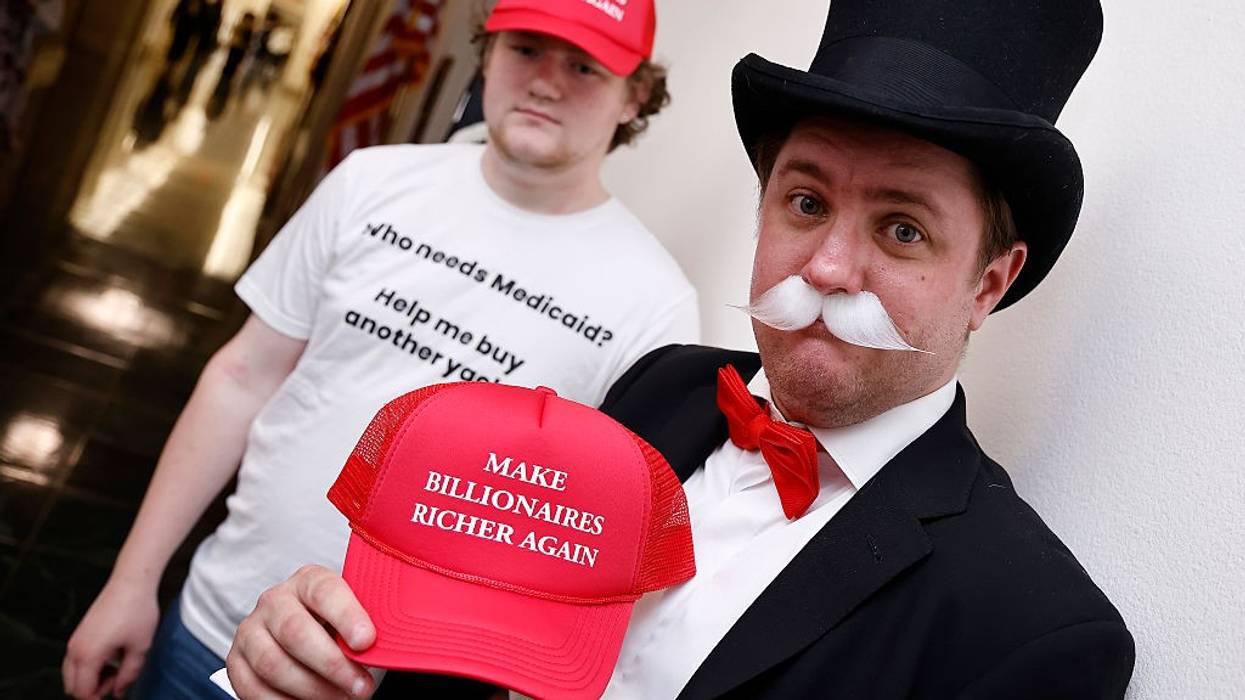
Wealth creates political power; political power produces tax and economic policies favorable to wealth; those policies concentrate still more wealth; and some of that wealth is reinvested in politics to keep the cycle going.
In 1971, corporate lawyer Lewis Powell wrote a confidential memo to the US Chamber of Commerce warning that American business was under attack. Among his complaints were politicians and activists who portrayed tax breaks as benefiting “only the rich” and who dared to set the “rich” against the “poor,” and “business against the people.”
Powell’s solution was not subtle. Corporate America needed political power, and that power “must be assiduously cultivated” and, when necessary, “used aggressively and with determination.” Business should organize, influence the media and universities, build political power, and exploit what Powell called the “vast opportunity” presented by the courts.
Heist: Who Stole the American Dream? traces much of what happened next. Powell joined the Supreme Court and later wrote the majority opinion in First National Bank of Boston v. Bellotti, expanding constitutional protection for corporate spending on ballot measures. Decades later, Citizens United would further expand corporate political spending rights. Meanwhile, Ronald Reagan ushered in enormous tax cuts, deregulation, attacks on organized labor, and an economic philosophy that promised prosperity would trickle down (it never did!).
That brings us to a question I think every politician promising a better future should have to answer: Tell me what you want to do—and tell me who you're willing to tax to pay for it.
More than half a century after the Powell Memo, we’ve got the receipts.
According to a new Americans for Tax Fairness analysis, America’s 977 billionaires now control a record $9.24 trillion. In just one year, their wealth increased by $2.2 trillion, or 32%, while the overall economy grew by about 6%. The richest 16 Americans alone possess nearly $4 trillion, more wealth than all US billionaires combined had less than six years ago.
But those gains look even more extraordinary when we look at what is happening to everyone else. The bottom half of American households collectively owns just over 2% of the nation’s wealth. Nearly 48 million Americans live in households struggling with food insecurity. And the divide between workers and those at the top of corporate America has exploded: CEOs at the country’s 350 largest firms made 325 times as much as the typical worker in 2025, up from 21 times as much in 1965. Since 1978, CEO compensation has risen 1,316%, while typical worker compensation increased just 28%.
Yet as wealth becomes increasingly concentrated at the top, Washington is moving in precisely the opposite direction for millions of working families: massive tax cuts disproportionately benefiting the wealthy alongside deep cuts to Medicaid, food assistance, and other programs people depend on.
That brings us to a question I think every politician promising a better future should have to answer: Tell me what you want to do—and tell me who you're willing to tax to pay for it. Want universal healthcare? Affordable housing? Better schools? Modern infrastructure? A serious response to climate change? A stronger safety net? Great. How are you going to pay for it?
After decades in which an extraordinary share of America's wealth has accumulated at the very top, pretending we can adequately fund those priorities without asking substantially more from those who have accumulated that wealth is not a serious answer.
California's Proposition 40 puts that question directly before voters.
The measure would impose a one-time 5% tax on billionaire wealth, primarily to help protect healthcare from massive federal cuts. In a letter endorsing the measure, six Nobel Prize-winning economists note that California's roughly 250 billionaires now possess $2.3 trillion, up from about $700 billion a decade ago. From 2019 through 2025 alone, those billionaires gained $1.4 trillion in wealth, while the state income taxes they paid during that period amounted to just 1.6% of those gains.
The good news is that none of this is inevitable. These rules were created through political choices, and they can be changed through political choices and organized action.
How have some of California's wealthiest people responded to being asked for a small portion of those enormous gains? By spending an extraordinary amount of money to stop it.
As of October 10, billionaire-backed opposition efforts have reportedly raised approximately $300 million to fight Prop 40, vastly outspending its supporters. The opposition includes Building a Better California, which is also backing Props 41 and 42, competing measures that could potentially block the billionaire tax even if voters approve it.
Think about that for a moment. A small number of extraordinarily wealthy people can spend a quarter-billion dollars influencing an election over whether extraordinarily wealthy people should pay more in taxes.
And California is only one battlefield. American billionaires had already contributed more than $433 million to the 2026 midterms by early this year. Nearly 80% went to Republican candidates and conservative organizations.
This is the feedback loop Powell envisioned, taken to an extreme he might not have imagined: Wealth creates political power; political power produces tax and economic policies favorable to wealth; those policies concentrate still more wealth; and some of that wealth is reinvested in politics to keep the cycle going.
That is why this debate is about more than tax rates. It is about democracy.
It is also why Prop 40 matters beyond California. As the six Nobel economists wrote, passage could help “kickstart a movement” to tax extreme wealth elsewhere. They concluded that this vote could ultimately be remembered as a turning point in the struggle between democracy and oligarchy.
The good news is that none of this is inevitable. These rules were created through political choices, and they can be changed through political choices and organized action.
Vote. Demand that candidates tell us not only what they want to accomplish, but who they are willing to tax to pay for it. Join the No Kings mobilization on October 17. And watch and share Heist: Who Stole the American Dream? to understand how we got here.
Then let's stop the heist.
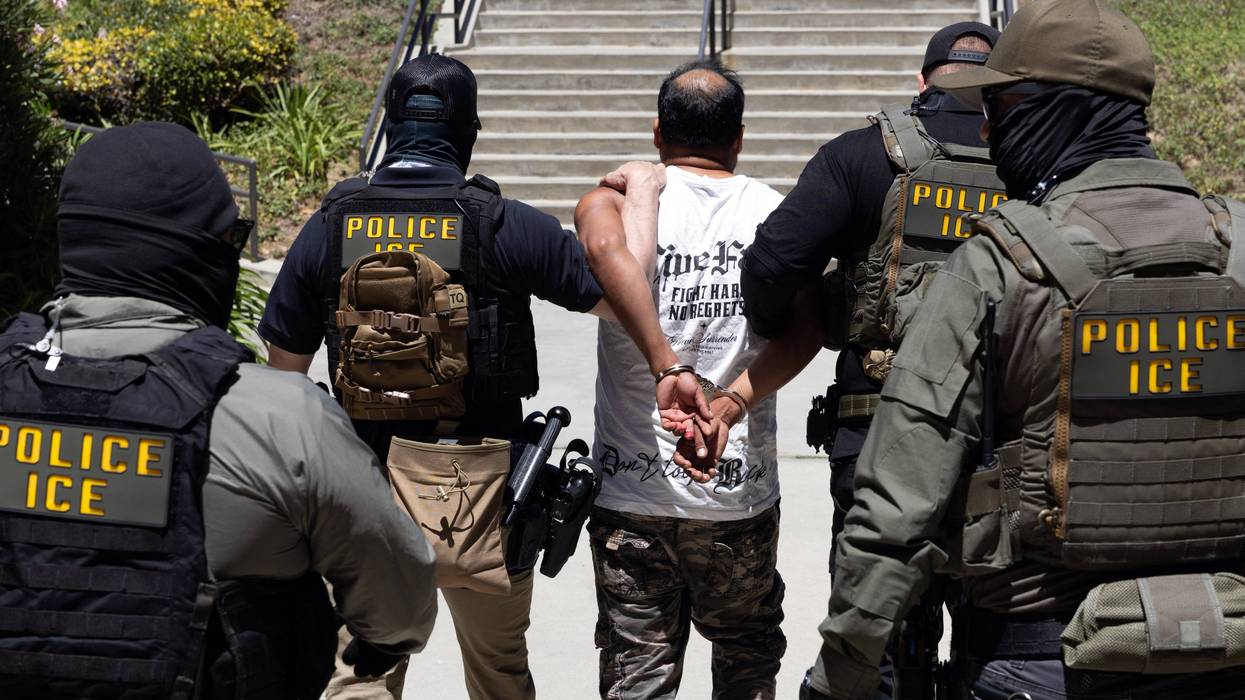
ICE rejected the recommendation to implement automated activation technology for use, making claims that are baseless and somewhat puzzling, especially since some federal law enforcement officers already use automated activation.
The Government Accountability Office, an independent non-partisan watchdog agency, released a report this month finding that the US Customs and Border Protection and US Immigration and Customs Enforcement have unsuccessfully implemented their body camera programs, with ICE failing to meet its own policy initiative of “accurately documenting events” to promote transparency and enhance public trust.
The GAO report noted, “ICE lacks a reasonable assurance of compliance with activation requirements in policy” and for this reason recommended that automated camera activation be used to ensure that body cameras are activated in accordance with its policy. ICE policy stipulates that agents activate their body cameras “as soon as practical at the beginning of an Enforcement Activity and deactivation when the activity is concluded.”
Automated activation technology guarantees that a body camera is automatically switched on the moment an officer draws their firearm or conducted energy device (commonly TASER) to capture as much as an enforcement activity (from start to finish) as possible.
Automated activation for body cameras is already used by federal law enforcement officers, so why not for ICE?
ICE however rejected the recommendation to implement automated activation technology for use with its body cameras citing “significant operational risks, including inadvertent or false activations during routine movement,” while suggesting that accidental activations of its body cameras could record sensitive information, violate privacy, and even contravene the First Amendment.
These claims are baseless and somewhat puzzling especially since some federal law enforcement officers already use automated activation, as do other police agencies across the country.
Consider the VA Police who are federal law enforcement officers of the US Department of Veterans Affairs. According to their policy, body cameras are automatically activated when an officer draws their firearm.
In the case of an accidental activation, VA Police policy classifies such footage under the category of “false activation” and when designated as such, denotes that the accidental footage can be stored for 30 days before deletion whereas the retention of footage categorized as “investigation” may be retained for as long as 25 years.
The VA Police use Axon body cameras, the same devices used by ICE and by many police departments in the US.
Axon body cameras have a “false activation cancellation” option as an additional feature of their body-cameras products, providing law enforcement officers with the ability to “stop accidental or undesired recordings” should they occur. The option is initiated with the simple press of a “cancel button” on the screen of the body camera.
There are obvious worries of the unauthorized deletion of recordings, but such concerns can be addressed with good policy. Consider Section 11 “Accidental Recordings” of the body camera policy of the San Jose Police Department (SJPD) as an example.
Section 11 outlines the process for the handling of body camera recordings that have no evidentiary or investigative value. In such circumstances, the “officer will submit a request for deletion via email” to their direct supervisor. The policy specifies that the request email is to be forwarded through the chain of command. The receiving commanding officer is then responsible for reviewing the accidental footage prior to approving (or denying) the request for deletion. The email chain provides a shared written record to deter any malfeasance and to ensure accountability.
As if all of this wasn’t enough to warrant automated body camera activation for use with its body cameras, ICE has maintained that it will only release footage that “is in the best interests of the agency.” Presumably then any “false activations” of ICE body cameras that capture sensitive information or violate privacy would not be released anyway.
Automated activation for body cameras is already used by federal law enforcement officers, so why not for ICE?
The logical conclusion is that ICE’s failure to adopt automated camera activation into its body camera program is merely a blatant attempt to evade any semblance of transparency and accountability.

There is no legal authority for the president to take control of federal elections or to conspire with House and Senate Republicans to exclude elected Democrats from taking office. But if you think that will stop Trump from trying, you have been asleep for the last 10 years.
“Those who vote decide nothing. Those who count the vote decide everything.” — attributed to Joseph Stalin
If the Trump administration fails to stop Democrats from taking back Congress in next month’s midterms, as nearly all major polls suggest, the MAGA cult is unlikely to accede quietly. The White House and its allies will file a flurry of lawsuits claiming election fraud, demand recounts across the country, pump out incessant propaganda about Chinese and Iranian cyber-interference, threaten to prosecute state election officials and perhaps even seize voting machines, among other gambits.
Should these maneuvers fail, they will set the stage for a decisive “High Noon”-style showdown on Jan. 3, 2027, when the 120th Congress is slated to begin. To maintain Republican majorities in the House and Senate, the president can be expected to wage a final battle of obstruction and orchestrated chaos, possibly culminating in a declaration of a national emergency. If the past is any sort of prologue, he will do anything to avoid the hearings and investigations that will be initiated if the Democrats prevail.
Under the 20th Amendment, a new Congress convenes at two-year intervals at noon on Jan. 3. This is supposed to be a ceremonial event similar to the joint session of Congress that counts Electoral College ballots on Jan. 6 every four years. But as we saw in 2021, ceremony can quickly give way to sabotage.
Each chamber has its own rules for the swearing-in of new and reelected members, and each will present Trump with different opportunities to undermine the election. Writing last month in The New Republic, former US Circuit Court Judge Michael Luttig outlined a scenario in which House Speaker Mike Johnson could use the office of the clerk of the House to alter the outcome of the midterms and precipitate a constitutional crisis in a last-ditch bid to secure Republican control.
The speaker has the unilateral power to remove the incumbent clerk.
The clerk is a nonpartisan administrator whose job on Jan. 3 is to prepare the “roll” of members-elect, which lists all individuals who have been elected and certified by their respective states to serve. After compiling the roll, the clerk calls the members-elect to order. The members thereafter elect a new speaker, who proceeds in turn to swear in the members-elect. The first session of the new House then begins, enabling it to conduct the nation’s business.
Although the clerk’s duties are strictly ministerial, Luttig posits that sometime before noon on Jan. 3, Johnson will replace the current House clerk, Kevin McCumber, with a MAGA loyalist who will refuse to list a decisive number of Democrats on the roll, preventing them from being seated. Under the House’s internal rules, the speaker has the unilateral power to remove the incumbent clerk, and under federal law, the power to replace the clerk with whomever he wishes until the whole House elects a successor.
“McCumber,” Luttig explains, “is a Republican appointed by former Speaker Kevin McCarthy. He is widely respected for his integrity and faithful adherence to the Constitution and is reputed to be unwilling to carry out orders he considers to be unconstitutional.” His replacement could be anyone—Alina Habba, Mike Lindell, Laura Loomer, or any number of other zealots. There are no age, citizenship or even sanity requirements.
Democrats targeted by a rogue clerk will no doubt seek immediate relief from the courts. Luttig believes they will eventually win, relying on a 1969 Supreme Court precedent decision (Powell v. McCormack) that ordered the seating of New York Rep. Adam Clayton Powell, who had been excluded from the 90th Congress by a majority vote of House members despite being duly reelected.
But any such litigation would take time, especially if appeals are taken all the way to the US Supreme Court, which is firmly in the hands of six MAGA-friendly justices. Although Luttig contends that even the Roberts Court would ultimately block the clerk’s action, he has no illusions. Roberts and company could conceivably dodge legal challenges on technical grounds, holding that the issue of the clerk’s authority presents a “political question” beyond its jurisdiction and that any intervention would violate the separation of powers between the legislative and judicial branches of government. In the meantime, the country would be left with a wholly dysfunctional House unable to discharge even its most basic appropriations and budgetary functions.
As might be expected, Luttig has received considerable pushback for his article. Critics on the right have accused him of fearmongering, and some prominent liberal commentators, such as election law expert Rick Hasen, have objected that his scenario is “unlikely” to occur.
What if Vance … refuses to swear in a critical number of Democrats?
But Luttig’s article may not go far enough. It contains no discussion, for example, of what may happen on Jan. 3 in the Senate. Even if Democrats win a majority, Vice President JD Vance will remain the body’s president, and it will be his responsibility to swear in each newly elected or reelected member. What if Vance, following instructions from his boss, refuses to swear in a critical number of Democrats? Legal and political bedlam may be an understatement.
In concert with their House counterparts, the unseated Democratic senators will take to litigation, but that, too, would take weeks if not months to resolve. In the meantime, the seated Republicans will hold the majority.
The other wild card absent from Luttig’s analysis is how Trump might take advantage of the bedlam. Trump’s allies on the extreme right have long urged him to take control of the midterms by invoking his considerable powers under the National Emergencies Act, a post-Watergate reform that was designed to rein in presidential authority but in practice has worked in the opposite direction.
The act accords the president broad discretion to issue an emergency declaration, as long as he specifies at least one existing statutory power that will be used to initiate and combat the emergency. Presidents of both parties have used the act with little congressional oversight. Trump has invoked it at least 21 times to advance such projects as building his southern border wall to stem immigration, promoting fossil fuel production and instituting his tariffs on foreign goods and services. And, while the Supreme Court invalidated much of his tariff regime last February, his other declarations, along with dozens declared by past presidents, are still in force.
There is no legal authority for the president to take control of federal elections or to conspire with House and Senate Republicans to exclude elected Democrats from taking office. But if you think that will stop Trump from trying, you have been asleep for the last 10 years. The best—and perhaps only—way to stop this scenario is to vote in numbers so massive that Trump’s election plots are killed in the crib. We have the power to prevent Jan. 3 from becoming the new Jan. 6. Let’s use it while we still can.
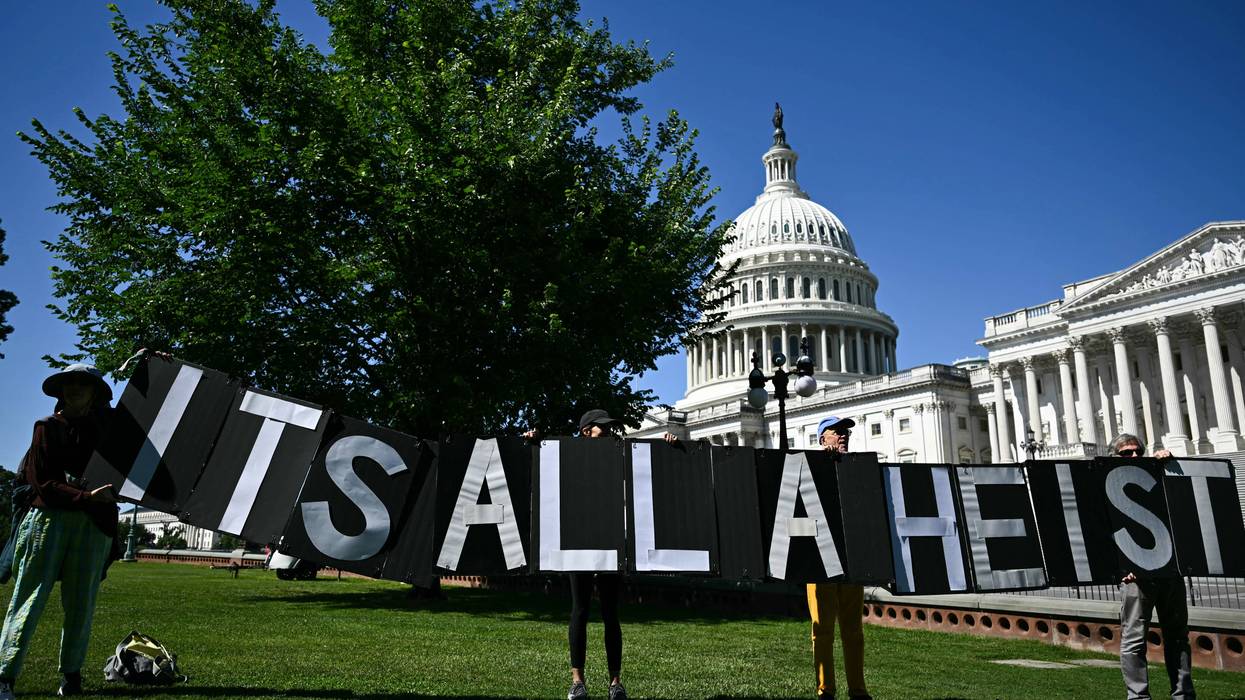
Part of the project of ridding ourselves of Trump must be to rekindle our understanding of the common good and appreciation of what we owe one another as members of the same society.
The Democrats’ focus on affordability seems to be a winning strategy (we’ll know for sure in a little over two weeks). But we mustn’t lose sight of the moral squalor at the core of the Trump regime.
It’s that moral squalor—the utter disregard for the opinions, norms, and ideals of the nation or, for that matter, of humanity—that uniquely marks Trump and the reprobates he has attracted to Washington. It has also poisoned much of the Republican Party, including the billionaires and tech bros who finance it.
To put this despicable era behind us, we’ll need to renounce and reverse this squalor.
What are loosely described as Trump’s “conflicts of interest,” for example, extend way beyond enriching himself from his presidency. He has violated the basic norms of presidential decency.
He just decided to host the Group of 20 annual summit of world leaders at his private golf club in Miami in December. When he sought to do this during his first term, it was viewed as a blatant violation of the emoluments clause of the Constitution. Now, after America’s moral sensibilities have been numbed by Trump’s appetite for foreign gifts—such as Qatar’s “donation” of a $400 million jumbo jet—it barely merits a mention.
He sells advance notice of his market-altering announcements for $100,000 a month, thereby profiting by tipping off people who trade on the information before it becomes publicly available. He files a trademark application for “Trump TV” to control the name of a streaming service that the White House uses for official presidential communications, thereby pocketing the benefits from taxpayer funds used to create and run the channel.
His family-backed crypto firm introduces a stablecoin just months before he signs legislation promoting it. His wife is paid tens of millions for a self-promotional film by Jeff Bezos’s Amazon, a federal contractor and major retailer subject to a myriad of regulations. His son has a Russian oligarch, close to Putin, pick up the tab for part of his wedding afterparty in the Bahamas.
He arranges for the Justice Department to grant him and his family immunity for any back taxes and penalties they might owe.
And so on. Trump has tossed away all constraints on making money off his presidency “because I got no credit in the first term” and “I found out that nobody cared.”
Credit? Someone who is entrusted with the highest office in the land must receive “credit” for doing what’s right, in order to continue doing what’s right? Nobody cares? A president can embrace corruption if the public doesn’t mind?
It’s not just the blatant self-dealing. His moral squalor extends to every aspect of governing.
He lies incessantly—a gushing firehose of deception.
His foreign policies make Henry Kissinger’s realpolitik seem principled by comparison. He orders the abduction of the president of another nation, installs a new president of his choosing, and announces he’s taking that nation’s oil—and doesn’t even account for what he does with the oil money.
He attacks Iran without consulting America’s traditional allies or even Congress.
Eager to reduce diesel prices (which are hurting Republicans in the midterms), he turns his back on Ukraine and sides with Putin, the aggressor in that conflict—making a deal to import Russian diesel fuel (a windfall for Putin who can now bomb Ukraine even harder) while demanding that Ukraine stop attacking Russian oil refineries. Trump then blames Ukraine president Zelenskyy for high oil prices rather than Trump’s own war with Iran, and says Ukraine should get a new president.
If this isn’t moral squalor, I don’t know what is.
The squalor also extends to usurping the authority of Congress to decide on tariffs, wars, and whether and how to spend taxpayer money.
And extends to his cynical defiance of Supreme Court orders. When the high court invalidates Trump’s tariffs, he reimposes them under a different statute. When the court rules that he doesn’t have grounds to remove a member of the Fed board of governors, he concocts a means to do so anyway. When the court says he has to remove his name from the Kennedy Center, he closes the center and threatens to demolish it.
It extends to his using the Justice Department and the FBI to prosecute people who have stood up to him, including courageous judges and prosecutors.
It extends to his overt bigotry and racism—claiming Mexicans are “bringing drugs and crime”; calling Somali-Americans “garbage” and denouncing “what they’ve done to Minnesota, these people from Somalia”; and taunting Muslims (calling Dr. Abdul El-Sayed, the Democratic Senate candidate from Michigan, “Mohammed”).
It extends to giving a gigantic tax cut to America’s wealthiest people, financed by cutting nutrition assistance and health care to America’s most vulnerable people.
The moral squalor has turned much of America into a police state—terrorizing large numbers of people residing here, including many here legally. Deploying ICE agents at schools, courthouses, and hospitals. Forcibly taking parents away from their children. Allowing masked gunmen without identification to grab suspected undocumented immigrants off our streets, from their cars, and out of their homes—giving them no opportunity to defend themselves in front of third parties before putting them into often overcrowded and unhealthy prisons or sending them to other countries where they’re imprisoned. Killing and murdering—even murdering Americans who are trying to monitor their activities—then refusing even to conduct official inquiries into the murders.
When asked if there are limits to his authority, Trump replies: “Yeah, there is one thing. My own morality. My own mind. It’s the only thing that can stop me.”
“My own” morality is no morality at all. Morality reflects collective judgments about right and wrong, shared values about what we owe one another as citizens of the same society. Morality refers to the ideals we seek to achieve together.
Trump is not guided by any sense of right and wrong. He is guided only by what enriches him or gives him more power and glory—a nihilistic might-makes-right ethos in which the strong do whatever they want and the weak suffer what they must.
To be sure, Trump’s moral squalor could not have permeated America—he could not have been elected a second time—had our shared norms and ideals not already been compromised.
Vast inequalities of income and wealth, coupled with a growing sense that the social contract at the heart of the American system was coming undone and that those at the top have rigged the game, were already fueling anger and distrust. Trump ignited that fuel.
But without shared ideals or common moral values, there is nothing pushing back against this despicable president and regime—no countervailing moral force against the ongoing squalor.
Part of the project of ridding ourselves of Trump, therefore, must be to rekindle our understanding of the common good and appreciation of what we owe one another as members of the same society.
Of course we must make life more affordable; Democrats are wise to emphasize this in the midterms. But we also must demand common decency from our president.
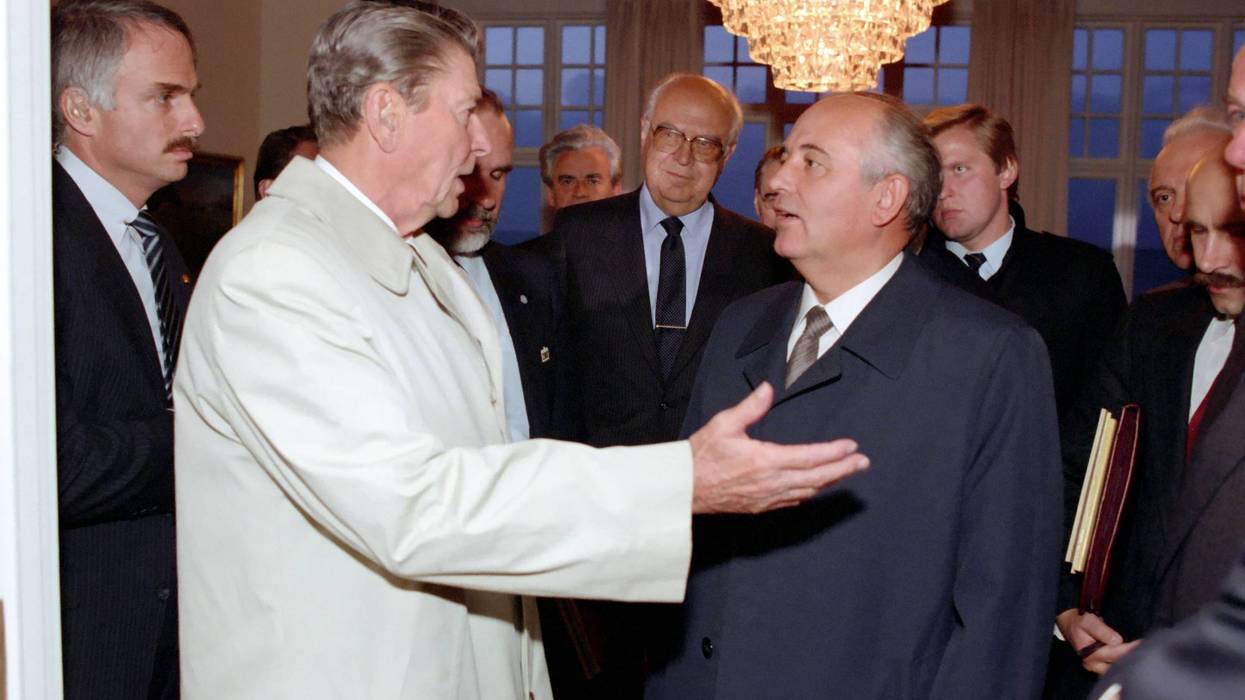
Four decades ago, US and Russian leaders came closer than ever to eliminating all nuclear weapons. How can we keep that vision alive today?
Forty years ago this week President Ronald Reagan and Secretary General Mikhail Gorbachev met from October 11-12 in Reykjavík, Iceland in a hastily organized summit that came closer to the complete elimination of all nuclear weapons than at any point in our nuclear age. This was a time at the peak of the Cold War, when there were roughly 70,000 nuclear weapons in the global arsenals and the Bulletin of Atomic Scientists Doomsday Clock was set at three minutes till midnight.
Meeting in Geneva in November 1985, the year before, the two leaders made their joint declaration that “a nuclear war cannot be won and must never be fought.” The two Cold Warriors shared an understanding of the horror of nuclear weapons.
The Icelandic summit between the two leaders came together quickly after Reagan gave a speech to the United Nations General Assembly in September 1986 calling for a nuclear arms reduction accord. This was followed closely by Secretary General Gorbachev extending an offer to meet in October culminating in the Icelandic Summit.
Nuclear war is a real and present danger. It is not a future that must be. But it is the future that will be if we do not act.
At Reykjavík, Gorbachev argued for a 50% reduction in strategic nuclear weapons and total elimination of all intermediate range missiles deployed in Europe. Back-and-forth discussions continued throughout the summit, and in the final hours, Reagan proposed the complete elimination of ALL nuclear arms. The caveat was his unwavering commitment to the flawed Strategic Defense Initiative or so-called “Star Wars,” a protective shield over the planet to protect from nuclear attack. He wanted testing and development to be allowed in space.
In the final hours, Gorbachev insisted that testing be limited to the labs and not in space. And thus the talks collapsed and humanity lost its greatest chance to date to eliminate these weapons.
This summit paved the way for continued dialogue and, in the years to follow, serious, though far less magnanimous, arms control agreements were reached. These included the Intermediate Nuclear Force Treaty, INF, which eliminated an entire class of nuclear weapons, and the 1991 START Treaty dramatically removing approximately 80% of the world's strategic nuclear weapons.
Fast forward 40 years to October 2026. While there have been dramatic reductions in global nuclear arsenals to 12,187 weapons we find ourselves much closer to nuclear war than at any time throughout the entire 81-year nuclear age.
We have the leaders of the two largest nuclear powers reminding the world of their nuclear arsenals and threatening to use them, whether in Russia’s war on Ukraine or Trump‘s repeated threats throughout his terms, both in terms of nuclear button size envy and threats to bring fire and fury on adversaries. His lack of leadership in arms control has allowed treaties to expire on his watch. His careless media bravado in April, posting “a whole civilization will die tonight never to be brought back again,” does little to resolve crises of his own making. Just last month, speaking to world leaders at the 81st opening sessions of the United Nations General Assembly, he asked, “Would there be a deal that let Iran rebuild a greater country than it ever was before?“ After which he considered whether to “annihilate the Islamic Republic” and “drive them into hell with no chance of survival and hope of future greatness or generations?“
Analogous to “Star Wars,“ Trump‘s obsession with being top dog has resulted in his own “Golden Dome,” a proposal to provide an impenetrable shield from a nuclear attack. At a projected cost of $1.2 trillion, the program with a projected success rate of 80% would be better named the “golden sieve.”
Taking into account these nuclear realities, the Bulletin of Atomic Scientists this year moved their Doomsday Clock minute hand to 85 seconds to midnight, which is the closest it has ever been since its inception.
In making their decision they have considered:
Nuclear war is a real and present danger. It is not a future that must be. But it is the future that will be if we do not act. If we do nothing then it is not a matter of “if” nuclear weapons will be used, it is a question of “when.” There are no “right hands” when it comes to controlling the nuclear button, but it is obvious that Trump’s hand must be removed from that possibility. As citizens, we must demand the United States move Back From the Brink of nuclear war, and lead a global effort to abolish these weapons once and for all.
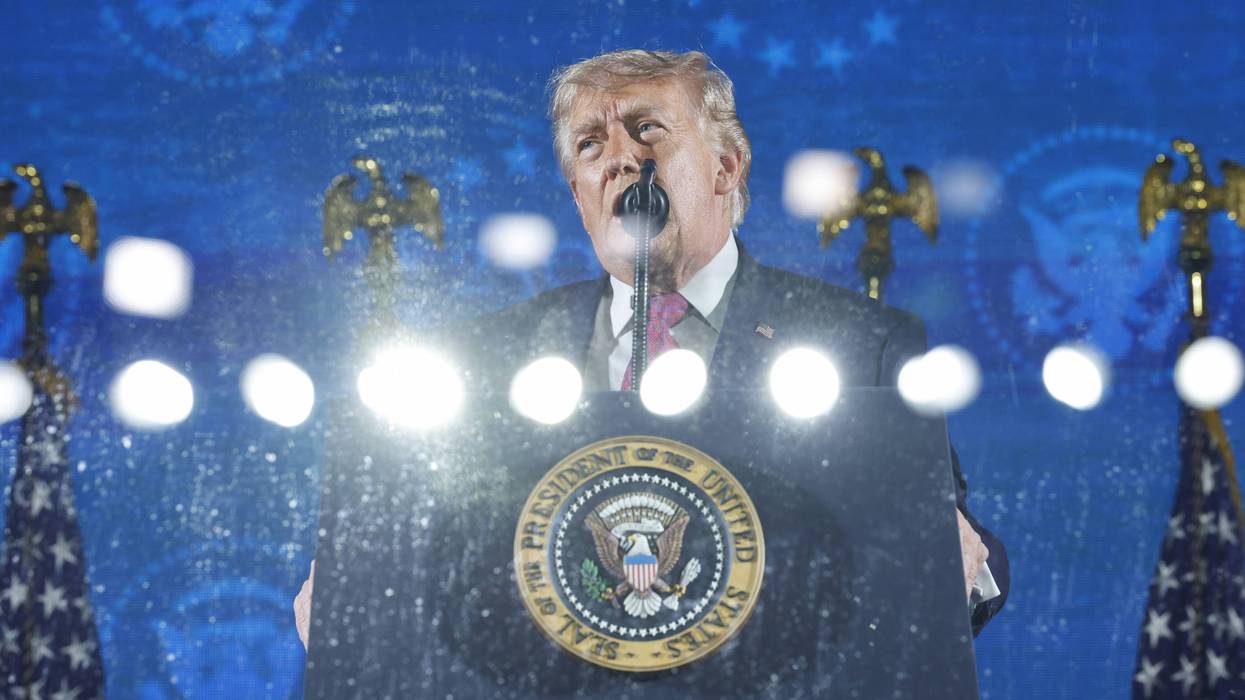
President Donald Trump has reenergized the Red Scare by labeling Democrats as communists, but this is ironic as today’s real threat is Trump’s authoritarianism and his dictatorial goals.
In his 1951 treatise, The True Believer, Eric Hoffer saw the fanatical leaders of communist and fascist states—Joseph Stalin and Adolf Hitler specifically—as fundamentally products of the same cloth, cloth different from, he quoted, the “Social-Democrat and the trade-union boss.” Stalin may have been a communist and Hitler a fascist, but similarly each a dictator.
Stalin forged a centralized, and brutal, control of the national economy under the guise of continuing the proletarian class struggle earlier led by Vladimir Lenin. Hitler led a racial struggle murdering millions of Jews and others with the goal of establishing a nation for the so-called Aryan race.
Today, with the midterm elections in November, President Donald Trump frames Democrats as the embodiment of communism, as the authoritarian threat America faces. This while Trump has also praised the communist leader, Xi Jinping, in China; Vladimir Putin in Russia; and the right-wing leadership of Viktor Orbán in Hungary, among similar leaders.
the hypocrisy is clear in Trump saying if Democrats win in the midterm elections they would threaten individual liberty as a caucus of communists.
And what is the leadership style shared by Orbán, Jinping, and Putin? Authoritarianism is the correct answer. Leaders, in Hoffer’s treatise, of the same cloth. Cloth Trump appears to want to dress himself in.
Since the defeat of Hitler, with the advent of the Cold War after World War II, communism has been seen as the major threat to the American way of life. Concern with the global spread of communism, after all, framed the context leading the US into the Vietnam War.
Richard Nixon, when the vice president, wrote on the threat of communism opening his essay in 1960 stating that, I quote, the “major problem confronting the people of the United States and free peoples everywhere in the last half of the 20th century is the threat to peace and freedom presented by the militant aggressiveness of international communism.”
Nixon’s warning followed the Red Scare that gripped America after World War II, often referred to as McCarthyism for the Wisconsin senator, Joseph McCarthy. McCarthy’s singular claim to fame, and eventual disgrace, was his anti-communism agenda in the 1950s as the chair of the Senate Permanent Investigation Subcommittee with his allegations of communist infiltration in the US government, the Army and, notoriously, Hollywood.
President Trump in his speech on July 4, during this year’s celebration of the 250th anniversary of the United States on the National Mall, hailed the triumph over both fascism and communism saying that “after we vanquished fascism [in World War II], Americans stood against the evil of communism in the Cold War.”
Ever since, as far as I am aware, he hasn’t mentioned any war against fascism. He targeted only communism in the reminder of his speech on July 4, telling the audience: “America will never be a communist country. Won’t happen... It’s like a cancer. You have to cut it out and you got to cut it out fast.”
Trump has polished his aim as the midterm elections in November have grown closer, alluding to the Democratic Party becoming the seat of communism in America. At the Republican midterm convention in Texas on September 9, Trump said that (his words) “the Democrat establishment has been overthrown and replaced by crazed lunatics and radicals. They call themselves Democrat socialists, but actually they’re communists.” Then he added that if “they win the greatest legislative body in history will for the first time ever be controlled by a communist caucus.”
In labeling Democratic candidates as communist, Trump diverts attention from failures in his policies and his growing and sustained disapproval.
The backdrop to Trump’s painting votes for Democrats as a vote for a communist takeover of the United States has been the emergence of a small minority of Democratic candidates with membership in the Democratic Socialists of America (DSA), following the success of Zohran Mamdani, New York City’s DSA-member mayor.
With that backdrop fueling Trump’s anti-communism rhetoric, other Democratic candidates in the midterm elections unaffiliated with DSA, like Michigan’s Democratic Senate candidate Abdul El-Sayed, have even had to emphasize they are not socialists and embrace capitalism.
The terms “socialism” and “communism” seem for many to represent the same entity, though in practice meaningful distinctions exist. In any case, polls have focused on opinions of socialism.
The subtitle to a research report in 2022 from Pew Research Center on views of socialism among Americans reads: “Many Democrats say socialism meets people’s basic needs; Republicans say it restricts individual freedoms.”
Among Democrats and those Democrat leaning in 2019, 65% reported viewing socialism positively, with 57% so viewing in 2022. Only 15% of Republican and Republican-leaning voters held a positive view of socialism in 2019, with 14% doing so in 2022.
In a more recent survey by Gallup in 2026, 65% of Democrats had an overall positive view of socialism compared with 45% among Independents and 14% of Republicans.
Regarding Authoritarianism. In her 2016 article at Vox, Amanda Taub chronicled research on how the rise of American authoritarianism, especially in the Republican Party, preceded and fertilized Trump’s rise to power. She highlighted the work of social scientists like Stanley Feldman, who saw authoritarianism more as a personality trait than simply a political preference. A trait highly valuing hierarchy, order, and conformity over other attributes. A trait Feldman measured by four questions on child-rearing goals, such as, “Please tell me which one you think is more important for a child to have: obedience or self-reliance?”
Vox commissioned a study in 2016 on the relationship between authoritarianism and perceived threats to one’s way of life. Summarizing some of the findings, Taub wrote:
…that 44% of white respondents nationwide scored as "high" or "very high" authoritarians, [and that] people in this 44% only vote or otherwise act as authoritarians once triggered by some perceived threat, physical or social. But that latency is part of how, over the past few decades, authoritarians have quietly become a powerful political constituency without anyone realizing it.
Over 65% of those scoring highest on Feldman’s authoritarianism scale were Republican voters. Whereas individuals whose scores were the most non-authoritarian, by always selecting the non-authoritarian parenting answers, were almost 75% Democrats.
These results, Taub emphasized, didn’t mean authoritarian-leaning folks were inherently Republicans. Rather, changes in the Republican Party’s platform attracted more authoritarians. Becoming the party promising “to stave off social change and, if necessary, to impose order happened to speak powerfully to voters with authoritarian inclinations,” Taub wrote. On the other hand, Taub wrote, “Democrats, by contrast, have positioned themselves as the party of civil rights, equality, and social progress—in other words, as the party of social change, a position that not only fails to attract but actively repels change-averse authoritarians.”
A more recent study in 2024 by the Public Religion Research Institute had related findings using a different measure of authoritarianism, the Right-Wing Authoritarian Scale. Among Republicans, 67% scored high on this authoritarianism scale, compared with only 35% among independents and 28% of Democrats.
A Perplexing Phenomenon. Those with more authoritarian inclinations, that is Republicans, are also more likely to view socialism as an authoritarian menace threatening their freedoms.
Perhaps the answer to this riddle is that the scope of concern over freedom among those with ingrained authoritarian traits may be more limited to concerns over their freedoms only, not freedoms among other groups; a hypothesis worthy of further study.
Whatever the case, the hypocrisy is clear in Trump saying if Democrats win in the midterm elections they would threaten individual liberty as a caucus of communists.
The Republican Party remains today a major seat of authoritarianism in the United States, and the supportive arm of Trump’s would-be dictatorial rule threatening individual freedoms.
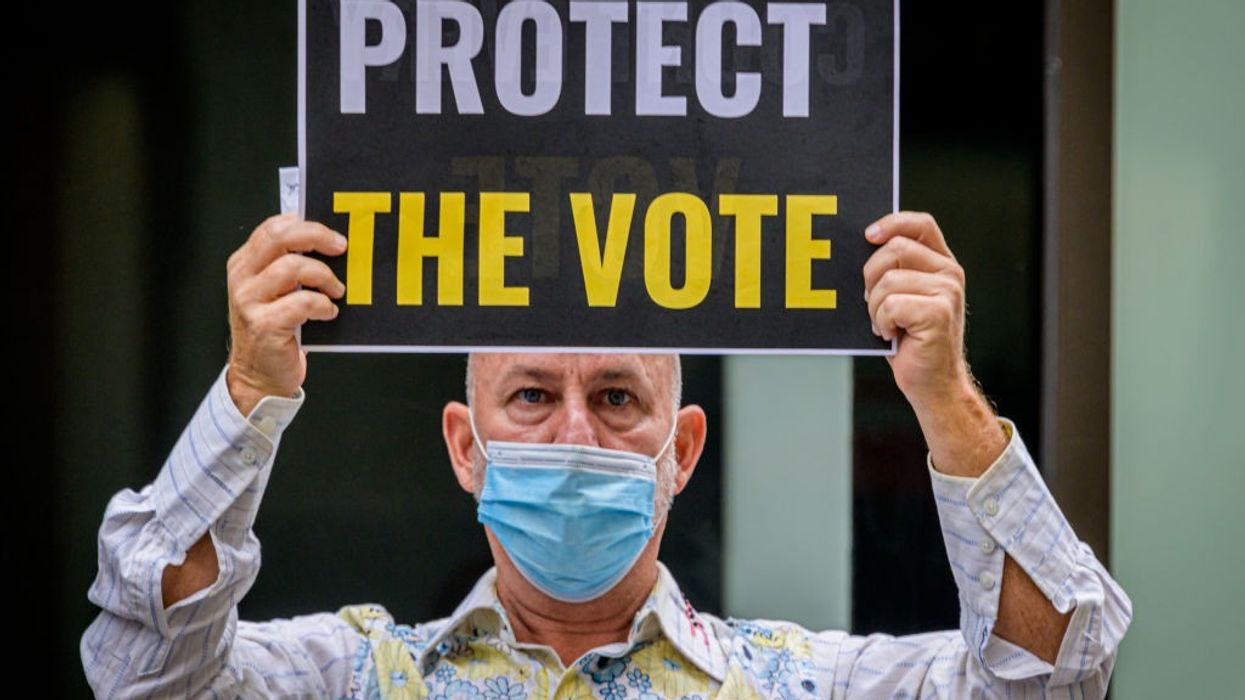
Republican secretaries of state are bragging about the millions of Americans whose right to vote they’re “purging” from the voting rolls this year. How are they getting away with it?
With virtually no mention or reporting in the corporate press, Republican-run states are again running the voter purge of millions that gave Donald Trump the White House in 2024.
On Wednesday morning, Reuters published a special report on the ways the Trump administration could “interfere” with the midterms, noting that a lawyer in Idaho’s Republican attorney general’s office bragged that his state had “taken a leading role in ensuring its voter registration list is purged….”
Yep, they used the word “purged.” They’re not even bothering with the polite terms anymore.
Your “right to a gun” is real but your “right to vote” is not, at least as long as corrupt Republicans control the Supreme Court and Congress.
And it’s not like the Republicans really believe the mythology they’re trying to sell the rest of us. The GOP-aligned, billionaire-funded Heritage Foundation spent over a decade doing a deep dive into every state looking for voter fraud and noncitizen voters, examining every American vote since 2000—more than a billion ballots cast nationwide—and found just 89 cases of noncitizen voters. In more than 20 years!
The libertarian Cato Institute did a similar analysis specifically on the 2020 election looking for any evidence that Trump’s claims were right that the election was “stolen” from him by “Mexicans” voting in the US election. They concluded the same thing:
There are likely many problems with America’s voting system and there is no doubt that a non-zero number of noncitizens illegally voted, but there is no good evidence that noncitizens voted illegally in large enough numbers to actually shift the outcome of elections or even change the number of electoral votes.
Nonetheless, Republicans keep promoting their lie that “illegals are voting” to justify massive purges of legal voters whose only crime is being Black, Hispanic, living in a college town, or being a big city dweller in a red state. A likely Democratic voter, in other words.
And let’s not forget that hypocrite Trump himself is all in on encouraging voter fraud; at his “midterm convention” in Dallas a few weeks ago he had thousands of people raise their hands and repeat an oath after him:
I don’t care if I’m registered or not, I’m going to try and cheat like hell...
And the Reuters story comes three weeks after six corrupt Republicans on the Supreme Court let Trump’s Department of Homeland Security, run by former plumber Markwayne Mullin, turn an Immigration and Customs Enforcement immigration database called SAVE into a bulk voter-purging machine right in the middle of an election.
When Texas ran its registered voters through SAVE they purged thousands of people wrongly flagged as noncitizens; League of United Latin American Citizens is suing to try to get these actual citizens voting rights restored.
Which all raises a question that I’ve been asking on the air (and in my book The Hidden History of the War on Voting) for years:
Why is it that if a Republican governor wants to take away your gun he has to go to court, but if he wants to take away your vote he doesn’t even have to notify you?
You’ll recall that back in 2008 five corrupt Republicans on the Supreme Court declared that we all have an absolute constitutional “right” to own a gun, and if any state or city wants to violate that right they have to go before a judge and present evidence that you can contest and even appeal all the way to the Supreme Court itself.
When we have a “right” in America and our government wants to take it away, they have to provide notice, irrefutable evidence, a courtroom and neutral judge, a finding, and a right to appeal. It’s called “due process” and is established by the Fifth and 14th Amendments.
And in 1993, Congress passed and Bill Clinton signed a law establishing—without any ambiguity—that your vote is also a “right.” The National Voter Registration Act (NVRA) lays it out clearly:
“[T]he right of citizens of the United States to vote is a fundamental right,” and that “it is the duty of the Federal, State, and local governments to promote the exercise of that right.”
And the phrase “right to vote” also appears five times in the Constitution itself, more than any other right that document names (guns get a single mention).
So, why is it that Republican secretaries of state are bragging about the millions of Americans whose right to vote they’re “purging” from the voting rolls this year? And how are they getting away with using junk-mail-appearing postcards to justify those purges?
In 1981, the Republican National Committee sent letters to Black and Hispanic voters in New Jersey to “verify” their voting status; they built a challenge list of 45,000 people and posted off-duty cops at polling places in predominantly Black and Democratic Newark and Trenton to check names to challenge those voters.
The Democratic Party sued against this practice, called “caging” in the direct mail industry, and won a court order blocking the Republicans from doing it. That consent decree expired in 2018, though, the same year that five corrupt Republicans on the Supreme Court told Ohio Secretary of State John Husted that he could resume the practice, but this time instead of the GOP paying for it the cost of mailing the postcards could be covered by Ohio taxpayers.
Justice Stephen Breyer’s dissent pointed out the obvious fraud of it, noting that on average around 4% of Americans move their residence every year but:
The record shows that in 2012 Ohio identified about 1.5 million registered voters—nearly 20% of its 8 million registered voters—as likely ineligible to remain on the federal voter roll because they [allegedly] changed their residences.
Now the practice has spread to virtually every Republican-controlled state. They send out millions of postcards that look like junk mail, and if you don’t return one and skip an election, you’re officially purged. They don’t even have to notify you; you find out when you show up on election day and they either turn you away or give you a “provisional” ballot.
During and after the 2024 election, my radio and TV show’s phone lines were jammed with people—many from big cities in Ohio and Georgia—complaining that this had happened to them and they’d just discovered it when they tried to vote. None had been notified.
And, sure enough, the provisional ballots were the tell that exposes this GOP scam. The Election Assistance Commission’s (EAC) own survey of the 2024 election found that 1,736,209 Americans were shunted onto provisional ballots that year, and that the single most common reason was that the voter “did not appear on the list of eligible voters.”
Provisional ballots are often not counted at all, unless the voter shows up at the Secretary of State’s office before the final count to certify that they are, in fact, a legal citizen and voter.
Since the Husted decision by the Supreme Court allowing this bizarre practice, Republicans have put their corrupt system into hyperdrive. That same EAC federal survey found that GOP-controlled states sent out nearly 40 million “confirmation postcards” in just the two years between the 2022 and 2024 elections.
As a result, more than 21 million registered voters were stripped from the voting rolls in the months leading up to the 2024 election, and the most common justification was that they failed to return that junk-mail postcard.
Reporter and former statistics professor Greg Palast testified about this in federal court for the NAACP and, here on Hartmann Report, detailed how his team went through Georgia’s purge list person-by-person.
They found 198,351 Georgians who’d been cancelled even though they hadn’t moved and were still (mostly Black) citizens. In Wisconsin, where former Vice President Kamala Harris lost by 29,397 votes, Republicans had purged 166,433 voters from the lists. Pennsylvania had purged 360,132 people, about three times Trump’s margin of victory in that state.
His conclusion was straightforward:
Trump lost. That is, if all legal voters were allowed to vote, if all legal ballots were counted, Trump would have lost the states of Wisconsin, Michigan, Pennsylvania, and Georgia. Vice-President Kamala Harris would have won the Presidency with 286 electoral votes.
And, if not for the mass purge of voters of color, if not for the mass disqualification of provisional and mail-in ballots, if not for the new mass “vigilante” challenges in swing states, Harris would have gained at least another 3,565,000 votes, topping Trump’s official popular vote tally by 1.2 million.
In other words, your “right to a gun” is real but your “right to vote” is not, at least as long as corrupt Republicans control the Supreme Court and Congress.
Imagine, for example, what would happen if your county sheriff started confiscating guns from people who failed to mail back a postcard. The right-wing press would be hysterical, and the court would strike it down in a New York minute.
So here’s where we are today. Georgia’s Brad Raffensperger (pronounced “Raff - ens - purger”) cancelled nearly 471,000 registrations last August, 6% of the entire state, the majority Democrats according to a Fair Fight analysis.
When Black Voters Matter asked for the records behind the purge, Raffensperger’s office handed over a stripped-down spreadsheet, and they had to sue him to try to get the names. Ohio’s Frank LaRose published a list of 352,389 names for cancellation just this past year, following a 2024 purge in which Ohio Democrats documented more than a thousand wrongly removed voters in Cuyahoga County alone.
Meanwhile Trump’s Justice Department has filed 31 lawsuits against states and the District of Columbia to seize their full voter files, including driver’s license and partial Social Security numbers, so the whole country can be run through his flawed SAVE purging database.
Republicans can’t win elections on their track record of taking away healthcare, gutting the Social Security Administration, and handing massive tax cuts to billionaires, so they send postcards into Black and Hispanic neighborhoods and college towns. The only thing that’s changed since Jim Crow, in other words, is the technology.
Democrats in Congress tried to fix this situation in 2022 with the Freedom to Vote: John R. Lewis Act. It passed the House and had a majority in the Senate, but every Republican in the Senate joined in a filibuster. If Sens. Kyrsen Sinema (I-Ariz.) and Joe Manchin (D- W. Va.) hadn’t stabbed us all in the back by voting with Republicans to sustain the filibuster, these crimes against our democracy would be explicitly illegal, as they already are in every other advanced nation in the world.
Fixing this—codifying our “right to vote” per the NVRA from 1993 and with new legislation—has to be right up there with overturning the other most-corrupt action to come from Republicans on the court, aka Citizens United.
But none of that will ever happen if Republicans continue to control the House and the Senate so Trump can further disintegrate our republic and turn us into his beloved Russia before the 2028 election.
So, vote!
And please share this article with your friends in red states, support independent journalism by subscribing to The Hartmann Report, and pass it on. They can’t purge all of us if we’re all watching.
Honestly, you couldn’t make most of this up, could you?
Here’s the truth of it: after all these years, today I don’t know what to write about.
I mean, in this ever-stranger world of ours, where even to start?
Oh, wait, give me a second and I’ll be right back! I don’t want to miss the latest ads featuring our president, paid for with millions of our tax dollars. It’s obviously important to check them out since, as he told us recently, “I’m not promoting myself because I’m not running for office. I’m promoting the country.” And who wouldn’t want him to reassure us about the state of this fair land of ours?
As he put it in one of those ads, “America will never be a communist country.” Whew! Who among us wasn’t worried about that!
Oops, and here I am again! It certainly seems as if my country (though, in truth, it doesn’t exactly feel like mine anymore) is now, to use a classic phrase, distinctly up shit’s creek without a paddle -- unless you consider Donald Trump a paddle. If so, there’s little question, of course, that he’s paddling us all to hell and back. And mind you, as I was writing this, the latest polls of voters for the upcoming November elections suggested that I wasn’t alone in thinking such thoughts. A surprising number of Americans, even ones who once voted for him (yes, him!), are now clearly worried that “our” president has put us on that very pathway to hell and, worse yet, the “and back” in that phrase (”to hell and back”) might no longer apply to this all-American world of ours.
Even more strikingly, we are evidently on a planet that, in terms of habitability -- from the historic (or do I mean ahistorical?) El Niño now developing in the Pacific Ocean to heat, drought, fire, you name it -- seems to be going down, down, down, again without a paddle in sight. We are, of course, living in an ever-hotter new world (and not faintly in the ancient all-American sense that the phrase “new world” once had). After all, with record seasonal heat from Europe to North America and distinctly beyond, we humans (not to speak of alligators, elephants, penguins, and turtles) are clearly living on a different planet in a fashion that should seem all too devastating to so many more of us than it evidently yet does.
Just consider it good luck that you and I aren’t polar bears living in a distinctly (yes, that word again!) heating Arctic -- its sea ice having “shrunk by nearly half a million square kilometers per decade since 1979, equivalent to losing an area the size of Spain every 10 years.” In fact, congratulate yourself if you’re not living in the Swiss Alps, where glaciers have lost nearly one-fifth of their volume over -- no, not the past half-century but the last five years! -- and between July and September of this year alone, around an additional 2.2 trillion liters of water. Oh, and it’s not just on land either. After all, “more than 90% of emperor penguin colonies could be near extinction by 2100 if sea ice loss persists at its current rate.”
Of course, in such a world, it won’t necessarily just be animals potentially going extinct but, perhaps somewhere down the line, we humans, too. (Okay, you’re right! We are indeed “animals.” I certainly didn’t mean to argue with you about that!)
Donald Trump Is Doing His Damnedest to Take Us All Down with Him
Although all of what I cited above represents the latest news and figures I could find, none of it should really surprise us. After all, it shouldn’t have been hard to learn that such a world was on the way, with one record year of heat succeeding another, and that far worse is clearly still to come. And yet, imagine that, somehow, in 2024, in a world already setting heat records globally, the American people elected a president -- for the second time, no less -- who refuses even to admit that anything whatsoever climate-related is happening on this planet. (I was tempted to write “of ours,” but it really isn’t anymore, is it?). He, of course, made it all too clear during that election campaign and thereafter that he considered climate change a “con job.” (Someday, he himself will undoubtedly be known as the con-job president.)
We’re talking about an 80-year-old guy who’s clearly starting to lose it (and given that I’m referring to Donald J. Trump, who even knows quite what that “it” means). In the process, he’s quite literally doing his -- yes, what an appropriate world under the circumstances! -- damnedest to take us all down with him.
Worse yet, in the midst of what should be the greatest crisis in human history, we -- in particular Donald Trump (Iran), Vladimir Putin (Ukraine), and Benjamin Netanyahu (Gaza and Southern Lebanon, not to speak of Iran, too), and of course local leaders from Myanmar to Sudan to Somalia (again with a helping hand from Donald Trump) -- seem to be doing our damnedest to make things so much worse, since war pours fossil fuels into the atmosphere in a stunning fashion.
And keep in mind that Vladimir Putin, the climate-change-averse leader of Russia, has now begun threatening to turn to that other method of global destruction humanity possesses for the first time since my country dropped atomic bombs on Hiroshima and Nagasaki in August 1945 to end World War II. I’m thinking about nuclear weapons, of course, to salvage (or do I mean savage?) his war in Ukraine. (Oh, and he seems to be planning, however indirectly, to harm Ukraine’s nuclear power plants as well.)
Honestly, you couldn’t make most of this up, could you? And who even knows what I’ve left out. As for the future, however uninventive we may be when it comes to lending this planet a hand, give us full credit, since we continue to be all too inventive when it comes to making war on each other and increasingly on the planet itself.
In early October, as I was writing this, the weather in my town, New York City, breached 80 degrees, and they’re predicting warmer-than-usual weather all fall here. (What a shock!) Of course, no one should be faintly surprised by that or any other news like it. Across the planet, an increasing heat hell seems to be causing violent avalanches in the Himalayas and wiping out glaciers in the Alps. In fact, you name it and it’s probably already happening on this ever more disturbed planet of ours.
And worse yet, count on this: unless we act with reasonable focus and speed, everything I’ve mentioned is likely to grow so much worse in the years to come. Yes, in terms of green energy, we increasingly have the means to put a brake on all of this. But perhaps it tells you everything you need to know that China, the greatest producer of green energy (and the equipment to make it) on this planet right now, also remains the greatest user of fossil fuels.
And don’t even get me started on that giant user of fossil fuels, AI!
All in all, tell me that we’re not indeed up shit’s creek without a paddle.
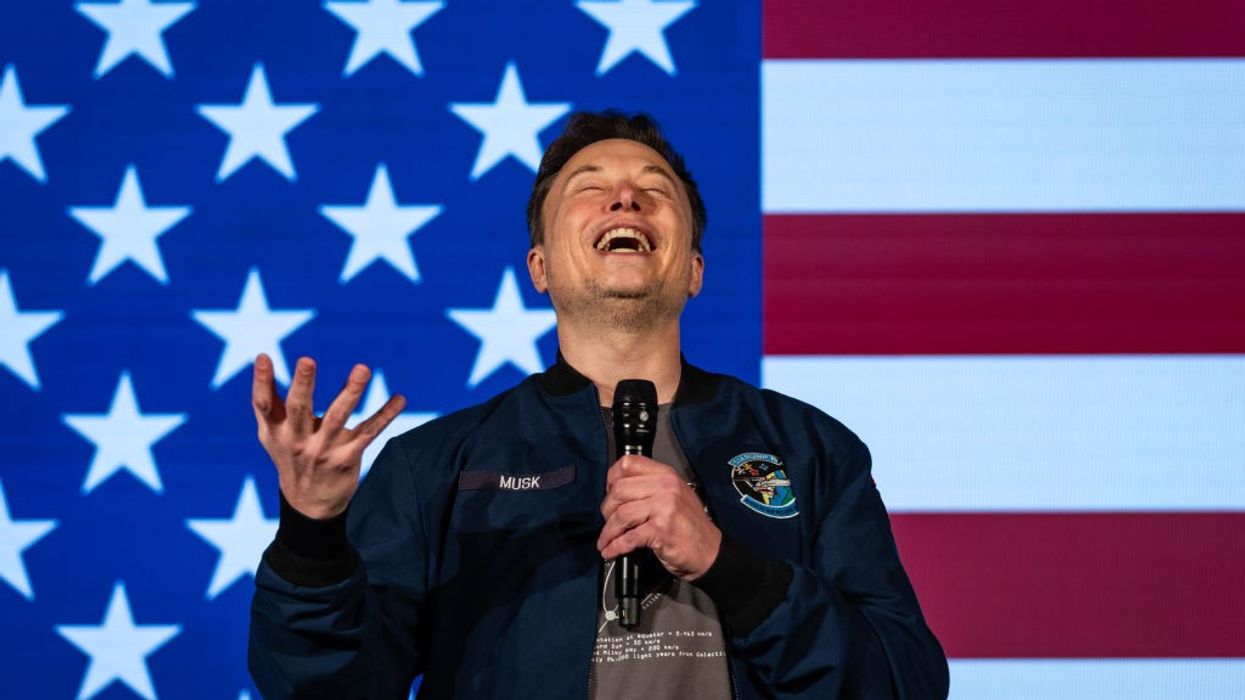
Not too long ago, Musk’s splurge would have been flatly illegal. A reckless Supreme Court and moribund Federal Election Commission took care of that. It should be made illegal again.
On a recent episode of the Bulwark podcast, journalist Ron Brownstein described the election as a contest between “the wave versus the wall.” The wave being voter anger and President Donald Trump’s plummeting popularity. The wall being structural impediments to voters’ voices, such as gerrymanders and the Republican Party’s stark spending advantage.
Now we know that much of that money comes from one man. Perhaps you’ve heard of him.
Elon Musk has contributed at least $366 million on behalf of Republicans since the last election. As The New York Times explained yesterday, “It means that when we talk about the Republicans’ considerable outside spending advantage over Democrats in this midterm, we are talking, in large part, about Musk’s personal contributions.”
Such a blatant attempt to buy the outcome of an election should be a big scandal. As is so often the case, the scandal is not what’s illegal, but what’s legal.
Not too long ago, Musk’s splurge would have been flatly illegal. A reckless Supreme Court and moribund Federal Election Commission took care of that. It should be made illegal again.
Musk’s spending is historic, and not in a good way. It is the biggest contribution during a campaign cycle by any human being in the history of American politics. (Billionaires Michael Bloomberg and Tom Steyer spent more in 2020, but on their own doomed presidential campaigns.)
At times, cautious donors have hedged bets, as lobbyists and PAC managers gave to lawmakers from both parties. Some years, small donors favor one side or another, evening things out in partisan terms.
But this year, big money has mobilized to defend Republican control. We have not had a major election where one party’s spending so dwarfs the other’s in at least a half century, likely since the 1972 election that brought us Watergate.
So much money sloshing around can produce odd or extravagant spending, such as expensive television commercials for a Texas Senate race running on football games and the ads boosting Sen. Susan Collins (R-Maine) that aired in Portland, Oregon, rather than Portland, Maine.
At this late date, more ads might yield minimal impact. That Musk’s contributions are paying for Republican get-out-the-vote operations may have a real impact in key states.
The Supreme Court led by John Roberts has told us that this is all glorious free speech, with campaign contributions “the whole point” of the First Amendment.
Elon Musk is a singular figure. We know of his destruction of foreign aid through DOGE, estimated to have cost hundreds of thousands of lives already around the world, his flamboyant celebrity, his status as the world’s first trillionaire.
Let’s not overthink it. The grubby reality is he’s a big federal contractor. According to The Washington Post, “Over the years, Musk and his businesses have received at least $38 billion in government contracts, loans, subsidies, and tax credits, often at critical moments.”
Musk has massive investments in artificial intelligence through platforms such as Grok, just as political debate finally has erupted around that technology. Defense Secretary Pete Hegseth just named Musk, another billionaire, and former House Speaker Newt Gingrich to lead Project Meridian to reshape the use of technology in warfare.
Such a blatant attempt to buy the outcome of an election should be a big scandal. As is so often the case, the scandal is not what’s illegal, but what’s legal.
Once, there were limits on what could be donated to campaigns. No longer. The Supreme Court’s Citizens United ruling, other court cases since then, and a Federal Election Commission that lacks even a quorum to act have deregulated money in politics. Operatives need no longer pretend these funds are “independent.” Musk’s spending is public, but this year at least $1.3 billion is dark money from undisclosed donors. (The candidates and officeholders know who they are. Just not voters.)
But candidates and lawmakers must do more than decry corruption. The aftermath of this election must lead to action, to reform that follows scandal.
The Brennan Center has proposed Nine Solutions for Political Corruption as part of our series, Solutions for a Stronger Democracy. One of them is especially relevant to the Musk news.
Statutes already purport to bar campaign gifts from federal contractors, but they are more loophole than law. In an article in Just Security published Wednesday, my colleague Eric Petry explains how an expanded and toughened contractor ban would work. It should cover, for example, not just the corporation that holds the contract but the major shareholders, parent company, and other “affiliated entities.” The ban should also extend to donations to inaugural funds, presidential libraries, and vanity projects like Trump’s White House ballroom. Above all, taxpayer money should go to the best contractors chosen under strict rules, not those who best curry favor.
The Watergate election and the scandals it produced led to major reforms, including contribution caps and public financing of presidential campaigns. That response came from lawmakers from both parties, many of them newly elected, demanding change. Ultimately it was voters who responded.
This year we’ve watched the effort to undermine the balloting, and fought back. One lesson may be: Why steal an election when you can buy it?

The Ilegal Immigration Reform and Immigration Responsibility Act of 1996 cast the very act of immigrating to the United States as potentially criminal, creating the concept of “criminal alienhood.
Under President Donald Trump, immigration enforcement agencies have launched a massive campaign of terror against immigrant families with raids, detentions, and deportations unequaled in recent history.
The effects of the president’s assault on immigrants is plain to see. But many people have forgotten that key parts of the legal infrastructure, and the very language around immigration and criminality to which we have become so accustomed, were built long before his administration.
Key foundations to Trump’s racist anti-immigrant policies were laid 30 years ago when the Clinton administration passed the Illegal Immigration Reform and Immigration Responsibility Act of 1996 (IIRAIRA).
Undoing IIRAIRA and its harmful consequences must be part of a broader plan to undo the tangle of laws that treat immigration as a pre-crime, and to dismantle the Department of Homeland Security and its punitive and militarized tools.
IIRAIRA cast the very act of immigrating to the United States as potentially criminal, creating the concept of “criminal alienhood.” The law vastly expanded the consequences on immigration status for convictions or for committing violations. It also blocked immigration judges in many cases from granting case-by-case protection to very sympathetic immigrants who had unusual circumstances.
Part of President Bill Clinton’s “tough on crime” wave of legislation in the 90s, IIRAIRA allowed immigration enforcement agencies to treat immigrants as criminals and laid the groundwork for the racist anti-immigrant policies we’re seeing today. IIRAIRA also created the 287(g) program, authorizing local police to arrest and detain immigrants on behalf of immigration enforcement agencies—which Immigration and Customs Enforcement (ICE) has used to terrorize immigrants across the country under the Trump administration.
IIRAIRA greatly increased the list of triggers for immigration penalties, as well as making them more vague. What started out as a focus on the worst offenses ballooned to sweep up lower-level offenses. IIRAIRA made it much harder for immigrants to apply for asylum and established grounds for detaining and deporting many more immigrants—including permanent legal residents. This included a bar on reentry for deported immigrants, and making reentry a criminal offense, which further criminalizes immigrants and which is currently the top charge for immigration prosecutions.
Another harm we can trace back to the passage of IIRAIRA is the legal framework the law created for mass detention without due process. The United States now has the largest immigration detention system in the world in which millions of people have been detained without guaranteed access to legal representation and in often inhumane conditions. As of July 2026, over 65,000 people were being held in ICE detention and—similarly to those already deported—over 70% had no criminal convictions.
Each administration after Clinton expanded the category of offenses for which immigrants could be detained and deported. By the Obama administration more than 20 categories of crimes were grounds for deportation. At the same time, criminal law and immigration law started working in tandem, in a process legal scholars dubbed “crimmigration.”
With the growth of “deportable offenses” came the rise in rhetoric that intertwined immigrants and criminality, despite repeated statistical studies showing lower crime commission rates among immigrants than among the native-born. By the time Trump said in his 2015 presidential campaign launch that Mexican immigrants were “bringing drugs… Bringing crime” and called them “rapists,” the US public had been well primed to associate criminality with immigrants.
In the decades since the passage of IIRAIRA, LatinoJustice PRLDEF and other immigrant rights organizations have repeatedly challenged both the perception of immigrants as criminals, and the laws and practices that have created the criminal charge-to-deportation express pipeline we are experiencing today. We brought our first case challenging 287(g) agreements in 2009, won $112 million last year for immigrants who had been illegally held in jail custody for handover to ICE, and filed our latest of these cases at the start of the current administration in 2025.
Over the past 30 years, IIRAIRA has frayed the fabric of our society by tearing apart families and criminalizing our immigrant neighbors. Undoing IIRAIRA and its harmful consequences must be part of a broader plan to undo the tangle of laws that treat immigration as a pre-crime, and to dismantle the Department of Homeland Security and its punitive and militarized tools. This is the only way we can once and for all have the immigration system we deserve.
If Democrats are serious about this promise, they should make a more ironclad commitment: A Democratic Congress will use its significant powers to deny any and all funding for continued US participation in this war.
The war on Iran—and the economic toll that President Donald Trump’s decision has taken on all aspects of Americans’ lives—is now the top issue on the campaign trail heading into November. Should Democrats take majorities in the House and Senate, they will have an unmistakable mandate to end the war.
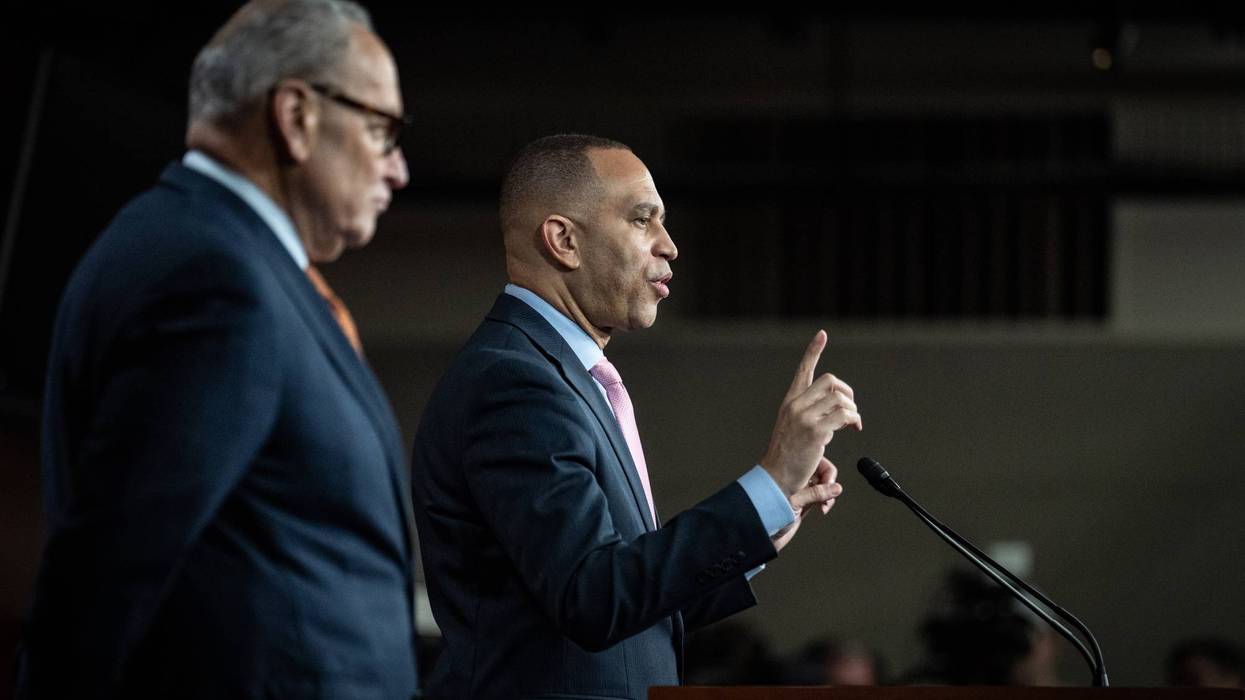
Yet many voters I talk to remain skeptical that a Democratic Congress would actually have the will and capability to stand up to Trump and force an end to the war. This is despite Rep. Hakeem Jeffries (NY), who hopes to be Speaker in a Democrat-led House, promising to end the war if they win. In a press conference outlining Democrats’ top priorities if they win the House, Jeffries said, “We should end, decisively, if it’s still going on, Donald Trump’s reckless and costly war in the Middle East.”
If Democrats are serious about this promise, they should make a more ironclad commitment: A Democratic Congress will use its significant powers to deny any and all funding for continued US participation in this war.
Voters need to know that if Democrats win back the Congress, they will actually use the significant leverage at their disposal and put their money where their mouth is by cutting off funding and end, decisively, this catastrophic war.
Anti-war rhetoric is good politics right now given the historic unpopularity of the Iran boondoggle, which over 70% of Americans now oppose. The conflict itself has already cost Americans over $50 billion in taxpayer funding and an additional $220 billion in economic costs from higher prices for gas, groceries, and other goods and services—more than $1,650 per household, according to an analysis by Moody’s Analytics.
The war is so politically toxic that Republican allies of the president who supported the war, like Rep. Ashley Hinson (R-Iowa) or Sen. Jon Husted (R-Ohio), have publicly called for the war to end as they face competitive elections. Yet when the time has come for those lawmakers to cast a yes or no vote to end the war, they have voted to continue it.
Can voters trust Jeffries and the Democrats to act differently than Republicans who say the war should end but who then enable its continuation through their actions?
Voters have heard promises about Iran before. Trump campaigned on ending forever wars and avoiding another war with Iran, only to do the opposite. Joe Biden promised to restore the Iran nuclear agreement ripped up by Trump, but then pursued a different strategy that failed to produce a deal and helped pave the way for the war. These broken promises are precisely why Democrats should understand that another open pledge to “end the war” will not be enough.
To their credit, congressional Democrats have forced—alongside a very small but growing number of Republicans—nearly two dozen votes in the House and Senate on war power resolutions to end the conflict, despite being in the minority. And their efforts have been historic—for the first time in history, both chambers of Congress passed a war powers resolution mandating the president terminate a war.
But now, the Iran war powers resolution risks withering on the vine of legal uncertainty. The president has ignored it and executive branch officials assert that the measure is not binding. Congressional efforts to challenge the White House’s interpretation in court remain nascent.
The war powers votes have been rightly applauded by activists, but most Americans still have no idea that Democrats forced passage of legislation to end the war. Voters can’t pay for gas with symbolic resolutions or buy groceries with stirring rhetoric.
Some believe that Democratic leadership unnecessarily dragged its feet on the war powers resolutions and were more eager to see Trump suffer politically from an ongoing war than actually using their power to end it. As the adage goes, “When your enemy is falling on his sword, get out of his way.” Others saw Jeffries and would-be Democratic Leader Sen. Chuck Schumer (NY) attacking Trump’s early diplomatic efforts with Iran and broad Democratic criticisms of the short-lived Memorandum of Understanding to end the war, and have been left with the impression that the anti-war rhetoric is political opportunism by lawmakers who are still beholden to pro-war groups like the American Israel Public Affairs Commttee.
It doesn’t help that certain senior officials from the previous Democratic administration have said Biden may have also attacked Iran if he got a second term and that a future Democratic successor to Trump will likely continue the war.
Sen. Mark Kelly’s (Ariz.) recent suggestion that Democrats will use the power of the purse to end the war is the best way to break this cycle, and this commitment should be publicly embraced by every Democratic candidate as well as anyone hoping to lead the party in the next Congress.
In the early days of Trump’s second term, Hakeem Jeffries infamously pushed back on activists demanding Democrats stand up to the President. “What leverage do we have? Republicans… control the House, the Senate, and the presidency. It’s their government,” he said. Voters need to know that if Democrats win back the Congress, they will actually use the significant leverage at their disposal and put their money where their mouth is by cutting off funding and end, decisively, this catastrophic war.
This article was first published by NIAC Insights.