SUBSCRIBE TO OUR FREE NEWSLETTER
Daily news & progressive opinion—funded by the people, not the corporations—delivered straight to your inbox.
5
#000000
#FFFFFF
To donate by check, phone, or other method, see our More Ways to Give page.
Daily news & progressive opinion—funded by the people, not the corporations—delivered straight to your inbox.
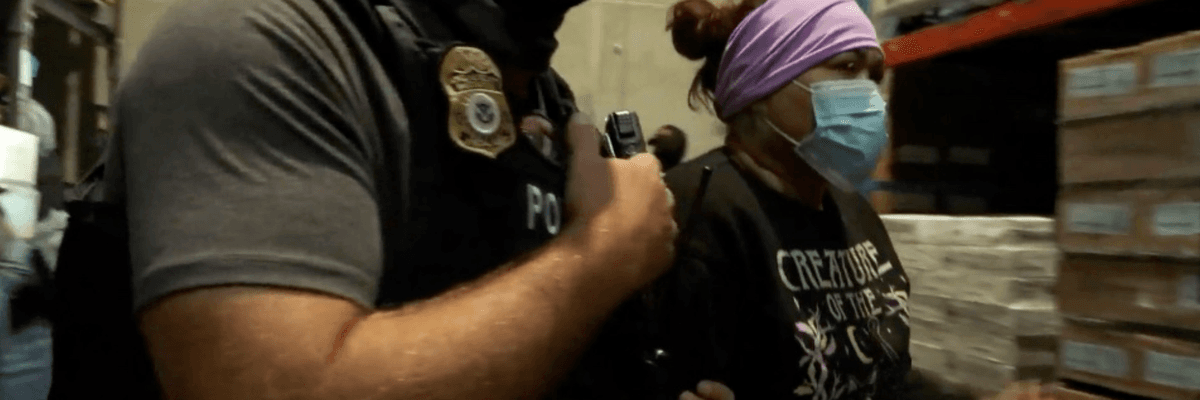
A masked US Immigration and Customs Enforcement agent arrests a woman during a raid on a Nebraska food processing plant amid the Trump administration's mass deportation campaign.
The Ilegal Immigration Reform and Immigration Responsibility Act of 1996 cast the very act of immigrating to the United States as potentially criminal, creating the concept of “criminal alienhood.
Under President Donald Trump, immigration enforcement agencies have launched a massive campaign of terror against immigrant families with raids, detentions, and deportations unequaled in recent history.
The effects of the president’s assault on immigrants is plain to see. But many people have forgotten that key parts of the legal infrastructure, and the very language around immigration and criminality to which we have become so accustomed, were built long before his administration.
Key foundations to Trump’s racist anti-immigrant policies were laid 30 years ago when the Clinton administration passed the Illegal Immigration Reform and Immigration Responsibility Act of 1996 (IIRAIRA).
Undoing IIRAIRA and its harmful consequences must be part of a broader plan to undo the tangle of laws that treat immigration as a pre-crime, and to dismantle the Department of Homeland Security and its punitive and militarized tools.
IIRAIRA cast the very act of immigrating to the United States as potentially criminal, creating the concept of “criminal alienhood.” The law vastly expanded the consequences on immigration status for convictions or for committing violations. It also blocked immigration judges in many cases from granting case-by-case protection to very sympathetic immigrants who had unusual circumstances.
Part of President Bill Clinton’s “tough on crime” wave of legislation in the 90s, IIRAIRA allowed immigration enforcement agencies to treat immigrants as criminals and laid the groundwork for the racist anti-immigrant policies we’re seeing today. IIRAIRA also created the 287(g) program, authorizing local police to arrest and detain immigrants on behalf of immigration enforcement agencies—which Immigration and Customs Enforcement (ICE) has used to terrorize immigrants across the country under the Trump administration.
IIRAIRA greatly increased the list of triggers for immigration penalties, as well as making them more vague. What started out as a focus on the worst offenses ballooned to sweep up lower-level offenses. IIRAIRA made it much harder for immigrants to apply for asylum and established grounds for detaining and deporting many more immigrants—including permanent legal residents. This included a bar on reentry for deported immigrants, and making reentry a criminal offense, which further criminalizes immigrants and which is currently the top charge for immigration prosecutions.
Another harm we can trace back to the passage of IIRAIRA is the legal framework the law created for mass detention without due process. The United States now has the largest immigration detention system in the world in which millions of people have been detained without guaranteed access to legal representation and in often inhumane conditions. As of July 2026, over 65,000 people were being held in ICE detention and—similarly to those already deported—over 70% had no criminal convictions.
Each administration after Clinton expanded the category of offenses for which immigrants could be detained and deported. By the Obama administration more than 20 categories of crimes were grounds for deportation. At the same time, criminal law and immigration law started working in tandem, in a process legal scholars dubbed “crimmigration.”
With the growth of “deportable offenses” came the rise in rhetoric that intertwined immigrants and criminality, despite repeated statistical studies showing lower crime commission rates among immigrants than among the native-born. By the time Trump said in his 2015 presidential campaign launch that Mexican immigrants were “bringing drugs… Bringing crime” and called them “rapists,” the US public had been well primed to associate criminality with immigrants.
In the decades since the passage of IIRAIRA, LatinoJustice PRLDEF and other immigrant rights organizations have repeatedly challenged both the perception of immigrants as criminals, and the laws and practices that have created the criminal charge-to-deportation express pipeline we are experiencing today. We brought our first case challenging 287(g) agreements in 2009, won $112 million last year for immigrants who had been illegally held in jail custody for handover to ICE, and filed our latest of these cases at the start of the current administration in 2025.
Over the past 30 years, IIRAIRA has frayed the fabric of our society by tearing apart families and criminalizing our immigrant neighbors. Undoing IIRAIRA and its harmful consequences must be part of a broader plan to undo the tangle of laws that treat immigration as a pre-crime, and to dismantle the Department of Homeland Security and its punitive and militarized tools. This is the only way we can once and for all have the immigration system we deserve.
Dear Common Dreams reader, It’s been nearly 30 years since I co-founded Common Dreams with my late wife, Lina Newhouser. We had the radical notion that journalism should serve the public good, not corporate profits. It was clear to us from the outset what it would take to build such a project. No paid advertisements. No corporate sponsors. No millionaire publisher telling us what to think or do. Many people said we wouldn't last a year, but we proved those doubters wrong. Together with a tremendous team of journalists and dedicated staff, we built an independent media outlet free from the constraints of profits and corporate control. Our mission has always been simple: To inform. To inspire. To ignite change for the common good. Building Common Dreams was not easy. Our survival was never guaranteed. When you take on the most powerful forces—Wall Street greed, fossil fuel industry destruction, Big Tech lobbyists, and uber-rich oligarchs who have spent billions upon billions rigging the economy and democracy in their favor—the only bulwark you have is supporters who believe in your work. But here’s the urgent message from me today. It's never been this bad out there. And it's never been this hard to keep us going. At the very moment Common Dreams is most needed, the threats we face are intensifying. We need your support now more than ever. We don't accept corporate advertising and never will. We don't have a paywall because we don't think people should be blocked from critical news based on their ability to pay. Everything we do is funded by the donations of readers like you. When everyone does the little they can afford, we are strong. But if that support retreats or dries up, so do we. Will you donate now to make sure Common Dreams not only survives but thrives? —Craig Brown, Co-founder |
Under President Donald Trump, immigration enforcement agencies have launched a massive campaign of terror against immigrant families with raids, detentions, and deportations unequaled in recent history.
The effects of the president’s assault on immigrants is plain to see. But many people have forgotten that key parts of the legal infrastructure, and the very language around immigration and criminality to which we have become so accustomed, were built long before his administration.
Key foundations to Trump’s racist anti-immigrant policies were laid 30 years ago when the Clinton administration passed the Illegal Immigration Reform and Immigration Responsibility Act of 1996 (IIRAIRA).
Undoing IIRAIRA and its harmful consequences must be part of a broader plan to undo the tangle of laws that treat immigration as a pre-crime, and to dismantle the Department of Homeland Security and its punitive and militarized tools.
IIRAIRA cast the very act of immigrating to the United States as potentially criminal, creating the concept of “criminal alienhood.” The law vastly expanded the consequences on immigration status for convictions or for committing violations. It also blocked immigration judges in many cases from granting case-by-case protection to very sympathetic immigrants who had unusual circumstances.
Part of President Bill Clinton’s “tough on crime” wave of legislation in the 90s, IIRAIRA allowed immigration enforcement agencies to treat immigrants as criminals and laid the groundwork for the racist anti-immigrant policies we’re seeing today. IIRAIRA also created the 287(g) program, authorizing local police to arrest and detain immigrants on behalf of immigration enforcement agencies—which Immigration and Customs Enforcement (ICE) has used to terrorize immigrants across the country under the Trump administration.
IIRAIRA greatly increased the list of triggers for immigration penalties, as well as making them more vague. What started out as a focus on the worst offenses ballooned to sweep up lower-level offenses. IIRAIRA made it much harder for immigrants to apply for asylum and established grounds for detaining and deporting many more immigrants—including permanent legal residents. This included a bar on reentry for deported immigrants, and making reentry a criminal offense, which further criminalizes immigrants and which is currently the top charge for immigration prosecutions.
Another harm we can trace back to the passage of IIRAIRA is the legal framework the law created for mass detention without due process. The United States now has the largest immigration detention system in the world in which millions of people have been detained without guaranteed access to legal representation and in often inhumane conditions. As of July 2026, over 65,000 people were being held in ICE detention and—similarly to those already deported—over 70% had no criminal convictions.
Each administration after Clinton expanded the category of offenses for which immigrants could be detained and deported. By the Obama administration more than 20 categories of crimes were grounds for deportation. At the same time, criminal law and immigration law started working in tandem, in a process legal scholars dubbed “crimmigration.”
With the growth of “deportable offenses” came the rise in rhetoric that intertwined immigrants and criminality, despite repeated statistical studies showing lower crime commission rates among immigrants than among the native-born. By the time Trump said in his 2015 presidential campaign launch that Mexican immigrants were “bringing drugs… Bringing crime” and called them “rapists,” the US public had been well primed to associate criminality with immigrants.
In the decades since the passage of IIRAIRA, LatinoJustice PRLDEF and other immigrant rights organizations have repeatedly challenged both the perception of immigrants as criminals, and the laws and practices that have created the criminal charge-to-deportation express pipeline we are experiencing today. We brought our first case challenging 287(g) agreements in 2009, won $112 million last year for immigrants who had been illegally held in jail custody for handover to ICE, and filed our latest of these cases at the start of the current administration in 2025.
Over the past 30 years, IIRAIRA has frayed the fabric of our society by tearing apart families and criminalizing our immigrant neighbors. Undoing IIRAIRA and its harmful consequences must be part of a broader plan to undo the tangle of laws that treat immigration as a pre-crime, and to dismantle the Department of Homeland Security and its punitive and militarized tools. This is the only way we can once and for all have the immigration system we deserve.
Under President Donald Trump, immigration enforcement agencies have launched a massive campaign of terror against immigrant families with raids, detentions, and deportations unequaled in recent history.
The effects of the president’s assault on immigrants is plain to see. But many people have forgotten that key parts of the legal infrastructure, and the very language around immigration and criminality to which we have become so accustomed, were built long before his administration.
Key foundations to Trump’s racist anti-immigrant policies were laid 30 years ago when the Clinton administration passed the Illegal Immigration Reform and Immigration Responsibility Act of 1996 (IIRAIRA).
Undoing IIRAIRA and its harmful consequences must be part of a broader plan to undo the tangle of laws that treat immigration as a pre-crime, and to dismantle the Department of Homeland Security and its punitive and militarized tools.
IIRAIRA cast the very act of immigrating to the United States as potentially criminal, creating the concept of “criminal alienhood.” The law vastly expanded the consequences on immigration status for convictions or for committing violations. It also blocked immigration judges in many cases from granting case-by-case protection to very sympathetic immigrants who had unusual circumstances.
Part of President Bill Clinton’s “tough on crime” wave of legislation in the 90s, IIRAIRA allowed immigration enforcement agencies to treat immigrants as criminals and laid the groundwork for the racist anti-immigrant policies we’re seeing today. IIRAIRA also created the 287(g) program, authorizing local police to arrest and detain immigrants on behalf of immigration enforcement agencies—which Immigration and Customs Enforcement (ICE) has used to terrorize immigrants across the country under the Trump administration.
IIRAIRA greatly increased the list of triggers for immigration penalties, as well as making them more vague. What started out as a focus on the worst offenses ballooned to sweep up lower-level offenses. IIRAIRA made it much harder for immigrants to apply for asylum and established grounds for detaining and deporting many more immigrants—including permanent legal residents. This included a bar on reentry for deported immigrants, and making reentry a criminal offense, which further criminalizes immigrants and which is currently the top charge for immigration prosecutions.
Another harm we can trace back to the passage of IIRAIRA is the legal framework the law created for mass detention without due process. The United States now has the largest immigration detention system in the world in which millions of people have been detained without guaranteed access to legal representation and in often inhumane conditions. As of July 2026, over 65,000 people were being held in ICE detention and—similarly to those already deported—over 70% had no criminal convictions.
Each administration after Clinton expanded the category of offenses for which immigrants could be detained and deported. By the Obama administration more than 20 categories of crimes were grounds for deportation. At the same time, criminal law and immigration law started working in tandem, in a process legal scholars dubbed “crimmigration.”
With the growth of “deportable offenses” came the rise in rhetoric that intertwined immigrants and criminality, despite repeated statistical studies showing lower crime commission rates among immigrants than among the native-born. By the time Trump said in his 2015 presidential campaign launch that Mexican immigrants were “bringing drugs… Bringing crime” and called them “rapists,” the US public had been well primed to associate criminality with immigrants.
In the decades since the passage of IIRAIRA, LatinoJustice PRLDEF and other immigrant rights organizations have repeatedly challenged both the perception of immigrants as criminals, and the laws and practices that have created the criminal charge-to-deportation express pipeline we are experiencing today. We brought our first case challenging 287(g) agreements in 2009, won $112 million last year for immigrants who had been illegally held in jail custody for handover to ICE, and filed our latest of these cases at the start of the current administration in 2025.
Over the past 30 years, IIRAIRA has frayed the fabric of our society by tearing apart families and criminalizing our immigrant neighbors. Undoing IIRAIRA and its harmful consequences must be part of a broader plan to undo the tangle of laws that treat immigration as a pre-crime, and to dismantle the Department of Homeland Security and its punitive and militarized tools. This is the only way we can once and for all have the immigration system we deserve.