SUBSCRIBE TO OUR FREE NEWSLETTER
Daily news & progressive opinion—funded by the people, not the corporations—delivered straight to your inbox.
5
#000000
#FFFFFF
To donate by check, phone, or other method, see our More Ways to Give page.
Daily news & progressive opinion—funded by the people, not the corporations—delivered straight to your inbox.
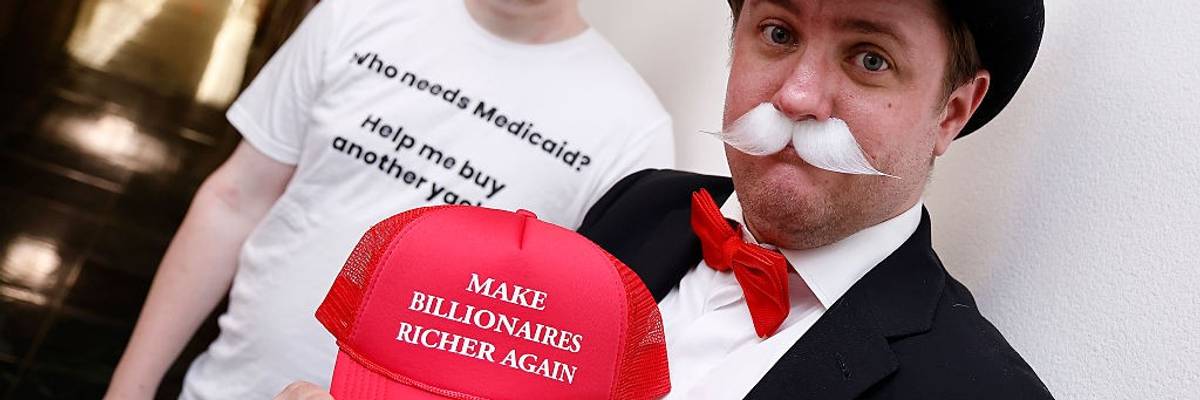
Advocates pose as Monopoly men and wealthy DOGE supporters while protesting tax breaks for billionaires and the Republican tax plan, inside and outside the Ways & Means Full Committee Markup to advance the legislation in the Longworth House Office Building on May 13, 2025 in Washington, DC.
Wealth creates political power; political power produces tax and economic policies favorable to wealth; those policies concentrate still more wealth; and some of that wealth is reinvested in politics to keep the cycle going.
In 1971, corporate lawyer Lewis Powell wrote a confidential memo to the US Chamber of Commerce warning that American business was under attack. Among his complaints were politicians and activists who portrayed tax breaks as benefiting “only the rich” and who dared to set the “rich” against the “poor,” and “business against the people.”
Powell’s solution was not subtle. Corporate America needed political power, and that power “must be assiduously cultivated” and, when necessary, “used aggressively and with determination.” Business should organize, influence the media and universities, build political power, and exploit what Powell called the “vast opportunity” presented by the courts.
Heist: Who Stole the American Dream? traces much of what happened next. Powell joined the Supreme Court and later wrote the majority opinion in First National Bank of Boston v. Bellotti, expanding constitutional protection for corporate spending on ballot measures. Decades later, Citizens United would further expand corporate political spending rights. Meanwhile, Ronald Reagan ushered in enormous tax cuts, deregulation, attacks on organized labor, and an economic philosophy that promised prosperity would trickle down (it never did!).
That brings us to a question I think every politician promising a better future should have to answer: Tell me what you want to do—and tell me who you're willing to tax to pay for it.
More than half a century after the Powell Memo, we’ve got the receipts.
According to a new Americans for Tax Fairness analysis, America’s 977 billionaires now control a record $9.24 trillion. In just one year, their wealth increased by $2.2 trillion, or 32%, while the overall economy grew by about 6%. The richest 16 Americans alone possess nearly $4 trillion, more wealth than all US billionaires combined had less than six years ago.
But those gains look even more extraordinary when we look at what is happening to everyone else. The bottom half of American households collectively owns just over 2% of the nation’s wealth. Nearly 48 million Americans live in households struggling with food insecurity. And the divide between workers and those at the top of corporate America has exploded: CEOs at the country’s 350 largest firms made 325 times as much as the typical worker in 2025, up from 21 times as much in 1965. Since 1978, CEO compensation has risen 1,316%, while typical worker compensation increased just 28%.
Yet as wealth becomes increasingly concentrated at the top, Washington is moving in precisely the opposite direction for millions of working families: massive tax cuts disproportionately benefiting the wealthy alongside deep cuts to Medicaid, food assistance, and other programs people depend on.
That brings us to a question I think every politician promising a better future should have to answer: Tell me what you want to do—and tell me who you're willing to tax to pay for it. Want universal healthcare? Affordable housing? Better schools? Modern infrastructure? A serious response to climate change? A stronger safety net? Great. How are you going to pay for it?
After decades in which an extraordinary share of America's wealth has accumulated at the very top, pretending we can adequately fund those priorities without asking substantially more from those who have accumulated that wealth is not a serious answer.
California's Proposition 40 puts that question directly before voters.
The measure would impose a one-time 5% tax on billionaire wealth, primarily to help protect healthcare from massive federal cuts. In a letter endorsing the measure, six Nobel Prize-winning economists note that California's roughly 250 billionaires now possess $2.3 trillion, up from about $700 billion a decade ago. From 2019 through 2025 alone, those billionaires gained $1.4 trillion in wealth, while the state income taxes they paid during that period amounted to just 1.6% of those gains.
The good news is that none of this is inevitable. These rules were created through political choices, and they can be changed through political choices and organized action.
How have some of California's wealthiest people responded to being asked for a small portion of those enormous gains? By spending an extraordinary amount of money to stop it.
As of October 10, billionaire-backed opposition efforts have reportedly raised approximately $300 million to fight Prop 40, vastly outspending its supporters. The opposition includes Building a Better California, which is also backing Props 41 and 42, competing measures that could potentially block the billionaire tax even if voters approve it.
Think about that for a moment. A small number of extraordinarily wealthy people can spend a quarter-billion dollars influencing an election over whether extraordinarily wealthy people should pay more in taxes.
And California is only one battlefield. American billionaires had already contributed more than $433 million to the 2026 midterms by early this year. Nearly 80% went to Republican candidates and conservative organizations.
This is the feedback loop Powell envisioned, taken to an extreme he might not have imagined: Wealth creates political power; political power produces tax and economic policies favorable to wealth; those policies concentrate still more wealth; and some of that wealth is reinvested in politics to keep the cycle going.
That is why this debate is about more than tax rates. It is about democracy.
It is also why Prop 40 matters beyond California. As the six Nobel economists wrote, passage could help “kickstart a movement” to tax extreme wealth elsewhere. They concluded that this vote could ultimately be remembered as a turning point in the struggle between democracy and oligarchy.
The good news is that none of this is inevitable. These rules were created through political choices, and they can be changed through political choices and organized action.
Vote. Demand that candidates tell us not only what they want to accomplish, but who they are willing to tax to pay for it. Join the No Kings mobilization on October 17. And watch and share Heist: Who Stole the American Dream? to understand how we got here.
Then let's stop the heist.
Dear Common Dreams reader, It’s been nearly 30 years since I co-founded Common Dreams with my late wife, Lina Newhouser. We had the radical notion that journalism should serve the public good, not corporate profits. It was clear to us from the outset what it would take to build such a project. No paid advertisements. No corporate sponsors. No millionaire publisher telling us what to think or do. Many people said we wouldn't last a year, but we proved those doubters wrong. Together with a tremendous team of journalists and dedicated staff, we built an independent media outlet free from the constraints of profits and corporate control. Our mission has always been simple: To inform. To inspire. To ignite change for the common good. Building Common Dreams was not easy. Our survival was never guaranteed. When you take on the most powerful forces—Wall Street greed, fossil fuel industry destruction, Big Tech lobbyists, and uber-rich oligarchs who have spent billions upon billions rigging the economy and democracy in their favor—the only bulwark you have is supporters who believe in your work. But here’s the urgent message from me today. It's never been this bad out there. And it's never been this hard to keep us going. At the very moment Common Dreams is most needed, the threats we face are intensifying. We need your support now more than ever. We don't accept corporate advertising and never will. We don't have a paywall because we don't think people should be blocked from critical news based on their ability to pay. Everything we do is funded by the donations of readers like you. When everyone does the little they can afford, we are strong. But if that support retreats or dries up, so do we. Will you donate now to make sure Common Dreams not only survives but thrives? —Craig Brown, Co-founder |
In 1971, corporate lawyer Lewis Powell wrote a confidential memo to the US Chamber of Commerce warning that American business was under attack. Among his complaints were politicians and activists who portrayed tax breaks as benefiting “only the rich” and who dared to set the “rich” against the “poor,” and “business against the people.”
Powell’s solution was not subtle. Corporate America needed political power, and that power “must be assiduously cultivated” and, when necessary, “used aggressively and with determination.” Business should organize, influence the media and universities, build political power, and exploit what Powell called the “vast opportunity” presented by the courts.
Heist: Who Stole the American Dream? traces much of what happened next. Powell joined the Supreme Court and later wrote the majority opinion in First National Bank of Boston v. Bellotti, expanding constitutional protection for corporate spending on ballot measures. Decades later, Citizens United would further expand corporate political spending rights. Meanwhile, Ronald Reagan ushered in enormous tax cuts, deregulation, attacks on organized labor, and an economic philosophy that promised prosperity would trickle down (it never did!).
That brings us to a question I think every politician promising a better future should have to answer: Tell me what you want to do—and tell me who you're willing to tax to pay for it.
More than half a century after the Powell Memo, we’ve got the receipts.
According to a new Americans for Tax Fairness analysis, America’s 977 billionaires now control a record $9.24 trillion. In just one year, their wealth increased by $2.2 trillion, or 32%, while the overall economy grew by about 6%. The richest 16 Americans alone possess nearly $4 trillion, more wealth than all US billionaires combined had less than six years ago.
But those gains look even more extraordinary when we look at what is happening to everyone else. The bottom half of American households collectively owns just over 2% of the nation’s wealth. Nearly 48 million Americans live in households struggling with food insecurity. And the divide between workers and those at the top of corporate America has exploded: CEOs at the country’s 350 largest firms made 325 times as much as the typical worker in 2025, up from 21 times as much in 1965. Since 1978, CEO compensation has risen 1,316%, while typical worker compensation increased just 28%.
Yet as wealth becomes increasingly concentrated at the top, Washington is moving in precisely the opposite direction for millions of working families: massive tax cuts disproportionately benefiting the wealthy alongside deep cuts to Medicaid, food assistance, and other programs people depend on.
That brings us to a question I think every politician promising a better future should have to answer: Tell me what you want to do—and tell me who you're willing to tax to pay for it. Want universal healthcare? Affordable housing? Better schools? Modern infrastructure? A serious response to climate change? A stronger safety net? Great. How are you going to pay for it?
After decades in which an extraordinary share of America's wealth has accumulated at the very top, pretending we can adequately fund those priorities without asking substantially more from those who have accumulated that wealth is not a serious answer.
California's Proposition 40 puts that question directly before voters.
The measure would impose a one-time 5% tax on billionaire wealth, primarily to help protect healthcare from massive federal cuts. In a letter endorsing the measure, six Nobel Prize-winning economists note that California's roughly 250 billionaires now possess $2.3 trillion, up from about $700 billion a decade ago. From 2019 through 2025 alone, those billionaires gained $1.4 trillion in wealth, while the state income taxes they paid during that period amounted to just 1.6% of those gains.
The good news is that none of this is inevitable. These rules were created through political choices, and they can be changed through political choices and organized action.
How have some of California's wealthiest people responded to being asked for a small portion of those enormous gains? By spending an extraordinary amount of money to stop it.
As of October 10, billionaire-backed opposition efforts have reportedly raised approximately $300 million to fight Prop 40, vastly outspending its supporters. The opposition includes Building a Better California, which is also backing Props 41 and 42, competing measures that could potentially block the billionaire tax even if voters approve it.
Think about that for a moment. A small number of extraordinarily wealthy people can spend a quarter-billion dollars influencing an election over whether extraordinarily wealthy people should pay more in taxes.
And California is only one battlefield. American billionaires had already contributed more than $433 million to the 2026 midterms by early this year. Nearly 80% went to Republican candidates and conservative organizations.
This is the feedback loop Powell envisioned, taken to an extreme he might not have imagined: Wealth creates political power; political power produces tax and economic policies favorable to wealth; those policies concentrate still more wealth; and some of that wealth is reinvested in politics to keep the cycle going.
That is why this debate is about more than tax rates. It is about democracy.
It is also why Prop 40 matters beyond California. As the six Nobel economists wrote, passage could help “kickstart a movement” to tax extreme wealth elsewhere. They concluded that this vote could ultimately be remembered as a turning point in the struggle between democracy and oligarchy.
The good news is that none of this is inevitable. These rules were created through political choices, and they can be changed through political choices and organized action.
Vote. Demand that candidates tell us not only what they want to accomplish, but who they are willing to tax to pay for it. Join the No Kings mobilization on October 17. And watch and share Heist: Who Stole the American Dream? to understand how we got here.
Then let's stop the heist.
In 1971, corporate lawyer Lewis Powell wrote a confidential memo to the US Chamber of Commerce warning that American business was under attack. Among his complaints were politicians and activists who portrayed tax breaks as benefiting “only the rich” and who dared to set the “rich” against the “poor,” and “business against the people.”
Powell’s solution was not subtle. Corporate America needed political power, and that power “must be assiduously cultivated” and, when necessary, “used aggressively and with determination.” Business should organize, influence the media and universities, build political power, and exploit what Powell called the “vast opportunity” presented by the courts.
Heist: Who Stole the American Dream? traces much of what happened next. Powell joined the Supreme Court and later wrote the majority opinion in First National Bank of Boston v. Bellotti, expanding constitutional protection for corporate spending on ballot measures. Decades later, Citizens United would further expand corporate political spending rights. Meanwhile, Ronald Reagan ushered in enormous tax cuts, deregulation, attacks on organized labor, and an economic philosophy that promised prosperity would trickle down (it never did!).
That brings us to a question I think every politician promising a better future should have to answer: Tell me what you want to do—and tell me who you're willing to tax to pay for it.
More than half a century after the Powell Memo, we’ve got the receipts.
According to a new Americans for Tax Fairness analysis, America’s 977 billionaires now control a record $9.24 trillion. In just one year, their wealth increased by $2.2 trillion, or 32%, while the overall economy grew by about 6%. The richest 16 Americans alone possess nearly $4 trillion, more wealth than all US billionaires combined had less than six years ago.
But those gains look even more extraordinary when we look at what is happening to everyone else. The bottom half of American households collectively owns just over 2% of the nation’s wealth. Nearly 48 million Americans live in households struggling with food insecurity. And the divide between workers and those at the top of corporate America has exploded: CEOs at the country’s 350 largest firms made 325 times as much as the typical worker in 2025, up from 21 times as much in 1965. Since 1978, CEO compensation has risen 1,316%, while typical worker compensation increased just 28%.
Yet as wealth becomes increasingly concentrated at the top, Washington is moving in precisely the opposite direction for millions of working families: massive tax cuts disproportionately benefiting the wealthy alongside deep cuts to Medicaid, food assistance, and other programs people depend on.
That brings us to a question I think every politician promising a better future should have to answer: Tell me what you want to do—and tell me who you're willing to tax to pay for it. Want universal healthcare? Affordable housing? Better schools? Modern infrastructure? A serious response to climate change? A stronger safety net? Great. How are you going to pay for it?
After decades in which an extraordinary share of America's wealth has accumulated at the very top, pretending we can adequately fund those priorities without asking substantially more from those who have accumulated that wealth is not a serious answer.
California's Proposition 40 puts that question directly before voters.
The measure would impose a one-time 5% tax on billionaire wealth, primarily to help protect healthcare from massive federal cuts. In a letter endorsing the measure, six Nobel Prize-winning economists note that California's roughly 250 billionaires now possess $2.3 trillion, up from about $700 billion a decade ago. From 2019 through 2025 alone, those billionaires gained $1.4 trillion in wealth, while the state income taxes they paid during that period amounted to just 1.6% of those gains.
The good news is that none of this is inevitable. These rules were created through political choices, and they can be changed through political choices and organized action.
How have some of California's wealthiest people responded to being asked for a small portion of those enormous gains? By spending an extraordinary amount of money to stop it.
As of October 10, billionaire-backed opposition efforts have reportedly raised approximately $300 million to fight Prop 40, vastly outspending its supporters. The opposition includes Building a Better California, which is also backing Props 41 and 42, competing measures that could potentially block the billionaire tax even if voters approve it.
Think about that for a moment. A small number of extraordinarily wealthy people can spend a quarter-billion dollars influencing an election over whether extraordinarily wealthy people should pay more in taxes.
And California is only one battlefield. American billionaires had already contributed more than $433 million to the 2026 midterms by early this year. Nearly 80% went to Republican candidates and conservative organizations.
This is the feedback loop Powell envisioned, taken to an extreme he might not have imagined: Wealth creates political power; political power produces tax and economic policies favorable to wealth; those policies concentrate still more wealth; and some of that wealth is reinvested in politics to keep the cycle going.
That is why this debate is about more than tax rates. It is about democracy.
It is also why Prop 40 matters beyond California. As the six Nobel economists wrote, passage could help “kickstart a movement” to tax extreme wealth elsewhere. They concluded that this vote could ultimately be remembered as a turning point in the struggle between democracy and oligarchy.
The good news is that none of this is inevitable. These rules were created through political choices, and they can be changed through political choices and organized action.
Vote. Demand that candidates tell us not only what they want to accomplish, but who they are willing to tax to pay for it. Join the No Kings mobilization on October 17. And watch and share Heist: Who Stole the American Dream? to understand how we got here.
Then let's stop the heist.