SUBSCRIBE TO OUR FREE NEWSLETTER
Daily news & progressive opinion—funded by the people, not the corporations—delivered straight to your inbox.
5
#000000
#FFFFFF
To donate by check, phone, or other method, see our More Ways to Give page.
Daily news & progressive opinion—funded by the people, not the corporations—delivered straight to your inbox.
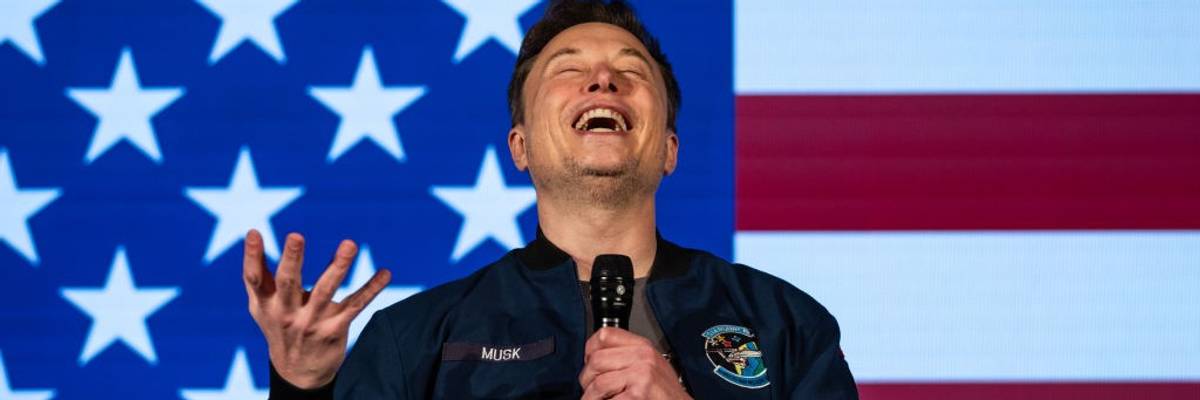
SpaceX and Tesla founder Elon Musk speaks during an America PAC town hall on October 26, 2024 in Lancaster, Pennsylvania.
Not too long ago, Musk’s splurge would have been flatly illegal. A reckless Supreme Court and moribund Federal Election Commission took care of that. It should be made illegal again.
On a recent episode of the Bulwark podcast, journalist Ron Brownstein described the election as a contest between “the wave versus the wall.” The wave being voter anger and President Donald Trump’s plummeting popularity. The wall being structural impediments to voters’ voices, such as gerrymanders and the Republican Party’s stark spending advantage.
Now we know that much of that money comes from one man. Perhaps you’ve heard of him.
Elon Musk has contributed at least $366 million on behalf of Republicans since the last election. As The New York Times explained yesterday, “It means that when we talk about the Republicans’ considerable outside spending advantage over Democrats in this midterm, we are talking, in large part, about Musk’s personal contributions.”
Such a blatant attempt to buy the outcome of an election should be a big scandal. As is so often the case, the scandal is not what’s illegal, but what’s legal.
Not too long ago, Musk’s splurge would have been flatly illegal. A reckless Supreme Court and moribund Federal Election Commission took care of that. It should be made illegal again.
Musk’s spending is historic, and not in a good way. It is the biggest contribution during a campaign cycle by any human being in the history of American politics. (Billionaires Michael Bloomberg and Tom Steyer spent more in 2020, but on their own doomed presidential campaigns.)
At times, cautious donors have hedged bets, as lobbyists and PAC managers gave to lawmakers from both parties. Some years, small donors favor one side or another, evening things out in partisan terms.
But this year, big money has mobilized to defend Republican control. We have not had a major election where one party’s spending so dwarfs the other’s in at least a half century, likely since the 1972 election that brought us Watergate.
So much money sloshing around can produce odd or extravagant spending, such as expensive television commercials for a Texas Senate race running on football games and the ads boosting Sen. Susan Collins (R-Maine) that aired in Portland, Oregon, rather than Portland, Maine.
At this late date, more ads might yield minimal impact. That Musk’s contributions are paying for Republican get-out-the-vote operations may have a real impact in key states.
The Supreme Court led by John Roberts has told us that this is all glorious free speech, with campaign contributions “the whole point” of the First Amendment.
Elon Musk is a singular figure. We know of his destruction of foreign aid through DOGE, estimated to have cost hundreds of thousands of lives already around the world, his flamboyant celebrity, his status as the world’s first trillionaire.
Let’s not overthink it. The grubby reality is he’s a big federal contractor. According to The Washington Post, “Over the years, Musk and his businesses have received at least $38 billion in government contracts, loans, subsidies, and tax credits, often at critical moments.”
Musk has massive investments in artificial intelligence through platforms such as Grok, just as political debate finally has erupted around that technology. Defense Secretary Pete Hegseth just named Musk, another billionaire, and former House Speaker Newt Gingrich to lead Project Meridian to reshape the use of technology in warfare.
Such a blatant attempt to buy the outcome of an election should be a big scandal. As is so often the case, the scandal is not what’s illegal, but what’s legal.
Once, there were limits on what could be donated to campaigns. No longer. The Supreme Court’s Citizens United ruling, other court cases since then, and a Federal Election Commission that lacks even a quorum to act have deregulated money in politics. Operatives need no longer pretend these funds are “independent.” Musk’s spending is public, but this year at least $1.3 billion is dark money from undisclosed donors. (The candidates and officeholders know who they are. Just not voters.)
But candidates and lawmakers must do more than decry corruption. The aftermath of this election must lead to action, to reform that follows scandal.
The Brennan Center has proposed Nine Solutions for Political Corruption as part of our series, Solutions for a Stronger Democracy. One of them is especially relevant to the Musk news.
Statutes already purport to bar campaign gifts from federal contractors, but they are more loophole than law. In an article in Just Security published Wednesday, my colleague Eric Petry explains how an expanded and toughened contractor ban would work. It should cover, for example, not just the corporation that holds the contract but the major shareholders, parent company, and other “affiliated entities.” The ban should also extend to donations to inaugural funds, presidential libraries, and vanity projects like Trump’s White House ballroom. Above all, taxpayer money should go to the best contractors chosen under strict rules, not those who best curry favor.
The Watergate election and the scandals it produced led to major reforms, including contribution caps and public financing of presidential campaigns. That response came from lawmakers from both parties, many of them newly elected, demanding change. Ultimately it was voters who responded.
This year we’ve watched the effort to undermine the balloting, and fought back. One lesson may be: Why steal an election when you can buy it?
Dear Common Dreams reader, It’s been nearly 30 years since I co-founded Common Dreams with my late wife, Lina Newhouser. We had the radical notion that journalism should serve the public good, not corporate profits. It was clear to us from the outset what it would take to build such a project. No paid advertisements. No corporate sponsors. No millionaire publisher telling us what to think or do. Many people said we wouldn't last a year, but we proved those doubters wrong. Together with a tremendous team of journalists and dedicated staff, we built an independent media outlet free from the constraints of profits and corporate control. Our mission has always been simple: To inform. To inspire. To ignite change for the common good. Building Common Dreams was not easy. Our survival was never guaranteed. When you take on the most powerful forces—Wall Street greed, fossil fuel industry destruction, Big Tech lobbyists, and uber-rich oligarchs who have spent billions upon billions rigging the economy and democracy in their favor—the only bulwark you have is supporters who believe in your work. But here’s the urgent message from me today. It's never been this bad out there. And it's never been this hard to keep us going. At the very moment Common Dreams is most needed, the threats we face are intensifying. We need your support now more than ever. We don't accept corporate advertising and never will. We don't have a paywall because we don't think people should be blocked from critical news based on their ability to pay. Everything we do is funded by the donations of readers like you. When everyone does the little they can afford, we are strong. But if that support retreats or dries up, so do we. Will you donate now to make sure Common Dreams not only survives but thrives? —Craig Brown, Co-founder |
On a recent episode of the Bulwark podcast, journalist Ron Brownstein described the election as a contest between “the wave versus the wall.” The wave being voter anger and President Donald Trump’s plummeting popularity. The wall being structural impediments to voters’ voices, such as gerrymanders and the Republican Party’s stark spending advantage.
Now we know that much of that money comes from one man. Perhaps you’ve heard of him.
Elon Musk has contributed at least $366 million on behalf of Republicans since the last election. As The New York Times explained yesterday, “It means that when we talk about the Republicans’ considerable outside spending advantage over Democrats in this midterm, we are talking, in large part, about Musk’s personal contributions.”
Such a blatant attempt to buy the outcome of an election should be a big scandal. As is so often the case, the scandal is not what’s illegal, but what’s legal.
Not too long ago, Musk’s splurge would have been flatly illegal. A reckless Supreme Court and moribund Federal Election Commission took care of that. It should be made illegal again.
Musk’s spending is historic, and not in a good way. It is the biggest contribution during a campaign cycle by any human being in the history of American politics. (Billionaires Michael Bloomberg and Tom Steyer spent more in 2020, but on their own doomed presidential campaigns.)
At times, cautious donors have hedged bets, as lobbyists and PAC managers gave to lawmakers from both parties. Some years, small donors favor one side or another, evening things out in partisan terms.
But this year, big money has mobilized to defend Republican control. We have not had a major election where one party’s spending so dwarfs the other’s in at least a half century, likely since the 1972 election that brought us Watergate.
So much money sloshing around can produce odd or extravagant spending, such as expensive television commercials for a Texas Senate race running on football games and the ads boosting Sen. Susan Collins (R-Maine) that aired in Portland, Oregon, rather than Portland, Maine.
At this late date, more ads might yield minimal impact. That Musk’s contributions are paying for Republican get-out-the-vote operations may have a real impact in key states.
The Supreme Court led by John Roberts has told us that this is all glorious free speech, with campaign contributions “the whole point” of the First Amendment.
Elon Musk is a singular figure. We know of his destruction of foreign aid through DOGE, estimated to have cost hundreds of thousands of lives already around the world, his flamboyant celebrity, his status as the world’s first trillionaire.
Let’s not overthink it. The grubby reality is he’s a big federal contractor. According to The Washington Post, “Over the years, Musk and his businesses have received at least $38 billion in government contracts, loans, subsidies, and tax credits, often at critical moments.”
Musk has massive investments in artificial intelligence through platforms such as Grok, just as political debate finally has erupted around that technology. Defense Secretary Pete Hegseth just named Musk, another billionaire, and former House Speaker Newt Gingrich to lead Project Meridian to reshape the use of technology in warfare.
Such a blatant attempt to buy the outcome of an election should be a big scandal. As is so often the case, the scandal is not what’s illegal, but what’s legal.
Once, there were limits on what could be donated to campaigns. No longer. The Supreme Court’s Citizens United ruling, other court cases since then, and a Federal Election Commission that lacks even a quorum to act have deregulated money in politics. Operatives need no longer pretend these funds are “independent.” Musk’s spending is public, but this year at least $1.3 billion is dark money from undisclosed donors. (The candidates and officeholders know who they are. Just not voters.)
But candidates and lawmakers must do more than decry corruption. The aftermath of this election must lead to action, to reform that follows scandal.
The Brennan Center has proposed Nine Solutions for Political Corruption as part of our series, Solutions for a Stronger Democracy. One of them is especially relevant to the Musk news.
Statutes already purport to bar campaign gifts from federal contractors, but they are more loophole than law. In an article in Just Security published Wednesday, my colleague Eric Petry explains how an expanded and toughened contractor ban would work. It should cover, for example, not just the corporation that holds the contract but the major shareholders, parent company, and other “affiliated entities.” The ban should also extend to donations to inaugural funds, presidential libraries, and vanity projects like Trump’s White House ballroom. Above all, taxpayer money should go to the best contractors chosen under strict rules, not those who best curry favor.
The Watergate election and the scandals it produced led to major reforms, including contribution caps and public financing of presidential campaigns. That response came from lawmakers from both parties, many of them newly elected, demanding change. Ultimately it was voters who responded.
This year we’ve watched the effort to undermine the balloting, and fought back. One lesson may be: Why steal an election when you can buy it?
On a recent episode of the Bulwark podcast, journalist Ron Brownstein described the election as a contest between “the wave versus the wall.” The wave being voter anger and President Donald Trump’s plummeting popularity. The wall being structural impediments to voters’ voices, such as gerrymanders and the Republican Party’s stark spending advantage.
Now we know that much of that money comes from one man. Perhaps you’ve heard of him.
Elon Musk has contributed at least $366 million on behalf of Republicans since the last election. As The New York Times explained yesterday, “It means that when we talk about the Republicans’ considerable outside spending advantage over Democrats in this midterm, we are talking, in large part, about Musk’s personal contributions.”
Such a blatant attempt to buy the outcome of an election should be a big scandal. As is so often the case, the scandal is not what’s illegal, but what’s legal.
Not too long ago, Musk’s splurge would have been flatly illegal. A reckless Supreme Court and moribund Federal Election Commission took care of that. It should be made illegal again.
Musk’s spending is historic, and not in a good way. It is the biggest contribution during a campaign cycle by any human being in the history of American politics. (Billionaires Michael Bloomberg and Tom Steyer spent more in 2020, but on their own doomed presidential campaigns.)
At times, cautious donors have hedged bets, as lobbyists and PAC managers gave to lawmakers from both parties. Some years, small donors favor one side or another, evening things out in partisan terms.
But this year, big money has mobilized to defend Republican control. We have not had a major election where one party’s spending so dwarfs the other’s in at least a half century, likely since the 1972 election that brought us Watergate.
So much money sloshing around can produce odd or extravagant spending, such as expensive television commercials for a Texas Senate race running on football games and the ads boosting Sen. Susan Collins (R-Maine) that aired in Portland, Oregon, rather than Portland, Maine.
At this late date, more ads might yield minimal impact. That Musk’s contributions are paying for Republican get-out-the-vote operations may have a real impact in key states.
The Supreme Court led by John Roberts has told us that this is all glorious free speech, with campaign contributions “the whole point” of the First Amendment.
Elon Musk is a singular figure. We know of his destruction of foreign aid through DOGE, estimated to have cost hundreds of thousands of lives already around the world, his flamboyant celebrity, his status as the world’s first trillionaire.
Let’s not overthink it. The grubby reality is he’s a big federal contractor. According to The Washington Post, “Over the years, Musk and his businesses have received at least $38 billion in government contracts, loans, subsidies, and tax credits, often at critical moments.”
Musk has massive investments in artificial intelligence through platforms such as Grok, just as political debate finally has erupted around that technology. Defense Secretary Pete Hegseth just named Musk, another billionaire, and former House Speaker Newt Gingrich to lead Project Meridian to reshape the use of technology in warfare.
Such a blatant attempt to buy the outcome of an election should be a big scandal. As is so often the case, the scandal is not what’s illegal, but what’s legal.
Once, there were limits on what could be donated to campaigns. No longer. The Supreme Court’s Citizens United ruling, other court cases since then, and a Federal Election Commission that lacks even a quorum to act have deregulated money in politics. Operatives need no longer pretend these funds are “independent.” Musk’s spending is public, but this year at least $1.3 billion is dark money from undisclosed donors. (The candidates and officeholders know who they are. Just not voters.)
But candidates and lawmakers must do more than decry corruption. The aftermath of this election must lead to action, to reform that follows scandal.
The Brennan Center has proposed Nine Solutions for Political Corruption as part of our series, Solutions for a Stronger Democracy. One of them is especially relevant to the Musk news.
Statutes already purport to bar campaign gifts from federal contractors, but they are more loophole than law. In an article in Just Security published Wednesday, my colleague Eric Petry explains how an expanded and toughened contractor ban would work. It should cover, for example, not just the corporation that holds the contract but the major shareholders, parent company, and other “affiliated entities.” The ban should also extend to donations to inaugural funds, presidential libraries, and vanity projects like Trump’s White House ballroom. Above all, taxpayer money should go to the best contractors chosen under strict rules, not those who best curry favor.
The Watergate election and the scandals it produced led to major reforms, including contribution caps and public financing of presidential campaigns. That response came from lawmakers from both parties, many of them newly elected, demanding change. Ultimately it was voters who responded.
This year we’ve watched the effort to undermine the balloting, and fought back. One lesson may be: Why steal an election when you can buy it?